
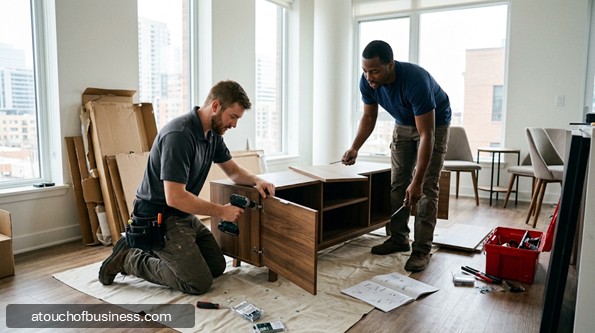
What to Expect From This Guide to Starting a Furniture Assembly Business
Starting a furniture assembly business takes more than owning a drill. This guide walks you through the key decisions and practical steps involved, from judging whether the business suits you to preparing for your opening jobs. The highlights below cover only part of what’s inside.
Inside the guide, you will find:
- Startup steps: Follow 17 numbered steps that move from checking your fit and local demand through licensing, insurance, pricing, and pre-opening test jobs.
- Common questions: Get answers on hourly versus per-item pricing, mixing platform and independent jobs, crib hardware problems, and how sales tax treats assembly.
- Business fit: Weigh the physical demands, core skills, household support, and income swings before spending money on tools or a vehicle.
- Local requirements: See how licensing thresholds, handyman exemptions, and sales tax on assembly labor can vary by location, and where to verify them.
- Financial planning: Work through break-even logic, margin pressures like unpaid drive time, startup cost items, and operating capital.
- Mobile operations: Plan a service radius, travel buffers, trip charges, and a vehicle loading routine that help protect your billable hours.
- Risks and warnings: Review red flags to weigh before starting and before opening day, including liability exposure, tip-over hazards, and crowded platform markets.
Before choosing tools or a service area, start with a clear picture of what a typical furniture assembly job involves.
As a furniture assembly business owner, you travel to customers’ homes and offices to build flat-pack furniture.
Many jobs also involve setting finished pieces in place and anchoring tall dressers and bookcases to the wall.
There’s no storefront. Your vehicle, your toolkit, and your schedule make up the whole operation.
Customers pay for speed, precision, and confidence in the result. They also pay to skip wordless diagrams and mystery hardware bags.
This guide walks through the practical steps to start a business, tailored to mobile furniture assembly, from your fit check through your test jobs.
Is a Furniture Assembly Business a Good Fit for You?
Before you buy tools or print business cards, take an honest look at why you want to own this business.
Is it the independence, the hands-on problem-solving, or a need for income? Each motivation holds up differently when bookings run thin.
Ask yourself these questions:
- Can you cover personal living expenses while your schedule fills?
- Will your household support evening and weekend jobs?
- Can you handle income that changes from week to week?
- Are you prepared for the possibility that the business doesn’t succeed?
- Can you manage quoting, scheduling, and bookkeeping on top of the physical tasks?
Startup costs are modest compared with most trades. Operating costs still add up through insurance, fuel, vehicle upkeep, and tool replacement.
Think about how customers will find you at opening. Why would they book you instead of a platform assembler?
You’ll test that answer against real local demand in the steps ahead, before any major spending.
Red Flags Before You Start
Some warning signs mean you should pause, verify more, or change your model. Others suggest this business may not fit you.
Watch for these conditions before committing:
- Crowded platform market: When many local assemblers on booking apps compete on price, you’ll need a clear difference, such as commercial jobs or complex systems.
- Retailer-arranged assembly: Some large furniture retailers offer prepaid assembly at checkout, which captures part of the demand before customers look elsewhere.
- Income tied to hours: Revenue depends on billable hours. Long drives across a spread-out area can make the numbers stop working.
- Physical strain: Lifting, stairs, and floor-level assembly happen every day. Physical limits may point you toward a two-person model or a different business.
- Liability exposure: Tip-overs, crib errors, and damage inside customers’ homes are serious risks. Don’t start without insurance and written safety policies.
- Licensing uncertainty: Wall mounting, cabinet installation, or larger jobs may cross your state’s licensing thresholds.
Some conditions are built into the industry. Low entry barriers keep competition steady.
Platform and retailer channels also shape what customers expect to pay.
Demand follows furniture purchases and household moves. Plan around these conditions rather than expecting them to change.
Step 1: Check Your Fit and the Physical Demands
Every furniture assembly job starts with carrying boxed furniture through stairwells, hallways, and tight doorways.
Then you spend hours kneeling and lifting heavy panels.
You’ll spend your days inside occupied homes, often with customers, children, or pets nearby.
The core skills include:
- Reading wordless diagrams and sorting hardware quickly
- Controlling a drill/driver without stripping particleboard
- Solving problems when parts arrive damaged or missing
- Communicating clearly with customers about time and scope
Most flat-pack pieces go together with basic tools such as hex keys. Your value comes from speed, precision, and handling the pieces customers find hardest.
Those pieces include wardrobes, bed frames, cribs, and large modular systems.
Dressers, tall storage units, and cribs need extra attention. Tip-overs and incorrect crib assembly can cause serious injuries to children.
Step 2: Talk With Owners You Won’t Compete Against
A conversation with someone who has already built this business can save you from costly guesses.
Choose owners outside your service area so they can speak freely.
Good candidates include furniture assemblers, handyman owners, and office furniture installers who serve a different area.
Prepare your questions before each call so you use their time efficiently.
Useful questions include:
- Do you price per item or by the hour, and why?
- How do you handle return trips for missing parts?
- Have you faced damage claims, and how were they resolved?
- Which pieces do you decline?
- How do you handle wall anchoring when customers resist it?
- How long did it take to fill a weekly schedule?
Every owner’s path is different. Their firsthand experience still reveals problems a guide can’t predict.
Step 3: Choose Your Service Model and Scope
Your furniture assembly service model shapes your tools, vehicle, insurance, and pricing. Decide on it before you spend money on any of them.
Common models include:
- Residential flat-pack assembly: Desks, beds, dressers, dining tables, shelving, wardrobes, and outdoor furniture.
- Office furniture installation: Workstations, height-adjustable desks, and modular office systems, often coordinated through an office furniture dealer.
- Delivery plus assembly: You haul the furniture and build it on-site, which requires a furniture-capable vehicle and moving equipment.
You also decide how bookings reach you. You can operate independently, take jobs through booking platforms, or combine both.
If you’re focusing on homes, expect many small jobs, weekend requests, and customers who watch you build.
If you’re pursuing office clients, expect building access rules, after-hours scheduling, and insurance paperwork before you set foot on-site.
Define your exclusions before taking bookings. Retailer-booked assembly services commonly exclude electrical, plumbing, and kitchen or bath installation.
Packaging removal is another scope decision. You can include it or offer it as a paid add-on.
Step 4: Decide Whether to Start, Buy, or Franchise
Most owners in this field start from scratch because the equipment barrier is low.
If a local assembly or installation business is for sale, verify what actually transfers with the purchase.
Check dealer or retailer relationships, reviews, equipment, and any written contracts.
A dedicated furniture assembly franchise is hard to find. Furniture franchises tend to center on retail, repair, custom-build, rental, and mattress concepts.
Some handyman franchise brands may include assembly. Review each brand’s Franchise Disclosure Document before assuming it fits.
Step 5: Validate Local Demand and Competition
Before you commit money, confirm that enough local demand exists and isn’t already fully served.
Your likely first customers include:
- Online and big-box furniture buyers
- People moving, including renters and new homeowners
- Parents setting up nurseries
- Home-office workers and small offices
- Property managers
Talk with owners of local furniture and office supply stores. Some may not offer assembly and could refer customers to you.
People who run moving companies are another referral source, since moves create plenty of reassembly jobs.
Check your competition with these steps:
- Count the platform assemblers serving your area and read their reviews.
- Note their posted rates.
- Find out whether local furniture store owners and office dealers already use an installer.
- Look at apartment and new-housing density.
- Measure realistic drive times across the area.
Why would customers choose you over a platform assembler?
Dependable arrival windows, tip-restraint installation, and packaging removal can set you apart.
So can a two-person crew for large pieces and experience with complex modular systems.
Step 6: Set Your Service Area and Travel Policy
Drive time and parking aren’t paid labor unless you build them into your pricing.
Decide these points before you advertise:
- Your service radius
- A minimum job charge
- Trip or distance charges for outlying jobs
- Rules for stairs, elevators, and difficult parking
Plan travel buffers between appointments. A traffic delay on one job shouldn’t make you late for the next customer.
Group nearby jobs on the same day when you can to cut unpaid driving.
If you’re serving a dense city, parking and elevator access can cost more time than distance.
If you’re serving a spread-out area, drive time becomes the bigger cost to price in.
Step 7: Verify Licensing Thresholds Before You Advertise
There’s no national license for furniture assembly. The rules depend on your state, county, and city.
Some states require a contractor license for most paid jobs. Others require one only above a job-value threshold.
Some states require registration for any paid home improvement, with no threshold at all. Local rules can add requirements on top.
In many states, furniture assembly falls under a handyman exemption when the job stays below the threshold.
Wall mounting or cabinet installation can change that picture, so check how your state treats them.
Electrical, plumbing, HVAC, and gas tasks require trade licenses in virtually every state, regardless of job size.
Don’t split invoices to stay under a threshold. Most states treat that as unlicensed contracting.
Watch your wording, too. In states that license contractors, advertising as a contractor without a license can be a violation by itself.
That includes business cards, websites, vehicle lettering, and online listings. Check the rules before you choose a business name.
Verify with your state contractor licensing board and your city or county offices.
Search for your state’s “handyman exemption” or “minor work exemption.”
Step 8: Form and Register the Business
Choose a business structure. Many assemblers start as a sole proprietorship or an LLC.
Register a DBA if you plan to operate under a trade name.
Get an EIN from the IRS. You’ll need one if you hire employees or form certain entity types.
An EIN is also commonly used when opening business bank accounts.
Get a local business license where your city or county requires one.
Step 9: Check Sales Tax on Assembly Labor
Many people assume service labor is never taxed. In fact, assembly labor is taxable in some states and not in others.
The answer affects your prices, your invoices, and whether you need a sales tax permit.
If you sell furniture along with your assembly service, the tax picture can change. Some states tax labor bundled with a product sale.
Verify with your state revenue department before you publish prices. Search its guidance for “taxable services” and “assembly labor.”
Step 10: Plan Insurance and Risk
Your biggest risks show up inside customers’ homes and offices.
Damaged floors, gouged walls, broken property, and injuries can all lead to claims.
Coverage to discuss with a licensed agent includes:
- General liability for accidental damage to customer property
- Commercial auto for business-owned vehicles
- Hired and non-owned auto coverage if you drive a personal vehicle for business
- Tools or inland marine coverage for lost, stolen, or damaged equipment
- Workers’ compensation once you have employees
Almost every state requires workers’ compensation for businesses with employees. Some states exempt very small employers, so verify your state’s rule.
A business owner’s policy bundles liability and property coverage, which can simplify your business insurance setup.
If you’re pursuing office jobs, have a certificate of insurance ready. Most commercial buildings require one naming the owner or management company as additional insured.
Processing a certificate can take a few days, so request it several days ahead of the job.
Step 11: Gather Tools and Set Up Your Vehicle
Your furniture assembly tools travel with you, so choose reliable gear that loads easily.
Core assembly tools:
- Cordless drill/driver with an adjustable clutch, plus spare batteries and a charger
- Hex key sets in metric and SAE sizes
- Screwdriver sets with Phillips, flat, and Torx bits
- Rubber mallet, pliers, and a utility knife
- Tape measure, level, and clamps
- Combination wrenches and a socket set
An impact driver is optional. Use it cautiously on particleboard.
Anchoring and mounting supplies:
- Stud finder
- Masonry and wood drill bits
- Wall anchors for drywall, plaster, and masonry
- Tip-restraint kits for when the manufacturer’s kit is missing or unsuitable
Protection and job-site supplies:
- Moving blankets, drop cloths, or floor protection board
- Knee pads, work gloves, and safety glasses
- Furniture sliders and a hand truck
- Hardware sorting trays, a headlamp, and a work light
- Wood glue, touch-up markers, and extra cam locks, dowels, and screws
- Trash bags and a handheld vacuum
Keep backup batteries and duplicate small tools in the vehicle. A dead battery mid-job costs time you can’t bill.
Build a loading routine so every kit is restocked before the next day’s route.
If you’re offering assembly only, a reliable car or SUV with organized tool storage can handle the job.
If you’re adding delivery, you’ll need a van or truck that fits furniture, plus a dolly and moving straps.
Schedule routine vehicle maintenance. When your vehicle is down, so is your income.
You’ll also need a smartphone, scheduling and invoicing software, a mobile payment method, bookkeeping software, and photo storage.
Step 12: Set Up Your Pricing
Most jobs are small, so pricing mistakes add up quickly.
Common pricing methods include:
- Hourly rates
- Flat per-item rates
- A minimum job charge
- Add-ons for anchoring, disassembly, packaging removal, or a second person
Retailer-booked assembly is usually priced per item.
Platform assemblers typically set hourly rates based on experience, reviews, and the local market.
Time practice builds of common pieces before you publish prices. A crib, a large wardrobe system, and an office workstation make useful benchmarks.
Show sales tax and travel charges in your quotes so customers see the full price up front.
If you’re taking platform jobs, factor platform service fees into your math before accepting bookings.
For more on setting rates, see this guide to pricing your services.
Business Plan
Your business plan turns your furniture assembly decisions into numbers you can test before committing money.
Your plan should pull together:
- Your service model, scope, and exclusions
- Your service area and travel policy
- Your licensing, tax, and insurance findings
- Your pricing method and add-ons
- Your startup costs, operating capital, and funding sources
Then run the profit check. Most revenue comes from many small tickets.
Larger jobs come less often, usually from moves, nursery setups, or office installations.
Margin pressure comes from several directions:
- Unpaid drive time between jobs
- Platform service fees, if you use platforms
- Return trips for missing or damaged parts
- Flat-rate jobs that take longer than quoted
List your fixed costs next. These include insurance, vehicle payments, fuel, phone, software, licenses, and tool replacement.
Calculate how many billable hours or jobs you need each week to cover fixed costs and your living expenses.
Be realistic about jobs per day once travel is included. Then estimate how many slow weeks you can survive.
Indoor assembly isn’t weather-dependent. Demand still follows furniture purchases and household moves, so confirm local patterns during your owner conversations.
Step 13: Estimate Startup Costs, Operating Capital, and Funding
No single budget fits every furniture assembly startup. Your model, service area, and equipment choices change the total.
List and price out these items locally:
- Tools, batteries, and chargers
- Anchoring, mounting, and protection supplies
- A vehicle purchase or upgrade, plus fuel and maintenance
- Registration, licensing, and permit fees
- Insurance premiums
- Software, phone, and a website or listing profile
- Starter stock of fasteners and supplies
Your choices shift the total. New versus used tools, tools-only versus delivery, and solo versus crew operation all change your costs.
Commercial jobs may require higher insurance limits to meet certificate requirements.
Set aside operating capital to cover several months of fixed costs and personal expenses.
Running out of operating money is a common reason small service businesses close.
Funding options to explore include:
- Personal savings
- A small business loan or microloan
- Equipment or vehicle financing
- A business credit card for tools
Step 14: Set Up Banking and Payments
Open a business bank account so business transactions stay separate from personal ones from the start.
Set up a mobile card-payment method you can use on-site.
Prepare invoicing for commercial clients. Set a deposit policy for large or multi-piece jobs.
Step 15: Prepare Forms and Job Policies
Clear documents prevent most scope disputes on furniture assembly jobs before they start.
Your service terms should cover:
- Scope and exclusions
- Arrival windows and cancellations
- Missing-parts and return-trip charges
- Packaging removal
Use a damage checklist and take before-and-after photos. They protect you when a customer questions pre-existing scratches or dents.
Write an anchoring policy. If a customer declines wall anchoring, have them sign an acknowledgment.
Before assembling dressers or cribs, check the CPSC recall list. Make it a standard step in every job.
Walk through each finished piece with the customer before collecting payment.
Step 16: Decide Between Solo Work and a Two-Person Crew
Large wardrobes, bed frames, and commercial installs often need a second person.
If you bring on help, classify workers correctly.
The IRS looks at behavioral control, financial control, and your relationship with the worker.
The more you control how, when, and where a helper completes a job, the more likely that helper is an employee.
Employees trigger workers’ compensation, withholding, and unemployment insurance registrations with your state.
If you’re working solo, decide in advance which pieces you’ll decline or book only with a helper.
Step 17: Run Pre-Opening Checks and Test Jobs
Before your official opening, confirm every part of your setup functions together.
Confirm these items:
- Registration, EIN, and business bank account are in place.
- Your business license and any contractor registration are confirmed, or your exemption is verified in writing.
- Your sales tax status is settled.
- Insurance is active, and a certificate template is ready.
- Service area, minimum charge, and travel policy are set.
- Service terms, damage checklist, and anchoring form are final.
- Tool kits are complete, and batteries are charged.
- Scheduling, invoicing, and card payments pass a test transaction.
- Platform profiles, if used, list accurate scope and exclusions.
Complete one or two test jobs before opening. Review how long each piece took and whether your prices held up.
Opening-Day Red Flags
These furniture assembly problems tend to surface as your first bookings arrive.
Pause and fix these before you take paid jobs:
- Your price list hasn’t been tested against timed practice builds.
- No certificate of insurance is ready for an office client who’s waiting.
- Your service terms don’t address missing parts or return trips.
- You have no anchoring decline form for customers who refuse wall anchoring.
- Batteries, anchors, or fasteners aren’t restocked for the day’s route.
- Your schedule leaves no travel buffer between appointments.
- You haven’t confirmed whether your exemption covers wall mounting.
Frequently Asked Questions
Should I charge by the hour or by the item?
It depends on how confident you are in your time estimates. Per-item pricing rewards speed but loses money when a build runs long.
Hourly pricing protects you on unpredictable jobs, such as builds with missing parts. Many customers prefer a known price, though.
Check what local platform assemblers charge and how. Their approach shapes what customers in your area expect.
Can I take platform jobs while building my own client base?
Yes. Assemblers on booking platforms operate as independent contractors, not as employees of the platform.
In a retailer-partner category, you may accept a set flat rate per product. Outside that category, you keep setting your own rates.
Read each platform’s terms for opt-out rules and service fees before relying on it for income.
What should I do if a crib part doesn’t fit or hardware is left over?
Stop and contact the manufacturer instead of improvising.
Incorrectly assembled cribs, or cribs with missing or loose hardware, can cause infant entrapment or suffocation.
Your return-trip policy should cover these situations so the delay doesn’t become an unpaid visit.
Does it matter for sales tax whether I build furniture or just place it?
In some states, yes. Assembling modular office furniture on-site can be taxable, while setting already-built pieces in place may not be.
Rearranging or reconfiguring existing furniture may be treated differently again.
Confirm how your state revenue department classifies each service before quoting.
Interviews with Furniture Assembly Business Professionals
These interviews share the experiences of people earning money through furniture assembly and related handyman work.
They discuss finding customers, building reviews, setting rates, specializing, scheduling jobs, communicating with clients, and managing income.
Readers can use these experiences to understand how working assemblers developed their services, attracted repeat business, and adjusted their approach as they gained experience.
This 79-Year-Old Retiree’s Side Hustle Earns $4,000 a Month
Dan Weiss explains how he started a furniture assembly side hustle through Taskrabbit. He discusses beginning with lower rates, building reviews, developing a customer base, seasonal changes in demand, and gradually increasing his pricing.
The interview is useful for seeing how an assembler can begin without an established reputation. Weiss also discusses patience, customer treatment, pricing according to experience, and the importance of strong work and reviews.
A Millennial Earns Up to $4,000 a Month on Taskrabbit
Michael Mendez discusses leaving traditional employment, trying different Taskrabbit services, and eventually specializing in general furniture assembly and IKEA assembly. He also explains how his rates, daily schedule, transportation, customer reviews, and service profile developed over time.
This interview offers useful lessons on testing different services before specializing. Mendez also discusses starting slowly, keeping rates competitive while building reviews, creating a detailed profile, recognizing personal limits, and providing consistent customer service.
I Made $37,000 Assembling Ikea Furniture Last Year
Sandra Navarro describes earning money assembling furniture through Taskrabbit while also operating a handyman business. She discusses assembling IKEA, Wayfair, and Amazon furniture and developing particular experience with IKEA’s PAX wardrobe system.
The interview shows the potential value of developing expertise with frequently requested furniture. Navarro also discusses scheduling work around other commitments and the importance of managing business income, taxes, expenses, and profit.
Ricky P. Makes $4k/Month While Pursuing His Dreams
Ricky P. discusses working in furniture assembly, IKEA assembly, mounting, and home improvement through Taskrabbit. He explains the importance of client communication, preparing extra tools and parts, building reviews, keeping availability open, estimating job duration, and documenting expenses.
This interview is particularly useful for someone thinking about the customer-service side of furniture assembly. Ricky explains how the first group of jobs and reviews can influence future work and why clear communication about time and expenses matters.
Meet Tatenda N.: Crafting Connections Through Tasking
Tatenda N., a furniture assembly and mounting Tasker, discusses scheduling, income goals, managing slower periods, business expenses, organization, and customer referrals. He also describes how one PAX assembly job generated additional connections and work.
The interview is useful for understanding the business routines surrounding assembly work rather than just the physical work itself. Tatenda’s experience highlights scheduling, financial discipline, knowing personal limits, staying organized, and developing relationships that can lead to referrals.
Related Articles
- How To Start a Handyman Business
- How To Start a Carpentry Business
- How To Start a Kitchen Cabinet Installation Business
- How To Start a Furniture Restoration Business
Sources:
- CPSC: Dresser Tip-Over Safety Standard, Anchor It Campaign Guidance
- Anchor It (CPSC): Anchor TVs and Furniture
- Federal Register: Clothing Storage Unit Standard
- New Jersey Division of Consumer Affairs: Crib Safety Tips and Recalls
- Maryland State Department of Education: CPSC Crib Safety Tips
- IKEA: Assembly by Taskrabbit, Taskrabbit Assembly Pricing FAQ
- Taskrabbit: IKEA Assembly Category Terms
- Recorder Jobs: Furniture Assembler Task Scope
- Entrepreneur: Furniture Delivery and Assembly
- Wikipedia: Ready-to-Assemble Furniture
- Franchising.com: Furniture Franchise Listings
- Bulletproof Handyman: Handyman License Overview
- Vortech Pro: Handyman Exemption Limits
- HandymanCan: Handyman License State Guide
- Contractors License Exam: Contractor vs Handyman License
- Avalara: Service Taxability by State
- Comptroller of Maryland: Fabrication Labor Tax Tip
- Insureon: Installation Business Insurance, Insurance Law Requirements
- The Modern Workspace: Office Furniture Install Guide