
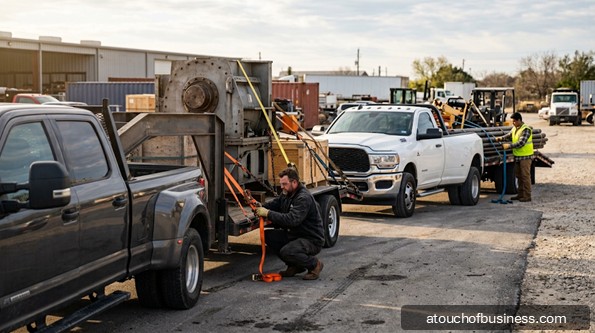
What to Expect From This Guide to Starting a Hotshot Trucking Business
This guide walks you through the key decisions and practical steps for starting a hotshot trucking business, from checking your fit to a test haul. The bullets highlight selected areas, and the article goes deeper on each.
Inside the guide, you will find:
- Startup steps: Follow 16 numbered steps, moving from a reality check and demand research through registration, equipment, load sourcing, and a test haul.
- Daily reality: See what a typical day involves, including the parts owners often enjoy and the parts they find hard.
- Risks and warnings: Spot warning signs such as thin local freight, heavy competition, weak cost-per-mile numbers, and missing cash for payment delays.
- Equipment and licensing: Compare truck and trailer ratings against federal commercial driver’s license thresholds before buying, and match trailer type to your freight.
- Financial planning: Build a local cost list, calculate cost per mile including empty miles, and plan operating capital for payment gaps.
- Compliance requirements: Learn how USDOT numbers, operating authority, insurance filings, medical certificates, hours-of-service rules, and inspections may apply, depending on your routes and rig.
- Loads and planning: Set up load boards and broker onboarding, then build a business plan that ties costs, funding, and pricing together.
Start with the fit check below to see whether hotshot trucking’s schedule, paperwork, and uneven income suit your situation.
Hotshot truckers haul small, time-sensitive loads with a medium-duty pickup and trailer. Most rigs are Class 3–5 trucks, often duallies.
Customers turn to hotshot service when a load is too small for a full semi and too urgent to wait.
Typical freight includes equipment, construction materials, vehicles, and parts.
Starting means more than buying a truck. You also need federal registration, insurance, a way to find loads, and cash to cover payment gaps.
Work through the numbered steps below in order, and draft your business plan as you go.
Keep the broader steps to start a business in mind.
Is Hotshot Trucking a Good Fit for You?
Hotshot trucking fits you if you accept uneven income, federal compliance duties, and time away from home on longer runs.
Ask why you want this business. Decide what draws you: freedom to pick loads, putting a truck you own to use, or side income.
Write down your risk tolerance. Income swings from month to month in hotshot trucking.
Confirm that your household can handle uneven income while you build relationships with brokers and customers.
Accept that any new business can fail. Planning, reserves, and compliance lower that risk but never remove it.
Read about the hardest parts of owning a business before you commit funds.
Learn from experienced owners who will not compete with you. Their firsthand insight is valuable, even though each owner’s journey is different.
Red Flags Before You Start
Pause or change course if local freight is thin, your cost-per-mile numbers fail, or you lack cash for payment delays.
Treat each flag below as a decision point. Each one tells you to pause, verify, change your model, or reconsider.
Watch for these decision-stage warning signs:
- Thin local freight. Check load board volume, rates, and broker days-to-pay in your area. Change lanes or niches if volume stays thin.
- Heavy competition. Lower equipment costs draw many operators. Verify local competition, then consider a niche or direct customers.
- Numbers that fail. Reconsider starting, or change your model, if rates do not cover cost per mile once empty miles count.
- No cushion for payment delays. Delay opening until you set aside operating capital.
- Equipment you cannot insure or license. Confirm ratings, commercial driver’s license (CDL) needs, and insurance before you buy.
- Insurance you cannot get. Collect quotes from several insurance agents before you spend on equipment.
- Reluctance to handle paperwork. Small rigs still face federal Department of Transportation (DOT) rules. Reconsider, or plan for outside help.
- Home parking limits. Zoning or homeowners association rules may block storing a truck and trailer. Verify before you buy.
Several industry conditions apply however you run your operation:
- Freight demand follows construction, industrial, utility, and similar sectors, so volume swings with customer activity.
- A pickup rig carries less than a semi, so heavy-haul freight is off the table.
- Operating authority and insurance rules apply regardless of rig size.
- Per-mile rates vary widely by load type and lane.
- Payment timing varies by broker, and many load boards show days-to-pay.
Profit warning signs deserve their own check:
- Rates quoted per loaded mile that ignore empty miles.
- Fuel advances and quick-pay fees that shrink revenue.
- A truck payment and insurance bill that stay fixed through slow periods.
A Day in the Life of Running a Hotshot Trucking Business
A typical day centers on checking your rig, securing a load, and driving to pickup and delivery.
Your day often starts with a check of your truck, trailer, and hitch. Securing the load follows, using tiedowns that meet federal rules.
Then you drive to the pickup, load up, and deliver. After delivery, you look for a return load or head home.
Some owners run short local jobs for steady customers. Others run longer regional trips.
If you run interstate, federal hours-of-service limits shape each driving day.
Recurring tasks fill the gaps between loads. You find and negotiate loads on load boards or directly with customers.
Paperwork and compliance tasks add up too, including permits, drug and alcohol programs, fuel cards, factoring, and record keeping.
Fueling, tires, and vehicle upkeep need regular attention.
One owner couple reported splitting duties, with one partner driving and the other running the back office.
Load volume and income vary from month to month.
Truck driving often means nights, weekends, and holidays.
What owners often enjoy:
- Independence and the freedom to choose which loads to take.
- Lower entry cost than a full-size Class 8 semi.
- Repeat local customers who rely on you.
- Flexibility to earn side income alongside another job.
What owners often find hard:
- Finding return loads and limiting empty miles.
- Regulations and paperwork that still apply to small rigs.
- Uneven income and waiting for payment.
- Sleeping in the truck and time away on longer runs.
- Limits on load size and weight.
Does this daily mix of driving, paperwork, and uneven income match the life you want?
Step 1: Run a Reality Check on Your Schedule and Reserves
Confirm that you can handle hotshot trucking’s irregular schedule, paperwork, physical loading tasks, and income gaps before you commit funds.
Check each of these points:
- Time away from home, including sleeping in the truck on longer runs.
- Paperwork and compliance duties.
- Loading, securing, and basic mechanical tasks.
- Your tolerance for gaps between delivery and payment.
Owners who run hotshot rigs advise you to be able to go a stretch without a paycheck.
Skip this reality check, and a payment gap can strain your household before your business builds momentum.
Step 2: Talk With Owners You Will Not Compete Against
Talk to hotshot owners outside your lanes and customer base, plus owners who haul different freight types. Include operators who lease onto carriers.
Prepare questions before you talk with each owner.
Prepare questions like these:
- How do you find loads?
- How much of your driving is empty?
- How long does payment take after delivery?
- What was your experience getting insurance?
- Which equipment choices do you regret?
- What compliance duties surprised you?
Read advice from real business owners to see how others approached their startups.
Skip these conversations, and you may learn about payment delays only after you own a truck.
Step 3: Choose Your Entry Path and Operating Model
Decide whether you will haul under your own authority or an existing carrier’s authority.
A leased operator hauls under another carrier’s authority. Running your own means you apply for operating authority yourself.
Next, choose between interstate and intrastate-only operation. Interstate work brings Federal Motor Carrier Safety Administration (FMCSA) registration duties.
Then choose your job type: local expedited jobs or brokered regional loads.
Consider buying an existing hotshot operation instead of building your own. Compare starting from scratch and buying a business before you decide.
Before you buy, verify with FMCSA and an attorney how your U.S. Department of Transportation (USDOT) number transfers. Ask the same about authority and equipment.
Your entry path changes your insurance needs, paperwork load, and revenue.
Step 4: Validate Local Demand and Plan Your First Customers
Check whether enough hotshot freight moves through your area to keep your truck loaded.
Likely customers include these groups:
- Construction, oilfield, utility, agricultural, and equipment-dependent firms.
- Dealers moving vehicles or RVs.
- Freight brokers with small loads to place.
Customers choose hotshot service for speed and a dedicated trip. They also value access to tight job sites.
Write down why customers would pick you over alternatives. Name your first customers and how you will reach them at opening.
Plan to reach customers through load boards, broker onboarding, and direct calls to managers at local firms.
One owner couple used load boards, knocked on doors, and handed out business cards.
Use load boards to check freight volume, rate history, and broker days-to-pay. Learn more about local supply and demand before you choose lanes.
Count competing operators in your area too. Skip this check, and you may enter a market with no room for you.
Step 5: Decide Your Equipment and Licensing Path
Compare the ratings on your hotshot truck and trailer against federal CDL thresholds before you buy anything.
Common rigs pair a Class 3–5 pickup with a gooseneck, flatbed, or similar trailer.
Confirm each unit’s gross vehicle weight rating (GVWR) and the combination’s gross combination weight rating (GCWR) with the manufacturer or dealer.
A Class A CDL applies when the combination rating reaches 26,001 pounds and the towed unit’s rating exceeds 10,000 pounds.
A combination rated under 26,001 pounds needs no CDL, even with a trailer over 10,000 pounds.
Industry articles state the non-CDL rule in different ways. Follow 49 CFR 383.91 and confirm details with your state licensing agency.
A Class A path raises insurance and compliance duties but allows heavier loads.
Even without a CDL, a DOT medical certificate may apply, as Step 14 explains.
Buy a rig before you check your ratings, and you may face a CDL requirement or an insurance mismatch.
Step 6: Build Your Cost List, Pricing Floor, and Break-Even Logic
Price every cost item locally, then work out the revenue per mile you need before you commit to any purchase.
List every item you need, then get local quotes. Your most accurate estimate comes from pricing your own list, not from a general figure.
Include these cost categories in your list:
- Truck and trailer, whether new, used, or already owned.
- Hitch and securement gear.
- Insurance.
- Registration and licensing items.
- Compliance setup, such as the DOT medical exam, an electronic logging device (ELD), and inspections.
- Fuel, tires, and maintenance.
- Load board subscriptions, factoring, and quick-pay fees.
- Operating capital.
Calculate your cost per mile from your own fixed and variable costs. Include fuel, tires, maintenance, insurance, loan payments, and fees.
Count empty miles. Rates quoted per loaded mile hide the miles you drive without freight.
Find the revenue per loaded mile that covers every mile, empty ones included.
See how to estimate profitability and revenue for a new business.
Test your numbers against slow months and delayed payment.
If your numbers do not cover costs and support you, change your model or stop before you spend.
Your choices change your cost list.
Own authority versus leased, CDL versus non-CDL, part-time versus full-time, and solo versus hired driver each shift costs.
Step 7: Plan Funding and Operating Capital
Decide how you will pay for equipment and keep cash on hand while you wait for payment.
Explore savings, equipment financing, and using a pickup or trailer you already own.
Learn how to get a business loan if you plan to borrow.
Ask each lender or investor which documents they require before you apply. Do not assume every lender wants the same paperwork.
Start drafting your business plan while you finish the previous steps.
The Business Plan section below pulls your cost, funding, pricing, and break-even inputs together.
Set aside operating capital before you open, because running out of it is a main startup risk.
Plan to cover fixed bills while you wait for payment. Payment terms vary by agreement, and some owners wait weeks after delivery.
Skip this reserve, and fuel and insurance bills arrive before your first payment does.
Step 8: Choose a Legal Structure and Register the Business
Plan your legal structure before you sign financing or broker agreements, because highway crashes and cargo claims put personal assets at risk.
Equipment loans and shipper contracts add exposure. Hired drivers add more.
Review your business structure choices, and verify entity-type options on the federal registration form before you decide.
Send your final entity choice to an attorney and a tax professional.
Next, get your business tax ID and complete your state registration. Add a DBA where required.
Check business licenses and permits with your city or county clerk. Requirements vary by location.
Use one business name on your FMCSA record, load board profiles, insurance certificates, and truck markings.
Step 9: Set Up Banking, Payments, and Bookkeeping
Open a business bank account, then set up invoicing and bookkeeping before your first load.
Track what customers owe you separately from cash received. A delivered load creates a payment you have earned but not yet collected.
Decide whether to use a fuel card.
Compare factoring, fuel advances, and quick-pay options, since these can add fees that cut revenue.
Set up mileage and fuel records if the International Fuel Tax Agreement (IFTA) applies to your combination. IFTA reporting depends on those records.
Step 10: Get Insurance Quotes Before You Apply for Authority
Collect insurance quotes before you apply for authority, because FMCSA grants operating authority only after your liability filing is on record.
The liability filing is made through your insurance provider, not by you. Confirm that your insurance agent can handle the filing.
Compare liability, physical damage, and cargo coverage. Review business insurance basics to prepare your questions.
Ask each insurance agent about driver experience requirements, equipment age rules, and broker-required limits.
Verify the federal minimum liability level in 49 CFR 387.9. Confirm each broker’s required limits, since they may exceed that minimum.
Do not assume cargo coverage is federally required for general freight. Verify with FMCSA and your insurance agent.
Step 11: Buy and Set Up the Truck, Trailer, and Securement Gear
Buy your hotshot rig only after you confirm funding, insurance quotes, and weight ratings.
Decide between new and used, and between bumper-pull and gooseneck. Price each option before you choose.
Match trailer type to your freight. Common types include gooseneck, bumper-pull, flatbed, dovetail, deckover, lowboy, and tilt deck.
Confirm that the rating plates on your truck and trailer match your licensing and insurance assumptions.
Buy tiedowns, chains, binders, straps, edge protectors, and load bars with marked working load limits.
Federal securement rules apply to every load (49 CFR Part 393, Subpart I).
Replace damaged gear, because cracked or cut tiedowns fail the federal standard.
Step 12: Register With FMCSA
Apply for a USDOT number if you run interstate and your vehicle or combination is rated or weighs 10,001 pounds or more.
The combination counts, not only the pickup. A pickup and trailer together can cross the threshold.
Apply for motor carrier (MC) operating authority if you haul for hire across state lines.
Private carriers hauling only their own goods do not need MC authority.
File a BOC-3 process agent designation.
Bind your policy so your insurance provider can file the liability form. Authority stays inactive until that filing is on record.
Expect a waiting period while your application is published. Verify timing and fees with FMCSA before you apply.
Register under Unified Carrier Registration (UCR) for your base state.
Mark your calendar to update your USDOT record every two years.
Display your company name and USDOT number on both sides of the power unit.
Verify which FMCSA portal is active when you apply.
Federal rules require active authority before you haul for hire across state lines.
Step 13: Complete Other Registrations and Permits
Check International Registration Plan (IRP), IFTA, Form 2290, intrastate, and permit rules for your rig and routes.
IFTA covers qualified vehicles: two axles over 26,000 pounds, three or more axles, or a combination over 26,000 pounds.
Compare your combination weight with the IFTA qualified-vehicle thresholds. Verify the result with your base state’s motor vehicle and fuel tax agencies.
Form 2290, the heavy highway vehicle use tax return, applies only at 55,000 pounds or more of taxable gross weight.
Pickup rigs typically fall below that threshold, so verify with the IRS.
Ask your state transportation or motor carrier agency about intrastate authority or USDOT requirements. Some states adopt the federal rules with exceptions.
Check oversize and overweight permit rules for each state you will cross. Some owners use a service for single-trip permits.
Step 14: Meet Driver Qualification and Safety Requirements
Interstate drivers of vehicles rated 10,001 pounds or more need a DOT medical certificate, even without a CDL.
Get the exam from a medical examiner listed on the FMCSA National Registry. Start a driver qualification file for yourself.
If a CDL applies, set up a drug and alcohol testing program and meet Clearinghouse requirements. Non-CDL drivers fall under different rules.
Interstate drivers of commercial motor vehicles follow these hours-of-service limits:
- 11 hours of driving after 10 consecutive hours off duty.
- No driving after the 14th consecutive hour on duty.
- A 30-minute break after 8 hours of driving.
- A 60/70-hour on-duty cap.
Decide whether you need an ELD or qualify for an exemption.
One exemption applies when you need a record of duty status on no more than 8 days in any 30-day period.
Verify eligibility with FMCSA before you skip an ELD.
Schedule an annual inspection for your truck and trailer if the combination meets the commercial motor vehicle definition.
Some state inspection programs may count as equivalent, so verify with your state.
A new entrant safety audit takes place within your first 18 months. Keep your records ready.
Operating without a required drug testing program, or using an unqualified driver, can fail a new entrant audit automatically.
Step 15: Set Up Load Sourcing and Customer Onboarding
Choose your load boards, then complete broker and customer onboarding before you need your first load.
Set filters for weight, length, and trailer type so results match what your rig can carry.
Prepare each broker’s carrier packet and verify requirements per broker.
Common carrier packet items include a W-9, an insurance certificate, and a copy of your authority.
Check each broker’s FMCSA status and days-to-pay before you accept a load. Many load boards show this information.
Consider a dispatch service if you cannot source loads yourself.
Write down your minimum acceptable rate from your cost per mile.
Read about pricing your products and services for more guidance.
Build direct customer relationships to reduce reliance on brokers.
Step 16: Complete the Pre-Opening Checklist and a Test Run
Confirm every item below before you book regular loads, then complete a short test haul.
Confirm these items are in place:
- USDOT number, MC authority, BOC-3, and insurance filing show as active on FMCSA’s SAFER lookup.
- UCR registration is complete.
- IRP and IFTA credentials are in place, if they apply.
- Insurance is bound, with certificates ready for brokers.
- USDOT name and number appear on the power unit.
- The annual inspection is complete, with proof in the cab.
- Your DOT medical certificate is in hand, and your driver qualification file is started.
- A drug and alcohol program is in place, if a CDL applies.
- An ELD is installed, or you have confirmed an exemption.
- Securement gear is checked against working load limits.
- Hitch, lights, brakes, and tires are checked.
- Your business bank account, fuel card, and invoicing are ready.
- Broker and customer packets are approved.
- Load board filters are set.
- Your cost per mile and minimum rate are written down.
- Operating capital is set aside.
After your test haul, review your delivery paperwork, securement, tracking, and invoicing.
Finish your business plan in the Business Plan section below before you open.
Business Plan
Draft your business plan as you complete the previous steps. Finish it once costs, funding, pricing, and break-even inputs are in place.
Pull your cost list, setup choices, legal checks, pricing, and funding into one document.
Include your break-even logic, using the revenue per loaded mile you worked out in Step 6.
Add a slow-period test. Show how fixed costs, such as truck payments and insurance, stay due when loads dry up.
Account for margin pressure from fuel, tires, maintenance, and fees that cut revenue.
Check your plan against each lender’s or investor’s document list before you apply.
Interviews with Hotshot Trucking Professionals
These interviews share firsthand perspectives on starting a hotshot trucking operation, finding and evaluating loads, building broker and customer relationships, maintaining a strong reputation, supporting drivers, and growing from a single truck into a larger operation.
Readers can use the advice to better understand the decisions involved before starting, including equipment, compliance, operating costs, load selection, customer service, and the challenges that can appear when expanding a trucking business.
Getting Into Hot Shot Trucking: An Industry Expert’s Guide
David Campos, founder and owner/operator of HotShot USA, discusses what it takes to enter hotshot trucking. The interview covers business setup, licensing, insurance, equipment, compliance, finding loads, evaluating load profitability, broker relationships, common mistakes, and changing market conditions.
This interview is useful for prospective operators because it connects the setup process with day-to-day business decisions. Campos also explains why knowing operating costs, staying compliant, choosing loads carefully, and developing broker relationships can be more important than simply keeping the truck moving.
Lessons From 12 Years in Hot Shot Trucking with Ben Thompson of HOTSHOT 107
Ben Thompson discusses rebuilding his business from a borrowed truck and trailer and eventually developing HOTSHOT 107 into an operation with about 150 drivers. The conversation covers non-CDL hotshot trucking, reputation, owner-operators, safety, customer service, company culture, driver support, and helping operators grow into fleet owners.
This interview is useful for readers who want to understand how a hotshot operation can develop beyond a single truck. Thompson’s experience highlights the importance of reputation, driver support, service standards, and building systems that can continue working as an operation grows.
Hotshot Trucking to Real Driver Support: Owner-Op’s Second Run Toward a Small Fleet
Owner-operator Jeffrey Crise discusses his return to hotshot trucking after previously growing an operation to several trucks and drivers. He talks about operating a Ram 3500 for hotshot flatbed freight, maintaining broker and direct-customer relationships, delivering on promises, communicating with customers, and his plans for building a small fleet again.
This interview is useful because Crise approaches growth with lessons from his earlier fleet experience. His story shows the value of maintaining customer relationships, providing dependable service, and thinking carefully about how drivers will be supported before expanding an operation.
Related Articles
- How To Start a Trucking Company
- How To Start a Courier Business
- How To Start a Dump Truck Business
- How To Start a Freight Brokerage Business
- How To Start a Logistics Business
Sources:
- FMCSA: Do I Need USDOT Number, Ask FMCSA Registration, Insurance Filing Requirements, FMCSA Registration Forms, Operating Authority Packet, Hours of Service Summary, Clearinghouse Non-CDL Guidance
- eCFR: 49 CFR 387 Financial Responsibility, 49 CFR 383.91 Vehicle Groups
- Cornell Law School LII: 49 CFR 393.102 Securement, 49 CFR 393.104 Securement
- J.J. Keller Compliance Network: Medical Exam Requirements, Driver Qualification FAQs, Annual Inspection Answers, New Entrant Requirements, Vehicle Groups Guidance
- Federal Register: New Entrant Safety Process
- Pennsylvania Public Utility Commission: Unified Carrier Registration
- Utah Department of Transportation: USDOT Registration and MCS-150
- Work Truck Online: Periodic Inspection FAQs
- DAT: What Is Hot Shot Trucking
- Overdrive: Hotshot Pros and Cons, Broker Fees and Quick Pay
- Land Line Media: Hotshotter Trucking Advice
- Commercial Carrier Journal: Hotshot Operator Profile
- Teletrac Navman: What Is Hotshot Trucking
- ATS: Hot Shot Trucking Definition
- Bureau of Labor Statistics: Truck Driver Work Environment
- Motive: ELD Mandate Exemptions
- Trucksafe: Short-Haul Exemption Explained