
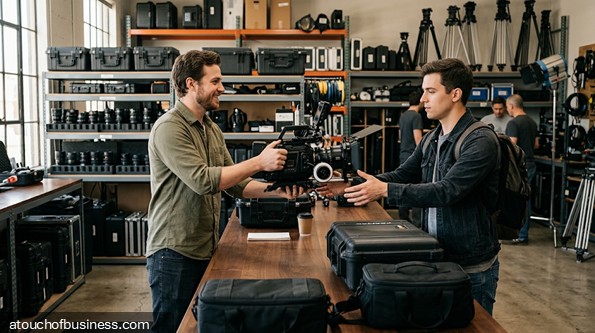
What to Expect From This Guide to Starting a Camera Equipment Rental Business
This guide walks you through the key decisions and practical steps involved in starting a camera equipment rental business, from checking your fit to a soft opening. The bullets below highlight selected areas, not everything included.
Inside the guide, you will find:
- Startup steps: Follow ordered steps from talking with owners and checking local demand through insurance, inventory testing, pricing, and a mock rental cycle.
- Business fit: Weigh your household finances, comfort with costly gear at risk, and technical skills, and see who your likely customers are.
- Daily reality: See what a typical day involves, including the parts owners often enjoy and the parts they find hard.
- Risks and warnings: Spot demand, fraud, insurance, shipping, and home-zoning warning signs before you commit money to gear.
- Break-even logic: Test whether bookings can cover gear, insurance, space, and repairs, with funding and operating capital planned before major purchases.
- Local requirements: Learn which tax, zoning, insurance, shipping, battery, and drone checks to verify for your location.
- Common questions: Find answers about starting part-time, needing experience, working alone, and choosing new or used gear.
The guide opens by asking whether owning costly gear that other people use fits your finances, skills, and daily routine.
As a camera equipment rental business owner, you buy camera gear and rent it by the day, weekend, or week.
Your inventory may include camera bodies, lenses, lighting, audio gear, and support equipment like tripods and stabilizers.
Renters pick gear up, receive it by delivery, or get it by shipment, depending on the model you choose.
Starting a rental business follows the usual steps to start a business, plus decisions unique to gear that other people use.
Is a Camera Equipment Rental Business a Good Fit for You?
A camera equipment rental business fits best when you’re comfortable owning costly gear that other people use and you can inspect equipment yourself.
Before you buy any gear, ask yourself:
- Can your household cover living expenses while you build inventory and bookings?
- Does your family support the plan?
- Can you handle pressure from renters who depend on gear working when they need it?
- How much of your capital would be tied up in gear if the business failed?
- Do you enjoy cameras and the shooters who rent them?
Gear that sits unbooked earns nothing, yet insurance, storage, and aging keep costing you.
Income will also be uneven while you build inventory and bookings.
Price out your startup and operating costs before you commit, then decide how you’d fund them.
Technical knowledge of cameras and lenses matters, since you’ll inspect and test what comes back.
Confirm local demand before you buy gear, not after.
You can start from scratch or buy a business, and rental owners do buy and sell existing rental operations.
Whether to start or buy depends on budget, timeline, desired control, and risk tolerance.
Experienced owners you won’t compete against can show you what the business is really like.
Who Your Customers Will Be
Your renters are freelance photographers, videographers, event shooters, small production companies, students, and hobbyists.
Each renter group needs something different from you, so your inventory and kits should follow demand.
Your first customers may include:
- Freelancers and event shooters who supplement the gear they own for a single project or day.
- Videographers, who often place larger orders and need support gear such as lighting and compatible cables.
- Small production companies that want complete kits and, in some cases, consultation on lens and camera choices.
- Students and hobbyists who want to use costly gear without buying it.
Local pickup serves nearby shooters.
Shipping reaches farther, though your customers can also order from national online rental houses.
Do you want to spend your days serving these customers?
Red Flags Before You Start
These red flags should make you pause, change your model, or reconsider starting a camera equipment rental business.
Several red flags describe industry conditions you should understand before committing.
Demand and competition red flags:
- Few working shooters or little production activity near you. Pause and verify demand through local conversations first.
- Strong national online competition. Consider changing your model toward local pickup, complete kits, and hands-on support.
- Rental demand follows production activity and budgets, so slower production spending can reduce demand and pricing power.
- Capable cameras becoming cheaper to buy can reduce rental demand. This has been reported in the UK, so verify the effect locally.
- Consolidation among national online rental houses and peer-to-peer marketplaces gives your renters many alternatives.
- Oversaturation depends on your market, so count your local competitors yourself.
Money red flags:
- Inventory capital at risk. Gear ages, and new releases can reduce demand for older models, so start with a small set of gear you own.
- A break-even that doesn’t work. Rate conventions shrink per-day income on long rentals, while repairs, insurance, and slow periods add costs.
- Tax surprises. Offering services alongside rentals can change resale treatment, so verify with your state revenue department.
Risk and compliance red flags:
- Fraud. A thief can use a card with a limit high enough to cover rental fees, so stop if you can’t build a renter-vetting process.
- Insurance gaps. Policies can exclude unattended vehicles or theft by a renter, so verify coverage before buying inventory.
- Shipping limits. Carrier liability is low and lithium batteries are regulated, so consider local pickup if you can’t manage both.
- Drones. Reconsider adding them until you verify Federal Aviation Administration (FAA) requirements.
- Home restrictions. Zoning, home-occupation rules, and homeowners association (HOA) covenants can block a home-based operation.
- A skill gap. A missing accessory can ruin a renter’s shoot, and unnoticed damage can pass to the next renter, so delay until you can inspect and test confidently.
A Day in the Life of Running a Camera Equipment Rental Business
Your day centers on inspecting returned gear, preparing outgoing orders, and answering renters’ questions.
You or your staff inspect, clean, and test each returned item before it goes out again.
Owners of larger rental businesses describe inspecting returns as a daily task, with technicians cleaning sensors and checking lenses.
Next, you pull gear for orders and check every item against the order list.
Larger rental owners use a two-person check-off, then pack the gear securely with a packing slip.
At pickups, renters review their orders at check-out, so you schedule time for each one.
Rental software often sends order confirmations, shipping notices, due-back reminders, and return confirmations for you.
Many rental owners bill a Friday pickup and Monday return as one day, which shapes when pickups and returns happen.
Tasks beyond the core rental include:
- Vetting renters, holding deposits or card pre-authorizations, and checking certificates of insurance.
- Keeping inventory and condition records, and scheduling repairs or factory service.
- Answering questions about gear.
- Handling bookings, tax collection, and bookkeeping.
What owners often enjoy:
- Working with gear and technology you like.
- Watching renters’ projects and businesses grow.
- Turning gear you own into income.
What owners often find hard:
- Vetting every new renter, since fraud and non-return are ongoing risks.
- Business tasks such as bookings, tax collection, and bookkeeping that can crowd out hands-on time with gear.
- Checking every item before it ships, because one missing accessory can ruin a renter’s shoot.
- Repairs and replacements, since damage happens even after thorough inspection and packing.
Does this daily rhythm of inspecting, packing, and vetting suit you?
Step 1: Talk to Non-Competing Owners and Check Your Fit
Before you buy gear, talk to experienced owners who won’t compete with you, and test your assumptions against their experience.
The steps in this guide run in the order most owners need them, because several steps depend on previous ones.
Good people to talk to include:
- Owners of rental houses in other markets
- Working photographers and videographers who rent gear
- People who run photo or video studios
Each owner’s journey differs, so listen for patterns rather than a single formula.
Prepare questions before each conversation, such as:
- How do you inspect and test returned gear?
- How do you vet renters and handle fraud?
- How do you handle damage and non-return incidents?
- What insurance do you carry?
- What does a typical day involve?
Owners’ answers will show whether the daily responsibilities suit you before you spend on gear.
Step 2: Choose Your Business Model and Niche
Decide how renters will get your rental gear and which kinds of gear you’ll offer, because both choices shape your cost list.
Most camera rental businesses choose one of these fulfillment models:
- Local pickup from your location
- Shipping to the renter
- Local delivery
- A hybrid of two or more
Shipping adds packing supplies and carrier costs.
Local delivery adds vehicle costs.
You can also focus on a niche, such as:
- Photo bodies and lenses
- Video and cinema gear
- Lighting and audio
- Support gear
- Drones
You can also test demand by listing a few owned items on a peer-to-peer rental platform before building your own booking site.
Fees, vetting, and owner protections differ by platform, so read each platform’s terms and ask what happens if a renter keeps your gear.
Check how your own insurance covers lent gear before you list it (see Step 9).
Step 3: Validate Local Demand and Competition
Confirm that enough local shooters rent gear before you commit capital, and learn why they’d choose your rental business.
Start with local supply and demand: who rents locally, what they rent, and what they struggle to find.
Gather this information:
- Gear lists and rate structures from local rental houses
- What working shooters rent most and what they can’t find locally
- What makes renters switch providers
- Which national online rental houses offer the same gear
Local pickup, fast turnaround, complete kits, and hands-on support are likely ways to stand out against national online rental houses.
Name your first customers, the problem you solve for them, why they’d choose you, and how you’ll reach them at opening.
Step 4: Define Your Starting Inventory
Build your starting rental inventory from what local demand shows, not from the gear you’d most like to own.
Owners often start with gear they already own and add items after bookings prove demand.
Group items into kits, such as a camera kit and a lighting kit, so each one is easy to book and track.
Include the accessories renters need to use each kit, such as batteries, media, and cables.
Every item you add brings purchase, insurance, storage, and repair costs.
Step 5: Run a Profit and Break-Even Reality Check
Before major spending, test whether bookings can realistically cover your gear, insurance, space, and repair costs.
Build your profit and revenue estimates from your own local prices, costs, and expected bookings, not national averages.
List these costs before you buy gear:
- Insurance premiums
- Storage or workspace
- Software and payment processing
- Shipping supplies
- Repairs and replacement
- Loan payments, if any
Estimate how many rental days each item must book to cover its purchase cost, repair risk, and aging.
Rental rate conventions matter here, since a full week is often billed as only a few day-rates.
Also plan for:
- Slow periods, since idle gear still costs money
- New camera releases that reduce demand for older gear
- Losing an item to damage, theft, or non-return
Revisit this check after you collect insurance quotes in Step 9 and set your rates in Step 15.
Step 6: Choose Your Legal Structure and Register the Business
Your business structure choice depends on the risks and assets your rental business carries.
These factors affect your choice:
- Liability exposure from gear in other people’s hands
- High-value inventory at your location
- Financing needs
- Rental agreements and supplier terms
- Employees
A simple sole-proprietor start can fit a very small side operation renting a few items you already own.
Personal-asset risk grows as your inventory value and renter volume grow.
Take the final choice to an attorney and a tax professional before you sign agreements or buy inventory.
After you choose a structure, get an Employer Identification Number (EIN) from the Internal Revenue Service (IRS).
Register your business name if needed, and secure the business license your city or county requires.
Step 7: Set Up Tax Registration Before You Buy Inventory
Register for sales tax before you buy inventory.
Many states let you buy gear exclusively for rental tax-free with a resale certificate, but you usually must be registered first.
Buying inventory before you register can mean paying sales tax on every purchase.
Rental charges are generally taxed like retail sales, though rules vary by state.
Offering services alongside rentals, such as an operator or technician, can change resale treatment, so verify with your state revenue department.
Ask a tax professional about depreciation of rental gear too. IRS Publication 946 and Form 4562 cover depreciation and Section 179.
Step 8: Choose and Verify Your Location or Workspace
Decide where your rental gear will live, then confirm that local rules allow it before you buy anything.
Common choices include:
- Home-based storage
- A rented space
- A storage unit
Check zoning and home-occupation rules with your local zoning or planning department.
If you live in a homeowners association, read its covenants too, since those private rules can restrict home businesses.
Customer pickups, delivery vehicles, and signage can trigger additional local requirements.
If customers will visit a commercial space, ask your local building department about a certificate of occupancy.
Plan secure storage and a battery charging area, since federal shipping guidance notes that lithium battery fires are hard to put out.
Ask your local fire authority about battery storage.
Your space type changes your cost list, because rent, utilities, security, and permits each vary by location.
Step 9: Get Insurance Quotes and Bind Coverage Before Renting
Collect insurance quotes before you commit to inventory, and bind coverage before the first rental goes out.
Camera rental coverage generally falls under inland marine insurance, also called an equipment floater, rather than general homeowner or business policies.
Talk to a commercial agent about business insurance that fits your setup.
Ask your agent about coverage for:
- Gear stored at your location
- Gear in a renter’s custody
- Gear in transit
- Theft by a renter who never returns the item
- General liability for your operations
Ask about exclusions too, such as unattended-vehicle exclusions that could undercut a claim.
Many rental owners require renters to supply a certificate of insurance listing you as loss payee or additional insured.
Premiums depend on your inventory value and exclusions, so quotes belong in your break-even math.
Ask local agencies whether any state or local rule requires specific coverage for your setup.
Step 10: Plan Funding and Operating Capital
Estimate how long you can operate before bookings cover your costs, then plan funding to match.
Running out of operating funds is one of the main reasons startups close.
Set aside operating capital for repairs, replacements, and slow periods, not just for buying gear.
Funding options to explore include:
- Personal savings
- Starting with gear you already own
- Bank or credit union business loans
- Equipment financing
- Lenders who offer government-backed loans
Ask each lender or investor what documents they require before you apply, and verify their products and terms.
Start drafting your business plan while you finish the previous steps.
The Business Plan section below pulls your costs, funding, pricing, and break-even inputs together.
Step 11: Open Your Bank and Payment Accounts
Open a business bank account after your legal setup, then add a payment processor that supports card pre-authorizations and deposits.
A merchant account may be part of that setup, depending on your processor.
Rental owners commonly place a deposit or pre-authorization hold on a renter’s credit card.
Test your hold process before your first booking.
Add processing costs to your cost list so they don’t surprise you later.
Step 12: Source and Test Your Inventory
Buy your gear, then test every item the day it arrives, because even new gear can arrive defective.
Decide whether each item will be new, used, or refurbished, and present your resale certificate at purchase.
Start with hands-on checks before optical tests:
- Listen to focus motors
- Check for loose parts that rattle
- Move zoom and focus smoothly through their range
Then record serial numbers, assign asset tags or barcodes, and photograph each item’s condition.
Those records protect you when a damage dispute comes up.
Step 13: Set Up Inspection, Packing, and Storage Stations
Set up stations for inspecting, packing, and storing rental gear before your first booking.
Your station list may include:
- Inspection and testing: a blower, microfiber cloths, lens pens, sensor-cleaning supplies, lens test charts, and spare batteries and cables for function checks.
- Packing: hard cases or padded bags for each kit, foam inserts, shipping boxes, and labels.
- Storage and security: locked cabinets or a vault, wall-anchored shelving, an alarm, and camera monitoring.
- Tracking: a computer, barcode or QR labels, a scanner, a label printer, and a shipping scale.
- Charging and safety: a dedicated battery charging area, a fire extinguisher, and a first-aid kit.
Owners of larger rental businesses also invest in optical test benches.
If you offer local delivery, add a vehicle that carries gear securely.
Price each supply, since you’ll use cleaning and packing materials on every return and shipment.
Step 14: Write Your Rental Policies and Agreement
Write a rental agreement that spells out rental periods, deposits, renter vetting, and who pays when gear is damaged or lost.
Your policies should cover:
- Rental period definitions
- Deposits or card pre-authorizations
- Identity checks and renter vetting
- Late returns and cancellations
- Damage responsibility, including any optional damage waiver
- Insurance requirements for renters
Some owners phone new renters before approving a rental, and others check identification and hold a card.
Some owners treat cosmetic wear as normal wear and tear, so decide what damage you’ll absorb.
Have an attorney review the agreement, and ask how local law treats deposits, late fees, and damage waivers.
Some states regulate damage waivers for other rentals, such as vehicles, so ask whether any rule applies to camera gear.
Step 15: Set Your Rental Pricing
Set a rate card that covers your costs, matches local rental conventions, and works for both short and long rentals.
Use a daily rate, a weekend rate, and a weekly rate, then check pricing your products and services for the logic behind them.
Many rental owners bill a Friday-afternoon pickup returned Monday morning as one day, and seven consecutive days as only a few day-rates.
Compare local competitors’ rate structures, then price from your own costs, utilization, and replacement values.
Long rentals earn less per day, so test your rates against your break-even numbers.
Step 16: Choose a Booking and Inventory System
Pick rental software that tracks availability, agreements, and check-in and check-out before you list any gear.
Look for features such as:
- An availability calendar that prevents booking conflicts
- Agreement templates
- Barcode check-in and check-out
- Packing slips
- Automated customer emails
Add the software subscription to your monthly cost list.
Step 17: Set Up Shipping and Logistics
If you ship rentals, plan your packing standards, carrier coverage, and battery rules before the first order.
Carrier default liability is a low contractual limit, and declared value raises it for an additional fee.
Some carrier terms, such as FedEx’s, state that declared value is a liability limit, not insurance.
Ask your insurer how shipped gear is covered, and read your carrier’s current terms.
Lithium batteries are regulated hazardous materials when shipped, so use the federal Pipeline and Hazardous Materials Safety Administration guide for shippers.
Carriers add their own battery policies, so ask whether hazmat shipper training applies to your practice.
Build a return process that includes a check-in step for every returned package.
Shipping supplies, labels, declared value fees, and return shipping all belong on your cost list.
Step 18: Check Drone Compliance Before Renting Drones
Skip drones until you’ve verified current FAA requirements for commercial operation, registration, and Remote ID.
If you don’t plan to rent drones, skip this step.
Commercial drone use involves FAA pilot certification.
Rental owners register their fleet drones and ask commercial renters about certification.
Confirm with the FAA how the rules assign responsibility between you and the renter.
Add spare propellers and batteries to your equipment list.
Step 19: Plan Staffing and Training
Anyone who checks gear in or out needs training in inspecting, cleaning, testing, and packing.
Larger rental owners use a two-person check-off before every shipment, so train staff on that routine.
If you hire, read about how and when to hire.
Verify payroll registration with the IRS and your state labor or workforce agency.
Budget for payroll and training time in your cost list.
Step 20: Run a Mock Rental Cycle and a Soft Opening
Run one full rental cycle with your own gear, then open to a small group of trusted local shooters before taking public bookings.
Your cycle should include booking, picking, packing, pickup or shipment, return, inspection, cleaning, and restocking.
Before public bookings, confirm that:
- Licenses, tax registration, and zoning checks are complete.
- Insurance is bound and you’ve reviewed its exclusions.
- Your deposit hold works and your payment processor is tested.
- Every item is tested, photographed, serial-numbered, and tagged.
- Your agreement is reviewed and your rate card is published.
- Your booking system holds your inventory and kits.
- Shipping and battery processes are set, and drone compliance is verified if you rent drones.
- Staff are trained, and operating capital is confirmed.
Business Plan
Draft your business plan as you complete the previous steps, then finish it once your costs, funding, pricing, and break-even inputs are in place.
A business plan pulls your startup steps, cost list, and funding choices into one practical document.
Your plan should bring together:
- Your startup cost list and operating capital
- Funding sources and the documents each lender requires
- Your rate card and rental period conventions
- Utilization and break-even logic
- Insurance quotes and exclusions
- A plan for slow periods
Your rental revenue arrives only when gear is out, while fixed costs continue when gear sits unbooked.
Calculate break-even with your own local prices, costs, and expected bookings, since no average fits every operation.
Opening-Day Red Flags
Delay opening if any of these gaps remain, because each one can turn a single rental into a costly problem.
- Insurance isn’t bound, so a loss or theft on your first rental has no coverage behind it.
- Gear isn’t tested and serial-numbered, so you can’t prove an item’s condition when it comes back.
- Your rental agreement hasn’t had attorney review, so deposit, late-fee, and damage terms may not hold up.
- You have no renter-vetting process, which leaves you open to fraud on the first order.
- Your battery shipping rules are unresolved, which can create hazardous-materials problems for shipments.
- Your check-in and check-out checklists aren’t written, so items can leave or return unverified.
Financial Decisions That Bite Later
These financial choices cause the biggest problems months after you make them:
- Buying inventory before registering for sales tax, which can mean paying tax on every purchase.
- Buying gear before insurance quotes, since premiums and exclusions can change your break-even.
- Pricing long rentals without applying rate conventions, which lowers income per day.
- Skipping a repair and replacement reserve, since damage happens even after thorough inspection.
- Treating carrier declared value as insurance, when carrier terms call it a liability limit.
- Buying more gear than bookings support, since idle gear earns nothing but still costs money.
- Skipping depreciation planning with a tax professional.
Write each of these decisions into your business plan before you commit.
Frequently Asked Questions
Can you start a camera equipment rental business while working a job?
Yes, some owners have started this way.
One founder began renting his own gear while still practicing medicine.
Two owners ran their business from home for a year before leaving their jobs.
Plan your schedule around returns, because every returned item needs inspecting before it goes out again.
Do you need photography or film experience to start a camera equipment rental business?
Experience isn’t a verified requirement for this business, but gear knowledge matters for every inspection and test.
Owners come from varied backgrounds, including medicine, camera assisting, and civil service.
Build your inspecting and testing skills before you open.
When does running a camera rental business alone stop working?
No fixed booking number marks that point, so judge it by your own volume.
Owners describe handing business tasks to others as volume grew, and larger rental owners staff technicians for daily returns.
How do you decide between buying new, used, or refurbished gear?
Compare testing effort, warranty terms, and whether the seller accepts your resale certificate, not just purchase price.
Used gear needs even more testing than new gear, which adds time before each item can rent.
Interviews with Camera Equipment Rental Business Professionals
These interviews share experiences from camera and film equipment rental professionals who discuss starting rental operations, choosing equipment, attracting customers, building trust, managing costs, and developing services around customer needs.
Readers can use these experiences to better understand how rental businesses develop, what challenges operators encounter, and which decisions may deserve closer attention before starting a camera equipment rental business.
How Temple Studios Is Making RED Cameras Accessible
Temple Studios co-founder Leo Liwag explains why he and his partner entered the camera rental market in Tokyo. He discusses pricing, customer accessibility, online booking, loyalty and referral programs, equipment packages, and adding services in response to customer demand.
This interview is useful for someone considering a camera equipment rental business because it shows how identifying problems with existing rental options can shape a business model. It also provides examples of differentiation, customer retention, and gradual expansion.
Through the Looking Glass: Mark LaFleur and Old Fast Glass
Old Fast Glass founder Mark LaFleur explains how renting his own equipment on the side developed into a camera rental business and eventually a physical location. He discusses equipment selection, customer trust, client recommendations, market gaps, and expanding inventory.
This interview is useful for prospective rental business owners because it shows how a small equipment collection can develop into a specialized rental operation. LaFleur also explains how customer needs and professional expertise can influence purchasing decisions and positioning.
Hidden Gems: Meet Tony Huang of DFI Rentals
DFI Rentals founder Tony Huang discusses building a cinema equipment rental company and the challenges of keeping up with changing technology and earning customer trust. He also explains how the company uses digital systems to simplify rentals and improve the customer experience.
This interview is useful for someone starting a camera rental business because it highlights the importance of technical knowledge, dependable service, efficient rental processes, and adapting inventory and operations as production needs change.
From the First Phone Call to Financing: Judit Romwalter
Judit Romwalter, head of SPARKS Camera & Lighting, discusses learning the rental business, entering the camera rental market, working with experienced mentors, financing the company, and handling the technical demands of production clients.
This interview provides perspective on the knowledge required to operate a professional rental company. It also illustrates the value of learning established rental processes, understanding production equipment, developing industry relationships, and preparing for complex customer requirements.
Zoom Interview: Richard Song of Eleven04
Eleven04 founder Richard Song discusses why he started a film equipment rental business while studying filmmaking and why Chicago provided an attractive market. He also describes programs the company developed to support filmmakers and expand its role within the local production community.
This interview is useful for prospective rental business owners because it shows how industry knowledge, local market conditions, and community relationships can influence a rental company’s direction. It also demonstrates ways a business can build services around the needs of its customer base.
How Two Founders’ Life-Savings Built Borrow Lenses
BorrowLenses co-founder Max Shevyakov discusses how the founders identified demand for online camera and lens rentals, funded their initial inventory, studied competitors, improved the rental experience, hired knowledgeable photographers and videographers, and grew the company.
This interview is especially useful for someone considering a camera equipment rental business because it addresses market validation, startup financing, inventory risk, customer experience, staffing, and growth. It provides a detailed look at the business decisions behind an online rental operation.
Related Articles
- How To Start a Photography Business
- How To Start a Video Production Business
- How To Start an Aerial Photography Business
- How To Start a Fashion Photography Business
Sources:
- Booqable: Start a Camera Rental Business
- Lensrentals: How to Test a Lens, Podcast Episode 19, Podcast Episode 60, Equipment Guarantee FAQ, Drone Registration FAQ, Lenscap Protection Plans, Roger Gets a New Job, Lensrentals Acquires BorrowLenses
- FDTimes: Roger Cicala Interview, Camalot Interview
- CineD: Koerner Camera Behind the Scenes
- Fstoppers: LensRentals Behind the Scenes
- Money: Physician Renting Camera Gear
- Ron Martin Blog: LensRentals Review, LensProToGo Review
- Booqable Customer Stories: JustRentLah Owner Story
- PetaPixel: Owner Guarantees Voluntary Parting
- Amateur Photographer: Rent Your Kit Interview
- DPReview: Rental Industry News
- Camera Rentals NYC: Rental Insurance Guide
- Pro Gear Orlando: Rental Insurance Requirements
- Samy’s Camera: Rental Rate Conventions
- Team Digital: Rental Periods and Deposits
- American Rental Association: Rental Sales Tax Treatment
- State Revenue Department: Rental and Leasing Tax
- Aprio: Purchase Exemptions and Services
- IRS: Publication 946
- PHMSA: Lithium Battery Guide
- FAA: Commercial Drone Operations
- Iron Pros: Renting the Sky
- FedEx: Limitation of Liability
- Texas Statutes: Loss Damage Waiver Statute
- Nolo: Home Business Permits
- LegalZoom: Home Occupation Permit
- ZenBusiness: Camera Shop Licensing
- IBISWorld: Equipment Rental Industry
- Definition Magazine: Kit Rental Challenges
- Lensrentals Podcast: TWiP Interview