
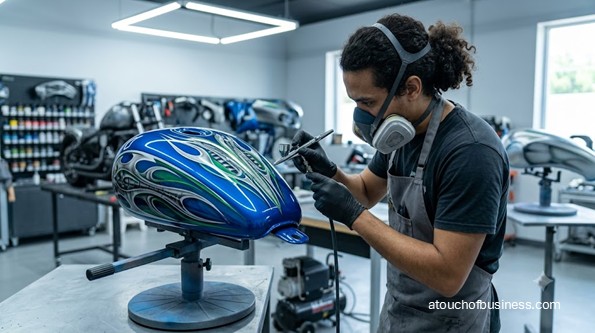
What to Expect From This Guide to Starting a Custom Airbrushing Service
This guide walks readers through the key decisions and practical steps involved in starting a custom airbrushing service, from assessing skills and demand to setting up a compliant studio and preparing for paid projects. The points below highlight several of the guide’s main areas of value.
Inside the guide, you will find:
- Startup roadmap: Follow 15 ordered steps from assessing owner fit and choosing a niche through studio setup, client systems, and opening preparation.
- Industry interviews: Hear studio owners discuss starting out, choosing niches, building clients, pricing creative projects, and treating artistry as a business.
- Startup FAQs: Review practical answers about licensing, spray booths, specialization, client property, pricing, deposits, home studios, and finding customers.
- Business fit: Consider professional skill, client communication, irregular project income, personal financial runway, and household support before committing.
- Market and finances: Assess local demand, entry options, startup costs, fixed expenses, realistic volume, profit potential, and break-even targets.
- Studio and safety: Plan space, ventilation, equipment, chemical storage, waste handling, insurance, and location-dependent permits for your chosen specialty.
- Opening checks: Use red flags to verify your portfolio, agreements, deposits, permits, insurance, ventilation, and equipment before accepting paid projects.
The guide begins by explaining what custom airbrushing service owners do and what the day-to-day responsibility requires.
What Is a Custom Airbrushing Service?
As a custom airbrushing service owner you create one-of-a-kind, hand-painted artwork on almost any surface a client brings — or a blank you supply. T-shirts, motorcycle helmets, vehicle panels, leather jackets, sneakers, murals, canvas portraits, and sports equipment all fall within reach of a skilled airbrush artist.
The work is project-based. Every job is quoted individually, completed by hand, and delivered as a finished piece that no digital printer can exactly replicate. That hand-crafted quality is the core of your value — and your primary selling point.
Before you rent a studio and stock your shelves with paint, it’s worth understanding what this business actually asks of you day to day.
You’ll spend most of your time painting, but a meaningful share of your day goes to client consultations, writing project quotes, managing expectations, photographing finished work, and cleaning and maintaining your equipment. You’ll also handle supply ordering, invoicing, and the occasional awkward conversation when a client’s vision and your realistic timeline don’t match.
This is a creative business, but it’s also a service business. Clients are trusting you with something personal — a favorite jacket, a custom helmet, a gift for someone they love. Delivering work that earns those referrals is how the studio grows.
Are you ready for that combination of artistry, communication, and daily responsibility? The right answer before you sign a lease is an honest one.
It also helps to speak with people already doing this work. Find custom airbrushing artists who operate in a different city or region — people you’ll never compete with directly — and ask them what surprised them most about running a studio. Prepare your questions in advance. Every artist’s path is different, but firsthand insight from someone who has navigated the startup phase is worth more than any guide.
If you’d like broader context on the steps involved in starting a small business, that overview can help you see where the airbrushing-specific steps fit into the larger picture.
Red Flags Before You Start
Some issues are better caught before you spend money than after. These are the most important ones to evaluate before moving forward.
Your technique isn’t at a professional level yet. This business lives or dies on what clients can see in your portfolio. If your work is still developing, opening a studio before it’s ready means building a reputation before you’re ready to defend it. Keep practicing until you can produce results you’d charge for without hesitation.
Digital printing competes directly in your niche. If you plan to focus on custom apparel, be clear-eyed about this. Direct-to-garment printing, heat transfer, and sublimation are faster and cheaper for most clients. Your studio needs customers who value hand-crafted airbrushed art over digital alternatives. Confirm that demand exists in your specific market before committing to an apparel-only approach.
Ventilation costs may exceed your startup budget. A properly set up spray space — especially for automotive or helmet work with solvent-based paints — can require a professional spray booth, electrical upgrades, and a fire marshal inspection. If the space you can afford can’t be properly ventilated, it can’t legally or safely operate as a spray studio.
You have no portfolio and no referral network. A studio without visual evidence of what you can do has nothing to sell. Delay opening until you have at least 10–20 strong portfolio samples ready to show — online and in person.
Your personal financial runway is thin. Project-based revenue is irregular by nature. Some weeks bring multiple paid jobs. Others bring none, especially early on. If you can’t cover your own living expenses for 3–6 months while the client base builds, the business may not survive long enough to find its footing.
High-value client-supplied items carry real liability. Painting on a client’s custom motorcycle tank or a vintage leather jacket carries the risk of irreversible damage. Without the right insurance and a clear written agreement, one accident can turn into a costly dispute.
Step 1: Assess Your Skill Level and Owner Fit
Start here — before you look at studio spaces or compare compressors. The question isn’t whether you love airbrushing. It’s whether your current skill level can sustain a paying client base.
Custom airbrushing clients expect professional results. Fine detail, realistic shading, smooth color gradients, clean lettering, and substrate-specific technique are all part of the job. If you can produce that work consistently, you’re ready to build a business around it. If you’re still developing those skills, that’s not a reason to give up — it’s a reason to keep practicing before you open.
Beyond technical skill, ask yourself whether this business model fits your personality. Every project is different. Clients bring high expectations and, sometimes, vague briefs. Turnaround times vary. Revenue comes in bursts. You’ll need patience for client communication as much as you need a steady hand.
Think about whether your interest in this business runs deep enough to carry you through slow months and difficult client conversations. The artists who build lasting studios are the ones who genuinely enjoy the craft and are willing to treat the business side with the same discipline.
Also consider whether your household is prepared for the launch period. Starting a studio takes time, capital, and emotional energy — and the first year rarely goes exactly as planned. Having the support of the people closest to you makes the hard stretches more manageable.
Step 2: Define Your Specialization
Custom airbrushing is a broad field. Trying to serve every client type from the beginning is one of the most common early mistakes.
The most common studio specializations include:
- Custom apparel and accessories — T-shirts, hats, hoodies, sneakers, leather goods
- Automotive and motorcycle work — panels, gas tanks, fenders, helmets
- Murals — interior residential, commercial, event spaces
- Fine art and canvas commissions — portraits, original artwork
- Sports equipment, props, and cosplay items
- Airbrush tattoos and event entertainment services
Your niche selection affects nearly everything that follows: your studio size, your ventilation requirements, your equipment needs, your insurance situation, and the clients you’ll attract.
A focused studio identity also makes your portfolio more credible. Clients looking for a custom helmet painter want to see helmets in your portfolio — not a mixed gallery of every surface you’ve ever touched.
Start with what you do best, where local demand is strongest. You can expand your offerings later once you have a paying client base and a clear reputation.
Step 3: Research Local Demand and Competition
Before you commit to a lease, spend time understanding your local market. Find out how many custom airbrushing studios and freelance artists are already operating near you — and what they specialize in.
Then look at your potential referral sources. Talk to automotive shops, motorcycle dealers, event planners, custom clothing boutiques, tattoo studios, and sports leagues. Ask whether their customers have requested hand-painted custom work. Their answers will tell you more about real local demand than any market report.
Pay attention to pricing reality in your area. Artists in higher-cost-of-living cities — New York, Los Angeles, Chicago — support higher rates than those in smaller or rural markets. Understanding what your local clients will actually pay is essential before you set up a studio with fixed monthly overhead.
Also be realistic about local supply and demand for your specific niche. A market full of home-based airbrushing freelancers charging low rates is a different challenge than a market with no established studio at all. Know what you’re entering before you enter it.
Step 4: Decide How to Enter the Market
There’s more than one way to start a custom airbrushing service, and the right path depends on your capital, timeline, and current client relationships.
First, consider starting from scratch. Building your own studio from the ground up gives you full control over your niche, brand, and setup — but it requires full capital commitment before the first client walks in.
Next, consider buying an existing studio. An established airbrushing business may come with equipment, a lease, and an existing client base. That head start has real value — but verify carefully what actually produced that prior revenue, and whether clients will stay once ownership changes.
Then, consider starting with event work first. Many successful studio owners started by offering airbrush tattoos and party favors at events and markets before opening a fixed studio. This approach builds your client base, cash flow, and portfolio with far less overhead. It’s a lower-risk way to test whether you can convert creative skill into consistent paid work.
The best path depends on your budget, your risk tolerance, the businesses available for sale in your area, and how quickly you need to generate income. There’s no universally right answer — only the one that fits your situation. You can read more about the tradeoffs between starting from scratch versus buying a business before making that decision.
Step 5: Set Up Your Legal Structure and Register the Business
Once you know what kind of business you’re starting, you need to make it official.
Choose a legal structure. Most solo airbrushing studio owners start as a sole proprietor or single-member LLC. An LLC (Limited Liability Company) is a legal structure that separates your personal assets from business debts and liability claims — meaning if a client sues the business, your personal savings and property have some protection. For a studio that handles client-supplied items — helmets, motorcycles, custom clothing — that liability protection is worth considering seriously.
Register your business name with your state’s secretary of state office (for an LLC) or your county clerk (for a sole proprietorship). If you plan to operate under a trade name — something other than your own legal name — file a DBA.
A DBA, or “Doing Business As,” is a registered trade name that lets you operate your business under a name you choose without forming a separate legal entity.
Also obtain an EIN (Employer Identification Number) from the IRS at irs.gov. You’ll need it to open a business bank account and for tax purposes, even if you’re the only person in the business.
For more on how to think through your options, see how to choose a business structure and the comparison between an LLC and sole proprietorship.
Step 6: Handle Licensing and Compliance
Custom airbrushing has more compliance considerations than most creative businesses, primarily because spray finishing operations involve chemicals that are regulated for health and safety reasons. Work through these carefully before you open.
General business license. Most cities and counties require one. Apply through your city or county clerk’s office or government website. Fees and requirements vary by jurisdiction.
Zoning. Confirm that your chosen location is zoned for commercial spray work and client visits. Commercial and light-industrial zones generally allow this. Residential zones typically don’t — especially for spray operations or significant client traffic. Verify with your local planning or zoning department before signing any lease.
Certificate of occupancy. If you’re moving into a new commercial space, your local building department may require one. Check before you sign.
Ventilation and spray finishing compliance. OSHA’s standard at 29 CFR 1910.94 governs ventilation requirements for spray finishing operations. The key trigger is whether your paints contain hazardous chemicals — not just how much paint you use. Studios using solvent-based automotive paints face stricter requirements than those using water-based airbrush acrylics. Your state environmental agency may also require notification or a permit based on your estimated annual VOC output. VOC stands for volatile organic compound — chemicals in paint that evaporate into the air and are regulated for both health and environmental impact. Contact your state’s Small Business Environmental Assistance Program (SBEAP), which provides free, confidential compliance guidance for situations like this.
Sales tax permit. In most states, selling custom-decorated tangible goods — airbrushed shirts, helmets, artwork — is a taxable transaction. How the labor portion is treated varies by state. Register with your state’s department of revenue and verify with a local CPA how your specific mix of services and goods will be taxed.
Fire marshal. If you plan to use flammable materials in your studio, contact your local fire marshal’s office before operating. Some jurisdictions require a spray booth inspection before commercial spray work can begin.
Step 7: Find and Set Up Your Studio Space
Your studio is your primary production environment and, for many clients, the first impression of your business. Getting the setup right before you open matters more here than in most businesses — once you’re spraying paint on client work, it’s too late to realize the ventilation isn’t adequate.
Size and layout. For apparel and small-object work, a studio in the range of 300–600 square feet may be enough. For automotive panels, motorcycle frames, or large murals, you’ll need considerably more space — and a spray booth large enough to accommodate those pieces.
Plan your layout before you commit to a space. You need a dedicated spray or painting zone, a client consultation area, supply storage, a cleaning station, and space to move around safely. Trying to fit all of that into an undersized studio creates workflow problems that affect quality and client experience.
Lease terms and landlord confirmation. Before signing any lease, confirm in writing that the landlord permits commercial spray work, chemical storage, and client visits on the premises. Some landlords — or their insurance carriers — prohibit spray operations or solvent storage. Find out before you’re committed.
Electrical capacity. Compressors, ventilation fans, and professional lighting all draw power. Verify that the space’s electrical panel can handle your equipment load. Upgrades to electrical capacity are a real cost that can surprise first-time studio tenants.
Lighting. Accurate color representation depends on good studio lighting. Use fluorescent or LED fixtures with daylight-balanced output. Paint your walls and ceiling white or a neutral tone — it dramatically improves light distribution and makes color matching more reliable.
Flooring. Sealed concrete is the best choice. It’s easy to clean and won’t absorb paint spills. Avoid carpeting entirely.
A shop sink is essential. Install one that allows quick cleanup between colors and at the end of each session.
Step 8: Plan and Install Ventilation and Safety Systems
This step is not optional, and it’s not something to work out after you move in. Your ventilation and safety setup must be ready before commercial spray work begins.
OSHA’s spray finishing standard requires adequate ventilation whenever hazardous chemicals are present in the paint — regardless of volume. For studios using primarily water-based airbrush acrylics on small objects, a quality tabletop spray booth with a filter system and an exterior exhaust duct may be adequate if personal exposure is kept within safe limits.
For operations using solvent-based paints — automotive finishes, urethanes, lacquers — a professional spray booth meeting NFPA 33 standards is required. NFPA 33 is the National Fire Protection Association standard that governs spray application using flammable or combustible materials — it defines airflow, construction, and fire safety requirements for spray booths.
Respiratory protection is required during spray operations. At a minimum, wear an N95 or half-face organic vapor respirator. If you’re working with high-solvent automotive materials, consult the safety data sheet for the specific product you’re using — stronger protection may be required.
Store solvent-contaminated rags in sealed metal safety cans, not open bins or plastic bags. Solvent-soaked rags left in open containers are a documented fire hazard.
Establish a paint waste disposal protocol before you generate any waste. Solvent-based paints and spent solvents are regulated hazardous waste and cannot be poured down the drain or placed in regular trash. Water-based acrylic paint residue that is fully dried and free of heavy metals may generally be disposed of in regular waste, but check your local rules. Contact your local municipal hazardous waste program for specific disposal guidance.
Step 9: Source and Purchase Equipment and Supplies
Your equipment list depends directly on your niche. Don’t buy for every possible specialization — buy for the work you’re actually opening to do.
Core airbrush equipment includes:
- Dual-action gravity-feed airbrushes in multiple sizes — fine-detail, medium, and broader-coverage nozzle configurations
- A professional-grade oil-free piston compressor with an air tank for smooth, consistent airflow
- Air hoses with moisture traps to prevent water contamination in the paint stream
- An airbrush cleaning station and cleaning pot with exhaust capture
- Spare needles, nozzles, and caps
Studio tools and supplies include:
- Friskets, stencil material, and masking film for design control
- Precision cutting tools, cutting mats, and low-tack masking tape
- Geometric guides, rulers, and French curves
- Organized paint racks and supply storage cabinets
- A drying rack or hanging system for finished garments
For your initial paint inventory, build it around your niche. Water-based airbrush acrylics (brands such as Createx or Auto-Air) work well for apparel and fine art. Automotive work requires substrate-appropriate urethane or lacquer systems. Don’t overstock — buy for the first three months of expected work and reorder as you learn your actual usage patterns.
On the safety side: install a fire extinguisher appropriate for chemical use, keep all Safety Data Sheets (SDS) for every paint and solvent on file and accessible, and have a first aid kit and eyewash station available if you work with solvents.
Step 10: Build Your Portfolio Before Opening
Your portfolio is your primary sales tool. No client discovery call, no website copy, and no business card will do more to convert an inquiry into a paid project than strong visual evidence of what you can do.
Produce 10–20 portfolio pieces across your chosen niche before you accept a single paying client. Photograph them professionally — clean backgrounds, accurate color, clear detail shots. If your portfolio photos don’t do the work justice, they will lose you clients who never even reach out.
Organize the portfolio by substrate or application type so a prospective client can immediately find the work most relevant to what they need. A motorcycle rider looking for a custom helmet should be able to find your helmet work in seconds.
If you plan to paint on client-supplied items, practice on the same types of substrates first — similar helmet shells, similar leather, similar fabric. You need to be confident in your results on those specific materials before a client’s prized item is on your workbench.
Display samples physically in the studio as well. When a client visits for a consultation, being able to hand them a finished piece and let them feel the quality of the work closes more deals than a photo gallery alone.
Step 11: Set Your Pricing Structure
Pricing custom airbrushing work is one of the most challenging aspects of launching this business — and one of the most important to get right before you open.
Custom airbrushing is almost always priced by project quote, not by a fixed menu. Every piece varies in complexity, substrate, design hours, and material cost. The same surface area can take three hours for a simple graphic and twelve hours for a photorealistic portrait.
Hourly rates for airbrushing artists generally range from roughly $58 to $250 per hour, with an average around $154 per hour, depending on experience, market, and niche. Project prices vary accordingly: simple apparel designs typically start at $50–$150; helmets and vehicle panels often start at $500 and exceed $2,000 for complex work; fine art canvas commissions can range from a few hundred dollars to $10,000 or more for original pieces.
When you build a project quote, include:
- Estimated labor time multiplied by your target hourly rate
- Cost of materials (paint, primers, clear coat, blanks if applicable)
- Consultation and design planning time
- Setup, cleaning, and equipment time
- A minimum project fee to cover small jobs that wouldn’t otherwise be worth taking
Always separate material cost from labor when you explain a quote to a client. It helps them understand why prices change between projects of similar size — and it protects you when material costs shift.
Establish a clear policy for client-supplied items: what happens if damage occurs, how you handle cancellations after work has begun, and what your revision limits are. Put all of it in writing before you take the first deposit. For more on how to approach pricing your creative services, that resource walks through the underlying logic.
Step 12: Assess Profit Potential Before Committing
Before you sign a lease and buy equipment, work through whether this studio model can actually support you financially — at your local rates, with realistic project volume in year one.
As a studio-based service, your fixed costs — rent, utilities, insurance, equipment payments — continue every month regardless of how many projects you complete. Your revenue, by contrast, comes in project by project with no guarantees between jobs.
Your niche affects your cash flow profile significantly. Studios focused on high-volume small jobs (apparel, event tattoos) can generate consistent flow if they stay booked. Studios built around large infrequent projects (automotive, fine art murals) may have weeks or months between significant payments.
To stress-test your model before opening:
- Estimate your realistic billable project-hours per week in the first six months
- Multiply by your planned hourly rate to project monthly revenue
- Compare that against your total monthly fixed costs — rent, insurance, supplies, utilities, equipment payments
- Determine how many months of slow performance you can sustain before the studio runs out of runway
If the numbers don’t work at realistic early volume, consider whether a smaller studio, a lower-overhead entry path, or an event-work-first approach makes more sense to start. You can explore how to think through estimating profitability and revenue for a new business before you make major financial commitments.
Step 13: Set Up Business Banking and Payment Processing
Open a dedicated business checking account before you take a single client payment. Keep all business transactions completely separate from your personal finances from day one — mixing them creates accounting problems and can complicate your legal protections as an LLC.
Set up a merchant account or payment processor — Square, Stripe, PayPal, or a similar service — so you can accept credit cards and issue invoices for deposits and final payments. For guidance on how to open a business bank account, that guide walks through what to expect.
For custom project work, require a non-refundable deposit before you start — typically 25–50% of the project total. The deposit covers your material costs and protects you if a client changes their mind after you’ve purchased paint and blanks or begun prep work. Put your deposit policy in every project agreement, and make sure clients sign before any work begins.
Step 14: Get Business Insurance
A custom airbrushing studio has genuine risk exposure. Clients visit your space. You work with chemicals. You handle items of significant personal and financial value to the people who bring them to you. Insurance is not optional in this business.
Coverage to put in place before opening:
- General liability insurance — covers third-party bodily injury (a client trips and falls in the studio) and property damage claims
- Commercial property insurance — covers your equipment, tools, and supplies against theft or damage
- Business Owner’s Policy (BOP) — bundles general liability and commercial property into a single policy, typically the most cost-efficient starting point for a small studio
- Workers’ compensation — required by law in most states as soon as you hire any employee
Also discuss professional liability coverage with your insurer. If you damage a client’s motorcycle tank or ruin a custom leather jacket, general liability alone may not cover completed work on client-supplied property. Verify what your policy actually covers before you take high-value client items.
If you use flammable solvents in a rented studio, confirm that your policy includes fire legal liability coverage. Some landlords may also require a minimum general liability limit as a condition of the lease. For more on what to consider, see business insurance basics.
Step 15: Establish Your Business Identity and Client Systems
Your studio’s visual identity and client-facing systems should be ready before your first inquiry arrives. Both directly affect how much clients trust you — and whether they follow through from inquiry to deposit.
Your portfolio website is your most important identity asset. Organize it by specialization. Use high-quality photos. Make it easy for a prospective client to find the type of work most relevant to their project. For a custom airbrushing studio, a weak or disorganized online gallery costs you clients who never contact you.
In the studio, display physical sample pieces where clients can see and handle them during consultations. The ability to put a finished helmet or a painted leather jacket in someone’s hands is more persuasive than any photo.
Prepare your client systems before you open:
- Project intake forms that capture the client’s vision, substrate, timeline, and budget range
- Project quote templates that clearly separate labor from materials
- Work agreements that define the scope, revision limits, deposit terms, cancellation policy, and damage waiver for client-supplied items
Unclear agreements are one of the most common sources of disputes in custom creative work. Scope creep — a client asking for additional changes or additions after the work has begun — is easier to prevent with a well-written agreement than to resolve after the fact.
If you’re installing exterior signage, check with your local government about signage permit requirements before anything goes up. Check your lease terms as well — some landlords have signage restrictions.
Business Plan
A business plan for a custom airbrushing studio doesn’t need to be a formal document, but it does need to force you to think through the numbers and decisions before you spend money.
Start with your niche and your pricing structure. Know what you’ll offer, who you’ll offer it to, and what you’ll charge — and make sure those prices reflect your actual costs, not what you think clients want to hear.
Map out your fixed monthly costs: rent, utilities, insurance, equipment financing, and supplies. Then estimate your realistic project-hours per week in the first six months. Compare revenue to expenses honestly. If the gap is too wide to survive, plan how you’ll bridge it — with savings, with event work, or with a smaller studio footprint.
Include your startup cost categories: studio build-out, ventilation, equipment, initial inventory, insurance, licensing, portfolio production, and website. Price each one out with actual quotes, not estimates pulled from thin air. Startup costs are easy to underestimate in a business that requires spray-safe infrastructure.
Plan for slow months. In a project-based business without a client base, the first few months may generate very little revenue. Your plan should account for that gap and identify what you’ll draw on to cover fixed costs during that period.
Think through your break-even point clearly: how many billable hours per week, at what rate, does it take to cover your fixed costs? That number is the target your client development efforts need to hit before the studio becomes self-sustaining.
For a fuller guide on how to write a business plan, that resource can help you structure your thinking before committing to major startup expenses.
Opening-Day Red Flags
Before you open the studio to paying clients, work through this list. Any item that isn’t ready is a reason to delay — not a reason to open anyway and figure it out later.
Ventilation isn’t tested and confirmed. If your spray booth isn’t fully operational and your exhaust system hasn’t been verified before you start commercial work, you’re operating outside safety and compliance requirements. Test everything — with the type of paint you’ll actually use — before a client’s item is on your workbench.
Permits and insurance are not yet in hand. Don’t take a single paid project without your business license, any required air quality registration, and active business insurance. One client injury or one compliance inspection before you’re licensed can end a studio before it starts.
Your deposit system isn’t set up. If you haven’t established a written deposit policy and a way to collect it before work begins, you’re exposed to cost losses from the first project.
Your work agreement isn’t ready. Every client — even a referral, even a friend — should sign a project agreement that defines scope, revisions, deposit, cancellation terms, and your damage liability position on client-supplied items. Going without it on even one job creates the opening for a dispute.
Your portfolio is too thin to convert inquiries. If your portfolio doesn’t show at least 10–20 strong examples across your primary niche, most inquiries won’t convert. Delay opening until the portfolio is ready to do its job.
Equipment hasn’t been tested at full production load. Complete at least two or three full test projects — from prep to cleanup — before taking paid work. A compressor failure mid-project on a client’s motorcycle panel is not the time to learn about your equipment’s limits.
Frequently Asked Questions
Do I need a special license or certification to run a custom airbrushing studio?
No nationally required specialty license exists specifically for airbrushing artists. You’ll need standard business registrations: a general business license from your city or county, business entity registration, and a sales tax permit for selling decorated goods. If you use solvent-based paints or operate a spray booth, your state environmental agency and local fire marshal may have additional permit or inspection requirements. Verify both before opening.
Do I need a professional spray booth, or can a tabletop booth work?
It depends on your niche. For apparel and small objects using water-based airbrush paints, a quality tabletop spray booth with filtration and an exterior exhaust connection may be adequate if personal exposure stays within safe limits. For automotive panels, motorcycle work, or any project using solvent-based paints, a professional spray booth meeting NFPA 33 standards is required for both safety and OSHA compliance. Operating with inadequate ventilation while using solvent-based finishes creates serious health and fire risk.
Should I specialize in one type of airbrushing or offer everything?
Specialization almost always serves a new studio better. A clear niche makes your portfolio more credible, your referral network more targeted, and your equipment and compliance setup simpler to manage. You can expand into additional substrates and client types as the business grows and your reputation develops.
How do I handle damage to a client’s item?
Establish a written work agreement before you accept any client-supplied piece. The agreement should define your liability position, state your damage policy, and include a waiver for high-value items where risk of accidental damage is present. Discuss with your insurer whether your policy covers completed work on client property — general liability coverage alone may not be enough.
How do I figure out what to charge for a project?
Estimate your time, multiply by your target hourly rate, and add the cost of materials. Include consultation and design planning time, not just the hours you’re holding the airbrush. Never quote on surface area alone — a small, complex piece may take three times longer than a large simple one. Get comfortable asking about design complexity and client expectations before you commit to a number.
Should I require a deposit before starting a project?
Yes. A non-refundable deposit of 25–50% is standard practice in custom creative work. It covers your material costs and protects you if a client cancels after prep work has begun. Put the deposit requirement in your written project agreement, and collect it before purchasing any materials or starting any design work.
Can I operate a custom airbrushing studio from my home?
Possibly, but local zoning rules, HOA restrictions, and ventilation requirements make it difficult for many operators. Most residential zones prohibit significant client traffic, hazardous material storage, and commercial spray operations. Even where technically permitted, working with solvent-based paints in a home environment creates real health and fire risk. Many airbrushing artists start with water-based home work and move to a commercial studio as volume grows. Confirm zoning before committing to any setup.
How does a new studio attract its first paying clients?
First, build relationships with non-competing local businesses that already serve your target clients: automotive shops, motorcycle dealers, custom apparel stores, tattoo studios, sports leagues, and event planners. Offer to display portfolio samples in their space. Second, consider taking airbrush tattoo or party favor work at local events and markets — it builds visibility, cash flow, and word-of-mouth before your studio is fully booked. Your portfolio and referrals will always outperform any other early client source.
Insights From Custom Airbrushing Studio Owners
Hearing directly from people who have built a custom airbrushing business is one of the most practical things you can do before you commit to a studio lease or a major equipment purchase.
What works on paper doesn’t always match the reality of quoting projects, managing client expectations, and keeping the studio financially afloat in the early months.
The interviews below feature working airbrush artists and studio owners who talk openly about how they started, what they learned the hard way, and how they think about the business side of their craft. Each conversation covers different aspects of the startup path — from legalizing the business and building a client base to choosing a niche and understanding what it actually takes to go from self-employed artist to studio owner.
The Airbrush T-Shirt Business with Pat Gaines — The Breakthrough Creative, Ep. 33
Pat Gaines is an experienced airbrushing artist and business owner interviewed on The Breakthrough Creative, a podcast about the business side of creative work hosted by John McDavitt.
Pat talks through how he built his airbrushing business, his approach to pricing and turning creative skill into reliable income, and what new artists need to understand about the real demands of running a custom airbrushing operation.
Pete Marin: Airbrush T-Shirts and Airbrush Events — The Breakthrough Creative, Ep. 105
Pete Marin is the owner of Airbrush Events, a business built around airbrushed party favors and event entertainment. He started his airbrushing career working retail before eventually narrowing his focus to events and private entertainment services.
Pete discusses how he found his niche, how starting with event work helped him build cash flow and clientele before committing to a fixed studio model, and the practical lessons he learned over more than a decade in the business.
Rashard Jones is a visual artist and airbrushing studio owner based in Greensboro, North Carolina, interviewed on The Artist Bloc Podcast, which covers entrepreneurship and the business of art.
Rashard walks through the difference between being self-employed and running a legitimate business, why legalizing your airbrushing operation matters more than most artists realize, and how to think about hiring, growing a team, and building a studio with staying power.
Related Articles
- How To Start a Custom Car Shop
- How To Start a Car Wrapping Business
- How To Start a Vinyl Decal Business
- How To Start a Graphic Design Business
- How To Start a T-Shirt Business
Sources:
- OSHA: Spray Finishing Ventilation 1910.94, Spray Operations Overview
- National SBEAP: Painting and Coating Compliance
- Airbrush Events (Pete Marin): Airbrush Studio Setup Guide
- Metastate Paint: What Airbrush Artists Charge Per Hour
- Thumbtack: Custom Paint Job Prices 2024, Custom Airbrushing Service Costs
- Fiverr: Airbrush Artist Pricing Guide
- The Hartford: Artist Business Insurance
- Intel Market Research: Airbrush Paint Market 2025–2031
- Iowa Waste Reduction Center: Paint-Related Waste Disposal
- Golden Artist Colors: Disposing of Painting Wastes
- Wolters Kluwer: Commercial Painter Licensing
- Avalara: Sales Tax Compliance for Artists
- Hazardous Waste Experts: Art Studio Hazardous Waste
- Entrepreneur.com: Custom Airbrushing Business Overview