
What to Expect From This Guide to Starting an Asphalt Sealcoating Business
This guide walks you through the key decisions and practical steps involved in starting an asphalt sealcoating business, from evaluating the opportunity through planning your setup and preparing for paid jobs.
Inside the guide, you will find:
- Startup steps: Move from evaluating the business and local demand through registration, equipment setup, pricing, testing, and opening preparation.
- Business fit: Consider physical working conditions, seasonal income, weather limitations, and whether the trade suits your circumstances.
- Market demand: Evaluate local competition, customer types, service-area size, and optional services such as crack filling and line striping.
- Equipment needs: Review vehicles, trailers, sealcoating systems, surface-preparation tools, crack-repair equipment, safety gear, and supplier planning.
- Local requirements: Check licensing, taxes, zoning, environmental restrictions, insurance, vehicle requirements, and other rules that may vary by location.
- Financial planning: Examine pricing factors, startup expenses, operating capital, seasonal cash flow, break-even planning, and possible funding sources.
- Common questions: Review practical answers about part-time operation, equipment choices, hiring help, expanding capacity, and insurance requirements.
The guide begins by clarifying what sealcoating work involves and the seasonal, mobile nature of the business.
What an Asphalt Sealcoating Business Actually Involves
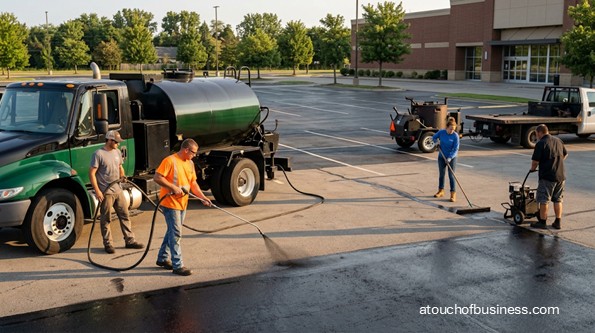
Asphalt sealcoating is a mobile, project-based trade. You travel to each driveway or parking lot instead of running a storefront.
Most people think sealcoating repairs damaged pavement, but that’s not accurate.
It’s a protective coating that shields asphalt from water, oil, and sun damage — not a structural fix.
As the owner, you clean the surface, fill cracks, and apply one or two coats of sealer.
Customers range from homeowners with driveways to property managers overseeing large commercial lots.
Starting any business involves a similar sequence of decisions before opening. See the general startup steps this guide builds on.
Is Asphalt Sealcoating the Right Business for You?
Are you comfortable working outdoors in heat, around hot equipment and strong fumes, day after day?
This work is physical, and much of it happens during the hottest stretches of the year.
Sealcoating is highly seasonal in most regions. Most of your income arrives in a narrow window of warm, dry weeks.
Can your household absorb a slow off-season while you build a steady client base?
Before you commit, talk with sealcoating or pavement-maintenance owners outside your own service area.
Ask about seasonal cash flow, equipment reliability, and how they handled licensing where they operate.
Firsthand experience is useful even though every owner’s path looks a little different. See these insights from real business owners before you commit.
Think about who your first customers will likely be — repeat residential clients, small commercial lots, or HOA contacts.
Consider how you’ll reach them at launch, whether through referrals, signage, or direct outreach to property managers.
Red Flags Before You Start
Sealcoating has a few structural realities worth understanding before you invest in equipment or commit to a service area.
Consider these red flags before you start:
- Your workable season is limited to warm, dry stretches, which concentrates most of your income into a few months.
- Some states and cities restrict coal-tar-based sealant, which may rule out your preferred product.
- Some jurisdictions require a specialty contractor license with experience or exam requirements that can delay your start.
- Equipment costs are low enough that many part-time competitors enter the residential market, pressuring your pricing.
- Commercial and municipal clients often require proof of insurance or bonding before awarding larger contracts.
- Rain and temperature swings can strand your crew and equipment during your limited working season.
- A single equipment breakdown during peak season can cost you jobs you can’t easily reschedule.
- Applying sealant outside the correct weather window can cause failures that damage your reputation.
None of this means you shouldn’t start.
It means you should plan around a short, weather-driven season from day one.
Step 1: Decide Whether to Start From Scratch, Buy a Route, or Work With a Dealer
Most sealcoating businesses start from scratch rather than through a franchise system.
True franchising is uncommon in this trade, though some equipment manufacturers offer dealer or distributor programs instead.
Before you buy new equipment, check whether an established local operator’s routes, customers, or equipment are for sale.
Buying an existing route can shorten your ramp-up time, but it also means inheriting someone else’s pricing and reputation.
Weigh your budget, timeline, and comfort with risk before deciding which path fits you best.
For a deeper look at the tradeoffs, see this guide on starting from scratch versus buying a business.
Step 2: Validate Local Demand and Choose Your Business Model
Before you buy a single tool, find out who else is sealcoating driveways and lots in your target area.
Look at the mix of residential driveways, commercial parking lots, HOA-managed properties, and any municipal contracts nearby.
Decide which customer type will anchor your business: homeowners, commercial properties, HOA contracts, or some combination.
Also decide whether you’ll offer crack filling and line striping alongside sealcoating.
These add-ons affect your equipment list and your startup budget.
Set a realistic service-area radius for your first season.
A wider radius means more potential customers, but also more drive time between jobs.
Step 3: Register Your Business and Set Up Your Tax Accounts
Choose a legal structure for your sealcoating business, such as a sole proprietorship, LLC, partnership, or corporation.
Each structure carries different liability protection and paperwork, so pick the one that matches your risk tolerance.
File any required formation documents with your state, then register your business under its legal name.
Apply for an Employer Identification Number, especially if you plan to hire employees or open a business bank account.
Check with your state’s revenue department to see whether sealcoating labor or materials are taxable where you operate.
Step 4: Confirm Licensing, Zoning, and Environmental Rules Before You Buy Equipment
Some states classify sealcoating as a licensed specialty trade, similar to paving or highway-improvement contracting.
Most people think a general business license covers everything, but that’s not always true in this trade.
Check with your state’s contractor licensing board to see whether a specialty license, exam, or bond applies to you.
Confirm general business license requirements with your city or county, since these apply even to home-based operations.
If you’ll operate under a name other than your own, file a DBA with your county clerk.
Some states and cities restrict the sale or application of coal-tar-based sealant due to environmental concerns.
Verify this with your state environmental agency before you commit to a specific sealant product.
If you’ll store your tank, trailer, or material drums at home, check local zoning rules first.
Also confirm whether a homeowners’ association restricts this kind of equipment storage.
These restrictions vary by U.S. jurisdiction, so confirm the specifics for your exact address before you buy anything.
Learn more about business licenses and permits before you finalize your equipment budget.
Step 5: Choose Your Vehicle, Trailer, and Sealcoating Equipment
Your tow vehicle and trailer need to handle the combined weight of a loaded sealcoat tank.
Check the gross vehicle weight rating of your truck and trailer combination against federal commercial-vehicle thresholds.
If your combined weight crosses that threshold, you may need a USDOT number and specific vehicle markings.
Entry-level setups often use a hand-agitated tank on a skid or small trailer.
Higher-volume operations typically move to a hydraulic, full-sweep agitation system on a dedicated trailer.
Base your choice on the job volume and lot sizes you expect in your first season.
Step 6: Set Up Suppliers and Build Your Equipment List
Line up a supplier for sealer, crack filler, and any oil-spot primer before your first booked job.
Compare coal-tar-based, asphalt-emulsion, and acrylic sealer options against what’s permitted in your service area.
Beyond the tank and sprayer, plan to gather equipment across several categories:
- Surface prep: push brooms, wire brushes, blowers, and a pressure washer for stubborn dirt.
- Crack repair: a hot-pour melter, pour pot, cold-pour filler, and sand for broadcasting.
- Application: a spray system or squeegee machine, hand squeegees, brushes, and an edging tool.
- Site protection: cones, delineators, caution tape, and plywood or cardboard to block overspray.
- Safety gear: heat-resistant and chemical-resistant gloves, splash goggles, an organic-vapor respirator, and slip-resistant boots.
If you plan to add line striping, budget separately for a striping machine, paint, and stencils.
Step 7: Set Up Banking, Insurance, and Risk Protection
As a sealcoating business owner, open a separate business bank account before you accept your first payment.
Set up a way to take payment on-site, whether that’s a card reader or mobile invoicing.
Before your first job, line up the following coverage:
- Workers’ compensation, which is legally required in nearly all states once you hire an employee.
- Commercial auto coverage that meets your state’s minimum liability requirements.
- General liability insurance, which many commercial property managers require before signing a contract.
You may also want tool and equipment coverage, along with pollution or spill liability for accidental sealant discharge.
These are risk-planning choices rather than legal requirements, so weigh them against your comfort with exposure.
Step 8: Build Your Pricing Method
Decide how you’ll measure and price each sealcoating job before you quote your first customer.
Most sealcoating businesses price by square footage, though some also price flat-rate by project size.
Build your pricing method around these factors:
- Total square footage and number of sealer coats applied.
- Linear footage of crack filling and any oil-spot treatment.
- Travel distance and time to reach the job site.
- A minimum job charge to cover setup and travel on small jobs.
List your sealer’s coverage rate as a planning input, not a fixed cost.
That’s the amount of surface area a unit of material typically covers.
Price out your material, fuel, and labor locally rather than relying on national averages.
See this guide on pricing products and services for a broader framework.
Step 9: Decide Whether to Hire Help or Work Solo
Decide early whether you’ll sealcoat solo or bring on a helper for your first season.
Solo operation keeps costs lower, but it also caps how many jobs you can complete in your short season.
If you hire, train your crew on equipment operation, PPE use, and safe handling of hot material.
Hiring also triggers workers’ compensation and payroll tax registration, so factor that into your timeline.
Step 10: Prepare Contracts, Records, and Safety Documentation
Prepare a simple work-order or contract template for your sealcoating jobs before you book your first customer.
Keep a Safety Data Sheet on file for every chemical product your crew uses on-site.
Set up your business name, contact information, and basic signage so customers can identify and reach you.
If your vehicle or trailer requires a USDOT number, make sure the required markings are displayed correctly.
Step 11: Run a Pre-Opening Test Before Your First Paid Job
Test your sealcoating tank, agitation system, and spray or squeegee equipment before your first paid job.
Run your crack-filling melter through a full cycle and confirm the propane supply and safety shutoffs work.
Set up a plan to contain and properly dispose of wash water and rinse water from equipment cleaning.
Consider running a test job — your own driveway or a friend’s — to confirm timing before taking on paid work.
Business Plan
A working business plan for a sealcoating operation pulls several pieces together.
It combines your equipment list, licensing checks, pricing method, and funding plan into one document.
List every startup cost category before you spend anything:
- Sealcoating and crack-filling equipment, new or used.
- Your tow vehicle and trailer.
- Initial sealer and material inventory.
- Licensing, registration, and insurance.
- Storage space for your tank, trailer, and materials.
Price each item locally, since costs vary widely by equipment tier and service-area size.
Set aside operating capital to cover your off-season and any stretch of rained-out weeks.
Running out of operating capital before your next busy season is one of the most common reasons startups close.
Think through your break-even point before you commit to a larger rig or a lease.
Calculate how many jobs, at what average size, you need to break even.
Your fixed costs include insurance, storage, vehicle payments, and fuel.
All of it needs to be covered within your short workable season.
If you need funding, compare personal savings, small-business loans, equipment financing, and supplier payment terms before choosing one.
Opening-Day Red Flags
A few pre-opening gaps can turn your first paid sealcoating job into a costly mistake.
- Propane and hot-equipment safety checks skipped before your first job.
- No wash-water containment plan in place before your first equipment cleaning.
- Incomplete crew PPE for fume, chemical, or heat exposure.
- A supplier account that isn’t finalized, risking your first scheduled job.
- Missing traffic-control or site-protection supplies, risking overspray onto curbs or vehicles.
- Insurance that isn’t active yet when your first job is scheduled.
- A vehicle or trailer that isn’t properly registered or marked if a USDOT number applies to you.
Work through this list before your first job goes on the calendar, not after.
Frequently Asked Questions
Can you run a sealcoating business part-time while keeping your regular job?
Many owners can, since the season itself is limited to a narrow stretch of warm, dry weeks.
The tradeoff is capacity — working part-time further shrinks how many jobs you can complete in an already short window.
How do you know you’ve validated enough demand to invest in a larger rig?
There’s no fixed number, but a pattern of repeat inquiries and signed jobs beyond what a portable setup can handle is a reasonable signal.
Until you see that pattern, a smaller, hand-agitated setup keeps your upfront investment lower while you test the market.
At what point does solo operation stop making sense?
When your booked job volume within the workable season regularly exceeds what one person can physically complete, solo work becomes the bottleneck.
That’s the point to weigh hiring a helper against turning away jobs during your busiest weeks.
Should you buy new or used sealcoating equipment?
Both have a place in this business.
The right choice depends on your budget, your production needs, and your comfort with reliability risk.
Used equipment lowers your upfront cost but may carry more maintenance risk during your limited season.
New equipment costs more upfront but typically comes with a warranty and more predictable performance.
What happens if you sign a commercial contract before your insurance is active?
You may end up legally unable to fulfill a contract that requires proof of coverage you don’t yet have.
Confirm your insurance is active before you sign any contract that requires a certificate of insurance.
Interviews with Asphalt Sealcoating Business Professionals
These interviews share firsthand perspectives on starting, operating, staffing, marketing, and growing asphalt sealcoating and pavement-maintenance businesses.
Readers can use the experiences to think through the demands of ownership, customer relationships, hiring, business systems, growth, and the transition from doing the work personally to building an operation that can function beyond the owner.
Interview with Bob Lester, Owner of Dura-Seal
Bob Lester discusses how he entered the paving and sealcoating industry, developed Dura-Seal, hired employees, organized crews, used technology for estimating, and approached marketing and company culture.
This interview is useful for someone starting a sealcoating business because it addresses staffing demands, delegation, estimating, customer referrals, operational preparation, and the challenges of moving from working in the business to managing its growth.
How Reinvestment Transformed a Sealcoating Business
Michael Melicia discusses starting a small sealcoating operation and developing it into a larger paving and excavation company. The conversation covers business growth, social media, leadership, risk, setbacks, personal branding, and balancing business demands with family life.
The interview gives prospective business owners a look at how reinvestment, persistence, marketing, leadership, and decisions made during difficult periods can influence the growth of a pavement-services company.
Bryant Luizzi of Luizzi Bros. Sealcoating & Paving
Bryant Luizzi explains how his family background in paving helped him enter the industry and how he developed his own company serving residential and commercial sealcoating and paving customers. He also discusses customer relationships, industry knowledge, and finding a service niche.
His experience is useful for someone considering this business because it illustrates how technical knowledge, existing skills, market opportunities, and relationships with customers can shape a sealcoating operation.
How Montana Martin Grew Sealcoat Specialists
Montana Martin discusses taking ownership of Sealcoat Specialists, learning the pavement trade, hiring and delegating, managing customer expectations, expanding services, building systems, and developing a company that can operate without depending entirely on its owner.
The conversation gives prospective owners practical perspective on learning the trade, building a team, expanding carefully, setting up systems, and making the transition from operating a small service business to managing a growing company.