
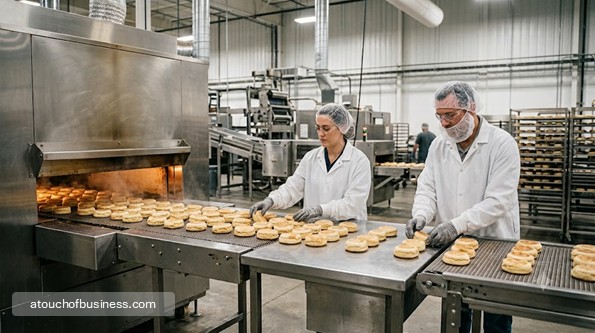
What to Expect From This Guide to Starting an English Muffin Bakery
This guide walks readers through the key decisions and practical steps involved in starting an English muffin bakery, from assessing baking skill and choosing a sales model to testing full-scale production. The highlights below represent only part of its detailed planning coverage.
Inside the guide, you will find:
- Startup roadmap: Follow 15 ordered steps covering business model, demand, product line, kitchen, permits, equipment, pricing, staffing, labels, and testing.
- Bakery interviews: Compare firsthand experiences with product development, customer testing, production spaces, wholesale accounts, equipment limits, and gradual expansion.
- Startup FAQs: Find answers about commercial kitchens, premium pricing, permits, sales channels, equipment, shelf life, and bakery failure risks.
- Business fit: Consider fermentation skill, predawn schedules, physical production demands, household support, financial runway, and alternative entry paths.
- Demand and finances: Test willingness to pay, confirm wholesale interest, calculate per-unit costs, manage waste, and plan break-even and operating capital.
- Production setup: Plan commercial-scale recipes, griddles, mixers, proofing, refrigeration, ingredient suppliers, workflow, staffing, packaging, and payment systems.
- Local and opening checks: Verify zoning, food permits, inspections, allergen labels, insurance, refrigeration, inventory, team procedures, and trial production.
The article begins with the skills, schedule, and income questions that shape whether this specialized bakery model is practical.
There’s something genuinely satisfying about an English muffin made the right way.
As a baker, you cook the dough on a flat griddle — not in an oven — and the result is a round, chewy bread with a crispy exterior and an open, airy interior full of nooks and crannies that form during fermentation, not from additives.
That’s the product that separates a handcrafted English muffin bakery from what’s on the grocery store shelf.
An artisan English muffin bakery can operate through a retail counter, through wholesale accounts with cafes and restaurants, through farmers markets, through pre-order pickup, or through some combination of those channels.
The production process is fermentation-driven, schedule-dependent, and physically demanding — and the business rewards owners who take quality seriously and price their product accordingly.
If that sounds like a fit, here’s how to get started the right way.
Is This the Right Business for You?
Before you lease a space or buy equipment, take some honest time with the fit question.
Running an artisan bakery means early mornings — often starting between three and five o’clock — standing at a hot griddle, lifting heavy bags of flour, and managing a production schedule built around fermentation timing you can’t rush.
It’s physical, repetitive, and skill-dependent work.
Do you have real experience with fermented dough production?
Sourdough starters, high-hydration doughs, and griddle cooking all behave differently than standard baking — and the nooks and crannies your customers will expect come from careful fermentation management, not from a simple recipe swap.
Think honestly about your financial runway as well.
Building a loyal wholesale account base or reliable retail foot traffic takes time. You need enough savings or capital to cover personal living expenses and business operating costs for several months before income steadies.
Does your household support this? Does your family understand the income gap and the schedule?
These aren’t reasons to walk away — they’re questions worth answering before you commit.
One of the most useful things you can do right now is talk to owners of non-competing artisan bakeries — sourdough bread shops, bagel bakeries, artisan roll producers — who understand fermented-dough production at commercial scale.
Ask them about production rhythms, real equipment costs, what customers actually pay, and what they wish they had known before opening.
Prepare your questions in advance, and talk to more than one person. Each owner’s path is different, but firsthand experience is worth more than any planning guide.
You might also think through how you want to enter the business. Starting from scratch gives you full control over your product and identity. Buying an existing bakery with compatible equipment and an established customer base can reduce early risk if the right opportunity exists.
There is no established English muffin bakery franchise system to consider — this is a build-it-yourself path.
Red Flags Before You Start
A few conditions are worth understanding before you go further.
Local demand may not support premium pricing. Your product will cost more than grocery store English muffins — because your ingredients and labor cost more. If your local market isn’t willing to pay a meaningful premium for handcrafted quality, the business model doesn’t work. Test this through a farmers market trial or sampling before committing to a lease.
Wholesale accounts need to exist before you open, not after. If your plan relies on cafes, restaurants, or hotels as your primary revenue channel, talk to those buyers directly before signing a lease or buying equipment. Assumed demand is a significant startup risk in specialty food.
Industrial competitors set the price anchor in the grocery category. Large-scale producers dominate English muffins at the grocery level with pricing an artisan producer can’t match. Your path to viability is through channels that value freshness, quality, and local identity — not through competing on price.
Fresh English muffins have a short shelf life. Without preservatives, your product stays fresh for only a few days. Daily overproduction without a sales outlet creates direct waste losses. Match your production volume to your confirmed orders as closely as possible from day one.
Artisan production is labor-intensive by nature. Fermentation-dependent baking can’t be easily automated at startup scale. Your labor cost — including your own time — is a real and significant factor in every unit you produce.
Startup and build-out costs can be substantial. A licensed commercial kitchen with the equipment this business requires isn’t a small investment. If your capital doesn’t realistically cover the build-out, equipment, permits, and several months of operating expenses, take time to secure stronger funding before moving forward.
Permit timelines take longer than most people expect. Health department inspections, certificates of occupancy, and fire permits can each take several weeks. Build significant time into your pre-opening plan so delays don’t drain your operating capital before your first sale.
Step 1: Assess Your Skills and Fit Honestly
The most useful first step is a clear-eyed look at whether you’re ready — not whether you love English muffins, but whether you can produce them consistently at commercial scale.
The nooks and crannies that define a great English muffin come from fermentation management and dough hydration, not from a shortcut. Inconsistent results show up in every batch, and customers notice.
If you have bread-baking experience — especially with high-hydration doughs, sourdough, or yeasted breads — you have a real foundation to build on.
If you don’t, consider investing time in formal baking education or working in an artisan bakery before opening your own. You’re not behind for wanting to learn — you’re just being realistic about what the product demands.
Also think about the daily pace. You’ll be on your feet for hours, often before dawn, lifting flour bags, managing fermentation schedules, and producing consistent batches under time pressure.
Is that a workday you want to repeat five or six days a week?
Step 2: Choose Your Business Model
Your business model shapes everything that follows — your location, your equipment, your staffing, your production schedule, and your path to break-even.
An English muffin bakery can operate in several ways, and each has a different cost and risk profile.
The main models to consider:
- Retail storefront — You produce and sell directly to customers from your own space. Requires both a production kitchen and a customer-facing counter. More capital-intensive at startup, but gives you direct control over pricing and the customer experience.
- Wholesale food service supplier — You produce in a licensed commercial kitchen and deliver to cafes, restaurants, hotels, and specialty grocers on recurring accounts. No customer-facing storefront required. Consistent volume and reliable delivery are the priorities.
- Hybrid model — Wholesale accounts anchor your revenue, and a farmers market presence or small retail counter builds direct-to-consumer sales alongside it.
- Farmers market and direct-to-consumer — You sell at markets and through pre-order pickup. Lower startup commitment and a practical way to validate demand before taking on a long-term lease.
The farmers market path is a genuinely useful starting point — sampling directly converts buyers, and the feedback you get on product and pricing is hard to replicate any other way.
There’s no single right answer. The best model depends on your capital, your production capacity, your local market, and how you want to spend your time.
Step 3: Validate Local Demand Before Committing
Before you sign a lease or buy a single piece of equipment, find out whether your local market will support this business.
Check whether anyone in your area already sells fresh or artisan-style English muffins — at farmers markets, in specialty grocers, or on local restaurant menus. Understanding what already exists helps you identify the gap your bakery fills.
If you’re planning to focus on wholesale, walk into the cafes, brunch restaurants, hotels, and specialty food stores you’d want as accounts. Talk to the owners and buyers directly.
Ask whether they’d be interested in a local artisan English muffin supplier and what their volume and delivery needs look like.
This isn’t a sales call — it’s a market reality check. You want to know how many accounts you’d realistically need to reach break-even, and whether those accounts actually exist and would work with you.
Understanding local supply and demand before you commit to a location is one of the most important decisions you’ll make in the startup process.
Step 4: Define Your Product Line and Production Approach
Nail down what you’ll produce before you design anything else.
Your core product is traditional English muffins — white, whole wheat, or multigrain. From there, you can build out flavored varieties like cinnamon-raisin, jalapeño-cheddar, or everything-seasoning, and you can offer a sourdough version with a more complex flavor and a deeper nook structure.
The production method choice matters a great deal.
Commercial yeast is predictable and fast. Sourdough takes longer — sometimes significantly longer, with overnight cold fermentation in a retarder-proofer — but it produces the more irregular interior structure and tangier flavor that genuinely differentiates your product from mass-market options.
English muffins are griddle-cooked, not oven-baked. A commercial flat-top griddle is your defining piece of cooking equipment, and temperature control across the cooking surface directly affects how each batch turns out.
Before opening, test your recipe at commercial batch scale. Fermentation timing, dough temperature, and dough hydration all behave differently when you scale from a home batch to a production run. What works for a dozen muffins may need real calibration at 100 or 200.
Decide early whether you’ll sell fresh only, offer frozen options, or both. Frozen product extends your distribution range and reduces daily waste pressure — but it adds packaging and logistics complexity.
Business Plan
Your business plan is where the startup steps, financial realities, and channel decisions come together in one written document.
Before you write it, you need to answer some foundational questions about this specific business.
Break-even is the number that matters most before you commit:
- How many muffins per week do you need to produce and sell — at your target price — to cover all your fixed costs (rent, insurance, utilities, loan payments) and variable costs (ingredients, packaging, labor, delivery)?
- How many confirmed wholesale accounts, or how much reliable retail foot traffic, would you need to reach that number within your first few months?
- Do those accounts or that foot traffic realistically exist in your market?
Understand your margin structure honestly.
Ingredient costs for quality flour, butter, and dairy are higher than for industrial producers. Fermentation-dependent production is time-intensive. Your labor cost — including your own unbillable hours — is a real expense that must be reflected in your price.
An artisan product has to command a premium price. Pricing at or near grocery store mass-market levels doesn’t support an artisan cost structure.
Fresh English muffins have a short shelf life without preservatives. Daily overproduction with no outlet creates direct waste losses. Your plan should account for how you’ll match production volume to confirmed daily orders, especially in the early months.
Plan your operating capital carefully. Have enough capital to cover all recurring expenses for several months while your customer base builds. Running out of operating funds before you reach consistent sales volume is one of the leading causes of artisan bakery closure.
Your business plan should also cover your funding path. Exploring a business loan early gives you time to prepare the documentation lenders require — and most lenders want to see a written plan before approving financing.
Use the business plan to map out your startup cost categories, your break-even calculation, your channel strategy, your production schedule, and your path to first sales.
Step 5: Choose Your Legal Structure and Register the Business
Choosing your legal structure is one of the first formal steps in building the business.
Most small artisan bakery owners choose between a sole proprietorship and an LLC. A sole proprietorship is the simplest structure, but it offers no separation between your personal assets and business liabilities.
An LLC creates that separation — which matters in a food service business where product liability claims are a real exposure.
Once you’ve chosen a structure, register your legal entity with your state’s secretary of state office. If you’ll operate under a trade name different from your legal entity name, you’ll also need to register a DBA.
Next, get your Employer Identification Number (EIN) from the IRS.
An EIN is required if you have employees, operate as an LLC, or open a business bank account. It’s free and takes about 10 minutes at IRS.gov.
Register for sales tax with your state’s revenue or taxation department. Some states exempt certain food products; others tax prepared food differently than packaged goods. Verify how your products are classified in your state before your first sale.
Step 6: Find Your Production Space and Verify Zoning
An English muffin bakery is a commercial food service operation. You need a licensed commercial kitchen — a home kitchen is not an option for this business model.
Your options for production space include:
- Leasing a dedicated commercial kitchen or bakery production space — highest upfront commitment, full control over your space and schedule
- Renting time at a shared commissary kitchen — lower startup commitment; works well for farmers market or pre-order models; verify that your local health department will issue a food service permit from that location
- Building out a leased retail space with a production kitchen and front counter — suitable for a retail storefront model
Verify zoning before you sign anything. Contact your local planning or zoning department and confirm the address is zoned for commercial food production. Zoning problems discovered after you’ve signed a lease are costly and slow to resolve.
For any leased space, confirm the utilities can support your equipment — gas or electric for the griddle and proofing cabinet, adequate ventilation, a three-compartment sink, dedicated handwashing stations, and a grease trap if required locally.
Have a commercial real estate attorney review the lease before you sign. Negotiate tenant improvement allowances if build-out work is required.
Step 7: Apply for All Required Permits and Licenses
Permit processing takes time — often two to eight weeks or longer — so apply early.
For most commercial artisan bakery operations, expect to need:
- A general business license from your city or county
- A food service establishment permit, issued by your local health department after a kitchen inspection
- Food Protection Manager certification for at least one staff member (ServSafe or an equivalent approved by your state) — and food handler cards for all food-handling employees in many states
- A certificate of occupancy from your building department after fire, plumbing, electrical, and building inspections
- A fire department permit, covering your ventilation hood, fire suppression system, and fire extinguisher requirements
- A sign permit, if you’re putting up exterior signage at a retail location
- A dumpster placement permit, if required by your municipality
Specific requirements vary by city, county, and state. Contact your local health department and building department early to get the full list for your location.
Learn more about the general license and permit process if you’re new to commercial business compliance.
If you pre-package English muffins for retail or wholesale sale, FDA food labeling rules apply.
Your product labels must include the product name, net weight, your business name and address, an ingredient list in descending order by weight, and allergen declarations for all major allergens present.
English muffins almost always contain wheat — a major allergen — and often contain milk and eggs as well. Allergen mislabeling is the leading cause of food product recalls. Get your labels reviewed for accuracy before you print them in quantity.
Step 8: Source and Set Up Your Equipment
Match your equipment to your planned production volume before you buy anything.
Undersized equipment creates a production bottleneck. Oversized equipment adds startup cost without adding early revenue. The goal is to be ready for your opening volume, not your hoped-for volume two years from now.
Core equipment for artisan English muffin production:
- Commercial spiral mixer — the preferred choice for high-hydration bread dough; minimizes heat transfer, which protects fermentation quality; a heavy-duty planetary mixer works at smaller batch sizes
- Commercial flat-top griddle — your defining cooking surface; English muffins are griddle-cooked, not oven-baked; even heat distribution across the surface matters for batch consistency
- Proofing or retarder-proofer cabinet — controls temperature and humidity during fermentation and final proofing; a retarder-proofer also allows overnight cold fermentation schedules, which are valuable for sourdough production
- Commercial refrigeration — reach-in units for ingredients and dough retarding; a walk-in cooler makes sense at higher production volumes
- Stainless steel work tables — food-safe, easy to sanitize
- Rolling bakery racks and wire cooling racks
- English muffin rings — stainless steel; hold the round shape during cooking and push the muffin upward rather than outward, which contributes to the interior structure
- Digital scale — weight measurement (not volume) is essential for consistency in bread production
- Three-compartment sink and dedicated handwashing sink — required by health code; separate from each other and from food prep areas
Your local health department may require NSF-certified equipment to pass inspection.
Used equipment can reduce startup cost significantly. Have everything inspected for compliance and safe operation before you purchase it.
Plan your kitchen layout around the production flow: ingredient storage → mixing → fermentation and proofing → griddle cooking → cooling → packaging.
A layout that requires staff to cross paths or backtrack slows production and increases the chance of food safety lapses.
Install and test all equipment before you schedule your health inspection.
Step 9: Set Up Your Ingredient Supply Chain
Your ingredient supply needs to be reliable and consistent before you open.
Your primary inputs are bread flour, butter, milk or water, yeast or a sourdough starter culture, salt, sugar, and cornmeal for dusting during shaping.
Flour is your most important ingredient — and the most volume-sensitive.
For commercial production, wholesale flour suppliers offer bulk pricing on 50-pound bags that significantly reduces your per-unit ingredient cost compared to retail or restaurant supply purchasing. National distributors, regional mills, and specialty flour companies all have commercial programs worth comparing.
If you’re producing sourdough English muffins, your starter needs to be active and producing consistent results well before opening. A healthy sourdough culture takes weeks to develop. Start maintaining one now rather than waiting until your kitchen is ready.
Identify a backup supplier for each core ingredient. A single-supplier dependency for flour or butter is a risk you don’t want to discover mid-production week.
Set up your packaging supplier relationship early as well. You need food-safe bags, clamshells, or bakery boxes that accommodate your required FDA labels, and some packaging suppliers have minimum order quantities that affect how much inventory you need to carry.
Step 10: Open a Business Bank Account and Set Up Payments
Keep your business finances completely separate from your personal finances from your very first transaction.
Open a dedicated business checking account and run all business income and expenses through it. This makes tax reporting straightforward and gives lenders a clean view of your operation if you ever need financing.
Set up a payment processor before you sell your first muffin.
For retail or farmers market sales, you need a card reader that accepts credit and debit payments. For wholesale accounts, you need invoicing software that makes it easy to send, track, and reconcile payments from recurring customers.
Step 11: Set Your Prices Before You Open
Price your muffins based on your actual cost to produce them — not on what grocery stores charge for mass-market products.
Your cost structure is fundamentally different from an industrial producer. Calculate your total cost per unit: ingredients, packaging, your labor and any employee hours, and an overhead allocation (your monthly fixed costs divided by the number of muffins you produce).
That number is your floor. Your selling price needs to be meaningfully above it.
Research what comparable artisan bread products sell for in your local market and channel. Wholesale accounts receive lower per-unit pricing than retail customers, but they provide volume and recurring orders. Retail and farmers market buyers pay more per unit, but volume is less predictable at launch.
Don’t underprice to compete with grocery stores. Customers at farmers markets and specialty food channels understand they’re paying for something different. Cheap pricing signals cheap quality — which is the opposite of what you’re building.
More guidance on pricing your product is worth reviewing before you set your opening rates.
Step 12: Plan Staffing and Assign Production Roles
A solo operation is workable at small production volumes — roughly 50 to 200 muffins per day — but becomes physically limiting as volume grows.
Think through which tasks require real baking skill — mixing, fermentation management, griddle operation — and which can be assigned to less-experienced staff: packaging, labeling, cleaning, and delivery runs.
If you’re bringing on employees, you’ll need to set up state employer accounts for income tax withholding and unemployment insurance, and federal payroll tax accounts with the IRS.
Workers’ compensation insurance is legally required by most states as soon as you hire your first employee. Verify your state’s specific threshold and requirements before your first hire.
Some states also require at least one person on staff to hold a Certified Food Protection Manager credential — like a ServSafe certification. Check with your state health department before opening.
Step 13: Get Your Insurance in Place
A commercial artisan bakery has real liability exposure, and business insurance needs to be in place before you open.
Most commercial landlords require proof of general liability insurance before you sign a lease. Many wholesale accounts require certificates of insurance as a condition of their supplier agreements. Don’t wait until the last minute.
The coverage categories to review for this type of operation:
- Workers’ compensation — legally required in most states if you have employees; covers medical costs and lost wages for work-related injuries; burns, back injuries from lifting flour, and repetitive strain are the most common claims in bakery operations
- Business Owner’s Policy (BOP) — bundles general liability and commercial property insurance; the standard starting point for a retail or production bakery
- Product liability — covers claims from customers alleging illness or injury from consuming your product; allergen reactions are the most common trigger; confirm this is included in your policy or BOP
- Equipment breakdown coverage — covers repair or replacement when your griddle, mixer, proofing cabinet, or refrigeration fails; often added as an endorsement to a BOP
- Spoilage coverage — covers lost ingredients or packaged product after a covered event like a power outage or refrigeration failure
- Commercial auto insurance — required if you use a vehicle for wholesale deliveries; personal auto policies exclude commercial use
Step 14: Develop Your Packaging and Labels
Your packaging and labels need to be ready before your first sale — not after.
All pre-packaged food sold to consumers in the U.S. must meet FDA labeling requirements. Your label needs to include the product name, net weight, your business name and address, an ingredient list in descending order by weight, and a clear declaration of all major allergens.
The nine major allergens — including wheat, milk, and eggs, which are common in English muffins — must be declared on the label. There are no exceptions.
If you’re selling pre-packaged product at retail or through wholesale accounts, a Nutrition Facts panel is generally required. Products sold for immediate on-site consumption may qualify for an exemption, but verify that with your local health department and FDA guidance before assuming it applies to your situation.
Have your labels reviewed for compliance before you print them in quantity. A label error can require a product recall, and allergen mislabeling is one of the most common causes of food recalls across the bakery category.
Step 15: Test Everything Before You Open
Run full commercial-scale production batches before you serve or deliver to a single customer.
This is where you find out whether your fermentation timing, griddle temperature management, and batch-to-batch consistency hold up under real production conditions.
Walk your full workflow with your intended staff — from ingredient receiving through mixing, proofing, cooking, cooling, packaging, and labeling. Time every stage. Identify where the flow breaks down before customers are watching.
Confirm all permits, inspections, and licenses are finalized before opening day.
Then run a soft opening — a trial farmers market day, a limited set of wholesale trial orders, or a limited retail day — before your official launch. Real production pressure reveals issues that planning never does.
Opening-Day Red Flags
A few things should give you pause before your first real production day.
Recipe inconsistency across batches at full scale. If your muffins are producing uneven nook structure, over- or under-browning on the griddle, or varying textures between batches, you need more calibration time — not a faster opening date. Consistency is what builds repeat wholesale accounts and loyal retail customers.
Fermentation timing hasn’t been dialed in for your kitchen. Temperature, humidity, and starter strength all affect fermentation speed. Your production schedule in practice may differ from what it looked like during testing. Know how your kitchen’s conditions affect your dough before production orders depend on it.
Any required permit or inspection is still pending. Don’t open until all permits are in hand. Operating without a valid food service establishment permit puts everything at risk.
Ingredient stock isn’t sufficient for your first week. Confirm your flour, starter or yeast, dairy, cornmeal, and packaging materials are in stock before day one. A supplier delay in your first week is a preventable disruption.
Wholesale accounts haven’t confirmed first orders. If wholesale is your primary revenue channel, open with at least one or two confirmed trial orders rather than assuming interest will convert to orders once you’re producing.
Your refrigeration hasn’t been temperature-tested under load. Cold storage that can’t maintain safe temperatures under a full ingredient load is a food safety problem and a health code violation. Confirm it before production begins.
Your team hasn’t run through allergen handling procedures. Every person involved in production should understand your allergen management process before the first batch. Wheat is always present in English muffins, and cross-contact with other allergens is a real risk in a shared preparation environment.
Frequently Asked Questions
Do I need a commercial kitchen to start an English muffin bakery, or can I use my home kitchen?
For a food service business selling to the public — including wholesale accounts, restaurants, cafes, and most retail channels — you need a licensed commercial kitchen.
Cottage food laws allow some home bakers to sell certain low-risk items with restrictions, but an English muffin bakery operating as a food service business is not a cottage food operation.
You must have a licensed commercial production kitchen and a food service establishment permit issued after a health department inspection. Options include leasing your own kitchen, renting time at a commissary, or building out a leased retail space.
What makes artisan English muffins different from grocery store products, and will customers pay more for them?
The nooks and crannies that define a good English muffin come from fermentation, not additives. Artisan producers use longer fermentation times — sometimes overnight cold retards or sourdough cultures — and cook on a griddle to develop the crust and interior texture that mass-market products can’t replicate at speed.
Whether your local market will pay a meaningful premium for that difference depends on your specific area and sales channel. Validating willingness to pay through a farmers market trial or sampling before committing to a location is the most reliable way to find out.
What permits and licenses do I need before I can sell English muffins?
At minimum, expect to need a general business license, a food service establishment permit after a health department inspection, food protection manager certification for at least one staff member, a certificate of occupancy for your commercial space, a fire department permit, and a sales tax permit.
If you pre-package your product for retail or wholesale, FDA-compliant labels are also required before the first sale. Specific requirements vary by city, county, and state — contact your local health department and building department early to get your complete list.
Should I focus on retail sales, wholesale accounts, or farmers markets at launch?
It depends on your production capacity, your capital, and your local market. Wholesale accounts provide predictable recurring revenue but require consistent volume and reliable delivery. A retail storefront requires a well-located space with real foot traffic. Farmers markets are lower commitment, allow direct customer feedback, and serve as a useful proving ground before expanding.
Many successful English muffin bakeries use a combination — a wholesale anchor with a direct-to-consumer channel alongside it for margin and brand-building.
How do I price English muffins to make the business work?
Start by calculating your total cost per muffin: ingredient cost plus packaging plus labor (including your own time at a realistic hourly rate) plus an overhead allocation of your monthly fixed costs across your total production volume. That gives you your floor.
Add a margin above that floor. Artisan English muffins are a premium product with a premium cost structure. Don’t price by comparing to grocery store mass-market products — your costs are fundamentally different from an industrial producer.
What are the most important pieces of equipment to buy first?
The essential equipment for English muffin production is a commercial spiral mixer for high-hydration dough, a commercial flat-top griddle as your primary cooking surface, a proofing or retarder-proofer cabinet for fermentation control, commercial refrigeration, stainless steel work tables, English muffin rings for shaping, a digital scale, and sanitation infrastructure including a three-compartment sink and a dedicated handwashing sink.
Your local health department may require NSF-certified equipment to pass inspection. Used equipment can reduce startup cost but needs to be inspected for compliance before purchase.
How should I handle the short shelf life of fresh English muffins?
Fresh artisan English muffins without preservatives stay fresh for only a few days at room temperature. Match your daily production volume to confirmed orders as closely as possible to limit waste.
Pre-order-based production, frozen product options, and wholesale accounts with recurring daily or weekly orders all help solve the perishability challenge by making production more predictable.
What are the biggest risks that cause small artisan bakeries to fail?
The most common issues are running out of operating capital before reaching consistent sales volume, underpricing below the cost of production, and inconsistent product quality — especially critical for fermentation-dependent products like English muffins.
Choosing a location without validated demand, and underestimating the business management side of the operation — food cost tracking, scheduling, equipment maintenance, and cash flow — are also significant contributors. The baking skill is necessary, but it isn’t sufficient on its own.
Expert Advice From People in the English Muffin Bakery Business
These interviews share firsthand lessons about developing a distinctive English muffin, testing customer demand, finding production space, attracting wholesale buyers, and increasing output without losing product quality.
Readers can use these experiences to compare startup approaches, identify production challenges, and decide whether to begin with local restaurants, farmers’ markets, direct sales, or retail distribution.
This Rapper’s Non-Musical Side Hustle Led to $100k a Month — Then 8 Figures
Stone & Skillet co-founder Cam Meekins explains how the company began with a mixer, flour, apartment production, restaurant deliveries, and farmers’ market sales before entering major retailers.
This interview is useful for learning how to test a product inexpensively, build industry relationships, find knowledgeable team members, and turn small opportunities into larger distribution deals.
Denise Weale & Olivia Weale, Co-Founders of Dam Good English Muffins
Denise and Olivia Weale discuss how their family business developed from making sourdough English muffins for friends into a commercial operation producing at a much larger scale.
This interview helps prospective owners understand gradual growth, family partnerships, production expansion, community involvement, and the value of building a business around a clear mission.
Bakery Bees: Great Company Served Sunny Side-Up at Vinal Bakery
Vinal Bakery owner Sarah Murphy describes changing careers, gaining experience in several bakeries, writing a business plan, testing English muffins, and choosing a specialized product line.
This interview is useful for learning how industry experience, small product tests, careful menu decisions, and a focused bakery concept can reduce uncertainty before opening.
Pete Merzbacher Brings an Artisan’s Take to a Simple Pleasure
Pete Merzbacher explains how he started baking while employed elsewhere, gave away samples, gained paying customers, rented another business’s kitchen, and developed his signature Philly Muffin.
This interview provides practical ideas for starting with limited resources, finding suitable production space, choosing compatible wholesale customers, and balancing local products with wider distribution.
Legendary Napa Valley Baker Perfects Pillowy English Muffins, Artisan Pastries
Model Bakery owners Karen Mitchell and Sarah Mitchell Hansen discuss purchasing a bakery, developing their English muffin through experimentation, expanding wholesale sales, and adapting equipment for higher production volumes.
This interview is useful for understanding bakery acquisition, financing, product development, equipment limitations, wholesale growth, and the operational adjustments required when demand exceeds expectations.
Related Articles
- How To Start a Bakery
- How To Start a Bagel Shop
- How To Start a Donut Shop
- How To Start a Kosher Bakery
- How To Start a Cookie Business
- How To Start a Cake Decorating Business
Sources:
- Sunflour Baking Company: English muffin sourdough production guide
- King Arthur Baking: English muffin nooks and fermentation
- Baking Steel: Griddle cooking and fermentation method
- Grokipedia: English muffin production and market history
- Vinal Bakery: English muffin café business model example
- The Model Bakery: Artisan English muffin bakery example
- Michael’s English Muffins: Multi-channel English muffin bakery example
- Snack Food & Wholesale Bakery: Artisan English muffin wholesale/online model
- Atlantic Food Equipment: Bakery business model and equipment overview
- WebstaurantStore: Bakery startup planning and equipment, Bakery business model types
- GoFoodService: Commercial bakery equipment sizing
- EM Bakery Equipment: Spiral vs. planetary mixers for bread dough
- Sambake: Commercial proofing cabinet types and use
- Wolters Kluwer: Bakery license and permit requirements
- Toast POS: Bakery licenses and permits overview
- ZenBusiness: Bakery licensing and zoning compliance
- KaTom Restaurant Supply: Commercial kitchen code and permit requirements
- Cloud Kitchens: Zoning and certificate of occupancy for food production
- FDA: Food allergen labeling requirements, FDA Food Labeling Guide
- Blue Label Packaging: Nutrition Facts exemptions for food businesses
- NC State Extension: Allergen labeling requirements overview
- OSHA: Bakery equipment safety standard
- OSHA Safety Manuals: Bakery workplace safety practices
- NerdWallet: Bakery insurance coverage overview
- MoneyGeek: Bakery insurance requirements and types
- The Coyle Group: Bakery insurance COI and liability requirements
- Bakers Authority: Wholesale flour options for commercial bakers
- King Arthur Baking (Pro): Commercial flour distribution network
- Bakery Business Boss: Bakery distribution strategy overview
- FindLaw: Bakery legal and business planning overview
- Packaging World: Fresh English muffin shelf life and packaging
- Artisan Bakery Market / BusinessResearchInsights: Artisan bakery structural challenges and competition
- Business Dojo: Mass-market artisan-style competition dynamics
- Baking Subs: Farmers market pricing and product strategy