
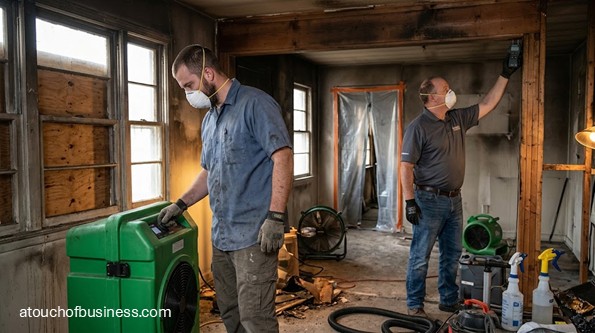
What to Expect From This Guide to Starting a Fire Damage Restoration Business
This guide walks you through the key decisions and practical steps involved in starting a fire damage restoration business, from weighing personal fit through licensing, equipment, and financial planning. The highlights below point to some of what’s covered, not the full picture.
Inside the guide, you will find:
- Startup steps: A numbered sequence moving from evaluating fit through licensing, equipment, staffing, and final opening preparations.
- Business fit: Honest questions about the physical demands, unpredictable hours, and income uncertainty this work involves.
- Market demand: Guidance on sizing up local competition and the types of fire damage common to your area.
- Local requirements: Coverage of licensing, certification, lead and asbestos compliance, and insurance needs tied to your scope of work.
- Financial planning: How to think through pricing, margins, and break-even numbers before committing money.
- Risks and warnings: Red flags to weigh before starting and checks to confirm before taking your first job.
- Common questions: Answers on certification, staffing, equipment choices, and operating capital.
Start by considering whether this hands-on, insurance-driven business fits your goals and everyday circumstances.
Is a Fire Damage Restoration Business Right for You?
As a fire damage restoration business owner, you help property owners recover after a fire.
The job covers cleaning soot, removing smoke odor, and often rebuilding what was lost.
The steps ahead follow the general process most new businesses go through, applied specifically to fire restoration.
Most jobs start with an urgent call, not a scheduled estimate.
You or a technician show up, assess the damage, and begin working with the property owner’s insurance company almost immediately.
A morning call about a small kitchen fire can turn into two more site visits.
The adjuster asks for photos of hidden smoke damage behind the cabinets.
The estimate has to be revised before the job can start.
Ask yourself honestly whether fire restoration work fits your life, not just your interest in the industry.
Fire restoration means physically demanding labor in soot and ash.
It also means unpredictable emergency hours, day or night.
You’ll also work directly with property owners on some of the worst days of their lives.
Before you commit, think through your household’s ability to handle income uncertainty during the startup period.
Early cash flow can be uneven, since insurance payments often arrive well after a job is finished.
Talk with restoration business owners in other markets before you commit any money.
Choose owners who won’t compete with you directly.
Prepare specific questions in advance.
Ask about staffing, equipment reliability, and how long it really takes to get paid after a job wraps up.
Firsthand insight from people who have already built a business like this is worth more than general startup advice.
You also have real choices in how you enter this business.
Starting independently gives you full control but no built-in reputation.
Buying an existing restoration company can hand you trained staff, working equipment, and insurance-adjuster relationships already in place.
Franchising is common in this industry and can provide training and a recognized name.
It comes with its own rules and fees, so weigh those carefully.
Weigh these paths against your available capital and how quickly you need referral relationships in place.
Think early about who your first fire restoration customers will actually be and why they would call you.
Most new companies in this field win early work through direct relationships, not insurance company vendor lists.
Red Flags Before You Start
Some challenges in fire restoration work are structural, not personal failures.
Understanding them helps you plan realistically.
Watch for these signs before you invest heavily:
- Equipment, vehicles, and warehouse space all cost money before your first paying job arrives.
- Insurance payments often arrive well after labor and materials are paid for, straining cash flow.
- New companies typically can’t join insurance preferred-vendor networks right away, since those programs usually require a track record first.
- State licensing rules for contracting, mold, and asbestos work vary widely and can delay you from taking certain jobs.
- Taking on reconstruction work without the right license can void a homeowner’s insurance claim and expose you to real liability.
The restoration industry has also seen heavy consolidation, with larger regional and national companies buying up independent operators.
Several established franchise brands already have insurance-carrier relationships built into their networks in many markets.
That doesn’t mean you can’t compete — it means your early growth will likely depend more on local relationships than name recognition.
None of this should scare you away from the business.
It should shape how much capital you set aside and how you plan your first months of customer outreach.
Step 1: Validate Local Demand and Study Your Competition
Before spending on fire restoration equipment or licensing, get a clear picture of your local market.
Look at how many restoration companies already serve your area.
Note whether large regional or franchise brands already dominate locally.
Consider what kinds of fires are common where you live.
Older housing stock, heating-related fires, and wildfire exposure all shape local demand differently.
Check local supply and demand for restoration services before committing to a specific service area.
Step 2: Choose Your Business Model and Legal Structure
Decide early whether you’ll offer mitigation-only work — cleaning, drying, and deodorizing — or full-service work that includes reconstruction.
This choice affects your licensing needs, staffing, equipment, and which insurance-referral channels are realistically open to you.
Once you’ve decided, choose your business structure and register your business.
You’ll also need an Employer Identification Number from the Internal Revenue Service.
Register a DBA too, if you operate under a different business name.
Step 3: Sort out Licensing and Core Certifications
Verify whether your state requires a general contractor license for your planned scope of work.
Mitigation-only work is treated differently than reconstruction in many states.
Confirm this before committing to either business model.
Some states also require separate licensing for mold remediation or asbestos supervision.
Both can come up unexpectedly on a fire scene.
Complete core industry training as well.
At minimum, get Fire and Smoke Restoration Technician certification through the IICRC, the industry’s main certifying body.
If you’ll also handle water intrusion from firefighting efforts, Water Damage Restoration Technician training is commonly paired with it.
Step 4: Handle Lead and Asbestos Compliance Before You Take Older Properties
If your crews will work in homes built before 1978, federal rules require Lead-Safe certification before you disturb painted surfaces.
This applies to firms and individuals, and penalties for skipping it can be severe.
Fire scenes involving demolition or major renovation can also trigger asbestos inspection requirements under federal law.
Build a simple internal check into your process.
Confirm a structure’s age and any known asbestos risk before your crew starts tearing anything out.
Step 5: Line up Insurance, Banking and Operating Capital
Secure the insurance coverage you actually need before taking your first job.
Most states legally require workers’ compensation once you have employees — verify your specific state’s threshold.
General liability and commercial auto coverage aren’t always legally required.
Most clients and insurance programs expect to see them anyway.
Review business insurance options with a broker familiar with restoration work.
Open a dedicated business bank account.
Set up a way to receive direct insurance-company payments too.
Plan your operating capital specifically around the gap between finishing a job and getting paid for it.
This gap is where many restoration startups run into real trouble.
Step 6: Secure a Workspace Built for Field Work
Most operators need a small office paired with light-industrial or commercial storage space, not a retail storefront.
You’ll need room for equipment, vehicles, and contents pack-out storage when a job requires removing a customer’s belongings.
Confirm local zoning allows this kind of use before you sign a lease.
Home-occupation rules in residential zones often restrict equipment storage and vehicle parking, so a home base rarely works long-term.
Step 7: Build Your Equipment and Vehicle Fleet
Your fire restoration equipment list splits into a few functional categories: assessment tools, protective gear, cleaning equipment, and air-treatment systems.
Assessment tools include moisture meters, a thermal imaging camera, and a carbon monoxide monitor.
Protective gear includes coveralls, respirators, gloves, and eye protection — with stronger respiratory protection required if asbestos is suspected.
Cleaning equipment ranges from HEPA vacuums to dry ice or soda blasting systems for removing char from wood and masonry.
Air-treatment equipment includes air scrubbers, ozone generators, and hydroxyl generators for odor control.
Ozone requires the space to be empty during use, while hydroxyl generators don’t.
You’ll also need at least one cargo van or truck equipped to haul equipment between job sites.
A crew setting up containment for a soda-blasting job once found a locked electrical panel that needed a licensed electrician first.
The half-day delay pushed the next scheduled site visit back, a reminder that jobsite conditions rarely match the estimate exactly.
Step 8: Set up Estimating Software and Supplier Relationships
Most insurance adjusters are trained on standardized estimating software, most commonly Xactimate, so learning it early smooths your claims process.
Set up accounts with chemical and cleaning-supply vendors before your first job, not after.
If you won’t handle reconstruction in-house, line up licensed subcontractors for electrical, plumbing, and structural repair work ahead of time.
Step 9: Set Your Pricing Approach
Insurance-funded work is generally priced through standardized estimating databases that most adjusters already recognize.
Private-pay work gives you more flexibility, but base it on your real local labor, equipment, and material costs — not a guess.
List everything a typical job requires, then price it out locally rather than relying on a single formula.
Step 10: Build Your Launch-Stage Customer Attraction Plan
Your first customers are unlikely to come from insurance company preferred-vendor programs.
Those networks typically require an established track record before they’ll refer work to you.
Instead, plan around direct relationships: local insurance agents, plumbers, roofers, property managers, and word of mouth from early jobs done well.
Being available and responsive around the clock matters more early on than any marketing campaign.
Step 11: Set up Business Identity and Bring on Your Crew
Before launch, settle on your business name.
Set up a phone line that can be reached at any hour.
Add basic signage for your vehicles too.
A simple website with contact information is enough at first — it doesn’t need to be elaborate.
If you’re hiring, bring technicians on and complete their IICRC and safety training before their first job, not during it.
Step 12: Build Your Safety Program and Test Your Workflow Before Launch
Put together a written hazard communication plan and PPE protocol matched to the hazards your crew will actually face.
Federal rules require this training to happen before exposure, not after a problem shows up.
Document a simple process for handling suspected asbestos or lead paint if it turns up mid-job.
Run a full test of your workflow — from the first call to documentation and equipment deployment — before you market yourself as open.
Business Plan
Turning everything above into a working plan means putting your numbers and decisions on paper, not carrying them in your head.
Map out your fixed costs — lease, vehicle payments, insurance, and any minimum staffing.
Weigh those costs against realistic job volume for your area.
Factor in the gap between finishing a job and getting paid.
That timing gap is one of the most common reasons restoration startups run short on cash.
Profit potential in fire restoration work isn’t uniform across every job type.
Mitigation work — cleaning, drying, and deodorizing — generally carries a wider margin than reconstruction.
Reconstruction involves more materials and subcontractor costs, which narrows the margin.
If you plan to offer both, think through how much revenue you expect from each.
That mix directly affects your break-even point.
Calculate your own break-even sales volume using your real local costs, not a number pulled from another market.
Ask how many jobs of what size you need each month to cover your fixed costs before you’re making any profit at all.
Also plan for slow stretches, since fire calls aren’t evenly spread through the year.
A quiet month shouldn’t catch you without a cushion.
Review how to write a business plan to put these pieces into a document you can actually use.
Opening-Day Red Flags
Before you take your first fire restoration job, a few pre-opening issues are worth double-checking.
Confirm these before you say yes to your first customer:
- Your contractor license and any required mold or asbestos certifications are active, not just applied for.
- Your insurance certificates — general liability, workers’ compensation if you have employees, and commercial auto — are in hand.
- Your equipment inventory actually matches the scope of work you’re advertising.
- Your estimating software account is set up and you know how to use it under pressure.
- Your crew has completed safety training before stepping onto a real job site.
A pack-out day once ran long when a homeowner needed extra time deciding what to save from a damaged room.
The truck sat half-loaded past its scheduled return time, pushing the day’s next site visit later than planned.
Small scheduling slips like this are common in field-based work.
They add up fast if your calendar has no buffer built in.
Build some flexibility into your first weeks rather than booking back-to-back jobs with no room for delay.
Frequently Asked Questions
Is IICRC certification enough to operate legally?
No. IICRC certification is an industry credential specific to restoration work, not a government license.
Most states still require you to verify contractor licensing separately, especially once your work includes reconstruction.
Can I start this business without a dedicated warehouse?
At a very small scale, yes — some owners start with a garage or a small storage unit.
As your equipment list and contents pack-out volume grow, most operators outgrow that setup and need light-industrial or commercial space.
Can I run this business solo, at least at first?
It’s possible for very small jobs, but real fire losses usually need more than one set of hands.
Structural demolition, equipment placement, and contents handling on a real job are hard to manage alone.
Round-the-clock availability is also difficult to sustain solo.
How much operating capital is actually enough before I open?
There’s no single number that fits every market or business model.
The right amount depends on your fixed costs and how long insurance payments typically take to arrive in your area.
Map both before deciding on a number.
Should I buy new equipment or used equipment?
Both are workable options, with no single right answer for every business.
New equipment usually comes with warranty coverage and more reliability.
Used equipment lowers your entry cost, if it’s available locally.
Should I get IICRC Certified Firm status before or after my first job?
This depends on what local insurance-referral sources expect to see in your market.
In some areas, having certified-firm status in place before your first job helps with early credibility.
In others, it matters less at the very start.
Interviews with Fire Damage Restoration Professionals
These interviews share firsthand perspectives from restoration business owners and professionals with experience in fire, smoke, water, catastrophe, and property damage work. They cover business development, training, emergency response, customer relationships, insurance work, staffing, and operating challenges.
Readers considering this business can use the interviews to understand both the technical and business demands of restoration work before committing resources, pursuing training, or developing their service model.
5 Questions with Barry Swidler
Barry Swidler, a fourth-generation owner of American Fire Restoration, discusses lessons from his career, changes in the restoration industry, certification, documentation, insurance challenges, training, and professional standards.
This written interview is useful for understanding how training, documented processes, insurance considerations, and adaptability affect the long-term operation of a fire restoration company.
Flood and Fire Recovery with Steve Flower
Restoration business owner Steve Flower discusses his career transition, the development of Restoration One, emergency response, fire and smoke restoration, customer communication, reliability, and day-to-day restoration work.
The discussion gives prospective restoration operators a useful look at the importance of fast response, communication, customer trust, and handling people who are dealing with property damage and stressful circumstances.
Rusty Amarante: Four Decades in Restoration
Rusty Amarante discusses his progression from owning a small cleaning and restoration company to becoming a senior restoration executive. Topics include entering the industry, building a strong staff, client relationships, project financing, business stress, expansion, and eventually selling his company.
His experience highlights issues that can be easy to underestimate before entering restoration, particularly working-capital demands, staffing, industry education, relationships, and the financial pressure created by growing a restoration company.
Scaling CAT Restoration Services with Avelina Lamb
PuroClean owner Avelina Lamb discusses expanding catastrophe restoration services and draws on work involving hurricanes as well as fire and smoke damage following Colorado wildfires. She covers preparation, insurance adjusters, local customer expectations, and collaboration with other restoration operators.
The interview is useful for understanding the preparation and coordination required when a restoration company takes on catastrophe work beyond its normal market, including relationships with adjusters and other restoration businesses.
Chad Mallonee’s Journey into Restoration
Hazard Clean Restoration founder Chad Mallonee explains how experience with a family cleaning business helped lead him into restoration. He discusses learning restoration fundamentals, pursuing industry certifications and advanced training, and providing water, fire, mold, and biohazard services.
This interview is particularly useful for someone considering how to enter the field because Mallonee describes the progression from an existing cleaning operation into specialized restoration work and the training he pursued as his services expanded.
Restoration Hope with Kirk Hopkins
Kirk Hopkins, general manager of a family fire and water restoration business, discusses customer service during major property losses, working with insurance companies, and keeping the homeowner’s needs central to the restoration process.
The interview helps prospective operators see how customer positioning can differentiate a restoration company and how restoration work may involve coordinating insurance-funded repairs while helping property owners make decisions during reconstruction.
Immaculate Restoration with Steve Pieri
Steve Pieri discusses his 28-year business journey from carpet cleaning to operating a broader disaster restoration company handling fire, water, and other emergency losses. The conversation also covers technology, operational efficiency, employee support, and lessons from his earlier years in business.
His experience is useful for readers interested in how a service company can evolve into restoration work and how efficiency, technology, staff management, and customer support become important as the operation develops.