
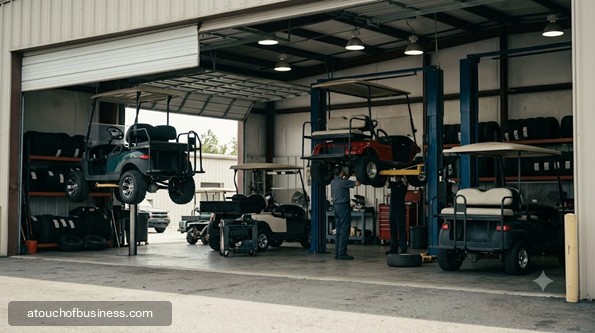
What to Expect From This Guide to Starting a Golf Cart Repair Shop
This guide walks you through the key decisions and practical steps involved in starting a golf cart repair shop, from evaluating the idea to preparing the shop to open. The highlights below represent only part of the planning detail included.
Inside the guide, you will find:
- Startup steps: Move from assessing your skills and local demand through planning, setup, staffing, and pre-opening checks.
- Industry interviews: Compare first-hand experiences involving repairs, parts, restoration, seasonal demand, service models, and business pressures.
- Startup FAQs: Review concise answers about training, space, battery disposal, insurance, billing, fleet accounts, and vehicle classifications.
- Business fit: Consider technical ability, physical demands, changing cart technology, household finances, and the realities of running a repair shop.
- Market and services: Evaluate local demand, competitors, target customers, service options, supported brands, and possible fleet accounts.
- Financial planning: Work through fixed costs, break-even targets, labor rates, parts margins, operating capital, and seasonal slow periods.
- Setup and safeguards: Plan the location, equipment, inventory, software, local requirements, insurance, warning signs, and opening preparations.
Begin by deciding whether the technical, financial, and day-to-day demands of this shop match your skills and circumstances.
As a golf cart repair technician, you diagnose problems, source parts, and restore carts to working condition — all from a fixed workshop where customers drop off their vehicles and return for pickup. The work is hands-on, detail-oriented, and increasingly technical as the industry moves from lead-acid battery packs toward lithium systems and programmable electronic controllers.
Golf carts are used far beyond golf courses. Retirement communities, gated neighborhoods, beach towns, resorts, campuses, industrial facilities, and event venues all rely on cart fleets for short-distance transportation. That broad base of ownership creates a real service market for skilled independent repair operators.
Before you commit time and money, be honest with yourself about what this business actually requires. Do you have strong hands-on mechanical skills and, critically, a solid foundation in DC electrical diagnostics? The majority of repair work in most markets involves battery packs, chargers, speed controllers, and wiring — not just wrenches. If your background is purely mechanical and you’ve never worked with DC electrical systems, that’s a gap you need to close before opening day.
Think about the financial reality, too. Starting a shop requires meaningful upfront investment in space, equipment, parts inventory, and insurance — before a single paying customer walks in. Can your household manage the income gap between launch and the point where revenue is reliable?
Do you have enough capital not just to open, but to stay open while your customer base builds?
Talking to people who already run golf cart repair shops — in markets where you won’t compete with them — is one of the most valuable things you can do before you start. Ask them what surprised them, what they wish they’d known, and how long it took to reach steady income.
You should also think about whether to start from scratch or buy an existing shop. An established operation may come with equipment, inventory, supplier accounts, and a ready customer base. Starting fresh gives you full control but requires building everything from zero. Some franchise opportunities exist in the golf cart service space, so it’s worth checking whether a franchise model is available in your target market before deciding.
The startup steps below follow a practical order. Each one builds on the last. Don’t skip ahead to equipment or leases until you’ve validated demand and confirmed the business model makes sense for your market.
Red Flags Before You Start
Some conditions should make you pause, change your plan, or reconsider entirely before committing.
Watch for these warning signs:
- No real customer base nearby. A golf cart repair shop needs proximity to golf courses, retirement communities, resorts, or gated neighborhoods. If your area has none of those, repair volume won’t support a dedicated shop.
- The market is already well served. If established repair shops, active dealer service departments, and mobile technicians already cover the area, breaking in as a new competitor will be difficult and margin-compressing.
- Electrical skills are weak. Most repairs today involve DC electrical systems, battery management, and programmable controllers. An owner who can’t diagnose electrical problems isn’t prepared for this market.
- No familiarity with lithium battery technology. The market is shifting away from lead-acid packs. Shops where no one can service lithium systems or install lithium conversions will lose a growing share of repair work.
- Parts availability gaps for certain brands. Some newer imported brands have inconsistent parts supply chains. Commit to servicing a brand only after verifying you can reliably source parts for it.
- Startup capital is too thin. You need enough funding not just to open the shop, but to survive the ramp-up period while your customer base builds. Undercapitalization closes service businesses in their first year.
- Strong seasonality in your market. In colder northern climates, golf cart use drops sharply in winter. Your financial plan must account for slow months and the capital needed to survive them.
Two structural conditions apply to this business regardless of how well you execute.
First, golf cart parts are widely sold online directly to cart owners at near-wholesale prices. Customers who want to buy a part and attempt the repair themselves will do so. The shops that keep customers are the ones that compete on expertise and diagnostic accuracy — not just parts access.
Second, this business is capital-intensive before it earns anything. Equipment, inventory, insurance, and space all require investment upfront. That structural reality demands serious financial planning before you sign a lease or order tools.
Step 1: Assess Your Skills and Fit
Running a golf cart repair shop requires both technical ability and the temperament to manage a service operation.
On the technical side, you need hands-on proficiency in DC electrical diagnostics, battery testing and replacement, speed controller and motor troubleshooting, brake and suspension service, and gas engine repair for older carts.
You also need to be comfortable with the business side: writing repair orders, managing parts inventory, handling customer vehicles with care, dealing with battery-related hazardous materials, and running a shop facility day to day.
The physical demands are real. Lead-acid battery packs are heavy — some weigh well over 50 pounds — and you’ll be lifting, positioning, and handling them routinely. Standing, bending, and working under a lift for long stretches is the norm.
Ask yourself honestly: Are you prepared to keep learning? The shift from lead-acid to lithium packs and from analog to programmable digital controllers is ongoing. Staying current with the technology isn’t optional — it’s how you stay relevant to customers.
If you have a background as an automotive technician, small engine mechanic, or electrician, you have a strong foundation. Prior golf cart experience is a genuine advantage, but it’s not the only path in — provided you’re willing to close the gaps before you open.
Step 2: Talk to Golf Cart Repair Shop Owners
Before you spend money, talk to people who already run golf cart repair shops in markets where you won’t compete with them.
Prepare specific questions before those conversations. Ask about realistic daily repair volume, their most frequent jobs, how they handle parts availability for newer brands, and what surprised them about running a shop.
Ask what they know now that they wish they’d known at startup — about location, inventory levels, insurance, slow seasons, and what it actually takes to build a fleet account relationship.
Their answers won’t all be the same, and every owner’s path is different. But firsthand experience from people doing this work is something no article can replicate.
Step 3: Validate Local Demand
Demand for golf cart repair concentrates in specific markets. Before choosing a location, map what’s actually nearby.
Strong demand indicators include:
- Golf courses (public and private) within a reasonable service radius
- Retirement communities and age-restricted neighborhoods
- Gated communities, beach towns, and resort properties
- College campuses and industrial or commercial facilities with cart fleets
If your target area has several of these, demand is likely sufficient to support a dedicated shop.
Next, look at the competitive landscape. Search for golf cart repair shops, dealer service departments, and mobile repair operators already working in the area. Visit golf course superintendents and pro shop managers in person and ask whether current service is reliable or whether they’re frustrated with long waits and poor quality.
In plain terms: local demand validation is your go/no-go check. A technically skilled owner in the wrong market will still struggle. A less polished shop in a market with real unmet demand has a much better chance.
Also factor in seasonality. In warm-climate markets — the Southeast, Southwest, and coastal communities — demand runs year-round. In northern markets, cart use drops significantly in winter. Understand which situation applies to you before you commit to a lease.
Step 4: Decide on Your Business Model
The core model for this article is shop-based repair: customers drop off their carts, you diagnose and fix them in the shop, and customers return for pickup. But several important decisions branch off from there before you spend a dollar on space or equipment.
Decisions to make before you go further:
- Pickup and delivery: Golf carts can’t drive on public roads in most areas, so many owners can’t easily get their cart to you. Offering pickup and delivery — even for an added charge — removes a major barrier and expands your reachable customer base.
- Parts and accessories retail: Will you sell parts and accessories to customers, or focus only on repair? Retail parts add startup inventory cost and complexity, but also add revenue.
- Cart refurbishment: Buying damaged or dead carts, restoring them, and reselling them can fill slow periods and add income. It requires capital to purchase carts and space to store them while you work.
- Which brands you’ll service: The three dominant brands are Club Car, E-Z-GO (EZGO), and Yamaha. Newer brands — ICON, Evolution, Advanced EV, Denago, and others — are growing. Some have limited parts networks. Decide which brands you’ll commit to servicing, and make that clear to customers at launch.
- Which repairs you’ll offer: Battery service, electrical diagnosis, motor and controller replacement, tire and brake work, lift kit and accessory installation, and preventive maintenance are all options. Define your service scope before you build the shop around it.
These decisions shape everything that follows: what space you need, what tools to buy, what inventory to stock, and who your customers will be.
Step 5: Start From Scratch, Buy, or Franchise?
You have at least three paths into this business, and it’s worth thinking through each one before defaulting to starting from scratch.
Buying an existing golf cart repair shop can give you immediate advantages: established customer relationships, existing equipment, stocked parts inventory, supplier accounts, and documented revenue history — all of which make financing easier to obtain.
The risks are the seller’s deferred maintenance, aging equipment, a lease that may not favor you, and the possibility that the customer base leaves when the owner does.
Starting from scratch gives you full control over location, service menu, shop layout, brand, and culture. The tradeoff is that you build everything from zero, including your customer base.
Franchise options exist in the golf cart service space, though they’re limited. A franchise may offer brand recognition, training, supplier relationships, and operational systems. Check whether any viable franchise model operates in your target market before ruling it out.
The right path depends on your budget, your timeline, how much support you want, and what’s actually available in your area.
Business Plan
A business plan for a golf cart repair shop isn’t a formality — it’s how you work out whether the numbers make sense before you commit to a lease, a tool purchase, or a parts order.
Start with your costs. List every fixed expense the shop will carry each month: rent, insurance, utilities, loan payments, and — if you hire a technician — payroll. Then add your living expenses. That total is the floor your revenue must clear before you earn anything.
Next, work out how many repair jobs you need each month to cover that floor. That requires estimating your average ticket size — which depends on the mix of battery replacements, electrical diagnostics, tune-ups, and accessory installs you expect — and how many jobs one technician can realistically complete per day.
In plain terms: this is your break-even math. Know it before you sign anything.
Factor in seasonality. If you’re in a northern market, some months will be slow. Your plan needs to show how you’ll cover overhead during those periods — whether through stored reserves, cart refurbishment projects, fleet service agreements, or winterization work.
Parts margin matters, too. Revenue from a golf cart repair shop comes from two sources: labor and parts markup. If your labor rate doesn’t fully cover overhead and your parts markup is too thin to compensate, the shop won’t be profitable regardless of how many carts come through.
Plan for operating capital. Most new shops take months to reach a sustainable revenue level. You need enough runway to keep the doors open and pay your bills while the customer base builds.
Use your plan to work through profit and revenue estimates, funding needs, and the startup cost items covered in the steps ahead. If the numbers don’t work on paper, they won’t work in the shop.
For a deeper guide to building out the plan, see how to write a business plan.
Step 6: Identify Your Customers and How to Reach Them
Knowing who your customers are before you open shapes everything from your location choice to the parts you stock on day one.
The customers most likely to use a shop-based golf cart repair operation are:
- Private cart owners in gated communities, retirement neighborhoods, beach towns, and rural properties
- Golf course fleet managers with 30 to over 100 carts that need regular service
- HOA and retirement community property managers with community fleets
- Resort and hotel property managers
- Used cart buyers who discover problems after purchase
Fleet accounts are particularly valuable. A golf course that commits to a service agreement gives you recurring, predictable revenue — especially helpful during slower months.
Why would customers choose your shop over an established competitor? Speed and reliability matter most. Customers who’ve waited weeks for a repair, or received an unclear estimate, will choose a shop that’s honest, fast, and accurate.
At launch, reach customers directly. Visit golf course superintendents and pro shop staff in person. Contact HOA and retirement community property managers. Build relationships with local used cart dealers who need a trusted repair shop to send customers to after a sale.
These personal introductions — not advertising — are typically how a new golf cart repair shop wins its first fleet account and its first wave of steady customers.
Step 7: Choose and Secure the Shop Location
Location affects everything in a shop-based model: who can reach you, whether zoning allows you to operate, and whether the space actually works for golf cart repair.
First, confirm zoning before you look at lease terms. Golf cart repair involves noise, power tools, customer vehicles stored on-site, and hazardous materials like spent lead-acid batteries and used oil from gas carts. Commercial or light industrial zoning is typically required. Residential zoning almost never permits this type of operation. Conditional use permits may be required even in commercial zones — verify with your local planning or zoning department before you sign anything.
When evaluating spaces, think through the layout carefully.
Before committing to a location, confirm:
- Bay space large enough to roll a golf cart in and work around all four sides
- Parking and maneuvering room for a truck and trailer to bring carts in and out
- Storage space for carts awaiting repair, carts awaiting customer pickup, and parts inventory
- Adequate electrical service — heavy commercial battery chargers draw significant amperage; verify the panel supports it
- Floor drain configuration — drains must not route directly to the storm sewer; an oil/water separator may be required
- A small reception or counter area where customers can drop off a cart and review an estimate
Check the lease for permitted use, signage rights, parking requirements, and what build-out the landlord will allow.
After any build-out or change of use, confirm that a certificate of occupancy has been issued for the intended purpose. Verify this with your local building department.
Step 8: Set Up Your Legal Business Structure
Get the legal foundation in place before you open a bank account, hire anyone, or accept a paying customer.
First, choose a business entity. Sole proprietorships, limited liability companies (LLCs), and corporations (S-Corp or C-Corp) are all options. An LLC is commonly used for service shop operations. For help thinking through the choice, see the guide on how to choose a business structure.
Once you’ve chosen a structure, register the business with the appropriate state agency. If you operate under a name different from your legal entity name, you’ll also need to register a DBA.
Next, obtain an Employer Identification Number (EIN) from the IRS. You need it for banking, federal taxes, and hiring employees. You can apply at no cost through IRS.gov.
Then register for a state sales tax permit (also called a seller’s permit or sales and use tax registration). In most states, the parts and materials you sell to customers as part of a repair are taxable. Repair labor is exempt from sales tax in many — but not all — states, and usually only if parts and labor are separately itemized on the invoice. If you combine them into a single price, the entire charge may become taxable in some states.
In plain terms: how you format your invoices affects what you owe in sales tax. Confirm the correct billing structure with your state’s department of revenue or a local CPA before you write your first invoice.
If you hire employees, set up federal and state employer tax accounts before the first payroll. At the federal level, that means registering to withhold income taxes and pay FICA contributions through the IRS. At the state level, it typically means registering for state income tax withholding and unemployment tax accounts.
Step 9: Research and Satisfy Compliance Requirements
A golf cart repair shop touches several compliance areas. Work through each one before you open.
At the city or county level: Most jurisdictions require a general business license. Verify this with your city or county clerk’s office or licensing portal.
At the state level: Some states require registration or licensing for businesses that repair motor vehicles for compensation. Whether golf carts fall under motor vehicle repair licensing varies — they typically aren’t classified as motor vehicles under most state DMV definitions, but that isn’t universal. Check with your state’s licensing agency or consumer protection office to find out what applies to you.
Battery and waste disposal (federal EPA): Spent lead-acid batteries removed from customer carts are regulated waste under the Resource Conservation and Recovery Act (RCRA). You must store them in intact, labeled containers and route them to a licensed battery recycler. Most auto parts retailers accept used lead-acid batteries for recycling.
Used oil from gas-powered carts must be stored properly and disposed of through a licensed used oil handler — not poured down any drain. State environmental agencies may add requirements beyond the federal rules; verify with your state environmental agency before opening.
OSHA safety standards: If you have employees, OSHA’s general industry standards (29 CFR 1910) apply — including personal protective equipment (PPE) requirements, lockout/tagout procedures for electrical work, electrical panel clearance, and hazard communication. A written safety program must be in place before your first employee starts.
Maintaining documentation of training and procedures matters significantly if a workplace injury ever leads to a regulatory review or a legal claim.
Signage and customer notices: Some jurisdictions require automotive repair businesses to post specific customer-rights or pricing disclosure notices. Verify with your local licensing authority whether that requirement extends to golf cart repair in your jurisdiction.
For a comprehensive overview of business licenses and permits, see business licenses and permits.
Step 10: Plan and Build Out the Shop
Before you accept a single customer cart, the physical shop needs to be ready to work safely and efficiently.
Electrical capacity comes first. Commercial battery chargers for golf cart packs draw significant amperage — verify that the building’s electrical panel can handle the load before you commit to the space. If an upgrade is needed, factor that into your startup costs and timeline.
Install the lifting and support equipment your technicians will use every day. A hydraulic floor jack and heavy-duty jack stands rated well above golf cart weight are essential. A dedicated golf cart service lift improves ergonomics and daily capacity — worth considering even for a small operation.
Set up a dedicated battery service area with secondary containment trays, proper labeling per EPA universal waste requirements, and chemical-resistant storage. Battery acid spills and terminal corrosion are part of the job; the area needs to handle them safely before the first cart rolls in.
Install an eyewash station and confirm it meets OSHA requirements for chemical exposure risk. Mount fire extinguishers appropriate for electrical fires in accessible locations near the battery work area.
Organize the parts storage area before you stock it. Labeled shelving bins, a consistent location system, and a tracking method prevent the parts-chasing chaos that slows repairs and frustrates technicians.
Also define customer flow before you open. If customers walk freely through active service bays, you face both safety and liability exposure. A dedicated counter or reception area — separate from the bays — solves that problem.
Step 11: Build Your Parts Inventory and Supplier Relationships
Parts availability directly affects how fast you can turn a cart around — and how many customers you’ll keep.
Establish accounts with at least two or three suppliers before you open. The major brands each have OEM and aftermarket parts networks. Wholesale and trade distributors serve professional repair shops with trade pricing, faster shipping, and bulk ordering options. Research which suppliers cover the brands you’ll service and set up accounts before you need to place an emergency order.
Build your opening inventory around the parts that fail most often: battery cable sets, solenoids, chargers and charging ports, speed controllers, tune-up kits, tires and inner tubes, and brake components.
These are the repairs customers bring in most frequently, and they expect you to have the parts on hand — not on a week-long backorder.
Battery inventory deserves special attention. Stocking at least one replacement pack per voltage configuration (36V and 48V are most common) before you open is expensive, but customers who need a battery replacement and can’t wait will find someone who has one in stock.
Ask suppliers about dealer pricing tiers, volume discounts, and same-day or next-day shipping availability. Know your lead times for parts you won’t stock before you give a customer a turnaround estimate.
Also develop a practice of salvaging usable parts from write-off carts. Good components pulled from totaled carts reduce future parts costs and can be the only source for certain discontinued parts on older models.
Step 12: Purchase and Set Up Equipment and Tools
A golf cart repair shop requires a specific set of tools that differs in some ways from a standard automotive shop.
Essential shop equipment includes:
- Hydraulic floor jack and heavy-duty jack stands rated for golf cart weights
- Wheel chocks and blocks
- Golf cart service lift (improves daily ergonomics and workflow)
- Commercial multi-bank smart charger for 36V and 48V lead-acid packs
- Battery load tester rated for 36V and 48V systems
- Hydrometer for lead-acid cell specific-gravity testing
- Digital multimeter and DC clamp ammeter
- Handheld controller programmer and diagnostic device (Curtis programmers are common; brand-specific diagnostic tools for Club Car, E-Z-GO, and Yamaha are also available)
- Tire machine and calibrated tire pressure gauge for golf cart tire sizes
- Air compressor and impact wrench
- Complete hand tool set: metric and standard wrenches (torque, Allen, combination), screwdrivers, pliers, wire strippers, and crimpers
- Single- or double-cart trailer with ramps and tie-downs for customer pickup and delivery
In plain terms: the controller programmer is the item most owners underestimate. Newer golf carts — especially those with lithium battery packs — require brand-specific diagnostic tools to read fault codes, reset controllers, and adjust parameters. Without one, you can’t diagnose a growing share of electrical problems.
Set up service management software before you open. Golf cart-specific dealer management systems handle repair orders, parts inventory tracking, customer records, invoicing, and technician productivity — all from one platform. Running these functions manually from day one creates disorganization that compounds quickly as volume grows.
Step 13: Set Up Banking, Payments, and Pricing
Get the financial infrastructure in place before the first customer arrives.
Open a dedicated business checking account using your EIN and business registration documents. Keep business transactions completely separate from personal ones from day one. Commingled accounts create accounting problems and complicate taxes. For a step-by-step guide, see how to open a business bank account.
Set up card payment processing before the first repair is completed. Most customers — especially on larger tickets like battery replacements — pay by card. A working merchant account isn’t optional.
Then establish your pricing structure. Start with your actual fixed overhead and calculate the minimum labor rate that covers it before profit. From there, build in a reasonable margin. Don’t guess at your rate based on what competitors charge — build it from your own costs first, then check it against the market. For help with the calculation, see the guide on pricing your products and services.
Flat-rate billing is the most common pricing method in vehicle repair. You charge a fixed amount per job type based on a standard time estimate, regardless of how long the job takes. Customers get a predictable price; efficient technicians earn more per hour. Hourly billing is less common because it’s harder for customers to plan around.
Set a separate diagnostic fee for electrical troubleshooting. Diagnosing a controller issue or battery management system fault requires specialized tools and expertise. Many shops charge a diagnostic fee that’s credited toward the repair if the customer approves the work.
Document your parts markup policy in writing before you price a single job. Parts margin is a core revenue component — not an afterthought.
Also establish a written customer authorization process. Before any repair work begins, get signed written approval of the estimate. Some states require this for vehicle repair businesses. Even where it isn’t legally required, it protects you from disputes and sets clear expectations.
Step 14: Get Insurance
Insurance for a golf cart repair shop isn’t standard small-business coverage. You need policies specific to vehicle service operations, and you need them in place before the first customer cart enters the shop.
The essential coverages are:
- Garage liability insurance: Covers bodily injury and property damage claims arising from your repair operation. This is the foundational policy for any vehicle service business.
- Garagekeepers legal liability insurance: Covers damage to or theft of customer carts while they’re in your care, custody, or control. Standard general liability policies specifically exclude property you’re working on — garagekeepers fills that gap. This coverage is non-negotiable for a shop that stores customer vehicles overnight.
- Commercial property insurance: Covers tools, equipment, parts inventory, and the physical space against damage or loss. Confirm with your insurer that battery-related fire risk is addressed in the policy.
- Workers’ compensation: Required at the first employee in most states. Applicable class codes for shop technicians affect the premium — verify the correct classification with your agent.
- Commercial auto: Required for any trailer or shop vehicle used for cart pickup and delivery. Personal auto policies typically don’t cover commercial use.
An umbrella or excess liability policy, sitting above your garage liability and commercial auto coverage, is worth considering — especially as the value of customer carts in your shop at any given time adds up.
For a broader overview of small business coverage options, see business insurance. Work with an agent who has experience placing coverage for vehicle service businesses specifically.
Step 15: Hire and Train Staff
A solo operator can launch without employees, but shop capacity is limited when one person is doing every repair, answering the phone, writing estimates, and ordering parts.
If you plan to service fleet accounts — golf courses, HOAs, resorts — with regular volume, a second technician significantly increases what you can take on. Think about whether the business model you chose in Step 4 requires staff from day one, or whether you can start solo and hire as volume grows.
When hiring a technician, look for a background in automotive repair, small engine service, or golf cart work. DC electrical diagnostic skills are the most valuable technical competency in this market.
OEM training programs are available and worth pursuing. Club Car maintains a formal technician certification program. E-Z-GO offers technical training for authorized service providers. Yamaha operates the Yamaha Technical Academy (YTA) Golf Car Course for service technicians.
OEM certification isn’t a legal requirement for independent shops, but it adds credibility with fleet customers and may be required for warranty work on certain brands.
Some states classify vehicle repair businesses under licensing programs that apply to technicians — verify with your state’s licensing agency whether any certification or registration applies to your situation.
Before any employee starts, have a written safety program in place. OSHA requires documented training for hazardous chemical handling, PPE requirements, and electrical safety procedures. That documentation protects you if a workplace injury ever leads to a regulatory review or a legal claim.
For guidance on when and how to bring on staff, see how and when to hire.
Step 16: Complete the Pre-Opening Checklist and Open
Before you accept a paying customer, confirm that every item below is fully in place — not mostly in place.
Legal and compliance:
- Business entity formed and registered
- EIN obtained from IRS
- DBA registered if operating under a trade name
- General business license obtained
- Zoning approval confirmed for vehicle repair at this location
- Certificate of occupancy in hand if required after build-out
- State sales tax permit obtained
- State employer tax accounts established if hiring staff
- Any applicable automotive repair dealer license obtained
- EPA battery storage procedures documented; labeled storage in place
- Used oil storage and disposal plan confirmed
- Stormwater and floor drain compliance verified with local authority
- Written OSHA safety program complete if employing staff
Insurance:
- Garage liability policy in force
- Garagekeepers legal liability policy in force
- Commercial property policy in force
- Workers’ compensation in force if employing staff
- Commercial auto in force for trailer and tow vehicle
Shop and operations:
- All equipment installed, tested, and confirmed working
- Parts inventory stocked with high-turnover items
- At least two supplier accounts open with active ordering capability
- Service management software installed and tested
- Card payment terminal installed and processing verified
- Business bank account open and active
- Customer authorization and repair order forms ready
- Invoice template designed with parts and labor separately itemized
- Labor rate and parts markup policy documented in writing
- Diagnostic fee policy documented
- Eyewash station installed; first aid kit stocked
- Fire extinguisher(s) mounted near battery work area
- Required customer notices posted (verify locally)
- Exterior signage installed after obtaining any required sign permit
Run a soft opening before you announce to the public. Bring in a handful of known contacts — friends, referred customers, or a golf course manager you’ve already spoken with — and process their carts through your full workflow.
Test the intake process, repair order system, invoicing, and payment before handling public walk-in traffic.
Then reach out directly to golf course managers, HOA property managers, and used cart dealers in your area to announce that you’re open and to introduce your services.
Opening-Day Red Flags
Even when you’ve done everything right, certain warning signs on or near opening day should prompt you to pause and fix the problem before moving forward.
- The garagekeepers policy isn’t confirmed. Don’t accept a customer cart until this coverage is verified in writing. A single theft, fire, or vandalism event before the policy is in force could be a financial catastrophe.
- The customer authorization process isn’t ready. If you don’t have a signed work order before starting any job, you have no documented proof of what the customer approved. This is how customer disputes start — and how shops lose them.
- The invoice template doesn’t separate parts and labor. A lump-sum invoice may make the entire amount taxable in your state. Fix this before the first invoice goes out.
- Battery storage isn’t labeled or contained. EPA requirements for universal waste batteries apply from the first spent battery you remove. Non-compliance starts the moment a battery sits in an unmarked container.
- The electrical panel can’t handle the charger load. Test every piece of electrical equipment before the first customer cart arrives. A tripped breaker during your first day reveals what wasn’t checked during build-out.
- No documented lead times from suppliers. Before you give customers turnaround estimates, know how long it actually takes your suppliers to deliver the parts you don’t stock. Overpromising on turnaround damages trust with customers you haven’t built yet.
- The shop layout creates safety conflicts. If customers can walk freely into active service bays, or battery charging is happening in an unventilated area, resolve those issues before you open. OSHA applies from day one of employment, and customer safety liability starts the moment someone steps through your door.
Frequently Asked Questions
Do I need a specific certification or license to repair golf carts professionally?
No single nationally mandated certification for golf cart repair exists at the federal level. Some states require registration or licensing under automotive repair dealer or motor vehicle repair programs — and whether golf carts fall under those categories varies by state. Verify with your state licensing agency.
The major OEMs — Club Car, E-Z-GO, and Yamaha — offer brand-specific technician training. OEM certification isn’t legally required to open an independent shop, but it’s often expected for warranty work and adds credibility with fleet customers.
What are the most common golf cart repairs a new shop should be ready to handle?
Battery-related issues are the most frequent: failing lead-acid battery packs, faulty chargers and charging ports, corroded cables and terminals, and battery management system (BMS) errors on lithium-equipped carts.
After battery work, the next most common repairs involve solenoids, controllers, forward/reverse switches, brakes, and tires. Gas-powered cart owners also bring in fuel system, carburetor, spark plug, and oil service needs. You should be equipped and trained to handle all of these before you open.
How large a space do I need for a shop-based operation?
A single golf cart takes up roughly the space of a compact car in a bay, but you also need maneuvering room for a trailer, access on all sides during service, and storage for carts awaiting repair and pickup.
A one- to two-bay operation typically needs at least 1,000 to 2,000 square feet, including a parts storage area and a small reception space. More bays, more stored carts, and a retail accessories display all require more space. Map out your bay and storage layout on paper before you commit to a location.
Do I need special permits to handle and dispose of used golf cart batteries?
Yes. Spent lead-acid batteries removed from customer carts are regulated waste under federal EPA rules (RCRA). You must store them in labeled, intact containers, maintain a covered storage area, and route them to a licensed battery recycler or authorized collection point. Most auto parts retailers accept used lead-acid batteries for recycling.
State environmental agencies may add requirements beyond the federal rules. Verify both federal and state obligations with your state environmental agency before opening.
Should I focus on electric carts, gas carts, or both?
Most shops service both, but the market has shifted heavily toward electric. Battery service, electrical diagnostics, controller and motor repair, and charger service make up the majority of repair volume in most markets.
Gas engine service — tune-ups, carburetors, fuel systems — remains relevant because a significant base of older gas-powered carts is still in use. To serve the broadest customer base, offer both. Make sure electrical diagnostics is a core competency before you open.
What types of insurance does a golf cart repair shop specifically need?
The two most critical policies are garage liability insurance and garagekeepers legal liability insurance. Garage liability covers bodily injury and property damage from your operations. Garagekeepers covers damage to or theft of customer carts while in your possession — standard general liability specifically excludes that.
You also need commercial property insurance for tools, equipment, and inventory; workers’ compensation at the first employee in most states; and commercial auto for any trailer or shop vehicle used for pickup and delivery.
How does billing and sales tax work for parts and labor?
Sales tax rules for vehicle repair vary significantly by state. In many states, parts sold to the customer are taxable while repair labor is not — but only if parts and labor are separately itemized on the invoice. If they’re combined into a single price, the entire amount may become taxable in some states.
Installation labor for new accessories — lift kits, LED lighting — may be treated differently from repair labor that restores the cart to its original condition. Confirm the correct billing structure with your state’s department of revenue or a local CPA before you write your first invoice.
Can I profitably service fleet accounts alongside individual customers?
Yes, and fleet accounts are worth pursuing as anchor revenue from the start. Golf course fleets, HOA community fleets, and resort fleets need regular preventive maintenance, battery service, and unscheduled repairs — often on a recurring contract basis.
A fleet service agreement provides predictable monthly or seasonal revenue, which is especially valuable during slower months. Calculate a per-cart service rate that covers parts, labor, and a reasonable margin before you negotiate any contract.
What’s the difference between a golf cart and a low-speed vehicle (LSV)?
A standard golf cart is not street-legal and cannot operate on public roads in most jurisdictions. A low-speed vehicle (LSV) is a street-legal variant that meets Federal Motor Vehicle Safety Standards and can operate on roads posted at 35 mph or less. LSVs are required to have safety features like seat belts, headlights, taillights, turn signals, and mirrors.
A golf cart repair shop may service both types. When a customer brings in an LSV, be aware that it may carry registration, insurance, and safety equipment requirements that a standard golf cart does not — which can affect the scope of work and documentation involved.
Golf Cart Repair Shop Owner Interviews
These interviews share practical lessons about entering the golf cart industry, offering repair and parts services, restoring used carts, managing seasonal demand, and building a dependable reputation.
Readers can use this advice to compare business models, plan their service offerings, prepare for operational challenges, and identify questions to answer before opening a golf cart repair shop.
An Interview with Sloan Whitaker of BA Carts
Sloan Whitaker explains how BA Carts entered the industry, handles seasonal demand, plans custom builds, restores used carts, and maintains its quality standards.
This interview helps a prospective owner understand restoration procedures, parts lead times, customer expectations, seasonal workloads, and the importance of inspecting mechanical systems before focusing on appearance.
Insider Secrets: Tony Schwarzman, Canyon Lake Mobile Golf Cart Repair
Tony Schwarzman discusses his experience operating a golf cart dealership and mobile repair shop, including risks he took and decisions that improved the business.
This interview is useful for comparing a mobile service model with a fixed repair location and considering how repair services can contribute to shop revenue.
Insider Secrets: David Hicks, Revolution Golf Cars
David Hicks shares lessons from operating a golf cart dealership since 2015, including a major shift toward parts and service rather than relying mainly on cart sales.
This interview can help a starting owner evaluate the value of repair and parts revenue, prepare for changing market conditions, and avoid depending on one income source.
Insider Secrets: Ryder Parkhill & Scott Kluber, Lifted & Lowered Golf Carts
Owner Ryder Parkhill and general manager Scott Kluber describe the development of Lifted & Lowered Golf Carts and discuss the challenges and lessons involved in growing the dealership.
Their experience can help a prospective owner think about management responsibilities, operational pressures, customer service, and the systems needed to support a growing repair and sales business.
Insider Secrets: Paul Spraetz, Resort Life Carts
Paul Spraetz discusses his experience as a California golf cart dealership co-owner, including business risks, decisions that supported success, and ways to stand out from competitors.
This interview is useful for planning a clear market position, assessing risk, and deciding how a repair shop can distinguish its service and customer experience from nearby competitors.
Related Articles
- How To Start a Golf Cart Dealership
- How To Start an ATV Repair Business
- How To Start an Auto Repair Shop
- How To Start a Farm Equipment Repair Service
- How To Start an Automotive Fleet Maintenance Business
Sources:
- Golf Cart Report: Starting a Golf Cart Repair Business
- Himalayas Career Guides: Electric Golf Cart Repairer Career Guide
- Nomadic RV Tech: Golf Cart Training Certifications OEM
- Yamaha Motor: Yamaha Technical Academy Golf Car
- ZoningPoint: Auto Repair Shop Zoning Guide
- StartPermit: Auto Repair Shop Permits and Costs
- AutoGMS Blog: Auto Repair Shop Permits Checklist
- US EPA: Universal Waste Overview
- US EPA: Universal Waste FAQs
- eCFR: Spent Lead-Acid Battery Regulations
- Tara Electric Vehicles: Golf Cart Battery Disposal Guide
- AutoLeap: OSHA Rules for Auto Repair Shops
- The Hartford: Garage Keepers Insurance Overview
- Texas Partners Insurance: Garage Keepers Liability Coverage
- Total WorkComp: Workers’ Comp for Repair Shops
- Helmar Parts: Wholesale Golf Cart Parts Supplier
- Buggies Unlimited: Golf Cart Parts and Accessories
- BiT DMS: Golf Cart Dealer Management System
- Golfcartstuff: Golf Cart Service Software Guide
- WickedFile: Auto Repair Labor Rate Guide
- WilDar Golf Carts: Best Golf Cart Brands 2026
- Apache Electric Vehicles: Modern Golf Cart Business Landscape
- Infolific: Golf Cart Maintenance Tool Guide
- Minnesota Department of Revenue: Motor Vehicle Repair Sales Tax Rules
- CDTFA California: California Auto Repair Tax Guide
- Gaebler Ventures: Golf Cart Service Business Guide