
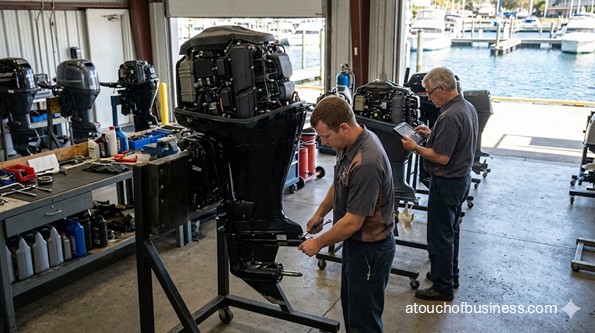
What to Plan Before Opening an Outboard Repair Shop
An outboard motor repair business repairs and services boat motors in a shop-based setting.
You are not just fixing engines. You are taking in customer motors, diagnosing problems, ordering parts, getting approval, completing the repair, testing the engine, collecting payment, and returning the motor with clear records.
Common work includes oil service, gear lube changes, water pump and impeller replacement, fuel-system service, carburetor cleaning, spark testing, lower unit service, winterization, spring commissioning, and general diagnostics.
This business usually serves recreational boat owners, anglers, fishing guides, marina customers, boat storage customers, rental boat operators, and small commercial boat users.
This guide focuses on a workshop-based setup. That means the shop itself matters. You need room for outboard stands, benches, parts storage, test equipment, waste containers, safe fuel handling, customer drop-off, and trailer access.
Do Your Interests Fit This Business?
An outboard motor repair business fits you best if you like mechanical work, customer trust, problem solving, and detailed shop work.
You also need to think about whether business ownership fits you. Owning the shop means you handle more than repairs. You deal with pricing, records, suppliers, customer calls, insurance, permits, cash flow, and delays.
Ask yourself a hard question: do you actually want to run a business, or do you only like working on engines?
That difference matters.
Starting this business to escape a job, a boss, or financial pressure is weak motivation. Prestige and status are weak reasons too. Those reasons usually do not carry you through slow months, parts delays, customer disputes, and expensive equipment needs.
Better reasons include a real interest in the business, skill with outboard motors, and a clear desire to serve boat owners well. Staying engaged for the long term is easier when you care about the work itself, not just the image of owning a shop.
It may help to think about how passion affects ownership before you invest capital in the business.
Owner Insight
Before starting an outboard motor repair business, speak with owners who are not your future competitors.
Look for owners in another city, region, or market area. Prepare real questions before you contact them. Ask about startup mistakes, shop layout, parts delays, pricing, seasonal slow periods, waste handling, and what they wish they had known earlier.
These conversations matter because those owners have direct experience. Their path will not match yours exactly, but their insight can reveal problems that are hard to see from the outside.
You can also use firsthand owner insight to test whether this business still feels right after you hear the hard parts.
Local Demand
An outboard motor repair business depends on local boating activity.
Before you lease space or buy equipment, check whether your area has enough boat owners to support the shop. Weak demand may mean the location or business idea is not a good fit.
Look at nearby lakes, rivers, coastal areas, marinas, storage yards, boat ramps, fishing communities, and boat dealers. Then compare that demand with the number of repair shops already serving the area.
Pay close attention to seasonality. Many markets are busy during spring prep, summer breakdowns, and fall winterization. Winter may be slower unless you have rebuild work, storage-related work, or strong year-round boating activity.
Use local supply and demand as a practical test. If there are many repair choices and few active boaters, opening a new shop may be difficult.
Start or Buy
An outboard motor repair business can be started from scratch or bought if an existing shop is available.
Starting from scratch gives you control over the location, tools, service scope, brand, and pricing. It also means you must build trust, supplier accounts, a steady flow of customers, and shop systems from the ground up.
Buying an existing business may give you a shop, equipment, customer records, supplier relationships, and local name recognition. It can also bring hidden problems, such as old tools, poor records, weak pricing, lease issues, or a damaged reputation.
Franchising is not usually the main path for a specialized outboard motor repair shop. Still, you may find marine service networks, dealer arrangements, or brand-authorized service models that affect training, parts access, and warranty work.
The better path depends on your budget, timeline, need for support, control preferences, risk tolerance, and whether a strong shop is available for sale. In some cases, buying a business already in operation may be worth comparing with a new launch.
Business Model
An outboard motor repair business should start with a clear service scope.
Do not open with every possible marine service unless your shop, tools, training, and insurance support it. A focused launch is easier to price, schedule, and control.
You may choose to service portable outboards, midrange engines, high-horsepower motors, two-stroke engines, four-stroke engines, or only certain brands.
Your scope may include:
- Diagnostics and troubleshooting
- Oil and filter service
- Gear lube changes
- Water pump and impeller replacement
- Fuel-system repair
- Lower unit service
- Winterization and spring commissioning
- Pre-purchase inspections
Be careful with warranty work, repowers, advanced electronics, inboards, sterndrives, trailer repair, and hull repair. Those services can change tools, staffing, insurance, parts access, and compliance needs.
Only advertise services your shop can perform safely and correctly. Taking on work outside your current scope can lead to delays, comebacks, damaged customer property, and lost customer trust.
Business Plan
An outboard motor repair business needs a plan that matches your shop, your service list, and your local boating market.
The plan does not need to be complicated, but it should answer real startup questions. What engines will you service? What brands can you support? What work will you refuse? How will parts move through the shop?
Include the following in your plan:
- Your target customer types
- Your service list
- Your local demand check
- Your competitor review
- Your shop layout needs
- Your equipment list
- Your startup cost estimate
- Your pricing method
- Your compliance checklist
- Your launch marketing plan
A good plan should also show how you will handle slow periods. Seasonal demand can affect rent, loan payments, payroll, parts inventory, and cash reserves.
Use a clear business plan to connect your idea to the real setup work ahead.
Customer Types
An outboard motor repair business earns trust from customers who need their boat running when the season opens.
Your customers may not understand the technical details. They want clear estimates, honest diagnosis, fair timing, good communication, and confidence that the engine was checked before pickup.
Common customer groups include:
- Weekend boat owners
- Fishing boat owners
- Charter operators
- Fishing guides
- Marina customers
- Boat storage customers
- Rental boat operators
- Small commercial boat users
Each group has different needs. A fishing guide may care most about uptime. A weekend owner may care about price clarity. A rental operator may need repeat maintenance and fast turnaround.
Match your first service offer to the customers you can serve well at launch.
Service Flow
An outboard motor repair business needs a clean workflow from first contact to final handoff.
A simple flow helps prevent missed approvals, wrong parts, late jobs, and customer disputes.
- Customer contacts the shop.
- Shop confirms engine brand, horsepower, year, symptoms, and service need.
- Customer drops off the motor or boat.
- Shop creates a work order.
- Technician inspects and diagnoses the issue.
- Shop gives an estimate and gets approval.
- Parts are ordered or pulled from inventory.
- Repair or service is completed.
- Engine is tested when practical.
- Invoice is prepared.
- Customer pays and picks up the motor or boat.
The workflow should also handle special-order parts, storage after completed work, warranty questions, abandoned property rules, and jobs that reveal more problems after diagnosis.
Skills Needed
An outboard motor repair business requires mechanical skills and basic business skills.
Technical skill matters, but it is not enough by itself. You also need to estimate jobs, explain problems, collect approvals, order parts, track sales tax, and protect customer property.
Useful startup skills include:
- Outboard diagnostics
- Fuel-system troubleshooting
- Marine electrical basics
- Lower unit service
- Cooling system service
- Safe fuel handling
- Reading service manuals
- Using torque specifications
- Customer communication
- Basic bookkeeping
Manufacturer training and industry certification can help, especially if you want to work on specific brands. Some warranty and dealer-level work may require brand access, training, and approved procedures.
If you plan to hire, you also need hiring, supervision, and quality-control skills. Review the core owner skills before you decide what to handle yourself.
Shop Setup
An outboard motor repair business needs a shop that supports safe repair work.
The space should fit your real workflow, not just your rent budget. Poor layout can slow every job and make the shop harder to keep clean, safe, and organized.
Look for space with:
- Repair use allowed under local zoning
- Trailer access or loading access
- Wide doors or overhead access
- Concrete floors
- Strong lighting
- Ventilation
- Power for tools and equipment
- Secure parts storage
- Room for engine stands
- Waste storage areas
Decide whether customers will enter the shop or stay at a front counter. If customers enter, you need clearer separation between customer space and work areas.
Do not sign a lease until repair use is verified. Zoning, fire review, wastewater rules, and certificate of occupancy requirements can affect whether the site works.
Tools and Equipment
An outboard motor repair business needs more than common hand tools.
Your equipment list depends on your service scope, engine sizes, brands, and whether you will handle advanced diagnostics or mainly maintenance work.
Core launch equipment may include:
- Outboard engine stands
- Engine hoist or gantry
- Workbenches
- Heavy shelving
- Metric and SAE hand tools
- Torque wrenches
- Prop wrench
- Gear lube pumps
- Oil extraction equipment
- Compression tester
- Leak-down tester
- Spark tester
- Digital multimeter
- Fuel pressure gauge
- Lower unit pressure and vacuum tester
- Test tank or safe flushing setup
You may also need a laptop or tablet, diagnostic software, brand-specific cables, service manuals, wiring diagrams, battery testing tools, an ultrasonic cleaner, and parts-washing equipment.
Do not buy equipment only because another shop has it. Buy what your first service list requires.
Parts Flow
An outboard motor repair business can waste labor time and tie up cash when parts are disorganized.
At launch, stock parts that match your most common services. Avoid tying up too much cash in slow-moving, brand-specific parts before demand is clear.
Common starter inventory may include:
- Spark plugs
- Oil filters
- Fuel filters
- Gear lube
- Engine oil
- Water pump kits
- Impellers
- Anodes
- Primer bulbs
- Fuel line
- Hose clamps
- Gaskets
- Cotter pins
Set up suppliers before opening. You may need original equipment manufacturer parts access, marine parts distributors, lubricant suppliers, battery suppliers, propeller shops, waste haulers, and a parts-washer service.
Your parts process should document where parts are ordered, received, labeled, staged, installed, returned, or billed. That discipline prevents many early mistakes.
Safety Basics
An outboard motor repair business handles gasoline, used oil, gear lube, batteries, solvents, aerosols, and sharp or moving parts.
Safety must be built into the shop before customers arrive. It cannot be added as an afterthought.
Prepare for:
- Chemical labels
- Safety Data Sheets
- Personal protective equipment
- Fire extinguishers
- Spill kits
- Approved fuel containers
- Used oil containers
- Battery storage
- Ventilation
- Safe lifting practices
If you hire employees, workplace safety rules become more important. You may need training, written procedures, and records for chemical exposure and hazard communication.
Fuel and solvent storage can also trigger local fire review. Ask the fire marshal before you store large quantities.
Waste Handling
An outboard motor repair business should plan used oil and waste handling before opening.
Typical waste streams may include used engine oil, gear lube, used oil filters, fuel-contaminated waste, solvent waste, batteries, aerosol cans, absorbents, and parts-washer waste.
Used oil rules can involve federal and state requirements. State rules may be stricter than federal rules.
You may need labeled containers, closed storage, spill containment, pickup records, recycling arrangements, and a waste contractor. Solvents and contaminated fuel can create hazardous waste issues depending on what you use and how much you generate.
Floor drains, wash water, parts washing, and outdoor storage can also create wastewater or stormwater concerns. Ask the local wastewater utility or environmental agency how your specific shop should handle discharge risk.
Legal Setup
An outboard motor repair business needs legal setup before it takes paid work.
Start with the basics. Choose a legal structure, register the business if required, get an Employer Identification Number if needed, and register a trade name if you use one.
You may need to review:
- State business formation
- Doing Business As registration
- Employer Identification Number
- State sales tax registration
- Employer accounts if hiring
- Local business license
- Certificate of occupancy
- Zoning approval
- Fire inspection
- Wastewater or environmental review
Rules vary by U.S. jurisdiction. Your city, county, state business office, state revenue agency, labor agency, fire marshal, and environmental agency may all matter.
You can use local license and permit requirements as a starting point, then verify the actual rules for your shop address.
Location Rules
An outboard motor repair business should verify the address before committing to a lease.
Ask the local zoning or planning office whether marine engine repair, small engine repair, or repair shop use is allowed at the property.
Also ask whether outdoor storage is allowed. Boats, trailers, engines, fuel tanks, and parts stored outside can create zoning, screening, fire, or environmental issues.
The building department can tell you whether the space needs a certificate of occupancy or a change-of-use approval. A space that was fine for storage or retail may not be approved for repair work.
Before opening, ask these direct questions:
- Is outboard motor repair allowed at this address?
- Does this use require a new certificate of occupancy?
- Are customer boats or trailers allowed outside?
- Are there fire rules for fuel, solvents, batteries, or aerosols?
- Are floor drains, washing, or parts cleaning restricted?
Keep the answers in your startup file. They may matter if you apply for insurance, financing, or inspections.
Taxes and Records
An outboard motor repair business must separate labor, parts, taxes, deposits, and fees in its records.
Sales tax treatment varies by state. Some states tax parts but not separately stated repair labor. Other states may tax repairs when parts or materials are supplied.
Do not guess. Ask your state Department of Revenue how to handle parts, labor, shop supplies, disposal charges, special-order parts, shipping, warranties, and repair packages.
Your invoice should be clear enough to support your tax reporting. Set up accounting categories before opening, not after the first busy week.
Track:
- Labor sales
- Parts sales
- Sales tax collected
- Customer deposits
- Special-order parts
- Shop supplies
- Waste disposal
- Warranty work, if applicable
If you hire employees, you will also need payroll records, withholding, unemployment accounts, workers’ compensation review, and new-hire reporting.
Insurance Planning
An outboard motor repair business has risks tied to customer property, test work, tools, employees, and the shop itself.
Speak with an insurance agent who understands repair businesses or marine service. Do not assume a basic general liability policy covers every risk.
Coverage to discuss may include:
- General liability
- Property insurance
- Tools and equipment coverage
- Garagekeepers or bailee coverage for customer property
- Business interruption coverage
- Workers’ compensation if hiring
- Commercial auto if using a business vehicle
Legal insurance requirements vary by state. Workers’ compensation is commonly tied to hiring employees. Commercial auto rules depend on vehicle use and state law.
Use business insurance basics to prepare your questions, then confirm coverage with a licensed agent.
Startup Costs
An outboard motor repair business has startup costs that depend on location, shop condition, service scope, and equipment level.
There is no reliable universal cost range for this exact setup. A small shop focused on basic service is different from a larger shop that handles diagnostics, repowers, high-horsepower engines, and brand-specific work.
Main startup cost categories include:
- Business formation and licensing
- Lease deposit and rent
- Shop build-out
- Electrical or ventilation upgrades
- Fire-safety changes
- Tools and diagnostic equipment
- Engine stands and lifting equipment
- Test tank or flushing setup
- Parts washer
- Waste storage and pickup
- Initial parts inventory
- Insurance
- Software and records
- Launch marketing
- Working capital
The biggest drivers are usually the shop space, equipment, diagnostic access, inventory, insurance, and cash reserves for seasonal slow periods.
Get written quotes before you borrow money or sign a lease.
Funding Options
An outboard motor repair business may need funding for tools, inventory, build-out, rent, and working capital.
Possible funding sources include owner savings, bank loans, Small Business Administration-backed loans, equipment financing, a business line of credit, and vendor credit.
Use debt carefully. Loan payments continue even when the season slows down.
Before applying, prepare a cost estimate, service list, startup timeline, local demand notes, pricing plan, and cash reserve plan. Lenders will want to see how the business can repay the loan.
If you plan to borrow, compare terms, collateral needs, interest rates, and repayment timing. Avoid buying more equipment than your first-stage service list can justify.
Pricing Repair Work
An outboard motor repair business needs pricing that covers labor, parts, delays, overhead, and risk.
Do not set your rates by matching a low-cost hobby mechanic. Your shop must pay rent, insurance, software, tools, waste handling, tax, payment fees, and replacement equipment.
Common pricing methods include:
- Hourly shop labor rate
- Diagnostic minimum
- Flat-rate maintenance packages
- Parts markup
- Minimum shop charge
- Special-order parts deposits
- Storage fees after completed work
- Disposal or environmental charges, if legal and disclosed
Seasonal services, such as winterization and spring commissioning, can be priced as clear packages if the scope is specific.
For repair work, get customer approval before going beyond the first estimate. Old engines often reveal extra problems once the diagnosis begins.
Use pricing your services as a broader guide, then adapt it to local labor rates and your actual shop costs.
Banking Setup
An outboard motor repair business should keep business transactions separate from personal ones from the start.
Set up a business checking account before taking customer deposits or buying parts for jobs. You may also want a separate savings account for sales tax and payroll tax reserves.
Your payment setup may include a card reader, ACH payments, online invoicing, and deposits for special-order parts.
Payment processing should be tested before opening. A busy drop-off day is not the time to find out your card reader or invoice system does not work.
Set accounting categories for labor, parts, sales tax, shop supplies, hazardous waste, warranties, customer deposits, and merchant fees.
Name and Web Presence
An outboard motor repair business needs a name that makes the service clear.
A clever name is less important than trust and clarity. Boat owners should quickly understand that you work on outboard motors.
Before choosing a name, check state business records, local DBA rules, domain availability, and possible trademark conflicts.
Your early digital footprint can stay simple. It should include:
- Business name
- Shop address
- Phone number
- Service area
- Engine types serviced
- Brands supported, if accurate
- Services offered
- Drop-off process
- Payment methods
Do not claim authorized dealer, warranty, or manufacturer service status unless that status is real and current.
Brand Basics
An outboard motor repair business should look organized before the first customer arrives.
You do not need a full branding project at launch. You do need clear signs, clean invoices, consistent contact details, and professional customer forms.
Useful first-stage materials include:
- Storefront signage, if allowed
- Basic logo or wordmark
- Business cards
- Work order template
- Invoice template
- Service list
- Vehicle or trailer lettering, if used
- Local listing profile
Clear branding supports trust. It also helps customers find the shop and remember where they had work done.
Forms and Documents
An outboard motor repair business needs written records for every customer job.
Verbal approvals can create disputes. Written forms protect the customer and the shop by making the scope clear.
Prepare these before opening:
- Work order
- Diagnostic authorization
- Estimate approval form
- Pre-service condition checklist
- Parts deposit policy
- Storage policy
- Customer pickup checklist
- Warranty disclaimer
- Invoice template
- Waste or disposal charge disclosure, if used
Ask a local attorney about abandoned property language and storage fees. Rules can vary, especially when a customer leaves a motor, boat, or trailer behind.
Hiring Choices
An outboard motor repair business can start as owner-operated or with employees.
Starting solo can reduce payroll risk, but it limits capacity. Hiring can increase output, but it adds payroll, training, supervision, insurance, scheduling, and safety duties.
If you hire a technician, confirm their skill with the engines you plan to service. Outboard work can involve mechanical systems, fuel systems, cooling systems, lower units, controls, and marine electrical issues.
If you hire a front-counter or parts employee, train them on work orders, customer approvals, parts staging, deposits, and pickup rules.
Do not hire only because the shop feels busy during spring. Seasonal demand can drop later.
Launch Readiness
An outboard motor repair business is ready to open only when the shop can complete real jobs safely and legally.
Use a controlled test before taking a full schedule. Run one or two sample jobs through the full process from work order to payment.
Before opening, confirm:
- Business registration is complete
- Required local approvals are in place
- Shop use is allowed at the address
- Insurance is active
- Equipment is installed and tested
- Waste containers are ready
- Supplier accounts are active
- Service forms are ready
- Payment processing works
- Pricing is written down
- Customer drop-off and pickup process is clear
Opening before the shop is ready can create expensive problems. Missing permits, weak parts flow, unsafe fuel storage, or broken payment systems can slow the launch immediately.
Daily Work
An outboard motor repair business has a practical daily rhythm once the doors open.
A typical day may start with checking engines already in the shop, reviewing parts orders, returning customer calls, and confirming approvals.
Then the work moves to diagnostics, service, repairs, testing, cleaning, invoices, and customer pickup.
A simple day may include a compression test on one motor, a water pump replacement on another, gear lube service, a parts order, a call for estimate approval, used oil labeling, and a test run in the tank.
This snapshot matters before launch. If you dislike the mix of wrenching, records, parts, calls, cleanup, and customer communication, this business may not fit you.
Inventory Capacity
An outboard motor repair business needs enough inventory to move common jobs without turning the shop into a parts warehouse.
Capacity is not just floor space. It includes bench space, engine stands, parts staging, technician time, test equipment, and pickup turnaround.
Too many open jobs can block the shop. Too little parts stock can delay simple work. Too much inventory can tie up cash.
Start with fast-moving maintenance parts. Track what you use during the first season. Then adjust slowly.
Also decide how many engines or boats the shop can hold at one time. If customer property piles up, turnaround time and damage risk rise.
Getting Customers
An outboard motor repair business should reach boat owners before the busy season starts.
Your early marketing should be simple and local. Make it easy for people to know what you fix, where the shop is, how to contact you, and what information to bring when they call.
Useful launch actions include:
- Claiming local business listings
- Listing clear services online
- Adding photos of the shop exterior
- Building relationships with marinas
- Connecting with boat storage yards
- Posting seasonal service reminders
- Using clear shop signage
- Asking satisfied customers for reviews when appropriate
Customer acquisition should focus on trust, speed, quality, convenience, price clarity, and confidence that the engine will be checked properly.
Repeat business can come from seasonal service, maintenance records, winterization, spring commissioning, and clear reminders. Do not overpromise turnaround times during peak season.
Main Red Flags
An outboard motor repair business has warning signs you should take seriously before launch.
These red flags do not always mean you should stop. They mean you need better answers before spending more money.
- Weak local boating activity: Few boats, ramps, marinas, or storage yards can limit demand.
- Too much competition: Dealers, marinas, mobile mechanics, and independent shops may already serve the area.
- Seasonality: Busy spring and fall periods may not cover a slow winter without planning.
- Unverified location: A lease is risky if zoning or certificate of occupancy rules are unclear.
- No waste plan: Used oil, solvents, batteries, and fuel-contaminated waste need proper handling.
- Weak estimating: Poor estimates can lead to disputes, unpaid work, and lost trust.
- Parts delays: Older or uncommon engines may be hard to support quickly.
- Underpriced labor: Low rates may not cover rent, tools, insurance, tax, and comebacks.
- Too broad a service list: Offering every marine repair too soon can strain the shop.
- No brand access: Warranty or advanced diagnostic work may be limited without manufacturer tools and training.
One more point matters. The broader boat market can be cyclical. New boat sales and consumer confidence can affect related repair demand, especially in areas where boating is highly discretionary.
Startup Checklist
An outboard motor repair business should not open until the core setup is complete.
Use this checklist before your first full launch week.
- Service scope is written down.
- Local demand has been checked.
- Business structure is chosen.
- Business registration is complete.
- Tax ID is obtained if needed.
- Sales tax rules are verified.
- Shop zoning is approved.
- Certificate of occupancy requirements are resolved.
- Fire and wastewater questions are answered.
- Insurance is active.
- Core tools are ready.
- Diagnostic equipment is tested.
- Engine stands and lifting equipment are ready.
- Used oil and waste handling are set up.
- Supplier accounts are open.
- Initial inventory is stocked.
- Work orders and estimate forms are ready.
- Pricing is approved.
- Payment processing is tested.
- Customer drop-off process is clear.
- Soft-opening test job is complete.
Frequently Asked Questions
An outboard motor repair business raises practical questions before launch.
These answers focus on startup decisions, not long-term operations.
Do I need a special license to open?
It depends on your state, city, and county. Many shops need business registration, local licensing, zoning approval, and certificate of occupancy review. Some places may regulate repair shops more specifically.
Do I need marine technician certification?
Certification is not a universal federal requirement. It can still help with credibility, technical skill, and certain service opportunities. Manufacturer work may require brand-specific training or authorization.
Can I perform warranty repairs?
Only if the manufacturer or an authorized arrangement allows it. Do not advertise warranty service unless your status is real and current.
What services should I offer first?
Start with services your shop can support well, such as diagnostics, tune-ups, oil service, gear lube changes, water pump service, fuel-system work, winterization, and spring commissioning.
Do I need a test tank?
A shop-based outboard repair business usually needs a safe way to run and test engines. A test tank or proper flushing setup helps confirm cooling, idle, shifting, and repair results.
How much does it cost to start?
There is no reliable universal range. Costs depend on the shop space, build-out, tools, diagnostic equipment, parts inventory, insurance, waste handling, and working capital.
How should I price repair work?
Use a shop labor rate, diagnostic minimum, flat-rate service packages where appropriate, parts markup, and clear deposit rules for special-order parts.
Can I run this from home?
Not usually for this workshop-based model. Home repair may be limited by zoning, fuel storage, noise, customer visits, outdoor storage, and waste handling rules.
What waste rules matter most?
Used oil, gear lube, oil filters, solvent waste, batteries, aerosols, fuel-contaminated waste, and spill response are key areas to review before opening.
Should I stock parts before opening?
Yes, but keep the first inventory focused. Stock common maintenance parts first, then adjust based on actual demand.
What should be ready before taking the first customer job?
Your work order, estimate approval process, parts source, waste plan, payment setup, service records, test process, insurance, and shop safety setup should be ready.
Insights From People in the Marine Repair Business
Learning from people already working in marine repair can help you see what the business looks like beyond the tools.
The resources include interviews, videos, podcasts, and industry articles with shop owners, marine technicians, service managers, and marine business leaders.
Use them to pick up practical lessons about training, customer trust, scheduling, parts flow, shop standards, and the realities of working in the marine service field.
- Marine Industry Career Path: Ask Andrew McDonald
- Hidden Gems: Meet Seth Ritter of Brothers Ritter Marine
- Meet Chet Morampudi of The BOAT YARD
- It Doesn’t Feel Like Work
- Pranks, Passion and Powerboats | Marine Engineering Business
- Behind-the-Scenes Marine Engineering Content
- Boating Industry Insider Podcast
Related Articles
- How To Start a Marine Supply Business
- How To Start a Boat Cleaning Business
- How To Start a Motorcycle Repair Shop
- How To Start an ATV Repair Business
- How To Start a Golf Cart Repair Shop
Sources:
- IRS: Get an EIN
- U.S. Small Business Administration: Register Your Business, Licenses and Permits, SBA Loans
- U.S. Environmental Protection Agency: Managing Used Oil, Small Waste Generators, Universal Waste, Industrial Stormwater, SPCC Regulation, Parts Washing Operations
- Occupational Safety and Health Administration: Hazard Communication, Flammable Liquids, Personal Protective Equipment
- O*NET OnLine: Motorboat Mechanics
- U.S. Bureau of Labor Statistics: Occupational Wages
- American Boat and Yacht Council: Certification Program, Engines Certification
- Mercury Marine: Dealer Network
- Yamaha Outboards: Master Technicians
- NMMA: Retail Boat Sales
- IBISWorld: Boat Repair Industry
- California Department of Tax and Fee Administration: Repair Tax Topics
- Florida Department of Revenue: Repair Sales Tax
- District of Columbia Department of Buildings: Certificate of Occupancy
- NYC Business: Auto Repair Shop