
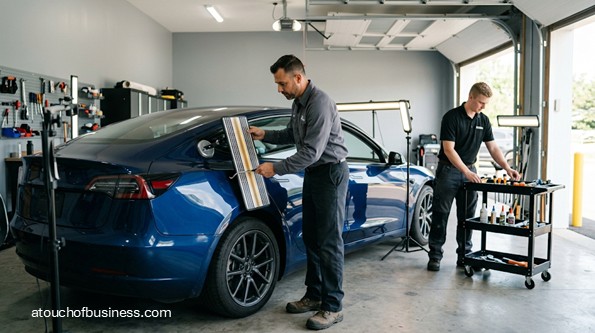
What to Expect From This Guide to Starting a Paintless Dent Repair Business
This guide walks you through the key decisions and practical steps involved in opening a shop where customers bring vehicles for paintless dent repair. The bullets below highlight selected areas, not everything inside.
Inside the guide, you will find:
- Startup steps: Move through numbered steps from checking your fit and learning the craft to testing your shop before opening.
- Common questions: Find answers to situations the main path skips, such as part-time operation, no body shop background, low-hail areas, and hail rushes.
- Daily reality: See what a typical day involves, including the parts owners often find hard.
- Market demand: Test whether nearby dealerships and body shops would send vehicles to a fixed shop before you commit to a lease.
- Financial planning: Work through break-even logic, startup costs, operating capital, funding options, and pricing methods using your own local numbers.
- Local requirements: Learn which zoning, permit, repair-shop, and tax questions to verify locally, since requirements vary by location.
- Risks and warnings: Review warning signs before you spend money and before your first customer vehicle arrives, including insurance gaps and repair liability.
Start with whether this hands-on trade, and the uneven income that comes with it, fits the life you want.
Paintless dent repair (PDR) technicians remove dents by working the metal back into shape from behind the panel.
PDR needs no sanding, filler, or repainting.
As a shop-based PDR owner, you work from a fixed bay or studio, and customers bring vehicles to you.
PDR works when the paint is intact and a technician can reach the back of the dent.
Most ventures follow similar startup steps, but dent repair has details of its own.
Is a Paintless Dent Repair Business a Good Fit for You?
A PDR shop fits best if you enjoy precise hand skills and can wait for skill and income to build. You also need to handle uneven demand.
Why do you want to own a PDR shop? Wanting to repair dents with your own hands differs from wanting to manage technicians.
Think about your strengths and interests too. This trade rewards patience and a trained eye.
A shop lease and other fixed costs keep running while your skill and customer list develop. Can your household cover living expenses during that time?
Income can stay uneven, and the shop can fail if volume never builds.
List the startup costs and operating costs you will need to price, and decide where the capital will come from.
Time demands matter too. You will spend part of each day on estimates, customer conversations, and records, not only repairs.
Test demand before you commit. Ask who will bring you vehicles, and why they would choose you over other providers.
How will your first customers find you? Answer that before you sign anything.
Learn from experienced owners who will not compete with you. Advice from real business owners is useful even though each owner’s path differs.
You can also start from scratch, buy an existing business, or buy into a franchise. Each path carries different tradeoffs.
Red Flags Before You Start
These warning signs should make you pause, verify more, change your model, or reconsider before you spend money.
Weak demand for a shop-based model: Dealership and body shop managers may already have vendors, or prefer a technician who visits their lots.
Ask local accounts for commitments before signing a lease. Pause or add a mobile option if none appear.
Heavy competition: This trade includes independent owners, small chains, and national providers. Outside crews can also arrive after a storm.
Whether your area is crowded is a local question. Verify who serves your target accounts.
Consider a narrower niche or a mobile option if your area is crowded.
A gap between your skill and customer expectations: Customers expect quick, clean results. Delay opening until your repairs meet those expectations.
Thin operating capital: Rent and other fixed costs keep running while skill and accounts develop.
Reduce overhead or reconsider the shop if your reserve looks thin.
Pricing limits: Insurers and shops use pricing matrices to set the price on many hail and subcontracted jobs.
Technician pay and revenue splits also reduce what you keep. Verify margins with your own costs before committing.
Weather-driven demand: Hail brings surges, and slower stretches follow. Plan for uneven monthly income.
Dependence on one technician: Illness or injury can stop income. Plan backup before you open.
Zoning limits: An address that does not allow automotive repair can block your plan. Verify zoning before signing a lease.
Insurance gaps: Customer vehicles in your custody may fall outside a general liability policy. Verify coverage with a licensed agent before accepting vehicles.
Repair liability: Cracked paint can force a full repair, and drilled access holes raise corrosion concerns.
Reduce risk with condition reports and a strict screen for dents you decline.
Vehicle materials: Composites and carbon fiber are not PDR candidates, and aluminum is harder to repair.
Manufacturer repair procedures and diagnostics can also add training and information needs.
Industry conditions to understand: Skill, not equipment, is the main barrier to entry.
Pricing power is limited on insurer-driven jobs. Customer relationships are personal and slow to build.
A Day in the Life of Running a Paintless Dent Repair Business
A typical day centers on inspecting dents and repairing them under controlled lighting. You also explain to customers what PDR can and cannot fix.
Each vehicle starts with inspection. You clean the dent, set up your light, and check whether the paint is intact.
Next, you gain access to the back of the panel. That can mean removing trim or working through a window or taillight opening.
You then choose tools and work the dent from the outside in with light pressure, checking for high spots under the light.
Estimating and explaining fill the gaps between repairs. You tell customers, shop managers, or adjusters whether PDR suits the damage.
Scheduling is another recurring task. Quick jobs have to fit around longer repairs.
Ongoing practice keeps your skill sharp, even after opening.
Job length varies. Simple dents are often quick, complex ones take longer, and a badly hail-damaged vehicle can take a day or more.
Demand also swings with the weather. Hail can bring a surge and long days, and slower stretches follow.
Conditions matter too. Weather permitting, some repairs happen outdoors, but some jobs suit an indoor bay better.
The trade is a craft: results depend on skill and practice.
What owners often find hard:
- Customers expect quick results, so short jobs interrupt longer repairs.
- Each dent calls for a judgment, including telling customers when PDR will not work.
- Volume swings with storms.
- Holding your skill takes sustained practice.
Does that daily rhythm fit the life you want?
Step 1: Can You Handle the Hands-On Side of Dent Repair?
You can handle the hands-on side if you have sharp vision, a fine touch, patience, and steady hand-eye coordination.
Technicians read reflections from a PDR light to see where the metal sits. Close inspection and slow, careful metalwork are the daily routine.
Decide whether you will repair dents yourself, manage technicians, or do both.
Body repair in general is physically demanding and often means awkward, cramped positions. Be honest about whether your body suits that.
Step 2: Who Should You Talk to Before Spending Anything?
Talk to PDR owners in distant markets and to body shop owners and managers who use PDR vendors.
Dealership used-vehicle and reconditioning managers are good sources too.
Body shops and dealerships are likely customers, not competitors. PDR owners in your own area are your competitors, so skip them.
Prepare questions like these:
- How do you choose a PDR provider?
- Do you prefer drop-offs or a technician who visits?
- What quality problems have you seen?
- What turnaround do you expect?
- How do you pay vendors, and what happens after hailstorms?
- What would make you switch providers?
Shop owners can also share lessons on volume, hiring, and leases. Each owner’s story differs, so treat what you hear as input, not a template.
Step 3: How Do You Learn the Repair Method?
You can learn through a formal course, time alongside an experienced technician, or practice on scrap hoods and panels. Mixing all three also works.
Courses range from a few days to several weeks, and some bundle a starter tool kit. Compare packages before buying tools separately.
Trade sources estimate several months of regular practice before simple dents come out reliably, and a year or more for complex damage.
Certification is optional. Vale Training Solutions offers a timed, hands-on test on steel and aluminum panels.
The National Alliance of Paintless Dent Repair Technicians (NAPDRT) accepts individual technicians who earn income from PDR.
Neither Vale certification nor NAPDRT membership is a government license.
Training continues while you complete later steps. Set a skill benchmark you must meet before accepting customer vehicles.
Plan how you will keep practicing before and after opening.
Step 4: Should You Start From Scratch, Buy, or Franchise?
You can start from scratch, buy an existing PDR business, or explore a franchise.
Existing PDR businesses are listed for sale. Some listings describe mobile or home-based operations, so a shop-based plan could mean moving the operation.
If you buy, confirm which customer accounts transfer and what training the seller provides.
Some PDR and reconditioning franchise systems exist. The franchise disclosure document (FDD) says whether a unit is mobile or center-based.
Federal rules require the franchisor to deliver the FDD at least 14 calendar days before you sign or pay. Have an attorney and an accountant review it.
The best path depends on budget, timeline, support needs, available businesses for sale, desired control, and risk tolerance.
Learn more about whether to start from scratch or buy a business before you choose.
Step 5: Who Will Bring Vehicles to Your Shop?
Likely sources of vehicles include retail drivers, dealerships, body shops, hail claims, and fleet, rental, or auction operators.
Choose which customer types you will serve at opening. Each one changes your pricing, paperwork, and schedule.
Decide whether customers drop off vehicles or wait, and whether you will accept hail jobs.
Whether to add a mobile option is a separate decision, because it changes your vehicle, insurance, and cost planning.
Define why customers would choose you over other providers.
Customers may choose you for verifiable quality, turnaround, convenient location, controlled lighting, or estimates that shops and insurers accept.
At opening, reach your likely customers in person. Meet the used-vehicle managers, reconditioning managers, body shop managers, and estimators who decide where dents get fixed.
Directories run by industry groups list eligible technicians.
Step 6: Is There Enough Local Demand for a Shop-Based Model?
Local demand looks strong when nearby dealership and body shop managers say they would send vehicles to a fixed shop.
Review local supply and demand before choosing a location.
List the dealerships, body shops, rental and fleet operations, and auctions within driving distance of candidate sites.
Ask managers and owners on your list how dents get fixed. They might use route technicians, on-call specialists, in-house staff, national providers, or nobody.
One trade source notes that some dealership and body shop managers prefer a technician who comes to them.
Ask dealership and body shop managers directly whether they would send vehicles to a fixed shop instead.
Count the existing providers, including independents, small chains, and national companies.
Ask local insurance agents and body shop managers about hail history in your area.
Then decide: proceed, change the model, or pause.
Step 7: Can the Numbers Support a Shop?
The numbers support a shop only if the jobs you can realistically win cover your fixed costs and leave income for you.
Revenue comes from per-dent, per-panel, or matrix pricing based on dent size and count.
Some jobs are subcontracted from body shops, where you earn a share of the price the customer pays.
List your fixed costs: rent, utilities, insurance, loan payments, software, training, and tool replacement.
List your variable costs too: glue, tabs, other supplies, and technician pay.
Estimate how many vehicles, panels, or dents per week you must repair at your local prices to cover your costs.
Your break-even job count equals your fixed costs divided by what each job leaves after direct costs. Use your own local numbers.
Add the income you need to your fixed costs if you want to draw a living from the shop.
Test your numbers against slow periods too. Demand swings with weather, and hail windfalls are unpredictable.
Capacity matters: one technician can repair only so many dents per day.
Learn how to estimate profit and revenue before leasing, buying equipment, or hiring.
Step 8: What Will Startup Costs and Operating Capital Cover?
Startup costs cover everything you must buy or pay for before the first paid repair, and operating capital covers the months after.
Build a line-item list that includes:
- Training and any certification fee
- Tools, lighting, and consumables
- Shop deposit and rent, plus any build-out
- Software and access to original equipment manufacturer (OEM) repair information
- Insurance, licenses, registrations, and a sign
- Operating capital
Get quotes for each line. Costs vary with tool quality, shop size, location, and whether you work solo or staffed.
Running out of operating money is a leading reason startups close.
Plan operating capital to cover rent, utilities, insurance, and loan payments. Add supplies, software, and your own living costs through slow months.
Decide how many months of expenses to hold in reserve.
Step 9: How Will You Fund the Shop?
You can fund the shop from savings, family support, or loans. Equipment financing and financing tied to buying a business or franchise are other options.
Funding sources include banks, credit unions, and lenders that offer government-backed small business loans. Learn how to get a business loan before you apply.
Ask each loan officer which documents to bring and in what order.
The first document needed differs by lender: registration or a lease for some, a business plan for others.
Settle funding before signing a lease or buying major equipment.
If a lender wants registration or a signed lease first, ask an attorney how to sequence them.
Step 10: Which Legal Structure Fits a Shop With Customer Vehicles?
A shop with a lease and customer vehicles carries liability exposure, so plan your structure before you sign agreements.
A sole proprietorship creates no separate entity and carries unlimited personal liability. A limited liability company (LLC) separates personal and business assets.
Learn how to choose a business structure, then take the final choice to an attorney and a tax professional.
Ask your attorney whether any entity type is required where you operate.
One common order is to form the entity and get your federal tax ID before opening the bank account or applying for licenses.
Verify the order for your area, because it varies by U.S. jurisdiction.
Register your business name or assumed name where required.
Apply for your federal business tax ID, also called an Employer Identification Number (EIN).
Set up state tax accounts, and employer accounts if you will hire.
Step 11: How Will You Handle Banking and Payments?
Open a separate business bank account and set up payments before accepting your first job.
Keep business and personal transactions apart from the start. Learn how to open a business bank account.
Set up card acceptance for retail customers who pay at pickup.
Decide how you will bill dealership and body shop accounts and what payment terms you will offer.
Step 12: What Do Zoning, Permits, and Repair Rules Require?
Requirements vary by U.S. jurisdiction, so confirm zoning, permits, and repair-shop rules before you sign a lease.
The city or county planning office can tell you whether your address allows automotive repair use.
Ask about the certificate of occupancy, building and fire inspections, the general business license, and sign permits.
Review business licenses and permits for the full picture.
Ask your state’s consumer-protection agency whether PDR falls under its motor vehicle repair shop rules.
Some states require registration, written estimates, invoices, record retention, and posted notices.
Some counties or cities also register repair shops. Check your county consumer agency.
Government occupational data lists certification as optional for body repairers. Confirm with your state licensing board whether any license applies to PDR technicians.
Federal air rules cover spray painting of vehicles.
PDR involves no painting. If you add paint work, verify the federal air rules with your state environmental agency.
Get answers from planning and licensing offices in writing where possible. Ask an attorney whether the lease can depend on permit approval.
Step 13: What Should Your Shop Space Offer?
Your shop space should offer controllable lighting, stable temperature, room for the largest vehicles you accept, and secure vehicle staging.
Trade sources note that metal responds differently when cold, and that some dents wait for a warm day or an indoor bay.
Plan electrical outlets for lights and glue guns. Ventilation should suit adhesives and solvents, as the product safety data sheets describe.
Plan how vehicles enter and leave the bay, where waiting vehicles park, and where keys are stored securely.
Will customers enter the shop, or will most vehicles arrive through dealership drop-offs? Your answer shapes whether you need a customer waiting area.
Ask your landlord about rules on vehicles, solvents, signs, and insurance certificates.
Step 14: Which Insurance Should You Price Before the First Vehicle Arrives?
Ask a licensed agent to quote general liability, property and contents coverage, and coverage for customer vehicles in your custody.
Get those quotes before any customer vehicle enters your shop.
Coverage for customer vehicles in your custody is usually called garagekeepers coverage.
General liability policies often exclude property in your care, custody, or control. Ask how each policy treats customer vehicles.
Add commercial auto if you use a business vehicle, and workers’ compensation once you hire. State rules on workers’ compensation vary.
Treat garagekeepers coverage as risk planning unless your state requires it, though your landlord may ask for an insurance certificate.
See business insurance for more.
Pair coverage with these habits:
- Photograph each vehicle before repair.
- Complete a written condition report at intake.
- Decline dents that do not suit PDR.
Step 15: Which Tools, Suppliers, and Systems Do You Need?
You need repair tools, lighting, glue-pulling gear, consumables, safety items, and estimating systems, bought after your training path is settled.
Plan for these categories:
- Rods in several lengths and tip shapes, whale tails, hail or roof rods, knockdown tools with interchangeable tips, and blending hammers
- A glue-pulling kit with a glue gun, PDR glue sticks, tabs in varied shapes, a mini lifter, a slide hammer, and isopropyl alcohol
- An LED PDR light or reflection board, plus stands and power options
- Trim removal tools, hole plugs, rust-inhibiting primer for any access hole, and basic hand tools
- A hood stand, tool cart, and practice panels
- Estimating and invoicing software, photo documentation, scheduling, and payment processing
One trade source calls a full-size PDR light the most needed estimating tool. It helps you see dents that other lighting hides.
Set up access to OEM repair information.
Decide how you will handle jobs where OEM repair information calls for scanning or calibration.
Options include owning a scan tool or referring scanning and calibration jobs out.
Plan these safety items:
- Protective equipment named on product safety data sheets
- A safety data sheet binder
- A fire extinguisher
You do not need a paint booth, spray equipment, body filler, welding gear, or a frame machine. PDR works without paint or filler.
Compare tool suppliers on quality, return terms, and what your training package already provided.
Step 16: How Will You Price Jobs and Document Them?
Price by dent size and count, by panel, or by a hail matrix, then add upcharges for harder jobs.
Common upcharges include oversized dents, aluminum or high-strength panels, difficult access, and remove-and-install (R&I) time.
Pricing matrices from insurers and shops often govern hail and subcontracted jobs. Learn those matrices, because those jobs follow their pricing.
Retail, wholesale, and subcontracted jobs earn different rates.
Learn going rates through your owner conversations, then price your services from your own costs.
Prepare an estimate form, repair authorization, intake condition report, invoice, and a warranty statement if you offer one. Follow state written-estimate rules where they apply.
Write a repairability screen that lists the dents you will decline:
- Cracked paint
- Stretched metal or deep creases
- Edge dents
- Blocked access
- Composite or carbon fiber panels
Step 17: Will You Work Alone or Add Technicians?
Decide whether you will start solo or with technicians, because each choice changes pay, paperwork, and insurance.
Pay for technicians is often commission or incentive based.
The Internal Revenue Service (IRS) weighs three categories when deciding employee versus independent contractor status:
- Behavioral control
- Financial control
- The relationship of the parties
If you hire, set up payroll accounts and workers’ compensation. State rules vary.
The Occupational Safety and Health Administration (OSHA) sets rules for employers who use hazardous chemicals. They must provide labels, safety data sheets, and worker training.
Check each adhesive, alcohol, and primer product’s safety data sheet to see whether these rules apply.
Step 18: What Identity Details Must Be Ready at Opening?
Have your registered business name, shop sign, contact details, and payment methods ready before your first customer arrives.
Confirm the name is available and registered where required.
Check sign permits and lease rules before ordering a sign.
Set up a phone number, email, address, and posted hours.
List your shop in a technician directory if you qualify. A website domain and business cards are optional.
Step 19: How Do You Test Everything Before Opening?
Run timed trial jobs on practice panels, fix what breaks, and confirm every item on a pre-opening checklist.
Time the full cycle: intake photos, estimate, repair, inspection under the light, and invoice.
Consider a soft opening with a few known accounts.
Confirm each of these before you open:
- Entity formed, EIN issued, state tax accounts set up, and business license in hand
- Repair shop registration, zoning approval, certificate of occupancy, inspections, and sign permit, as required
- Posted notices displayed where required
- Insurance bound, certificate in hand, and customer-vehicle coverage confirmed with your agent
- Lighting, temperature, outlets, tools, and consumables tested and stocked
- Safety data sheet binder and fire extinguisher in place
- Skill benchmark met and repairability screen written
- OEM information access and diagnostic plan confirmed
- Supplier accounts open and software working
- Estimate, authorization, intake, invoice, and warranty forms ready
- Bank account and card acceptance tested, with billing terms set for accounts
- Sign installed, contact details live, and a final shop walk-through done
Business Plan
Your business plan should connect your demand findings, cost list, funding, pricing, and break-even numbers into one decision document.
Start with your customer mix and the reasons those customers would choose your shop.
Add your startup costs, operating capital, and the funding sources you have lined up.
Include your pricing methods and the sales volume needed to cover fixed costs.
Explain your break-even logic in plain language, using your own local numbers.
Note margin pressure from insurer matrices, revenue splits, and technician pay.
Plan for slow and no-sale stretches, since weather can leave gaps between surges.
Finish with the permits, insurance, skill benchmark, and equipment you must have in place to open.
A guide on how to write a business plan can help you organize it.
Opening-Day Red Flags
These warning signs mean you are not ready to take your first customer vehicle.
Unconfirmed zoning or certificate of occupancy: Open only after you have written confirmation.
Insurance not bound: Do not accept a vehicle until the insurance certificate is in hand and your agent has confirmed how customer vehicles are treated.
Untested lighting or temperature: Test both on real panels before accepting customer vehicles.
An unmet skill benchmark: If trial jobs still crack paint or leave high spots, keep practicing.
Missing forms: Without estimate, authorization, intake, and invoice forms, you cannot document a vehicle’s condition or approved charges.
Untested payments: Run a test transaction and confirm billing terms for accounts.
No plan for OEM information or diagnostics: Know where you will find repair procedures and who handles scanning.
Missing chemical safety items: If you employ anyone, have labeled products, safety data sheets, and protective equipment in place.
Frequently Asked Questions
These questions cover situations the main startup path does not address.
Can You Run a PDR Shop Part-Time While Keeping Your Job?
Usually only if you can keep practicing and keep jobs flowing.
One trade source compares PDR to a sport or an instrument: the more you do it, the better you get.
A week or two without practice can hurt your results.
A shop also adds fixed costs that run whether or not you are there.
Can You Start Without a Body Shop Background?
Yes, but plan for more practice. The Bureau of Labor Statistics notes that many body repairers begin without previous training.
One trade source says shorter courses may suffice for people already trained in body work.
Others should expect a longer path before accepting customer vehicles.
Can a PDR Shop Work in an Area With Little Hail?
Yes, if everyday jobs fill the bay.
One trade source says PDR suits used-car lots with many small dings, and areas with frequent hail.
Dealership inventory, body shop overflow, and retail parking-lot dents can fill the gap.
Hail brings the surges, so confirm everyday volume with local accounts before you lease space.
Should You Hire a Technician With No PDR Experience?
Usually only if you can afford a slow payoff.
Training a beginner takes months before simple dents come out reliably.
One trade source reports that trained technicians often move on, taking your training investment with them.
Weigh that payoff period against the volume you can offer.
Can You Handle a Hail Rush Alone?
Not a large one. A single badly hail-damaged vehicle can take a day or more.
Body shop managers bring in many outside specialists during hail rushes. You cannot absorb that volume alone.
Decide in advance how much storm volume you will accept and what you will turn away.
Interviews with Paintless Dent Repair Business Professionals
These interviews share firsthand perspectives from paintless dent repair professionals, business owners, and trainers. They cover topics such as learning the trade, starting a PDR business, marketing, customer relationships, training, and managing demand.
Use their experiences to better understand the technical skills and business practices involved before starting a paintless dent repair business. Pay particular attention to how they learned the trade, found customers, developed relationships, and handled the business side of PDR.
Episode 22 | Stefan Esche
Stefan Esche discusses his transition from autobody work into running a PDR business full time. The conversation covers his business progress, marketing, cold calling, challenges, and what he expects as the business develops.
This episode is useful for someone considering a PDR business because Stefan discusses the experience while still relatively new to operating full time, including the marketing and business-development issues he is working through.
Jarrett Ross’s Journey in Paintless Dent Repair & Entrepreneurship
Jarrett Ross discusses his path from the U.S. Air Force into paintless dent repair and building Virginia Dent. Topics include starting a business from scratch, customer reactions to PDR, mentorship, teamwork, diversification, and business growth.
This interview gives prospective PDR business owners a longer-term view of building a company, developing a team, and expanding beyond simply performing dent repairs.
Disappearing Dents and Building Relationships with Dan Christian
Dan Christian explains how he entered PDR through an apprenticeship and learned customer interaction, insurance work, and shop operations. He also discusses seasonal hail demand, networking, and referral relationships with other automotive businesses.
This interview is useful for understanding that running a PDR business involves more than repair skills. Dan’s experience highlights apprenticeship, insurance processes, seasonal demand, and relationship-building as important parts of operating the business.
Why I Started Learn PDR Online | Interview with Keith from PDR College
This interview describes a path from body-shop work into paintless dent repair and eventually running a dent repair business. It covers the appeal of the mobile business model, buying tools, discovering the need for proper training, developing PDR skills, and building a business.
Someone considering PDR can use this interview to see why tools alone may not be enough and why training and guidance can matter when developing both repair skills and a sustainable business.
Trainers Edition – Rob McDowell with Paintless Dent Repair University
Rob McDowell discusses his background as a PDR technician and trainer, along with beginner and advanced training, tools, pricing, marketing, sales, customer service, ergonomics, route work, retail work, and hail repair.
This interview is especially useful for understanding the range of skills a prospective PDR technician may need. It also shows how technical training connects with customer service, marketing, and managing the business side of the trade.
Why Are You Passionate About Paintless Dent Repair?
American Dent Specialists owner Andy Ball discusses discovering PDR, getting tools, gaining experience through hail-damage work, and learning when paintless repair is appropriate. He also explains why preserving a vehicle’s factory finish is an important part of the service.
This interview gives prospective operators insight into what can attract someone to the trade and the value proposition they may need to explain to customers when offering paintless dent repair.
Related Articles
- How To Start an Auto Body Repair Shop
- How To Start an Auto Detailing Business
- How To Start a Car Wrapping Business
- How To Start a Custom Car Shop
- How To Start a Windshield Repair Business
Sources:
- AAA: Paintless Dent Repair Update
- Mitchell International: Trends in Paintless Dent Repair
- Vale Training Solutions: Vale Certified PDR Technician
- NAPDRT: NAPDRT Technician Membership
- Bureau of Labor Statistics: Body and Glass Repairers
- BodyShop Business: Practice Makes Perfect in PDR, Proper PDR Estimating
- FenderBender: New PDR Profit Center, In-House PDR Department, Body Shops and PDR Techs
- Dent Wizard: SMART Repairs Reconditioning
- Metal Medic: Types of PDR Tools
- Car-O-Liner: What Is Paintless Dent Repair
- Paintless Dent Repair School: Tools Needed for PDR
- U.S. Small Business Administration: Choose Business Structure, Apply for Licenses and Permits
- SCORE: Business Licenses and Permits
- IRS: Employer Identification Number, Contractor vs Employee Topic
- OSHA: Hazard Communication Program
- Federal Register: Area Source Coating Rule
- Legal Information Institute: FTC Franchise Rule Cover Page
- Franchise Overview: Dentsmart Franchise Profile
- FranData: Dent Doctor Franchise Document
- Congressional Research Service: Workers Compensation Overview
- Washington LawHelp: Auto Repairs Rights Overview
- The Florida Bar: Auto Repair Consumer Tips
- NAIC: Small Business Insurance Basics
- Wexford Insurance: GL Exclusion Customer Property