
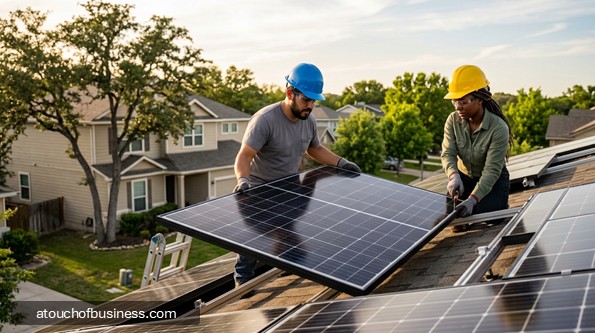
What to Expect From This Guide to Starting a Solar Panel Installation Business
This guide walks you through the key decisions and practical steps involved in starting a solar panel installation business, from evaluating whether the work fits you to preparing for your first project. The highlights below point to select areas of value, not everything the guide covers.
Inside the guide, you will find:
- Startup roadmap: Follow numbered steps that move from checking your fit through licensing, funding, equipment, and your first completed project.
- Business fit: Work through honest questions about income swings, household support, physical demands, and whether this work suits you.
- Market demand: Check local sun exposure, roof stock, utility bill-credit programs, and competition before committing to a service area.
- Financial planning: See how to plan startup costs, operating capital, pricing methods, and financing options without relying on invented figures.
- Local requirements: Learn what to verify on licensing, permits, insurance, bonding, and utility interconnection before taking on projects.
- Risks and warnings: Review structural industry risks and practical warning signs worth catching before they turn into costly problems.
- Common questions: Find answers to part-time operation, homeowners association limits, and how much cash reserve to keep on hand.
Start with an honest look at whether solar installation fits your skills, finances, and appetite for physical, project-based work.
What Starting a Solar Panel Installation Business Involves
As a solar installation contractor, you design, permit, and install photovoltaic systems.
These systems let homeowners and small businesses generate their own electricity.
You start with a site visit and end with utility approval to turn the system on.
In between, you handle system design, permitting, equipment, and the installation itself.
Some projects are straightforward rooftop jobs. Others involve battery storage, unusual roof types, or small commercial buildings.
Either way, the work blends electrical know-how, construction skill, and direct customer contact.
That mix runs from the first phone call to the final walkthrough.
Is a Solar Panel Installation Business a Good Fit for You?
This work is physically demanding. Expect ladders, heat, rooftops, and long days on your feet.
You also need enough technical comfort with electrical systems to manage code compliance, even if you hire licensed electricians to do the hands-on wiring.
You’ll likely generate much of your own sales, especially in the beginning.
Ask yourself honestly whether in-home consultations, quoting, and closing a project-based sale play to your strengths.
Before you commit, think through these points:
- Whether you or your household can absorb income swings while you build a customer base
- Whether you have, or can quickly build, access to enough operating capital to cover materials before customers pay in full
- Whether you have support from family or a household partner during unpredictable early months
- Whether you’re comfortable with the risk that a project could stall or fall through after work has begun
Talk with solar installers and electricians who work outside your market before you commit to anything.
Ask them about realistic licensing timelines and supplier accounts.
Find out how long it typically takes to get paid in full on a project.
Firsthand insight from people who have already built a similar business is worth gathering before you spend anything.
You also have a choice in how you enter this trade.
You can start from scratch, buy an existing company, or affiliate with a dealer network.
An existing company may come with an established crew and supplier accounts already in place.
A dealer network typically supplies leads and installation support.
Each path trades startup cost against control, so weigh them against your budget and how much independence you want.
The tradeoffs between starting fresh and buying a business are worth reading before you decide.
Before locating equipment or a truck, check your area’s conditions first.
Confirm there’s enough sun exposure and suitable roof stock in your service area.
Check, too, whether the utility offers a workable bill-credit program.
Your first customers are likely to be homeowners with high electric bills and usable roofs, or small commercial property owners looking to cut operating costs.
They tend to choose a local, responsive contractor over a distant call center.
Plan to lean into that advantage from your first conversation.
For the full sequence this guide walks through, see the general startup steps for any new business.
Red Flags Before You Start
Some of these issues are personal fit questions. Others are structural facts about this industry that apply no matter how well you run your company.
Licensing takes longer than people expect.
Electrician apprenticeship hours or advanced solar certification paths can take a long time to complete.
This affects when you can legally operate independently.
Verify the realistic timeline before you set a target date to start taking projects.
Much of residential demand depends on financing. Loans, leases, and power purchase agreements drive many home solar sales.
That ties your sales volume to financing partners and interest rates you don’t control.
Incentives change. Federal tax credit treatment differs depending on who owns the system, and the rules shift through legislation.
Utility bill-credit programs are set locally and can change too. Verify current terms before quoting any customer’s payback.
Equipment costs move. Panel, cell, and racking prices are exposed to shifts in trade policy that can raise your costs with little notice.
A backup supplier and caution around long, fixed-price contracts help protect your margin.
The industry has seen real financial instability. Installation and financing companies of many sizes have gone through significant business failures.
Before you rely on a dealer network or financing partner for volume, look into how stable that partner actually is.
Permitting timelines vary widely. Review speed depends on your local building department and your utility, not just on your own work.
Build your cash flow planning around a slower timeline rather than the fastest case you’ve heard about.
Skilled labor can be hard to find. Licensed electricians and certified installers are not always available on short notice in every market.
This can cap how quickly you can grow a crew.
The physical risks are real. Rooftop falls, live electrical hazards, and heavy lifting drive both injury risk and insurance cost in this trade.
Workmanship problems can surface years later.
Systems are meant to perform for decades.
A poor installation can turn into a liability claim long after the job is done.
Sales tactics affect the whole industry’s reputation. Aggressive door-to-door practices used by some companies have drawn consumer complaints and regulatory attention.
Building your own sales approach around clear, honest information protects your name and your referral pipeline.
None of these problems are difficult to fix on their own.
They become expensive only when they surface mid-project, after materials are already purchased and a customer is already expecting a completion date.
Step 1: Choose How You’ll Enter the Solar Business
Before anything else, decide what kind of solar company you’re building.
If you run a vertically integrated company, often called an EPC, you handle sales, design, permitting, installation, and service in-house.
You keep more control and more margin, but you also have to build every capability at once.
If you work as a subcontract installer, you perform the physical installation work under contract for solar dealers or sales organizations.
This lowers your marketing burden, but ties your workload and reputation to a partner company you don’t control.
If you take a dealer or sales-partner role, you focus on selling systems while a backend installer handles the physical work.
This model resembles a franchise relationship in some respects.
Weigh it by the same factors: cost, support, and how much control you’re giving up.
Buying an existing solar company is also worth considering.
Look for a seller with an established crew, supplier accounts, and an active license already in place.
Compare that option honestly against building from the ground up before you commit either way.
Step 2: Check Local Demand and Utility Rules
Before you spend on tools or a truck, confirm that your target area can actually support this business.
Look at local electricity rates and typical sun exposure in your service area.
Consider the general age and condition of the roof stock there, too.
Then look at how your local utility structures its bill-credit program for exported solar energy.
This directly affects how you’ll pitch payback to a customer, and it varies significantly from one utility to the next.
Also look at how many competitors already serve your market and whether they focus on residential work, small commercial work, or both.
A market that’s saturated at one price point may still have room in another.
Step 3: Map Your Licensing and Certification Path
Most states require an electrical contractor license for solar work, since it involves grid interconnection and code-regulated wiring.
Some states issue a dedicated solar contractor license classification instead.
A few allow solar work under a general or residential contractor license.
Some of these add structural or roofing requirements depending on how the system is mounted.
Licensing often ties to journeyman or master electrician experience hours.
Building those hours can take years if you aren’t already licensed.
This affects your realistic timeline more than almost anything else in this guide.
Confirm it before you plan the rest of your startup.
NABCEP’s PV Installation Professional certification is voluntary in most places, but many financing partners and incentive programs favor or require it.
It generally calls for a minimum of 58 hours of advanced training plus documented field experience and construction safety training.
What to ask your state licensing board:
- Which license classification actually covers solar installation in this state
- What experience hours or exams that classification requires
- Whether a contractor bond or surety bond is required to hold the license
- Whether the license attaches to you personally or to the business entity
A licensing attorney or your state contractor board’s own staff can walk you through anything that isn’t clear from the published rules.
Step 4: Register Your Business and Set up Tax Accounts
Choose a business structure and register your entity before you apply for a contractor license.
Many boards require the license to attach to a registered entity, a qualifying individual, or both.
Get an employer identification number, since you’ll need it for banking, hiring, and most licensing paperwork.
File for a DBA if you plan to operate under a name different from your legal entity.
Check whether your city or county requires a separate general business license or registration beyond what the state requires.
Business licenses and permits often stack at more than one level of government, so confirm all of them at once.
Step 5: Fund the Business and Set up Banking and Payments
Project-based solar work usually means paying suppliers for materials before you collect full payment from the customer.
Plan for that gap specifically, not just for a general startup budget.
Explore a business loan or equipment financing for vehicles and tools to help cover this gap.
A business line of credit is another option worth comparing.
Weigh loan terms against equipment-leasing terms before you commit to one.
Open a dedicated business bank account and set up merchant processing for deposits and progress payments.
Build a milestone-based billing structure for each project.
A typical structure includes a deposit at signing and a payment at material delivery.
The final payment comes once the utility approves the system.
Decide whether you’ll offer customer financing through a loan, lease, or power purchase agreement partner.
Each option changes who owns the system and who can claim any available tax credit.
It also changes when you actually get paid.
Step 6: Set up Insurance and Bonding
General liability insurance is a baseline for this trade, covering third-party injury and property damage claims tied to your work.
Workers’ compensation is required in most states once you have employees, though a handful of states treat it as elective.
Confirm this directly with your state’s labor department rather than assuming either way.
Commercial auto coverage protects the vehicles you use to haul tools, panels, and crew between job sites.
Professional liability, sometimes called errors and omissions coverage, protects against claims tied to design or installation mistakes.
Many states also require a contractor license bond as a condition of licensing, separate from any insurance policy.
Confirm current bonding amounts and rules with the same board that issues your contractor license.
Business insurance needs in this trade tend to run higher than in less physically demanding services, so budget for that from the outset.
Step 7: Set up Suppliers and Order Core Equipment
Open accounts with panel, inverter, and racking distributors, and ask directly about credit terms and minimum order amounts.
Line up a backup supplier for your core components.
This protects you if one supplier faces a shortage or a sudden price change tied to trade policy.
Core tools and safety equipment for this trade include:
- A drill, impact driver, and torque wrench set to manufacturer specifications for racking hardware
- Wire strippers, crimpers, and an MC4 connector assembly kit
- A digital multimeter and clamp meter for testing voltage and current
- Fall-protection harnesses, anchor points, and, for larger jobs, guardrail or warning-line systems
- Panel-lifting or hoisting equipment, since panels should never be hand-carried up a ladder
You’ll also need a work truck with ladder racks and secure storage for tools and materials.
Most installers order panels and inverters project by project rather than keeping a large stock on hand.
This limits how much space or storage you need at the outset.
As you take on bigger or more complex jobs, add diagnostic equipment such as an IV curve tracer or a thermal imaging camera for commissioning.
Step 8: Build Your Job Workflow From Inquiry to Final Walkthrough
Every project moves through the same general phases.
It helps to build a repeatable process for each one before you take your first paying job.
A customer inquiry leads to a site visit, where you review roof condition, shading, and the property’s electricity usage.
From there, you size the system and prepare a written estimate.
Once the customer approves the estimate and signs a contract, you move into permitting and scheduling.
Decide whether you’ll produce system designs and permit plan sets in-house or through a contracted design service.
Either way, build the permit package for your local building department.
Include any required labeling for rapid shutdown and power source identification under the National Electrical Code.
Installation itself is often a separate visit from the site assessment.
Larger jobs may need more than one crew day.
Stage materials and confirm access to the roof or work area before your crew arrives.
A scheduling problem on-site can otherwise stall the whole project.
After installation, an inspector reviews the work before the project can move toward utility approval.
Close every job with a final walkthrough, where the customer sees the completed system and signs off before final payment.
If your sales presentation happens in the customer’s home, remember that federal rules give the customer three business days to cancel the contract after signing.
Build that disclosure into your standard paperwork rather than treating it as an afterthought.
Step 9: Set up the Utility Interconnection Process
Separate from your building permit, your utility must approve connecting the system to the grid before it can operate.
This starts with an interconnection application and ends with a signed agreement and, eventually, Permission to Operate.
Never energize a system before that approval arrives.
Utilities can require you to disconnect equipment or reject the application outright if construction starts ahead of authorization.
Build your project schedule and your customer communication around this step, since it’s frequently the slowest part of the entire process.
Step 10: Set Your Pricing and Financing Options
Decide between per-watt pricing and a line-item, cost-plus approach for your estimates.
Either method works, but pick one and apply it consistently so your quotes stay comparable from job to job.
Pricing your products and services thoughtfully from the outset avoids the common trap of underpricing a complex first project.
Decide which financing options you’ll offer customers, such as cash, a solar loan, a lease, or a power purchase agreement.
Explain clearly which party owns the system and any tax credit under each option.
That difference affects both the customer’s decision and your own cash flow.
Step 11: Hire and Train a Crew if You’re Growing Beyond Solo
If you plan to grow past a one-person operation, start thinking about crew needs before you’re overloaded with projects.
Hiring at the correct pace matters more in this trade than in many others.
An undertrained crew member on a roof is a safety issue, not just a productivity one.
Any crew member on a job site needs documented construction safety training before working at height.
Be clear about which tasks require a licensed electrician and which can be handled by a trained helper.
Step 12: Prepare To Attract Your First Customers
Identify who your first customers are actually likely to be, based on what you learned when checking local demand.
Homeowners with high electric bills and usable roofs, and small commercial property owners looking to reduce operating costs, are the most common first buyers.
Explain clearly why they should choose a smaller, local contractor over a large regional company.
Direct accountability, faster response, and a name they can actually call tend to matter more than scale.
Build referral relationships with roofers, electricians, and general contractors who run into solar-interested customers but don’t do this work themselves.
Step 13: Complete Your Pre-Opening Checklist and Run a Test Project
Before taking on paid work, confirm every piece of this guide is actually in place.
Confirm the following before you open:
- Your contractor license is active under the correct business entity
- Construction safety training is documented for you and any crew
- Insurance policies and any required license bond are in force
- Your business bank account and payment processing are set up
- A primary and a backup supplier account are both established
- Your design and permitting workflow has been tested with a sample project
- Required labels and signage are stocked and standard contracts are ready
Treat your first project as a live test of the entire process, from the site visit through the final walkthrough.
Work out any scheduling or paperwork problems on that project before you scale up how you attract customers.
Business Plan
Pull together everything from the steps above into one working plan before you take on much volume.
Start with your fixed costs: vehicles, insurance, licensing renewal, and any administrative help.
Then work out roughly how many completed projects you need each month to cover those costs.
Factor in your typical project size as you calculate when you’ll turn a profit.
Materials are usually purchased before a customer or financing partner pays in full.
Your plan needs a realistic operating capital cushion, not just a materials budget.
Underestimating that cushion is a common reason project-based contractors run into trouble even while their sales look strong.
Margin pressure in this trade comes from a few predictable places.
Equipment cost swings tied to trade policy are one source.
Customer acquisition costs are another, especially if you rely on paid leads or a dealer network.
Permitting delays add pressure too, since they stretch out how long cash stays tied up in a project.
Work out your break-even using your own local costs, pricing method, and expected project volume.
Figures from another market or another business model won’t transfer directly.
Estimating profitability and revenue before you scale up gives you a clearer picture than reacting after cash gets tight.
Opening-Day Red Flags
A few pre-opening issues are common enough in this trade to call out specifically.
Watch for these before your first paid project:
- Equipment ordered without a confirmed backup supplier in case of a shortage or price change
- A crew scheduled for installation before the permit or interconnection paperwork has cleared
- Fall-protection or lifting equipment that hasn’t been inspected before the first roof job
- A financing partner or dealer-network agreement signed without checking its track record and stability
- Sales contracts missing the required cancellation disclosure for in-home presentations
- No documented cash reserve to cover a delay between paying suppliers and receiving customer payment
None of these problems are difficult to fix on their own.
They become expensive only when they surface mid-project, after materials are already purchased and a customer is already expecting a completion date.
Frequently Asked Questions
Can you run this business part-time while keeping another job?
Yes, though licensing and construction safety training requirements still apply in full, regardless of how many hours you work.
Scheduling site visits and inspections around another job is the main practical constraint, since utilities and inspectors set their own timelines.
Can a homeowners association block a solar installation?
Often not entirely. Many states limit how much an association can restrict solar installations, though the exact scope and exceptions vary by state.
Check your state’s statutes on solar access or solar easements, and consult a local attorney if a specific customer’s situation looks unusual.
How much cash reserve is enough before your first paying project?
There’s no fixed figure for this.
It depends on your project size, your supplier’s payment terms, and how quickly your customers or their financing partner pay.
Map out the actual gap between paying for materials and receiving final payment on a realistic first project.
Then reserve enough to cover that gap, plus a margin for delay.
Interviews with Solar Panel Installation Professionals
These interviews bring together solar company owners and executives who discuss operating, growing, and managing installation businesses.
Their experiences cover staffing, project planning, customer relationships, equipment choices, partnerships, workforce development, and business growth.
Before starting a solar installation business, use these conversations to compare different approaches to running the company.
Pay particular attention to how experienced operators handle employees, technical decisions, customer expectations, partnerships, changing markets, and the challenges that appear as the business grows.
How to Build a Great Solar Company: Lessons from LightWave Solar CEO Chris Koczaja
Chris Koczaja discusses operating LightWave Solar and the practices behind its growth. The conversation covers recruiting and retaining employees, detailed project planning, diversification, technology selection, reputation, and supporting installation crews.
This interview is useful for understanding how operational discipline affects a solar installation company. It also provides perspective on building a dependable team, avoiding unnecessary technology risks, and creating multiple ways for the business to generate work.
RE+ Podcast – Episode 13: Sam Joerger of Go Spring Solar
Sam Joerger explains his move from financial advising into solar business ownership and how a personal solar installation developed into Go Spring Solar. He discusses pricing, customer relationships, long-term customer support, and equipment considerations.
This interview is useful for someone considering the transition into solar installation ownership. It offers perspective on establishing a business approach, competing on more than price, building customer relationships, and making product decisions.
S2E21 – George Auchterlonie | REST Energy
George Auchterlonie discusses his progression from working with the tools to running REST Energy in Tasmania. The conversation covers off-grid installations, difficult technical jobs, battery product issues, subcontractor models, industry requirements, and the realities of operating a small solar business.
This interview is useful for seeing how technical work and business ownership overlap in a smaller solar installation company. It also raises practical considerations involving subcontractors, equipment problems, regulatory frustrations, and remaining involved in fieldwork.
Brand Building: From a One-Person Business to a Commercial Solar Contractor
Abioduni Martin discusses his entrepreneurial path and the development of Do Everything Wonderful into a commercial solar contractor. The conversation covers scaling the installation business, partnerships, mentorship, workforce development, and creating a solar installation apprenticeship program.
This interview is useful for understanding how relationships and workforce development can support business growth. It also offers perspective on developing skilled workers, using partnerships to create opportunities, and moving from doing the work yourself toward building a larger organization.
Interview with Metkel Abraham, CEO of Aptech Africa
Metkel Abraham describes how Aptech Africa was established and expanded as a solar installation and EPC company. He discusses financing, difficult operating conditions, market diversification, project logistics, customer selection, solar equipment, and delivering projects across multiple countries.
This interview is useful for thinking about financial pressure, operational risk, market diversification, and project execution. It shows how a solar business can encounter challenges far beyond installation work and why financing, logistics, customers, and geographic exposure can influence business decisions.
Related Articles
- How To Start an Electrician Business
- How To Start a Home Energy Audit Business
- How To Start a Roofing Business
- How To Start an EV Charging Station Business
- How To Start a General Contracting Business
Sources:
- OSHA: Solar Fall Hazards,
- FTC: Cooling-Off Rule,
- NABCEP: Board Certifications,
- NAHB: Interconnection Process,
- SEIA: Solar Tax Exemptions,
- Solar Energy International: State Licensing Requirements,
- GreenLancer: Solar Licensing Guide, Tax Credit Changes,
- Aurora Solar: Dealer Programs 101,
- Rob Freeman: Contractor Insurance, Solar Surety Bonds,
- SkilledTrades: Installer Tool Guide