
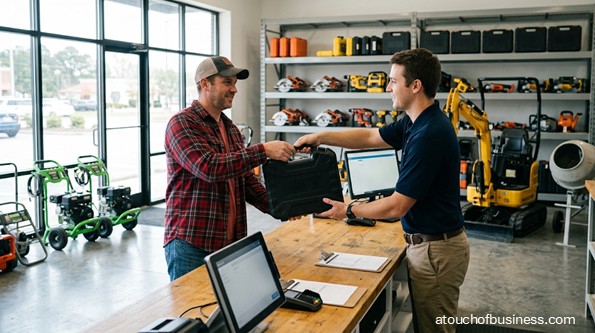
What to Expect From This Guide to Starting a Tool Rental Business
This guide walks you through the key decisions and practical steps involved in starting a tool rental business, from deciding whether it suits you to preparing for opening day. The bullets below highlight selected areas, not everything inside.
Inside the guide, you will find:
- Startup steps: Follow 16 ordered steps, from checking your fit and local demand through funding, zoning, insurance, fleet sourcing, and a test rental cycle.
- Common questions: Find answers on situations outside the main path, such as home-based setups, small towns, strong seasons, and starting without mechanical experience.
- Daily reality: See what a typical day involves, including the parts owners often enjoy and the parts they find hard.
- Business fit: Reflect on the physical, mechanical, customer-service, and liability demands, plus who your customers will be.
- Profit and break-even: Understand how fleet utilization, fixed costs, and slow periods affect whether rentals can cover your costs.
- Local requirements: See which zoning, tax, insurance, and safety questions to verify locally, since rules vary by location and equipment scope.
- Risks and warnings: Review red flags to weigh before you start and warning signs that should delay opening.
The first section looks at whether running a tool rental business suits your skills, finances, and daily routine.
As a tool rental owner, you buy tools and equipment once and rent them out again and again.
Customers pay by the day, week, or four-week period instead of buying, storing, and maintaining tools they rarely use.
Your fleet is your product, and each unit earns only while it is out on rent.
Profit comes from renting each unit many times, so idle units and repair delays reduce what you keep.
Before you spend on tools, review the broader startup process and ask whether this business suits you.
Is a Tool Rental Business a Good Fit for You?
Owning a tool rental business suits you when you can handle shop and counter responsibilities and carry fleet costs before rental income arrives.
Start with your reason for wanting this business. Your motivation needs to carry you through slow weeks, repair backlogs, and difficult customers.
Real passion for the business helps on hard days. Does the idea of owning a tool rental business excite you, or only sound steady?
Owning any business means income uncertainty, constant responsibility, and the possibility that it does not work out.
Talk with your household about time demands and how you will cover living expenses while the business builds.
Consider startup costs, operating costs, and your access to capital. A fleet ties up much of that capital.
Learn from experienced owners you will not compete against. Their daily experience shows what no guide can.
You also have choices about how to enter: start from scratch, buy an existing rental business, or join a rental program.
Who Your Customers Will Be
Your customers will mostly be homeowners and DIY renters, small and mid-size contractors, landscapers, and property managers.
Many of these customers rent to avoid owning, storing, and maintaining a tool they use only occasionally.
Your first customers may include:
- Homeowners and DIY customers: tools for occasional projects, plus a chance to try a tool before buying.
- Small and mid-size contractors: a replacement tool when theirs fails, so jobs keep moving.
- Landscapers: lawn and garden equipment they need only on some jobs.
- Property managers: tools for occasional jobs they would rather not own, store, or maintain.
Customer mix varies by shop. Some owners rent mostly to contractors, some mostly to homeowners, and many to both.
Do you want to spend your days helping these customers choose a suitable tool and use it?
Red Flags Before You Start
A red flag is a condition that should make you pause, verify more, change your model, or reconsider starting.
Market and competition red flags:
- Weak local demand: verify more before you commit.
- A large, long-established rental operation with a wide range already serving your area: reconsider, or narrow your niche.
- Large home-improvement stores that offer tool rental in your market: pause and decide how you would differ.
- Price cutting when a new competitor enters: reduce risk with a lower-cost model.
Money red flags:
- Startup items that exceed your realistic budget: pause, or start with a smaller fleet.
- Funding barriers or no operating reserve: pause before you sign anything.
- Rates that cannot rise enough to offset equipment cost increases while staying competitive: verify more with local rate checks.
- Break-even that needs more rental days than your market can supply: reconsider.
- Slow periods or delayed payments that could drain your cash: reduce risk with a larger operating reserve.
Operations and people red flags:
- No mechanical aptitude and no repair access: pause until you line up service.
- Depending on you for every daily task: verify whether you could step back.
- Equipment lead times that delay opening: verify supplier timelines before you lease.
- Late returns, damage, and refund disputes: reduce risk with ID checks, card holds, and a clear agreement.
- Unreturned equipment: ask an attorney and local law enforcement how it is treated where you operate.
Regulation and risk red flags:
- Zoning that bars equipment rental or outdoor storage: change your location or model.
- A scope that includes equipment needing operator training: verify more on training and insurance, or choose simpler tools.
- Insurance that is unavailable or too costly for your scope: change the model.
- Injury and property damage exposure from tools used on others’ sites: reduce risk with an entity, coverage, and an attorney-reviewed agreement.
- Shop waste, propane, or wash-water rules that add compliance tasks: verify before you buy.
Industry-wide conditions are context for planning, not reasons to quit.
- Capital intensity: you buy the fleet before it earns, and units wear out and need replacement.
- Large retailers and national chains have strong buying power.
- Independent owners commonly compete on service, range, and expertise.
- Supply chain delays and rising equipment costs affect fleet planning.
- Rules differ by equipment class, so a wider scope adds compliance.
- Insurance and liability exposure rise with equipment size and hazard.
Does any red flag describe your situation?
A Day in the Life of Running a Tool Rental Business
A typical day centers on the counter: you rent out tools, take returns, and prepare every returned unit for the next customer.
Customers pick up tools, return tools from earlier rentals, and call in orders.
You or your staff inspect, clean, and repair equipment after every return before it goes out again.
You also finalize paperwork and billing at return.
Much of the day is guidance. Customers often need help choosing a suitable tool and learning to use it.
Recurring tasks beyond the counter include scheduling repairs, ordering equipment and parts, and handling late returns and damage disputes.
Demand shifts with the season and the economy, and some owners adjust staffing in slow periods.
What owners often enjoy:
- Meeting customers and helping them solve project problems.
- Time at the counter with customers, often the best part of the day.
- Working with a people-focused team.
What owners often find hard:
- Late returns, broken equipment, and dishonest or demanding customers.
- Keeping up with new tools and technology.
- Being pulled into day-to-day tasks instead of running the business.
- Keeping equipment in good condition.
- The cost of adding equipment, plus supply and lead-time delays.
- Slow periods and cash flow.
Does this daily mix of customer service, shop tasks, and paperwork suit you?
Step 1: Check Your Fit and Motivation
Test yourself against five demands of this business before you commit to it.
- Physical demands: loading, unloading, cleaning, and moving heavy tools in a shop or yard.
- Mechanical comfort: preparing returned tools, doing simple repairs, or supervising a mechanic.
- Counter and phone service: explaining tools and settling late-return, damage, and refund disputes.
- Liability tolerance: tools go to job sites where injuries can happen.
- Spending before income: you buy the fleet before any rental income arrives.
Which of these would wear on you fastest?
Step 2: Talk With Owners Who Won’t Compete With You
Talk with owners you will not compete against, and prepare your questions before each conversation.
Good choices include rental owners in other markets, hardware store owners, landscapers, and contractors who rent tools.
Trade association state chapters and events are one way to meet rental owners.
Learning from real business owners shows you daily realities before you commit funds.
Prepare questions on:
- Fleet mix.
- Damage and late-return problems.
- Maintenance.
- Insurance.
- Software.
Each owner’s path differs, so treat their answers as experience, not a template.
Step 3: Choose Your Rental Model, Niche, and Equipment Scope
Choose one rental model and an equipment scope before you price anything, because both drive your insurance, training, and space needs.
Common rental models include:
- A counter-based tool rental shop for homeowners, DIY customers, and small contractors.
- Contractor-focused general tool and light equipment rental, with a yard and service bay.
- A rental department inside an existing hardware or retail store.
- Home-based or storage-unit-based rental with a small local fleet.
- Delivery-based rental, where you bring tools to the customer.
Decide whether you rent only hand and power tools or also equipment that needs operator training.
Equipment needing operator training includes aerial lifts, trench shoring, forklifts, and small earthmoving machines.
A wider scope adds insurance, training, delivery, and facility needs.
Decide whether you offer delivery or counter pickup only. Delivery adds a vehicle, a trailer, and driver rules.
Does a simple hand-tool model suit your life, or are you drawn to heavier equipment?
Step 4: Compare Starting, Buying, and Joining a Rental Program
You can start from scratch, buy an existing rental store, or join a rental program.
The best path depends on budget, timeline, support needs, available stores for sale, control, and risk tolerance.
Compare the tradeoffs of starting from scratch or buying a business before you decide.
Buying an existing store involves financing, legal work, and keeping daily operations running during the handoff.
You must also earn the trust of loyal customers who knew the former owners.
Member-owned hardware cooperatives offer rental programs and store identities. Some programs cover rental departments and stand-alone rental centers.
If a rental program is franchised, review its franchise disclosure document before committing.
Step 5: Validate Local Demand and Competition
Validate demand by finding out who rents in your area, what they rent, and what they cannot find.
Study local supply and demand before you choose a location.
Many large home-improvement stores include tool rental departments, and larger contractors often rent from national chains.
List every rental operation in your service area. Note the tool range, customer types, and services each one offers.
Ask local contractors, landscapers, property managers, and homeowners what they rent, what they cannot find, and what frustrates them.
Ask your city or county permit office which permit records are public. Building activity points to contractor demand.
Hardware and home-improvement stores that do not stock rental equipment can become local partners.
Decide why customers would choose you: convenience, a wider range, product knowledge, or availability.
Plan how you reach first customers at opening. Start with direct contact with contractors, landscapers, and nearby retailers.
Step 6: List Startup Costs and Test Profit Potential
Test whether the business can earn enough before you commit: list every startup cost, then check your break-even logic.
Price each cost item locally. A single estimate from another owner will not fit your setup.
Your list should cover the fleet, space, shop equipment, software, vehicles, insurance, permits, and an operating reserve.
Fleet cost sits on your books whether or not units are rented.
Learn two industry measures. Time utilization is the share of time a unit is on rent.
Financial utilization compares rental revenue to the fleet’s original cost.
Work out how many rentals recover a unit’s purchase cost after maintenance, insurance, and storage.
Fixed costs to identify:
- Rent.
- Staff.
- Insurance.
- Loan payments.
- Utilities.
- Software.
- Vehicles.
Estimate how many rental days your market can supply. Compare that to the days you need to cover fixed costs.
Test slow periods and delayed payments. Seasonal swings and economic slowdowns both reduce demand.
Check whether you can raise rates to offset higher equipment costs and still stay competitive.
For method, see this guide to estimating profit and revenue.
Do not commit to a lease, fleet purchase, or hire until your break-even check is done.
Would you still open if your numbers show a thin margin?
Step 7: Plan Operating Capital and Funding
Plan enough operating capital to keep the doors open while your fleet earns.
Cover rent, payroll, insurance, repairs, parts, fuel, and loan payments during slow periods.
Common funding routes include:
- Personal funds.
- Equipment loans or leases secured by the equipment.
- SBA-backed loans.
- Dealer or supplier financing programs.
Learn how to get a business loan before you apply anywhere.
Lenders often require owner equity, collateral, and personal guarantees. Terms vary, so verify them with each lender’s loan officer.
Before you apply, ask the loan officer at each lender, or each investor, which documents are required.
Many lenders also ask for formation and license documents, so plan to submit applications after Step 8.
Start drafting your business plan as you finish earlier steps. The Business Plan section below pulls your costs, funding, pricing, and break-even numbers together.
Step 8: Choose a Structure, Register, and Set Up Taxes
Choose your business structure before you sign major agreements, buy a fleet, or lease a site.
Customers take powered equipment to job sites where injuries and property damage can occur.
You also hold physical assets, sign contracts, and may have employees and vehicles.
Even a small, home-based model carries injury and property damage exposure, so ask an attorney whether forming an entity fits.
Review how to choose a business structure. Take the final choice to an attorney and a tax professional.
Get an EIN, your business tax ID, and register your business.
Register your business name or DBA as needed. Requirements vary by location.
Get any business licenses and permits your city or state requires.
Register for sales tax before you buy rental inventory.
Many states let registered sellers buy rental inventory tax-free by giving suppliers a resale certificate.
Rental taxation varies. Some states tax rental charges, some tax the purchase, and some let you choose.
Equipment you use for your own purposes may not qualify for tax-free purchase.
Ask your state revenue department how it taxes equipment rentals, deposits, damage waivers, and delivery fees.
If you will hire, withholding, unemployment, and workers’ compensation rules also vary by state.
Step 9: Check Zoning and Choose a Location
Confirm in writing that zoning allows equipment rental and outdoor storage at your address before you sign a lease.
Some local codes require a conditional or special use permit for outdoor storage.
Codes may also require fencing, screening, paved surfaces, or trailer parking.
Plan space for a counter, tool storage, and a maintenance bay. Add a wash area, fuel and parts storage, and a loading area.
Which space features you need depends on your model and equipment scope.
Tell landlords plainly about equipment traffic and storage before you sign.
Ask the landlord what insurance proof the lease requires, and get quotes before you sign (see Step 10).
Confirm a certificate of occupancy for the space and your use.
Ask the local fire marshal about fuel and propane storage. Ask your local sewer or stormwater office about wash-water discharge.
Check city rules before ordering signs. A sign permit may be required.
Step 10: Arrange Insurance and Risk Planning
Get insurance quotes from an agent who works with rental businesses before you buy a fleet.
Review the basics of business insurance so you can compare quotes.
Coverages to price include:
- Inland marine coverage on the fleet, also called a rental equipment floater.
- General liability.
- Commercial property for the premises.
- Commercial auto for vehicles and trailers.
- Property in transit.
- Environmental or pollution liability.
- Business interruption.
Ask about coverage for equipment off your premises, theft, and replacement-cost limits.
Leases and lenders may require proof of coverage, so verify before you sign.
Step 11: Source Equipment, Suppliers, and Maintenance
Open supplier accounts, buy only the fleet your first customers need, and plan how every returned tool gets serviced.
Ask supplier and manufacturer representatives about programs built for rental operations.
Match your first purchases to your customers’ needs. Many owners start narrow and add units as demand shows.
Check lead times before you commit.
Plan inspection, cleaning, and repair after each return. Decide who services the fleet, and line up parts and repair access.
Set up asset tags or numbering so you can track each unit.
Servicing engines produces used oil, filters, rags, and antifreeze. Some shop wastes, such as parts-washer fluid, may count as hazardous waste.
Waste quantity decides whether you are regulated as a generator. Verify generator status with the EPA and your state environmental agency.
If you plan propane exchange, some states license LP-gas filling and adopt NFPA 58 safety rules.
Verify with your state LP-gas regulator before you offer propane exchange.
Does a smaller, focused fleet suit your budget and your comfort with risk?
Step 12: Set Up Rental Software, Agreements, and Policies
Choose rental management software and have an attorney review your rental agreement before you take your first rental.
Rental software tracks availability, reservations, contracts, returns, damage, and maintenance.
Your rental agreement should cover:
- Rental period and rates.
- Late fees and deposits.
- Use limits and who may operate the tool.
- Return condition.
- Damage and loss.
Decide whether to offer a damage waiver.
A damage waiver is a contract term between you and the customer, not insurance. It does not cover third-party liability.
Some states have damage waiver rules written for rental vehicles.
Whether any rule covers tool rental damage waivers is unverified, so ask an attorney or your state consumer-protection agency.
Set policies for ID, card authorization, and deposits.
Record each unit’s condition at check-out and check-in. Photos and checklists support damage claims.
Step 13: Set Your Rental Rates
Many owners price from a daily rate, then discount weekly and four-week or monthly rates.
Use this guide to price your products and services with your own costs in mind.
Build each rate from:
- Unit cost.
- Expected utilization.
- Maintenance.
- Insurance.
- Storage.
- Transport.
Compare local competitors’ rates, minimum rental blocks, and add-on charges.
Set rules for late fees, cleaning fees, delivery fees, and deposits.
Step 14: Set Up Banking and Payments
Open a business bank account and set up card processing that supports holds for deposits.
Follow this guide to open a business bank account, and keep business and personal finances separate.
Set up sales tax collection on rental charges as your state requires.
Confirm your payment setup matches your lender’s requirements.
Step 15: Plan Staffing, Training, Delivery, and Safety
Train every person who handles customers, tools, fuel, or vehicles before opening day.
Counter staff need product knowledge. Customers often need guidance on the tool and the job before they leave.
Plan how you explain operation and safety for each tool category.
For some equipment classes, such as aerial work platforms, plan model-specific familiarization when equipment is rented.
A state-run OSHA plan has cited a rental company for missing familiarization at rental.
Customers who employ operators carry operator training duties, and you carry them for your own staff.
Trench work requires a competent person on site, usually the excavation contractor.
If you have employees, check OSHA workplace safety rules, protective equipment, and hazard training.
If you deliver, confirm vehicle weight, trailer rules, and driver requirements.
A USDOT number may apply when a truck-and-trailer combination is used in interstate commerce at certain weights.
Check with the Federal Motor Carrier Safety Administration on whether delivering your own rental equipment requires a USDOT number.
Set safety rules for fuel, propane, and shop tasks.
Could you run staff training yourself, or would you need to bring in help?
Step 16: Run Pre-Opening Checks and a Test Rental Cycle
Run a sample rental from reservation through return and billing, then confirm every item below before you open.
Permits and taxes:
- Entity formed, EIN issued, and business name or DBA registered.
- Business license and sales tax account in place.
- Resale certificates ready for suppliers.
- Zoning and outdoor-storage approval confirmed in writing.
- Certificate of occupancy confirmed.
- Fire, environmental, and propane approvals verified if they apply.
Insurance and finances:
- Insurance bound, with proof ready for your lease and lender.
- Business bank account and card processing live.
- Sales tax set up on rental charges.
Fleet and shop:
- Fleet delivered, inspected, tagged, and entered in your software.
- Operating manuals and decals on every unit.
- Used oil, fuel, and wash-water handling set up.
- Opening supplies, parts, and fuel stocked.
Paperwork and policies:
- Rental agreement reviewed by an attorney.
- Deposit, ID, and card authorization procedures set.
- Damage waiver terms final, if you offer one.
- Rates and late fees entered in your software.
People and signs:
- Staff trained on tools, safety, check-out, and check-in.
- Delivery vehicle and driver rules confirmed, if you deliver.
- Required signs, labels, and notices posted.
Business Plan
Draft your business plan as you complete the earlier steps, then finish it once costs, funding, pricing, and break-even inputs are in place.
Your business plan pulls together your rental model, equipment scope, and startup cost list.
Add your legal and tax checks, funding plan, rental rates, and pre-opening confirmations.
Include your profit potential: fixed costs, the rental days you need, utilization, margin pressure, and slow-period risk.
Use your own local numbers. A figure from another owner will not match your costs, prices, or market.
A lender or investor may require a business plan, so confirm document requirements before you apply.
Opening-Day Red Flags
Delay opening if any warning sign below applies to you.
- Zoning or outdoor-storage approval exists only verbally. Get it in writing first.
- Insurance is not bound, or proof is not ready for your lease or lender.
- Units lack manuals, decals, or inspection records that customers need at handoff.
- Your deposit and card-hold process has not been tested on a sample transaction.
- Staff cannot explain operation and safety for each tool category.
- Sales tax is not set up on rental charges. Fix this before your first invoice.
- Waste, fuel, or propane handling has no plan. Verify with the regulator first.
Frequently Asked Questions
Answers below cover situations outside the default startup path, such as home setups, small towns, and strong seasons.
Can I run a tool rental business from home?
Yes, some owners start with a small local fleet kept at home or in storage units.
Zoning often limits outdoor storage of equipment to commercial or industrial districts.
Check your zoning and home-occupation rules before you store a fleet at home.
Can I start without equipment or mechanical experience?
Yes. Owners have entered rental with equipment as new territory, and the learning curve continues.
Retailers advise finding a reliable mechanic, either third-party or in-house.
One owner started small with sprayers and pressure washers after Small Business Development Center classes.
Another owner is also the lead fleet mechanic.
Your skills, your repair access, and the range of tools you plan to rent decide how much experience you need.
Should I add tool rental to an existing hardware or retail store?
Often, yes. Retailers report that rental fits alongside retail sales.
You still need a reliable mechanic and close attention to the liability that larger equipment brings.
How does a small-town market change the plan?
Competition may be lighter, but prices must match what local customers can afford.
One owner reported that towns that small rarely draw national chains.
What if my market has strong seasons?
Plan for a cash-flow squeeze in the slow season.
One owner described a winter cash-flow crunch and responded by adding off-season items such as ground-thaw machines and propane exchange.
Does a signed liability waiver protect me from injury claims?
No. A signed waiver does not replace insurance, and a lawsuit is still possible.
Negligence claims have followed injuries involving rented equipment that allegedly was not inspected.
Ask an attorney how waivers work where you operate.
How do I know when to sell or retire a rental unit?
Compare each unit’s maintenance cost to the rental income it brings in.
Rental software can estimate a unit’s return from its usage history, and resale value matters too.
One owner reviews equipment each fall and sells units before year’s end.
Interviews with Tool Rental Business Professionals
These interviews cover starting small, choosing equipment, controlling overhead, serving customers, managing employees, maintaining a fleet, using technology, and preparing a rental business for growth.
Readers can use these experiences to examine their equipment choices, operating costs, customer needs, staffing plans, business systems, and growth assumptions before starting a tool rental business.
How to Bootstrap an Equipment Rental Company From a Single Skid Steer
James Polkinghorne, owner of James Equipment, explains how he started with one skid steer, a trailer, and a few attachments before gradually building the business. He discusses starting part time, controlling overhead, and the financial pressure that can affect a young rental operation.
This interview is useful for someone considering a tool rental business because it shows how a rental operation can begin with a limited fleet rather than a large initial inventory. It also highlights the importance of keeping fixed costs manageable while demand develops.
The Challenge & Complexity of Rental
Josh Nickell, CEO of Northside Tool Rental, discusses his experience in the equipment rental industry, staffing challenges, customer service, technology, inventory decisions, data, and operating multiple rental locations.
This interview helps prospective rental business owners understand that the business involves much more than purchasing equipment and renting it out. Nickell’s experience illustrates the importance of employees, customer consultation, tracking demand, and using rental data when making equipment and growth decisions.
Operational Scalability with Johnny Dragicevic of CanLift Equipment
CanLift co-founder Johnny Dragicevic discusses starting an equipment rental company, including an early decision to open without a business plan. He explains lessons involving facilities, budgeting, hiring, systems, key performance indicators, cash flow, and planning for sustainable growth.
This interview is particularly useful before starting because Dragicevic describes mistakes made during CanLift’s beginning and how those experiences changed the company’s approach to planning. His advice provides practical issues to consider before committing to a location, equipment, employees, and expansion.
Rental Center: Betting on What’s Next
Crown Rental owner Doug Haas and members of his team discuss how the rental operation has evolved with changing customer demand. The conversation covers fleet selection, seasonal demand, maintenance, labor, customer convenience, security, technology, and changes in the types of tools customers rent.
This interview can help a prospective rental business owner see why inventory decisions should follow the needs of the local market rather than remain fixed. It also shows how maintenance standards, labor requirements, customer convenience, and theft prevention can influence daily operations.
Small Telehandlers Make a Big Impact: A Conversation with AK Equipment Rental
Brian Arndt, manager of AK Equipment Rental and Sales, explains how customer requests influenced the company’s decision to add a compact telehandler to its fleet. He discusses how customers use the equipment, why its versatility matters, and how demand has affected the company’s inventory decisions.
This interview is useful for someone planning a tool rental business because it demonstrates a customer-driven approach to choosing equipment. Instead of simply adding machines, AK Rentals looks at specific customer problems, equipment versatility, transportation requirements, and actual rental demand.
Related Articles
- How To Start a Heavy Equipment Rental Business
- How To Start a Hardware Store
- How To Start a Restaurant Equipment Leasing Business
Sources:
- American Rental Association / Rental Management: Veteran Rental Operators, Alexx Bacon 12 to Watch, Taking Over a Rental Store
- International Rental News: ARA Rental Metrics Standards, Rental Familiarization Citation
- ForConstructionPros: Rental Branch Owner Q&A, Rental Owners Talk Challenges, Rental Owners Air Concerns, Lowe’s Tool Rental Rollout
- Rental Equipment Register (RER): Masters of Rent, Competing With Big Boys, Taylor Rental Store Opens, Home-Based Tool Rental Opens
- Turf Magazine: Equipment Rentals Good and Bad
- Point of Rental: Smoothing Out Slow Season, 12 to Watch Under 40
- RentalHQ: Rental Owners’ Three Facts
- True Value Company: True Value Rental Services
- State Revenue and Tax Agencies: Rental and Leasing Fact Sheet, Rental Resale Advisory Opinion, Lessor Resale Certificate Note
- EZRentOut: Filing Rental Sales Tax
- Insurance and Damage Waivers: Rental Operator Insurance Guide, Rental Insurance Types, Liability Waiver Basics, Equipment Rental Insurance, Damage Waiver Program Terms
- State Statutes and Analyses: Vehicle Damage Waiver Statute, Damage Waiver Bill Analysis
- DOT and Trucking: DOT Number Requirements, Do I Need DOT Number
- Safety and OSHA: Aerial Lift Training Rules, Rented Forklift Training, Trench Shoring Inspection, Rental Inspection Case Study
- Propane Safety: Filling Propane Containers, Propane NFPA 58 Adoption, Cylinder Filling Checklist, LP-Gas Filling Procedures
- Environmental Compliance: Rental Shop Waste Inspection, Maintenance Shop Compliance Guide, Reducing Shop Wastes
- Zoning Documents: Equipment Rental Special Use, Rental Yard Use Permit, Outdoor Storage Zoning Rules
- Funding: SBA Loan Requirements, Equipment Financing Requirements, SBDC Business Loan Guide
- Pricing and Agreements: Rental Pricing Guide, Rental Equipment Pricing, Rental Agreement Contents
- JIM Blog: Equipment Rental Startup Guide