
What to Expect From This Guide to Starting a Car Wrapping Business
This guide follows the key decisions and practical steps involved in starting a car wrapping business, moving from installer fit and service design to market research, training, finances, shop setup, documentation, and opening checks. The points below represent selected benefits rather than the article’s full depth.
Inside the guide, you will find:
- Startup roadmap: Move from skills and service choices through market research, training, funding, registration, shop setup, documents, hiring, and opening checks.
- Owner interviews: Learn from wrap shop owners discussing training, equipment, pricing, operations, growth decisions, and difficulties encountered while building their businesses.
- Common questions: Review answers on wrap licensing, skill development, insurance, sales tax, deposits, vinyl choices, space needs, acquisitions, and profitability risks.
- Craft and fit: Consider installation skill, physical precision, graphic-design workflow, household finances, and whether detailed vehicle work suits you.
- Market and model: Compare retail wraps, fleet graphics, partial jobs, added services, outsourced printing, in-house production, and local demand.
- Cost and pricing: Map equipment, lease, materials, fixed expenses, break-even volume, reserves, deposits, and the danger of underpricing.
- Shop preparation: Check zoning, climate control, lighting, ventilation, tools, supplier accounts, insurance, intake records, test wraps, and payment systems.
The main article first explains how a professional wrap shop operates and why installation quality depends on both skill and environment.
What a Car Wrapping Business Actually Is
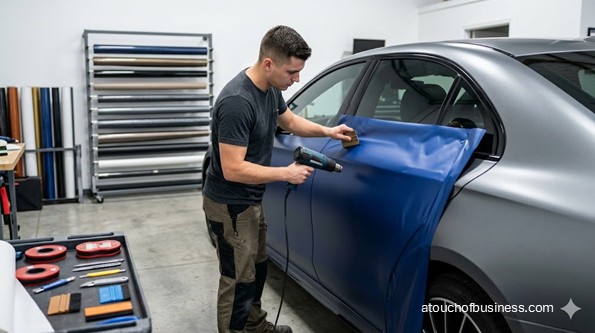
A shop-based car wrapping business installs vinyl film over vehicle surfaces to change the color, apply commercial graphics, or transform a vehicle’s appearance without paint.
Services can range from full color-change wraps and fleet branding to partial wraps, spot graphics, chrome delete, and specialty finishes like matte, satin, metallic, or carbon fiber.
The work is done in a dedicated installation bay — an enclosed, climate-controlled space where precision and cleanliness directly affect the quality of every finished job.
Demand comes from two directions: individual vehicle owners who want a fresh look without a costly repaint, and businesses that want their vans and trucks wrapped in branded graphics.
Fleet clients tend to provide more consistent, repeat volume than individual retail customers.
This is a skilled trade business. Quality installation takes months of deliberate practice to develop — not a few weekend sessions.
The owner or lead installer must consistently stretch vinyl around compound curves, prep surfaces properly, and finish edges cleanly before taking on paying customers.
Before you follow the startup steps, spend time deciding whether this business fits your skills, your finances, and your life right now.
Ask yourself whether you can handle income uncertainty during the startup period. Can your household cover expenses for several months without predictable revenue?
Does your family understand and support the financial risk? These questions matter before you spend anything.
The challenges of ownership hit harder when you are the installer, the estimator, the scheduler, and the customer contact all at once — especially at the start.
Three entry paths are worth weighing early:
- Starting from scratch — the most common path; full control over model, pricing, and setup
- Buying an existing wrap shop — can include equipment, customers, and supplier accounts; requires careful due diligence on equipment condition and the reason for the sale
- Joining a franchise — options like SpeedPro, Image360, Tint World, and Signarama offer training and systems support in exchange for higher upfront investment and ongoing fees
The right path depends on your available capital, timeline, desired support level, and how much control you want over your own model.
One of the most useful things you can do before spending a dollar is talk to wrap shop owners in non-competing markets. Go in with prepared questions.
Ask about realistic startup costs, how long it took to reach break-even, which suppliers they trust, and what they would do differently.
Their journeys will differ from yours, but the patterns they describe are worth more than any guide. You can explore what owner conversations can look like at advice from real business owners.
Red Flags Before You Start
Some issues are worth examining before you commit to a location, sign a lease, or buy equipment. These are not reasons to quit — they are reasons to slow down and verify.
Pause or change direction if any of these apply:
- You cannot yet complete a clean full wrap on a test vehicle. Launching before you can produce consistent quality leads to re-wrap rework — which costs material and labor with no additional revenue.
- You have not decided whether to print in-house or outsource printing. This single decision drives the largest chunk of startup equipment cost. Outsourcing is a legitimate lower-cost entry path. Committing to in-house equipment before validating job volume can trap you with high fixed costs from day one.
- The target market is already saturated with well-reviewed competitors. If local shops have strong reputations and no apparent service gaps, entering as an unknown at competitive prices may not generate enough volume to reach break-even.
- You have not calculated break-even job volume. Rent, climate control, equipment financing, and insurance are fixed monthly costs. If you do not know how many jobs per month you need to cover them, you cannot commit to a lease responsibly.
- You plan to underprice early jobs to win customers. This is the most commonly cited profitability failure in this industry. Once a base is established at low rates, raising prices is very difficult.
- You have no cash reserve for the first several months. Commercial clients take time to develop. Retail jobs can be seasonal and inconsistent early on. Without a financial cushion, the business may not survive long enough to reach steady volume.
- The space you are considering lacks climate control, ceiling clearance, or proper lighting. These are functional requirements — not optional upgrades. A poor environment produces poor results regardless of installer skill.
Step 1: Assess Your Fit and Skills Honestly
Before anything else, take a clear look at whether you have — or can realistically develop — the skills this business requires.
The skills you need to launch include:
- Vinyl application technique: surface prep, squeegee control, heat gun use, and handling compound curves
- Knowledge of surface decontamination before any film is applied
- The ability to estimate job scope, material needs, and labor time accurately
- Client communication — setting expectations on timelines, material limits, and aftercare
- Basic graphic design skill or the ability to manage a design workflow
The physical demands are real. Installers spend long stretches bending, crouching, and stretching around a vehicle’s body panels.
A full wrap can take many hours. The installation requires sustained concentration — one contamination or alignment error can mean pulling and reapplying an entire panel.
This business fits people who are patient, detail-oriented, and genuinely interested in mastering a process-based craft.
If you find repetitive precision tasks draining rather than satisfying, that is worth knowing before you invest in a shop.
Step 2: Talk to Wrap Shop Owners in Non-Competing Markets
Seek out owners in cities or regions where you will not be direct competitors. Prepare specific questions before each conversation.
Ask about:
- How long it took to develop installation consistency good enough for commercial clients
- Which suppliers they rely on and why
- How they structured early pricing and what they would do differently
- What their slow months look like financially and how they managed them
- Whether they print in-house or outsource, and what drove that decision
- How they handle vehicle intake documentation to protect against disputed damage claims
Each owner’s story is different. But the patterns across multiple conversations — the mistakes that keep coming up, the setup choices they wish they had made earlier — are genuinely useful before you commit.
Step 3: Decide on Your Service Model
Your service focus drives nearly every other startup decision — shop size, equipment, suppliers, target customers, and pricing.
The main service model choices for a wrap shop are:
- Color-change and aesthetic wraps for individual vehicle owners — gloss, matte, satin, metallic, chrome, carbon fiber, color-shift finishes
- Commercial fleet graphics and advertising wraps for businesses — higher per-project volume, more consistent and repeat work, more B2B-oriented
- Partial wraps, spot graphics, and cut decals — lower ticket per job but faster turnaround and simpler installation
- Multi-service model adding paint protection film (PPF), window tinting, or detailing — increases revenue streams but adds equipment cost and operational complexity
Decide early whether to handle graphic design in-house or outsource it to a designer or vendor.
Also decide whether to invest in a wide-format printer and laminator or to send print files to a trade print supplier. This is one of the biggest cost variables in the entire startup.
In-house printing vs. outsourcing each has real tradeoffs:
- In-house printing enables faster turnaround and higher margin on graphic wrap jobs, but requires a substantial equipment investment
- Outsourcing printing significantly lowers startup costs and lets the shop focus on installation quality while building volume — many successful shops start this way and bring printing in-house later
Make this call deliberately, not by default. Your startup budget and projected job volume should drive it.
Step 4: Research Your Local Market
Before committing to a location or a lease, understand whether enough demand exists in your market to support the shop.
Check these points on your local market:
- Map competing wrap shops using Google Maps and local business directories — note their services, review quality, and apparent wait times
- Observe commercial vehicle traffic: how many vans and trucks are already wrapped in your area?
- Call competitors for quotes on a specific job, such as a full color-change wrap on a mid-size SUV, to understand local pricing ceilings
- Talk with local fleet-owning businesses — landscapers, HVAC companies, food businesses — to gauge commercial wrap demand
- Check whether busy competitors with strong reviews have visible wait times — this can signal unmet demand
If the market is already dense with established shops and no clear service gaps exist, that is important to know before you sign a lease.
Local demand analysis is a legitimate go/no-go step — not just background research.
Step 5: Weigh Your Entry Path
Once you have a clearer picture of the market, think carefully about how you want to enter.
Starting from scratch gives you full control over the model, pricing, setup, and culture. It is also the most common path and works well for owners who want to build deliberately and reinvest.
Buying an existing shop can mean stepping into an operating business with equipment, trained staff, supplier accounts, and an active customer list.
Due diligence matters here. Check the age and condition of the printer and laminator, understand whether commercial accounts are truly transferable, and get clarity on why the owner is selling.
Franchise options are worth exploring if you have higher capital and want structured support. SpeedPro, Image360, Tint World, and Signarama all operate in this space.
Franchises offer brand recognition, training programs, and supplier advantages, but require higher upfront fees and ongoing royalties.
There is a useful breakdown of how to think through this decision at starting from scratch vs. buying a business.
Step 6: Get Hands-On Training
Formal training is essential before opening a shop-based wrap business. Videos and home practice alone are not enough to develop the consistent technique commercial clients expect.
The main industry training and certification paths are:
- PDAA (Professional Decal Application Alliance) — Basic and Master Certified levels; written test plus hands-on flat and compound vinyl installation demonstration; widely respected across the industry
- Avery Dennison Certified Wrap Installer (CWI) — two-day workshop covering vinyl application, surface prep, tool use, and specialty films; written and hands-on exam
- 3M / UASG (United Application Standards Group) — hands-on training at authorized centers; leads to 3M Certified Graphics Installation Company status; individual skill training is available before company-level certification
- Independent training providers such as The Wrap Institute and Elite Wrappers offer beginner-to-advanced course options
Certification is not legally required to operate a wrap shop. However, it signals quality to commercial clients and reduces the re-wrap rework that destroys early profitability.
Practice extensively on scrap panels and test surfaces before accepting your first paying job.
Complete at least one full wrap in your actual shop space — under real lighting and temperature conditions — before you open.
Business Plan
A solid startup plan needs to do more than describe what you want to offer.
It needs to answer whether the business can actually cover its costs at realistic prices in your market.
Start by defining your service model, target customer types, and the in-house vs. outsourced printing decision.
These choices drive your equipment list, space requirements, and break-even math.
Your plan should map out:
- Total startup cost items to price out — equipment, lease deposit, tenant improvements, insurance, training, supplies, and initial vinyl inventory
- Monthly fixed costs — rent, utilities, equipment financing payments, insurance premiums
- Variable costs per job — vinyl and laminate film, prep supplies, print costs if outsourced, labor if you hire
- Local market pricing ceiling based on competitor quotes
- Break-even job volume — how many jobs per month at your average price and margin cover your fixed costs
- Cash reserve — what you need set aside to cover fixed costs during the first months before volume builds
The relationship between those numbers is the most important thing in your plan.
If the break-even job volume exceeds what your shop can physically complete — or exceeds realistic local demand — the model does not work at that location or at those costs.
Price from your actual costs upward, not from the lowest competitor downward. Underpricing to win early customers is the most commonly cited failure mode in this industry.
A cost-plus model — direct costs plus a markup sufficient to cover overhead and return a profit — is a practical starting point. Local competitor quotes set the market ceiling you need to stay within.
Slow months are real, particularly before commercial clients are established. Plan for that slow period in your cash reserve — not around it.
You can find a broader framework at how to write a business plan.
For a realistic look at how revenue and profit estimates work in practice, see estimating profitability and revenue for a new business.
Step 7: Secure Your Startup Funding
Before approaching any lender, know your total startup cost picture. Lenders want to see that you have done the math.
Common funding paths for a wrap shop include:
- SBA 7(a) loans — lenders typically want a credit score above 680, a written business plan, and collateral
- Equipment financing — secures the loan against the printer, laminator, and other equipment; often faster approval than a general business loan
- Personal savings or family support — most flexible but requires enough personal capital to also cover a meaningful cash reserve
Avoid over-investing in top-of-the-line equipment before the shop has a real customer base.
A reliable mid-range printer generates revenue while keeping monthly financing payments lower. Upgrading later, once volume justifies it, is the safer path.
Your funding plan also needs to cover working capital — not just equipment and setup. Plan for at least six months of fixed costs beyond your initial launch expenses.
Step 8: Choose a Legal Structure and Register the Business
Most wrap shops organize as an LLC (Limited Liability Company). This separates personal assets from business liabilities and keeps taxes straightforward for a small operation.
Choose a business name, confirm it is available through your state’s Secretary of State, and register your entity.
If you operate under a name different from your legal entity name, file a DBA (doing business as) with your state or county as required.
Apply for a free Employer Identification Number (EIN) directly through the IRS at irs.gov.
The application takes minutes and issues the number immediately online.
You need the EIN for banking, taxes, payroll, and supplier accounts. Do not use third-party websites that charge a fee — the EIN application is free from the IRS directly.
More on entity choices is at how to choose a business structure.
Step 9: Handle Tax Registration and Compliance Setup
Register for a state sales tax permit — often called a seller’s permit — through your state’s Department of Revenue or Taxation before making any taxable sales.
Sales tax on vehicle wrap services varies significantly by state. Some states tax the full charge for both labor and materials.
Others tax only the material portion — and rules may differ further based on how the invoice is structured.
Rules may differ further based on how the invoice is structured and whether a vehicle is new or used.
This is not something to sort out after the first invoice goes out. Consult your state’s Department of Revenue or a CPA familiar with automotive services before you bill a single client.
If you hire employees, you will also need to register for state employer withholding and unemployment tax accounts. Requirements vary by state.
Step 10: Get Licensed and Verify Local Permits
Obtain a general business license from your city or county clerk or licensing office before opening.
Some states require an auto repair business license, automotive service dealer registration, or similar credential for businesses that work on vehicles — including cosmetic modification services like vehicle wraps.
This is not uniform nationally. Check with your state’s Department of Motor Vehicles or Bureau of Automotive Repair to confirm what applies in your state before opening.
More on the permit and license landscape is at business licenses and permits.
Step 11: Find the Right Shop Space
Your installation environment directly determines the quality of every wrap you produce. A bad shop environment produces bad wraps regardless of installer skill.
The physical requirements for a professional wrap bay are non-negotiable:
- Size: At least 1,000–1,500 square feet, with room to walk completely around a full-size vehicle plus space for your printer, prep tables, and material storage
- Ceiling height and door clearance: At least 10–12 feet of ceiling clearance and a garage door opening of at least 12 feet to accommodate vans and SUVs
- Climate control: Vinyl application requires consistent temperatures between approximately 65–75°F year-round; below 60°F, film becomes brittle and adhesive bonds weaken; above 85°F, film overstretches and bonds unevenly — this is a functional requirement, not a comfort upgrade
- Lighting: Bright, even LED panel lighting to reveal bubbles, creases, and surface contamination during installation
- Ventilation: Adequate airflow to manage prep chemical fumes, particularly when using isopropyl alcohol
- Dust control: A sealed environment — dust trapped under vinyl film shows up as visible defects in the finished wrap
Confirm zoning before you sign. Wrap shops typically require light industrial or commercial zoning.
Check with the city or county planning department before committing to any space.
A certificate of occupancy may be required before you operate, depending on the jurisdiction. Verify this with the local building department.
When negotiating the lease, ask about a Tenant Improvement allowance if the space needs lighting upgrades, HVAC work, floor sealing, or garage door modifications.
Step 12: Purchase Equipment and Set Up the Shop
Your equipment list depends primarily on whether you are printing in-house or outsourcing. This matters because the difference in upfront cost is significant.
If printing in-house, your core production equipment includes:
- Wide-format inkjet printer — eco-solvent, latex, or UV-LED; 54″ or 60″ format (brands: Roland, HP, Mimaki, Mutoh)
- Roll laminator — protects printed panels with a clear overlam; must match printer width
- Vinyl cutting plotter — for die-cut contour cutting and custom lettering (brands: Graphtec, Summa, Roland)
- RIP software — controls print output, color management, and cut paths (FlexiSIGN, Roland VersaWorks, Onyx, Caldera)
For installation, every shop needs these tools regardless of the print decision:
- Felt-edged squeegees in multiple hardness levels
- Knifeless tape for clean panel edge cuts without scoring the paint underneath
- Heat guns with variable temperature control
- Infrared thermometer to verify surface temperature during application
- Utility knives with fresh blades
- Trim removal tools for panel removal where needed
- Slip solution for wet application technique
Surface preparation supplies are essential before any vinyl touches a vehicle:
- pH-neutral car wash soap
- Clay bars and lubricant for bonded contaminant removal
- Isopropyl alcohol (IPA) at 70% or higher concentration for panel wipe-down
- Iron remover spray for rail dust and fallout
- Clean microfiber towels
Your design workstation should include:
- A capable computer for handling large-format design files
- Adobe Illustrator or CorelDRAW Graphics Suite — both are industry standard for wrap design
- A vehicle template library subscription for accurate wrap layout around specific vehicle models
Set up a color swatch display so walk-in customers can see and compare vinyl finishes — gloss, matte, satin, metallic, carbon fiber, and color-shift options.
Step 13: Open Supplier Accounts
Open trade accounts with wholesale vinyl distributors before your first order. Waiting until you need materials to establish an account adds unnecessary delay.
The two major U.S. wholesale distributors for the wrap industry are Fellers and Grimco.
Both carry the leading brands: 3M Wrap Film Series 2080, Avery Dennison Supreme Wrapping Film, and ORACAL 970RA and 975 series.
Know the difference between the two main vinyl types before ordering:
- Cast vinyl — flexible, conformable, designed for complex body curves and full wraps; typically lasts 5–7 years; the professional standard for quality commercial and color-change installations
- Calendered vinyl — less expensive and less flexible; suited for flatter surfaces or shorter-term applications; not recommended for full wraps on complex body panels
If outsourcing printing, identify and qualify a print vendor before you need them. Understand their turnaround time, file format requirements, and how they handle color profiles.
A slow or unreliable print vendor directly delays your jobs and your revenue. Establish a local backup supplier as well so a single supply disruption does not hold up a customer’s vehicle.
Step 14: Set Up Insurance
A shop-based wrap business carries specific insurance needs that differ from most service businesses. Get coverage in place before any customer vehicle enters the bay.
The key coverages for a wrap shop are:
- General Liability — covers bodily injury and property damage claims at the shop
- Garage Keepers Liability — covers physical damage to a customer’s vehicle while it is in your care, custody, or control; this is a separate policy from general liability; it specifically covers scenarios like fire, theft, collision, vandalism, or weather damage while a vehicle is in your bay
- Commercial Property — covers the building, equipment, and shop contents
- Professional Liability — covers claims related to design errors that require a re-wrap or rework
- Workers’ Compensation — legally required in nearly every state once you hire employees; the employee threshold that triggers coverage varies by state; verify your state’s specific requirement before hiring anyone
Work with an insurance broker experienced in automotive service businesses. They can build a policy package that reflects the specific risks of operating a vehicle modification shop.
Step 15: Set Up Banking, Payments, and Pricing
Open a dedicated business checking account after you have your EIN and entity registration documents in hand. Keep business transactions entirely separate from personal finances from day one.
Set up a merchant account or payment processing system to accept debit cards, credit cards, and digital payments.
Most wrap shops require a non-refundable deposit — commonly 50% of the total job — at booking. The deposit covers material cost and secures the customer’s installation slot.
The remaining balance is typically due at pickup after the customer approves the finished wrap.
Before quoting your first job, build a clear pricing structure. Research local competitor pricing, calculate your direct cost per job, and apply a markup that covers fixed overhead and returns a profit.
Pricing below your actual cost structure to win early customers is a path that is very difficult to reverse once a customer base is established.
More on pricing is at pricing your products and services.
Step 16: Prepare Your Job Documents and Shop Forms
Before the first vehicle rolls in, have your paperwork ready. A professional job process protects both the customer and the shop.
The documents you need before opening include:
- Written job order / service agreement — defines the scope, materials, timeline, and payment terms before any installation begins; do not start a job on a verbal agreement
- Vehicle intake inspection checklist — documents all pre-existing paint damage, chips, scratches, and surface issues before you accept the vehicle; this is your protection if a customer disputes damage after the wrap is removed
- Deposit invoice and final receipt template
- Customer aftercare instruction sheet — tells the customer how to wash, maintain, and protect the wrap; reduces rework complaints caused by improper care
- Resale certificate (if applicable in your state) — allows you to purchase vinyl materials from suppliers without paying sales tax, since the obligation passes through to the end customer
A signed job scope before installation starts — not after — is the single most effective way to prevent disputes that eat into early profitability.
Step 17: Hire or Partner for Installation Help
Many wrap shops launch owner-operated. A second skilled installer speeds full wraps significantly and increases daily capacity.
If you hire, look for applicants with installation experience and ideally a certification from PDAA, Avery Dennison, or 3M/UASG.
A paid trial installation on a test panel is a standard vetting approach before making a hiring commitment.
If full-time hiring is not yet warranted, consider a skilled contract installer on a per-job basis until volume justifies a permanent addition.
Workers’ Compensation insurance is legally required in nearly every state as soon as you hire employees. In most states, the requirement applies with your very first hire.
Verify your state’s requirement before any hiring decision. Guidance on bringing people on is at how and when to hire.
Step 18: Complete Pre-Opening Readiness Checks
Do not open until every item on this list is confirmed. A shop that opens before it is truly ready risks damaging customer vehicles, creating compliance problems, or producing poor-quality work on paid jobs.
Before the first customer vehicle enters the bay:
- All business licenses, permits, and certificate of occupancy (if required) obtained and in hand
- Zoning confirmation documented
- Sales tax permit active; sales tax treatment confirmed with your state or CPA
- All insurance policies active; certificates of insurance obtained
- Workers’ Compensation active if any employees are hired
- Shop lighting, climate control, and ventilation operational and verified
- Equipment installed, calibrated, and tested — at least one test print run completed if printing in-house
- Supplier accounts open; initial vinyl inventory and prep supplies stocked
- Design software installed; vehicle template library loaded; printer color profiles configured
- Business bank account and payment processing tested
- Written job order form ready; deposit policy established
- Vehicle intake inspection checklist ready for use
- Customer aftercare instruction sheet prepared
- At least one full practice wrap completed inside the actual shop under real operating conditions
That last item is not optional.
Running a practice wrap in the actual bay confirms that your lighting, temperature, ventilation, and workflow function as a system — before a paying customer’s vehicle is on the line.
Opening-Day Red Flags
These are the setup gaps that most commonly trip up new wrap shops at or just after launch. Go through this list before you accept the first booking.
- No vehicle intake inspection checklist in use. Every vehicle must be documented for pre-existing paint chips, scratches, and damage before it enters the bay. Without documentation, any post-wrap damage dispute defaults to your liability.
- Written job orders not in use. A verbal agreement or short email is not enough. Every job needs a signed scope — materials, coverage area, timeline, and payment terms — before installation begins.
- Deposit policy not established or not enforced. If a customer cancels after you have ordered the vinyl, an unprotected booking costs you real material money with no recovery path.
- Climate control not tested under load. Confirming the HVAC works on a mild day is not the same as confirming it holds 65–75°F in peak summer or winter conditions. A temperature failure mid-installation is a job-ruining event.
- Printer and laminator not fully calibrated. Confirm color profile accuracy with test prints before a customer’s paid graphics go to press. Re-print costs and delays are avoidable.
- Initial vinyl stock not received or verified. Confirm materials are on hand and undamaged before scheduling the first jobs that depend on them.
- No aftercare documentation to give customers at pickup. A customer who damages the wrap through improper care and then disputes the result is a preventable problem. Have the aftercare sheet ready at every handoff.
- Payment processing not tested. Run a test transaction before the first real customer payment. A system that fails at pickup is an embarrassing and avoidable problem.
Frequently Asked Questions
Do I need a government-issued license specifically to do vehicle wrapping?
There is no nationally uniform wrap-specific license. However, some states require an auto repair business license, automotive service dealer registration, or similar credential for businesses that work on vehicles — including cosmetic services.
Requirements vary by state. Check with your state’s Department of Motor Vehicles or Bureau of Automotive Repair before opening.
Should I buy a printer from the start or outsource printing?
Outsourcing print to a trade vendor is a legitimate and widely used entry path. It significantly lowers startup equipment costs and lets you focus on installation quality while building volume.
The tradeoff is lower margin on graphic wrap jobs and dependence on a vendor’s turnaround time. Many shops start outsourced and bring printing in-house as volume justifies the investment.
How long does it take to develop installation skill good enough for commercial clients?
Most people who train consistently need several months of deliberate practice to produce the consistency required for quality commercial work.
Formal training from PDAA, Avery Dennison, or 3M/UASG provides structured hands-on instruction that shortens the learning curve.
Starting with simpler jobs — partial wraps and cut graphics — and progressing to complex full wraps is the practical path.
What insurance does a wrap shop specifically need?
At minimum: General Liability, Garage Keepers Liability (which covers damage to customer vehicles in your care — this is a separate policy from general liability), and Commercial Property.
Workers’ Compensation is legally required in nearly every state upon hiring.
Professional Liability protects against design error claims that result in a re-wrap. Work with a broker experienced in automotive service businesses.
How does sales tax work for vehicle wrap services?
It varies significantly by state. Some states tax the total charge for labor and materials.
Others tax only the material portion.
Rules can also differ based on how the invoice is structured and whether the vehicle is new or used.
Before billing your first client, consult your state’s Department of Revenue or a CPA familiar with automotive services.
What is the standard payment structure for a wrap job?
Most professional wrap shops require a non-refundable deposit — commonly 50% of the total — at the time of booking. This covers material costs and secures the installation slot.
The remaining balance is due at pickup after the customer approves the finished wrap.
What vinyl types do professional wrap shops use?
Cast vinyl is the professional standard for full wraps and commercial graphics. It is flexible, conformable around complex body curves, and typically lasts 5–7 years.
Leading brands include 3M Wrap Film Series 2080, Avery Dennison Supreme Wrapping Film, and ORACAL 970RA series. Most shops open trade accounts with wholesale distributors like Fellers and Grimco to access these materials.
What space does a professional wrap shop actually need?
At minimum: an enclosed, climate-controlled bay with at least 1,000–1,500 square feet total, 10–12 feet of ceiling clearance, and a garage door opening of at least 12 feet.
Climate control capable of maintaining 65–75°F year-round is a functional requirement. Bright, even LED lighting and dust control are non-negotiable for quality installations.
Can I buy an existing wrap shop instead of starting from scratch?
Yes, and it is a realistic option when a suitable shop is available. Buying can mean inheriting equipment, active customers, and supplier accounts.
Key due diligence: check the age and condition of printers and laminators, understand whether commercial accounts will transfer, and clarify why the current owner is selling.
What is the most common reason new wrap shops fail to reach profitability?
Underpricing is the most consistently cited cause. New shops price below their actual cost structure to win early customers, which makes covering fixed costs impossible.
Related issues include taking on a lease before validating local demand, having no cash reserve for the early months, and not accounting for the time and material cost of installation rework when errors occur.
Hear It from Wrap Shop Owners
Reading about starting a car wrapping business is useful. Hearing it from people who have actually built one is something else.
The interviews and podcasts below feature working wrap shop owners talking through how they got started, what equipment decisions they made, how they priced their services, what they got wrong early on, and what they know now that they wish they had known at the beginning.
Each story is different, but the patterns — around training, pricing, shop setup, and the slow early months — come up again and again.
How to Start a Car Wrapping Business (that Makes $50K/Month) Pt. 1 — UpFlip
UpFlip interviews Fred Roman, founder of WrapCo, who started with a torch, a knife, and a squeegee doing mobile wraps before opening a dedicated shop. He covers how he got started, why he pursued 3M and Avery Dennison certification, how certification helped him land major commercial clients, and what the early learning curve actually looked like.
How to Start a $835K/Year Car Wrapping Business — UpFlip
A follow-up UpFlip video interview with the WrapCo team showing what the business looked like at a later stage of growth. Useful for understanding the gap between starting out and running a more established shop — what changed in operations, staffing, and volume expectations as the business scaled.
How to Start a $500K/Year Car Wrapping Business — UpFlip Written Interview
The written companion to the UpFlip video interviews, containing direct quotes from Fred Roman (WrapCo) and Anthony Fisher (Tailored Auto Styling). Covers certification advice, pricing approach, equipment choices, and the honest lessons both owners would pass on to someone starting fresh. Good for scanning alongside the videos.
The WrapOps Podcast — Andrew and Tanor Banks, Performance Wraps
A podcast series run by the husband-and-wife team behind Performance Wraps in Dayton, Ohio — a shop they took over while $250,000 in debt and rebuilt into an award-winning 8,000 sq. ft. operation. Episodes cover the real day-to-day of running a wrap shop: quotes, installs, hiring, scheduling chaos, and what operational systems actually made the difference. Available on Spotify, Apple Podcasts, and the WrapOps website.
All Wrapped Up Podcast — Jeff Gregorio, Designflow Wraps
The first dedicated podcast for the vehicle wrap industry, hosted by Jeff Gregorio, a wrap shop owner who started as a college intern cutting vinyl and built his own shop from scratch in 2009. Each episode is an interview with a working wrap company owner covering how they got started, how they run their business, and what the positives and negatives have been. Practical, candid, and built for people working in or entering the wrap trade.
Related Articles
- How To Start a Vinyl Decal Business
- How To Start a Custom Car Shop
- How To Start a Window Tinting Business
- How To Start an Auto Detailing Business
- How To Start an Airbrushing Business
Sources:
- JIM Blog: Car Wrap Business Startup Guide
- IRS: Get an EIN Online
- U.S. SBA: Federal and State Tax ID Numbers
- PDAA / A Sign and Graphics: PDAA Certification Overview
- 3D Creative Graphics: Installer Certification 3M and Avery Dennison
- Wrapper Mapper: Wrap Training Program Directory
- VViViD Shop: Workspace and Tool Requirements
- YesWrap: Workspace, Licensing, and Insurance Overview
- Vinyl Wrap Pro: Temperature Requirements for Installation
- USA Wrap Co: Professional Shop Environment Requirements
- Graphics Pro: Equipment: Printer, Laminator, Plotter
- Roland DGA: Wide-Format Printer Applications
- Vinyl Lab Wraps: Design Software for Vehicle Wraps
- Printing News: Design Software and Tools in Practice
- Fellers: Wrap Film and Supplies Distributor
- Grimco: Wholesale Vinyl Wrap Film Distributor
- JenCap Group: Garage Keepers Liability vs. General Liability
- Blake Insurance Group: Garage Keepers Insurance for Wrap Shops
- Insureon: Workers’ Comp Requirements by State
- CDTFA California: Sales Tax on Vehicle Wrapping (California)
- NY State Tax Dept.: Sales Tax on Auto Repair Services (New York)
- Minnesota Revenue: Sales Tax on Motor Vehicle Repair (Minnesota)
- Simplify Graphics: Common First-Year Wrap Shop Mistakes
- UpFlip: Start, Buy, or Franchise Overview
- Raxtify: Service Model Decisions and Workshop Setup
- Auto GMS: Automotive Shop Permits and Licenses