
What to Expect From This Guide to Starting an Asbestos Removal Business
This guide walks through the ordered decisions and practical steps involved in starting an asbestos removal business, beginning with owner fit, service scope, training, and medical clearance before covering licensing, insurance, equipment, disposal, documentation, bidding, and first-project checks. The highlights below represent selected areas.
Inside the guide, you will find:
- Startup roadmap: Follow a sequential path from business scope and certification through market checks, licensing, funding, equipment, disposal, records, pricing, and mobilization.
- Professional resources: Gain field perspective from inspectors and approved training providers explaining asbestos conditions, certification paths, regulations, and supervisor responsibilities.
- Startup FAQs: Review answers about accreditation, independent testing, waste records, annual refreshers, approved landfills, workers’ compensation, residential rules, and notifications.
- Certification requirements: Understand AHERA training, state contractor licensing, medical exams, respirator testing, worker records, and location-dependent agency requirements.
- Financial planning: Account for project gaps, specialty insurance, recurring training, medical monitoring, disposable supplies, disposal, clearance testing, reserves, and funding.
- Equipment and disposal: Plan HEPA equipment, containment materials, respirators, decontamination tools, vehicles, secure storage, approved landfills, and backup disposal access.
- Project controls: Prepare notifications, site logs, pressure records, waste documentation, independent clearance testing, insurance certificates, bids, PPE, and first-job verification.
Continue into the guide to evaluate whether your training, capital, physical capacity, and compliance systems can support regulated abatement projects.
An asbestos removal business—also called an asbestos abatement contractor—provides services to safely remove or seal hazardous asbestos materials in buildings before renovation, demolition, or sale. Services typically include on-site setup of controlled work areas, removal or sealing of asbestos, and proper documentation of the work.
This is a federally regulated trade. Every person who touches asbestos on a job site must be trained and accredited under EPA and OSHA standards. Every project generates compliance paperwork. Every load of waste goes to a specifically approved landfill with a signed record. There are no shortcuts, and enforcement is active.
The demand is real and steady. The U.S. has an enormous stock of pre-1980 buildings — homes, schools, offices, industrial facilities — all of which may contain asbestos in pipe insulation, floor tiles, ceiling texture, roofing, fireproofing, and more. Regulations require professional abatement before many renovation and demolition projects proceed.
But starting this business costs more up front than most trades, takes longer to get legally operational, and carries higher liability than almost any other contractor service. Be clear-eyed about that before you spend a dollar.
The startup steps for an asbestos removal business are specific, sequential, and non-negotiable in places. This guide walks through each one.
Is an Asbestos Removal Business a Good Fit for You?
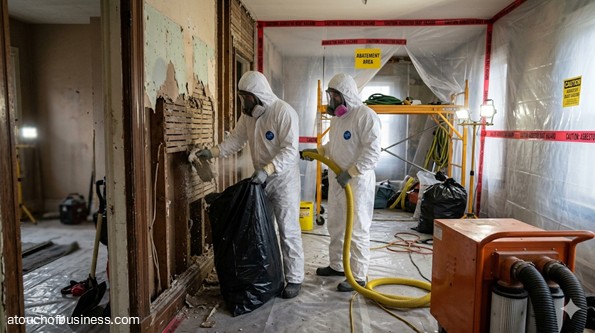
This business is not a low-stress service trade. You’ll work in confined spaces wearing a full-face respirator, Tyvek coveralls, gloves, and rubber boots — often in hot conditions. You’ll supervise certified crew members performing Class I or Class II asbestos work, where a containment failure or documentation error can trigger an OSHA inspection and significant penalties.
The health stakes are real. Asbestos exposure causes mesothelioma, lung cancer, and asbestosis. You and your crew must follow every protective protocol on every job without exception. Shortcuts don’t just create legal liability — they create health consequences that may not show up for years.
Ask yourself honest questions before moving forward.
- Are you physically fit and able to work in a full-face respirator for extended periods?
- Do you have the risk tolerance for high-liability, compliance-intensive work?
- Can you cover your living expenses for six to 12 months while you complete training, get licensed, and build a client base?
- Does your household support this level of financial and professional commitment?
- Do you have enough startup capital — not just for training and equipment, but for insurance, operating reserves, and the gap between projects?
Talk to working abatement contractors in non-competing markets before you commit. Prepare specific questions about insurance costs, cash flow between projects, and compliance challenges. Firsthand owner insight from people doing this work daily is worth more than any overview.
You can also consider whether starting from scratch, buying an existing certified abatement company, or subcontracting under a larger environmental firm initially is the right entry path. Each option has different capital requirements, timelines, and risk profiles. Understanding those tradeoffs before you commit is worth the time.
Red Flags Before You Start
Some of these red flags mean pause and verify. Others mean stop and reconsider entirely.
You don’t have enough startup capital.
The cost to get trained, licensed, insured, and equipped before your first project is high. If you can’t fund training, licensing, insurance, equipment, and three to six months of operating reserves without exhausting your savings, this is a serious problem. Undercapitalized abatement startups fail at a high rate.
Local demand is weak or unverified.
If your area is dominated by post-1990 construction, or if multiple licensed abatement contractors are already serving a small market, you may not have enough project volume to survive the startup period. Verify demand before you spend money on training.
The residential market in your area is oversaturated.
Residential abatement is the most price-competitive segment in most markets. If you’re planning to start with residential-only work, expect thin margins and strong competition. Commercial and industrial projects often have fewer compliant bidders and better pricing — but they require higher insurance limits and more complex documentation.
You can’t get pollution liability insurance at a workable cost.
Some insurers decline asbestos abatement contractors outright. If you can’t obtain pollution liability coverage at a cost your projected revenue can support, you can’t legally and safely operate. Verify insurance availability and cost before you complete training and apply for a license.
You have physical or medical limitations.
Workers must pass a physician’s examination to perform abatement at or above OSHA’s action level. If you can’t obtain medical clearance to wear a negative-pressure or powered-air-purifying respirator, you can’t legally do field work. Find this out before investing in certifications.
There is no approved disposal facility in your area.
Asbestos waste must go to a specifically approved landfill. Not all landfills accept it. If there’s no accessible approved facility in your service area, you have a foundational operational problem before you take on a single job.
The market is consolidating around large competitors.
Large multi-state environmental firms are acquiring smaller abatement businesses in many regions. In markets where a major regional player is actively expanding, subcontracting opportunities for new independents may be shrinking. Assess the competitive landscape in your area before committing.
Step 1: Assess Owner Fit and Choose Your Business Model
Before you spend money on training, decide what scope of work your business will perform. This decision shapes every cost, compliance, and equipment choice that follows.
The main scope decisions are:
- Residential projects only, commercial and industrial projects, or both
- Removal only, encapsulation only, or both
- Whether to also offer asbestos inspection services — a separate AHERA discipline that, in most states, can’t be performed by the same contractor doing the removal on the same project
Commercial and industrial work is typically higher revenue and more complex, with more stringent documentation requirements. Residential work is more accessible at startup but price-competitive.
Encapsulation — sealing asbestos-containing material in place with an approved sealant — is sometimes an option when full removal isn’t practical or required. Both removal and encapsulation require certified personnel and follow distinct protocols.
Consider whether buying an existing certified abatement company makes more sense than starting from scratch. An acquisition can transfer existing certifications, equipment, and client relationships — but check the company’s compliance history, insurance record, and any pending violations carefully before signing anything.
Step 2: Get Your Certifications First — Before Any Other Spending
No licensed asbestos abatement work can legally proceed without the right certifications. Do not buy equipment, sign a lease, or purchase a vehicle until this step is done.
Federal law under the Asbestos Hazard Emergency Response Act (AHERA) and OSHA standard 29 CFR 1926.1101 requires all workers and supervisors performing asbestos work to be trained and accredited. Training must come from an EPA-approved or state-approved provider.
The five AHERA accreditation disciplines are:
- Asbestos Abatement Worker — 32-hour initial course; 8-hour annual refresher required
- Contractor/Supervisor — 40-hour initial course (five days); 8-hour annual refresher; required to supervise Class I or Class II work
- Inspector — 24-hour initial course; 4-hour annual refresher; required if you offer inspection services
- Management Planner — requires the Inspector discipline first; 16-hour add-on
- Project Designer — 24-hour initial course; 8-hour annual refresher; required if designing abatement plans for commercial buildings
As the owner and on-site supervisor, you must hold the Contractor/Supervisor discipline at minimum. After completing the initial course and passing the required exam, you receive an AHERA accreditation certificate in that discipline.
You must complete an annual refresher every year — without exception — to keep your accreditation current. If it lapses, you may have to retake the full initial course.
Most states require a state asbestos abatement contractor license in addition to federal accreditation. Requirements vary. Nevada, for example, requires proof of two years of asbestos work experience in addition to training. Contact your state’s environmental or public health agency for the specific requirements where you plan to operate.
Step 3: Complete Pre-Work Medical Exams and Respirator Fit Testing
Before your crew performs any asbestos work at or above OSHA’s action level, each worker must complete a baseline medical examination under a licensed physician’s supervision. This is required under OSHA 29 CFR 1926.1101(m) and is not optional.
The baseline exam includes a medical history, respiratory questionnaire, physical examination, and chest imaging if clinically indicated. Annual medical examinations are required for all covered employees after that.
All workers who will wear tight-fitting respirators must also complete respirator fit testing under OSHA 29 CFR 1910.134 before they start work. Fit testing must be repeated annually. Workers with beards or facial hair that interferes with the respirator seal cannot wear tight-fitting respirators under OSHA standards.
Medical and exposure records for asbestos-exposed workers must be retained for 30 years. Plan your records system with that requirement in mind from day one.
Step 4: Validate Local Market Demand
Before you spend money on state licensing fees, insurance, and equipment, confirm that your local market can support a new abatement contractor.
Start with the building stock. Areas with large concentrations of pre-1980 residential, commercial, and industrial buildings generate the most demand. Check local school districts, municipal facilities, and commercial real estate developers — these are consistent sources of project volume.
Then assess the competition. Look up licensed abatement contractors already certified in your area. Identify whether any focus on commercial and industrial work while leaving residential demand underserved, or vice versa. Talk to general contractors and demolition contractors about who they currently call for certified abatement subcontracting — and whether they’re satisfied with current options.
Also check whether state or federally funded infrastructure or school renovation projects are planned locally. Those projects often generate significant subcontracting work for qualified abatement firms.
Understanding local supply and demand before you commit to full startup costs is one of the most consequential decisions you’ll make.
Step 5: Register Your Business and Get Your EIN
Once you’ve validated the market and confirmed that certifications and insurance are achievable, set up the business entity.
Given the significant liability exposure in asbestos work, an LLC is a common choice — it separates your personal assets from business liability. Consult a business attorney before choosing your structure. The consequences of a compliance failure or lawsuit in this industry are serious enough that this conversation is worth having before you register anything.
You can read more about choosing a business structure to compare your options. Once you’ve decided, register your entity with your state’s Secretary of State office.
Apply for a federal Employer Identification Number (EIN) from the IRS. You’ll need it for hiring, banking, and tax registration. If you’re operating under a trade name different from your LLC name, file a DBA with your state and county.
Set up state employer tax accounts if you’ll have employees. Then open a dedicated business checking account using the EIN and your entity registration documents before you accept any project payments.
Step 6: Apply for Your State Asbestos Contractor License
With your AHERA accreditation certificates in hand and your business entity registered, you can apply for the state asbestos abatement contractor license. This is the license that authorizes your business to perform regulated abatement work in your state.
State programs vary: some are housed in the Department of Health, others in the Department of Environmental Quality, and others in the Department of Labor. Search your state name plus “asbestos abatement contractor license” to find the right agency.
Most state license applications require:
- AHERA accreditation certificates for you and any initial crew
- Proof of insurance (see Step 7)
- Business entity registration documents
- State application forms and fees
- A surety bond in some states — verify the required amount with your state licensing agency
Some states require a general contractor’s license in addition to the asbestos-specific license. Verify both requirements before submitting your application.
Processing times vary. Plan for several weeks to several months. Do not commit to project start dates until your license is issued — or confirm with your state whether any work is permitted while an application is pending.
Step 7: Obtain the Right Insurance Coverage
Standard business insurance is not enough for asbestos abatement. You need coverage specifically designed for this work, and it must be in place before any licensed activity begins.
The required coverage types are:
- Workers’ compensation — Required in virtually every state when you have employees. In some states, including California under SB 216 (effective January 1, 2023), asbestos abatement contractors must carry workers’ compensation even without employees. Verify your state’s rule.
- General liability insurance (asbestos-endorsed) — Standard general liability policies typically exclude asbestos. The policy must explicitly cover asbestos abatement operations. Confirm this with your insurer in writing.
- Pollution liability insurance — Asbestos is classified as a pollutant. Most commercial clients and general contractors will require this coverage before awarding you any work.
- Commercial auto insurance — Required for your work vehicle. Verify that your policy covers hauling regulated waste when applicable.
Asbestos abatement insurance is a specialty market. Work with a broker who has experience placing environmental or contractor specialty coverage. A general commercial broker unfamiliar with pollution liability exclusions can easily leave you with gaps you won’t discover until a claim is filed.
Step 8: Assess Profit Potential and Arrange Funding
This step belongs before major equipment purchases, not after. Understand your break-even reality first.
Asbestos abatement is a project-based business. Revenue arrives project by project, not on a steady schedule. Gaps between projects — caused by slow seasons, clearance test delays, permit disputes, or client scheduling — can stretch for weeks. Your fixed costs keep running regardless.
Those fixed costs are substantial. Insurance premiums for asbestos abatement contractors are significantly higher than in most trades. Add annual training refreshers, medical surveillance, respirator fit testing, and PPE restocking, and you have recurring non-negotiable expenses that must be paid before the first project starts and between every project thereafter.
Understand your cost structure before you set prices. Every project must cover certified labor, disposable PPE (Tyvek suits and respirator filters are consumed per job), containment materials, waste disposal fees, clearance testing costs, insurance allocation, and overhead. Pricing that doesn’t account for all of these items loses money even when the job is done well.
Review your profit and revenue estimates carefully before committing to major expenses.
Startup funding options to explore include:
- SBA 7(a) loans — environmental remediation companies are eligible; most lenders require your EPA contractor certification, state license, and tax returns
- Equipment financing — negative air machines and HEPA equipment can often be financed separately
- Lines of credit for insurance premium financing and PPE restocking between jobs
- Working as a certified subcontractor for an established abatement firm while building capital
Maintain three to six months of operating reserves before opening. A single slow quarter or a project delayed by a clearance test failure can close a startup that launched without adequate cash on hand.
Step 9: Source and Purchase Your Equipment
Buy equipment after funding is secured, insurance is bound, and your license application is in process. This is a capital-intensive list, so don’t rush it.
Core equipment for a field-based abatement operation includes:
- Negative air pressure machines with HEPA filtration (sized for different enclosure volumes)
- Spare HEPA filters for negative air machines
- Manometers (pressure differential gauges) to verify and document negative pressure
- Industrial HEPA vacuums rated for asbestos use
- Full-face air-purifying respirators with P100/HEPA filters
- Powered air-purifying respirators (PAPRs) for extended Class I work
- 6-mil polyethylene sheeting in volume (for containment enclosures)
- Spray adhesive, duct tape, and foam sealant for sealing containment
- Decontamination unit components (clean room, shower chamber, equipment room)
- Wet-suppression sprayers for adequate wetting of ACM during removal
- Hand tools for removal — scrapers, putty knives, wire brushes
- 6-mil poly waste bags with required OSHA/EPA warning labels pre-printed
- Fiber drums for heavy or sharp material that could pierce bags
- Waste shipment record (WSR) forms
- Required OSHA warning signs (DANGER — ASBESTOS language)
- Air monitoring and sampling pumps (or a contracted industrial hygienist arrangement)
- Work truck or cargo van with sufficient capacity for equipment and waste transport
Some equipment — particularly negative air machines and decontamination units — can be rented initially to reduce startup costs. Once you have consistent project volume, purchasing makes more financial sense.
Source from specialty environmental equipment and safety supply vendors. General hardware stores don’t carry the HEPA-rated equipment asbestos abatement requires.
You also need secure storage between projects. A garage, rented storage unit, or warehouse space that protects negative air machines, HEPA vacuums, and poly sheeting from weather and theft is a practical necessity.
Step 10: Identify Approved Disposal Facilities
Under EPA NESHAP regulations (40 CFR Part 61, Subpart M), asbestos-containing waste must be disposed of at a landfill specifically approved to accept asbestos waste. Not all solid waste landfills qualify. Sort this out before you take on a single job.
Contact approved landfills in your service area before you open. Confirm acceptance, packaging requirements, hours of operation, and any pre-approval steps the facility requires. Some approved facilities impose conditions about container type, minimum or maximum load volumes, and advance scheduling.
Every load of regulated asbestos-containing material (RACM) requires a waste shipment record (WSR). Both the transporter and the landfill operator must sign it. Transportation must also comply with U.S. Department of Transportation hazardous materials requirements for labeling and packaging.
Identify at least two approved facilities. If one changes its acceptance policies or closes, you need a backup without scrambling mid-project.
Step 11: Set Up Documentation and Notification Systems
Asbestos abatement generates more required paperwork than almost any other contractor trade. Your documentation system needs to be in place before your first project.
The EPA NESHAP 10-day notification requirement applies to regulated demolitions and qualifying renovations. Before work begins, you must notify the appropriate state agency or EPA Regional Office at least 10 working days in advance. Emergency demolitions and emergency renovations have different notice windows. Most states have their own online notification portals. Contact your state air quality or environmental agency to confirm the correct submission process before your first project.
Required project records include:
- Pre-project NESHAP notification confirmation
- Written work plan and safety plan (project-specific, prepared before each job)
- Daily site log: negative pressure readings, start and end times, supervisor and crew on site
- Air monitoring records — at least one sample per four hours during abatement in many states
- Evidence of worker training — accreditation certificates must be posted and available for inspection on site
- Clearance air testing results after abatement is complete
- Waste shipment records for every load transported to the landfill
OSHA requires that employee asbestos exposure records and medical records be retained for 30 years. Build this into your records system from the beginning.
Step 12: Set Your Pricing and Bidding Process
Asbestos abatement is priced by square foot for surfacing materials, floor tiles, ceiling texture, and roofing — and by linear foot for pipe insulation. Many projects use a combination of both methods, plus a lump-sum component for setup and clearance.
Every bid must account for the full cost of the job, not just labor. Disposable PPE — Tyvek suits, respirator filters, gloves — is consumed on every project and adds up quickly. Containment materials, waste disposal fees, and clearance testing costs must also be built into every bid.
Clearance testing is typically performed by an independent industrial hygienist or third-party inspector rather than the abatement contractor. This independence is required on many commercial projects and is standard practice on residential work as well. Budget for this cost in every bid.
Commercial and government clients usually require itemized bids with separate unit cost breakdowns. They also typically require certificates of insurance before you can bid at all. Have these ready before approaching commercial clients.
Set clear payment terms in every written contract. Many abatement contractors require a deposit before mobilization. Establish in writing what happens if a clearance test fails and re-abatement is required — and who covers the cost if the failure is attributable to the contractor’s work.
Review guidance on pricing your services to make sure your structure covers all costs before you set your first bid.
Business Plan
An asbestos removal business has a startup path that requires careful sequencing. Your business plan should map the order of events, not just the end goals.
Start with the certification timeline. Training courses take days, licensing takes weeks or months, and insurance underwriting for pollution liability can take time in specialty markets. Know exactly when you’ll be legally operational before you project any revenue.
Build your cost structure before you set prices. Your recurring costs — insurance premiums, annual training refreshers, medical surveillance, fit testing, PPE restocking — are fixed whether you’re working or not. Your per-project costs — containment materials, disposable PPE, disposal fees, clearance testing — must be recovered in every bid. Pricing that doesn’t cover both categories loses money even on well-executed jobs.
Revenue in this business is project-based and variable. Between projects, overhead continues. Factor in at least three to six months of operating reserves in your plan. A single clearance test failure, a permit delay, or a slow construction season can create a cash gap that closes an undercapitalized startup.
Address the entry path decision in your plan. Starting from scratch means the longest runway to first revenue. Buying an existing operation shortens that runway but requires capital for acquisition and thorough due diligence. Subcontracting under a larger firm initially generates income while you build capital and a client base.
Commercial clients offer better margins but require prequalification, higher insurance limits, and more documentation than residential clients. Your plan should identify which client segment you’re pursuing first and what qualifications those clients require before they’ll add you to their vendor list.
Read through guidance on writing a business plan to make sure your financial projections and startup timeline are structured clearly.
Opening-Day Red Flags
Do not mobilize to a first project until every item on this list is confirmed.
Certifications and licensing are not fully in order.
If any worker’s AHERA accreditation certificate is missing, expired, or not yet issued, that worker cannot legally perform regulated abatement work. Verify every crew member’s accreditation before the first job, and confirm your state contractor license is issued — not just applied for.
Insurance certificates are not ready to produce.
Commercial clients and general contractors require a current certificate of insurance before work begins. If your general liability, pollution liability, or workers’ compensation is not bound and documented, most commercial clients won’t allow you on site.
Medical baseline exams and fit testing are incomplete.
Any crew member who hasn’t completed a pre-exposure medical exam and respirator fit testing cannot legally perform work at or above OSHA’s action level. This is a required pre-work step, not a post-hire formality.
Negative air machine performance has not been verified.
Your containment depends on the negative air machine maintaining the required pressure differential (-0.02 inches of water column minimum). Test the equipment before the first job. A machine that fails at the job site for the first time puts containment integrity at risk and may require immediate work stoppage.
The disposal facility has not confirmed acceptance for the project material.
Contact the approved landfill before every project to confirm they’re accepting asbestos waste on the days you’ll need to deliver. Conditions change. Don’t assume the relationship you established at startup covers every future load without verification.
NESHAP notification has not been filed on time.
The 10-working-day advance notification requirement for regulated projects is not a formality. Failure to notify is a federal violation with significant penalties. Confirm the notification was filed and received before mobilizing.
PPE supplies are insufficient for the project scope.
Tyvek suits, respirator filters, and gloves are consumed per worker per work period. Underestimating what a job requires creates a compliance problem mid-project. Stage your PPE quantities before mobilization.
Frequently Asked Questions
Do I need to be AHERA-accredited before I can start an asbestos abatement business?
Yes. Federal law under AHERA and OSHA 29 CFR 1926.1101 requires all workers and supervisors performing asbestos abatement to be trained and accredited before any work begins. As an owner who supervises projects, you must complete the AHERA Contractor/Supervisor discipline — a 40-hour initial course — and pass the required exam.
Training must come from an EPA-approved or state-approved provider. Most states then require a separate state contractor license using your accreditation certificate as supporting documentation.
Can I perform asbestos inspection and clearance testing on the same job where I do the removal?
In most states, no. Most regulatory programs require that inspection, air monitoring, and final clearance testing be performed by an independent party — not the abatement contractor — to prevent a conflict of interest. Hiring an independent industrial hygienist for clearance testing is standard practice and is required on most commercial projects.
What is a waste shipment record, and when is it required?
A waste shipment record (WSR) is a chain-of-custody document required under EPA NESHAP for every load of regulated asbestos-containing waste transported from a job site to an approved disposal landfill. Both the transporter and the landfill operator must sign it. You must retain copies as part of your project records.
How often do I need to renew my AHERA accreditation?
Annual refresher training is required for all AHERA disciplines without exception. The Contractor/Supervisor and Abatement Worker refresher is eight hours per year. The Inspector refresher is four hours per year. If accreditation lapses without a completed refresher, you may have to retake the full initial course. Track expiration dates for yourself and every crew member.
What type of landfill can I use for asbestos waste disposal?
Asbestos-containing waste must go to a landfill specifically approved to accept asbestos waste under EPA NESHAP regulations (40 CFR Part 61, Subpart M). Not all solid waste landfills qualify. Confirm acceptance and packaging requirements with your disposal facility before your first project — and before you commit to a project schedule.
Is a sole owner-operator of an asbestos abatement company required to carry workers’ compensation insurance?
It depends on your state. Most states require workers’ compensation when you have employees. However, some states — California under SB 216, effective January 1, 2023, is a clear example — require asbestos abatement contractors to carry workers’ compensation even without employees. Verify your state’s rule with the state Department of Labor or Workers’ Compensation agency before assuming you’re exempt.
Can I perform asbestos removal in a single-family home without following NESHAP rules?
Residential buildings with four or fewer units under private ownership are generally exempt from NESHAP notification and work practice requirements. However, OSHA standards (29 CFR 1926.1101) still apply to any paid contractor performing asbestos work regardless of building type. State rules may also be more stringent than federal rules — some states extend NESHAP-equivalent requirements to residential projects. Verify your state’s specific rules before assuming residential work is less regulated.
What is the NESHAP 10-day notification requirement?
For regulated demolitions and qualifying renovations involving threshold quantities of regulated asbestos-containing material, you must notify the appropriate state agency or EPA Regional Office at least 10 working days before work begins. Emergency demolitions and emergency renovations have shorter notice windows. Most states have their own online notification portals. Contact your state air quality or environmental agency to confirm the correct process before your first project.
Advice From Asbestos Removal Professionals
Starting an asbestos abatement business is unlike starting most contractor trades. The certifications come first, the equipment purchases come later, and the compliance requirements run from day one to well after each project closes.
Hearing from people who have navigated this path — or who work directly at the intersection of asbestos, buildings, and field practice — gives you detail that no regulation page provides on its own.
The three resources below offer grounded, practitioner-level perspective on asbestos in buildings, certification training, and what the AHERA accreditation process actually involves. Each comes from a confirmed U.S. source with verifiable expertise.
Podcast: Asbestos, Home Inspections, and Vermiculite — Structure Talk
Reuben Saltzman and Tessa Murry are home inspection specialists at Structure Tech, Minnesota’s highly rated home inspection firm. Both have encountered asbestos on job sites throughout their careers.
This episode of the Structure Talk podcast covers what asbestos looks like in real residential buildings — the materials that almost certainly contain it, the ones that might, and why condition matters more than presence.
Saltzman and Murry explain the difference between friable and non-friable ACM in plain terms, identifying pipe insulation, floor tiles, transite ductwork, and vermiculite as the most commonly encountered materials in older homes.
Their discussion of vermiculite insulation is particularly useful. They explain why the standard EPA threshold (1% asbestos by weight) does not apply to loose-fill vermiculite, and why professional abatement — not DIY removal — is the correct approach regardless of test results.
For a new abatement contractor, understanding exactly what inspectors and homeowners see before calling you is essential. This episode maps that landscape clearly from the inspector’s side of the conversation.
AHERA Contractor/Supervisor Initial Course (40 Hours) — The Asbestos Institute
The Asbestos Institute is a U.S.-based EPA-approved training provider offering AHERA-accredited courses for asbestos abatement professionals.
This page describes the 40-hour initial Contractor/Supervisor course — the certification required to supervise any Class I or Class II abatement work and to serve as the OSHA competent person on a project.
The course covers work practices and engineering controls, abatement procedures, personal protective equipment, and the federal regulations an owner-supervisor must understand before stepping onto a job site as the person in charge.
Insurance, bonding, and contract specifications are also addressed — subjects that matter immediately during the startup phase, not just once projects are underway.
If you’re planning to supervise your own projects, this is the certification that makes that legally possible. Reviewing what this course covers before you enroll tells you exactly what you need to know going in.
Asbestos Training Courses — Acclaim Environmental Training
Acclaim Environmental Training is a Colorado-based EPA-approved and CDPHE-approved training provider offering AHERA-accredited courses for asbestos abatement professionals across multiple disciplines.
Their training page describes the initial course requirements and annual refresher requirements for each AHERA discipline: Contractor/Supervisor (40-hour initial, 8-hour annual refresher), Inspector (24-hour initial, 4-hour refresher), and Project Designer (24-hour initial, 8-hour refresher).
The detail here is useful for planning your certification path before you start. You can see exactly how the disciplines stack, which certifications are prerequisites for others, and what the annual maintenance commitment looks like for each.
The page also notes that the Contractor/Supervisor course covers regulatory requirements a supervisor must consider before beginning any abatement project — making it a useful reference for understanding what the training actually prepares you to do in the field.
Related Articles
- How To Start an Environmental Cleanup Business
- How To Start a Demolition Business
- How To Start an Environmental Testing Laboratory
- How To Start a Construction Business
- How To Start a Fire Safety Business
Sources:
- US EPA: Asbestos NESHAP Overview, Asbestos Professionals Accreditation, Asbestos Certification Process, Asbestos Laws and Regulations, AHERA/MAP Guidance Documents
- US OSHA: 29 CFR 1926.1101 Full Text, Construction Asbestos Standard Guide, NPE Work Practices Appendix F
- Harbor Compliance: State License Requirements by State
- Alaska DEC: Asbestos Handling and Disposal
- Precedence Research: Abatement Services Market Size 2026–2035
- This Old House: Asbestos Abatement Cost Guide 2026
- Integrity Now Insurance: Asbestos Abatement Insurance Coverage
- Crestmont Capital: Asbestos Removal Business Loans Guide
- MN Dept. of Health: Negative Pressure Guidelines
- NJ Dept. of Health (PEOSH): OSHA Asbestos Construction Standard NJ
- CNS Occupational Medicine: Medical Surveillance Exam Requirements
- Dannis Woliver Kelley: CA SB 216 Workers Comp Requirement
- Santa Barbara County APCD: Common NESHAP Questions
- AbateLocal: Abatement Cost Guide 2026