
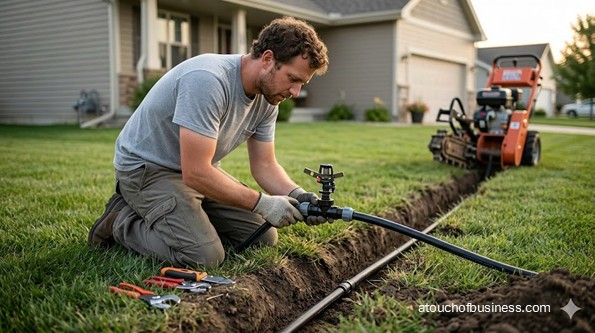
What to Expect From This Guide to Starting a Lawn Sprinkler Installation Service
This guide walks readers through the key decisions and practical steps involved in starting a lawn sprinkler installation service, from assessing field experience and seasonal demand to arranging licensing, equipment, pricing, job controls, and opening preparation. The bullets highlight selected parts of the article’s deeper review.
Inside the guide, you will find:
- Startup roadmap: Progress from owner fit and market research through service scope, registration, field setup, pricing, documentation, and opening checks.
- Industry interviews: Hear contractors and irrigation professionals discuss pricing, training, service quality, customer trust, field systems, and water efficiency.
- Startup FAQs: Review answers about licensing, seasonality, permits, backflow prevention, staffing, service mix, business purchases, and certifications.
- Market and service model: Evaluate climate, construction, competition, water restrictions, installations, repairs, seasonal service, and start-buy-franchise options.
- Local requirements: Check contractor licensing, backflow rules, permits, business registration, zoning, insurance, bonding, taxes, and mandatory utility locating.
- Vehicle and equipment: Plan a reliable truck, trenching access, organized tool storage, component inventory, supplier accounts, and job-site materials.
- Financial and job controls: Build pricing from costs, plan slow-season cash, use deposits, contracts, change orders, checklists, and opening safeguards.
Continue into the guide to see how technical experience, local rules, seasonal cash flow, and disciplined job systems affect this field service.
Running a lawn sprinkler installation service means you design and install in-ground irrigation systems for residential and commercial properties — then, in many markets, return each spring and fall to start up and winterize those same systems. It’s skilled trade work that combines light excavation, pipe installation, low-voltage electrical wiring, and water pressure calculations, all completed outdoors across multiple job sites each week.
The startup path has real requirements: a state-issued license in many states, general liability insurance before your first job, a reliable work truck, and a working knowledge of irrigation system design before you take a single paying customer.
This is also a seasonal business in most parts of the country. In northern markets, nearly all installation revenue arrives between early spring and late fall. That compression shapes every financial decision you make at startup.
Before you spend a dollar on equipment or licensing, ask yourself a few honest questions. Do you have hands-on experience installing irrigation systems, or are you planning to learn on paying customers? Can your household cover living expenses through a winter with near-zero revenue? Do you have enough capital to equip a truck, pay for insurance, and fund operations for several months before jobs come in steadily?
Talk to irrigation contractors who operate in markets you won’t compete in. Prepare specific questions before those conversations: What does licensing cost and how long did it take? How many installations did they complete in their first season? What did they underprice? What insurance issues came up? Firsthand knowledge from experienced owners is more useful than any general estimate, even though every owner’s path will differ.
Customers choosing an irrigation contractor care about trust, timeliness, and price clarity. They want to know the scope is documented, the crew will clean up the site, and the system will work correctly when you leave. Building that confidence starts with how you present yourself before a single trench is dug.
Red Flags Before You Start
A few warning signs are serious enough to delay or redirect a launch entirely.
You lack hands-on installation experience. Zone layout, hydraulic calculations, PVC and poly pipe work, low-voltage controller wiring, and backflow device installation are not skills you can pick up from reading. Attempting installations on paying customers without field experience leads to warranty callbacks, water damage claims, and reputation damage that can end a new business quickly. Work a full season in the trade first, or pursue a franchise that provides structured field training.
Your state requires a license you don’t have yet. Multiple states require an irrigation contractor license, a plumbing-category license, or a landscape contractor license with an irrigation subcategory before you can legally install systems. Operating without the required license prevents you from pulling permits — which means you can’t legally complete installations in most jurisdictions. Verify your state’s requirement before committing any startup dollars.
You can’t cover personal living expenses through the slow season. In northern markets, revenue from November through March can be near zero. If your household doesn’t have savings, a second income, or a planned winter service to bridge the gap, a long off-season creates a real financial survival risk.
Your startup capital won’t cover the full equipment list. A truck, installation tools, a components inventory, insurance, and licensing all need to be funded before your first dollar of revenue arrives. If that total exceeds what you can realistically fund without creating a dangerous personal financial position, starting with a lower-cost repair-and-service model — or buying an established business — is a more sustainable path.
Your market is saturated or structurally weak. A rainy climate with short summers means weak installation demand. A market already served by many established, licensed contractors means price pressure and harder customer acquisition for a new entrant. Assess both before launching.
Step 1: Assess Owner Fit and Decide Whether to Start, Buy, or Franchise
The work is physically demanding. You’ll trench yards in summer heat, carry pipe and equipment, crawl around tight access points, and spend full days outdoors on job sites. Assess that reality honestly before you commit.
Beyond the physical demands, this business requires technical proficiency from the start. You need to understand zone layout, water pressure and flow rate calculations, pipe types and fittings, low-voltage controller wiring, and backflow prevention requirements. Customers expect working systems on the day you leave.
If you have field experience and want to start independently, that’s the most common path. Two alternatives are worth evaluating before you decide.
Buying an existing irrigation business is a realistic option worth serious consideration. An established operation with active service contracts, a customer base, and equipment in place generates revenue from day one. Key due diligence items are license transferability, actual recurring revenue versus claimed, equipment condition, and whether customers are loyal to the business or to the previous owner personally. Learn more about building vs. buying a business.
Franchising is also worth exploring. Conserva Irrigation and Pacific Lawn Sprinklers are active U.S. irrigation franchises. A franchise provides structured training, operational systems, and brand recognition. If you lack hands-on technical experience, a franchise may be a lower-risk entry point than building from scratch — but franchise fees and ongoing royalties are real cost factors to account for before deciding.
The right path depends on your budget, experience level, timeline, and how much independent control you want over the business.
Step 2: Research Local Demand and Competition
Not every market supports a new irrigation installation service. Before you spend money on tools or licensing, confirm that yours does.
The strongest demand comes from markets with long dry seasons, active residential construction, established suburban neighborhoods, and local water utilities that promote efficient irrigation systems. The weakest demand comes from consistently rainy climates or dense urban areas with few private lawns.
Drive through new housing developments and established suburban neighborhoods. Talk to property managers and ask what irrigation services are most requested in the area. Visit local irrigation wholesale suppliers — SiteOne Landscape Supply and Ewing Outdoor Supply both have locations across most U.S. markets — and ask the staff how many contractors they currently serve locally. A high density of active contractor accounts is a rough indicator of market saturation.
Check your local water utility’s website before you commit to the market. Some municipalities actively restrict new irrigation system installations, require specific water-efficiency equipment on every new installation, or impose mandatory scheduling rules that limit when systems can run. Those rules affect what you can install and what customers expect from a compliant system.
Assess your local competition directly. Search Google Maps for irrigation contractors in the area. Review their service listings, pricing signals, and customer feedback. A local supply-and-demand check before committing is one of the most valuable hours you’ll spend before launch.
Step 3: Choose Your Service Scope and Business Model
The model you choose at startup determines your equipment needs, licensing requirements, pricing structure, and cash flow pattern. Decide this before you buy a single tool.
Three common approaches exist for a new operator:
- New installations only — highest revenue per job, strong demand in growing housing markets, but requires more equipment investment and labor.
- Repairs and service only — lower startup cost, faster path to early revenue, and a practical way to build field experience before taking on full installations.
- Mixed model (installations plus seasonal service) — new installs combined with spring startups, fall winterizations, and repair calls. This model builds a recurring service book from your installation customer base, which stabilizes cash flow over time and improves overall margins.
Installation jobs and service jobs carry different margins. Net profit on installations typically runs 15–20%. Repair and service calls can yield 30–40% net margins. Materials markup — typically around 20% above contractor cost — is a separate revenue component on every job type.
If your startup capital is limited, starting with repairs and service is a financially lower-risk approach. You build experience, generate early revenue, and add installation capability as your tools, skills, and cash position allow.
In some states, service-only and installation contractors face different licensing thresholds. Verify your specific scope against your state’s requirements before finalizing the model.
Step 4: Check Licensing Requirements in Your State and Locality
This is where many new operators make a costly mistake: spending money on equipment and then discovering they need a license that takes months to obtain.
Licensing requirements for lawn sprinkler installation vary significantly by state. Three scenarios exist:
- Some states require a standalone irrigation contractor license or a certified landscape irrigation contractor credential. New Jersey requires both a certified individual and a separate business permit. Illinois requires irrigation contractor registration and mandates that at least one employee complete an approved installation course.
- Some states require the work to be performed under a plumbing contractor license, a landscape contractor license with an irrigation subcategory, or a specialty contractor license. South Dakota requires a state-issued underground irrigation installer license under the Plumbing Commission.
- Some states have no state-level irrigation contractor license requirement, but county or municipal requirements may still apply.
Verify your state’s requirement with the state contractor licensing board or state plumbing board before assuming you can operate freely. The Irrigation Association publishes a state-by-state contractor licensing guide at irrigation.org — use it as a starting reference, not a final answer.
Check your local city or county building department separately. Local licensing requirements can exist independently of state law and may require a separate registration or permit application.
Backflow preventer compliance is a related licensing issue. Many jurisdictions require the installer to be a certified backflow assembly tester, or require a certified tester to verify the device at installation and annually thereafter. Check with your local water utility and building department before you take your first job. See more about business licenses and permits.
Step 5: Complete Required Training and Certifications
Even in states with no mandatory licensing, industry certification changes how customers and commercial clients perceive you — and it changes what jobs you can bid on.
The Irrigation Association’s Certified Irrigation Contractor credential, known as the CIC, is the most widely recognized national certification for installation contractors. To sit the exam, you need at least three years of irrigation-related field experience. The exam covers irrigation design, installation, scheduling, water management, backflow prevention, low-voltage electrical controls, and general business management. Exam fees are $250 for Irrigation Association members and $495 for non-members. Maintaining the credential requires 20 continuing education units per two-year renewal cycle.
Manufacturer training programs from Rain Bird and Hunter Industries are practical and widely respected. These are worth completing regardless of whether you pursue the CIC designation — the technical depth applies directly to daily installation decisions.
If your state requires a license exam, that exam takes priority and must be completed before you open. Budget for exam prep courses and exam fees as part of your pre-opening cost plan.
In water-restricted markets, the EPA WaterSense partner program is a voluntary credential that signals a commitment to water efficiency. In drought-affected areas, that designation can support differentiation and help you meet local water utility requirements on new installations.
Step 6: Choose a Business Structure and Register the Business
A limited liability company, or LLC, is the most common legal structure for a field service contractor. It separates your personal assets from business liability — an important protection given the water damage and property risks that come with every installation job.
Register your LLC with your state’s secretary of state office. Fees and processing times vary by state.
Apply for an Employer Identification Number, or EIN, from the IRS at irs.gov. The EIN is free and is required to open a business bank account, hire employees, and set up payroll. Don’t skip this step — you’ll need it before your first supplier account application.
If you plan to operate under a trade name different from your legal entity name, register a DBA (doing business as) name with your state or county. Registering your business name correctly from the start prevents naming conflicts later. Learn more about choosing the right business structure before you file.
Step 7: Handle Tax and Employer Account Registrations
Sales tax treatment for contractor work varies significantly by state. Some states tax the materials portion of a contract but not the labor. Others tax both under a bundled contract price. Getting this wrong means either undercharging customers or underpaying the state.
Register with your state department of revenue and confirm the tax treatment of contractor installation transactions before your first job. Do not assume the rules; verify them.
If you plan to hire employees, register for state income tax withholding and state unemployment insurance accounts. Contact your state department of revenue for the specific registration process.
Step 8: Obtain Your Local Business License and Confirm Zoning
Most cities and counties require a general business license or occupational tax certificate for any contractor operating locally. Apply with your city or county clerk’s office before opening.
If you plan to operate from a home address, verify local zoning rules first. Many municipalities restrict commercial vehicle parking, equipment storage, and customer visits at residential addresses under home occupation rules. A single violation notice can disrupt your operation before it gets started.
If you plan to lease a warehouse or storage yard, confirm the location is zoned for contractor operations and outdoor equipment storage before signing a lease. Zoning errors at this stage create expensive problems.
Step 9: Secure Insurance and Bonding
Insurance is not optional for this type of contractor. Don’t take a single job before your general liability coverage and commercial auto coverage are in place.
The key coverage types you need before opening:
- General liability insurance — Required in nearly every state for contractors. Covers third-party bodily injury and property damage, including flooding caused by improper installation or accidental damage to underground utilities. Most state minimums run $500,000 to $1 million per occurrence, but commercial clients and municipalities often require higher limits.
- Commercial auto insurance — Required in most states for vehicles used for business. You’ll transport heavy equipment, pipe, and materials daily, making this essential for both legal compliance and financial protection.
- Contractor’s equipment coverage — Also called inland marine coverage. Covers tools, controllers, pipe, and components in transit and on job sites. Standard general liability does not cover mobile tools and equipment. This gap can be expensive to discover after a theft or job-site loss.
- Workers’ compensation — Required in almost all states once you hire employees. Some states extend requirements to sole proprietors in construction trades — verify your state’s rule before assuming it doesn’t apply to you.
- Contractor’s license bond or surety bond — Required in some states and municipalities as a condition of licensure. Verify locally.
Obtaining insurance early also lets you hand a certificate of insurance to a commercial client, HOA, or municipality the moment they request one. Learn more about business insurance for contractors.
Step 10: Set Up Your Vehicle and Equipment
Your work truck or van is your most important capital asset. It needs to haul pipe lengths — commonly 10-foot PVC sections — along with a trenching machine when not rented, valve boxes, controllers, a components inventory, and hand tools, every day to every job site.
Whether you buy new or used, and the payload capacity you need, are decisions that directly affect your startup cost. A used truck that reliably handles the load is a reasonable starting point. A breakdown mid-season is an expensive disruption.
For installation jobs, you need access to a pipe puller or vibratory plow for pulling poly pipe under turf, or a walk-behind trencher for PVC pipe installations and difficult soil conditions. Renting this equipment per job is a smart strategy at startup — it lowers your initial outlay and lets you gauge actual job volume before committing to a purchase.
Set up a secure, organized storage area for pipe inventory, spare heads, controllers, valve boxes, and fittings before your first job. Home garage storage is workable if local zoning permits it. A rented storage space or small warehouse is the alternative.
Organized truck storage matters more than it might seem. A disorganized truck costs you time on every site visit and makes a poor first impression on customer properties.
Step 11: Open Supplier Accounts
Establish contractor accounts with irrigation wholesale suppliers before your first installation. Waiting until a job is confirmed and then scrambling for materials is a scheduling and cash flow risk.
SiteOne Landscape Supply and Ewing Outdoor Supply are the two largest national wholesale suppliers for irrigation contractors. Both allow contractors to open a cash account without a credit check or minimum order requirement. Cash accounts give you access to contractor pricing on heads, valves, controllers, pipe, fittings, and backflow devices.
Identify regional suppliers in your market as well. Local suppliers sometimes carry brands or specialty fittings not stocked by national chains, and a strong local relationship can speed up material sourcing on tight timelines.
For new installations, the standard industry practice is to collect a 50% deposit from the customer at contract signing to cover materials before the job begins. That deposit funds your supplier purchases for the project, which protects your cash position on larger jobs.
Step 12: Establish Your 811 Protocol for Every Job
Before any trench is dug on any job, the law in all 50 U.S. states requires you to contact the national 811 call-before-you-dig system. Call 811 or submit online at 811beforeyoudig.com. Utilities have 2–3 business days to respond by marking their buried lines with paint or flags. You cannot legally begin excavation until all utilities have responded to your ticket.
Build this step into your job scheduling workflow from the start. The 2–3 business day wait period must be factored into every project timeline and customer commitment you make.
There is a critical limitation: 811 marks only publicly owned utilities to the meter or service point. Private utility lines on the customer’s property — including existing irrigation lines, invisible dog fencing, gas lines to outbuildings, and low-voltage landscape lighting — are not marked by the 811 system. A wire locator tool is essential for identifying private lines before you trench.
Hitting an underground utility is illegal, expensive, dangerous, and entirely preventable. This protocol is non-negotiable on every job.
Step 13: Set Up Pricing, Payment, and Business Finances
Your pricing structure needs to be built on your actual costs — not on what a competitor charges or what a customer is willing to pay. Setting prices before you know your costs is one of the most common early failures in a field service business.
Per-zone pricing is the most common method for residential installations. A widely cited industry benchmark is approximately $1,000 per zone as a starting reference, but actual pricing in your market depends on local labor rates, soil conditions, property complexity, your materials cost, and your overhead. Per-square-foot pricing is more common for larger or commercial properties. Repairs and service calls are typically priced by the job or by time and materials.
Know your fixed costs before you price anything. Fixed costs include truck payments, insurance premiums, license fees, software subscriptions, and storage rent. Know your variable cost per job — materials, labor hours, permit fees where required, and fuel.
Your target gross profit margin should be in the range of 35–50%. Industry guidance for net profit on installations sets a minimum target of 20%.
Parts markup is a separate revenue component on every job. A markup of roughly 20% above contractor cost on materials is common in the industry and should be built into every estimate, not added as an afterthought.
For payment setup: open a dedicated business bank account before your first job and keep it completely separate from personal finances. Set up credit and debit card acceptance through a merchant account or mobile payment processor before you open. Relying only on check payments slows your cash flow unnecessarily.
Payment terms for new installations: a 50% deposit at contract signing, balance due at project completion. For repair calls and service visits, collect payment in full at the end of each appointment.
Operating capital is the most commonly underestimated financial requirement in this business. You need enough cash on hand to cover business expenses — truck payment, insurance, loan obligations, supplier purchases — through the entire slow season, before the spring rush arrives. Factor this into your capital planning before you open.
Step 14: Develop Your Contracts, Forms, and Job Documentation
A written contract on every installation job is not optional. Scope disputes, unexpected site conditions, and customer misunderstandings are common in field service contracting. Documentation is your protection.
Your contract for each installation should include:
- Job scope: number of zones, head count, pipe layout, controller model, and any optional add-ons
- Total price and payment terms (deposit and final payment amounts)
- Project timeline and start date
- What is explicitly excluded from the price
- Warranty terms: what is covered and for how long
Set up a change order form before you take your first job. Any scope change after contract signing gets a written change order with a price before the additional work begins. Verbal scope changes that don’t get documented are a reliable source of payment disputes.
Create an as-built diagram template to document zone layout, head locations, valve box positions, pipe paths, and controller settings on every completed installation. Give the customer a copy and keep one in your records. This protects you if a future owner disputes the installation and simplifies every future service call on that property.
Formalize a pre-job checklist as well: confirm the 811 locate is complete and all utilities have responded, the deposit is received, property access is clear, and all materials are staged before you start.
Step 15: Confirm Backflow Compliance Before Every Installation
Backflow prevention is a recurring compliance requirement on every job. Most jurisdictions require an approved backflow prevention device on every irrigation system connection to a potable water supply — either a pressure vacuum breaker (PVB) or a reduced-pressure zone (RPZ) assembly, depending on local code.
Many jurisdictions also require that the device be tested at installation and then annually by a certified backflow assembly tester. In some states, the installer must hold that certification. In others, you can subcontract the testing to a certified tester. Subcontracting adds cost per job, which needs to be reflected in your estimate.
Many municipalities also require a plumbing permit for the water service connection and backflow device installation, plus an inspection sign-off before the system can be activated. Confirm your local requirements with the building department and water utility before your first job. In some jurisdictions, the permit process involves plan submission and a review period — build that time into your project scheduling.
Business Plan
A business plan for a lawn sprinkler installation service is a financial stress test you run before committing capital to equipment, licensing, and insurance.
Start with your cost structure. List every startup cost: vehicle purchase or lease, initial tool and equipment purchases, starter components inventory, licensing and exam fees, certification costs, business formation, and insurance premiums. These costs need to be funded before your first job. Identify which items you can defer — trencher rental vs. purchase, for example — and which cannot be delayed, such as insurance and licensing.
Then model your operating capital need. In northern markets, the installation season may run five to seven months. Your plan needs to show how you cover truck payments, insurance, loan obligations, software, storage, and personal living expenses through the entire off-season. If the numbers don’t hold up, adjust the model before you launch.
Build your pricing on verified costs. Know your fixed overhead per month and your variable cost per installation job. Confirm that your per-zone pricing, applied to a realistic job count, generates enough gross margin to cover overhead and leave a net profit. Industry targets are a gross margin of 35–50% and a net profit on installations of at least 20%. If your local market’s pricing won’t support those margins, adjust the model before you start.
Profit potential improves meaningfully when you combine installation work with recurring seasonal service. Spring startups and fall winterizations on your installed systems generate consistent annual revenue from the same customer base. Plan for this mix from the start.
Your plan should also address the start-or-buy decision, your target market, your service scope for year one, your funding sources, and your break-even job count. How many installations per month do you need to cover your fixed costs? How many service calls supplement that? Answer those questions before you sign a lease, buy a truck, or take your first job. For further guidance, see how to write a business plan and how to estimate revenue and profit.
Financial Decisions That Bite Later
Several financial choices that seem reasonable at startup turn into significant problems once the business is running.
Underpricing early jobs to win customers. Charging less than your actual cost to win your first few jobs is a habit that doesn’t fix itself. Every job you underprice sets a reference point that’s hard to walk back. Price based on your verified costs from the start, even if it means losing some bids.
Skipping contractor’s equipment coverage. General liability does not cover tools and components stolen from a trailer or damaged on a job site. The first time your wire locator, pressure gauge, or a truckload of heads and valves disappears, you’ll pay this gap out of pocket. Add this coverage before you take a job.
Not collecting a deposit before ordering materials. Buying materials before a signed contract and a deposit in hand means your cash is at risk if the customer changes their mind or the job gets delayed. The 50% deposit standard exists for a reason — use it on every installation from day one.
Ignoring permit costs in your estimates. Where permits are required, the fees are a real cost of completing the job. Failing to include them in your estimate means you absorb them as a loss. Confirm permit requirements and fees for your local market and build them into every affected estimate.
Treating peak-season revenue as annual income. If most of your revenue arrives in five to seven months, spending as though it’s spread across 12 will leave you unable to cover expenses in winter. Budget your operating capital across the full year, not just the busy season.
Opening-Day Red Flags
Before you take your first job, confirm each of the following is fully in place.
Your license or required registration is confirmed — not pending. Operating before a required license is issued is a compliance violation. If your state’s process is taking longer than expected, delay your opening date. Taking jobs without the required license puts every contract you sign at legal risk.
Your insurance certificates are issued and on file. You need to be able to hand a certificate of insurance to a customer or HOA manager the day they ask for one. Without it, you’ll lose commercial and managed-property jobs before they start.
Your 811 protocol is built into your job scheduling workflow. Every job that involves trenching needs an active 811 ticket with confirmed utility responses before you schedule the dig date. If this isn’t a fixed part of your workflow before you open, it will be inconsistently applied — and a utility strike is the consequence.
Your backflow compliance process is documented. Know what device type is required locally, who must install it, and who must test it. If you need to subcontract backflow testing, have that subcontractor identified and a process in place before your first installation.
Your contract template and change order form are ready. Don’t start a job without a signed contract. Don’t expand the scope of a job without a signed change order. Having these forms ready before your first customer conversation removes the temptation to proceed informally.
Your supplier accounts are active and a material order can be placed the day a job is confirmed. Materials delays that push installation dates cause customer dissatisfaction before the first head is in the ground. Test the supplier ordering process before you need it under pressure.
Frequently Asked Questions
Do I need a license to install lawn sprinkler systems?
It depends on your state. Some states require a standalone irrigation contractor license. Others require irrigation work to be done under a plumbing or landscape contractor license with an irrigation subcategory. Some states have no state-level requirement but may have local requirements. The Irrigation Association publishes a state-by-state guide. Verify with your state contractor licensing board or plumbing board before starting.
Is an irrigation installation business highly seasonal?
Yes, in most U.S. markets. In states with freezing winters, the installation season typically runs from early spring through late fall. In the South and Southwest, demand is more consistent year-round. Most owners in northern markets plan finances around a peak season of five to seven months and minimal revenue in winter.
Do I need to pull a permit for every installation?
Not always, but in many jurisdictions a permit is required for new system installations — particularly for the water service connection and backflow preventer. Requirements vary by city and county. Confirm with your local building department before your first job. Operating without a required permit can result in stop-work orders and fines.
What is a backflow preventer and why does it matter for my business?
A backflow preventer is a plumbing device that stops contaminated water from flowing backward from an irrigation system into the home’s potable water supply. Most jurisdictions require an approved device on every installation. The required type — pressure vacuum breaker or RPZ assembly — and the testing requirements vary by local water utility and state plumbing code.
Should I start as a solo operator or hire from the beginning?
Most new owners start solo or with one helper and hire additional labor as job volume grows. Hiring before you have reliable job volume adds fixed payroll cost before revenue justifies it. Starting solo also lets you refine your pricing, scheduling, and job documentation process before managing employees.
Should I focus on new installations or service and repair?
Both are viable, but they require different startup investments and carry different margins. Installation jobs have higher revenue per job but thinner margins — typically 15–20% net. Repair and service calls carry margins closer to 30–40% net and are easier to start with minimal equipment investment. Many experienced operators recommend starting with repairs to build experience, then adding full installations as skills and capital allow.
Is buying an existing irrigation business a realistic option?
Yes, and it’s worth evaluating carefully. An established operation with active service contracts, equipment, and a known customer base generates revenue from day one. Key due diligence items include license transferability, equipment condition, actual recurring revenue versus claimed, and whether the customer relationships are tied to the business or to the previous owner personally.
What certifications should I pursue before opening?
The most recognized national credential is the Irrigation Association’s Certified Irrigation Contractor designation. It requires three years of field experience and a 150-question exam covering design, installation, water management, and backflow prevention. Manufacturer training from Rain Bird and Hunter Industries is practical and widely respected regardless of your certification path. If your state requires a license exam, that takes priority and must be completed before you open.
Lessons From Sprinkler Installation Pros
These interviews and interview-style resources share practical lessons from irrigation contractors and industry professionals on pricing, service quality, training, customer trust, field operations, smart controllers, water conservation, and building a stronger sprinkler installation or service business.
How One Irrigation Contractor Makes 50% Net Profit Margins and Takes Four Months Off Per Year
This video/audio interview features an irrigation contractor discussing profitability, job selection, seasonal scheduling, and how focused positioning can help create a more profitable irrigation business.
The Service Business is The People Business
This podcast interview with Justin Wilson, founder of American Irrigation, covers building an irrigation service company, training technicians, maintaining service quality, earning customer trust, and managing a larger field team.
Hard on Process, Soft on People with Erik Dyba
This irrigation business interview explains how better systems, training, vendor relationships, team development, service checks, and repeatable processes can help improve and grow an irrigation department.
Contractors Are The People Who Make Irrigation Work
This documentary-style podcast episode includes conversations with irrigation contractors about flat-rate pricing, service profitability, smart controllers, remote monitoring, water savings, and why experienced contractors still value the trade.
Making Every Drop Count – Reed Brown on Profitable Irrigation
This podcast interview with irrigation industry professional Reed Brown focuses on profitability, managing costs, improving efficiency, building customer loyalty, and keeping service quality strong.
Watch Us Grow: 2022 Industry Standouts
This written profile includes irrigation professionals sharing real-world lessons on building an irrigation department, training technicians, organizing service vehicles, creating career paths, and improving crew performance.
Related Articles
- How To Start an Irrigation Business
- How To Start a Plumbing Business
- How To Start a Lawn Care Business
- How To Start a Gutter Installation Business
- How To Start a Garden Supply Business
Sources:
- Irrigation.org: Contractor state licensing guide, Certified irrigation contractor program
- NJ.gov: Landscape irrigation contractor certification
- ServiceTitan.com: Start grow irrigation business, Irrigation business profit margins, Plumbing license requirements states
- LawnandLandscape.com: Irrigation pricing lessons
- TotalLandscapeCare.com: Adding irrigation services perks
- Insureon.com: Irrigation company insurance overview
- WexfordIns.com: Lawn irrigation insurance requirements
- 811BeforeYouDig.com: Call before you dig requirement
- TrustedSprinklerService.com: Sprinkler permit requirements state
- Jim.com: Start irrigation business steps
- RealGreen.com: Professional irrigation tools list
- HousecallPro.com: Start run irrigation business
- FISState.org: Florida irrigation licenses overview
- Justia.com: Illinois irrigation contractor registration
- AtlasBackflow.com: Backflow preventer legal requirements