
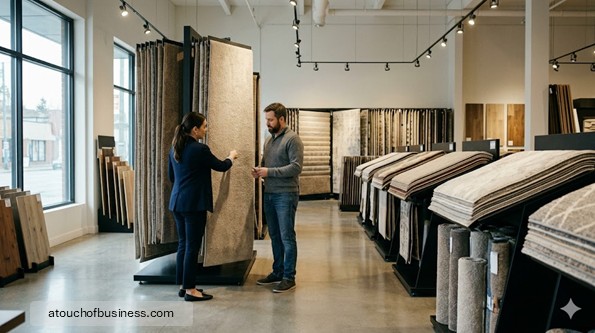
What to Expect From This Guide to Starting a Carpet Store
This guide walks readers through the key decisions and practical steps involved in opening a carpet store, from testing the retail model and local demand to organizing suppliers, installation, finances, and the showroom. The highlights below show selected areas, while the full article goes further.
Inside the guide, you will find:
- Startup roadmap: Move from owner fit and market validation through planning, location, supplier setup, installation choices, and opening checks.
- Industry interviews: Compare practical observations from flooring retailers about showrooms, estimates, customer service, sales systems, staffing, and margins.
- Startup FAQs: Review concise answers about installation licensing, supplier accounts, inventory models, subcontractors, product range, and housing-market exposure.
- Financial planning: Examine fixed costs, product and installation margins, break-even volume, slow periods, funding, and operating reserves.
- Showroom planning: Consider location, displays, roll storage, flooring software, payment systems, lighting, and the customer consultation area.
- Local requirements: Identify location-dependent rules for zoning, occupancy, signs, sales tax, installation services, employees, and product labeling.
- Opening warnings: Check installer insurance, supplier documentation, estimating procedures, inventory controls, payment processing, permits, and showroom preparation.
Continue with the owner-fit questions and market warnings that shape the earliest carpet store decisions.
As a carpet store owner, you run a retail showroom where customers browse samples, select flooring, and arrange purchase and installation — all under one roof.
You’ll spend your days consulting with homeowners, property managers, and contractors, guiding them through fiber types, pile construction, padding options, and installation details that big-box stores rarely explain well.
This is not a passive business. You’re responsible for managing showroom displays, coordinating installer schedules, tracking roll inventory, handling supplier deliveries, and producing accurate job quotes — often all in the same day.
The startup path for a carpet store is well-defined, but the decisions you make early — about your product mix, location, installation model, and inventory approach — shape everything that follows.
Before you commit to a lease or a supplier, take time to understand what you’re stepping into.
Is a Carpet Store the Right Fit for You?
This business rewards product knowledge. Customers expect you to explain the difference between nylon and polyester fiber, between cut pile and loop pile, and between padding types — confidently and without hesitation.
If you’ve worked in the flooring industry, a home improvement environment, or retail sales, you have a genuine head start.
If you’re coming in with no flooring background, plan to spend real time learning product before you open.
Beyond product knowledge, this is a high-overhead retail business. You’re committing to rent, staffing, inventory, insurance, and vehicle costs before a single sale is made.
Ask yourself honestly whether you can cover your personal living expenses for six to 12 months while the store builds its customer base.
Talk to carpet store owners in other markets — cities or towns where you won’t be competing with them. Ask what the slow seasons feel like, how they found reliable installers, what their first year actually cost, and what they’d do differently.
Firsthand owner insight is more honest than any industry overview. Prepare your questions before those conversations.
Also consider whether the people in your household understand the commitment. A retail storefront operates six or seven days a week in most markets. Income is uncertain early, and family support matters.
Red Flags Before You Start
Some of these warning signs mean pause and verify more. Others mean rethink the model entirely.
The local housing market is soft or declining.
Carpet store revenue tracks home sales, residential renovation, and new construction closely. When housing slows — as it did broadly in 2023 and 2024 — showroom traffic drops across the industry. Check local home sales trends and renovation activity before committing to a lease.
Big-box flooring retailers already dominate your trade area.
Floor & Decor, Home Depot, and Lowe’s compete directly on price for commodity carpet. Independents win on expertise, selection depth, and installation quality — not on price. Make sure your market has room for that positioning before you open.
You can’t fund six to 12 months of fixed costs before opening.
Rent, staff wages, insurance, and inventory don’t stop whether you have customers or not. Running out of operating capital is one of the most common reasons retail startups close. If your runway is too short, reduce the scale of the launch or delay until your reserves are stronger.
Carpet-only margins may not support the model.
Carpet product margins are lower than many other flooring categories. Without installation revenue or a broader product mix, a carpet-only store at small scale faces real profitability pressure. Consider building installation services or carrying hard-surface products — luxury vinyl plank, hardwood, or laminate — into your model from the start.
You don’t have reliable installers lined up before opening.
Skilled flooring installers are in limited supply in many markets. If you plan to offer installation but haven’t confirmed subcontractors or in-house installers before the first customer appointment, you’re starting with an operational gap that will cost you jobs and reputation.
You can’t get wholesale supplier accounts approved before launch.
Major carpet manufacturers and distributors are selective. They may require a confirmed physical location, a resale certificate, and sometimes a track record before approving wholesale accounts. Begin those conversations early — don’t sign a lease before confirming that key supplier relationships are attainable.
Installer labor costs are rising industry-wide.
Independent carpet retailers consistently identify rising installer pricing as a structural challenge. If your local market has limited installation labor, the economics of a product-and-installation model become harder to sustain. Verify installer availability and rate levels as part of your pre-opening research.
Step 1: Decide Whether This Business Fits You Before Committing Anything
The first decision isn’t about a location or a product line. It’s about whether you’re genuinely ready to run a high-overhead retail showroom that depends on consistent traffic, skilled installers, and strong product knowledge.
Running a carpet store well means making good decisions across inventory, sourcing, pricing, display, installation coordination, and customer service — often simultaneously.
This business may not fit you if:
- You have no background in flooring, retail, or construction-adjacent sales
- You can’t sustain personal living expenses for at least six months with no guaranteed income
- You’re risk-averse about high fixed monthly costs before the business breaks even
- You’re not prepared to be in the store, on the phone, or coordinating jobs six days a week
If you check out on all those fronts, the next step is talking to non-competing carpet store owners and building a realistic picture of the business before you spend anything significant.
Step 2: Choose Your Business Model Before You Look at Locations
This decision shapes your space requirements, inventory needs, staffing, installer relationships, and pricing structure. Getting it wrong early is expensive to fix.
The three main storefront approaches are:
- Product and installation: You sell carpet and coordinate installation — either through in-house installers or subcontractors. This is the most common full-service model and gives you access to higher revenue per job. It also adds scheduling, insurance, and installer management complexity.
- Product only: Customers buy from your showroom and arrange their own installation. Lower operational complexity, but you leave installation revenue — often the higher-margin piece of the job — on the table.
- Hybrid showroom with in-home consultations: The showroom anchors your brand, but your salespeople also visit customers at home with sample books. This approach can work in markets with price-conscious buyers who won’t drive to a showroom unprompted.
You also need to decide your customer focus before choosing a location or setting up supplier accounts.
Residential homeowners, property managers, builders, and commercial clients — offices, hotels, and rental properties — all behave differently, shop differently, and have different volume and margin profiles.
Your product mix decision matters just as much.
A carpet-only store limits the number of customers you can serve. Most independent floor covering retailers carry hard-surface products — luxury vinyl plank, hardwood, laminate, or tile — alongside carpet, because customers actively compare flooring types before choosing.
The broader your product range, the more display infrastructure, warehouse space, and supplier relationships you’ll need. Decide your scope before you sign anything.
Step 3: Validate Local Demand and Know Your Competition
Map the existing flooring retailers within your intended market: independent carpet stores, regional chains, and big-box competitors. Understand where there’s a gap you can fill — whether that’s deeper product expertise, better installation service, a specific customer type, or a price point that’s underserved.
Check local supply and demand conditions honestly. Look at home sales trends, residential renovation activity, and whether commercial demand — from property managers, builders, and hospitality clients — can supplement residential sales when the housing market softens.
Specialty stores hold a meaningful market advantage because consumers value expert guidance. That advantage only materializes if you can deliver it consistently — and if enough customers in your trade area are willing to seek it out over the convenience of a big-box alternative.
Step 4: Decide Whether to Start from Scratch, Buy, or Franchise
Starting from scratch gives you full control over your product mix, store identity, and operating model. You also build your customer base and supplier relationships from zero, which takes time and capital.
Buying an existing carpet or floor covering store gives you a running start — existing customer accounts, approved supplier relationships, trained staff, and a showroom that’s already set up. Review the financials carefully and understand why the seller is exiting. Learn more about buying vs. building a business before deciding.
Franchise options exist in the carpet and flooring space.
Brands such as Abbey Carpet & Floor, Floor Coverings International, and Big Bob’s Flooring Outlet offer franchise models with brand recognition, supplier buying power, and operational support. Franchises require an upfront fee and ongoing royalties. Evaluate the franchise disclosure document carefully and talk to existing franchisees before committing.
Flooring retail networks are a third option worth researching.
Groups like Floors & More or FCA Network offer collective purchasing power, showroom layout support, and peer networking without franchise-level fees or restrictions. These networks can give an independent store the supplier leverage of a larger organization while letting you keep your own brand.
Your best path depends on your budget, your timeline, how much support you need, and how much control you want to keep.
Business Plan
Before you commit to a location, a lease, or a significant inventory purchase, you need a written plan that forces you to confront the numbers honestly.
A strong business plan for a carpet store maps out your startup cost categories, your monthly fixed costs, your expected revenue model, and the sales volume you need to break even — using your own local quotes and market research.
Carpet product margins are lower than many other flooring categories. Understand, before opening, how many jobs per week at your expected average job size cover your fixed overhead.
If you plan to offer installation, factor in installer costs carefully. Rising installation labor pricing is a documented industry challenge. If your installation margin is thin, you need either higher product volume or higher per-job average sales to make the model work.
Model the slow periods honestly. Flooring retail slows in winter in most U.S. markets and is sensitive to housing conditions. Your plan should show how you survive a slow quarter, not just how you thrive during a busy one.
Your plan should address how you’ll estimate revenue and profitability for your specific location and model. Build your numbers from local rent quotes, supplier pricing, installer rates, and realistic traffic assumptions.
Plan for enough operating capital to cover at least six to 12 months of fixed costs before the store reaches consistent profitability. This includes your personal living expenses.
Review your plan against potential funding sources — SBA loans, conventional business loans, lines of credit, supplier payment terms, and your own savings. For guidance on financing options, see how to get a business loan.
Step 5: Find the Right Location and Lock Down the Lease Terms
Location is one of the highest-stakes decisions you’ll make. A showroom no one can find, or can’t park at, will underperform regardless of your product mix or service quality.
Look for spaces that offer:
- Visibility from a well-traveled road or intersection
- Adequate parking for customers who may spend an hour browsing
- Enough square footage for a proper showroom, sample displays, and roll storage
- Proximity to home improvement retailers, furniture stores, or other destinations that attract renovation-minded shoppers
Think carefully about showroom size versus inventory model. A larger showroom with full roll stock creates a strong in-store experience but carries higher rent and more capital tied up in inventory.
A smaller showroom paired with sample boards, quick-order fulfillment from suppliers, and in-home consultations can reduce overhead while still serving customers well.
Before you sign a lease, verify zoning.
Your selected space must be commercially zoned for retail floor covering sales. Confirm this with your local planning or zoning office — don’t assume. A retailer who signs a lease and then discovers the space can’t legally support their use has a very expensive problem.
Also confirm that a certificate of occupancy exists for the space and covers retail use at your expected occupancy level. If the space needs interior modifications — new walls, updated electrical, HVAC changes — local building permits will be required before you open. Check with your local building department before finalizing the lease.
Review lease terms carefully.
Look at rent escalation clauses, who is responsible for build-out costs, your signage rights, and what happens if you need to exit early. A sign permit will be required for exterior signage in most jurisdictions — confirm the rules before ordering signs.
Step 6: Register the Business and Complete Your Legal Setup
Get your legal foundation in place before you sign supplier agreements, hire anyone, or open a bank account.
Choose a business structure first. A limited liability company is a common choice for retail businesses because it separates your personal assets from business liabilities. An attorney or accountant familiar with small retail businesses can help you evaluate your options.
Register your business entity with your state, then file a DBA (doing business as) if you’re operating under a trade name rather than your personal legal name. Requirements vary by state and county — check with your Secretary of State’s office or county clerk.
Apply for a federal Employer Identification Number (EIN) directly through IRS.gov at no cost. You need this before opening a business bank account and before most wholesale supplier applications.
Register for a state seller’s permit through your state’s Department of Revenue. This is required in most states before you can legally collect sales tax from customers. Your seller’s permit also allows you to apply for a resale certificate, which lets you purchase carpet and other inventory from wholesalers without paying sales tax at the time of purchase.
Step 7: Understand What Licenses and Compliance Items Apply to You
A carpet store’s compliance picture depends significantly on whether you offer installation services and whether you hire employees. Get clear on your specific situation before you open.
Start with the basics that apply to almost all retail businesses:
- General business license at the city or county level (check your local business licensing office)
- Certificate of occupancy for your retail space
- Seller’s permit and sales tax registration with your state’s revenue department
- Zoning confirmation for retail floor covering use at your specific address
- Sign permit for exterior signage
- Fire safety inspection, which many jurisdictions require before a new retail business opens
Installation creates additional compliance questions.
Some states require a carpet retailer to hold a contractor’s license or home improvement registration when arranging installation — even through licensed subcontractors. Others allow dealers to use licensed subcontractors without holding that license themselves. A few states don’t require installation licensing for carpet at all.
Check with your state’s contractor licensing board and business licensing authority before you commit to offering installation. Don’t assume the answer — it varies by state.
The sales tax treatment of combined product-and-installation sales also varies by state.
In some states, a carpet sale that includes installation is taxed on the total charge. In others, the installation component is treated differently depending on whether the retailer is classified as primarily a retailer or primarily a contractor. Confirm the correct treatment with your state’s Department of Revenue before finalizing your invoicing and pricing procedures.
For more detail on permits and business licenses, start with your city and county licensing offices, then work through state-level requirements from there.
If you hire employees, register for state employer withholding accounts and state unemployment insurance with the relevant state labor and revenue agencies.
Federal compliance applies regardless of location. The FTC Textile Fiber Products Identification Act requires that fiber content, country of origin, and manufacturer identification appear on all carpet and rug products you sell. Verify that all products you receive from suppliers carry compliant labeling before putting them on the floor.
Step 8: Set Up Supplier Accounts and Build Your Product Assortment
Your product assortment is the heart of what customers see when they walk in. Getting it right before opening — and keeping it current — is one of the most operationally demanding parts of running a carpet store.
Begin supplier conversations during the planning phase, before you sign a lease. Major carpet manufacturers and wholesale distributors may require a confirmed physical address, a resale certificate, and in some cases an in-person visit to your showroom before approving an account.
When you apply for wholesale accounts, have your resale certificate ready.
This document — issued under your state seller’s permit — allows you to purchase inventory tax-free from suppliers. Present it to each new supplier and keep a copy of each transaction on file.
Decide on your inventory model before placing first orders:
- Sample-and-order model: Display samples and sample books; order product once a customer commits. Lower upfront inventory cost, but delivery lead times affect your ability to promise quick installation dates.
- Stocked roll inventory: Keep fast-moving product in rolls on-site for immediate fulfillment. Requires more warehouse space and capital, but allows faster turnaround and the ability to sell remnants.
- Hybrid: Most stores combine both — samples for the full catalog, stocked rolls for popular entry-level and mid-range products.
Ask suppliers about co-op programs that offset the cost of sample display boards and racks. Many manufacturers provide or subsidize these as part of opening a new dealer account.
Plan your assortment by price tier and by category. Carry a clear entry-level, mid-range, and premium option in each product category you stock. Weak assortment — too narrow or poorly merchandised — is a common early failure point in flooring retail.
Track dye lots carefully from the start. Carpet produced in different dye lots may not match visually, which becomes a serious problem if a customer needs additional material after an initial installation. Your inventory system needs to handle this from day one.
Log remnants — the cut pieces left over from roll sales — and sell them at reduced prices rather than discarding them. A disciplined approach to remnant management protects your inventory investment.
Step 9: Make the In-House vs. Subcontractor Decision for Installation
If you’re offering installation, you face a significant operational choice: hire employee installers or work with licensed subcontractors.
In-house employee installers give you direct control over quality and scheduling. They also mean payroll management, workers’ compensation coverage, vehicle costs, tool investment, and the challenge of keeping full-time installers productive between jobs.
Independent subcontractors reduce fixed payroll costs and give you scheduling flexibility. The tradeoff is that you depend on their availability, their quality standards, and their compliance with licensing and insurance requirements.
If you use subcontractors, collect a certificate of insurance from every installer before the first job.
Each certificate should confirm general liability coverage at limits at least equal to yours, active workers’ compensation coverage, and commercial auto coverage. Keep these certificates on file and update them when they expire.
Also verify whether your state requires you — the retailer — to hold a contractor’s license when arranging installation through subcontractors. Check with your state’s contractor licensing board before your first installation job.
Be cautious about misclassifying employee installers as independent contractors. The legal and tax consequences of getting this wrong are significant. If you’re unsure how your state defines the distinction, consult an employment attorney or your state’s Department of Labor before structuring installer relationships.
For guidance on hiring employees if you go the in-house route, review what’s involved in payroll, onboarding, and employer obligations before making commitments.
Step 10: Set Up Banking, Pricing, and Your Payment System
Open a dedicated business bank account as soon as your EIN is in hand. Keep all business income and expenses completely separate from your personal finances from the first transaction.
Set up payment processing before the store opens. You need a credit card terminal for in-store transactions, the ability to accept ACH or electronic payment for larger commercial accounts, and invoicing capability for jobs that include both product and installation.
Consumer financing programs — offered through third-party lenders — are common in flooring retail. The ability to offer financing at the point of sale can directly affect your close rate on bigger jobs.
Pricing for a carpet store typically involves several layers:
- Product price per square foot (or square yard), based on your wholesale cost plus markup
- Padding cost, priced separately or bundled with product
- Installation cost, quoted per square foot or per square yard
- Waste allowance — typically 10–15% added to the measured area to account for cuts, seams, and pattern matching
Understand how your pricing compares to local competitors before you finalize it. For guidance on building a pricing structure, see how to price your products and services.
Develop your estimating process before the first customer walks in.
Accurate room measurement and job quoting are essential operational skills. Errors in floor area calculation, waste allowance, or padding quantities come directly out of your margin. Test the estimating workflow with real room dimensions before opening day.
Step 11: Get Insurance Coverage in Place Before You Open
A carpet store carries meaningful risk on multiple fronts — customer injuries in the showroom, damaged property during an installation, product liability claims, and the real cost of losing inventory to fire or theft.
Coverage to secure before opening:
- General liability insurance: Covers third-party bodily injury and property damage claims. Most commercial leases require proof of this coverage before you can occupy the space.
- Commercial property insurance: Covers your showroom contents, roll inventory, display racks, and equipment.
- Business owner’s policy (BOP): Bundles general liability and commercial property into one policy — usually the most cost-effective option for small retail businesses.
- Workers’ compensation: Required in most states as soon as you hire the first employee. Check your state’s specific threshold. Some states also require sole proprietors in construction-adjacent industries to carry this coverage even without employees.
- Inland marine / installation floater: Covers carpet and materials in transit and at a customer’s location during installation. Standard commercial property policies only cover items at your business address.
- Commercial auto: Required for any company-owned vehicle. If staff drive personal vehicles for business errands, ask your insurer whether a non-owned auto endorsement is needed.
Product liability coverage protects against claims that a product you sold caused injury or property damage. It’s especially relevant for carpet retailers given ongoing concerns about VOC (volatile organic compound) content in flooring products. Confirm with your insurer that it’s included in your general liability or BOP policy.
Learn more about business insurance options and what to look for when comparing policies.
Step 12: Set Up the Showroom and Get It Ready to Sell
The showroom is your most powerful selling tool. How you display product, organize the floor, and guide the customer’s eye directly affects how long people stay, how much they engage, and whether they buy.
Display infrastructure to have in place before opening:
- Sample board racks and rotating sample holders for broadloom and carpet tile
- Roll display stands for stocked product
- Area rug display racks or wall-mounted rug hangers
- Flooring vignettes or display platforms that show installed product in a staged room context
- LED track lighting that accurately represents product color — critical for carpet, where poor lighting misleads customers
- Customer consultation desk or workstation with computer, printer, and estimating tools
- Customer seating near the consultation area
Organize the showroom by category, then by price tier within each category. Customers should be able to navigate from entry-level to premium without confusion.
Keep the presentation current. Outdated samples and dusty display boards undermine the impression of expertise you’re building. Establish a process for refreshing samples when manufacturers update their lines.
In the warehouse or storage area, set up for roll management from day one.
Carpet roll inventory requires tracking by roll number, width, dye lot, and remaining yardage. Generic retail inventory systems don’t handle this well. Use flooring-specific software — options include RFMS, Comp-U-Floor, and Broadlume/Cyncly — built for carpet roll tracking, remnant management, and job costing.
Set up a clear receiving area with a cutting table or straight-edge guide for processing incoming rolls and generating remnants.
Opening-Day Red Flags
These are the gaps that will hurt you on day one if they’re not resolved before you open.
- Certificate of occupancy not confirmed for retail use at your specific occupancy level — operating without it is a compliance violation
- Resale certificates not submitted to all wholesale suppliers — buying inventory without them means overpaying on every order
- No subcontractor certificates of insurance on file — don’t schedule a single installation job until every installer’s certificate is in your files and current
- POS and inventory software not configured and tested — managing carpet rolls in a spreadsheet during a busy opening week leads to inventory errors and billing mistakes
- No estimating workflow tested with real room dimensions — errors in waste allowance or padding calculations erode your margin on every job
- Payment processing not operational — not being able to accept payment from the first customer is an avoidable problem
- Business bank account not open — running business income through a personal account creates accounting and tax complications from day one
- Required signage not permitted or installed — verify that your exterior sign permit is issued before the sign goes up
- Sample displays not fully stocked or organized — opening with an incomplete showroom sends the wrong signal to your first customers
- Installer relationships not confirmed for first jobs — don’t promise installation timelines you can’t deliver
Frequently Asked Questions
Do I need a contractor’s license to offer carpet installation from my retail store?
It depends on your state. Some states require the retail carpet dealer to hold a contractor’s license or home improvement registration when arranging installation, even through subcontractors. Others allow dealers to use licensed subcontractors without holding that license themselves. Check with your state’s contractor licensing board and business licensing authority before committing to an installation model.
What’s the difference between selling carpet as a retailer and being treated as a contractor for tax purposes?
The distinction matters for sales tax. When you sell carpet that the customer installs independently, it’s typically a retail sale. When you sell and install — or arrange installation — the tax treatment varies by state. Some states tax the combined sale at the retail rate; others treat the installation portion differently depending on your classification. Confirm the correct treatment with your state’s Department of Revenue before finalizing your pricing and invoicing procedures.
Do I need to stock full carpet rolls in a warehouse, or can I operate from samples?
Both models work. A sample-and-order approach keeps upfront inventory costs low but creates delivery lead times that may frustrate customers expecting quick installation. Stocking fast-moving rolls allows faster fulfillment and generates remnant inventory you can resell. Most stores use a hybrid — samples for the full catalog, stocked rolls for popular mid-range items. Your decision should match your supplier capabilities, available storage space, and customer expectations in your market.
How do I open wholesale supplier accounts before I have a physical store?
Begin supplier conversations during the planning phase. Have your EIN and state seller’s permit ready so you can provide a resale certificate. Some distributors and manufacturers want to see your showroom before approving an account, which means your space needs to at least be under lease before accounts are finalized. Start early — don’t wait until after you’ve signed a lease to begin these conversations.
Should I focus only on carpet, or carry other flooring types as well?
Most successful independent retailers carry more than carpet. Customers actively compare carpet against luxury vinyl plank, hardwood, and laminate before deciding. A carpet-only store sends some of those customers to a competitor who can serve all their flooring needs. Expanding into hard-surface products broadens your market and increases revenue potential per visit, but it adds display complexity, more supplier relationships, and additional inventory demands.
Can I use subcontractors for installation instead of hiring employees?
Yes, and many independent carpet stores do. Using licensed and insured subcontractors lowers your payroll burden, but requires careful vetting. Every subcontractor must provide a current certificate of insurance showing general liability coverage, workers’ compensation, and commercial auto coverage before the first job. Also verify that your state doesn’t require you — the retailer — to hold a contractor’s license when arranging installation through subcontractors. Be careful about worker classification: misclassifying employees as independent contractors carries serious legal and tax consequences.
How closely tied is a carpet store’s revenue to the housing market?
Very closely. Industry data and retailer surveys confirm that flooring retail tracks home sales, renovation spending, and new construction activity. When the housing market slows, showroom traffic and sales decline. Some independent stores reduce this exposure by cultivating commercial accounts — property managers, offices, and hospitality clients — whose replacement cycles are less tied to home sale activity. Build housing market conditions into your financial planning from the start.
What does a well-run independent carpet store offer that a big-box retailer can’t?
Independent retailers consistently compete on product knowledge depth, personalized service, access to multiple brands, higher-quality installation, and the ability to handle measuring, design consultation, product selection, and installation coordination as a single seamless service. On commodity product pricing, independents generally can’t win against large retailers. Competing on expertise and service is the viable strategy — but only if you can deliver it consistently and your local market values it enough to support your pricing.
What Flooring Retailers Can Teach New Carpet Store Owners
These interviews share practical lessons from carpet and flooring retailers, including showroom setup, pricing, estimating, customer service, software, sales, and managing growth.
Readers can use these examples to think through how a carpet store will sell, quote, measure, install, follow up, and protect margins before opening.
Best Practices: Oshawa Carpet One
This written interview-style profile covers how Guy and Michelle Pylypiw operate Oshawa Carpet One, including customer service, product focus, margins, staffing, technology, and community outreach.
It is useful because it shows how a carpet store can compete on service, clear quotes, trusted advice, and strong local relationships instead of low prices alone.
From Installer to Retailer – Donald Perkins – Carpetland of New England
This video interview follows Donald Perkins as he discusses moving from installation into flooring retail ownership with Carpetland of New England.
It is useful for someone starting a carpet store because it shows the mindset shift from doing installation work to managing customers, sales, operations, and a retail business.
Opening a Second Location – Chris Rogers – Wally’s Carpet and Tile
This video interview covers Chris Rogers of Wally’s Carpet and Tile and the decisions involved in opening another flooring showroom.
It is useful because it explains the systems, team structure, sales process, and local market thinking that should be stable before a carpet store owner expands.
This audio interview discusses how Chris Rogers grew from installer to owner of a multi-location flooring business, with attention to marketing, sales, and retail brand building.
It is useful because it gives a new carpet store owner practical ideas for positioning, hiring, sales training, and building a recognizable local flooring brand.
The Carpet Lady Dianne Explains How She Gets Paid to Go on Estimates
This audio interview covers how Dianne charges for estimates, improves close rates, and prepares for better conversations with flooring customers.
It is useful because estimating can drain time and profits in a carpet store, and this interview helps owners think about quoting, value, and customer commitment.
This audio interview covers showroom pricing, marketing, sales team management, and real struggles involved in running and growing a flooring business.
It is useful because a carpet store depends on profitable pricing, trained salespeople, and clear showroom systems from the beginning.
Related Articles
- How To Start a Carpet Installation Business
- How To Start a Carpet Cleaning Business
- How To Start a Retail Furniture Store
- How To Start a Home Decor Business
- How To Start a Drapery Business
- How To Start a Hardware Store
Sources:
- Brainy Insights: Carpet market specialty share
- Floor Covering News: Flooring industry stats 2024, Retailer challenges 2024
- IBISWorld: Floor covering stores analysis
- ProSource Wholesale: Carpet flooring markups, Flooring business strategies
- Wood Floor Business: Opening retail location advice
- Floors and More: Franchises dealer networks compared
- Top Franchise: Carpet store franchise opportunities
- Comp-U-Floor: Start flooring store
- ABC Carpet Pro: Contractor license requirements
- Insureon: Carpet store insurance
- Huff Insurance: Flooring store insurance
- UpCounsel: Retail store legal requirements
- Toast POS: Retail licenses permits
- Sales Tax Institute: Resale certificate explained
- Ohio Department of Taxation: Carpet sales tax guidelines
- CSLB: License application requirements
- ZipRecruiter: Flooring installers licensed
- LegalZoom: Zoning laws overview
- Faire: Resale certificate guide
- Lightspeed: Flooring POS inventory software
- FTC: Textile labeling law