
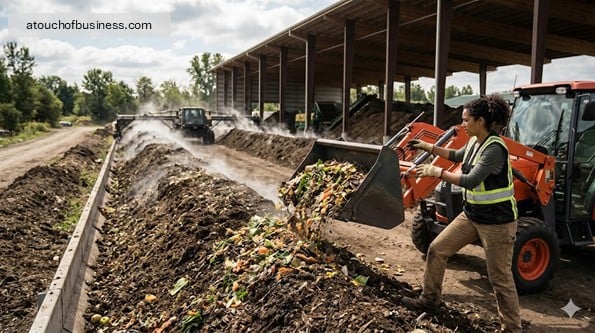
What to Expect From This Guide to Starting a Composting Business
This guide walks readers through the ordered decisions and practical steps involved in starting a commercial composting business, from evaluating revenue and feedstock demand to choosing a method, securing permits and a suitable site, installing equipment, and preparing for the first delivery.
Inside the guide, you will find:
- Startup roadmap: Move from revenue testing and market validation through method selection, siting, permits, facility design, equipment, staffing, sales, and opening checks.
- Operator interviews: Learn from composting founders and service providers discussing customer demand, routes, equipment, pricing, staffing, education, and daily operations.
- Startup FAQs: Find answers about permits, land needs, feedstocks, production time, gate fees, product testing, operational challenges, and buying a facility.
- Business fit: Consider outdoor conditions, odors, heavy equipment, compost biology, regulatory complexity, personal finances, and the lengthy pre-revenue period.
- Revenue and demand: Examine gate fees, finished compost sales, seasonal cash flow, feedstock supply, local buyers, competition, yield, and break-even logic.
- Site and permits: Review buffers, access, zoning, environmental approvals, stormwater, leachate, air rules, feedstock categories, and location-dependent timelines.
- Facility preparation: Plan engineering, odor controls, equipment, supplier agreements, staff training, quality testing, pricing, funding, and first-delivery checks.
Read further to determine whether your market, site options, capital, feedstock supply, and regulatory path support a viable composting operation.
What Is a Composting Business?
As a commercial composter, you accept organic materials — yard trimmings, food scraps, wood chips, and agricultural residuals — and transform them into finished compost through a controlled biological process.
You then sell that finished product to farms, landscapers, nurseries, municipalities, and homeowners as a soil amendment and fertilizer.
Running a production-scale composting operation is not a simple or low-capital venture. It involves heavy equipment, environmental permits, careful site design, and a multi-month production cycle before finished compost is ready to sell.
Experienced operators describe it plainly: there is not a lot of profit in dirt. But for the right owner in the right market, it is a viable and meaningful operation that diverts waste from landfills and builds something farmers and landscapers genuinely need.
This guide walks you through the full startup process — from assessing fit to completing your pre-opening checklist before the first feedstock delivery arrives.
Is This Business Right for You?
Before you research permits or equipment, be honest about whether this type of operation suits your strengths and lifestyle.
You’ll be working outdoors in all weather, operating and maintaining heavy equipment, managing organic waste including food scraps and animal residuals, and dealing with odor as a daily reality.
You also need a basic understanding of composting biology — how carbon-to-nitrogen ratios affect decomposition, how temperature and moisture interact, and why aerobic conditions matter for product quality and odor control.
A background in agriculture, environmental science, or equipment operation helps. You’ll need to learn composting fundamentals before you open regardless.
Consider the financial picture honestly. Startup costs for land or a long-term lease, site preparation, permits, equipment, and working capital are substantial.
Revenue from finished compost product sales lags months behind your first operating costs because the composting cycle itself takes six to eight months to complete. You need enough capital — and enough personal financial runway — to carry the operation through that gap.
Talk to people who already run composting facilities in non-competing markets before you commit to anything. Firsthand owner insight on permitting timelines, odor management, equipment reliability, and seasonal cash flow is more valuable than any research you can do on your own. Prepare specific questions before those conversations.
If you prefer predictable indoor work, dislike regulatory complexity, or can’t fund a lengthy pre-revenue period, this business is a poor fit.
If you’re also weighing whether to start from scratch or buy an existing facility, that decision is worth thinking through carefully. Buying an existing composting operation can shortcut the permitting and siting process significantly — both of which are the hardest parts of starting new.
Red Flags Before You Start
Several conditions should make you pause, change your approach, or walk away before committing money to this business.
Evaluate each of these before you spend anything:
- No suitable site exists near your target market. Composting facilities require significant buffer distances from residences, surface water, and wells. In suburban or densely developed areas, finding a zoning-appropriate parcel with adequate buffers may be impossible. If you can’t identify multiple candidate sites, stop and search further before spending money on permits or planning.
- Community opposition surfaces early. NIMBY opposition to composting facilities is documented and widespread. If neighbors or local officials push back during initial zoning inquiries, the permitting process can be stalled, conditioned with expensive requirements, or blocked entirely. Gauge community sentiment before signing anything.
- Permitting timelines exceed your financial runway. In some states, a composting facility permit takes 12 to 24 months or more to receive. If you commit to land or equipment purchases before permits are in hand, a delay can be financially devastating. Understand your state’s typical timeline before making commitments.
- Local landfill tipping fees are very low. Your gate fee — the charge you collect for accepting feedstocks — must undercut the local landfill rate to attract material. Where landfill fees are very low, gate fees may not cover your operating costs at small scale. Verify local landfill pricing before building your financial model.
- No confirmed feedstock supply. Without a reliable and consistent volume of incoming material, your production operation can’t maintain throughput. Secure feedstock commitments before committing to a site.
- No confirmed product buyers. Compost demand is heavily seasonal, with the bulk of sales concentrated in the spring planting season. Without buyer commitments before opening, you risk producing finished compost you cannot move — which creates site management problems and cash pressure.
- You plan to accept food waste or biosolids without understanding the added complexity. Those feedstocks substantially increase permitting requirements, odor risk, and operational demands. Yard trimmings are the simplest starting feedstock. Don’t assume you can handle food scraps or biosolids from day one without researching the permit tier and infrastructure they require.
- Startup capital is insufficient to cover pre-revenue operating costs. Thin margins and a long production cycle are structural realities. If you can’t fund at least six months of operating expenses before compost product revenue arrives, the financial risk is high.
These are not reasons to abandon the idea without more research. They are conditions that need a clear answer before you proceed.
Step 1: Understand the Dual-Revenue Model and Profit Potential
A composting production operation generates revenue from two distinct sources. Understanding both is essential before you commit to anything.
The two revenue streams are:
- Inbound gate fees (also called processing fees or tipping fees): You charge feedstock suppliers — landscapers, municipalities, restaurants, food processors — for dropping off organic material at your facility. This is your immediate cash flow engine.
- Outbound compost product sales: You sell finished compost in bulk or in screened premium grades to farms, landscapers, nurseries, municipalities, golf courses, and retail garden centers. This revenue arrives months after you begin operations.
Gate fees compete directly with local landfill tipping fees. If your fee is higher than what the landfill charges, feedstock suppliers will choose the landfill. Price gate fees at a meaningful discount to local landfill rates to attract material.
Product sales are heavily seasonal. The large share of annual compost sales typically occurs in the spring. You must produce and stockpile compost across slow months and budget for the cash flow gap until spring demand arrives.
Composting also shrinks feedstock volume significantly — roughly by half. For every two cubic yards of material you accept, you produce approximately one cubic yard of finished compost. Factor that yield ratio into your revenue projections before you build a financial model.
Optional revenue sources include delivering finished compost to customers, charging collection fees for picking up feedstocks from supplier locations, and offering contract grinding services.
Run your break-even calculation with your own local cost structure and pricing before committing to land, equipment, or permits. This is a startup-stage go-or-no-go decision. See the profit and revenue estimation guide for a framework.
Step 2: Validate Your Local Market and Feedstock Supply
Before you spend money on permits or planning, confirm that your local market can support the operation.
On the demand side, contact potential product buyers directly:
- Farms and commercial growers
- Landscaping contractors
- Nurseries and garden centers
- Municipalities (parks, highway restoration, stormwater projects)
- Golf courses
Ask what they currently pay for compost, where they source it, what quality issues they’ve experienced, and whether they’d consider switching suppliers. That direct feedback tells you more than any industry report.
Check your local competition. Are there existing composting facilities within hauling distance that already accept feedstocks and sell finished product? If so, how are their gate fees and product prices structured?
Operating within 50 miles of a facility that already accepts feedstocks for a fee means your pricing must be competitive from day one.
On the supply side, identify your feedstock sources:
- Landscaping companies (yard trimmings, grass clippings, brush)
- Municipalities (leaf collection, yard waste programs)
- Restaurants and food service operators (food scraps)
- Tree services (wood chips)
- Farms and stables (agricultural residuals)
- Food processing facilities (food sidestreams)
Confirm that willing feedstock suppliers exist in your area before you commit to a site. A production facility with no reliable incoming material cannot operate.
Also check whether your state or city bans landfilling of organics. Where those bans exist, feedstock supply is more reliable and your gate fee pricing has more room, because feedstock generators have fewer alternatives.
Where no ban exists, you compete directly with the landfill for every load. Understanding which situation applies to your market matters before you finalize your model.
Research local supply and demand carefully before committing to a location.
Step 3: Choose Your Composting Method and Scale
Your composting method determines your land needs, equipment requirements, odor management approach, and startup cost structure. Make this decision before you evaluate any site.
The three main commercial composting methods are:
- Windrow composting: Feedstocks are built into long rows and turned mechanically with a windrow turner to add oxygen and manage heat and moisture. This is the most common method for startup production operations with access to land. It requires the most acreage but has the lowest equipment cost to start.
- Aerated static pile (ASP): Feedstocks are piled over perforated pipes connected to a blower system. Forced airflow aerates the pile without frequent turning. Odor control is generally better than windrow. Commonly used for food waste.
- In-vessel composting: Feedstocks are processed in enclosed containers or tunnels. Highest capital cost but best odor and environmental control. Used where the site is close to sensitive neighbors or where regulators require enclosed processing.
Most first-time composting producers start with windrow composting on agricultural or industrially zoned land. It’s the lowest-capital entry point, and equipment is more widely available new and used.
Define your production scale before you finalize your method. A small operation produces far less and requires far less infrastructure than a mid-scale facility. Scale affects your permit tier, equipment investment, staffing, and land requirements.
Step 4: Research Site Requirements and Screen Candidate Properties
Site selection is one of the most consequential decisions you’ll make, and many otherwise promising properties are disqualified before the permit process even begins.
Properties that can’t support a composting facility include:
- Properties within a 100-year flood plain
- Properties near wellhead protection areas or public water supplies
- Properties too close to surface water or wetlands
- Properties without adequate separation from residential buildings — commonly 250 feet or more from occupied structures and 150 feet or more from residential property lines; verify your state’s specific requirements
- Properties with soil conditions that allow excessive leachate runoff to groundwater
- Properties without road access adequate for heavy feedstock and product delivery trucks
Use satellite mapping to screen out disqualified properties before you walk them. Focus on agriculturally or industrially zoned parcels well separated from residential areas.
Leachate is the liquid that drains through compost piles. Regulators treat it as wastewater — not stormwater — and you must contain and manage it on site or divert it to a treatment facility. Your site must have room for leachate containment infrastructure.
Don’t purchase land or sign a long-term lease before understanding the permitting timeline and buffer requirements. Land and lease costs accumulate during a permitting process that can last 12 to 24 months or more. Line up as much of the permit process as possible before you commit to a site.
Step 5: Get Zoning and Local Planning Approvals
Before you apply for a state composting permit, your site needs local land-use clearance.
Contact your city or county planning department early. Ask specifically whether commercial composting is a permitted use in the zone where your candidate site is located, what type of approval is required, and what the review timeline is.
Zoning approvals for composting can be classified as permitted by right, permitted by conditional use permit, permitted by special exception, or not permitted at all. The classification determines how much review your facility faces before you can operate.
In some jurisdictions, the local government must include the proposed facility in its multi-year Solid Waste Management Plan before state regulators will approve a permit. That process can add many months to your opening timeline.
You’ll also need post-design permits for site construction, stormwater management infrastructure, and erosion control. These come after your site plan is designed but before construction begins.
Start local planning conversations before you finalize your site decision.
Step 6: Obtain State Environmental Permits
Commercial composting requires a state-level operating permit in virtually every U.S. state. This is the central regulatory hurdle of the operation, and it comes before you accept a single load of material.
Your primary regulator is your state’s environmental agency — commonly called the Department of Environmental Protection, Department of Environmental Quality, or Department of Natural Resources.
Download your state agency’s composting permit application packet and request a pre-application meeting with your regulator. Those conversations save time and prevent costly surprises.
The permit categories that may apply to your facility include:
- Solid waste facility permit or composting facility permit: The primary operating permit. Feedstock types — yard trimmings only versus food scraps versus biosolids — often determine which permit tier applies and how complex the requirements are.
- Stormwater / NPDES permit: Most composting facilities must manage stormwater discharges under the National Pollutant Discharge Elimination System program, administered by states under EPA delegation. Leachate from compost piles is treated as wastewater and must be contained, treated, or diverted to a permitted facility — not discharged as stormwater.
- Air quality state operating permit: Some states require state operating permits for composting facilities to set limits on air emissions, particularly volatile organic compounds. Most composting operations aren’t large enough to trigger a federal Title V permit, but verify your potential-to-emit with your state air quality agency.
- Site plan approval: Regulators typically require a detailed site plan showing feedstock and compost storage areas, processing areas, structures, equipment positions, stormwater controls, leachate containment, buffer zones, fencing, and access roads.
If you plan to accept biosolids — composted sewage sludge — additional federal requirements apply under EPA 40 CFR Part 503. That regulation sets pathogen reduction standards, trace metal limits, and testing protocols.
For windrow composting of biosolids, the federal Process to Further Reduce Pathogens (PFRP) standard requires maintaining pile temperatures at 55°C or higher for 15 days with a minimum of five turnings. Biosolids are a more heavily regulated feedstock category. Understand the full compliance picture before deciding to accept them.
Permitting complexity and timelines vary significantly by state and feedstock type. Some states issue permits in a few months; others take over a year. Plan your financial runway accordingly.
See the guide on business licenses and permits for general guidance on the permit process.
Step 7: Complete Your Legal Business Setup
Legal setup happens in parallel with your site and permit process. Get these items in place before you take any money or sign supplier agreements.
Choose and register a business structure. An LLC is commonly used in this industry because it separates your personal assets from business liability. Composting involves environmental exposure, heavy equipment, and land — liability protection matters. Consult an attorney or accountant before deciding.
Get your Employer Identification Number (EIN) from the IRS. You’ll need it for taxes, banking, and hiring.
If you’re operating under a trade name, register a DBA with your state or county.
Open a dedicated business bank account and keep business transactions completely separate from personal finances from the start.
Obtain a general business license from your city or county clerk’s office.
Check your state’s sales tax rules for compost product sales. Some states exempt compost sold as a soil amendment; others don’t. Verify with your state revenue department before you make your first sale.
Step 8: Design the Site and Complete Facility Setup
Once your permits are in process and your site is secured, facility design and construction begins. This is not a do-it-yourself step.
Work with engineers and environmental consultants who have composting facility experience. Major design failures at composting facilities have consistently resulted from engineers who understood construction but not the composting process, the feedstocks being managed, or the regulatory requirements specific to organic waste processing.
Your site design must address:
- Processing pad surface — may require impermeable material depending on feedstocks and state requirements
- Stormwater management system (retention basins, berms, diversion channels)
- Leachate containment and collection infrastructure
- Water supply for windrow moisture management
- Buffer zone berms or fencing for odor and noise screening from neighbors
- Truck access roads and a scale or weighing platform for gate fee billing
- Finished compost stockpile and staging area separate from active processing
Your site must also have a documented odor response plan — a process for receiving and responding to neighbor complaints — before the first feedstock delivery arrives.
Almost every composting facility will have odor incidents at some point. Having a rapid response process in place from the beginning is essential.
Step 9: Purchase Equipment Before Accepting Feedstocks
Regulators typically require all required equipment to be on site and operational before you accept any incoming material. Acquire equipment while the site is being prepared, not after.
The core equipment for a windrow composting operation includes:
- Front-end loader or wheel loader: Your primary material-moving machine on site. Used for receiving feedstocks, building windrows, and loading finished product.
- Windrow turner: The central production machine. It aerates windrows by lifting, mixing, and redepositing material, which drives the composting process and controls heat and moisture. Tow-behind turners powered by a tractor are lower-cost and practical for smaller operations. Self-propelled straddle turners suit larger production volumes.
- Tub grinder or horizontal grinder: Reduces incoming woody material to appropriate particle size before composting. Large pieces reduce aeration and slow decomposition.
- Trommel screen or star screen: Separates finished compost into marketable grades after curing. A trommel is the most common choice — it handles wet material well and allows easy adjustment of screen size. Finer screening produces premium-grade compost; coarser screening suits bulk landscape supply.
- Water supply system: For maintaining proper moisture in active windrows. A water truck is acceptable for smaller operations if no on-site water source is available.
- Temperature probes: For monitoring pile temperatures across all active windrows. Required for permit compliance records and for PFRP compliance if you accept biosolids.
Buying used equipment from reputable dealers or equipment marketplaces can reduce startup costs significantly. Have a qualified mechanic inspect any used heavy equipment before you purchase it.
When negotiating a site lease, confirm water rights and runoff containment responsibilities explicitly in the lease agreement. Don’t leave those terms to interpretation after you’re already operating.
Step 10: Secure Feedstock Agreements and Set Gate Fee Pricing
Feedstocks are your raw material. Without a reliable and consistent supply, you can’t maintain production volume or support a viable gate fee revenue stream.
Secure feedstock supply commitments from landscapers, municipalities, food service operators, or food processors before you open. Written agreements are preferable to informal commitments.
Set gate fees based on what your local landfill or transfer station charges for the same material. Your fee should be priced at a meaningful discount to the landfill rate to give feedstock generators a financial reason to choose your facility over disposal.
In markets where your state or city bans landfilling of organics, you have more room to set gate fees based on your actual cost to process a cubic yard of compost, since feedstock generators have fewer alternatives.
Decide upfront what feedstocks you will and won’t accept. Yard trimmings only is the simplest starting point. Food scraps increase gate fee potential but also increase odor risk, regulatory complexity, and operational demands. Biosolids add federal compliance requirements. Be deliberate about this decision before you begin soliciting suppliers.
Create feedstock acceptance procedures and intake records before you open. Documenting feedstock types and volumes received is a regulatory requirement under most state composting permits.
Step 11: Hire and Train Your Team
At minimum, you need one skilled equipment operator who can run the loader and windrow turner before you accept your first load. Hire and train your team before opening day.
The US Composting Council (USCC) offers a Compost Operations Training Course (COTC). Sending your operator or site supervisor through that training builds the technical knowledge needed to manage pile temperatures, moisture levels, carbon-to-nitrogen ratios, and quality control — all of which directly affect product consistency and marketability.
OSHA standards apply to composting facilities. Key workplace hazards include rotating machinery, mobile heavy equipment in close proximity to workers, confined-space risks in in-vessel systems, hydrogen sulfide and ammonia gas exposure, and heat stress during outdoor operations.
Establish a written safety program and complete required OSHA training for all employees before work begins.
Workers’ compensation insurance is legally required in most states once you have employees. Composting involves significant physical hazards. Verify your state’s employee threshold for mandatory coverage and bind a policy before anyone starts work.
Learn more about business insurance requirements for operations with employees.
When you’re ready to bring on staff, have your job roles, training materials, and safety procedures documented before the first day on site.
Step 12: Set Up Quality Control and Product Testing
Finished compost is only marketable if it meets buyer expectations and passes required safety thresholds. Quality control starts in the windrow, not at the point of sale.
Monitor and record pile temperatures across all active windrows throughout the composting cycle. Thermophilic temperatures — the high-heat phase that kills pathogens and weed seeds — must be reached and sustained for the material to produce a safe, stable product.
Maintain turning records, moisture logs, and temperature logs for each windrow. These records are required for permit compliance and serve as your production documentation if buyers or regulators ask about process history.
Before selling any finished compost, have it tested by an independent laboratory certified under the USCC’s Test Methods for the Examination of Composting and Composts (TMECC). Testing should cover pathogen levels, heavy metals, nutrient content, maturity, and stability.
Consider enrolling in the US Composting Council’s Seal of Testing Assurance (STA) program. STA participation requires regular third-party laboratory testing and disclosure of results through a standardized Compost Technical Data Sheet (CTDS). You provide that data sheet to buyers so they know exactly what they’re purchasing — feedstock ingredients, test results, and directions for use.
STA certification signals quality and consistency to professional buyers. Landscapers, municipalities, and institutional purchasers who specify compost by quality grade take the STA designation seriously. It can differentiate your product in a competitive local market.
Match your screen size to your target market before selling. Finer screening (3/8 inch) produces premium-grade compost suitable for high-value buyers. Coarser screening (3/4 inch) works for bulk landscape and agricultural supply.
Your screener capacity should match your windrow turner output — there’s no point turning more volume than you can screen.
Step 13: Set Compost Pricing and Sales Channels
Price finished compost based on your cost of production and your local market benchmarks. Survey what landscapers, nurseries, and garden centers in your area currently pay for bulk compost before you set your pricing.
Distinguish between bulk compost — sold by the cubic yard to farms, landscapers, and municipalities — and premium-screened or STA-certified compost sold to garden centers and professional buyers at a higher unit price.
If you deliver finished compost to customers, price delivery to cover your vehicle cost, driver time, and fuel. Delivery fees can be a meaningful added revenue line for established accounts.
Review pricing guidance for products and services to build a structured approach before your first sales conversation.
Set up a scale or weighing system if you sell by weight rather than by cubic yard. Have invoicing or ticket systems in place before the first product sale.
Step 14: Secure Funding and Build Your Business Plan
Composting production operations are capital-intensive at startup. You need to fund land or a long-term lease, site preparation and construction, environmental permits and engineering fees, equipment, working capital for the pre-revenue period, and a cash buffer for unexpected delays.
Funding options to explore include:
- SBA loans (7(a) or 504 programs for land and major equipment)
- USDA Rural Development Business and Industry loan programs
- USDA Natural Resources Conservation Service (NRCS) programs for agricultural composting operations — verify currently available programs directly with USDA
- State environmental infrastructure loan programs — some states offer low-interest financing for composting and organics recycling infrastructure; check your state environmental agency
- Equipment financing through manufacturers or dealers
- Bank commercial loans
A business loan application will require a formal business plan. Build that plan around your specific numbers — local feedstock pricing, local gate fee benchmarks, local compost product pricing, equipment quotes, and site costs.
Plan working capital to cover at least six months of operating expenses before finished compost product revenue arrives in meaningful volume. Running out of operating capital before the first product sales season is one of the most common reasons new composting operations close.
Business Plan
Your business plan for a composting production operation is more complex than most startup plans. It must account for two revenue streams, a multi-month production cycle, capital-intensive site and equipment requirements, and a regulatory process with an uncertain timeline.
Your plan should cover these core areas:
- Site selection rationale: Why the site you’ve chosen meets buffer, zoning, and environmental requirements, and what the permitting timeline looks like.
- Feedstock sourcing plan: Who your feedstock suppliers are, what material types and volumes they’ll deliver, and what gate fee pricing supports break-even.
- Composting method and production capacity: How much feedstock volume you can process per year at your chosen scale, and how that translates into finished compost output after volume reduction.
- Equipment plan: What equipment you need to launch, whether you’re buying new or used, and how you’ll handle maintenance downtime during peak turning periods.
- Startup cost estimate: Land or lease, site preparation, permits, engineering, equipment, and working capital — priced from local quotes, not generic estimates.
- Revenue projections: Gate fee revenue based on expected feedstock volume and local pricing; compost product sales based on expected output volume, seasonal distribution, and local buyer pricing.
- Operating cost estimate: Fuel, labor, equipment maintenance, insurance, lease or land carrying costs, laboratory testing, permit compliance, and delivery costs.
- Break-even analysis: How much feedstock volume and compost product sales you need to cover fixed and variable costs with your specific local numbers.
The dual-revenue model means your break-even depends on the right combination of both streams. Gate fees drive early cash flow. Product sales build over time as you produce and stockpile finished compost through the first production cycle.
Margins are typically thin at small scale. The operation earns best when gate fees are strong, product quality supports premium pricing, and operating costs — especially fuel, labor, and equipment maintenance — are managed tightly.
Seasonal demand concentration is a structural reality. The majority of compost product revenue arrives in a short spring window. Your financial model must account for this pattern and ensure enough working capital to carry the operation through slow months.
Use the business plan guide to structure your document before taking it to a lender.
Opening-Day Red Flags
Before you accept the first feedstock delivery, confirm that every item on this list is in place. Gaps at opening create compliance problems, safety risks, and operational failures that are far harder to correct once material is on site.
- State composting facility permit is not yet issued. Accepting feedstocks before your permit is in hand is a regulatory violation. Do not open early. Wait for the permit.
- Local zoning or site plan approval is still pending. Confirm all approvals are received before operations begin.
- Required equipment is not on site or not operational. Regulators typically require all equipment to be on site before you accept material. A broken windrow turner on opening day means you can’t turn incoming feedstocks — which leads to anaerobic conditions and odor.
- Leachate containment or stormwater systems are incomplete. Leachate from the first feedstock piles must be managed immediately. Incomplete containment puts you in regulatory violation from the first delivery.
- No odor response plan is documented. The first odor complaint from a neighbor can arrive within days of opening. Without a documented response process and a contact method for the public, you have no defensible position.
- No feedstock intake records or temperature logging system. These records are required under most state composting permits. Start logging from day one.
- Staff are operating equipment without completing training. OSHA requires trained workers before they operate heavy machinery. Running a loader or windrow turner without proper training is a safety violation and an insurance liability.
- Workers’ compensation insurance is not bound. If you have employees, confirm the policy is active before their first shift.
- No confirmed product buyers for the finished compost. You’ll be producing compost for months before you have product to sell. Confirm buyers before opening so you’re not starting sales from zero when finished product is finally ready.
- Working capital is insufficient to cover the production cycle. If you don’t have enough cash to operate for at least six months before meaningful product revenue arrives, secure the additional funding before you open.
Frequently Asked Questions
Do I need a permit to operate a commercial composting facility?
Yes. Commercial composting requires a state-level permit in virtually every U.S. state.
Your state’s environmental agency — typically the Department of Environmental Protection or equivalent — issues the primary operating permit. Feedstock types often determine the permit tier. You may also need local zoning approval, a stormwater permit, and in some cases an air quality permit. Contact your state environmental agency early and request a pre-application meeting.
How much land do I need?
It depends on your production scale and composting method. For a small windrow operation, a few acres may be enough — but that acreage must also accommodate buffer zones, stormwater management infrastructure, access roads, and finished product storage.
Confirm buffer zone requirements with your state environmental agency and local planning department before selecting a site.
What feedstocks should I start with?
Yard trimmings — grass clippings, leaves, brush, and wood chips — are the most straightforward starting feedstock. They’re widely available, relatively low-odor, and carry the least permitting complexity in most states.
Food scraps increase gate fee potential but add odor risk, regulatory requirements, and operational demands. Biosolids add federal compliance requirements under 40 CFR Part 503. Start with yard trimmings and expand feedstock types as your experience and compliance infrastructure grow.
How long does it take to produce finished compost?
An active windrow composting cycle typically takes six to eight months from feedstock receipt to screened finished product. A curing period follows active decomposition before the material is stable and ready for sale.
Your financial projections must account for this production timeline when estimating when product revenue will begin.
What is a gate fee, and how should I price it?
A gate fee — also called a processing fee or tipping fee — is the charge you collect from feedstock suppliers who deliver organic material to your facility. It’s one of two primary revenue streams for a composting production operation.
Price gate fees at a meaningful discount below what local landfills and transfer stations charge for the same material. That discount is the financial incentive for feedstock generators to choose your facility over disposal alternatives.
What is the USCC Seal of Testing Assurance program, and should I participate?
The STA program is a voluntary testing, labeling, and information disclosure program run by the US Composting Council. Participating producers send samples to certified laboratories on a regular schedule, receive analytical test results, and provide customers with a standardized Compost Technical Data Sheet showing nutrient content, pathogen levels, heavy metals, maturity, and feedstock ingredients.
STA certification signals product quality to professional buyers — landscapers, municipalities, and institutional customers who specify compost by quality grade. There are annual program fees. Participation is optional but can meaningfully differentiate your product with serious buyers.
What are the biggest operational challenges in the first year?
The most common first-year challenges reported by composting operators are: managing odor before experienced site management practices are established; equipment breakdowns during critical turning periods; slower-than-expected product sales because of seasonal demand concentration; and permit conditions that limit feedstock volumes until you demonstrate compliance.
Talking with experienced composting facility operators before you open is the most reliable way to anticipate and prepare for these challenges.
Can I buy an existing composting facility instead of starting from scratch?
Yes, and it’s worth investigating if suitable facilities are available in your target area. An existing facility comes with permits already issued, an established feedstock supply, site infrastructure in place, and an existing product customer base. The permitting and siting challenges that make starting a new facility difficult are already resolved.
Before you purchase, verify the status and transferability of all permits, review the facility’s compliance history for any violations or enforcement actions, inspect all equipment thoroughly, and confirm whether existing supplier and buyer relationships will continue under new ownership.
Expert Advice From People in the Composting Business
These interviews share practical lessons from composting founders, operators, and service providers who collect food scraps, manage compost operations, serve residential and commercial customers, and build community support.
Readers can use these interviews to think through customer demand, collection routes, equipment needs, pricing, education, staffing, and the day-to-day realities of starting a composting business.
Lessons In Community Composting: Business Focus And Structure
This interview-based article shares insight from several community composters about how they started, chose a business focus, and structured their operations.
It is useful for understanding how local demand, land access, permits, hauling, and processing choices shape a composting business before opening.
Turning Waste Into Wealth: Interview with Blue Earth Compost CFO Sam King
This written interview covers Blue Earth Compost’s food scrap hauling model, commercial growth, municipal demand, finished compost sales, and industry trends.
It is useful for readers thinking about revenue streams, commercial contracts, fleet needs, and the business case behind compost collection.
Working ON the Compost Business, Not Just IN it with Pierce Louis of Dirt Hugger
This podcast interview discusses Dirt Hugger’s operating lessons, planning habits, innovation, ownership changes, and business strategy.
It is useful for understanding why compost operators need time for planning, not just daily problem-solving with odors, staffing, piles, and logistics.
This Young Entrepreneur Will Collect Your Food Waste and Turn It Into Compost
This audio interview features Nate Hogsten of Kaimuki Compost Collective discussing subscription pickup, bucket exchange, customer demand, and hot composting barriers.
It is useful for readers considering a small local pickup model with recurring customers, simple containers, and education around food waste.
Liam Donnelly on How and Why to Try Composting
This podcast interview features WasteNot Compost founder Liam Donnelly and covers his origin story, beginner composting questions, and common customer misconceptions.
It is useful for seeing how a composting service can start very small and grow into a larger local collection operation.
Lauren Clarke Never Lets a Good Problem Go to Waste
This written interview with TURN founder Lauren Clarke covers why she started the business, lessons learned, team building, and customer experience.
It is useful for readers planning a service-based composting business that serves homes, restaurants, businesses, and events.
We Compost Is Keeping Tons of Waste Out of Landfills
This podcast interview with Steve Rickerby and Gemma Spring explains how We Compost found a gap in the market and started with one customer.
It is useful for understanding customer discovery, commercial pickup demand, route growth, and the practical pressure of building collection infrastructure.
Related Articles
- How To Start a Recycling Business
- How To Start a Garbage Pickup Service
- How To Start an Environmental Cleanup Business
- How To Start a Fertilizer Production Business
- How To Start a Biodiesel Business
- How To Start a Battery Recycling Business
Sources:
- US EPA: EPA Composting Overview, Start a Composting Program
- BioCycle: Composting Facility Permits, Revenue Forecasts for Composters, Facility Development Pitfalls, Stormwater Management Regulations, Workers Compensation in Organics Recycling, Introducing STA Certified Compost
- US Composting Council: State Composting Regulations, Composting Equipment Guide, Water Management Plans
- Sustainable Development Code: Composting in Agricultural and Commercial Districts
- Machinery Partner: Composting Business Permits Guide, How to Start a Composting Business
- Insteading: How to Start a Compost Business
- Jim.com: Composting Business Startup Guide
- Engineered Compost Systems: Odor Management Best Practices
- Vermeer: Grinders, Turners, and Screeners for Compost
- Komplet America: Trommel Screeners for Composting
- Target Organics / USCC Hub: Composting Equipment Overview
- A&L Great Lakes Laboratories: Compost STA Program Explained
- eCFR / US Law: 40 CFR Part 503 Biosolids Standards, 40 CFR Part 503 Appendix B — PFRP
- NPR: Cities and Community Composters
- OSHA: OSHA FAQ — Workplace Safety Requirements
- NJ DEP: Composting Facility Siting and Preparation