
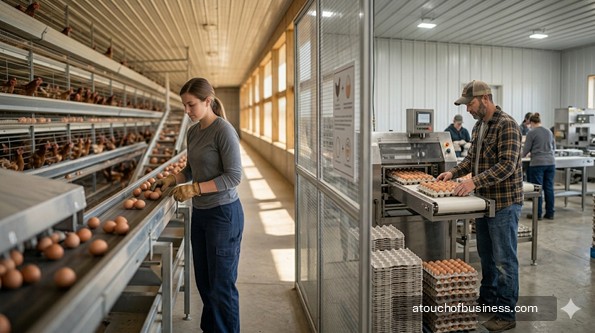
What to Expect From This Guide to Starting an Egg Farm
This guide walks readers through the key decisions and practical steps involved in starting an egg farm, from choosing a production model to securing buyers and preparing the first sales. The selected highlights point to deeper coverage of flock care, compliance, cash flow, equipment, and risk.
Inside the guide, you will find:
- Startup roadmap: Move from owner fit, housing and sales choices, demand testing, and permits through flock sourcing, handling systems, pricing, and opening checks.
- Producer interviews: Learn from egg farmers and industry voices discussing daily routines, housing, equipment, biosecurity, markets, costs, and operating risks.
- Startup FAQs: Find answers about first production timing, federal egg rules, sales channels, labeling claims, HPAI, NPIP, staffing, and CAFO permits.
- Market and model: Compare housing systems and sales channels while confirming local buyers, buyer requirements, competition, and realistic production volume.
- Financial planning: Account for feed volatility, thin conventional margins, the pre-laying cash gap, local break-even costs, funding, and disease-related shutdowns.
- Handling and compliance: Review zoning, licensing, grading, washing, refrigeration, carton labels, organic claims, environmental rules, and location-dependent requirements.
- Opening preparation: Verify housing, flock sourcing, suppliers, cold storage, handling equipment, labels, records, insurance, biosecurity, and daily backup care.
Begin with the daily-life questions before choosing the housing and sales model that determines the farm’s setup.
Running an egg farm means showing up every single day — feeding hens, collecting eggs, washing and packing cartons, and keeping a flock healthy through weather, disease pressure, and market swings.
As an egg farmer, you raise laying hens and move shell eggs from the coop to the carton. The production cycle never pauses. Hens lay whether or not you have buyers lined up, whether feed prices spike, or whether avian influenza is circulating in your region.
That daily reality is worth understanding before you spend a dollar on land, housing, or birds. This guide walks you through the startup steps for an egg farm, from choosing your production model to landing your first buyers.
Is an Egg Farm Right for You?
Egg farming is a 365-day commitment with no seasonal off-switch. Hens need feed, water, and collection every day — including weekends, holidays, and the days you’re sick.
Are you comfortable with animal biology — mortality, disease, flock behavior, and hands-on daily labor in all weather?
Can your household absorb a gap in income while you build a customer base and work through the rearing period before your first egg revenue arrives?
Pullets — young hens approaching laying age — take 18 to 22 weeks before they begin producing. That’s months of feed, utilities, and labor with no eggs to sell.
Running out of operating capital during that stretch is one of the most common reasons small egg farms fail before they ever get going.
Think carefully about your motivation, too. Are you drawn to the daily work of animal care, production management, and direct customer relationships? Or are you mainly trying to escape a difficult job or financial situation?
Talk to people who run egg farms in non-competing markets before you commit to anything. Ask about their daily routines, the compliance headaches they didn’t expect, the slow weeks, and what they wish they’d known before starting.
Consider whether you want to start from scratch or buy an existing operation. Purchasing an established egg farm with existing housing, hens, buyers, and compliance history can compress the startup timeline significantly — though it comes with its own due-diligence requirements.
Red Flags Before You Start
Some of these warning signs mean pause and verify. Others mean rethink the model entirely.
Watch for these before you commit:
- No hands-on poultry experience. Owners who have never managed laying hens face a steep learning curve. Flock health failures and low production rates are expensive early on. Spend time on a working egg farm before you build yours.
- Unclear sales channel. Hens lay daily whether you have buyers or not. If you can’t describe exactly who will buy your eggs before you purchase birds, you’re not ready to produce them.
- Zoning hasn’t been verified. Some residential and suburban zones prohibit poultry entirely. Others restrict flock size, setbacks, or on-site sales. Confirming zoning before purchasing land or signing a lease is non-negotiable.
- Undercapitalized for the rearing gap. If your budget covers only equipment and birds but not the 18–22 weeks of feed and operating costs before your first egg revenue, you’re starting with a structural cash-flow problem.
- No daily coverage plan. If you get sick, travel, or face an emergency, someone else needs to care for the flock. If you have no backup person identified, that’s a real risk before launch.
- HPAI is an active, ongoing industry risk. Highly Pathogenic Avian Influenza has caused the depopulation of tens of millions of laying hens across the U.S. A single confirmed detection triggers mandatory flock depopulation under USDA protocols. Facility downtime runs five months or more while replacement pullets reach laying age. This is a recurring industry condition — factor it into your biosecurity planning and insurance budget before you start.
- Feed cost volatility is structural. Feed accounts for the majority of total egg production costs and is tied to grain commodity markets. A pricing plan without a buffer for feed cost increases can collapse margins without any management error on your part.
- Conventional wholesale is dominated by large producers. Large commercial operations supply conventional grocery and food-service wholesale at volumes and prices small farms can’t match. Small egg farms typically survive and thrive through differentiation — direct sales, specialty labels, organic, local branding — not on price.
- Cage-free housing mandates are evolving. Some states require cage-free housing for eggs sold within their borders. If you’re planning a conventional cage system, verify whether the markets you intend to sell into restrict that housing type before you build.
Step 1: Assess Owner Fit and Motivation
Egg farming is repetitive, physical, and unforgiving of skipped days. The work — flock checks, feed and water management, egg collection, washing, packing, cleaning — happens on the same schedule every day.
That predictability can be satisfying if you genuinely enjoy working with animals and running a hands-on production operation. It becomes grinding quickly if you don’t.
Think through the lifestyle tradeoffs honestly before spending on infrastructure. Ask whether your household can manage the income uncertainty and daily demands.
Talk to egg farm owners in non-competing areas and prepare specific questions before those conversations — their experience is more reliable than any guide.
Read through pre-startup considerations and think honestly about the challenges of business ownership before moving forward.
Step 2: Choose Your Production Model Before Anything Else
The production model is the most consequential decision you’ll make. It determines your housing design, equipment, flock size, feed type, compliance requirements, and which customers you can actually reach.
Do not commit to land, equipment, or birds before choosing a model.
Housing system options include:
- Conventional (caged): Highest density, lower feed cost per egg, simpler collection. Some states restrict or ban conventional cage egg sales.
- Cage-free (floor or aviary): Hens move freely indoors. Required or strongly preferred by a growing number of retail buyers.
- Free-range: Cage-free with continuous outdoor access during the laying cycle. Required for the “free-range” label under USDA/AMS definitions.
- Pasture-raised: Hens rotate on outdoor pasture with mobile coops or range access. Supports the highest premium pricing but requires more land and daily management.
- Organic: Requires USDA National Organic Program (NOP) certification. Birds must be under continuous organic management from their second day of life, fed 100% certified organic feed, and given outdoor access.
Your housing system decision is closely tied to your sales channel. Choose your sales channel before designing your housing and compliance approach — the channel drives the requirements, not the other way around.
Common sales channel options:
- Farm gate / on-premises direct sales: Typically the simplest compliance path. Some states have lighter licensing and labeling requirements for on-premises sales.
- Farmers markets: Usually requires a state egg handler or dealer license and refrigerated transport at the market.
- CSA (community-supported agriculture): Direct subscription relationship with customers. Pre-payment helps cash flow.
- Wholesale to restaurants, grocers, or distributors: Usually requires graded eggs, specific labeling, a state egg handler license, and consistent delivery volume. Selling ungraded eggs to retail buyers is prohibited in most states.
- Online / delivery: Often treated as retail. Licensing and labeling requirements vary by state.
If you’re selling direct to consumers at the farm gate, your compliance requirements are typically lighter — but verify with your state department of agriculture before assuming any exemption applies.
If you’re selling to restaurants or grocery stores, plan for state egg handler licensing, graded and labeled eggs meeting specific standards, product liability insurance, and a consistent delivery schedule before you approach a wholesale buyer.
A starting flock of 50 to 100 laying hens is commonly recommended for first-time egg farm owners. That scale lets you learn production and handling skills, test your sales channel, and validate your model without heavy capital exposure before you decide to grow.
Step 3: Validate Local Market Demand Before Building Anything
Hens lay daily. If you don’t have buyers before they start, you’ll have eggs you can’t move.
Before you commit to infrastructure, validate the market:
- Identify potential buyers — neighbors, farmers market managers, restaurant buyers, food co-ops — and talk to them directly before you break ground.
- Check local supply. How many other egg producers are already selling in your area, at what prices, and through which channels?
- Ask wholesale buyers what they require before they’ll purchase from you: labeling standards, insurance certificates, delivery schedule, minimum weekly volume, and grading requirements.
- Price-check local eggs across all channels you’re considering so your pricing plan is grounded in real market data.
A flock of 100 hens at peak lay can produce roughly 70 to 80 dozen eggs per week. Know where those dozens will go before you bring home a single bird.
Use local supply and demand thinking here. If the area is already saturated with small egg farms, you’ll need a clear differentiator — specialty production, organic certification, or a direct-to-consumer model — to carve out a viable market position.
Step 4: Confirm Zoning, Location, and Environmental Permits
Do not purchase land, sign a lease, or start construction until you’ve answered the zoning and environmental questions for your specific location.
Zoning for poultry varies significantly. Some residential and suburban zones prohibit chickens entirely. Agricultural zones typically allow layer operations, but they may regulate flock size, setback distances, on-site sales, signage, odor, noise, and waste management.
Check with the local planning or zoning department:
- Is poultry production allowed in this zone?
- Are there flock-size limits or setback requirements from property lines and neighboring structures?
- Does on-premises egg sales require a conditional use permit or separate approval?
- Does the egg handling area need a building permit or a certificate of occupancy?
For larger operations, check whether a Concentrated Animal Feeding Operation (CAFO) designation applies. Under EPA regulations, medium and large poultry operations may need a National Pollutant Discharge Elimination System (NPDES) permit covering manure management.
Thresholds are based on bird counts and confinement conditions. Contact your state environmental agency — typically the department of environmental protection or natural resources — to verify whether your planned flock size triggers any permitting requirements.
Even operations below CAFO thresholds may be subject to state-specific agricultural water quality rules. Confirm with your state environmental agency and local planning office before you build.
Step 5: Research Federal, State, and Local Compliance
Egg farming is regulated at multiple levels, and the rules that apply to you depend on your flock size, how you sell, and what labels you use.
At the federal level, the FDA Egg Safety Rule (21 CFR Part 118) applies to shell egg producers with 3,000 or more laying hens who sell eggs into commercial channels. If you meet that threshold, you must implement a written Salmonella Enteritidis (SE) prevention plan covering biosecurity, pest control, poultry house cleaning, environmental testing, on-farm refrigeration at 45°F or below, recordkeeping, and FDA farm registration. Farms below 3,000 hens are currently exempt from the federal rule — but state rules still apply.
USDA APHIS administers the voluntary National Poultry Improvement Plan (NPIP). The FDA rule requires that farms with 3,000 or more hens source chicks and pullets from NPIP-certified suppliers. A written biosecurity plan consistent with NPIP standards is also a condition for receiving USDA indemnity if your flock is depopulated due to HPAI.
If you’re pursuing organic certification, birds must be under continuous organic management from their second day of life, fed 100% certified organic feed, and given outdoor access. Any egg handling or packing operation must also be certified. Operations selling more than a set threshold in organic products per year must be certified by a USDA-accredited certifying agent. Apply early — the process takes time.
At the state level, most states require producers who sell eggs off-premises or into commercial channels to obtain a state egg handler or dealer license. Requirements, flock-size exemptions, volume thresholds, and fees vary by state. Check with your state department of agriculture.
Most states also require that eggs sold to restaurants, grocers, and wholesale buyers be candled, graded (Grade A or B minimum), and labeled with at least: producer name and address, quantity, grade, size, pack date in Julian date format, “Keep Refrigerated,” and safe-handling instructions. Confirm all state label requirements before printing cartons.
Some states have enacted housing standards requiring cage-free production for eggs sold within their borders. If you’re selling into those markets, confirm that your housing system meets those requirements before construction.
At the local level, some counties require a food establishment permit or food handler’s license for egg washing and packing operations regardless of state-level exemptions. Check with the county health department. Also confirm whether a building permit and certificate of occupancy are required for new poultry housing or handling areas.
Register your farm premises with the state department of agriculture for HPAI surveillance. Even where voluntary, registration provides early outbreak notifications for your area.
Verify business licenses and permits at every level — federal, state, and local — before you open.
Step 6: Choose a Legal Structure and Register the Business
Choose a legal structure before you open a bank account or accept income.
Common options for egg farm owners:
- Sole proprietorship: The simplest and least costly structure. You and the business are legally the same entity, which means full personal liability.
- LLC (limited liability company): Separates your personal assets from business liability. Egg contamination lawsuits can be significant. Many egg farm owners move to an LLC as production and sales volume grow.
- Partnership or corporation: Options for co-owned operations or more complex arrangements.
Register your chosen structure with the state’s secretary of state or equivalent agency. Obtain a federal Employer Identification Number (EIN) from the IRS — required for tax reporting, banking, and hiring employees.
File a DBA (“doing business as”) if you’re operating under a farm name that differs from your legal name.
Open a dedicated business bank account and keep all business transactions separate from personal finances from day one. Read more about opening a business bank account and registering a business for more detail.
Confirm whether sales tax applies to egg sales in your state. Some states exempt raw farm products; others do not. Verify with your state department of revenue before your first sale.
Business Plan
A formal business plan is required by most agricultural lenders and strongly recommended for all egg farm owners before spending on land, infrastructure, or livestock.
Your plan should cover your production model, housing system, flock size, feed sourcing, intended sales channel, startup cost categories, and operating cost estimates — including the full pre-laying period before you earn your first egg revenue.
The profit side of egg farming deserves careful attention before you commit. Feed accounts for a large share of total production costs and is subject to grain market volatility. A pricing plan that doesn’t account for feed cost swings can erode margins quietly.
Per-dozen margins on conventional unbranded eggs are structurally thin. Very small flocks make fixed costs — cartons, refrigeration, labor, licensing — proportionally high per dozen. Most small egg farms that survive do so through premium channels: direct-to-consumer, organic, pasture-raised, or local branding.
Run a break-even estimate using your own local numbers: feed cost per dozen produced, carton and label cost per dozen, labor allocation, utilities, refrigeration, transportation, licensing overhead, and insurance. Don’t use national averages — your costs depend on your flock size, housing type, feed source, and location.
Include a cash flow projection that shows the 18–22 week rearing gap clearly. You need enough operating capital to cover all expenses through that period and through the early months of building a consistent buyer base.
Factor in HPAI risk. A flock loss and five-month production shutdown is a realistic scenario. Your plan should address how you’d handle that financially — through insurance, reserves, or a restocking plan.
Use this business plan guide and the profitability estimation resource as starting points.
Step 7: Secure Funding and Set Up Banking
Identify your funding needs before you commit to land, construction, or livestock purchases.
Potential funding sources for egg farm startups include:
- Personal savings or family investment
- USDA Farm Service Agency (FSA) Beginning Farmer and Rancher Loans — covering land, livestock, equipment, buildings, and operating costs. Apply through your local FSA Service Center at farmers.gov/loans.
- USDA FSA Microloans — designed for small, beginning, and non-traditional farm operations with streamlined requirements
- USDA Farm Storage Facility Loan Program (FSFLP) — low-interest financing for egg storage infrastructure
- Farm Credit System institutions and commercial agricultural lenders
- State agricultural development agencies and beginning farmer programs
- USDA Organic Cost Share Program — for operations pursuing NOP certification, this helps offset certification fees through state agencies
If you need a loan, read about how to get a business loan and gather your production plan, projected costs, and market validation before approaching any lender.
Set up payment processing for direct and farmers market sales before your first transaction. Confirm what payment equipment or mobile capability you’ll need at the point of sale.
Step 8: Secure Land or Facility and Set Up Production Housing
The land and housing decisions are interconnected. The production model you chose in Step 2 drives what your housing must look like.
Site your poultry house to minimize contact with wild birds and migratory waterfowl, which are the primary vectors for HPAI. Avoid proximity to wetlands, ponds, and known bird flyways wherever possible.
If you’re starting with a small flock on an existing property, an outbuilding can often be retrofitted at lower cost than new construction. Inspect any existing structure carefully for ventilation adequacy, biosecurity vulnerabilities (gaps for rodents or wild birds), and the space per hen required by your chosen housing system.
If you’re building new housing, factor in building permits, potential environmental review requirements, and lead time before construction is complete and a certificate of occupancy is issued. New construction for larger operations is a significant capital commitment with a longer path to first production.
Regardless of housing type, the structure must include adequate ventilation, artificial lighting with timers for production management, nesting boxes appropriate to the housing system, feed and water delivery systems, litter or manure management, and a controlled biosecurity entry point with boot-change or disinfection provisions.
Plan for refrigerated on-farm egg storage at 45°F or below before the first egg is collected.
Step 9: Source and Procure the Laying Flock
Purchase birds from a NPIP-certified source. NPIP certification means the breeding flocks and hatchery have been tested and found free of specified diseases including Salmonella Pullorum, Salmonella Typhoid, Salmonella Enteritidis, and Mycoplasma. The FDA Egg Safety Rule requires NPIP-certified sourcing for farms with 3,000 or more hens — and it’s best practice at any scale.
You have two starting options:
- Day-old chicks: Lower cost per bird but requires brooder setup and 18–22 weeks of rearing before lay. More management-intensive early on.
- Started pullets (16–18 weeks old): Higher cost per bird but ready to begin laying within weeks of arrival. Faster path to first revenue.
Check with hatcheries early. Started pullet availability can be limited, especially during active HPAI recovery periods when demand for replacement birds is high across the industry. Advance booking is often required.
Breed selection matters for production outcomes. High-production commercial laying hybrids are common for egg-focused operations. Heritage and specialty breeds are used by some direct-to-consumer and premium-market producers. Match your breed choice to your housing system, climate, and target customer.
Step 10: Establish Feed and Supplier Relationships
Feed is your largest ongoing production cost. Identify a reliable local supplier and confirm availability before you finalize your production model — especially if you’re pursuing organic or specialty feed claims.
Standard layer mash or crumble for commercial laying hens should contain at least 16% crude protein and 3.5% calcium. Water should be available free-choice at all times.
If you’re pursuing organic certification, all feed must be 100% certified organic. Organic feed availability and cost vary significantly by region. Confirm a reliable supply chain before committing to an organic production model — a local shortage will halt your certification compliance.
If you’re making non-GMO or specialty-feed labeling claims, verify the supply chain and confirm consistent availability before those claims appear on a carton. You can’t make a feed-based claim you can’t consistently substantiate.
Establish relationships early with bedding material suppliers, egg carton and packaging vendors, cleaning and sanitizing supply sources, and a poultry veterinarian or state veterinary diagnostic laboratory contact. Having a vet relationship before illness occurs is far better than searching for one during a flock health emergency.
Step 11: Set Up Egg Handling, Grading, and Cold Storage
The production flow from collection to carton needs to be built and tested before your hens start laying, not after.
Your handling process — collecting, washing, candling, grading, sizing, packing, and refrigerating — is a quality control sequence. A bottleneck anywhere in that chain affects egg quality, compliance, and buyer trust simultaneously.
For graded egg sales to restaurants or retail buyers:
- Eggs must be washed and sanitized using only FDA-approved compounds. Wash water must be warmer than the eggs to prevent thermal contamination.
- Eggs must be candled to inspect interior quality (blood spots, cracks, air cell size) and graded as AA, A, or B.
- Eggs must be sized (peewee through jumbo) and packed in new, clean cartons with required labeling.
- Graded eggs must be refrigerated at 45°F or below from packing through delivery.
For direct-to-consumer farm gate sales, some states permit the sale of ungraded, unwashed “nest-run” eggs. Requirements vary — confirm with your state department of agriculture before assuming any exemption applies.
Set up your egg carton labels before the first commercial sale. At minimum, most states require: producer name and address, quantity, grade (if graded), size, pack date in Julian date format, “Keep Refrigerated,” and safe-handling instructions. Confirm label compliance with your state department of agriculture before printing or ordering labels at volume.
Most states prohibit off-premises egg sales in reused cartons. Use new cartons for any eggs leaving the farm.
Step 12: Set Pricing and Confirm Sales Channel Requirements
Price your eggs to cover every actual cost: feed per dozen produced, cartons and labels, labor, utilities, refrigeration, transportation, licensing fees, insurance, and a contribution toward capital recovery.
Don’t price from what competitors charge without first confirming those prices cover your own cost structure. Your cost-per-dozen depends on your flock size, feed source, housing type, and operating model.
If you’re selling direct to consumers at the farm or at a farmers market, you typically have the most pricing flexibility. Direct channels support higher per-dozen prices, but they require your time for customer contact, packaging, and market attendance.
If you’re selling wholesale to restaurants or grocery stores, buyers will negotiate on price and may require a consistent delivery schedule, specific labeling, insurance certificates, and advance notice of supply changes. Confirm exactly what they need before you commit to supplying them.
Review pricing guidance before setting your rates.
Step 13: Complete Insurance and Risk Planning
Insurance isn’t legally required across all jurisdictions, but lenders and most wholesale buyers require it. Check your state’s requirements and your lender’s conditions before assuming any coverage is optional.
Risk-planning coverage to discuss with a farm insurance agent who has poultry experience:
- Farm property insurance: Covers buildings, housing structures, storage facilities, and equipment.
- Livestock/poultry mortality insurance: Covers flock loss from disease, HPAI, accidents, or natural disasters. Highly relevant given active and recurring avian influenza risk.
- General liability insurance: Covers bodily injury and property damage claims from visitors, farm operations, or neighbors.
- Product liability insurance: Critical for any operation selling eggs commercially. Covers contamination and foodborne illness claims. Most wholesale buyers require proof of product liability coverage before purchasing.
- Business interruption insurance: Covers income loss from a forced shutdown — HPAI depopulation, facility damage, or other disruptions that halt production.
- Workers’ compensation: Required in most states when employees are on payroll. Verify your state’s threshold.
- Commercial auto insurance: Required if you use vehicles for egg delivery or business transportation.
- Pollution liability: Relevant for manure runoff risk, particularly for larger operations.
USDA APHIS also offers free, voluntary biosecurity assessments for commercial producers. These assessments matter beyond improving biosecurity — having a written plan consistent with NPIP standards actively in place is a condition for receiving USDA indemnity if your flock is depopulated due to HPAI.
Learn more about business insurance basics as a starting point.
Step 14: Complete Pre-Opening Setup and Launch
Run through every compliance and operational item before you sell a single egg.
Pre-opening checklist for egg farm owners:
- Zoning approval confirmed in writing
- Building permits and certificate of occupancy obtained for housing and handling area
- CAFO/NPDES permit obtained if applicable
- FDA registration filed (required for farms with 3,000 or more hens selling commercially)
- Premises registered with the state department of agriculture for HPAI surveillance
- State egg handler/dealer license or equivalent obtained
- NPIP enrollment confirmed through the state coordinator
- Organic certification confirmed, if applicable
- EIN obtained from the IRS and entity registered with the state
- Business bank account open
- All required insurance policies in place
- Written biosecurity plan completed; access and sanitation protocols active
- Poultry housing fully operational: ventilation, lighting, nesting, feeding, watering
- Flock sourced from NPIP-certified supplier, delivered, and healthy
- Feed supply secured with adequate stock through the first weeks of operation
- Egg washing, candling, and grading equipment tested
- Cold storage confirmed at 45°F or below
- Carton labels reviewed against state requirements and confirmed compliant
- State sales tax status confirmed (exempt or registered)
- Record-keeping system in place for production counts, mortality, feed, sales, cleaning logs, and SE prevention plan documentation
- Poultry veterinarian contact identified
Begin with direct sales to known buyers or farm gate sales before approaching wholesale accounts. Building a reliable quality reputation with a small, known customer base is a lower-risk way to open than chasing wholesale volume before your production and handling process is fully tested.
Opening-Day Red Flags
These are the setup gaps that cause real problems on or just after your first sale.
- Cold storage isn’t holding temperature. If your refrigeration isn’t confirmed at 45°F or below before the first egg moves, you have a food safety problem — not just an equipment problem.
- Carton labels haven’t been verified. Printing labels before confirming state-specific requirements with the department of agriculture is a common and costly mistake. Don’t order labels at volume until compliance is confirmed.
- No backup daily care person is identified. Flock care can’t lapse. If no one can cover for you on day one, the operation isn’t complete yet.
- Compliance registrations are incomplete. Operating before your egg handler license, FDA registration (if applicable), or premises registration is confirmed creates legal exposure. Verify in writing — not by assumption.
- No power failure plan is in place. Refrigeration, ventilation, and water access are mission-critical. A power outage without a backup plan can compromise egg quality, flock health, and compliance simultaneously.
- Egg handling bottlenecks haven’t been tested. Running the full collection-to-carton workflow as a test before your first commercial sale reveals layout problems, equipment gaps, and timing issues before they cost you a buyer relationship.
- Supplier relationships aren’t confirmed. A feed delay or carton shortage in week one is manageable — if you have a backup contact. Confirm supplier availability and lead times before you need them.
Frequently Asked Questions
How long does it take before a new egg farm produces its first saleable eggs?
If you start with day-old chicks, expect 18 to 22 weeks before hens begin laying. Started pullets, purchased at 16 to 18 weeks of age, can begin producing within a few weeks of arrival.
Plan your operating capital budget and feed costs for the full pre-laying period, regardless of which starting option you choose.
Do I need to comply with the FDA Egg Safety Rule?
The FDA Egg Safety Rule (21 CFR Part 118) applies to shell egg producers with 3,000 or more laying hens who sell eggs beyond direct-to-consumer sales at the place of production. Farms below 3,000 hens are currently exempt from the federal rule.
State rules still apply at any flock size. Check with your state department of agriculture for the requirements that apply to your operation.
What’s the difference between selling at a farmers market and selling wholesale to a restaurant?
Direct-to-consumer sales at a farmers market are typically regulated differently than wholesale sales. Farmers market sales often have lighter licensing and labeling requirements, though a state egg handler license is still required in many states.
Selling to restaurants or grocery stores generally requires graded eggs at a minimum Grade B, specific labeling, state egg handler licensing, and in most cases proof of product liability insurance. Confirm requirements with your state department of agriculture before approaching any commercial buyer.
Can I use the “free-range” or “organic” label on my cartons?
“Free-range” requires cage-free hens with continuous outdoor access during the laying cycle, as defined by USDA/AMS. “Organic” requires full USDA NOP certification: birds managed organically from the second day of life, 100% certified organic feed, outdoor access, and no prohibited substances.
You can’t use either label without meeting the underlying requirements. Using unearned label claims on egg cartons is a federal and state food labeling violation.
What happens if my flock tests positive for HPAI?
A confirmed HPAI detection triggers mandatory depopulation of your entire flock under USDA APHIS protocols. The facility must be decontaminated before any restocking can begin. Restocking typically takes five months or more, as replacement pullets must be sourced and raised to laying age.
To be eligible for USDA indemnity for the depopulated birds, you must have a written biosecurity plan consistent with NPIP standards in place and actively followed at the time of detection.
What is the NPIP, and do I have to participate?
The National Poultry Improvement Plan (NPIP) is a voluntary federal-state cooperative program that certifies breeding flocks and hatcheries as free of specified diseases. Participation is required by the FDA Egg Safety Rule for farms with 3,000 or more hens, as a condition of sourcing birds.
NPIP certification is also required to legally ship live birds, chicks, or hatching eggs across state lines. A biosecurity plan consistent with NPIP standards is a condition for receiving USDA indemnity if your flock is depopulated due to HPAI.
Even for smaller operations, sourcing birds from NPIP-certified suppliers is strongly recommended.
Do I need to hire employees to start an egg farm?
A small flock of 50 to 100 hens can typically be managed by one owner, possibly with part-time or family assistance. As flock size grows or wholesale delivery commitments increase, additional labor becomes necessary.
Plan for daily coverage from the beginning. Flock care can’t lapse regardless of who is available on a given day. If you don’t have a backup person identified before launch, close that gap before you open. Read through guidance on hiring when you’re ready to bring on help.
What is a CAFO, and do I need a permit?
A Concentrated Animal Feeding Operation (CAFO) is an animal feeding operation that meets certain bird-count thresholds and confinement conditions under EPA regulations (40 CFR Part 122).
Large and medium CAFO thresholds for laying hens in houses without liquid manure systems begin at 25,000 birds or above, depending on classification.
Smaller operations may still be subject to state-specific environmental permitting for manure management and water quality.
Contact your state environmental agency — the department of environmental protection, natural resources, or equivalent — to confirm whether your planned flock size and waste management approach trigger any permit requirements.
Real-World Guidance From Egg Producers
These interviews share practical lessons from egg farmers and poultry industry leaders who discuss daily flock care, equipment checks, hen housing, farm costs, biosecurity, customer trust, and the realities of running an egg operation.
Readers can use these interviews to compare different egg farm models, understand the daily responsibilities, and prepare better questions before investing in birds, barns, equipment, land, feed, or permits.
This written interview with Farmer Dave Turunjian explains a typical day on a laying ranch, including barn checks, feeders, water lines, egg collection, maintenance, and cleanup.
It is useful for beginners because it shows the daily routine behind egg production and the importance of animal care, working equipment, and consistent flock monitoring.
Interview with Roger Pelissero, Chair of Egg Farmers of Canada
This interview covers egg farming in Canada, supply management, consumer trust, industry challenges, and advice for new farmers entering the egg sector.
It is useful for someone starting an egg farm because it explains the larger industry structure and why new farmers should understand regulations, markets, and long-term industry responsibilities.
Ask an Egg Farmer: Alberta Egg Industry
This Q&A resource answers practical questions about new egg farm costs, profitability, cartons, specialty eggs, flock size, and small-scale chicken ownership.
It is useful for beginners because it highlights how variable egg farm costs can be and why new owners should speak with lenders, local agencies, and experienced egg farmers before starting.
Green Grass Egg Farming Podcast with Daniel OBrien Episode 1
This podcast episode explains pastured free-range egg farming, movable chicken sheds, land use, early business experiences, and lessons from working with many free-range egg farms.
It is useful for someone considering a pasture-based egg farm because it explains how the model differs from stationary free-range systems and why movement, grass access, and setup choices matter.
Bet the Farm: Mike Weber’s Fight Against Activist Attacks & Avian Flu
This podcast interview with fourth-generation egg farmer Mike Weber covers cage-free production, capital pressure, family farm decisions, avian flu risk, farm security, and operational resilience.
It is useful for beginners because it gives a realistic view of modern egg farming risks, including disease prevention, public scrutiny, equipment investment, and written processes.
Related Articles
- How To Start a Chicken Farm
- How To Start a Farm Equipment Repair Service
- How To Start a Hay Farm
- How To Start a Fish Farming Business
- How To Start a Food Co-Op
- How To Start a Grocery Store
Sources:
- FDA: Egg Safety Final Rule, Small Entity Compliance Guide
- USDA FSIS: Shell Eggs Farm to Table
- USDA APHIS: Avian Influenza Overview, Biosecurity Assessments, APHIS Biosecurity Announcement
- USDA AMS: Organic Livestock and Poultry Standards, Organic Poultry Production Tipsheet
- USDA Farmers.gov: Farm Loans Overview, Beginning Farmer Funding
- USDA FSA: Beginning Farmer and Rancher Loans, Farm Loan Programs
- National Agricultural Law Center: Food Foundations: Regulation of Eggs
- eOrganic (USDA SARE): Organic Poultry Production Requirements
- ATTRA – Sustainable Agriculture: Small-Scale Egg Handling, Organic Poultry Production Tipsheet
- Penn State Extension: Small-Scale Egg Production
- EPA: CAFO NPDES Permitting
- US EPA CFR: 40 CFR § 122.23 CAFO Definition
- Egg Safety Organization: Egg Industry Regulations
- The Poultry Site: US Egg Safety Rules
- United Egg Producers: Cage-Free Housing Systems
- American Egg Board: HPAI Industry Resources
- USDA APHIS Biosecurity Manual: Poultry Biosecurity Manual
- Washington State Department of Agriculture: Washington Egg Requirements
- NC State Extension: Selling Eggs in North Carolina
- Purdue Agriculture (Indiana State Egg Board): Indiana Egg Licensing
- AFDO: State Egg Laws and Guidance