
What to Expect From This Guide to Starting a Fish Farming Business
This guide walks you through the key decisions and practical steps involved in starting a fish farming business, from evaluating personal fit and market demand to building a production system and preparing for your first stock.
Inside the guide, you will find:
- Startup steps: Follow an ordered progression through evaluation, planning, permits, financing, physical setup, stocking, and opening preparation.
- Industry interviews: Learn from fish farmers and aquaculture professionals discussing production systems, water management, markets, financing, and daily operations.
- Startup FAQs: Review practical answers about licensing, production systems, sales channels, feed efficiency, insurance, harvest timing, and existing farms.
- Business fit: Consider the daily physical demands, technical knowledge, financial pressure, household support, and production risks involved.
- Market and finances: Examine buyer validation, pricing limits, operating costs, break-even calculations, financing sources, and capital needed through first harvest.
- Systems and requirements: Compare production methods, species, sites, equipment, water needs, permits, processing rules, biosecurity, and insurance.
- Opening preparation: Use detailed warnings and a pre-stocking checklist to verify systems, suppliers, buyers, records, backup power, and risk coverage.
Begin by deciding whether the demands, risks, and production cycle of fish farming suit your circumstances.
As a fish farming business owner, you raise fish from juvenile stock to market size in a controlled production environment — then sell through processors, wholesalers, restaurants, or direct channels.
This is a production agriculture business at its core. You’re managing a living crop, a complex water system, and a perishable product simultaneously — every single day.
Before you read the startup steps, understand what this business actually demands from you personally.
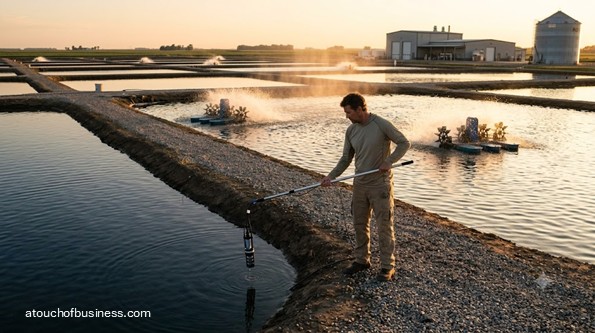
You’ll monitor water quality before sunrise, check every aeration system, feed fish on a strict schedule, and watch for disease signs — all before handling any administrative work.
A dissolved oxygen crash overnight can kill an entire pond before morning.
This isn’t a business you run from a desk. It’s a daily production operation that demands physical presence, biological knowledge, and mechanical troubleshooting — in all weather, throughout the year.
The income gap is real and long. Fish farming has one of the largest stretches between initial investment and first revenue of any agricultural model.
Your household finances must sustain months of ongoing costs before you sell a single pound of fish.
Can your family manage that gap? Do you have access to capital, or a clear path to financing? Does your household support what you’re taking on?
Risk tolerance matters here more than in most businesses. Disease, equipment failure, and import competition can all threaten profitability — and none of them are fully within your control.
Talk to people who run fish farms before you spend anything. Find farmers outside your target geography so they aren’t competing with you.
Ask what startup actually cost them, what surprised them, what they’d do differently, and who they sell to. No amount of online research replaces that conversation.
If you’re drawn to this work — the biology, the production cycle, the challenge of raising a food crop from scratch — that’s a meaningful foundation. But passion alone won’t carry you through a disease outbreak or a bad market year.
Red Flags Before You Start
Fish farming is worth serious thought before serious money. These warning signs deserve your attention before you commit.
No confirmed buyer before you build: Spending on land, construction, and stock before identifying a real buyer at an acceptable price is a primary failure mode in this business. Verify buyer relationships and price points first.
Import competition you haven’t priced out: For catfish and tilapia — the two most common beginner species — imported product consistently underprices domestic product at wholesale. If your plan depends on commodity wholesale pricing, run the numbers honestly before committing to production infrastructure.
A production system that doesn’t match your resources: Recirculating aquaculture systems (RAS) are technically demanding and capital-intensive. Equipment failures can cause mass mortality within hours.
Pond systems require large acreage and high-volume water supply. Match your system choice to your actual skills, capital, and water access — not to what seems most impressive.
Water rights you haven’t secured: An aquaculture operation without a legally secured water supply cannot function. In some regions, new water appropriations aren’t available. Verify water rights, volume, quality, and permit status before any land commitment.
A permit timeline you’ve underestimated: National Pollutant Discharge Elimination System (NPDES) permits, U.S. Army Corps of Engineers (USACE) permits, state aquaculture licenses, and water use permits can each take months to process.
Building before all permits are in hand creates legal risk and wasted expense if a permit is denied.
Capital that doesn’t reach first harvest: If your operating capital doesn’t cover feed, utilities, labor, and loan payments through the full production cycle — including unexpected losses — the business won’t survive to see its first sale. Calculate that number honestly before committing.
No aquatic biology background or plan to get one: An owner who can’t read water chemistry data, recognize early disease signs, or troubleshoot aeration failure will experience preventable losses. Start with training, mentorship, or a qualified partner.
Structural regulatory complexity: U.S. aquaculture is regulated by multiple federal agencies simultaneously — the EPA, FDA, USDA, USACE, and NOAA all play roles. No single agency coordinates everything. The regulatory landscape is unusually complex for new entrants, regardless of farm size.
Step 1: Assess Whether This Business Fits Your Life
Before choosing a species or drawing a single pond on paper, spend time honestly evaluating fit.
Fish farming extension resources are direct about this: there is no easy money in aquaculture. The work is daily, technical, physical, and unforgiving during production problems.
Ask yourself these questions before moving forward:
- Do you have a background in biology, agronomy, or production operations — or a clear plan to acquire those skills?
- Can your household sustain an income gap of many months without stress that derails the business?
- Do you have the risk tolerance for crop losses from disease, weather, or equipment failure?
- Are you prepared to work outdoors, physically, every day — including during problems?
If you hesitate on any of those, that’s not a reason to quit — it’s a reason to keep researching before spending.
Step 2: Talk to Working Fish Farmers
Find fish farm owners outside your target sales geography and have real conversations before spending any significant money.
Prepare specific questions: What production system do they run, and why did they choose it? What did startup actually cost them — and what do they wish they’d known?
What compliance items caused delays? Who are their buyers, and how did those relationships develop?
Their paths won’t be identical to yours. But the experience of people who’ve already navigated permits, equipment decisions, disease outbreaks, and first sales is information you can’t get anywhere else.
Step 3: Choose Your Production System and Target Species
This is the most consequential decision in the entire startup process. It determines your land requirements, water source needs, equipment costs, capital requirements, regulatory obligations, and viable sales channels.
Make this decision before any land purchase, lease, or system design.
The three primary production systems are:
- Pond aquaculture: Large earthen ponds suited to warm-climate species like catfish and tilapia; lower capital per acre but requires significant land and high-volume water supply
- Raceway (flow-through) systems: Long channels with continuous water flow designed for cold-water species like trout; requires a reliable source of consistently cold, clean water
- Recirculating aquaculture systems (RAS): Indoor closed-loop tanks that filter and reuse water; allows year-round production; suited to high-value species like tilapia, yellow perch, hybrid striped bass, and barramundi; highest capital and operating costs; greatest technical demands
Your species choice must match your system type, local climate, water temperature, and water source. Well-established U.S. commercial species for beginners include catfish, trout, and tilapia.
Less-proven species carry higher biological and market risk. Stick with species that have established feed products, known production protocols, and real buyer demand in your region.
One more check before finalizing your species: Some states restrict or prohibit the culture of certain non-native or conditional species. Verify with your state fish and wildlife or agriculture agency before committing.
Step 4: Validate Your Market Before Building Anything
Know who will buy your fish before you build a single pond or tank. The production model and species you choose must align with a real, reachable buyer at launch.
First-customer types for a production fish farm typically include:
- Processors and live haulers or brokers — the first point of sale for most U.S. commercial food fish operations
- Wholesale seafood distributors
- Restaurants and restaurant distributors
- Direct consumers through farmers markets or on-farm sales
Talk to potential buyers directly. Ask what species and sizes they want, what volume they need, what their price and quality requirements are, and what inspection documentation they require.
For commodity species at wholesale, understand the import pricing reality before projecting your revenue. Low-cost imported fish set a price ceiling that constrains domestic producer margins — particularly for catfish and tilapia.
Step 5: Choose and Evaluate Your Site
Site selection drives every subsequent decision. The wrong site can make your operation legally or financially impossible to run.
Evaluate each of these before committing to any location:
- Water source and quality: Volume, temperature, pH, dissolved oxygen, and mineral content must match your target species. Well water, spring water, surface water, and municipal water each carry different costs and permit requirements.
- Soil quality (for ponds): Clay-heavy soils hold water; sandy or gravelly soils don’t. Test soil before committing to pond construction.
- Topography: Relatively flat land with a gentle slope reduces pond construction and drainage costs.
- Electrical access: Aeration, filtration, heating, and monitoring systems are power-intensive. RAS is especially demanding. Verify reliable electrical supply and backup generator capacity.
- Market proximity: Fresh fish is perishable. Proximity to buyers reduces logistics cost and product loss.
- Zoning: Aquaculture is generally permitted on agriculturally zoned land, but requirements vary. Verify at the county planning or zoning office before purchasing or leasing.
- Wetlands: Wetlands on or near the site may trigger USACE Section 404 permitting for any pond construction or dredging. Contact the USACE district office early in your site evaluation — before breaking ground.
Step 6: Run Your Break-Even Numbers Before Any Major Commitment
Fish farming profitability depends on species, system type, production volume, feed efficiency, market access, and your ability to sell at or above your cost of production.
Feed is typically the single largest variable cost in any production aquaculture operation. Feed efficiency is measured by the feed conversion ratio (FCR) — the pounds of feed used per pound of fish weight gained.
A lower FCR means less feed cost per pound of fish and directly improves your margin.
Your fixed costs — land, construction, utilities, equipment, loan payments — must be covered by the volume and price of fish you sell. Before committing to any production system or infrastructure, calculate the pounds you’d need to sell per cycle to cover all fixed and variable costs at realistic market prices.
For commodity species at wholesale, margin pressure is structural. Import competition sets a price ceiling.
For specialty or high-value species sold direct, your buyer market may be smaller and harder to reach at launch.
RAS systems carry high capital and operating costs. Profitability at small scale is difficult to achieve. Model your break-even production volumes carefully before committing to RAS infrastructure.
Fish farming has no off switch. Fish must be fed and water must be managed every day — including during market downturns and before fish reach market size.
Plan operating capital to cover all costs through the full production cycle.
Check out this guidance on estimating profitability for a new business before running your numbers.
Business Plan
A fish farming business plan isn’t a formality — it’s the financial and operational roadmap that lenders require and that you need to avoid expensive surprises.
At minimum, your plan should cover your production system and species choice, land and facility setup, itemized startup costs, operating cost estimates, projected production volume per cycle, target sales channels and pricing, break-even analysis, and operating capital needs through first harvest.
Include a realistic timeline from groundbreaking or system installation to first saleable harvest. Pond systems typically run many months from fingerling stocking to market size. Your capital plan must match that timeline.
Your plan should also address the margin structure honestly. Feed conversion ratio drives your variable cost per pound.
Market prices for your species — particularly if you’re targeting commodity wholesale channels — set the ceiling on what you can charge. The space between those two numbers is your margin, and it narrows quickly if FCR is poor or market prices drop.
Plan for slow periods, disease losses, and delayed harvests. Any of those can extend the time before revenue arrives. Your operating capital reserve must account for that risk.
Use your plan to evaluate whether the business is viable at your planned scale before committing to land, leases, or construction. A thorough business plan is how you find the gaps before they find you.
Step 7: Decide Whether to Start Fresh or Buy an Existing Farm
An existing, permitted aquaculture operation can offer a faster path to production — established water rights, existing infrastructure, and buyer relationships already in place.
But an existing farm can also carry problems: aging or improperly maintained equipment, poor soil or water quality from overproduction, disease history in ponds, or a debt structure that offsets the advantages.
Before purchasing any fish farm, conduct a thorough review of all permits, water rights, compliance history, production records, and equipment condition — preferably with an independent aquaculture consultant.
Starting from scratch lets you design the system for your chosen species and model, but it takes longer and requires full permit processing from the beginning.
For more on weighing these paths, see this guide on building versus buying a business.
Step 8: Choose a Legal Structure and Register the Business
Choose your business structure before applying for permits or opening accounts. Common options include a sole proprietorship, partnership, LLC, or corporation.
Food production liability and agricultural lender requirements may favor certain structures. Consult a business attorney before deciding.
Register your business with the relevant state agency. If you’re operating under a trade name, file a DBA. Obtain an Employer Identification Number (EIN) from the IRS — you’ll need it for banking, hiring, and permit applications.
Step 9: Apply for All Required Permits — and Start Early
Permitting is the most time-sensitive startup step in fish farming and the most common cause of costly delays. Begin the permit process before breaking ground or purchasing major equipment.
The permits you need vary by state, locality, system type, species, and production volume. At minimum, research and apply for these:
- State aquaculture license or certificate: Most states require this from the state department of agriculture, department of natural resources, or fish and wildlife agency before you can stock or sell fish.
- State water use or water appropriation permit: Required in many states before drawing water from wells, springs, or surface sources for aquaculture use.
- EPA NPDES permit: Any facility that discharges wastewater to U.S. waters requires NPDES coverage — regardless of production volume. Contact the EPA or your state’s NPDES permitting authority to determine what type of permit your operation requires.
- USACE Section 404 permit: Required for pond construction, dredging, or fill activity near wetlands or water bodies.
- Local zoning and building permits: Required for site construction, electrical work, and facility development.
- Food handling and processing permits: Required if you process fish on-site. Contact your state department of agriculture and local health department for requirements.
For more on business licenses and permits generally, that resource is a useful starting point — but always verify aquaculture-specific requirements with the relevant state agencies for your jurisdiction.
Two federal requirements apply regardless of your location and deserve specific attention.
If you raise catfish or catfish-like species (the order Siluriformes) and process them for wholesale, mandatory inspection by the USDA Food Safety and Inspection Service (FSIS) is required. This applies to any establishment processing these fish for the wholesale market.
If you process fish on-site — cutting, filleting, or packaging — the FDA Seafood HACCP regulation (21 CFR Part 123) applies. You’ll need a written Hazard Analysis and Critical Control Point (HACCP) plan. HACCP training is available through university extension programs and the FDA.
Step 10: Secure Financing
Aquaculture is capital-intensive. For most production models, external financing will be necessary.
Primary financing sources for fish farms include:
- USDA Farm Service Agency (FSA) Direct Farm Ownership Loans — for land purchase for land-based operations
- USDA FSA Direct Operating Loans — for equipment and supplies
- USDA FSA Guaranteed Farm Loans — made by local lenders, backed by FSA
- NOAA Fisheries Finance Program — long-term direct loans for aquaculture facility construction or purchase, up to 25 years
- USDA Farm Storage Facility Loan (FSFL) Program — low-interest financing for storage and handling equipment
- Conventional agricultural lenders and farm credit institutions
- State agricultural development authority loans or grants
Before applying for any loan, have your business plan, site control documentation, and preliminary permit status ready. Lenders expect to see all three.
For guidance on the loan application process, this article on how to get a business loan covers the key steps.
Step 11: Set Up Business Banking and Tax Accounts
Open a dedicated business bank account and separate all business transactions from your personal finances from the start.
Register for state sales tax if it applies to your sales channels and jurisdiction. Set up employer tax accounts with the IRS and your state tax agency if you’re hiring workers.
Step 12: Prepare the Site and Install the Production System
The physical setup phase begins only after site control, permits, and financing are in place.
What this involves depends on your system type:
- Pond systems: Soil testing, pond excavation, inlet and outlet structure construction, levee building, and aeration system installation
- Raceway systems: Channel construction, water supply and drainage infrastructure, aeration, and screening
- RAS: Tank installation, biofilter setup, filtration and recirculation plumbing, oxygen systems, environmental controls, backup power, and continuous monitoring systems
Do not introduce any fish until the entire water system is tested and stable.
For RAS, the biological filtration cycle — the nitrogen cycle, in which beneficial bacteria establish themselves in the biofilter — must be fully active before stocking.
For pond systems, water quality parameters must be within the species-appropriate range before fish arrive.
Test every critical system — aeration, alarms, backup generator, and water circulation — before fish arrive. Equipment that fails during a production run, rather than during a dry test, causes losses you can’t recover.
Step 13: Source Fingerlings from Health-Certified Suppliers
Fingerlings — juvenile fish — are your production input. The quality and health of incoming stock determines the trajectory of the entire production cycle.
Purchase fingerlings from reputable, certified hatcheries that provide disease history, health testing records, species and size confirmation, and health certificates where required by your state.
Trap to avoid: Incoming fingerlings are a primary disease introduction risk. Establish a quarantine protocol before introducing any new stock to existing production units — even if the supplier is one you’ve used before.
Some states require health certificates or permits for live fish moved across state lines. Verify interstate transport requirements with your state fish and wildlife agency before ordering from out-of-state hatcheries.
Step 14: Set Up Your Feed Supply
Commercial aquaculture feeds are available for catfish, trout, tilapia, and most production species. Feed formulation — protein level, pellet size, lipid content — must match your species and the life stage of the fish.
Establish at least one primary feed supplier and one backup before stocking. Feed delivery reliability is a production-critical dependency.
Running out of feed mid-cycle is not a minor inconvenience — it directly affects fish growth and feed conversion efficiency.
Step 15: Build Your Biosecurity Plan
Biosecurity — preventing disease introduction and spread — is a core production requirement, not an optional extra.
Disease outbreaks in aquaculture can be catastrophic. In RAS environments, an outbreak can spread rapidly through a closed system. In pond operations, disease has forced mandatory depopulation of hundreds of ponds at a time.
Before stocking, document all production units, water entry and exit points, and fish movement pathways. Establish biosecurity zones. Define access and sanitation protocols for staff, visitors, and vehicles.
Establish a relationship with an aquatic animal health professional or fish-experienced veterinarian before stocking — not after a problem appears.
All drug treatments in aquaculture must use only FDA-approved compounds. They must follow label restrictions and required withdrawal periods before harvest. Document every treatment.
Step 16: Plan Your Harvest, Transport, and Sales Logistics
Plan the post-harvest flow before you stock a single fish. The production cycle ends at the point of sale — and that transition needs to be ready before harvest, not improvised during it.
Your harvest and sales plan should address:
- How fish will be harvested — seine net, pump, or pond drain
- Whether fish will be sold live or processed
- Who handles transport — you or a live hauler with a properly equipped live-haul truck
- Whether processing happens on-farm or through a third-party processor
- What documentation buyers require at delivery
Live fish transport requires active management of oxygen levels, water temperature, and stocking density. Most hauling losses result from poor water quality or improper handling during transport.
If you’re processing fish on-farm, your HACCP plan must be in place and the facility must meet food safety sanitation standards before the first harvest.
If you raise catfish for wholesale processing, FSIS inspection registration must be complete before you begin.
Trap to avoid: Don’t assume a buyer will appear at harvest time. Confirm buyer commitments or purchase arrangements before your fish reach market size — not the week you’re ready to sell.
Step 17: Set Your Pricing
Fish price is set in part by market conditions, not solely by your cost of production. For commodity species at wholesale, the processor price serves as the market ceiling — and that ceiling is shaped heavily by import competition.
Calculate your production cost per pound: feed, fingerlings, utilities, labor, debt service, and facility costs. Then confirm the target selling price covers all of those costs with enough margin to sustain the operation.
For direct-to-consumer or direct-to-restaurant channels, you can price above commodity wholesale — but that premium requires consistent quality, reliable volume, and buyer relationships that take time to build.
Review this guide on pricing your products and services for practical framing on cost-plus and value-based approaches.
Step 18: Obtain Insurance and Risk Coverage
Fish farming carries production risks — disease, equipment failure, and weather — that can wipe out an entire cycle’s revenue. Insurance is how you protect the investment you’ve built.
Plan to carry at minimum:
- General farm liability insurance: Covers third-party bodily injury and property damage on your premises
- Stock mortality insurance: Covers unexpected fish death losses from disease, equipment failure, or weather; available through specialty aquaculture insurers on named-peril or all-risk terms
- USDA RMA Whole-Farm Revenue Protection (WFRP): A subsidized federal program available nationwide for fish, trout, bait fish, and other aquatic species; covers revenue from all farm commodities under one policy
- USDA FSA Noninsured Crop Disaster Assistance Program (NAP): Natural disaster risk management for aquaculture species not covered by RMA programs; must be enrolled before a disaster occurs
- USDA FSA Emergency Assistance for Livestock, Honeybees, and Farm-Raised Fish (ELAP): Covers farm-raised fish death losses above normal mortality from eligible weather events
- Property insurance: For buildings, equipment, and infrastructure
- Workers’ compensation: Required in most states if you employ workers; verify with your state workers’ compensation office
For a broader look at coverage types and what to discuss with an agent, see this overview of business insurance.
Opening-Day Red Flags
Before stocking your first fish, confirm every item on this list is in place. A gap in any of these areas can cost you the entire production cycle.
- All permits received and posted as required — aquaculture license, NPDES coverage, USACE permit if applicable, and local building permits
- FSIS establishment registration complete if you’re processing catfish for wholesale
- HACCP plan written and implemented if you’re processing fish on-site
- Water quality stable and within species-appropriate parameters in all production units
- All aeration, filtration, and circulation systems tested and operational
- Backup generator installed and tested
- Alarm systems operational — dissolved oxygen, power failure, and temperature alerts
- Feed supply stocked for the full first production cycle, with a backup supplier identified
- Fingerling health certificates reviewed and quarantine protocol established
- Biosecurity plan documented and staff trained on protocols
- Aquatic animal health professional relationship established before stock arrives
- Harvest and transport plan confirmed — nets, scales, and live hauler or processor arrangements
- First buyer commitment or purchase arrangement confirmed
- USDA NAP enrollment complete if you’re using that program — enrollment must happen before a disaster, not after
- All insurance coverage confirmed and active
- Operating capital reserve confirmed to cover costs through first marketable harvest
- Production record system in place — water quality logs, feed logs, and mortality records
Trap to avoid: Don’t skip the dry test run. Test your systems, run your alarms, and confirm your backup power before any fish are in the water.
Finding a failed aerator or a dead alarm battery during a test costs nothing. Finding it at 2 a.m. during a production run costs you a crop.
Frequently Asked Questions
Do I need a license to operate a fish farm?
Yes, in virtually all U.S. states. Most require a commercial aquaculture license or certificate of registration from the state department of agriculture, department of natural resources, or fish and wildlife agency.
The specific license type and requirements depend on your species, production system, and location. Begin the licensing process before stocking any fish — it can take significant time.
Do I need an NPDES permit even if I’m a small operation?
Any aquaculture facility that discharges wastewater to U.S. waters requires NPDES coverage, regardless of production volume.
Even facilities that discharge only during storm overflow events may need a permit. Contact the EPA or your state’s NPDES permitting authority early to determine what type of permit your operation requires.
What is the difference between a raceway, a pond, and an RAS?
A pond is a large earthen water body — the most common and lowest-capital-per-acre system for warm-water species like catfish and tilapia. A raceway is a long channel with constant water flow, typically used for cold-water species like trout.
A recirculating aquaculture system (RAS) is an indoor, closed-loop tank system that filters and reuses water, allowing year-round production. RAS requires substantially higher capital and technical expertise than the other two systems.
For most beginners, a pond system with an established species is the lower-risk starting point.
Can I sell fish directly to restaurants and consumers, or do I have to go through a processor?
You have options, but each has compliance requirements. Selling live fish to a processor or live hauler is the simplest path — the processor handles food safety compliance from that point.
If you process fish yourself for sale, you must comply with FDA HACCP regulations. If you raise catfish, your processing facility must also operate under mandatory USDA FSIS inspection.
Direct sales to restaurants or consumers typically require food handling permits and cold-chain management. Check with your state department of agriculture and local health department for requirements specific to your location.
What is a feed conversion ratio, and why does it matter?
The feed conversion ratio (FCR) is the pounds of feed used per pound of fish weight gained. A lower FCR means more efficient feed use and lower production costs per pound of fish.
Feed is the single largest variable cost in most aquaculture operations, so even a small improvement in FCR directly improves your profitability.
Managing FCR through proper feeding practices, water quality maintenance, and appropriate stocking density is one of the most important operational skills in fish farming.
What kind of insurance does a fish farm need?
At minimum, plan for general farm liability insurance, stock mortality insurance, and property insurance for buildings and equipment.
USDA programs add further risk management: Whole-Farm Revenue Protection (WFRP) covers farm revenue; the Noninsured Crop Disaster Assistance Program (NAP) covers natural disaster losses; and the Emergency Assistance for Livestock, Honeybees, and Farm-Raised Fish (ELAP) covers weather-related fish death losses.
If you hire employees, workers’ compensation may also be required — verify with your state workers’ compensation office.
How long does it take to go from startup to first harvest?
It depends on the species and production system. Catfish and tilapia in pond systems typically take several months from fingerling stocking to market size. Trout grow more slowly in cold water.
RAS systems can modulate temperature to speed growth but require several weeks of biofilter establishment before any fish can be introduced.
Plan your operating capital and cash flow to cover all costs from construction through first harvest — plus a cushion for delays.
Is buying an existing fish farm a realistic option?
It can be. An existing farm may have established permits, water rights, infrastructure, and buyer relationships — all of which reduce time and entry cost.
But an existing farm can also carry problems: aging equipment, water quality issues from overproduction, disease history, or a debt structure that offsets the advantages.
Before purchasing any fish farm, conduct a thorough due-diligence review of all permits, water rights, compliance history, buyer contracts, production records, and equipment condition — ideally with an independent aquaculture consultant.
Fish Farmers Share Their Business Experience
These interviews share practical experiences from fish farm owners, managers, and aquaculture professionals. They discuss site selection, production systems, water management, feed, financing, staffing, markets, and daily farm operations.
Readers can use the advice to compare farming methods, identify costly risks, and prepare questions for local professionals. The interviews also show why location, reliable water, suitable fish species, and a realistic market plan should be evaluated before investing.
The Journey of a Fish Farmer: An Interview with Ty Walker | Sustainable Fish Farming
Ty Walker discusses taking over a neglected trout hatchery, restoring the property, securing enough flowing water, purchasing fish eggs, and raising trout for restaurant and retail markets.
This interview helps prospective owners understand the infrastructure, time, water supply, supplier requirements, and personal commitment involved in starting a trout farming operation.
Aquaculture in Ghana: Fish farmer increases farm profits and improves family nutrition
Fish farmer Peter Opoku describes constructing and preparing a pond, protecting it from predators, stocking tilapia, choosing feed, and learning from a slow first production cycle.
This interview is useful because it shows how pond preparation, fingerling quality, feed decisions, drainage, and basic farm design can affect growth rates and financial results.
Aquantic Fish Farm: where traditional and cutting-edge aquaculture meet
Aquantic Fish Farm director Youssef Eltahawy explains the farm’s tilapia systems, hatchery, biofloc tanks, water testing, fish sampling, biosecurity routines, recordkeeping, and water-scarcity challenges.
This interview helps readers see why the production system must match the location, available water, environmental conditions, fish species, and financial plan.
Glenn Cooke, CEO, Cooke Aquaculture: The Birth of a Global Company (Part I)
Glenn Cooke discusses fish production cycles, live inventory, harvesting, processing, distribution, environmental exposure, reinvestment, and the company’s expansion into different species and regions.
This interview is useful for understanding fish farming as a complete supply chain that requires risk management, dependable logistics, suitable markets, and enough capital to support long production cycles.