
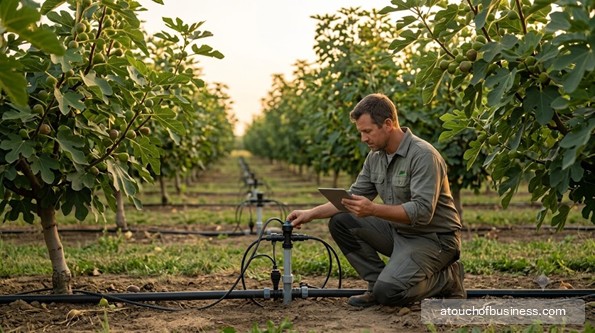
What to Expect From This Guide to Starting a Fig Farm
This guide walks you through the key decisions and practical steps involved in starting a fig farm, from evaluating personal and financial fit to planning the orchard, meeting applicable requirements, preparing the harvest system, and reaching the first commercial sale.
Inside the guide, you will find:
- Startup roadmap: Follow 17 ordered steps covering evaluation, planning, registration, orchard setup, management, harvesting, and opening preparation.
- Industry interviews: Learn from growers discussing production systems, climate challenges, harvesting, packing, markets, and orchard management.
- Startup FAQs: Review practical answers about production timelines, pollination, food-safety rules, insurance, regional varieties, and organic certification.
- Business fit: Consider the physical demands, seasonal pressures, delayed income, household support, and patience required for fig farming.
- Financial planning: Examine funding needs, fixed and variable costs, sales channels, break-even logic, and the long wait for commercial yields.
- Land and requirements: Evaluate soil, water, climate, zoning, business registration, food-safety obligations, and location-dependent agricultural rules.
- Orchard preparation: Plan varieties, irrigation, equipment access, tree management, insurance, harvesting, cold storage, packaging, and buyer arrangements.
Begin by deciding whether the long timeline, physical demands, and financial commitment of fig farming suit your circumstances.
A fig farmer grows Ficus carica trees for fruit sold fresh, dried, as paste, or into processing channels. You manage the land, the trees, the water, the harvest, and the sale — from the first planting to the first buyer.
It’s a production operation at its core. The orchard is your production line, and every decision you make in the early years — about variety, spacing, irrigation, and sales channel — shapes what you can actually deliver when the fruit is ready.
If you’re drawn to outdoor work, patient with long timelines, and genuinely interested in growing something you can sell, this could be a strong fit. You’re not behind if you’re still asking basic questions. This guide walks the full path.
Is a Fig Farm Right for You?
Fig farming is physical, seasonal, and slow to pay off. Trees take two to three years before they produce a commercial crop and reach full yield closer to year eight.
That gap is real. You’ll be investing in land, trees, water, and labor well before any meaningful revenue arrives. Make sure your household can carry that weight.
Ask yourself a few honest questions before you go further:
- Can you fund two to three years of farm costs and personal living expenses before the orchard earns its keep?
- Does your household support the plan — the time demands, the income uncertainty, and the possibility that things don’t go as expected?
- Are you comfortable with work that depends on weather, biology, and timing you don’t fully control?
- Do you have enough horticultural knowledge to manage trees, irrigation, pests, and post-harvest handling — or a clear plan to learn?
Owners who go in with realistic expectations tend to make better decisions along the way.
Before you commit to land or trees, talk to fig farmers who operate in non-competing areas. Ask what their first two years really looked like. Ask what they underestimated. Ask whether their original sales channel held up.
Talk to the growers themselves — not to the operations as organizations, but to the people running them.
If you want a broader sense of what business ownership actually involves, the pre-startup considerations page is a good place to start.
Red Flags Before You Start
A fig farm is a serious capital commitment with a long lead time. A few conditions can make it the wrong move — or at least the wrong move right now.
The funding gap isn’t covered. If you don’t have enough capital to sustain the farm and your personal expenses through the first commercial harvest, starting now puts the whole operation at risk. Running out of operating funds before year three is one of the most common reasons new orchards fail.
Your climate isn’t right for figs. Commercial fig production is practical in USDA Plant Hardiness Zones 7 through 10. In colder zones, consistent winter dieback limits what you can produce. Confirm your zone and your site’s sun exposure before committing to land.
Water access is unclear. A fig orchard without reliable irrigation can’t sustain commercial production in most U.S. regions. If the parcel lacks confirmed water rights, sufficient well capacity, or irrigation infrastructure — and the cost of establishing that access is prohibitive — the site may not be viable. This is especially critical in western regions where water rights are legally separate from land ownership.
You haven’t identified a buyer. Fresh figs are extremely perishable. Planting trees before you know where the fruit will go is a real risk. You don’t need a signed contract before you plant, but you should understand your market before you commit to scale.
You’re planning to compete on dried figs at commodity prices. The U.S. dried fig market competes directly with large international producers that have substantially lower production costs. A small domestic producer can’t win on volume pricing. If dried figs are part of your plan, your path to profitability likely runs through premium or organic markets — not commodity wholesale.
You’re starting large without orchard experience. Starting big before you understand how your land, your varieties, and your local market actually behave is one of the most common early failures in fruit farming. You can always expand. Starting smaller and learning the production cycle first gives you room to adjust.
None of these are automatic reasons to walk away. They’re reasons to pause, verify, and plan more carefully before you spend money.
Step 1: Assess Fit and Talk to Farmers
Before you evaluate land or varieties, assess whether this business suits your life right now.
Orchard work is outdoor, physical, and weather-dependent. Harvest compresses into a narrow window where ripe figs must be picked, sorted, cooled, and moved quickly — sometimes every day or two at peak season.
Between harvests, you’re managing irrigation, tree maintenance, pest scouting, records, and buyer relationships. There’s no slow season in the sense of a pause — just a different kind of work.
Think through the personal side honestly. Can your household absorb an income gap while the orchard matures? Do you have the patience for multi-year timelines? Are you prepared for a season where weather or disease reduces your yield?
Then talk to people already doing this. Reach out to fig growers in non-competing areas — somewhere far enough away that they won’t see you as a future competitor.
Ask what surprised them in the first year. Ask what they wish they’d budgeted for. Ask which sales channel worked and which didn’t.
Firsthand insight from working growers is something no guide can fully replace. Use this resource on learning from business owners to shape those conversations before you reach out.
Step 2: Choose Your Production Model
Your revenue model must be decided before you choose a variety, commit to a scale, or buy a single tree. The production form you target shapes every decision that follows.
The three main paths are:
- Fresh figs — sold directly to consumers, specialty grocers, and restaurants. High per-unit value, but the fruit must move within days of harvest. Cold chain management is essential.
- Dried figs — longer shelf life, more forgiving logistics. Requires drying infrastructure. Typically sold to wholesalers or processors in volume. Thin margins at commodity pricing.
- Fig paste or processed products — adds value but also adds regulatory complexity. Processing figs into a finished product may trigger FDA food facility registration requirements beyond standard farm rules. Verify where the regulatory line falls before investing in processing equipment.
Some growers use a hybrid approach — selling the best fresh fruit directly and routing the rest into drying or processing channels.
That can work well, but it means managing two different workflows and buyer relationships at the same time.
Decide on your primary output before you move forward. That decision anchors your variety choices, your infrastructure build-out, and your opening-day sales channel.
Step 3: Validate Demand, Climate, and Market Access
This step protects you from committing to land, trees, and infrastructure in a location that can’t support the model you’ve chosen.
Start with climate. Figs produce reliably in USDA Zones 7 through 10, with most U.S. commercial production concentrated in warm, dry-summer regions. In cooler zones, consistent frost or dieback limits production.
Confirm your zone and your site’s sun exposure — at least eight hours of direct sunlight daily is needed for strong fruit development.
Then assess your market access. For fresh figs, you need buyers within practical delivery range. Fresh figs can’t be shipped long distances economically at small scale.
Think through where your first customers will come from:
- Farmers market shoppers who seek out specialty fruit
- Restaurant chefs who actively source fresh, local, in-season ingredients
- Specialty grocers or natural food retailers
- Wholesale produce buyers or distributors (for higher-volume fresh sales)
- Dried fig or paste processors (if the dried model is your primary path)
Also check the local competitive picture. Are there established fig farms nearby? In markets where consumers aren’t familiar with figs, you may need to educate buyers before the first sale.
Demand validation isn’t a marketing exercise — it’s a go/no-go decision. Don’t commit to land and trees until you have a reasonable picture of who will buy your fruit and at what volume.
Step 4: Work Through the Profit Potential Before You Spend
Fig farming has genuine profit potential, but the numbers need to work for your specific situation before you make major commitments.
Start with the timing reality. You’ll carry land, irrigation, maintenance, insurance, and potentially loan payments for two to three years before a commercial crop arrives. Your operating capital plan needs to cover all of it.
Think through your fixed cost base: land access costs, irrigation infrastructure, equipment, insurance premiums, and any debt service. These run regardless of how the harvest goes.
Then think through variable costs: tree maintenance, fertilization, pest management, seasonal harvest labor, packaging, and transport. These scale with your acreage and production volume.
On the revenue side, fresh figs command the highest per-pound value but require the fastest handling and the shortest logistics window. Dried figs are more forgiving in storage and transport but typically sell at lower per-pound prices — especially at wholesale.
Before you commit to land or trees, answer these questions with your own numbers:
- How many pounds per acre do you need to sell to cover all fixed and variable costs?
- Is that yield realistic for your site, variety, and tree age?
- Is the price you’re expecting realistic for your sales channel and local market?
- Do you have enough operating capital to carry the farm from planting to first commercial harvest?
If you want a framework for thinking through profitability before you launch, the profitability estimation guide can help you build that logic with your own inputs.
Step 5: Explore Financing and Determine Land Access
A fig orchard requires meaningful upfront investment in land, trees, irrigation, and equipment — well before the first crop.
Your first stop for agricultural financing should be your local USDA Farm Service Agency (FSA) Service Center. FSA offers Farm Ownership Loans, Farm Operating Loans, and a Microloan program specifically designed for beginning farmers. Staff there can walk you through eligibility and help you build your loan application.
The USDA Natural Resources Conservation Service (NRCS) also administers cost-share programs — like the Environmental Quality Incentives Program (EQIP) — that can offset costs for irrigation installation, organic transition, and conservation practices. These programs require a farm number, so registering with FSA early opens the door.
Agricultural lenders through the Farm Credit System and community banks with agricultural portfolios are also worth exploring, depending on your scale and credit situation.
On the land side, you have three basic options: purchase, long-term lease, or an arrangement with an existing landowner.
Each carries different cost structures and commitment levels. If you’re leasing, make sure the lease term is long enough to justify planting trees that won’t reach full production for nearly a decade.
Learn more about farm loan options as you build out your financing plan.
Step 6: Select and Assess the Land
The land you choose is the foundation of the entire operation. Getting this right matters more for a fig farm than for almost any other business, because you’re committing to it for decades.
Figs prefer well-draining soil with a pH between 6.0 and 6.5. Sandy loam with good organic matter is ideal for fresh fruit production. Heavy clay or waterlogged soils increase root rot risk significantly.
Before purchasing or committing to a site, confirm these conditions:
- Soil pH and nutrient levels (soil test required)
- Nematode pressure — root-knot nematodes are a known production hazard, especially in sandy soils
- Drainage — poor drainage is one of the harder problems to fix after trees are in the ground
- Water access — reliable irrigation is non-negotiable for commercial production
- Sunlight — at least eight full hours of direct sun daily
In western regions, water rights are legally separate from land ownership. Verify water rights and irrigation water availability before committing to any site. Contact your state’s water resources agency to understand what rights are attached to the parcel.
Also confirm zoning. Most counties require agricultural zoning for orchard production, and some require a zoning compliance determination before new agricultural activity begins on a parcel. Contact the county planning or zoning department before signing anything.
If you’ll be adding infrastructure — a packing shed, an irrigation pump house, a storage building, or access roads — check what local building permits are required.
Step 7: Set Up Your Legal Structure and Register the Business
Once your site and model are clear, formalize the business structure before taking on debt, signing contracts, or accepting payment.
Choose a legal entity — sole proprietorship, limited liability company, partnership, or other structure — based on your liability exposure, tax strategy, and ownership goals. Talk to a business attorney or accountant before deciding.
Register your entity with your state. If you’re operating under a name other than your own, file a Doing Business As (DBA) registration with the appropriate office.
Obtain a federal Employer Identification Number (EIN) from the IRS if you’ll be hiring employees, operating as a partnership or LLC, or opening a business bank account under the farm’s name. You can apply for an EIN online at no cost.
Register with your state tax authority to understand your sales and use tax obligations. Agricultural sales tax exemptions vary by state — some products may be exempt, others taxable. Verify with your state’s department of revenue before your first sale.
If you’ll be hiring workers, register with your state labor department for employer accounts, including unemployment insurance and any state income tax withholding that applies.
Step 8: Register with USDA FSA
Registering with the USDA Farm Service Agency is one of the most important early steps for any new farm — and it’s free.
Visit your local FSA Service Center to obtain a farm number and tract number. That farm number is your gateway to FSA loan programs, USDA crop insurance, disaster assistance, NRCS conservation programs, and EQIP cost-share funding.
Bring to your appointment:
- A government-issued ID
- Proof of your right to operate the land (deed if you own it, lease agreement if you rent)
- The legal description or address of the farm
Once registered, file an annual crop acreage report with FSA each season to stay eligible for ongoing programs.
If you have 10 or fewer years of farming experience, you qualify as a “beginning farmer” under USDA definitions. That status gives you priority access to FSA and NRCS funding — register your beginning-farmer status at the same appointment.
Step 9: Address Federal and State Compliance
A commercial fig farm operates under several overlapping federal and state rules. None of them are especially complicated once you understand what applies — but work through them before your first sale.
FSMA Produce Safety Rule. Figs are a listed covered crop under the FDA Food Safety Modernization Act (FSMA) Produce Safety Rule. If your farm’s average annual sales exceed the qualifying threshold, you’re a covered farm and must comply with standards for growing, harvesting, packing, and holding fresh figs.
At least one supervisor or responsible party must complete FSMA food safety training through the Produce Safety Alliance (PSA) or an equivalent program recognized by the FDA. Verify your farm’s coverage status with your state’s produce safety coordinator or local Cooperative Extension Service.
Pesticide applicator certification. Under the Federal Insecticide, Fungicide, and Rodenticide Act (FIFRA), if you plan to purchase or apply restricted-use pesticides (RUPs) on your own farm, you need a private pesticide applicator certification from your state’s pesticide program. General-use pesticides don’t require a license, but you must follow the label regardless. Contact your state’s department of agriculture for the certification process.
EPA Worker Protection Standard (WPS). If you hire workers who operate in pesticide-treated areas, the WPS requires worker safety training, pesticide information posted at a central location, and compliance with restricted-entry intervals after applications.
Labor law compliance. The Fair Labor Standards Act (FLSA) covers federal minimum wage, overtime, and child labor rules for agricultural employers. Some small-farm exemptions apply — verify with the U.S. Department of Labor for your specific situation.
If you use a farm labor contractor for seasonal harvest workers, that contractor must be registered with the Department of Labor under the Migrant and Seasonal Agricultural Worker Protection Act (MSPA).
Your state may also have its own produce safety program with additional registration or inspection requirements. Check with your state’s department of agriculture.
For a broader look at what permits and licenses your farm may need, the business licenses and permits guide covers the general framework.
Step 10: Decide Whether to Pursue Organic Certification
Organic certification is optional, but it can support a meaningful price premium and open access to specific buyers and markets.
The process requires a 36-month transition period during which no prohibited substances are applied to the land. You can’t label or sell any product as organic until that transition is complete and certification is granted.
If organic is your goal, start the transition period before or at the time of planting — or find land that has been free of prohibited substances for the prior three years and can be documented as such.
Select a USDA-accredited certifying agent early in the process. The certifying agent guides you through the Organic System Plan (OSP), provides an annual inspection, and issues the certificate once you meet the standards.
USDA Organic Certification Cost-Share Programs can reimburse eligible operations for a portion of certification costs. Ask about this at your FSA Service Center appointment.
Organic certification adds planning and documentation requirements from day one. If it’s part of your model, account for it in your land selection, input sourcing, and record-keeping from the beginning.
Step 11: Select Varieties and Source Trees
Variety selection is one of the highest-stakes decisions in the startup process. The wrong choice for your climate, your production form, or your sales channel creates problems that are expensive and slow to fix.
Most commercial U.S. fig operations use common fig varieties — trees that are self-fertile and don’t require pollination from fig wasps. Calimyrna and other Smyrna-type figs do require wasp pollination (caprification) and are only practical in California where caprifig trees and fig wasps are established. For nearly all other U.S. growers, common figs are the correct choice.
Match your variety to your climate zone:
- Zones 8–10 (warm, dry summers): Black Mission, Kadota, Conadria, and Brown Turkey all perform well in hot, dry conditions. Mission and Kadota are especially suited to drying.
- Zone 7–8 (humid South): Celeste is a strong choice — its closed eye (ostiole) reduces disease and insect entry. Brown Turkey is also widely adapted in this range.
- Zones 5–6 (colder climates): Chicago Hardy is the primary commercially viable option. It regrows from the root crown after dieback, but yields and production reliability are significantly lower than in warmer zones.
Soil pH above 7.5 in alkaline desert environments can cause iron chlorosis (yellowing leaves) in susceptible varieties. Discuss soil amendment options with your local Cooperative Extension Service if your site is in an arid, alkaline region.
Source your trees from reputable, certified nurseries. Request phytosanitary documentation with any purchase. Fig mosaic virus (FMV) spreads through infected planting material and mite vectors — there’s no cure once it’s in your orchard, so starting with clean stock is the primary protection.
Don’t purchase California commercial fig types if you’re planting in the southeastern U.S. Regional adaptation matters for both disease tolerance and production reliability.
Step 12: Plan and Install Orchard Infrastructure
The physical setup of your orchard determines how efficiently you’ll be able to manage trees, move equipment, irrigate, and harvest for years to come. Plan the layout carefully before you plant a single tree.
Tree spacing options:
- Standard open-center or vase-trained trees: 10–15 feet in the row, 15–20 feet between rows for full canopy development
- High-density systems: 6–8 feet in the row, 10–12 feet between rows — requires strict annual pruning and more intensive management; initial per-acre planting cost is higher
- Row width must accommodate your tractor, sprayer, and any harvest equipment
Install drip irrigation before planting. Drip systems deliver water directly to the root zone, minimize evaporation, reduce foliage wetness that promotes disease, and scale easily as the orchard grows.
Design the system with mainline tubing, emitter lines, pressure regulators, inline filters, a timer or controller, and a fertilizer injector for fertigation.
Install fencing before the trees go in. Deer and wildlife pressure can damage young trees significantly.
Plant during dormancy. Spring planting is preferred in most U.S. regions. In warm climates, bare-root trees can go in during fall or early winter, as long as late frosts aren’t a risk.
Young trees need consistent irrigation in the first weeks after planting. Build that into your labor plan — hand-watering new trees every day or two is common until the root system establishes.
Step 13: Establish Year-One Orchard Management Routines
The first growing season is about establishment, not production. Your job is to keep trees alive, healthy, and growing in the right form.
Early training pruning sets the tree’s shape for life. An open-center vase form is standard for most U.S. commercial fig orchards — it allows light penetration and air movement through the canopy. Mistakes in early training are difficult to correct later.
Begin an integrated pest management (IPM) program from the start. Key threats to U.S. fig orchards include fig rust, root rot, root-knot nematodes, fig beetles, carpenterworm, scale insects, spider mites, and fig mosaic virus.
IPM combines cultural practices, biological controls, and targeted chemical intervention when pest levels reach action thresholds.
Core year-one management practices:
- Weed control around young trees without disturbing shallow roots
- Mulching to retain moisture, moderate soil temperature, and reduce weed competition — keep mulch away from the trunk
- Fertilization based on soil test results and tree growth stage (excess nitrogen promotes leaves over fruit)
- Soil and nematode testing if not completed before planting
- Regular pest and disease scouting
Keep detailed records from day one. Planting dates, irrigation volumes, fertilizer applications, pesticide applications with dates, and worker activities are all required for FSMA compliance. They’re also essential if you’re pursuing organic certification.
Step 14: Set Up Business Banking and Accounting
Open a dedicated business bank account before the farm takes on any expenses or accepts any payments. Keep farm finances completely separate from personal accounts from the start.
Set up a payment system for your first sales channel — a card reader for farmers market sales, or an invoicing system for restaurant and wholesale accounts.
Basic farm accounting software or a simple ledger helps you track income, expenses, labor costs, and equipment depreciation accurately. Clean records are essential for FSA loan management, crop insurance documentation, and tax filing.
Learn more about opening a business bank account and setting up payment processing before your first sale.
Step 15: Obtain Farm Insurance
Insurance for a fig farm covers several different risk areas. Work through each one before you open.
Crop insurance. Contact a USDA Risk Management Agency (RMA)-approved crop insurance agent. If there’s no specific fig policy available in your region, Whole Farm Revenue Protection (WFRP) covers specialty crop farms without individual crop policies. The FSA Non-Insured Crop Disaster Assistance Program (NAP) is a separate option for crops without commercial insurance availability. You’ll need your FSA farm number to access either program.
Farm general liability and product liability insurance. General farm liability covers bodily injury and property damage claims. Product liability covers food safety and contamination claims — essential if you’re selling fresh figs directly to consumers, restaurants, or retailers. Some buyers require proof of product liability coverage before accepting deliveries.
Workers’ compensation insurance. Most states require workers’ compensation for farms with hired employees. Thresholds and rules vary by state. Orchard operations are classified as elevated-risk by many insurance carriers, so shop multiple carriers. Contact your state’s workers’ compensation regulatory agency for the requirements that apply to your operation.
Farm property and commercial auto insurance. Property coverage protects farm structures and equipment. Commercial auto coverage is required if you’re transporting product or workers in farm vehicles.
A general overview of business insurance options can help you understand the coverage landscape before you meet with an agricultural insurance agent.
Step 16: Plan Your Harvest and Post-Harvest System
The production flow from tree to buyer is where fig farming gets demanding. Fresh figs have to be handled right — there’s very little margin for error.
Ripe figs must be picked when the fruit softens and the neck begins to wilt. At peak season, you may need to harvest every day or two. Fruit left on the tree too long overripens, splits, or ferments quickly.
The fresh fig handling chain has to work smoothly from the first pass:
- Shallow picking containers or baskets lined to prevent compression
- Gentle placement — never stacking multiple layers of ripe fruit
- Immediate cooling after harvest (32–34°F with high humidity extends shelf life to roughly one week)
- Sorting and quality control before packing (size, color uniformity, defects)
- Packaging matched to the buyer’s specifications: clamshells, pint baskets, or flat cases with pint cups
Workers must wear gloves during harvest and packing. Fig latex can cause skin and eye irritation with repeated exposure. Train all harvest workers on hygiene protocols before the first pick.
Plan a use for cull fruit — figs that don’t meet fresh-market grade. Routing lower-grade fruit to drying or processing rather than composting reduces waste and supports margins.
For dried fig production, plan your drying method before harvest. A dry yard works for sun-drying in appropriate climates. Mechanical dryers offer more control over quality and timing but require a larger upfront investment.
If you’re selling to wholesale buyers or processors, confirm packaging specs, volume commitments, and delivery logistics before the crop is ready. Don’t arrive at harvest without a confirmed outlet for the fruit.
Step 17: Confirm Pre-Launch Readiness
Before your first commercial sale, work through this checklist. It’s easier to find gaps now than after the fruit is in baskets and the buyer is waiting.
- All permits, licenses, and compliance items confirmed and in place
- FSMA produce safety records systems operational before harvest begins
- Pesticide application log in place if using restricted-use pesticides
- Irrigation system tested and running before the growing season
- Insurance coverage active: crop, liability, property, workers’ compensation
- Harvest containers, packaging, and cold storage (if fresh market) ready before the first pick
- Sorting and packing area set up, sanitized, and FSMA handwashing stations in place
- Payment processing confirmed and functional
- First sales channel secured in writing: farmers market vendor spot approved, restaurant account confirmed, or processor relationship established
- Worker hygiene and safety training completed
You don’t need everything to be perfect. You do need everything to be functional before the fruit comes off the trees.
Business Plan
A fig farm business plan isn’t about projecting perfect numbers — it’s about making sure you understand the financial reality of this operation before you commit serious capital.
Start with your production model choice. Fresh, dried, processed, or hybrid — that decision determines your infrastructure requirements, your compliance profile, your sales channel, and your pricing structure. Document the reasoning behind your choice.
Map out your cost structure across three distinct phases: land and pre-planting setup, the establishment period (years one through two or three), and the first commercial harvest season.
The establishment phase is where undercapitalized farms fail. Your plan needs to account for all farm operating costs plus your personal living expenses through this period, with a cash cushion for unexpected inputs.
On the revenue side, work through your break-even logic with realistic assumptions. How many pounds per acre do you expect to produce when trees reach commercial yield? What price per pound is realistic for your channel and your market? How many pounds at that price do you need to sell to cover your total cost base?
Fig trees take two to three years to produce commercial fruit and don’t reach peak yield until around year eight. Profit in the early bearing years will be modest. Your plan should reflect that trajectory — not project full-yield income from year one.
Include your funding plan: what financing you need, from which sources, and what terms you’re expecting. Detail your FSA loan application timeline, any NRCS cost-share programs you’re pursuing, and how much personal capital you’re bringing in.
Address revenue risks honestly. A late frost in year three, a fig rust outbreak, a harvest season where labor runs short, or a buyer who drops out before the season ends — what does your plan look like if one of those things happens? Having a backup sales channel before you need it is a specific planning action, not a general idea.
Finally, document your pre-opening readiness milestones — the permits, certifications, infrastructure installations, and buyer relationships that need to be in place before the first commercial crop. Use the checklist in Step 17 as your framework.
For guidance on building the plan itself, the business plan guide walks through the structure in practical terms.
Opening-Day Red Flags
By the time you reach your first commercial harvest, most of the major setup work should be behind you. But a few gaps can still create problems if you haven’t closed them before fruit starts coming off the trees.
No confirmed buyer before harvest. If your first sales channel isn’t locked in before the season begins, you’re placing perishable fruit under time pressure without a plan. Farmers market spots, restaurant accounts, and wholesale arrangements all take time to establish. Don’t assume you can sort it out once the figs are ripe.
Cold storage isn’t ready. For fresh fig sales, refrigeration needs to be operational and tested before harvest — not purchased in response to a first overripe batch. A gap in the cold chain costs you fruit and can cost you a buyer relationship.
FSMA records systems aren’t in place. If your farm is a covered farm under the FSMA Produce Safety Rule, your records systems need to be functional before harvest begins — not after. Worker training records, water testing records, and pesticide application logs should all be running before the first pick.
Harvest labor isn’t secured. Fig harvest is time-sensitive and physically demanding. If you’re counting on seasonal workers and haven’t confirmed their availability, a labor shortage at peak season can result in fruit loss. Line up your harvest crew before you need them.
Packaging supply isn’t on hand. Running out of clamshells or flat cases mid-harvest is a preventable problem. Order packaging well ahead of the season with enough buffer for your expected volume.
Irrigation system hasn’t been tested this season. A drip line failure at a critical growth stage costs more than the repair. Test the full system — mainline, emitters, filters, and controller — before the growing season begins, not during it.
Frequently Asked Questions
How long before my fig trees produce a commercial crop?
Fig trees typically begin producing minimal fruit in their first two years and yield commercial-grade harvests starting in year three. Yields increase each year and stabilize around year eight.
The economic life of a well-maintained tree is roughly 35 years. Plan for a two-to-three-year establishment period before the farm generates meaningful revenue.
Do I need to pollinate fig trees?
Most commercial U.S. fig varieties are common figs — self-fertile trees that don’t require pollination or wasp caprification.
Brown Turkey, Celeste, Kadota, Black Mission, and Conadria all fall into this category. Calimyrna and other Smyrna-type figs do require wasp pollination and are only practical in California where caprifig trees and fig wasps are present.
Choose common fig varieties for nearly all other U.S. locations.
Does the FSMA Produce Safety Rule apply to my fig farm?
Figs are a listed covered produce under the FDA Produce Safety Rule. Whether your farm is a “covered farm” depends primarily on your average annual sales relative to the current qualifying threshold.
Use the FDA decision tree to assess your status, and confirm current thresholds with your state’s Produce Safety coordinator or local Cooperative Extension Service.
Do I need a pesticide applicator license?
If you plan to purchase or apply restricted-use pesticides on your own farm for agricultural production, you need a private pesticide applicator certification from your state’s pesticide program.
General-use pesticides don’t require a license, but you must follow all label directions regardless. Contact your state’s department of agriculture pesticide division for the certification application process.
What crop insurance options are available for a fig farm?
There may not be a specific fig crop insurance policy available in your region. USDA Risk Management Agency (RMA) Whole Farm Revenue Protection (WFRP) is available for specialty crop farms that lack individual crop coverage.
The USDA FSA Non-Insured Crop Disaster Assistance Program (NAP) is a separate option for crops without available commercial insurance. Contact an RMA-approved crop insurance agent and your local FSA office to compare what’s available for your location.
What is the difference between selling fresh figs and dried figs from a regulatory standpoint?
Fresh figs sold as a raw agricultural commodity are subject to the FSMA Produce Safety Rule for growing, harvesting, packing, and holding.
Drying, pressing into paste, or making processed products may move the operation into a food manufacturing category under FSMA — which can trigger FDA food facility registration and preventive controls requirements.
The regulatory line depends on the specific activities you perform and where in the supply chain they occur. Verify this with your state’s department of agriculture or an attorney familiar with FSMA before investing in processing equipment.
What varieties should I consider for my region?
Match variety to your USDA Plant Hardiness Zone and planned production form. For Zones 8–10, Black Mission, Kadota, Conadria, and Brown Turkey are reliable commercial choices. For Zone 7–8 humid areas, Celeste offers good disease tolerance with its closed eye.
For Zones 5–6, Chicago Hardy is the primary viable option, though production reliability is lower in cold climates. Consult your local Cooperative Extension Service for performance data specific to your county.
What is the Organic System Plan, and do I need one?
The Organic System Plan (OSP) is a required written document describing how your farming practices comply with USDA National Organic Program (NOP) standards. It’s required as part of the organic certification application you submit to a USDA-accredited certifying agent. You only need an OSP if you’re pursuing organic certification.
During the three-year transition period, you can use a Transitional Production Plan to begin documenting organic practices before the formal OSP is required. Contact a USDA-accredited certifying agent to start the process.
Practical Fig Farming Advice From Experienced Growers
These interviews share practical lessons from commercial fig growers, orchard operators, and farming families. Topics include variety selection, climate control, harvesting, packing, marketing, soil management, and seasonal challenges.
Use their experiences to compare growing systems, identify possible markets, and understand the daily demands of fig production before investing in land, trees, equipment, or protected growing structures.
Growing Figs in Quebec: A Family’s Journey Into Greenhouse Innovation
Anne-Marie Proulx explains how her family developed La Vallée du Moulin into a commercial fig operation in a cold climate.
The interview is useful for learning how greenhouse production, seasonal planning, and experimentation can support a specialized fig farm.
Growing Fig Cordons in Cold Climates: Craig Boyer Interview
Craig Boyer discusses low cordons, high tunnels, winter protection, pruning, spacing, airflow, and varieties used for commercial production.
His experience can help prospective growers evaluate protected cultivation methods and reduce heating costs in colder regions.
Sweet Success: The Art and Challenges of Fig Farming With Emily Hope
Emily Hope describes orchard maintenance, weather risks, harvest pressures, customer preferences, and the need to deliver fresh figs quickly.
The conversation shows why careful harvesting, dependable distribution, and realistic expectations are important when planning a fresh fig business.
Kevin and Diane Herman on Fig Farming and Farm Management
Kevin and Diane Herman discuss their experience growing fresh and dried figs while working with processors, suppliers, researchers, officials, and customers.
Their interview provides a broader view of farm management and the relationships required to operate within the commercial fig industry.
Forever Figs: A Visit With Fig Farmer Vittorio Marando
Vittorio Marando shares guidance on varieties, drainage, watering, feeding, pruning, ripeness, and managing approximately 1,500 fig trees.
The farm visit offers practical growing lessons that can help a beginner understand orchard maintenance and fruit-quality decisions.
South African Fig Farmer Focuses on White Figs
Stef Papendorf explains his variety strategy, propagation methods, biological pest control, soil practices, grading system, cooling facilities, and market choices.
His experience demonstrates how crop selection, differentiation, packing, and buyer relationships can shape a commercial fig operation.
Commercial Fig Production With Ross Raddi
This video interview explores commercial fig production and the growing practices used to manage fig trees for dependable harvests.
It can help prospective farmers compare commercial methods with small-scale growing before deciding how to structure an orchard.
Related Articles
- How To Start a Fruit Orchard
- How To Start a Raspberry Farm
- How To Start a Kiwi Farm
- How To Start a Ginger Farm
- How To Start a Greenhouse Business
- How To Start a Hydroponic Farm Business
Sources:
- Alabama Cooperative Extension System: Fig Production Guide, Fig Guide PDF
- Purdue University Horticulture: Fig Horticulture Overview
- Valley Fig Growers: Commercial Fig Growing Processing
- Food Forest Nursery: Fig Variety Selection Region
- Giles County Figs: Fig Orchard Irrigation Setup, Fig Tree Spacing Guide, Fig Pests Diseases
- UC IPM: Fig Nematode Management, Fig Pest Management PDF
- UC Davis Food Safety: Produce Safety Rule Overview
- U.S. FDA: FSMA Produce Safety Rule
- Cornell Produce Safety Alliance: Produce Safety Rule Training
- University of Connecticut Extension: FSMA Produce Safety Coverage
- University of Minnesota Extension: FSMA Rule Applicability
- U.S. EPA: FIFRA Overview
- PestPrep: Pesticide Licensing States
- USDA Farmers.gov: USDA Service Centers, Beginning Farmer Funding, Farm Loan Programs
- USDA FSA: Farm Ownership Loans, Farm Operating Loans, Beginning Farmer Loans
- USDA AMS National Organic Program: Organic Certification Process, Transitioning to Organic
- USDA RMA: Specialty Crop Insurance
- National Young Farmers Coalition: Why Farmer Needs Farm Number
- Oklahoma State University Extension: Getting Started USDA FSA
- University of Nebraska Extension: Organic Certification Process
- StartPermit: How to Start Farm 2026
- Virginia Tech Extension: OSHA Agriculture Regulatory
- Whip Around: OSHA Agriculture Standards
- Massachusetts Department of Agriculture: Major Federal Ag Laws
- The Produce Nerd: Fresh Fig Harvest Packing
- Produce Business: Figs Gain Profitability
- Foodwise CUESA: Figs Direct Marketing
- Ruhl Insurance: Farm Workers Compensation
- University of Missouri Extension: Farm Liability Insurance
- Cornell Small Farms: Farm Insurance Guide
- LegalClarity: Agricultural Land Zoning