
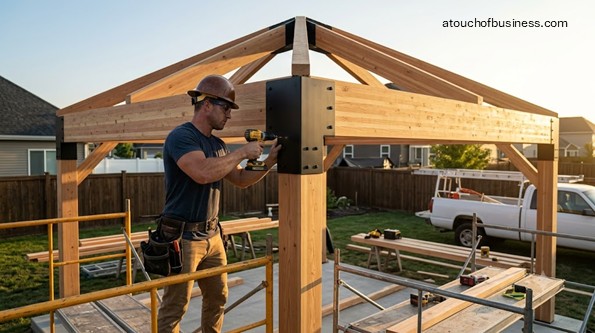
What to Expect From This Guide to Starting a Gazebo Building Business
This guide walks you through the key decisions and practical steps involved in starting a gazebo building business, from judging your fit to preparing for paid projects. The highlights below represent only part of the practical detail included.
Inside the guide, you will find:
- Startup steps: Follow an ordered path from assessing skills and demand through business setup, pricing, contracts, and pre-opening checks.
- Industry interviews: Compare experiences and observations from pergola leaders, outdoor contractors, and builders discussing projects, customers, teams, and operations.
- Startup FAQs: Find answers about licensing, permits, subcontracting, service models, materials, seasonality, deposits, and home-based operation.
- Business fit: Consider carpentry ability, physical demands, weather exposure, project-based income, seasonal slowdowns, and household financial pressure.
- Financial planning: Examine project capacity, fixed costs, cash flow, pricing methods, deposits, margins, startup expenses, and operating reserves.
- Local requirements: Understand location-dependent licensing, permits, inspections, taxes, insurance, zoning, HOA approvals, and contract rules.
- Opening preparation: Review tools, vehicles, safety gear, suppliers, subcontractors, warning signs, and a detailed pre-opening checklist.
Begin by considering the skills, working conditions, and income pattern that come with building gazebos for paying customers.
How to Start a Gazebo Building Business
As a gazebo contractor, you travel to your customers’ properties and build permanent outdoor covered structures from the ground up.
Projects run anywhere from a few days for a kit assembly to two weeks or more for a custom build.
Every job ends differently — some with a footing inspection, some with an electrical sign-off, some with a final walkthrough and a handshake.
What ties it all together is hands-on carpentry skill, solid project management, and the ability to handle permits, materials, scheduling, and customer expectations on every job.
This is not a business you can fake your way into. Before you read any further, be honest about whether you’re ready for what it actually takes.
Is This Business Right for You?
Gazebo construction is physically demanding outdoor work. You’ll carry lumber, frame at height, dig post holes, and work in heat, rain, and cold.
You need real carpentry and framing skills before you take on paying customers. Structural errors create liability, fail inspections, and can result in mandatory teardowns.
Ask yourself honestly: Can you read a site plan? Frame a hip roof? Set posts in concrete and get them plumb?
Beyond the build work, you’ll also handle estimates, permits, materials orders, scheduling, and customer communication. The job off the site matters just as much as the job on it.
Think about your household too. This is project-based income — you get paid when jobs close, not on a regular schedule.
Can your family manage the income gaps between projects?
In cold-weather markets, outdoor work slows sharply in late fall and winter. Your fixed costs — vehicle, insurance, license fees — keep running whether you’re booked or not.
Talking to experienced builders before you start is one of the most valuable steps you can take. Seek out gazebo contractors and outdoor structure builders who work in other markets so there’s no conflict of interest.
Prepare specific questions before those conversations. Ask how they price jobs, handle permit delays, manage slow seasons, and find their first customers.
Every owner’s path is different, but firsthand experience is irreplaceable.
Red Flags Before You Start
Some warning signs deserve serious attention before you commit time and money.
Your carpentry skills aren’t solid yet. Structural failures don’t just disappoint customers — they fail inspections and create legal exposure. If you can’t honestly say your framing is competent, get more experience before going independent.
You’re in a state that requires a contractor license and don’t have one. Operating unlicensed where a license is required can mean fines, loss of the right to collect on contracts, and in some states, criminal penalties. Research your state’s requirements before you sign a single contract.
You haven’t thought through the slow season. In cold-weather markets, work can stop for months. If you have high monthly fixed costs and no operating capital reserve, a few slow weeks can end the business before it finds its footing.
You’re planning to skip insurance. Property damage on a job site is real and common. Without general liability insurance, one claim can wipe out a new business.
Custom gazebos compete at a different level than kit assembly. A significant portion of residential customers will compare your quote against buying and installing a kit themselves. You’ll need to differentiate on craftsmanship, design, permit handling, and structural quality — not just price.
Liability on permanent structures lasts long after the job closes. Roof leaks, footing failures, or framing defects can surface months later. Carry insurance with completed operations coverage and use written contracts with clear warranty terms from day one.
Step 1: Assess Your Fit and Skills Honestly
Before anything else, take a clear-eyed look at what this business requires day to day.
On active build days, you’re loading the truck, staging materials at the site, framing in whatever the weather is doing, and coordinating the sequence of tasks so the job moves efficiently.
Between projects, you’re writing estimates, applying for permits, ordering materials, and returning customer calls.
Do you have the carpentry skills to build a structure that passes inspection and holds up for decades?
Do you have the tolerance for the business side — the paperwork, the permit delays, the difficult estimate calls?
Can your household absorb the income uncertainty of a project-based business, especially in the first year?
If the answer to any of those is uncertain, spend time in the trade first — as an employee or subcontractor — before launching on your own.
Step 2: Talk to Non-Competing Builders
Find gazebo contractors, deck builders, and outdoor structure specialists who work in different markets than yours.
There’s no competitive risk in talking to someone who operates well outside your service area. There is a lot to learn from them.
Before those conversations, write out your questions:
- How do you price custom builds versus kit jobs?
- How long does permitting typically take in your market?
- What are the most common job-site problems?
- How do you manage slow seasons?
What experienced builders know — about pricing errors, bad estimates, permit surprises — is hard to learn any other way.
Step 3: Choose Your Business Model
Decide how you’ll operate before you spend a dollar on tools, licenses, or legal setup.
Three common models for a gazebo contractor:
- Custom-build model — You frame structures from raw lumber on-site. Higher project values, more skill required, longer timelines, more permit involvement.
- Kit assembly model — You purchase pre-cut kits from suppliers and assemble them at the customer’s property. Faster turnaround, lower complexity, lower margins.
- Hybrid model — Custom builds for some clients, kit assembly for others. Broader customer reach, but more moving parts to manage.
Also decide whether to focus on residential customers, commercial clients (parks, hotels, HOA communities), or both.
Commercial work often requires stronger licensing documentation, higher insurance limits, and more formal bidding processes.
Many gazebo contractors also build pergolas and pavilions alongside gazebos. These structures use similar skills and tools and help fill schedule gaps between larger projects.
Your model choice affects everything downstream — your tool list, your vehicle needs, your pricing approach, and how you handle permits.
Step 4: Validate Local Demand and Check the Competition
Research who else is doing this work in your area. Search local home service platforms and look at how many established outdoor structure contractors are already active.
Identify the gap. Are there too many competitors at the low-complexity end? Is there room for a skilled custom builder?
Think about climate too. Warm-weather markets allow year-round builds. In colder regions, the outdoor season may run only six to eight months.
Your most likely first customers include:
- Residential homeowners upgrading their backyard
- HOA communities building shared outdoor amenities
- Commercial property owners — hotels, resorts, golf courses, parks
- Landscape contractors who subcontract structure work
The outdoor structure market is relatively fragmented locally. Independent contractors with strong portfolios and referral reputations compete well.
Understanding local supply and demand before you commit is one of the best decisions you can make early on.
Step 5: Decide Whether to Start From Scratch or Buy an Existing Business
Starting from scratch is the most common path for a gazebo contractor, given the modest initial tool investment compared to heavier construction trades.
Buying an existing outdoor structure business can give you an established customer base, a portfolio of completed work, supplier relationships, and possibly a trained helper — all of which take time to build from zero.
There’s no established gazebo-specific franchise model in the U.S. Some broader outdoor structure or deck-building franchise systems do exist and may be worth exploring if you want brand support and operational structure from day one.
The right path depends on your budget, timeline, desired control, and risk tolerance. Read more about starting from scratch versus buying an existing business before you decide.
Step 6: Do the Profit Math Before You Spend Anything
This step happens before entity formation, tool purchases, and any major financial commitment.
Gazebo building is a project-based business. Revenue arrives in lump sums at project completion — not on a predictable weekly schedule.
But your fixed costs run every month: vehicle payment, insurance premiums, license fees, phone, software. They don’t pause between projects.
Work through your own numbers before moving forward:
- How many projects can you realistically complete per month?
- What are your target project values at your planned price points?
- What are your estimated monthly fixed costs?
- Does projected monthly revenue cover those costs and leave enough for you to live on?
If the math doesn’t work at realistic project counts, adjust your model, add related services, or reconsider the scale before you invest.
Slow seasons create real cash flow pressure. Build operating capital into your plan — enough to cover at least the expected slow period in your market.
Get help estimating profitability and revenue for a new business before you commit to major expenses.
Step 7: Choose a Legal Structure and Register the Business
Most solo gazebo contractors start as a sole proprietorship or LLC (limited liability company).
An LLC provides liability separation. In construction, where property damage or structural defects can create significant legal exposure, that separation matters.
Consult a business attorney or CPA before finalizing your structure.
If you plan to operate under a trade name different from your legal name, you’ll also need to file a DBA (doing business as).
Run a state business name search before committing to any name. If someone else already has it registered, you’ll need to choose something different.
Learn more about choosing a business structure and registering your business with the state.
Step 8: Get Your EIN From the IRS
An EIN (Employer Identification Number) is your federal tax ID for the business.
You need it before opening a business bank account, hiring anyone, or applying for most contractor licenses.
Apply directly at irs.gov. It’s free and takes only a few minutes online.
Step 9: Research and Obtain Your Contractor License
This is one of the most critical compliance steps in the entire startup process.
Contractor licensing requirements vary significantly by state — and in many states, also by city and county.
Many states require a general contractor license or residential contractor registration for projects above a threshold value. Some states require passing both a trade exam and a business law exam. Others require proof of work experience or financial documentation.
In states without statewide licensing, your county or city may have its own registration requirement. Verify it before assuming you’re exempt.
Operating without the required license can mean:
- Fines and penalties
- Loss of the legal right to collect on contracts
- Stop-work orders mid-project
- In some states, criminal liability
Check your state’s contractor licensing board. It’s often housed under the department of consumer affairs, department of licensing, or department of business regulation.
Many states also require a surety bond — a financial guarantee to customers that you’ll follow licensing rules and fulfill your contracts. Bond amounts vary by state. Verify the requirement and bond amount as part of your license application.
See the full breakdown of business licenses and permits to understand what may apply in your area.
Step 10: Understand the Permit Process Before You Promise Any Customer a Start Date
As the contractor, you’re typically responsible for pulling the building permit — not the homeowner.
Most permanent gazebos require a building permit. The trigger is usually size (approximately 100–120 square feet or larger), a permanent foundation, or the addition of electrical service.
A permit application typically requires:
- A site plan showing property lines and setback distances
- Construction drawings — framing plan, footing detail, roof framing, elevation views
- Your contractor license and insurance documentation
Permit review can take days or weeks depending on the jurisdiction. Never promise a start date before the permit is in hand.
After footings are dug, most building departments require a footing inspection before you backfill. You must schedule it, pass it, and then continue.
Building ahead of a required inspection can trigger a stop-work order.
If the project includes electrical service, that requires a separate electrical subpermit — and in most jurisdictions, a licensed electrician must do that work.
Also check for setback requirements (minimum distance from property lines) and HOA approval requirements. Some customers need HOA sign-off in addition to the municipal permit.
Confirm this at the initial site visit, not after work has started.
Step 11: Set Up Your Tax Accounts
As a self-employed contractor, you’re responsible for your own federal taxes. No one withholds them for you.
You’ll pay self-employment tax — Social Security and Medicare — plus federal income tax. If you expect to owe more than a threshold amount annually, the IRS requires quarterly estimated payments.
File Schedule C and Schedule SE with your Form 1040 each year. Visit irs.gov’s Self-Employed Individuals Tax Center for the full picture.
Check whether your state requires a sales tax permit for construction services. Tax treatment of labor and materials varies by state — some tax materials only, some tax the entire contract.
Verify with your state’s department of revenue before you price any job.
If you hire employees, register for federal and state employer tax accounts before your first payroll.
Step 12: Open a Business Bank Account and Set Up Payments
Keep business money completely separate from personal finances from the first day.
Open a dedicated business checking account after your entity is formed and your EIN is in hand.
Set up a payment method before your first project. Most gazebo contractors collect a deposit at contract signing and the balance at project completion.
Common methods include check, ACH bank transfer, or a contractor-friendly payment platform.
Your deposit should cover at minimum the full materials cost for the project. Materials must be ordered before construction begins — don’t fund them out of pocket.
Read more about opening a business bank account and setting up a merchant account for payment processing.
Step 13: Get the Right Insurance in Place
Insurance is not optional in this business. It’s a prerequisite for most jobs.
General liability insurance covers third-party bodily injury and property damage on the job site. Most clients — especially commercial clients — require a Certificate of Insurance (COI) before you set foot on the property.
Workers’ compensation insurance is required in most states for businesses with employees. Some states require it even for sole owners in construction. Verify your state’s rule before assuming you’re exempt.
Commercial auto insurance is required for your work truck and trailer. A personal auto policy typically does not cover business-use vehicles.
If you haul lumber to a job site with only personal coverage, you may have no protection at all.
A tools and equipment floater covers your owned tools against theft, loss, or damage.
Consider a commercial umbrella policy as well. It adds a layer of liability protection beyond your primary general liability limits — important on a job where one serious accident could exceed standard policy limits.
Learn more about business insurance for contractors.
Step 14: Get Your Tools, Equipment, and Work Vehicle Ready
A reliable work truck is the starting point. You need a full-size pickup — minimum half-ton — capable of towing a utility or flatbed trailer loaded with lumber and tools.
The trailer is not optional. Long structural members, posts, and beams won’t fit in a truck bed alone.
Commercial auto insurance must be active before any business-related driving begins.
Core tools you’ll need before your first job:
- Measuring and layout: tape measures, framing square, chalk line, laser level, batter boards
- Power tools: circular saw, reciprocating saw, miter saw, drill/driver set, impact driver
- Fastening: pneumatic framing nailer, finish nailer, air compressor, air hoses
- Foundation work: post-hole digger or gas auger, concrete forms (Sonotube), tamper
- Access: extension ladder (24 ft. minimum), step ladder, ladder stabilizer
Safety equipment required on every job:
- Personal fall arrest system (harness and lanyard) for roof framing at six feet or higher
- Hard hat, safety glasses, hearing protection, work gloves, steel-toed boots
- Dust mask or N95 respirator — always wear one when cutting pressure-treated lumber
- First aid kit on site
OSHA requires fall protection in construction at six feet or more above a lower level. Roof framing qualifies. This is a federal requirement.
Buying quality used professional-grade tools is a common and smart approach for a startup. Consumer-grade tools fail fast on a job site.
Step 15: Line Up Your Suppliers and Subcontractors
Identify at least one primary lumber supplier and one backup before you take a job.
Many lumber yards offer contractor accounts with net payment terms. This helps manage cash flow on projects where materials are purchased weeks before the final payment arrives.
Standard materials for gazebo construction include:
- Pressure-treated lumber for posts and structural members near or in the ground — it resists rot and insects
- Cedar or redwood for visible finish members — naturally rot-resistant and aesthetically preferred by many customers
- Corrosion-resistant fasteners and hardware — required when using pressure-treated lumber, which reacts with standard steel
If you’ll be doing jobs that include electrical rough-in, establish a relationship with a licensed electrician before you need one.
Verify their insurance before they work on any job with you.
Same goes for concrete work. If you’ll use a concrete subcontractor for larger footings, vet them before you have a permit in hand and a customer waiting.
Step 16: Build Your Pricing Structure and Contract Template
Develop your estimating approach before you quote a single job. The first estimate you get wrong is usually the most expensive lesson a new contractor learns.
Common pricing methods for gazebo contractors:
- Per-square-foot pricing — covers materials plus labor per square foot; standard for custom builds
- Time-and-materials pricing — hourly labor rate plus materials at cost plus markup; transparent but less predictable for customers
- Fixed-price project quotes — flat bid for a defined scope; most residential customers prefer this
Whatever method you choose, your price must cover all direct costs — materials, labor, subcontractors — plus overhead and your margin.
Most contractors also apply a materials markup above their cost. This covers procurement time, transport, and materials risk.
Your written contract template is equally important. Never start a project without a signed written contract.
At minimum, your contract should define:
- Project scope and materials to be used
- Who is responsible for the building permit
- Payment schedule (deposit plus balance)
- Change order process
- Timeline and weather contingencies
- Workmanship warranty terms
Some states require specific content in home improvement contracts — disclosures, rescission rights, or written approval requirements. Check with your state’s contractor licensing board or consumer protection agency before finalizing your template.
Learn more about pricing your services as a contractor.
Step 17: Set Up Your Business Identity
Before you take your first customer, you need a few basics in place.
- A registered business name (if operating under a trade name)
- A local general business license if your city or county requires one
- A business phone number and email address
- A COI ready to send to clients before any job begins
- A basic online presence where customers can find and verify you
Portfolio photos are among the most effective tools for attracting early customers. If you don’t have completed jobs yet, do a practice build or an early job for a trusted contact whose property can serve as a reference site.
Set up a simple project folder system — physical or digital — for tracking permits, signed contracts, change orders, and inspection records.
Good documentation protects you if a dispute arises.
Step 18: Complete Your Pre-Launch Checklist
Before you take a paying project, confirm that every item below is in place.
- Contractor license obtained (or confirmed not required in your target jurisdiction)
- Surety bond in place if required by your state
- Entity formed and business name registered
- EIN obtained from the IRS
- Business bank account open
- General liability insurance active — COI ready to provide
- Commercial auto insurance active on your truck and trailer
- Workers’ compensation in place if required
- Local general business license obtained if required
- All tools, safety gear, and vehicle ready and operational
- Primary lumber supplier account established
- Electrician and concrete subcontractors identified and their insurance verified
- Written customer contract template complete
- Estimate template built with all cost categories
- Permit application process understood for your first target market
- OSHA fall protection training completed for all crew members who work at height
- At least one practice or low-stakes build completed to identify process gaps
Business Plan
A written plan forces you to make the hard decisions before they cost you money.
Start with the revenue math. How many projects can you complete per month — realistically, not optimistically?
What are your target project values at your planned price points? Do those numbers cover your fixed monthly costs with enough left for you to live on?
This is a project-based business with no recurring revenue. You get paid when jobs close. Fixed costs run regardless.
Plan your operating capital carefully. You need enough in reserve to cover slow months — especially in a cold-weather market where outdoor work drops in fall and winter.
On the cost side, list every startup expense: license fees, surety bond, insurance premiums, tools, vehicle, trailer, software, and initial materials procurement. Price them all out locally before committing to any of them.
Address funding early. If you’ll need a loan for a vehicle or major tools, explore your options before you need the cash. Read more about getting a business loan.
Your plan should also cover how you’ll attract your first customers. Your most likely early sources are homeowners in your service area, referrals from landscape contractors, and your own network.
A strong portfolio from even one or two completed builds goes a long way.
Think through your pricing model. What method will you use? How will you verify your materials costs locally before quoting? How will you handle change orders when the project scope shifts mid-build?
Document all of this. A clear plan reveals gaps before they become problems. Use the guidance at how to write a business plan to structure your thinking.
Opening-Day Red Flags
Even with strong preparation, things can go sideways on your first projects. Watch for these warning signs before and during your early jobs.
You don’t have the permit before you break ground. Starting without a required permit risks a stop-work order, fines, and a forced teardown. Wait for the approved permit — even if the customer is impatient.
The customer hasn’t confirmed HOA approval. Make this a standard question at every residential consultation. HOA rejection after you’ve started is a costly problem. Address it in your contract as a contingency.
Your deposit doesn’t cover materials. If you front materials out of your own pocket, you’ve effectively lent money to the customer. Set a deposit policy and stick to it on every job.
Your estimate doesn’t include permit fees, footing inspection costs, or subcontractor work. These are real costs. If they’re not in your quote, they come out of your margin.
You’re rushing past the footing inspection. This is a mandatory hold point in most permit processes. Build the inspection wait time into your schedule and your customer communications upfront.
You haven’t verified subcontractor insurance. Before any electrician or concrete contractor works on your job site, confirm their coverage. If they’re uninsured and something goes wrong, you may be liable.
You don’t have fall protection on-site during roof framing. OSHA’s six-foot rule applies to construction workers. Your harness and lanyard must be on the truck for every job that involves framing at height.
Frequently Asked Questions
Do I need a contractor license to build gazebos professionally?
Requirements vary by state — and sometimes by city and county. Many states require a license for projects above a certain value. Some states have no statewide license but require local registration.
Research your state’s contractor licensing board before signing any contract. Operating without the required license can mean fines, loss of the right to collect on contracts, and stop-work orders.
Who is responsible for pulling the building permit — me or the customer?
In most jurisdictions, you — the contractor — pull the building permit. You submit the application, provide the required drawings, and schedule the inspections.
Confirm this with the local building department before each project, and address permit responsibility explicitly in your customer contract.
How do I handle electrical work if I’m not a licensed electrician?
In most jurisdictions, electrical service to a gazebo requires a separate electrical subpermit and a licensed electrician. Don’t perform electrical rough-in unless you hold a valid electrical license for that jurisdiction.
Subcontract it, verify the electrician’s insurance, and factor the cost into your project quote from the start.
Should I offer kit assembly, custom builds, or both?
Custom builds command higher project values and allow you to differentiate on craftsmanship and design. Kit assembly has faster turnaround but lower margins and more direct competition from do-it-yourself homeowners.
Many contractors start with kit assembly to build a portfolio and cash flow, then shift toward more custom work as their reputation grows.
What are the best wood choices for gazebo construction?
Pressure-treated lumber is standard for posts and structural members near or in the ground — it resists rot and insects. Cedar and redwood are preferred for visible finish members.
When using pressure-treated lumber, all fasteners and hardware must be corrosion-resistant — the chemical treatment reacts with standard steel.
How does seasonality affect a gazebo building business?
In cold-weather markets, outdoor construction work drops significantly in fall and winter. The primary build season may run only from spring through early fall. In warmer markets, year-round building is possible.
Startup owners in cold-weather markets must plan operating capital to cover the slow season — fixed costs don’t pause when projects do.
What is a reasonable deposit policy for gazebo projects?
Your deposit at contract signing should cover at minimum the full materials cost for the project. Materials must be ordered before work begins. The balance is typically collected at project completion.
Some states regulate deposit percentages for home improvement contractors — verify your state’s rules before setting your policy.
Can I operate a gazebo building business from home?
Yes. Most gazebo contractors work from home with no storefront or shop. All work happens at the customer’s property. However, some localities restrict commercial vehicle parking or business activity in residential zones.
Check your city or county’s home-occupation zoning rules before assuming home-based operation is fully permitted.
Interviews: Advice From Pergola and Gazebo Professionals
These interviews share practical lessons from pergola company leaders, outdoor living contractors, and experienced builders. They discuss entering the market, managing installations, positioning services, developing teams, improving customer experiences, and building profitable operations.
Readers can use the advice to compare service models, identify valuable specialties, and understand the systems behind successful outdoor structure projects. The discussions can also help with planning sales, staffing, supplier relationships, project management, and quality standards.
PERGOLUX: Interview With Country Director Tim Heneveld About The Outdoor Living Space Company
Tim Heneveld discusses PERGOLUX products, market expansion, installation challenges, supply chains, customer service, product development, and competitive positioning.
This interview helps prospective gazebo builders understand how product quality, logistics, customer education, weather performance, and post-installation support can influence an outdoor structure business.
Breaking Into the Luxury Pergola Market | Ep. 2
Cristian from Sho Pros FL explains his move from general contracting into high-end pergola projects across Florida and the Caribbean. He discusses smart pergola sales, custom installations, and residential and commercial projects.
This episode is useful for understanding how a contractor can develop a specialty, manage customized projects, and position outdoor structures for customers seeking premium results.
The Proven Path to Scale a Luxury Pergola Business | Ep.4
Jason Herring, CEO of Syzygy, discusses building a successful pergola company in South Florida. Topics include louvered pergola design, software systems, lead follow-up, and customer experiences.
Prospective gazebo builders can learn why organized sales systems, consistent lead management, design capabilities, and strong client service matter when selling higher-value outdoor structures.
How to Run a High Volume Aluminum Pergola Company, Profitably! | Ep.7
Russ Wettstein, an experienced Azenco dealer in Texas, explains what it takes to operate a high-volume luxury pergola company while maintaining profitable projects.
This discussion can help a new builder think about project volume, pricing discipline, installation capacity, operational efficiency, and the demands of specializing in premium outdoor structures.
Tony Mcklem shares how he and his wife established Hollywood Decks after moving to Northeast Florida. He discusses networking, referrals, market positioning, higher-end outdoor projects, equipment, staffing, and industry partnerships.
The interview offers useful guidance on entering a local construction market, developing supplier relationships, choosing a profitable specialty, and building a reputation through quality projects and customer recommendations.
Episode 92 – Building Luxury Outdoor Living Spaces with Mason Kuipers of Lakeshore Customs
Mason Kuipers discusses operating Lakeshore Customs, a company specializing in custom decks, lakefront transformations, and luxury outdoor spaces. He covers sales technology, customer experiences, team culture, and premium projects.
Gazebo builders can use this advice to consider how design presentations, crew culture, project positioning, and attentive customer service can help attract larger outdoor living projects.
Related Articles
- How To Start a Deck Building Service
- How To Start a Carpentry Business
- How To Start a General Contracting Business
- How To Start a Construction Business
- How To Start a Home Renovation Business
- How To Start an Outdoor Furniture Store
Sources:
- AMISHGAZEBOS.COM: Commercial Gazebo Customer Types
- CCISBONDS.COM: GC Insurance Coverage Guide
- CBSMN.COM: Pergola vs Gazebo Comparison
- CONSTRUCTIONCOVERAGE.COM: Contractor GL Insurance Requirements
- CONSTRUCTIONEXEC.COM: Construction Seasonality Guide
- DECKS.COM: How to Build a Gazebo Guide
- DOINEEDAPERMIT.ORG: Gazebo Permit Complete Guide 2026
- GAZEBOAWNINGS.COM: Gazebo Permits and Codes Guide
- HARBORCOMPLIANCE.COM: GC License Requirements by State
- IRS.GOV: Self-Employed Individuals Tax Center, Independent Contractor vs. Employee
- JWSURETYBONDS.COM: Contractor License Bond Guide
- KEBONY.COM: Right Wood for Gazebo Construction
- MARKUPANDPROFIT.COM: State GC Bond Amounts Guide
- OSHA.GOV: Fall Protection Overview, Fall Protection in Construction
- PATIOPRODUCTIONS.COM: Pergola Gazebo Pavilion Differences
- PROCORE.COM: Contractor License All States Guide
- TOOLUP.COM: Framing Tools List for Carpenters
- TREATEDWOOD.COM: Building a Gazebo with PT Wood
- VHW.ORG: Local Gazebo Permit Procedures
- BLOGS.FIXTMAN.COM: Gazebo Permit Legal Guide