
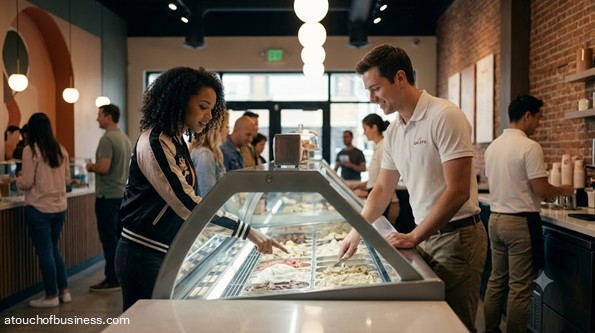
What to Expect From This Guide to Starting a Gelato Shop
This guide walks you through the key decisions and practical steps involved in starting a gelato shop, from evaluating personal fit and local demand to planning production, compliance, finances, and opening preparations. The highlights below represent only part of the detail included.
Inside the guide, you will find:
- Startup steps: Follow an orderedhttps://blog.finamac.com/en/common-challenges-for-ice-cream-shop-owners-and-how-to-overcome-them/ path from business fit and product choices through market validation, setup, pricing, insurance, and a tested opening.
- Industry interviews: Explore owner and professional experiences involving production, location, finances, staffing, sourcing, and daily shop operations.
- Startup FAQs: Review practical answers about training, equipment, licensing, production methods, seasonality, space needs, and federal registration.
- Fit and demand: Consider the physical demands, seasonal income, local competition, foot traffic, customer testing, and available entry options.
- Financial planning: Examine startup costs, fixed expenses, break-even sales, pricing, operating reserves, funding choices, and slow-season planning.
- Production setup: Understand training, production models, commercial equipment, kitchen layout, ingredient sourcing, staffing, and service systems.
- Requirements and warnings: Identify location-dependent permits, food-service rules, insurance needs, equipment risks, compliance gaps, and final opening checks.
Begin by considering whether the demands, skills, seasonality, and financial uncertainty of a gelato shop match your situation.
Opening a gelato shop means stepping into a skilled food production business — one where what you make, how you make it, and where you make it determines everything.
As a gelato shop owner, you produce artisan frozen desserts in your shop and serve them to customers from a refrigerated display case. Gelato differs from standard ice cream in meaningful ways: it contains less butterfat (typically 4–9%), has less air churned in, and is served at a slightly warmer temperature that makes flavors more intense and the texture silkier.
Production happens before customers arrive. You pasteurize the mix, run batch freezer cycles, blast-chill the finished product, and manage the display case throughout the day.
Between rushes, you clean equipment, log temperatures, prep ingredients, and coordinate supplier deliveries. Long days — especially in summer — are the norm, not the exception.
Before you dive into the startup steps, spend honest time with a few questions.
Do you genuinely want to run a high-volume, physically demanding food service operation? Can your household manage an income gap during the startup period and through the first slow season? Do you have the production skills, or the willingness to invest in serious training before you open?
Talk to people who already run gelato shops or artisan frozen dessert businesses — in different markets, so they’re not competitors. Ask about workload, seasonality, equipment problems, staffing realities, and what they would do differently. Prepare your questions before those conversations. Firsthand insight from experienced owners is one of the most useful things you can gather before committing.
Also think through your entry path. Starting from scratch, buying an existing gelateria, or exploring a franchise are all legitimate options — each with different capital requirements, timelines, and tradeoffs. Several gelato franchise brands operate in the U.S.
A franchise gives you a proven system and brand recognition but limits creative control and requires ongoing royalties. Buying an existing shop may offer established foot traffic and equipment but requires careful due diligence.
The right path depends on your budget, skill level, and how much control you want over the product and brand.
Red Flags Before You Start
Some of these warning signs mean pause and verify. Others may mean reconsider entirely.
Seasonality is the biggest structural risk:
- Frozen dessert sales peak in warm months and can fall sharply in fall and winter.
- Your fixed costs — rent, payroll, equipment payments, insurance — don’t pause during slow months.
- Map your projected revenue for all 12 months before signing a lease. Confirm your operating capital can cover the gap.
Location determines survival:
- Gelato is largely an impulse purchase driven by foot traffic. A low-traffic location is very hard to overcome.
- If you can’t secure a high-traffic spot at a rent your revenue can support, the model may be unworkable before you even open.
Equipment and build-out costs are significant:
- Professional gelato equipment must be NSF-certified for U.S. health department approval — and quality Italian machines aren’t cheap.
- Building out a commercial food production kitchen adds cost on top of equipment.
- Underestimating these costs is one of the most common planning mistakes in this business.
Production skill gaps will show in the product:
- Gelato formulation requires trained technique. Inconsistent product erodes customer loyalty fast.
- If you’re not producing yourself, you need a skilled gelatiere in place before you open — not after.
Competition and compliance both deserve a hard look:
- If a well-established premium frozen dessert competitor already owns your target market, entering is significantly harder.
- Health department plan reviews, inspections, and certificate of occupancy processes can delay your opening by weeks or months. Start compliance early.
- Equipment failure can destroy your entire product inventory within hours. Confirm your insurance covers refrigeration breakdown and spoilage before your first production run.
One more structural reality to understand: the term “gelato” has no federal standard of identity in the U.S. Unlike “ice cream,” which must meet a minimum butterfat percentage under federal regulations, any operator can call their product gelato regardless of quality or method. Your real competitive advantage is production quality and consistency — not the label.
Step 1: Check Your Fit and Motivation First
Assess this honestly before spending money on anything else.
Ask yourself whether you want to run a food service operation with long hours, physical demands, and income that varies sharply by season.
Think about your household situation. Can your family sustain reduced income during the startup period and through the first off-season? Do you have enough personal financial runway to last longer than you expect?
Consider your passion for this business alongside a clear-eyed view of the real challenges of ownership.
Talk to gelato shop owners and artisan frozen dessert operators in non-competing markets. Ask specific questions about workload, slow seasons, equipment problems, and what surprised them most. Their answers won’t predict your exact outcome, but firsthand experience is more useful than any market research report.
Step 2: Understand the Product and Decide Your Business Model
Decide your production model before committing to any equipment, space, or supplier.
Three main production paths exist:
- Scratch production — you make gelato from raw dairy ingredients in your own kitchen. Highest quality and differentiation; requires trained skill and a full equipment setup (pasteurizer, batch freezer, blast chiller).
- Pre-made base production — you use commercially prepared gelato bases, reducing the skill barrier but limiting your ability to stand out from competitors using the same bases.
- Wholesale sourcing — you purchase finished gelato from a producer and display it. Minimal production equipment; limited brand identity.
Most artisan gelaterie that command premium pricing produce from scratch. That’s the model this guide focuses on.
Also decide your revenue model before setting up:
- Scoop shop only
- Scoop shop with espresso and hot beverages (affogato, coffee — extends year-round revenue)
- Scoop shop plus catering and events
- Retail take-home pints alongside in-shop service
- Wholesale to restaurants or hotels (requires significantly more production capacity)
Each model changes your equipment needs, licensing exposure, staffing requirements, and cost structure. Settle this before anything else.
Step 3: Get Trained in Gelato Production
Invest in training before investing in equipment or signing a lease.
Gelato formulation is a technical skill. Recipe balancing, pasteurization temperature control, overrun management, and blast-chilling timing all affect the final product. Errors at any stage produce inconsistent texture, poor flavor, or food safety problems.
Structured training options in the U.S. include:
- Carpigiani Gelato University / Frozen Dessert University — in-person basic and advanced gelato courses held in Illinois and North Carolina
- Gelato & Pastry Institute of America (GPI America)
- PreGel America — school of gelato and pastry with hands-on instruction
- Professional Gelato Training — one-on-one instruction available outside Philadelphia
- Online programs including Gelatodemy and Gelato Expert Academy
Training should cover gelato base formulation, pasteurization procedure, batch freezer operation, blast chilling, display temperature management, and recipe development.
If you plan to hire a skilled gelatiere rather than produce yourself, identify and vet that person before you finalize your equipment setup. Your equipment specifications may need to match their production method.
Step 4: Validate the Market Before Committing
Confirm demand and competition before you sign anything.
Walk your target trade area at different times of day and different days of the week. Observe dessert shops, foot traffic, and dining density — these are practical indicators of whether a gelato shop can succeed in this location.
Identify all competing frozen dessert operators within a reasonable radius: gelato shops, ice cream parlors, frozen yogurt shops, premium dessert cafés. Note their quality level, price points, and customer volume.
The absence of authentic artisan gelato in a market is a meaningful entry signal. An already-saturated premium dessert market is a significantly harder position.
Consider testing your recipes at a farmers market, pop-up, or local food event before committing to a lease. Customer feedback on flavor, pricing tolerance, and presentation is valuable — and far cheaper than signing the wrong lease on the wrong concept.
Check publicly available demographic data for your target trade area. Artisan gelato performs well where household incomes are solid and a mix of families, young adults, and visitors creates steady foot traffic.
Evaluate seasonal demand in your specific market. Climate and local tourism patterns directly affect how severe your off-season will be. A beach town’s off-season looks very different from a college town’s.
Business Plan
Write your business plan before committing to a location, equipment purchase, or build-out contract.
Start with your business model: production method, menu scope, seating approach, hours of operation, and revenue streams. Every financial assumption flows from those decisions.
Your plan should map out:
- Startup cost categories — build-out, equipment, licensing, training, insurance, initial ingredient inventory, disposables, operating reserve
- Monthly fixed costs — rent, loan or equipment payments, payroll, utilities, insurance
- Projected revenue model — how many customers per day, at what average transaction, across all 12 months
- Break-even logic — what daily sales volume you need to cover fixed costs, and whether that’s realistic for your location
- Gross margin position — gelato ingredient costs are generally low as a percentage of revenue, which is a structural advantage; fixed overhead can erode that margin quickly
- Operating capital reserve — funds to cover fixed costs during ramp-up and through your first slow season
Running out of operating capital is one of the primary reasons food service startups close. Budget for it before you commit to a lease.
Pay close attention to rent as a percentage of projected annual revenue. If rent is disproportionately high relative to what your location can realistically generate, no other variable can fix the break-even problem.
Map your 12-month revenue cycle honestly. Slow winter months are part of the business. Your plan needs to show you can survive them, not just thrive in July.
For funding, explore personal savings, SBA loan programs (the 7(a) program for general business and the 504 program for major equipment), traditional bank or credit union loans, equipment financing or leasing, and SBDC resources. Some equipment suppliers and franchise systems offer financing relationships.
Use the business plan to pressure-test your assumptions before you spend. Get contractor quotes and equipment quotes before finalizing your numbers — do not estimate build-out and equipment costs from general ranges.
Step 5: Choose a Business Structure and Register
Lock in your legal structure before opening a business bank account or signing any agreements.
Most small food service operators choose an LLC for personal liability separation. Review your business structure options — an LLC and a sole proprietorship carry different liability and tax implications.
Register your entity with your state’s secretary of state or equivalent office. If you’ll operate under a trade name that differs from your legal entity name, file a DBA.
Obtain your EIN from the IRS — required for business banking, hiring, and federal tax obligations. Apply free at IRS.gov.
Register for your state’s sales tax permit if your state taxes prepared food or frozen dessert sales at retail. Check your state’s department of revenue for the specific rules — some states exempt certain food categories, and the rules vary by jurisdiction.
If you plan to hire staff, set up employer payroll tax accounts with your state’s revenue and labor agencies before you bring on your first employee.
Step 6: Find and Secure Your Location
Your location may be the single most consequential decision in this startup.
Look for a commercially zoned space that permits food service retail use. Target roughly 800–1,500 square feet to fit a production kitchen, display counter, service area, and optional seating. Confirm zoning with the local planning or zoning department before signing anything. Getting this wrong after signing a lease is expensive.
Prioritize high foot-traffic locations near parks, shopping districts, entertainment venues, tourist corridors, or busy commercial streets. Walk the area yourself at multiple times of day. Observe real customer flow.
Before committing, verify that the space’s utilities can support commercial gelato equipment. Batch freezers and pasteurizers have specific electrical and water-cooling requirements. A space without adequate electrical capacity will require expensive upgrades — or may not work at all.
Negotiate lease terms before signing. Ask for a Tenant Improvement allowance toward your build-out costs. Confirm the lease term aligns with your business plan timeline. Have an attorney review the lease before you sign.
If the space requires build-out or change of use, you’ll need a certificate of occupancy after construction is complete. Factor that process — and its timeline — into your opening schedule.
Check local sign permit requirements before designing your exterior signage. Rules on size, illumination, and placement vary significantly by municipality.
Step 7: Handle Licensing and Compliance
Start the compliance process early — well before your target opening date.
The health department process alone typically requires four to eight weeks from plan submission to permit approval. Add build-out time, inspections, and potential correction cycles, and delays compound quickly.
Work through these compliance items in sequence:
- Health department plan review: Submit your kitchen layout, equipment placement, ventilation, plumbing, and sanitation station plans to your local or county health department for review before construction begins. This is required in most jurisdictions.
- Build-out to approved specs: Complete the build-out according to the approved plans. NSF-certified commercial equipment is required — residential-grade equipment will fail inspection.
- Food Service Establishment Permit: Issued by the local or county health department after a facility inspection. You cannot legally open without it. Schedule and pass this inspection after build-out is complete.
- General business license: Required in virtually every U.S. municipality. Apply through the city or county clerk or business licensing portal.
- Certified Food Protection Manager (CFPM) certification: Required in most states before opening. The ServSafe Manager certification (or an equivalent ANAB-accredited program) meets this requirement. The on-duty manager must hold this certification.
- Food handler cards: Most states require food handler cards for all food-handling employees. Timelines for obtaining cards after hire vary — verify with your state health department.
- Certificate of occupancy: Required after any build-out or change of commercial use. Confirm with your city or county building department whether this applies to your space.
- Sign permit: Required for exterior signage in most municipalities. Verify with the local planning or zoning office before installing anything.
- Fire inspection: Required as part of the certificate of occupancy process. Your production kitchen must have fire suppression systems, Class K fire extinguishers, and emergency exit compliance in place before inspection.
Also check these state-level items with your state’s health and agriculture agencies:
- Some states require a separate state food establishment license in addition to the local health permit.
- Some states require a frozen dessert license or dairy permit if you produce a dairy product on-site from raw ingredients. Verify this with your state department of agriculture or health.
- If you plan to sell pre-packaged take-home gelato, some states require a separate retail food dealer license. Check your state’s department of agriculture.
Confirm allergen labeling requirements for any pre-packaged products you sell.
Start verifying business licenses and permits as soon as you have a location in mind — not after you sign the lease.
Step 8: Set Up Your Equipment and Production Kitchen
Your equipment determines your production capacity, your compliance status, and your product quality. Get the setup right before you schedule your health inspection.
The four core production pieces every in-house gelato operation needs:
- Pasteurizer: Heats the gelato base to eliminate pathogens. Required when working from raw dairy. Some operators buy a combi machine — a single unit combining pasteurization and batch freezing — which works well for smaller operations with limited production space.
- Batch freezer: Churns the pasteurized mix into finished gelato at low speed, incorporating minimal air. This is the core production machine. Major brands with NSF certification for the U.S. market include Carpigiani, Cattabriga (Iceteam 1927), Bravo, and Coldelite.
- Blast freezer / blast chiller: Rapidly drops freshly churned gelato to deep freezing temperatures. Without it, your gelato loses texture within hours of production. This piece of equipment is essential, not optional.
- Gelato display case: The customer-facing freezer holding gelato at serving temperature. Two main styles: the traditional open-top sloping glass display (high visual impact, requires daily presentation work) or the covered pozzetti wells (better product preservation, less visually dramatic). Choose based on your production method and the customer experience you’re building.
Confirm these items are in place before the health inspection:
- Three-compartment sink (required for washing, rinsing, and sanitizing equipment and tools)
- Dedicated handwashing sink, separate from the prep and equipment-cleaning sinks
- Mop sink
- Walk-in or upright storage freezer for finished product
- Reach-in refrigerator for raw ingredients
- Precision digital scale, probe thermometers, stainless mixing bowls, spatulas, and measuring tools
- Ventilation system meeting local health and fire codes
- Non-porous, easy-to-clean floor and wall surfaces in the production area
Plan the layout of your production kitchen before ordering equipment. Equipment placement affects workflow efficiency, health department approval, and utility connections.
Confirm electrical requirements with your equipment supplier before finalizing your space. Batch freezers and blast chillers often require 220V service or higher amperage than a standard retail space provides.
Step 9: Set Up Suppliers and Ingredient Sourcing
Establish your supply chain before you need it — not the week you open.
Federal law requires all dairy used in frozen desserts sold directly to consumers to be pasteurized. Most retail gelaterie purchase commercially pre-pasteurized dairy from a licensed dairy distributor, then pasteurize the completed mix in their own pasteurizer. Verify the exact process requirements with your local health department.
For specialty flavor ingredients — nut pastes, chocolate, fruit purées, and natural flavor bases — Italian ingredient distributors operating in the U.S. include PreGel America, Comprital, Fabbri, and Rubicone. Domestic food service distributors can supply dairy and general ingredients.
Set up accounts for disposables as well: cups, cones, tasting spoons, wax-paper liners, napkins, and retail take-home containers if applicable.
Establish a backup supplier for at least your most critical ingredients. Single-supplier dependency for a perishable product is a real operational risk. A delayed delivery or supplier disruption can shut down production.
Confirm your supplier delivery schedules before you set your production schedule. Receiving, storage, and production timing need to align.
Step 10: Hire and Train Your Team
Decide your staffing model before you commit to a production schedule.
If you’re not producing gelato yourself, hire a qualified gelatiere before you open. Skilled gelato producers are rare in most U.S. markets, and the hiring process takes time.
Confirm these certifications are in place before opening day:
- The designated food service manager holds a Certified Food Protection Manager certification (ServSafe Manager or ANAB-accredited equivalent)
- All food-handling staff have obtained food handler cards as required by your state
Train all staff on allergen awareness, cross-contamination prevention, temperature logging, equipment cleaning and sanitization, and customer service before their first shift.
Plan for seasonal staffing needs. If your market has strong summer demand, hire and train surge staff before peak season — not during it.
Workers’ compensation insurance is required in most states as soon as you employ anyone. Verify your state’s requirements with the state workers’ compensation board before your first hire.
For guidance on when and how to hire, review your obligations before bringing on any employee.
Step 11: Open a Business Bank Account and Set Up Payments
Separate your business finances from your personal accounts from the start.
Open a dedicated business checking account — you’ll need your EIN and entity registration documents. Set up a business credit card for expense tracking.
Choose a POS (point of sale) system that handles product mix sales, tracks inventory, and records daily revenue by category. Toast, Square, Clover, and similar systems are widely used in food service. Program it with your full menu, pricing, and applicable tax settings before opening day.
Set up your merchant account for credit and debit card processing. Most gelato customers pay by card.
Set up bookkeeping software to track COGS, labor, rent, utilities, insurance, and other costs from day one. Losing visibility on your cost structure in the first months makes it nearly impossible to manage the business intelligently.
Step 12: Set Your Prices Before Opening
Set prices using real costs — not what competitors charge or what sounds reasonable.
Start with cost-plus pricing: calculate your ingredient cost per serving, add proportional labor and overhead, and use that as your price floor. Then check that result against local comparable pricing for premium artisan desserts.
Artisan gelato commands a meaningful premium over mass-market ice cream. Research what your specific market will support — but don’t price below what your cost structure requires. Pricing based on ingredient cost alone, without factoring in labor and fixed overhead, is a costly mistake.
Price for every format you’ll offer:
- Scoop sizes — single, double, cup versus cone
- Premium cone upgrade (waffle cone)
- Toppings as add-ons
- Affogato (gelato with espresso) if you offer coffee
- Retail take-home containers if applicable
- Catering packages if applicable
Confirm that your pricing — at realistic daily customer counts — generates enough gross margin to cover your full fixed cost structure across all 12 months, including slow winter months.
For a deeper look at pricing your products and services, use real local cost data, not general industry averages.
Step 13: Get Your Insurance in Place
Secure business insurance before you take your first customer.
General liability insurance is required for most commercial leases and covers customer injuries, food safety claims, and third-party property damage.
Consider a Business Owner’s Policy (BOP), which bundles general liability with commercial property insurance at a lower combined cost than purchasing each separately. For a gelato shop, two specific endorsements are critical:
- Equipment breakdown coverage — covers repair or replacement if your batch freezer, blast chiller, or display case fails
- Spoilage coverage — covers product loss if your refrigeration fails; a total loss of frozen inventory can happen within hours
Workers’ compensation insurance is legally required in most states for any employer with employees. Verify your state’s threshold with the state workers’ compensation board.
Work with insurers that specialize in food service businesses. FLIP, Next Insurance, and The Hartford offer coverage designed for frozen dessert retail operations. A generalist agent may not understand the specific risk profile of a gelato shop.
Step 14: Complete a Soft Opening and Confirm Readiness
Run a soft opening before your public launch — not instead of it, but as a required test before it.
Produce gelato, serve it to a limited number of customers, and observe. Does your production workflow run on schedule? Does the equipment perform as expected? Does the service flow work under realistic conditions? Do staff know their roles?
The soft opening exposes gaps in your prep flow, service speed, and staffing coordination before those gaps cost you real customers.
Confirm each of these is complete before opening day:
- All permits are obtained and posted as required by your jurisdiction
- Food Service Establishment Permit is in hand
- Certificate of occupancy is in hand (if required after your build-out)
- All required allergen notices and handwashing signs are posted
- Temperature logging system is operational and staff are trained on it
- Equipment cleaning and sanitization schedule is documented
- Opening ingredient inventory is in place; first supplier orders are confirmed
- POS system is programmed, tested, and ready for transactions
- All staff certifications are complete
- Insurance certificates are on file
Don’t open until the systems are tested and the permits are in hand. Opening without your Food Service Establishment Permit is a violation that can result in immediate closure.
Opening-Day Red Flags
Watch for these issues in the days immediately before and after you open.
Production and equipment problems:
- If your batch freezer, blast chiller, or display case underperforms during the soft opening, resolve the issue before opening publicly. Equipment problems don’t improve under higher volume.
- Confirm temperature logs show all storage and display units are holding correct temperatures before and after the first production run.
Prep flow and staffing gaps:
- If your production schedule is running late — batches aren’t ready when the shop opens — adjust your prep start time before opening day, not during it.
- If staff are unsure of their roles during the soft opening, add a training session. Service slowdowns during opening week damage early customer impressions.
Supplier and inventory gaps:
- Confirm your first week’s ingredient orders are placed and confirmed before opening. Running out of a core ingredient in the first week is preventable.
- Verify your disposables inventory — cups, tasting spoons, cones, napkins — is stocked for expected opening volume.
Compliance gaps:
- Confirm all required permits are posted visibly in the required location before your first public customer. Health inspectors can visit unannounced after you open.
- Verify that allergen labeling is in place for any pre-packaged items before they go on display.
Insurance gap:
- Confirm your equipment breakdown and spoilage coverage is active before your first production run. A display case failure on day one without coverage is a serious financial problem.
Frequently Asked Questions
Do I need formal training to open a gelato shop, or can I learn on the job?
Formal training is strongly recommended before opening, especially if you plan to produce in-house. Gelato formulation requires understanding of recipe balancing, pasteurization control, overrun management, and texture science.
Errors produce inconsistent product that erodes customer trust. Organizations offering structured training in the U.S. include Carpigiani Gelato University, the Gelato & Pastry Institute of America, and PreGel America. Online programs are also available.
Do I need a special license to sell gelato beyond a regular business license?
At minimum, you need a Food Service Establishment Permit from your local or county health department, a general business license, and a Certified Food Protection Manager certification — required in most states.
Some states also require a state-level food establishment license, a frozen dessert or dairy permit for on-site dairy production, or a retail food dealer license if you sell pre-packaged take-home gelato.
Verify all requirements with your local and state health and agriculture agencies before opening.
Can I use residential-grade freezers and equipment to reduce startup costs?
No. Health departments in the U.S. require commercial-grade, NSF-certified food service equipment for any commercial food production facility.
Residential equipment will fail your health inspection and require replacement before you can open. Factor NSF-certified commercial equipment into your startup budget from the beginning.
How important is the production method — scratch production versus pre-made bases?
This is a fundamental business model decision that affects product quality, differentiation, equipment needs, and staffing. Scratch production delivers the most authentic and differentiated product but requires trained technique and a full equipment setup.
Pre-made bases lower the skill barrier but limit your ability to stand out from competitors using the same bases. Most artisan gelaterie that command premium pricing produce from scratch or use minimal prepared components.
Do I need to pasteurize my gelato mix myself, or can I use a supplier who does it for me?
Both are valid approaches. Federal law requires all dairy used in frozen desserts for direct human consumption to be pasteurized. You can meet this requirement by purchasing commercially pre-pasteurized dairy and making your base from those ingredients — without performing pasteurization yourself.
Alternatively, you can purchase raw dairy and pasteurize your own mix on-site. Verify which approach is acceptable with your local health department, as local rules may add requirements beyond the federal standard.
How severe is seasonality for a gelato shop, and how do operators manage it?
Seasonality is a real structural challenge. Sales peak in warm months and can fall sharply in fall and winter. Operators reduce exposure by offering hot beverages, pastries, warm desserts, and catering.
Some operators in cold climates plan to close seasonally and budget accordingly. Before signing a lease, map your projected 12-month revenue cycle and confirm your operating capital reserve covers the slow period.
What size space do I need for a gelato shop?
A workable format is roughly 800–1,500 square feet of commercial space. This accommodates a production kitchen, three-compartment and handwashing sinks, storage freezers, a service counter, a gelato display case, and optional customer seating.
Verify that your target space can support the electrical load and water supply your specific equipment requires before signing a lease.
Do I need to register with the FDA if I sell gelato at my shop?
Retail food establishments that serve food directly to consumers on-site are typically exempt from FDA food facility registration. However, if you produce gelato and sell it wholesale to other businesses or ship it across state lines, FDA registration may be required.
If you only produce and serve gelato at your own location, you likely don’t need FDA registration — but confirm your specific situation with the FDA or a food safety compliance professional, since the line between retail and manufacturing depends on your exact sales model.
Interviews with Gelato Shop Professionals
These interviews share practical experiences involving business planning, location selection, product quality, ingredient sourcing, staffing, pricing, customer education, production, and daily shop management.
Readers can use the advice to evaluate costs, training needs, operating demands, market opportunities, and product standards before committing to a gelato shop.
This interview with Sanders Marvin examines production capacity, staffing, payroll, ingredient sourcing, pricing, seasonal demand, operating expenses, and revenue from retail and wholesale customers.
It is useful because it provides a detailed look at the financial and operational decisions involved in running a small gelato shop.
Turning a Gelato Shop Into a 16 Store Franchise, With Frost Gelato
This podcast interview follows the founders of Frost Gelato from their original shop through the development of multiple locations and a franchise system.
It helps prospective owners understand startup training, location-related expenses, operating systems, business partnerships, decision-making, and the importance of proving a shop concept before expanding.
When Friends Make Gelato – The Success Story of Grom
Federico Grom discusses writing the company’s business plan, learning gelato production, financing the first shop, selecting a location, sourcing ingredients, and defining a clear product promise.
The interview is valuable for readers who need to understand how complementary skills, focused positioning, ingredient quality, financing, and supplier relationships can shape a gelato business.
Interview With Marcella Mantovani of Gelatosità Artisanal Gelato Shops
Marcella Mantovani explains how she and her brother researched costs, production methods, equipment, training, location, product differentiation, customer education, and quality control.
Her experience helps aspiring owners see that operating a gelato shop requires technical skill, constant product improvement, staff training, and a substantial personal time commitment.
Ralf Sander of Gimme Gelato on Five Things You Need to Create a Successful Food or Beverage Brand
Ralf Sander discusses market analysis, product testing, business planning, budgeting, ingredient sourcing, trademarks, outside advisors, financing choices, and the risks of expanding too quickly.
The interview gives prospective gelato entrepreneurs a practical framework for testing demand, starting at a manageable size, and building a stable foundation before investing heavily.
This podcast interview with Gelatissimo co-owner Ariel Husband covers the opportunity she and her husband identified, their choice of gelato concept, in-house production, and the experience of opening their shop.
It is useful for readers considering a franchise or branded concept because it shows how owners evaluated local demand and selected a business model that matched their product standards.
Sources:
- ECFR.GOV: 21 CFR 1240.61 Pasteurization Rule, 21 CFR Part 135 Frozen Desserts
- FERMAG.COM: Batch Freezers for Gelato Production
- FLIPROGRAM.COM: Ice Cream Shop Insurance Overview
- GELATOMACHINE.COM: Machines Needed for Gelato Shop, Equipment Needed to Make Gelato
- GELATOUNIVERSITY.COM: Basic Gelato Course Details
- GIANNI-GELATO.COM: Complete Gelato Equipment Guide
- GPIAMERICA.ORG: Gelato & Pastry Institute of America
- IFPTI.ORG: Ice Cream Food Safety Training
- INSUREON.COM: Ice Cream Shop Insurance Guide
- JIM.COM: How to Start a Gelato Business, How to Start an Ice Cream Business
- KATOM.COM: Commercial Kitchen Requirements Guide
- MODALITA.COM: Opening a Gelato Shop USA Guide
- MODULARCULINAIRE.COM: Health Permit for Commercial Kitchens
- PROFESSIONALGELATOTRAINING.COM: Gelato Machine & Batch Freezer Specs
- RELUCTANTGOURMET.COM: Gelato vs Ice Cream Key Differences
- RESTAURANT365.COM: ServSafe Certification Guide
- BIZTRENDS.COM: Best Gelato Franchise Opportunities
- THEFEED.ZINGERMANS.COM: Gelato vs Ice Cream Explained