
What to Expect From This Guide to Starting a Glass Etching Business
This guide walks readers through the key decisions and practical steps involved in starting a glass etching business, from assessing personal and market fit to setting up production and preparing to open. The highlights below represent selected areas, while the article provides fuller explanations, warnings, and planning guidance.
Inside the guide, you will find:
- Startup steps: Follow an ordered sequence covering business fit, demand, production methods, premises, legal setup, equipment, pricing, insurance, and opening tests.
- Industry interviews: Explore first-hand experiences involving training, equipment, studio practices, commissioned projects, customer communication, and glassworking techniques.
- Startup FAQs: Review practical answers about etching methods, customer property, hazardous waste, pricing, corporate clients, space needs, and sales approaches.
- Business fit: Consider creative skills, patience, household finances, seasonal demand, competition, customer groups, and possible ways to enter the market.
- Financial planning: Examine startup quotes, fixed expenses, break-even order volume, seasonal cash needs, pricing inputs, setup fees, and profit margins.
- Equipment and compliance: Compare production setups while reviewing ventilation, workshop layout, chemical handling, permits, insurance, and location-dependent requirements.
- Opening preparation: Prepare supplier backups, order paperwork, deposits, equipment tests, staff training, payment systems, and solutions for opening-day red flags.
Begin by considering whether the creative, production, financial, and seasonal realities of a glass etching shop suit your circumstances.
Running a glass etching shop means you spend your days turning plain glassware into personalized pieces — etching names, logos, and designs into wine glasses, awards, mirrors, and custom barware that customers can’t find on a shelf anywhere.
The work combines a creative eye with a production workflow. You take a customer’s idea, develop a design proof, cut a stencil or prepare a digital file, prep the glass, apply the etch, inspect the result, and hand over a finished piece.
A shop-based operation lets you run both a customer-facing retail space and a production workshop from the same location. Walk-in gift buyers browse your display. Corporate clients order logoed glassware in bulk. Wedding couples pick up custom bridesmaid gifts.
Before you commit to a space or a single piece of equipment, take an honest look at whether this business fits where you are right now. You’ll need a steady hand, an eye for detail, patience with custom orders, and enough creative confidence to translate a customer’s brief into something they’ll love.
You’ll also need capital — not just for startup costs, but to keep the doors open during slow months. Glass etching is a discretionary, event-driven product. Weddings and holidays drive traffic. January and February can be quiet.
Your household needs to manage that gap while the business finds its footing.
Talk to people who run non-competing custom gift or engraving shops before you make any commitments. Ask them about seasonal swings, corporate client acquisition, equipment reliability, and what they wish they had known. Their firsthand experience is worth more than any amount of research. You can learn from experienced business owners who have already solved the problems you’re about to face.
Think about who your first customers will be. Your personal and professional network is the most likely starting point — anyone planning a wedding, a corporate event, or a milestone celebration.
Local businesses that buy branded glassware or recognition awards are the clients that can turn into repeat accounts. You’ll reach them through direct outreach with physical samples, not by waiting for walk-ins.
The general steps to starting a business apply here, but glass etching has its own specific path. The steps below follow the order that makes sense for this type of shop.
Red Flags Before You Start
A few warning signs are worth examining before you go further.
Demand is seasonal and discretionary. Gift buyers show up around holidays and wedding season. Corporate gifting peaks at year-end. If you’re planning to rely primarily on retail walk-in traffic, model what a slow month looks like against your fixed costs before signing a lease.
Online competitors are a structural reality. Large personalized glassware platforms and Etsy sellers compete on price at a scale a local shop can’t match. Your advantages are quality, speed, local relationships, and in-person service. If you can’t clearly articulate why a customer would come to you instead, that’s worth resolving before you open.
Equipment cost and order volume must align. A CO2 laser engraver and a professional sandblasting setup are meaningful investments. At low order volume, the cost of that equipment spread across each piece can compress your margins significantly.
Consider starting with one production method, proving demand, and adding equipment as revenue supports it.
If you plan to use etching cream, chemical compliance is real. You’ll have OSHA and EPA obligations for chemical handling and disposal. Some landlords and zoning districts restrict chemical storage. Verify zoning and ventilation requirements before signing any lease — not after.
Finally, breaking a customer-supplied item is a serious risk. Customers sometimes bring in heirlooms, gifts received from someone special, or irreplaceable bottles. Without clear written terms and the right insurance, a single damaged piece can cost you more than the job was worth.
Step 1: Assess Whether This Business Fits You
Start here, before you look at spaces or browse equipment listings.
Glass etching demands patience, precision, and a creative instinct. You’ll spend long stretches at a bench — prepping glass, cutting stencils, running equipment, and inspecting finished pieces.
You’ll also manage customer briefs, send proofs, handle revisions, and deliver consistent quality under deadline.
Do you have the design sensibility to translate a customer’s idea into a clean, well-composed etch? If not, do you have a plan to develop that skill or bring someone in who has it?
Think honestly about the financial picture too. Can your household cover personal living expenses while you build a client base? Can you absorb a slow stretch without closing the shop?
Are the people who depend on you financially on board with the risk?
Talk with owners of non-competing custom gift or engraving shops — people who run trophy shops, sign studios, or custom gift boutiques. Prepare specific questions about their seasonal patterns, equipment choices, corporate client relationships, and what they underestimated at the start.
Think through your entry path. Buying an existing glass etching or engraving shop — if one is available locally — can give you equipment already in place, a client list, and a running workflow.
No significant franchise model exists in this industry, so starting from scratch or buying an existing operation are the realistic options. Learn more about starting from scratch versus buying a business before you decide.
Step 2: Choose Your Etching Method and Define the Business Model
This is the decision that drives everything else — equipment, space, ventilation, pricing, and the type of work you take on.
Three main production methods apply to a glass etching shop:
- Etching cream — the lowest-cost entry point; uses an ammonium bifluoride-based cream applied through a vinyl stencil to produce a surface-level frosted finish; results can be inconsistent on complex designs; triggers chemical handling and hazardous waste disposal obligations
- Sandblasting / sandcarving — propels abrasive media (aluminum oxide or silicon carbide — never silica sand) through a pressurized cabinet to carve permanent designs; produces deep, professional results preferred for corporate glassware and crystal awards; requires a sandblast cabinet, air compressor, dust collector, and good ventilation
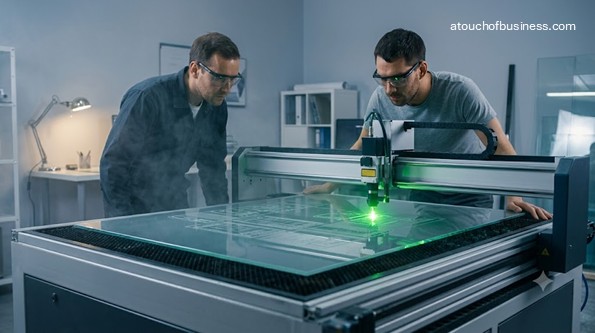
- CO2 laser etching — uses a focused beam to etch precise designs including fine text and photographic images; clean operation with no chemical disposal; requires a CO2 laser engraver (not a diode laser, which requires workarounds for glass) and a rotary attachment for cylindrical items like wine glasses and tumblers
Many established shops combine sandblasting and laser etching to serve different customer needs and price points. You don’t have to offer both on day one, but know which method aligns with your target customers and your startup budget before you spend anything.
Also define your business model before you move forward. Will you focus on retail walk-in custom orders, corporate and B2B accounts, wholesale supply to gift shops and hotels, pre-made inventory items, or some combination?
The model you choose shapes your location needs, your equipment priorities, and your pricing structure.
Decide whether you’ll supply your own glassware blanks, accept customer-supplied items for etching, or both. Each choice has implications for inventory investment, liability terms, and the type of clients you attract.
Step 3: Research Local Demand and Competition
Does your local market have room for a glass etching shop?
Search for existing engraving shops, trophy and award shops, custom gift studios, and laser engraving operations in your area. Identify what they offer, who they serve, and where gaps exist.
If several well-established shops already cover the corporate award and custom drinkware market, you’ll need a clear differentiation — whether that’s a method they don’t use, a customer segment they don’t serve well, or a quality level they don’t deliver.
Corporate and hospitality demand is worth assessing separately. Hotels, restaurants, breweries, law firms, real estate agencies, and event venues buy etched glassware and recognition pieces on a recurring basis.
These clients are more predictable than individual gift buyers and can anchor the business through slower retail periods.
Look at the wedding market in your area too. Couples order custom bridesmaid and groomsman gifts, personalized favors, and commemorative pieces. Wedding planners and venue coordinators can become natural referral sources — but only if you connect with them before they already have a vendor they trust.
If you’re considering buying an existing shop instead of starting from scratch, this research will also help you evaluate whether an acquisition makes sense and at what scale.
Business Plan
Your business plan is where everything you’ve researched gets pressure-tested before you spend real money.
Start with the revenue structure. A glass etching shop is a custom-order operation, which means most revenue comes in piece by piece or batch by batch — not on subscription or contract.
Single-piece custom orders carry higher per-unit pricing but take more design and setup time per sale. Bulk corporate orders are lower per unit but more predictable and less labor-intensive per piece once the setup is done.
Map out what it costs to cover your fixed monthly expenses — rent, utilities, equipment financing, and insurance — and work backward to understand how many orders you need each month to break even.
That math changes dramatically by season. Plan for slow months explicitly. If holiday season covers a large portion of your annual volume, you need enough operating capital to carry the business through the quiet stretches between those peaks.
Your plan should also document your equipment method choice, your target customer segments, your pricing model, and your startup cost estimates.
Get quotes on equipment, lease space, build-out, insurance, and permits before finalizing any figures. The most accurate startup budget comes from pricing out your specific situation — not from industry averages.
Read more about how to write a business plan and about estimating profitability for a new business before you finalize your numbers.
Include a funding plan. If you need a loan, have your plan ready before you approach lenders. Learn about getting a business loan and what lenders typically want to see.
Step 4: Find and Secure the Right Workshop Space
For a glass etching shop, the space has to work as both a production workshop and a customer-facing storefront.
That means you need the right zoning, the right infrastructure, and enough square footage to run your bench efficiently without crowding your customer area.
Verify zoning before you fall in love with a space. A combined retail-workshop operation typically requires commercial or light industrial zoning. If you plan to use sandblasting equipment or store chemical etching products, confirm with the local planning or zoning department that those activities are permitted at the address you’re considering.
The building itself needs to support your production method. Sandblasting requires a dust-contained cabinet, an air compressor, and a dust collector — all of which need floor space, power, and ideally ventilation ducted to the outside.
A CO2 laser engraver needs a dedicated exhaust system. Etching cream requires an eyewash station, chemical-resistant work surfaces, and a locked chemical storage cabinet.
If the space needs build-out or ventilation installation, get cost estimates before signing anything. Check whether a certificate of occupancy is in place and covers your intended use.
If you’re renovating, building permits are required before work begins. If you plan exterior signage, confirm local sign permit requirements before ordering anything.
Adequate customer parking and accessible entry matter if you’re running a walk-in retail model. ADA accessibility requirements apply to any customer-facing space.
Step 5: Register the Business and Complete Legal Setup
Legal setup follows your location decision — not the other way around.
Choose a legal structure before you register anything. An LLC is a common choice for small custom-service shops because it separates your personal assets from business liabilities.
A sole proprietorship is simpler but offers less protection. The right choice depends on your financial situation, risk tolerance, and whether you’re bringing in partners.
Register your business name with the appropriate state agency. If you’re operating under a name different from your legal entity name, file a DBA (doing business as).
Obtain an Employer Identification Number (EIN) from the IRS. You’ll need it for your business bank account, any hiring, and tax filings. Get your business tax ID before you open a bank account.
Register for sales tax with your state revenue or taxation agency. Custom glass etching products are generally taxable as tangible personal property.
A resale certificate lets you buy glassware blanks and raw materials from suppliers without paying sales tax, since you’re incorporating them into products for resale. Confirm the process with your state agency.
Open a dedicated business bank account once your entity and EIN are in place. Keep business and personal finances completely separate from day one.
Set up a merchant account or payment processor so you can accept card payments and send deposit invoices to corporate clients before you open.
Step 6: Complete Compliance Checks and Obtain Permits
What compliance looks like for your shop depends on your etching method and whether you employ staff.
If you use etching cream — which contains ammonium bifluoride and sodium bifluoride — OSHA’s Hazard Communication Standard (29 CFR 1910.1200) applies whenever employees are exposed to hazardous chemicals.
You must maintain a Safety Data Sheet (SDS) for every chemical product in the shop, keep those sheets accessible in the work area, and train any employees on safe handling. This applies even to a small shop with one employee.
You also have EPA hazardous waste obligations. Used etching cream, rinse water contaminated with chemical residue, and related materials cannot go in regular trash or down a drain.
Most small glass etching shops will qualify as Very Small Quantity Generators (VSQGs) — producing 100 kilograms or less of hazardous waste per month — but you must calculate your actual waste volumes and confirm your category.
VSQGs must identify their hazardous waste and ensure it’s delivered to an authorized disposal facility. Some states have stricter rules than the federal minimums, so verify with your state environmental agency before disposing of anything.
If you use sandblasting, confirm with your city or county that compressor noise and dust production are permitted in your zone during your planned operating hours.
Obtain all required local business licenses from your city or county before opening. Check with your local building department whether any special use permits apply if you plan to host public classes or workshops in the shop.
Learn more about business licenses and permits and what to verify in your area.
Step 7: Buy Equipment and Set Up the Workshop
How you lay out and equip your workshop determines how efficiently you can produce — and whether your shop is safe to operate.
The core production equipment depends on your chosen method. A sandblasting setup requires a sandblast cabinet sized for your largest work pieces, an air compressor matched to the cabinet’s requirements, a dust collector with fine-particle filtration, and abrasive media.
Use aluminum oxide or silicon carbide at a fine grit of 120 or higher for glass work. Never use silica sand, which creates dangerous airborne particles.
A CO2 laser engraver is the professional standard for laser glass etching. Diode lasers require workarounds for glass and aren’t the right choice for a production shop.
You’ll also need a rotary attachment for cylindrical pieces — wine glasses, tumblers, bottles, and vases — and an exhaust system ducted away from the work area.
For design and stencil production, you need a vinyl cutter, a computer capable of running vector design software, and software that supports SVG or similar file formats. Adobe Illustrator, CorelDRAW, and most vinyl cutter native applications work well.
Every design you produce for sandblasting or chemical etching starts as a vector file and gets cut into stencil vinyl before touching the glass.
Install and test all ventilation and safety equipment before any production work begins. The eyewash station, chemical storage cabinet, PPE, and dust collection system are operational requirements — not optional finishing touches.
Think through the flow of work in your layout. Where does a piece enter the shop? Where does it get cleaned and prepped? Where is the production bench? Where does a finished piece go before pickup or packaging?
A logical bench-to-counter flow reduces handling time and the risk of damage between stages.
Keep the customer display area and the production area clearly separated. Customers shouldn’t be near sandblasting equipment or open chemical containers.
Step 8: Source Suppliers and Set Up Vendor Accounts
Who supplies your glass blanks and production consumables matters more than most new owners expect.
Identify at least two sources for each critical supply — glassware blanks, etching cream, abrasive media, stencil vinyl, and packaging. Relying on a single vendor for any essential input creates risk you don’t need.
For glassware blanks, look at wholesale barware distributors, award and trophy glass suppliers, and specialty glass blank vendors. Establish wholesale accounts so you’re buying at volume pricing rather than retail.
The quality and variety of your blank inventory directly affects the range of products you can offer customers.
If you use etching cream, set up a relationship with a licensed chemical waste disposal vendor before you open. Identify an authorized disposal facility in advance and understand their pickup schedule and requirements.
For customer-supplied items, create an intake and tracking system before you start accepting them. Every item a customer brings in should be logged, tagged, and covered by signed terms of service before it goes anywhere near your production bench.
Step 9: Set Pricing and Prepare Your Order Workflow
How do you price custom glass etching without underselling your time?
Build every price from the bottom up. Start with your material cost — the glassware blank if you’re supplying it, or the consumable cost if the customer brings the piece.
Add your design and file-prep time, your machine time or hands-on bench time, your packaging, and your share of overhead — the portion of rent, utilities, insurance, and equipment depreciation that belongs to each order.
Then add your profit margin. If the total doesn’t include all of those inputs, you’re not pricing the work — you’re subsidizing it.
Custom single-piece orders deserve a setup fee that reflects the time required to convert artwork, prepare a proof, and get customer approval. Never absorb that time into a flat per-piece rate.
When a customer sends a logo in a format that needs cleanup, the conversion work has real value.
Quantity pricing for bulk orders can be lower per unit, because setup is spread across more pieces. But even the lowest bulk tier must cover your costs.
Corporate clients often have faster turnaround expectations — price rush jobs accordingly.
Read more about pricing your products and services and what pricing models work for custom creative work.
Before you take a single order, have your order intake form, design proof approval process, deposit policy, and terms of service for customer-supplied items in writing and ready to use.
A deposit protects you against a customer who abandons a custom order after you’ve done the design work and cut the stencil.
Step 10: Set Up Insurance Before Opening
A glass etching shop has real liability exposure — chemical use, breakable customer property, and a production environment where customers may visit.
General liability insurance is the baseline. It covers customer injuries on your premises and third-party property damage claims. Many commercial lease agreements require proof of general liability coverage before you can occupy the space.
Add commercial property insurance to cover your equipment, glassware inventory, and shop contents. A Business Owner’s Policy (BOP) combines general liability and property coverage in a single policy and is a common choice for small shops.
Confirm whether your general liability policy includes products and completed operations coverage. This matters because etched items go home with customers and get used by third parties — if something goes wrong, you want coverage that extends beyond your premises.
If you plan to accept customer-supplied property for etching, ask your insurer whether damage to items in your care is covered — this is called bailment coverage and may require a separate endorsement. Don’t assume it’s included.
If you employ staff, workers’ compensation insurance is legally required in most states. Verify your state’s threshold and requirements before hiring anyone.
Learn more about business insurance and what coverages apply to your situation.
Step 11: Hire, Train, and Prepare for Opening
Many glass etching shops open owner-operated, with the owner handling all production, design, and customer service.
If you bring in help — even part-time — every person who works in the production area must be trained on chemical handling, SDS access, equipment operation, and emergency procedures before they touch any materials.
This is not optional when hazardous chemicals or industrial equipment are involved.
Before you accept your first customer order, run production tests across every product type you plan to offer. Test your laser settings on different glass types. Run sandblasting passes to verify depth and consistency. Apply etching cream to confirm your stencil adhesion is clean.
Inspect every piece against your own quality standard.
Keep several of your best test pieces as samples for the customer display area. Customers who can see and handle a finished piece — feel the depth of a sandblasted edge, hold a laser-etched tumbler up to the light — are far more likely to place an order.
Learn about when and how to hire if you’re considering bringing on staff from the start.
Opening-Day Red Flags
A few issues can stop you from delivering on your first customer orders if they’re not resolved before you open.
Ventilation not operational. If your exhaust system isn’t fully functional on day one, you can’t safely run a laser engraver or use etching cream in your workspace. Don’t open without it.
No SDS binder or missing chemical documentation. Every hazardous chemical product in your shop must have a current Safety Data Sheet on file and accessible in the work area before any production begins. Walking in on day one without this puts you out of compliance immediately.
Equipment not calibrated or tested. If your laser settings, sandblast pressure, or stencil vinyl process haven’t been fully tested across your planned product range, you risk ruining the first real customer orders. Test everything before you accept a job.
No terms of service for customer-supplied items. If you open without a signed customer agreement for items brought in from outside, you have no documentation to fall back on if a piece breaks during production. Put this paperwork in place before you accept anyone’s glassware.
No hazardous waste disposal plan. If you’re using etching cream and haven’t identified a licensed waste disposal vendor, you have no compliant way to manage your chemical waste. Establish that relationship before you open.
Payment processing not tested. Confirm your point-of-sale system and card reader work correctly, and that you can issue a deposit invoice before day one. Running custom orders without deposits is a cash flow risk you don’t need at launch.
Frequently Asked Questions
Do I need any formal certification or license specific to glass etching to open a shop?
No specific professional license for glass etching exists at the federal level or in most states. The compliance requirements are standard business licensing — a general business license, sales tax permit, and EIN — along with zoning confirmation and method-specific obligations.
If you use etching cream, OSHA’s Hazard Communication Standard and EPA hazardous waste rules apply. Verify all local requirements with your city, county, and state agencies before opening.
Which etching method is best for a shop starting out?
It depends on your budget and the clients you want to serve. Etching cream with a vinyl cutter is the lowest-cost entry point but produces surface-level frosting and less consistent results on complex designs.
A CO2 laser engraver delivers precision and repeatability with no chemical disposal obligations, making it well-suited for custom gifts and corporate logoed work. Sandblasting produces the deepest, most professional finish for corporate glassware and crystal but requires more equipment and space.
Many shops eventually combine laser and sandblasting to cover different price points.
Can I accept customer-supplied items for etching, and what risks does that create?
Yes, and it’s a key selling point of a local shop. The risk is breakage — glass can crack during etching, including pieces with sentimental or monetary value that can’t be replaced.
Before accepting any customer property, establish written terms that document your liability policy, get the customer’s signature, and confirm with your insurer whether damage to items in your care is covered. That coverage — called bailment coverage — may require a separate endorsement on your policy.
Do I have hazardous waste obligations if I only use commercial etching cream?
Yes. Commercial etching creams contain ammonium bifluoride and sodium bifluoride, both corrosive hazardous materials. Used cream, contaminated rinse water, and related waste cannot go in regular trash or down the drain.
The EPA classifies this as hazardous waste, and even very small-volume generators must identify their waste and have it disposed of by an authorized facility. Contact your state environmental agency for the specific process in your location.
How do I price custom glass etching orders?
Build the price from the ground up: material cost, consumable cost, design and file-prep time, machine time or bench time, packaging, and a share of your overhead. Add your profit margin.
For custom single-piece orders, include a setup fee to cover artwork conversion and proof preparation. For bulk corporate orders, apply per-unit quantity tiers that still cover all costs. Research what local and online competitors charge for comparable work to understand the price ceiling in your market.
How do I attract corporate and B2B clients early in the business?
Direct outreach works better than waiting. Before or shortly after opening, bring physical samples to local businesses — law firms, restaurants, breweries, event planners, and hotels — to demonstrate quality.
Corporate clients need recognition awards at year-end, branded promotional items for events, and client gifts on a recurring basis. Building a relationship before someone has an immediate need positions you ahead of the search when the need arises.
How much space does a glass etching workshop typically need?
It depends on the method. A laser-only setup has a smaller footprint since CO2 engravers are relatively compact and fume extraction is manageable. A sandblasting setup needs more floor space for the cabinet, compressor, and dust collector.
A combined retail-workshop model also needs a customer-facing display area and inventory storage. Verify your specific layout needs against your chosen equipment before signing a lease.
Is it better to focus on retail walk-in customers or corporate B2B accounts at launch?
Both streams serve the business, but corporate and B2B accounts tend to provide more predictable, higher-volume orders. Walk-in retail gift buyers drive variable, single-piece transactions that are more sensitive to seasonal swings.
Many established shops anchor their revenue in corporate work — awards, logoed glassware, event orders — while retail walk-in traffic fills production time between larger jobs and builds local recognition.
Building both from the start is reasonable, but if you have to prioritize at launch, corporate outreach tends to produce steadier early cash flow.
Advice from Experienced Glass Etching Professionals
These interviews share firsthand experiences from glass engravers, etching specialists, studio owners, and commissioned artists. They discuss training, equipment, design development, customer consultations, studio arrangements, commissions, sales channels, and the techniques used to produce finished glass pieces.
Readers can use this advice to understand the skills, patience, equipment, customer communication, and business relationships involved. The interviews can also help aspiring owners evaluate suitable services, find training opportunities, develop a portfolio, and prepare for commissioned projects.
How’s It Made? Glass Etching Process Revealed
Peter Edward Jurgens explains how his custom glass company handles consultations, artwork approval, stencil preparation, sandblasting, sand carving, finishing, installation, and shipping.
This interview is useful for understanding the complete flow of a commissioned project. It shows why clarifying the client’s purpose and approving the design before etching can prevent costly misunderstandings.
Interview With Glass Engraver Sue Burne
Sue Burne describes beginning with a basic engraving kit, finding a mentor, developing a home studio, producing original designs, accepting commissions, and selling through galleries and exhibitions.
Her experience shows the value of joining a professional guild and learning from established engravers. She also offers direct advice about reducing isolation and building useful relationships within the craft community.
Interview with Award-Winning Glass Engraver Steve Lee
Steve Lee explains stipple engraving, how he entered the craft, the products offered through Emotive Glass, and how his courses introduce students to tools, equipment, safety, and basic techniques.
This interview helps readers see how specialist skills can support several income sources, including custom portraits, engraved glassware, freestanding pieces, and instruction.
Made With These Hands Podcast Hugh McNeill Interviews Engraver Chris Ainslie
Chris Ainslie discusses his long career in glass engraving, the development of his techniques, his creative influences, and the importance of guilds and relationships within the engraving community.
The conversation is useful for anyone considering the craft as a career because it emphasizes continued learning, professional connections, experimentation, and sustained commitment to developing a personal style.
Miki Kubo Glass Artist – Japanese Artist in Australia
Miki Kubo discusses her engraving training, design influences, studio practices, concentration requirements, glass production experience, distributor introductions, and the relationship between technical quality and customer appeal.
Her comments provide useful guidance on learning from an experienced practitioner, developing recognizable subject matter, understanding how buyers evaluate glass pieces, and maintaining precision during detailed engraving.
Glass engraver Tracey Sheppard discusses commissioned projects, architectural glass, exhibitions, open-studio events, and her use of engraving, drilling, sandblasting, and acid etching.
This interview shows how specializing in a technique can lead to varied commissions and larger projects. It also highlights the importance of accepting technical challenges, building client trust, and displaying completed pieces publicly.
Related Articles
- How To Start a Glassblowing Business
- How To Start a Laser Engraving Business
- How To Start an Airbrushing Business
- How To Start a Resin Craft Business
- How To Start a Pottery Business
Sources:
- OSHA: Hazard Communication Standard overview, Small Entity HazCom Compliance Guide
- US EPA: Hazardous Waste Generator Compliance Steps, Generator Category Definitions
- OMTech Laser: Sandblasted vs. Laser Etched Glass
- Epilog Laser: CO2 Laser Glass Etching Guide
- Electronics360 / GlobalSpec: Sandblasting vs. Laser for Decorating Glass
- Pittsburgh Spray Equipment: Complete Guide: Sandblasting Glass Etching
- Bread and Badger: Sandblasting vs. Other Etching Methods
- Immerman Glass: Sandblast Cabinet and Dust Collector Setup
- IQS Directory: Sandblast Cabinet Selection Guide
- CNC Sourced: CO2 Laser Engraver Selection for Glass
- The Maker’s Chest: Pricing Laser Engraving Services
- TaxJar: Sales Tax Guide for Artists and Crafters
- SF Bay Signs: Glass Etching Methods and Safety
- Armour Products / Jackson’s Art SDS: Armour Etch SDS — Ammonium Bifluoride
- Insureon: Glass Business Insurance Overview
- Business Insurance USA: Glass Shop Insurance Coverages
- Gaebler Ventures: Glass Engraving and Etching Business Guide
- LegalZoom: Business License and Permit Checklist
- UpCounsel: Legal Requirements for a Retail Business