
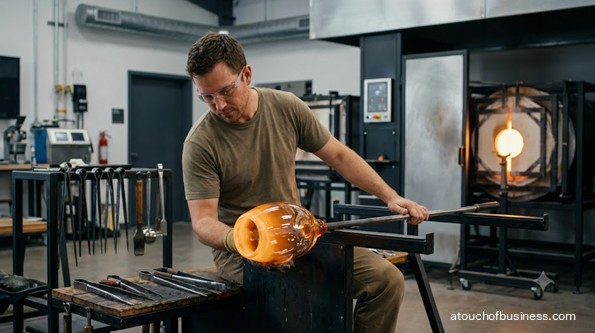
What to Expect From This Guide to Starting a Glassblowing Business
This guide walks you through the key decisions and practical steps involved in starting a glassblowing business, from testing your fit and local demand to planning the studio, finances, equipment, compliance, and opening checks. The highlights below represent only part of the information included.
Inside the guide, you will find:
- Startup steps: Follow an ordered path from business fit and revenue choices through funding, studio setup, pricing, staffing, and opening checks.
- Industry interviews: Compare experiences from glassblowers, studio owners, instructors, and managers covering training, costs, operations, and physical demands.
- Startup FAQs: Find practical answers about training, permits, space, revenue models, operating costs, and required safety documentation.
- Business fit: Weigh craft skills, physical demands, household finances, startup timing, local demand, and whether renting studio time makes sense.
- Financial planning: Examine fixed overhead, energy costs, break-even questions, funding needs, pricing, operating capital, and slow-period risks.
- Studio requirements: Review location suitability, zoning, permits, ventilation, furnaces, tools, materials, suppliers, insurance, and location-dependent rules.
- Opening preparation: Use detailed checks and red flags to test equipment, safety systems, staff training, bookings, payments, supplies, and customer flow.
Begin by considering what daily ownership of a high-heat, public-facing glassblowing studio would require from you.
How to Start a Glassblowing Business
As a glassblowing studio owner, you gather molten glass from a furnace burning at roughly 2,000°F, shape it at a workbench using pipes and hand tools, and transform raw material into finished art.
You might run a hot shop where you produce and sell hand-blown vessels, sculpture, and custom commissions. You might teach introductory sessions to tourists, couples, and families. You might book corporate team-building events on weekday afternoons and fill Saturday mornings with beginner classes.
Most commercially successful studios do a version of all three. Classes and private events cover the high fixed overhead, and art sales build the reputation that draws both buyers and students.
Before you go any further with the startup process, take an honest look at what this business actually asks of you.
Working a hot shop is physically demanding. You stand near an open heat source for hours at a stretch, handle heavy steel pipes, manage fragile molten material, and make split-second shaping decisions that can’t be undone once the glass cools.
This is not a business you can fake your way into. The craft takes years to develop. If your skills aren’t at a commercial level yet, your first real startup decision is whether to build them before opening — or whether to partner with someone who already has them.
Beyond the craft itself, think clearly about the business side. Do you have the capital to fund a high-overhead studio through the early months before bookings fill up?
Can your household manage financial uncertainty while you build a reputation and customer base? Do you have the tolerance for operational complexity — permitting, safety compliance, scheduling, and equipment maintenance — on top of the actual glasswork?
Business ownership is harder than it looks from the outside. This one is harder than most.
Talk to people who are already running glassblowing studios in markets where you won’t compete with them. Ask specifically about utility costs, how long it took to reach break-even, what they underestimated in the build-out, and how they handle weeks when bookings are thin.
Firsthand insight from experienced operators is worth more than any research you can do on your own — just keep in mind that each owner’s path was different.
Red Flags Before You Start
Some of these signals mean pause and verify. Others mean stop, change the model, or reconsider entirely.
Your glassblowing skills aren’t at a commercial level yet. You need advanced technique before you open — for safety, for quality, and for the credibility to charge for it. If there’s a real skills gap, close it before you spend money on a space.
You’ve underestimated what the build-out actually costs. Equipment is one line item. Ventilation installation, gas line work, electrical upgrades, fire suppression, permitting, and lease deposits can collectively exceed it. Get written quotes on all of these before you commit to a lease.
The energy math doesn’t work in your market. Gas-fired furnaces running at 2,000°F consume substantial fuel continuously while the shop is open. Utility costs are one of the highest recurring overhead items in this business and exist whether or not the studio is fully booked. If local gas or electricity rates are high, or if the building can’t receive adequate service, verify this before signing anything.
The space you’re considering isn’t actually suitable. Not every commercial space can become a hot shop. You need correct zoning, ceiling height, floor load capacity, gas service, fire marshal compliance, and the ability to install an exhaust and ventilation system. Discover this before the lease starts — not after.
Local demand is unclear or unvalidated. Glassblowing studios need a market with discretionary spending and enough foot traffic to fill sessions. A strong tourist corridor, arts district, or college town is very different from a rural or low-traffic suburban location. Don’t assume demand — confirm it.
You’re planning to open before safety infrastructure is complete. This is a hard stop. The studio doesn’t open to the public until all permits, inspections, ventilation, fire suppression, eye protection, and emergency shutoff systems are fully in place and tested.
There are also structural realities that apply to this business regardless of how well you execute. It’s capital-intensive — equipment and infrastructure costs are high relative to many other creative businesses.
It’s energy-dependent — your profitability is tied to gas and electricity prices you can’t fully control. And the retail art segment competes structurally with mass-produced glass, so your hand-blown work needs a clear identity and price position to earn its premium.
Step 1: Decide Whether This Business Fits You Right Now
The most important question isn’t whether you want to own a glassblowing studio. It’s whether you’re ready to — and whether right now is the right time.
If your glassblowing skills need serious development, opening a studio now means building the craft under financial pressure. That pressure rarely makes the work better.
This business may not be the right fit if:
- You haven’t reached a level of technique where you can produce consistently quality work and teach safely
- You’re not comfortable working in sustained heat and physical intensity for hours at a time
- Your household can’t absorb a period of low or no income while the studio ramps up
- You don’t have access to the significant capital this startup requires
- You want creative control without the operational complexity of permits, safety compliance, and equipment management
If you’re on the edge, consider working in or renting time at an existing studio first. You’ll develop your craft, validate demand, and test your pricing before you commit to your own space and equipment.
Passion for the work matters more than people admit. When the permitting delays stack up, the energy bill is higher than expected, and a class session goes sideways, passion is what keeps you problem-solving instead of looking for the exit.
Step 2: Learn the Business from People Who Are Running It
Before you commit money or sign a lease, talk to glassblowing studio owners in markets where you won’t compete with them.
The goal isn’t to copy what they’ve done. It’s to get a clear picture of what actually happens when you run one of these studios — the costs, the surprises, and the things that took longer than expected.
Ask studio owners and operators about:
- What their utility costs actually look like month to month
- How long it took to reach break-even after opening
- What they underestimated in the build-out or permitting process
- How they structured their revenue mix and what they’d change
- How they handle slow periods and off-season booking gaps
Organizations connected to the glass art community — such as the Glass Art Society and UrbanGlass — maintain member directories that can help you identify appropriate contacts.
Prepare your questions before these conversations. Every owner’s path was different, but firsthand perspective is something no article or business plan template can replicate.
You can also get a broader view of what business ownership asks of you at an Inside look at the business you want to start.
Step 3: Choose Your Revenue Model Before Anything Else
The model you choose determines your space requirements, equipment needs, staffing, pricing structure, and the customer experience you’re designing for. Make this decision before you look at a single lease or price a single piece of equipment.
The three main revenue streams for a workshop-based glassblowing studio are:
- Art production and retail sales: You produce finished pieces — vases, vessels, sculpture, ornaments, paperweights, custom commissions — and sell them through your studio retail display, galleries, craft fairs, or consignment arrangements. Revenue depends on what you produce and what the market will pay for it.
- Classes and workshops: You teach introductory sessions, multi-week courses, private group events, and corporate team-building experiences. Revenue is session-based, and this stream tends to be more predictable and recurring than retail art sales.
- Studio rental: Trained glassblowers rent furnace time and bench access. This generates income from your equipment without requiring you to teach or produce constantly.
Most studios that survive the early years run a mixed model — art production combined with classes and private events.
Classes and private group bookings generate the steady, recurring income that helps cover high fixed costs. Art sales build the creative identity that draws both buyers and students over time.
The trade-off: a class-heavy model requires more customer-facing infrastructure, stricter safety protocols, liability waivers, and scheduling systems. A pure production model requires less of that but depends entirely on your ability to produce and sell work consistently.
Your service mix also shapes your studio layout. A teaching studio needs a clear customer entry zone, a separate viewing area, and physical barriers between visitors and the hot zone. A production-only studio can be organized purely around workflow efficiency.
Step 4: Validate Local Demand Before Locking In a Location
Choosing your location and choosing your market are the same decision. Make sure you have real evidence of demand before you commit.
Glassblowing studios perform best in markets with discretionary spending and consistent foot traffic — tourist corridors, arts districts, college towns, and mid-to-large urban areas. A location without that foundation makes every revenue stream harder.
Before you settle on a market, investigate:
- Whether other glassblowing studios or hot shop experience venues already exist nearby, and what they offer
- What tourism, event, and arts infrastructure exists in the area
- Whether local galleries, visitor centers, event planners, and corporate contacts would realistically refer clients to your studio
- How seasonal the demand would be, and what the slow months actually look like
Your most likely first customers are tourists and visitors wanting a hands-on experience, local art buyers and collectors, couples and families looking for something memorable, corporate groups seeking a team-building event, and craft students who want real instruction.
These groups have different reasons to choose your studio. Tourists want novelty and a takeaway piece. Corporate clients want something unusual and professionally run. Serious students want to learn from a skilled gaffer. Your positioning should be clear enough to reach each of them.
The supply and demand check is a startup go/no-go decision — do it before you spend on anything else.
Step 5: Decide Whether to Start from Scratch or Buy an Existing Studio
Starting fresh gives you full control over the build, the layout, the equipment, and the positioning — but it also means building everything from the ground up, including the customer base.
Buying an existing studio can get you to opening day faster. You may inherit installed equipment, existing permits, an established booking base, and supplier relationships.
The trade-off is that you inherit the studio’s reputation, lease terms, and any deferred maintenance or compliance issues. If a studio is available for sale in your target market, investigate it seriously before dismissing it.
Verify why it’s for sale, inspect the equipment condition, and review the permit and inspection history.
A franchise model isn’t an established path in art glassblowing. Focus your research on the start-from-scratch versus acquisition decision.
If you’re weighing those two options, this overview of starting versus buying a business can help you think through the trade-offs.
Step 6: Understand the Break-Even Reality Before You Spend
A glassblowing studio carries high fixed overhead from the day the furnace is installed — whether or not a single student books a session.
Your primary fixed costs are rent for a commercial or industrial space, gas and electricity to run high-temperature furnaces and the annealer, equipment loan payments, and insurance.
To know if the model works, you need to understand your break-even point.
Work through these questions before you commit to a lease or equipment:
- What will your total fixed monthly costs be — rent, utilities, insurance, any equipment financing?
- What does each class session or private event cost you in materials and energy?
- How many sessions per month, at what price per session or per seat, does it take to cover all costs and pay you?
- Can your location realistically support that booking volume?
- What happens during slow months or off-season periods?
Energy cost is a defining variable. Gas-fired furnaces running continuously consume significant fuel, and the utility cost varies by your equipment, your operating hours, and local utility rates. Get local quotes — not estimates from another market.
High-margin private group bookings and corporate events are typically what tip the model from break-even to profitable. A studio that depends entirely on low-ticket introductory sessions needs very high occupancy to cover its overhead.
You also need to account for production breakage and rework. A normal rate of loss is built into the craft, and every cost estimate and pricing decision should reflect that reality.
Think through how to estimate profitability and revenue before you make any major financial commitment using the revenue and profitability estimator.
Business Plan
Write your business plan before you sign a lease, order equipment, or talk to a lender.
It should document your model choices, your target customers, your revenue streams, your pricing approach, and your path to break-even.
Your business plan should answer:
- What is your primary revenue model — art production, classes, events, studio rental, or a mix?
- Who are your most likely first customers, and how will you reach them at launch?
- What are your estimated startup cost categories — equipment, build-out, ventilation, permitting, materials, insurance, operating capital?
- How much will your fixed monthly costs be once the studio is open?
- What pricing approach covers your costs and pays you?
- How much capital do you need before the first session is booked?
- How many months of operating costs must you fund before revenue covers them?
The energy and overhead analysis belongs in this plan. High fixed costs mean the studio needs consistent revenue to stay solvent.
Your plan should map out what happens in slow months and how long your operating capital can sustain you.
Breakage and rework affect your art production economics. Build that into your pricing and your plan before you start producing inventory.
The plan is also what lenders and investors will want to see. A studio with significant build-out and equipment costs typically requires formal financing — and no lender will move forward without a credible plan behind the ask.
The business plan guide walks through the full structure if you need a starting framework.
Step 7: Secure Funding Before You Commit to Space or Equipment
This business requires real capital before it generates any revenue. Resolve your funding situation before you make commitments that require money you don’t yet have.
The major startup cost categories to fund include:
- Melting furnace and glory hole (reheating furnace)
- Annealer
- Ventilation system installation
- Gas line installation or upgrade
- Electrical service upgrades
- Build-out for the customer area and cold shop
- Hand tools and safety equipment
- Initial glass batch, colorants, and consumable materials
- Lease deposits and pre-opening rent
- Permitting and inspection fees
- Insurance premiums
- Legal and registration costs
- Operating capital — the reserve that covers fixed costs until revenue is sufficient
Operating capital is the item most commonly underestimated. The furnace doesn’t wait for your first booking to start consuming fuel.
Common funding paths for this type of startup include:
- Personal savings and capital
- Small Business Administration (SBA) loans
- Equipment financing from lenders familiar with studio or industrial equipment
- Business partner or investor capital
If you’ll need a loan, the business loan overview explains what lenders typically want to see.
Step 8: Choose and Vet Your Physical Space
Your space is not just a location. It’s an infrastructure decision that shapes your permits, your build-out costs, your equipment placement, and how safely you can operate.
Not every commercial space can become a glassblowing hot shop. The requirements are specific, and discovering a problem after you’ve signed the lease is expensive.
Before you commit to any space, verify:
- Zoning classification allows high-heat studio operations, retail sales, and public instruction — commercial or light-industrial zones are most common
- Ceiling height in the hot zone is adequate — at minimum around 10 to 12 feet of clear height, with more clearance making pipe movement and ventilation easier
- The floor can bear the weight of the furnace, annealer, and cold shop equipment
- Natural gas or propane can be supplied at the volume and pressure your equipment requires
- Electrical service can support the annealer and other equipment loads, or can be upgraded
- The building can physically accommodate a ventilation and exhaust system
- The fire marshal will approve this type of use at this address
Industrial and light-industrial spaces — former warehouses, converted production buildings — are common choices for hot shops precisely because they tend to have high ceilings, heavy floors, and the utility infrastructure to support high-BTU equipment.
Think about customer access and logistics as well. If you’re running classes and events, participants need to enter safely, move through the studio without crossing the hot zone unsupervised, and exit easily.
Receiving access for heavy equipment deliveries and bulk glass batch shipments matters too.
Verify zoning in writing before you sign. A verbal assurance from a landlord is not enough.
Step 9: Handle Legal Setup and Registration
Getting your legal structure right early protects you personally and makes every subsequent step — banking, insurance, hiring, taxes — cleaner.
Choosing your business structure is the first call to make:
A limited liability company (LLC) separates your personal assets from business liabilities — a meaningful protection in a high-risk, public-facing environment. A sole proprietorship is simpler to set up but provides no liability separation.
Given the elevated risk profile of a studio working with high heat and hosting the public, most owners choose an LLC. Consult a business attorney or accountant before deciding.
Once you’ve chosen your structure, register the business entity with your state’s Secretary of State office.
Apply for an Employer Identification Number (EIN) from the IRS — it’s free, takes minutes online at irs.gov, and is required for hiring employees and opening a business bank account. Even as a sole proprietor with no employees, an EIN protects your Social Security number in business dealings.
If you’ll operate under a trade name that differs from your registered entity name, file a DBA with the appropriate local office.
Register for a sales tax permit with your state revenue agency before you make any taxable sale. Tangible hand-blown glass art is generally taxable as personal property in most states.
The taxability of class fees and instructional services varies — check your state’s rules specifically. Search “sales tax permit” at your state revenue department’s website.
If you’ll have employees, register for state income tax withholding and unemployment insurance accounts with the appropriate state agencies before the first paycheck.
For an overview of the full range of licenses and permits that may apply to your studio, that resource covers the landscape clearly.
Step 10: Pull Every Permit Before Installing Anything
Permitting for a high-heat studio involves multiple agencies. The order matters, and the timeline is often longer than new owners expect.
Start the permit process before you sign the lease whenever possible. A lease that’s running while you’re waiting for approvals is burning money.
The permit categories to verify locally include:
- Zoning verification: Written confirmation that your address allows high-heat studio operations, retail, and public instruction
- Building permit: Required for build-out, renovation, or change of use — contact the local building department
- Mechanical, electrical, and plumbing permits: Required for furnace installation, gas line work, ventilation system installation, and electrical panel upgrades
- Fire department permit or fire marshal inspection: Required before operating gas-fired equipment commercially — covers propane or natural gas system placement, emergency shutoff valve location, fire extinguisher requirements, and fire suppression compliance
- Certificate of occupancy: Required before you open to the public — if the space is changing use, you’ll likely need an amended or new certificate
- General business license: Required in most cities and counties — available through the local business licensing portal
The fire department conversation is especially important. Bring them in early. High-heat operations with gas-fired furnaces and the public on-site trigger specific requirements that vary by jurisdiction — and finding out late can delay your opening significantly.
Search “building permit,” “fire marshal commercial permit,” and “certificate of occupancy” at your city or county’s official website to find the right offices and application processes.
Step 11: Build Out and Equip the Studio
The build-out is where your floor plan becomes a functioning hot shop. Do it in the right order: permits first, then contractors, then equipment installation, then inspections.
Work with licensed contractors who have experience with high-heat or light-industrial builds. Gas line installation, electrical panel upgrades, and ventilation system work all require licensed professionals and permit inspections in most jurisdictions.
Design your studio layout before construction begins:
- Hot zone: Furnace, glory hole, glassblower’s bench, yoke, pipe warmer — organized for safe pipe movement and clear sightlines between the gaffer and any helpers or instructors
- Annealer zone: Placed for easy transfer of finished pieces from the bench without crossing customer areas
- Cold shop: Cutting, grinding, and finishing equipment separated from the hot zone — different hazards require different controls
- Customer area: Reception, retail display, and student staging clearly separated from the hot zone by physical barriers — storage cabinets and furniture can serve double duty as safe zone dividers
- Materials storage: Organized racks for blowpipes, pontil rods, and glass tube inventory; separate locked storage for any acid-based cold work materials
Ventilation is non-negotiable, and it’s one of the most variable build-out cost items. An exhaust canopy over the glassblower’s bench removes heat and combustion byproducts from the hot zone.
The cold shop requires separate local exhaust ventilation if employees are cutting, grinding, or sandblasting glass — silica dust control is an OSHA obligation when employees are present. Consult a ventilation professional with industrial experience before finalizing your build plan.
The hot shop equipment you’ll need at minimum:
- Melting furnace (gas-powered, capable of approximately 2,000°F)
- Glory hole (separate reheating furnace for maintaining working temperature during formation)
- Annealer (controlled-cooling oven — every finished piece goes here before it leaves the hot zone)
- Glassblower’s bench with pipe-support arms
- Yoke (supports the blowpipe as glass enters the glory hole)
- Pipe warmer or color box
- Marver (flat steel or graphite surface for rolling and shaping gathers)
- Hand tools: blowpipes, pontil rods, jacks, blocks, paddles, tweezers, shears, soffietta
- Pyrometer (temperature verification for furnaces and annealer)
Schedule all required inspections before you melt any glass. Equipment that hasn’t passed inspection isn’t equipment you should be using.
Step 12: Source Raw Materials and Establish Supplier Relationships
Your material supply chain needs to be established before opening — not pieced together after a class is booked and you realize you’re short on colorant.
The primary materials for a hot shop are glass batch (soda-lime silica glass, the most common type for furnace-based work) and colorants — frit (crushed colored glass), color rods, and concentrated colorants.
Specialty suppliers serving art glass studios include Spruce Pine Batch Co. for batch materials, and a range of colorant and tool suppliers listed in directories maintained by Glass Art Magazine and UrbanGlass.
Set up accounts with more than one supplier for critical materials. Single-source dependency for glass batch or colorants creates supply risk — a shipping delay or an out-of-stock can cancel a session.
Plan for lead times. Glass batch materials and heavy equipment components aren’t available for same-day local pickup in most markets. Factor supplier lead times into your pre-opening timeline.
Step 13: Set Your Pricing Before You Announce Anything
Pricing for a glassblowing studio is a cost-based calculation, not a guess based on what looks competitive. Know what each session and each piece actually costs you before you post a price publicly.
For class and event pricing, work out:
- Materials consumed per session (glass batch, colorants, fuel)
- Energy cost per operating hour based on your furnace’s consumption and local utility rates
- Your time or instructor time per session
- Your studio’s share of fixed overhead allocated per session hour
Private group events and corporate bookings should carry a premium over per-seat intro sessions. They require more coordination, more exclusive equipment access, and more instructor attention — and clients expect to pay for that.
For finished art pricing, calculate:
- Material cost per piece
- Energy cost per production hour
- A realistic breakage and rework allowance — this is part of the real cost of every piece
- Finishing time in the cold shop
- Your target hourly rate that covers overhead and pays you
Once you understand your cost floor, research what comparable studios in similar markets charge for intro sessions, private groups, multi-session courses, and custom commissions.
The pricing guide walks through this framework in detail.
Step 14: Set Up Business Banking and Payments
Keep business finances completely separate from personal finances from the first transaction.
Open a dedicated business checking account before you accept any payment. Most banks require your EIN and business registration documents to open a business account.
Set up a merchant account or payment processor that can handle in-studio credit and debit transactions, online class bookings, and deposits for private events.
Deposits and cancellation policies matter significantly for private group bookings. A corporate event that cancels at the last minute represents a real loss in a studio with high fixed overhead. Your booking system should enforce your policies automatically.
Set up an accounting system before the first invoice goes out. Tracking costs accurately from the beginning is the only way to know whether the business is covering its expenses.
Step 15: Get Your Insurance in Place
A glassblowing studio carries elevated risk on multiple fronts — open heat sources, molten glass, public participation, and fragile, high-value finished pieces. Business insurance is not optional here.
The coverage categories to address before opening include:
- General liability insurance: Covers third-party injury and property damage claims — a visitor hurt in the studio, a student burned during a class. This is typically required by commercial landlords and should be in place before anyone enters the space.
- Product liability insurance: Covers claims arising from finished glass pieces you’ve sold — important for retail art and custom commissions.
- Commercial property insurance: Covers your equipment, inventory, and studio contents against fire, theft, and other covered losses.
- Workers’ compensation insurance: Required by most states once you have at least one employee. Verify the threshold and requirement with your state’s workers’ compensation regulatory agency.
Studios with open flames and high-heat operations are considered higher risk by insurers. Premiums will reflect that — get quotes from multiple insurers and disclose the full nature of your operations when you apply.
Your commercial landlord may specify minimum coverage levels in the lease. Review that before you shop for policies.
Step 16: Hire and Train Staff If the Model Requires It
If your studio will offer classes, you need to teach them yourself or bring in trained glass artists who can instruct safely and competently.
Safety training isn’t a background item you cover at orientation. Every instructor who works in your hot shop needs to demonstrate correct technique, enforce all safety protocols, identify hazards in real time, and respond appropriately when something goes wrong.
Document your safety duties, studio protocols, and emergency procedures in writing before the first instructor works a session. If standards aren’t written down, they aren’t consistently enforced.
If you’re bringing on employees, this hiring guide covers when and how to bring people on correctly. Have your EIN, payroll setup, and state employer accounts in place before the first paycheck goes out.
Step 17: Complete Pre-Opening Checks Before the First Booking
The studio isn’t ready to take paying customers until every item on this list is confirmed and in place.
Pre-opening confirmation checklist:
- All permits and inspections completed and approved — including building, mechanical, electrical, fire, and certificate of occupancy
- Furnace, glory hole, and annealer installed, inspected, and fully operational
- Ventilation system tested and functioning as designed
- Gas supply system permitted, inspected, and emergency shutoff valves labeled and accessible
- Fire extinguishers serviced, tagged, and positioned in the hot zone
- IR-rated eye protection stocked for the gaffer, instructors, and participants in the hot zone
- First aid kit in place with burn treatment supplies
- Studio safety rules posted visibly in hot zone and customer areas
- Emergency evacuation plan posted
- All staff fully trained on safety protocols and emergency procedures
- Glass batch, colorants, frit, and consumable supplies stocked
- Booking system, scheduling software, and payment processing active and tested
- Liability waiver forms finalized (reviewed by an attorney) and ready for signatures
- General liability and property insurance policies active
- Retail display staged with finished pieces if retail is part of opening day
- Deposit and cancellation policies published and enforced through the booking system
Run at least one test session — a soft opening or friends-and-family session — before you take paying bookings. You’ll find workflow problems, safety gaps, and customer experience issues that aren’t visible until real people move through the space.
Opening-Day Red Flags
These are the signs that something is wrong and you shouldn’t open — or that a problem needs to be fixed before you let customers into the hot zone.
Stop and resolve before opening if any of these are true:
- Any permit or inspection is still pending or unresolved
- The furnace, glory hole, or annealer hasn’t been tested to operating temperature
- The ventilation system isn’t confirmed functional
- The emergency gas shutoff valves aren’t labeled, accessible, and known to all staff
- Fire extinguishers aren’t in position, serviced, and tagged
- IR-rated eye protection isn’t available for everyone entering the hot zone
- Liability waivers aren’t ready for the first participant to sign
- Any instructor hasn’t completed safety training and protocol review
- The booking deposit policy isn’t enforced by the system — manual collection leads to no-shows and unpaid sessions
- The glass batch or colorant supply isn’t confirmed adequate for the first week of sessions
Poor studio layout is a risk that surfaces on day one. If the customer path crosses the hot zone, if tools don’t have defined storage locations, or if the workflow between the bench and the annealer is awkward, fix it before a paying student is in the room.
Tool downtime is another opening-week hazard. A blowpipe that fails, a jacks spring that snaps, or a glory hole that won’t hold temperature during a session can derail a class or a corporate event. Have backup tools staged and a plan for equipment failure before it happens during a booking.
Frequently Asked Questions
Do I need formal glassblowing training before starting a studio?
There’s no universal certification required to practice art glassblowing, but your skills need to be at a commercial level before you open. That means years of practice — through formal education in a university glass arts program, workshop study, apprenticeship, or substantial independent studio time.
If you plan to teach, you also need to demonstrate safe, confident instruction in a hot-glass environment. The skill gap is the most commonly underestimated challenge in this business.
What permits are needed to install a glassblowing furnace in a commercial space?
Permit requirements vary by city and county, but expect building permits for the installation, mechanical permits for gas line and exhaust system work, electrical permits for panel upgrades, and a fire department review or permit for the gas-fired equipment.
The specifics depend on your building, jurisdiction, and equipment type. Engage the local building department and fire marshal before you sign a lease or order anything.
Do I need my own studio space to start?
Not necessarily at first. You can rent time at an established studio to develop your craft, validate your pricing, and test demand before committing to your own space and equipment. Studio rental is a viable launch path for the production model.
For a full teaching, event, and retail studio operation, you’ll eventually need your own permitted space with all required equipment and compliance in place.
What’s the most common revenue model for a glassblowing studio?
Most studios that reach break-even combine art production and retail with a class and private event program.
Classes and events generate more predictable income to help cover high fixed overhead, while art sales build the creative identity that attracts both buyers and students. Pure art production without a class revenue stream is a viable path but a slower road to financial stability for a new studio.
What are the biggest ongoing operating costs to plan for?
The two largest are rent for commercial or industrial space and energy — gas or propane for the furnace and electricity for the annealer and studio equipment. Both exist whether the studio is fully booked or not. Insurance, raw materials, and any staffing costs follow.
Plan your operating capital to cover these for a meaningful runway before revenue is sufficient to handle them on its own.
Is a glassblowing studio a home-based business option?
Almost never, for a furnace-based hot shop. Residential properties are rarely suitable — ceiling height limitations, zoning restrictions, and fire code restrictions on gas-fired equipment in residential structures all tend to block it.
Some lampworking setups using a bench torch rather than a furnace can work from a home studio with appropriate ventilation, but the full hot-shop glassblowing model requires a commercial or industrial space.
What type of space is needed for a hot shop glassblowing studio?
You need a commercially or industrially zoned space with clear ceiling height of at least 10 to 12 feet in the hot zone, access to natural gas or propane at adequate volume, sufficient electrical service for the annealer and other equipment, and the physical capacity to install an effective exhaust and ventilation system. Light-industrial and former industrial spaces are common choices because they often already have high ceilings, heavy floors, and the utility infrastructure to support high-BTU equipment.
What safety documentation is required before opening to the public?
At minimum: all fire department and building permits completed and approved, studio safety rules posted visibly in the hot zone and customer areas, liability waivers ready for every participant to sign, fire extinguishers serviced and positioned, IR-rated eye protection available for all hot zone participants, first aid supplies including burn treatment, and documented emergency procedures.
If employees are present and cold work generates silica dust, OSHA’s respirable crystalline silica standard requires an exposure control plan and additional compliance steps. All staff must complete safety training before a single student enters the hot zone.
Interviews with Glassblowing Business Professionals
These interviews share practical experiences from glassblowers, studio owners, instructors, and managers. They discuss training, equipment costs, studio operations, product development, customer relationships, teamwork, and the physical demands of the craft.
Readers can use this advice to compare operating models, estimate the commitment involved, explore training options, and identify financial or operational challenges before starting a glassblowing business.
Chris Skibbe of The Glass Spot: 5 Things I Wish Someone Told Me When I First Became An Artist
Hot shop owner Chris Skibbe discusses building a public-access studio, renting space to professionals, managing overhead, serving customers, and keeping a furnace operating around the clock.
This interview provides a realistic view of the time commitment, operating pressure, customer retention, and adaptability required to manage a glassblowing studio.
The Art of Glassblowing with Brandon Price
Blown Studios owner Brandon Price explains how he learned the craft, selected a location, developed workshops, handled specialized equipment costs, and sought guidance from business-development organizations.
His experience helps prospective owners understand training, financing, equipment repairs, studio safety, community support, and the value of combining production with educational experiences.
An Afternoon with Sirius Glassworks
Studio manager Iris Fraser-Gudrunas discusses the history of the family business, collaborative design, production constraints, product experimentation, audience building, and word-of-mouth growth.
The interview is useful for planning team responsibilities, developing recognizable products, working within technical limits, and exploring education or residency paths into glassblowing.
Shining Light on Creativity: An Interview with Artist & Collector Joe Tsoulfas
Glass artist and studio founder Joe Tsoulfas compares flameworking with furnace-based glassblowing, including differences in equipment, space, hourly operating costs, assistants, workflow, and production scale.
Readers can use the comparison to choose a glassworking model that fits their available space, budget, staffing capacity, preferred schedule, and intended product size.
Meet Michelle Pennington | Glassblower
High Gravity Glassworks owner Michelle Pennington discusses intensive training, scholarships, borrowing for education, developing product lines, teaching, relying on assistants, and receiving financial and personal support.
Her experience shows why owners must plan for a long skill-development period, training expenses, production assistance, long hours, and sufficient support while building financial stability.
Meet Dustin Wagner | Glassblower
Nyminal Glass owner Dustin Wagner describes saving for equipment and property, building a studio without bank financing, dividing responsibilities with a business partner, and maintaining the physical stamina required for production.
The interview helps prospective owners consider funding strategies, facility ownership, partner roles, physical demands, and the importance of accepting help during a lengthy startup process.
Related Articles
- How To Start a Glass Etching Business
- How To Start a Pottery Business
- How To Start a Resin Craft Business
- How To Start a Laser Engraving Business
Sources:
- ILPI (Scientific Glassblowing Learning Center): Designing the Glassblowing Shop
- Working the Flame: Glassblowing Tools Guide
- Glassblowing for Beginners: Essential Glassblowing Tools List
- DMG School Project: Basic Tools Introduction
- Northstar Glassworks: Glassworking Safety Guidelines
- Bullseye Glass: Safety in the Kiln-Glass Studio
- ScienceInsights: Glass Blower Safety Concerns
- Artcentron: Glassblowing Safety Expert Tips
- OSHA: Silica Standard General Industry, Silica Standard Compliance Guide
- Corning Museum of Glass (Rakow Research Library): Occupational Safety Resources, The Glassmaking Institute
- Liquid Propane: Propane Permitting Overview
- Propane 101: LP-Gas Permits and Local Codes
- ACT Insurance: Glassblower Insurance Coverage
- Artsy Shark: Insurance Basics for Artists
- Insureon: Glass Business Insurance
- NerdWallet: EIN for Sole Proprietors
- Avalara: Sales Tax for Artists Guide
- TaxJar: Sales Tax Guide for Artists
- CareerExplorer: Glassblower Education and Training
- Watlow: Furnace Energy Cost Case Study
- Small Biz Trends: Glassblowing Supply Sources
- Spruce Pine Batch Co.: Glass Batch Supplier
- Glass Art Magazine: Glassblowing Equipment Directory
- UrbanGlass: Glass Suppliers Directory
- Number Analytics (Zoning): Studio Zoning Regulations
- Pottery Teachers: Studio Permits Overview
- Verified Market Reports: Glass Blowing Services Market
- TRUiC: Starting a Glass Blowing Business
- THEBOSS Magazine: Setting Up a Glassblowing Studio