
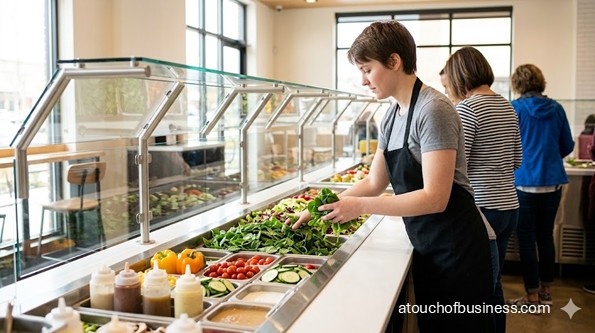
Starting a Salad Bar: Key Setup Considerations
A salad bar business serves ready-to-eat salads, bowls, toppings, dressings, and often a few side items like soup, drinks, or grab-and-go meals.
For a food service setup, your real job is not just serving food. You need a clean flow for receiving, cold storage, prep, service, payment, cleanup, and restocking during rush periods.
A salad bar can look simple from the customer side. Behind the counter, it depends on cold holding, safe prep, fast service, and steady supplier timing.
If those parts are weak, the business gets hard very quickly.
Is A Salad Bar The Right Fit For You?
Before you go further, ask a basic question. Do you actually like the day-to-day tasks behind a salad bar?
You will deal with produce deliveries, washing, chopping, labeling, refrigeration, line setup, cleaning, staff scheduling, and customer rushes. That is the business.
You also need to be honest about pressure. Food service can be physically demanding, time-sensitive, and unforgiving when systems are loose.
If you do not enjoy food prep, cleanliness standards, and quick customer service, this may not be the right fit.
Your motivation matters too. Starting a business only to escape a bad job, solve money problems fast, or chase the idea of ownership is risky.
You need a real interest in the business itself. Being passionate about running the business helps you get through the long days that come before opening.
Interested in Starting a Business? Find One That Fits You
Answer 5 quick questions to discover business ideas that match your interests, budget, and preferred way of working. Explore matches from our library of 677 free startup guides. No email or sign-up required.
Find a Business That Fits MeGive yourself a reality check. A salad bar can sound lighter than a full restaurant, but it still brings food safety pressure, labor demands, spoilage risk, and local approvals. That is why it helps to review the essential factors to consider before you commit to opening.
Talk to owners who run similar businesses, but only in another city, region, or market area where you will not compete with them.
Prepare your questions ahead of time. Ask about prep flow, waste, staffing, permits, supplier problems, and what they wish they had known before opening. That kind of firsthand owner insight is hard to replace.
Then look at local demand. Is there enough lunch traffic, office traffic, student traffic, or health-focused demand in your area to support a salad bar?
If demand is weak, the idea may not fit that location, even if the concept sounds good.
You should also compare your entry path. Starting from scratch gives you more control, but it also gives you more setup risk.
In some cases, buying a business already in operation may save time if the site, equipment, and permits are already in place. For a salad bar, franchising may exist in some markets, but it is not the default path for most first-time owners.
Understand How A Salad Bar Really Works
Before you sign anything, understand the real flow of the business.
Food comes in, gets checked, stored cold, washed, cut, portioned, labeled, loaded into pans, placed on the line, monitored during service, replaced as needed, and discarded when it no longer meets safety standards.
This matters because every startup choice should support that flow. Your layout, equipment, labor plan, supplier timing, and service style all need to make that process easier.
If the flow feels awkward on paper, it will feel worse when you open.
Choose Your Salad Bar Model
Not every salad bar runs the same way. Your first big decision is how customers will be served.
A self-serve setup, a staff-served line, and a hybrid model each change the layout, labor needs, speed, contamination risk, and local health review.
- Self-serve: Customers serve themselves from protected display units.
- Staff-served: Employees build bowls or plates for each guest.
- Hybrid: Some items are staff-served while others are customer-accessible.
A self-serve line may seem easier to run, but it needs close attention to food protection, utensil control, and line monitoring.
A staff-served line often gives you better portion control and may reduce some contamination risk.
AI isn't optional anymore. Start with one small step.
Define Your Offer Before You Pick A Location
Your offer needs to match what you can safely prepare and serve.
A salad bar may include greens, chopped vegetables, grains, proteins, toppings, dressings, soups, drinks, and grab-and-go items.
Keep your opening offer focused. Too many ingredients create more prep time, more waste, more storage pressure, and more room for mistakes.
Early on, a simple offer is often stronger than a crowded line.
Think in practical terms. How many pans do you need on the line? How many ingredients will need daily prep? Which items spoil fastest?
That is the kind of detail that shapes your startup costs and your daily routine.
Test Local Demand And Competitive Reality
A salad bar depends heavily on location and customer habits. You need to know whether your area can support the concept before you move ahead.
Taste matters, but traffic matters just as much.
Look at nearby offices, schools, gyms, medical areas, shopping districts, and lunch patterns. Watch where people already buy quick meals.
This is where local supply and demand is the deciding factor, not a side issue.
- How many direct competitors are nearby?
- Are they self-serve, fast casual, premium, or budget-focused?
- Is there enough lunch and early evening traffic?
- Does your area support repeat visits for fresh food?
If the area is already crowded with strong salad and bowl concepts, you need a clear reason for customers to try you.
If the area has weak demand for this kind of food, opening there may not make sense at all.
Write A Business Plan For The Salad Bar
You do not need a fancy document. You do need a useful one.
Your business plan should show how the salad bar will make money, what it will cost to open, what the service model looks like, and how you will get customers in the first stage.
At a minimum, your plan should cover your concept, target customers, service style, menu scope, startup costs, location needs, staffing, pricing, sales expectations, and launch timeline.
If you need structure, this guide on building a business plan can help you shape it.
Choose A Location That Fits Food Service
A salad bar needs more than a nice storefront. It needs a space that can support food prep, cold storage, service flow, handwashing, warewashing, and inspections.
This is one of the biggest early decisions you will make.
A second-generation restaurant space can reduce time and cost if key systems are already in place.
A raw retail space may look attractive, but it can become expensive once you add sinks, plumbing, refrigeration, and required approvals.
Before signing a lease, confirm zoning, food-service use, utility capacity, and whether a certificate of occupancy will be needed before opening.
Do not assume a nice space is a usable food-service space.
Set Up The Business Legally
You need a legal structure before you handle registration, taxes, banking, and contracts.
For many small food businesses, owners compare a sole proprietorship, limited liability company, partnership, or corporation.
Your choice affects taxes, liability, and paperwork. If you need a starting point, review how to decide on a business structure.
If you will trade under a business name that differs from your legal name or entity name, you may also need a Doing Business As filing.
Once the structure is chosen, handle registration, your tax ID, and any name filing needed in your state or county.
Keep the process clean from the start so your lease, bank account, permits, and supplier accounts all match.
Handle Food Permits And Local Approvals Early
This is where many first-time owners lose time. Food service approvals often start long before opening day.
A new salad bar may need health department review, building permits, fire review, sign permits, and location-specific approvals depending on the site and build-out.
You may also need plan review before construction or remodeling begins. If you wait too long, your build-out timeline can slide.
Keep this part crisp and practical. Find out what applies, in what order, and who signs off before you open.
What To Ask
- Does this address allow a salad bar or restaurant use under zoning?
- Will this site need plan review before construction or equipment installation?
- What approvals must be finished before opening to the public?
- Are there local food manager or food handler requirements for this type of operation?
- Will the layout require extra hand sinks, warewashing changes, or protected display standards?
Keep your notes organized by agency. For a salad bar, the key contacts are usually planning or zoning, building, fire, and the local health department.
This is also the point where a short review of permit and license requirements can help you avoid gaps.
Design The Food Flow Before You Buy Equipment
A salad bar rises or falls on food flow. You need a layout that supports receiving, washing, cutting, portioning, chilling, line setup, service, cleanup, and restocking.
If staff keep crossing paths or reaching too far for basic items, service slows down and errors grow.
Think about the path of the food. Where will produce arrive? Where will it be washed? Where will it be cut and stored? How will backup pans move to the line during rush periods?
That setup affects labor, consistency, and speed every day.
For a salad bar, cold holding matters as much as speed. Your layout should make it easy to keep ingredients cold, protected, and easy to replace without creating clutter.
That is not just a convenience issue. It is part of safe opening.
Buy The Right Equipment For A Salad Bar
Your equipment should match your service style and expected volume.
For most salad bars, refrigeration and prep equipment matter more than cooking equipment.
- Refrigerated cold wells or approved display units
- Food shields or sneeze guards
- Reach-in refrigerators
- Prep tables and worktables
- Produce prep sink and required warewashing setup
- Ingredient pans, backup pans, and lids
- Cutting boards, knives, peelers, and mixing tools
- Probe thermometers and temperature logs
- POS system and card reader
- Shelving, storage bins, labels, and cleaning supplies
If you plan to offer soups or hot items, that adds another layer of equipment and service steps.
For a salad-first concept, try to avoid buying equipment that does not support your opening model.
Build Supplier Relationships Before Opening
A salad bar depends on fresh ingredients and reliable timing. Your produce, proteins, dairy, dry goods, packaging, and cleaning supplies all need dependable sources.
Late deliveries or poor quality can hurt you fast.
You do not need only one supplier for everything. In fact, it can help to know your backup options before launch.
That gives you more control when product quality changes or a delivery falls through.
Your receiving process matters too. Decide how you will check product quality, temperature, quantity, and invoice accuracy when shipments arrive.
That small routine protects your food quality and your margins.
Plan Startup Costs The Right Way
There is no useful universal number for what a salad bar costs to open. The real answer depends on your location, layout, equipment, build-out, local approvals, staffing, and opening inventory.
That is why generic guesses do not help much.
Start by defining your exact setup. Then list what you need and get real quotes.
That is the only practical way to build a cost picture you can trust.
- Lease deposit and rent-related costs
- Build-out and contractor work
- Permits, plan review, and inspections
- Refrigeration and display equipment
- Sinks, plumbing, and electrical changes
- POS and payment hardware
- Opening inventory
- Packaging and smallwares
- Insurance
- Payroll before the business settles in
- Working capital for the first stage
Be careful here. A salad bar can look inexpensive at first because there may be less cooking equipment than a full restaurant.
But refrigeration, prep space, and food-safe build-out can still be expensive.
Once you have quotes, you can start estimating profit more realistically before you launch.
That is far better than building a plan around rough averages.
Decide How You Will Fund The Business
After you know the likely startup costs, decide how you will pay for them.
Some owners use savings. Others combine personal funds with outside financing.
Your funding options may include savings, family money, partners, or a loan.
If borrowing is part of the plan, look at what lenders will want to see before you apply. This overview of getting a business loan can help you prepare.
Do not forget working capital. Opening costs are only part of the picture.
You also need cash for payroll, food purchases, supplies, and slow early weeks.
Set Up Banking, Payments, Bookkeeping, And Taxes
Before opening, put your financial setup in place. You need a business bank account, payment processing, a bookkeeping method, and a clear way to track sales, expenses, taxes, and supplier payments.
Keep it simple, but keep it clean.
Keep personal and business transactions separate from the start.
That makes taxes, bookkeeping, and daily decision-making much easier.
You will also need a point-of-sale setup that can handle menu items, add-ons, refunds, and daily reporting.
If you are comparing options, think about card fees, reporting, ease of use, and whether online ordering matters for your launch.
It helps to think through getting your business banking in place and the basics of card payment processing before you buy a system.
Price The Menu With Portions And Waste In Mind
Pricing a salad bar is not just about what nearby businesses charge. Your prices need to cover ingredients, labor, packaging, rent, spoilage, and the service style you chose.
Portion control matters a lot here.
A self-serve format may need different pricing than a staff-served bowl line. Premium proteins, specialty toppings, and packaged drinks also change the pricing picture.
If your portions are inconsistent, your numbers will drift fast.
Work from real portions, real ingredient costs, and real waste expectations. Then test whether the final price still fits your local market.
This article on setting your prices can help you think through that process.
Set Up Systems, Forms, And Internal Documents
A salad bar needs simple systems before opening. Do not wait until your first busy lunch rush to create them.
Your startup paperwork does not need to be fancy. It does need to be usable.
- Opening and closing checklists
- Temperature log sheets
- Cleaning schedules
- Supplier contact list
- Receiving checklist
- Prep list by station
- Waste tracking sheet
- Employee training checklist
- Cash handling rules
- Allergen and ingredient reference sheets
These documents help you stay consistent when you are tired, short-staffed, or training someone new.
For food service, that kind of structure is part of launch readiness, not extra paperwork.
Create A Clean Customer Experience
Customers judge a salad bar quickly. They notice freshness, speed, cleanliness, and whether the line feels organized.
That means your customer-facing setup matters from day one.
Think about your business name, website domain, menu board, basic signs, and how the line looks when someone walks in.
You do not need a big branding campaign to open, but you do need a business identity that feels clear and consistent.
For a storefront salad bar, your signs should be easy to read and your ordering process should be obvious.
If you need ideas for the basics, a quick review of signs for your business and simple brand identity materials can help.
Hire And Train For Rush Periods
If you are not opening solo, think carefully about who you need first. A salad bar does not just need friendly staff.
You need people who can follow sanitation routines, keep pace during lunch rushes, and restock without losing control of the line.
Your early team may include prep help, line service staff, a cashier, and a shift lead depending on your size.
Training should cover food safety, cold holding, line setup, cleaning, customer service, and what to do when product runs low during service.
Do not hire more people than your volume supports, but do not under-hire so badly that service breaks down on busy days.
That balance takes thought. This guide on deciding when to hire can help you think through the first stage.
Know What Daily Ownership Looks Like
Before opening a salad bar, picture an ordinary day.
You may start with deliveries, temperature checks, prep lists, line setup, staffing issues, supplier calls, and small problems that need quick decisions.
Later, you may shift into customer flow, payment issues, restocking, cleanup, and planning for the next day.
That mix of physical tasks, food safety attention, and constant adjustment is normal in food service.
If that sounds draining rather than interesting, take that seriously now.
The tough side of ownership shows up fast in a food business.
Plan How You Will Get The Right Customers
Your first-stage marketing should stay practical. A salad bar usually needs nearby customers who can become repeat buyers.
You are not trying to reach everyone.
Start with the people most likely to buy from your location. That may include office workers, students, gym members, local residents, or nearby shoppers.
Your early marketing can include storefront visibility, local listings, simple social posts, opening offers, and lunch-focused outreach.
If you offer online ordering or pickup, make that visible right away. Convenience matters.
A good launch is not only about getting attention. It is about getting the right customers to try you and come back.
Watch For Red Flags Before You Launch
Some warning signs should make you slow down.
Do not push ahead just because you have already spent time or money.
- The location does not clearly support food service
- The prep area feels cramped on paper
- The menu is too broad for the staff and storage you have
- You still do not know your real startup costs
- Supplier arrangements are still loose
- Key permits or approvals are unclear
- Your cold-holding plan is weak
- You have not tested service speed during a rush
These are not small issues. For a salad bar, they can affect safety, speed, waste, and customer trust from the first day.
Better to delay opening than open into avoidable problems.
Get The Salad Bar Ready For Opening
Opening readiness is more than having ingredients in the cooler.
Your salad bar should be fully set up, legally cleared, staffed, tested, and ready for a real service period.
- Business registration and tax setup completed
- Food permits and local approvals in place
- Certificate of occupancy handled if required
- Cold-holding units tested and holding safe temperatures
- Food shields and line equipment installed
- POS and card processing tested
- Supplier accounts active and opening orders scheduled
- Labels, signs, and menu boards ready
- Cleaning supplies and log sheets in place
- Staff trained on service and sanitation routines
- Soft opening or test service completed
A soft opening helps you catch weak spots while the pressure is lower.
For a salad bar, that often means spotting issues with line speed, restocking, portions, and temperature checks before the full launch.
Final Thoughts On Starting A Salad Bar
A salad bar can be a good business for the right owner in the right location.
But it works best when the concept is focused, the layout supports the food flow, and the opening plan is grounded in real numbers and local demand.
Keep your first version simple. Build the setup around safe prep, cold storage, quick service, and repeatable routines.
That gives you a better chance of opening with control instead of chaos.
FAQs
Question: Do I need a special permit to open a salad bar?
Answer: In most places, yes. A food business usually needs approval from the local health department before opening.
Some locations also require plan review, building permits, fire sign-off, or a certificate of occupancy depending on the space and the changes you make.
Question: Is a self-serve salad bar harder to open than a staff-served salad shop?
Answer: It can be. Self-serve setups often need more attention to food protection, line design, and how guests handle utensils and shared ingredients.
A staff-served model may give you tighter portion control and a simpler service line during the early stage.
Question: What kind of location works best for starting a salad bar?
Answer: Look for a space that already fits food use or can be converted without major surprises. You need room for prep, cold storage, handwashing, dishwashing, and a clean service path.
A former restaurant space is often easier than building a food setup from a plain retail unit.
Question: How much does it cost to start a salad bar?
Answer: There is no single number that fits every setup. Your cost depends on the site, build-out, refrigeration, permits, inventory, labor, and how much equipment you need.
The best way to estimate it is to define your exact setup, make a list, and get real quotes before you look for funding.
Question: What equipment do I need first for a salad bar business?
Answer: Start with the tools that support safe cold food service. That usually means refrigerated display units, prep surfaces, sinks, storage, thermometers, utensils, and a payment system.
If you add soups or hot items, your equipment list grows fast.
Question: Do I need an Employer Identification Number for a salad bar?
Answer: Many owners do, especially if they hire staff or form a business entity. It is also commonly needed for banking and tax setup.
If you are unsure, review the Internal Revenue Service rules before you register anything else.
Question: Should I open with a big toppings list or keep it small?
Answer: Keep it tighter at the start. A long ingredient list can create extra prep time, more waste, more storage pressure, and slower service.
A smaller opening selection is usually easier to control while you learn what people actually buy.
Question: How do I set prices for a salad bar?
Answer: Base your prices on real food costs, portions, labor, packaging, and spoilage. Then compare the final numbers to what your local market will accept.
If your portions change from one order to the next, your pricing will not hold up for long.
Question: What insurance should I look at before opening?
Answer: You may need coverage tied to the space, employees, and food service risks. General liability, property coverage, and workers’ compensation are common starting points.
The exact mix depends on your location, lease, headcount, and business structure.
Question: What is one common startup mistake with a salad bar?
Answer: Many new owners underestimate the prep side. Washing, cutting, portioning, labeling, chilling, and refilling the line take more time than most people expect.
Another common problem is choosing a site before confirming whether it truly works for food service.
Question: Do I need food safety training before I open?
Answer: Very often, yes. Many areas require a certified food protection manager, food handler training, or both.
Even when the rule is lighter, proper training is still one of the first things you should put in place.
Question: How do I know if my area can support a salad bar?
Answer: Study the local lunch pattern, nearby competition, and the kind of people who already buy quick fresh meals. You need enough repeat demand, not just a good idea.
If the area does not support the concept, the problem may be the location rather than the business itself.
Question: Should I start from scratch or buy an existing food business?
Answer: That depends on your budget, timeline, and risk tolerance. Buying an existing operation can save time if the site, equipment, and approvals are already in place.
Starting fresh gives you more control, but it also gives you more setup decisions and more chances for delay.
Question: What should my first-week workflow look like after opening?
Answer: Keep it simple and repeatable. Focus on receiving, cold storage, prep, service, temperature checks, cleanup, and restocking without confusion.
The first week is not the time to improvise every step.
Question: When should I hire my first employees for a salad bar?
Answer: Hire before opening, not after you get busy. You need time to train people on food handling, line setup, sanitation, and rush periods.
If you wait too long, your opening days can feel rushed and disorganized.
Question: What early systems should I have in place before launch?
Answer: Set up temperature logs, cleaning checklists, prep lists, receiving checks, cash handling rules, and a simple way to track waste. These systems help you stay steady when the pace picks up.
You also need a point-of-sale setup that staff can learn quickly.
Question: How important is cold storage in the first month?
Answer: It is critical. A salad bar relies on chilled ingredients, and poor temperature control can create food safety problems and waste at the same time.
Check your refrigeration performance early and often while volumes are still changing.
Question: What should I watch closely in my first month of cash flow?
Answer: Watch food purchases, payroll, packaging, rent, and sales volume. Early cash can disappear fast if waste is high or customer counts are lower than expected.
Keep enough working capital on hand so a slow opening period does not put you under pressure right away.
Question: How should I market a new salad bar at the beginning?
Answer: Start with nearby people who are most likely to become regulars. Focus on local visibility, easy ordering, and a clear reason to try you.
For many salad bars, the first wins come from convenience and consistency, not from complex promotion.
Question: What basic policies should I create before opening day?
Answer: Put your cleaning routine, employee illness rules, refund handling, cash handling, and ingredient labeling process in writing. Keep each policy short and easy for staff to follow.
If your service style allows guest access to food, add clear rules for utensil replacement and line checks.
Question: How do I reduce waste when I first open a salad bar?
Answer: Open with a controlled ingredient list and smaller production batches. It is easier to refill during service than to throw out too much prepared food.
Track what runs out early and what gets discarded so you can adjust fast.
Question: What should I test before the public opening?
Answer: Test your prep pace, service line speed, payment process, restocking rhythm, and refrigeration performance. A soft opening can show you where the weak spots are.
That is also the best time to catch small problems before they affect paying guests.
Learn From Salad Business Founders And Operators
You can save yourself a lot of trial and error by listening to people who have already built salad-focused food businesses. The best interviews can sharpen how you think about concept fit, menu scope, hospitality, supplier relationships, technology, and what actually matters when you are trying to get a location open and working smoothly.
Advice Line with Jonathan Neman of Sweetgreen — Audio interview. Useful if you want founder-level advice aimed at early-stage businesses and decisions around product quality, focus, and growth discipline.
He Turned One Small Store Into One of America’s Fastest-Growing Salad Chains — Audio interview with Nick Kenner of Just Salad. Helpful for lessons on brand building, sustainable operations, and moving from one shop to a much larger footprint.
From Deli Dreams to Salad Empires with Joey Cioffi — Podcast interview with the founder of The Salad House. Strong for practical guidance on hospitality, guest feedback, and how catering can support a salad concept.
Joey Cioffi of The Salad House: 5 Things You Need To Create a Successful Food Line or Specialty Food — Written interview. Useful for startup readers because it gets into vendor reliability, training, point-of-sale setup, menu sprawl, and early product decisions.
Related Articles
- How To Start Your Sandwich Shop
- Starting an Acai Bowl Cafe
- How To Start a Juice Bar
- Start a Meal Prep Business
- How To Start Your Noodle Bar and Build a Successful Business
- How To Start Your Delicatessen
- How To Start a Café
- How To Start Your Catering Business
- Starting a Food Truck Business
- How To Start a Pizza Shop
- How To Start a Bakery
Sources:
- SBA: business location guide, choose a structure, register your business, licenses and permits, open a bank account, startup cost guide, break-even basics, microloan program, 7(a) loan overview
- IRS: employer tax ID, employment taxes
- FDA: start a food business, plan review guide, Food Code 2022, cut leafy greens control, food safety materials, menu labeling rules
- USDA: salad bar handling guide
- NSF: food equipment standards
- BJ Food Equipment: salad station basics
- ACF: new hire reporting
- DOL: state labor contacts