
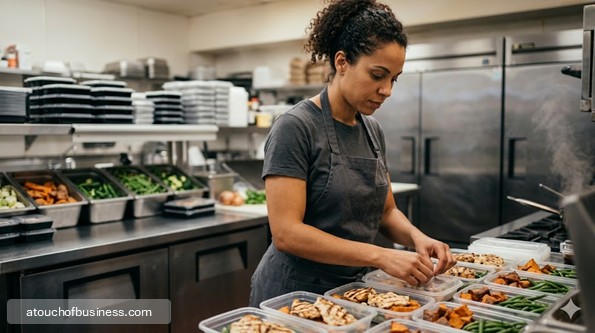
What to Expect From This Guide to Starting a Meal Prep Business
This guide walks readers through the key decisions and practical steps involved in starting a meal prep business, from selecting a food model and kitchen path to meeting local requirements, planning finances, arranging production, and testing the first prep cycle. The points below preview selected areas.
Inside the guide, you will find:
- Startup roadmap: Follow an ordered progression from business model and kitchen choice through permits, funding, suppliers, equipment, staffing, and workflow testing.
- Owner interviews: Learn from meal prep operators discussing niches, menus, pricing, customer needs, kitchen changes, delivery, consistency, and business development.
- Startup FAQs: Review answers about home kitchens, permits, food safety training, labels, meal formats, pricing, acquisition, and common failure points.
- Model and kitchen: Compare cooked meals, meal kits, and workshops while matching the menu to an allowable home, shared, or commercial kitchen.
- Food requirements: Check local training, health approval, zoning, occupancy, permits, inspections, labeling, sanitation, temperature control, and staff obligations.
- Financial planning: Price kitchen access, equipment, packaging, ingredients, operating capital, funding, suppliers, spoilage, delivery, and break-even order volume.
- Opening preparation: Test receiving, cooking, portioning, packaging, labels, payments, delivery or pickup, cold-chain handling, and timing before serving customers.
Continue into the article to connect your menu, kitchen choice, compliance path, and weekly production cycle before committing resources.
What a Meal Prep Business Involves
As a meal prep business owner, you batch-cook or assemble meals so customers can eat with little or no extra work.
First, you decide what you’re selling: heat-and-eat meals, meal kits, or a mix of both.
Next, you build a repeatable prep cycle, since most meal prep businesses run on a weekly or near-weekly batch schedule rather than cooking to order.
In plain terms, “meal prep” means cooking in advance, in volume, for delivery or pickup later, not preparing a single dish the moment a customer asks for it.
That single shift, from cooking on demand to cooking ahead, changes almost every decision you’ll make about your kitchen, your suppliers, and your startup steps.
Is a Meal Prep Business a Good Fit for You?
Before you commit, think honestly about whether this work fits your life.
Batch cooking means long stretches on your feet, repetitive tasks, and tight timing on prep days.
You’ll also need a household that can absorb early, uneven income while you build a customer base.
Ask yourself these questions before moving forward:
- Can you cover personal living expenses during the slower startup period?
- Does your household support the time demands of a recurring prep-and-delivery cycle?
- Are you comfortable with food safety discipline, labeling rules, and inspection visits?
- Do you have a realistic answer for why a customer would choose your meals over a competitor’s?
Talk with meal prep operators, caterers, or personal chefs you won’t compete against before you spend money.
Prepare specific questions about kitchen workflow, supplier timing, and the realities of running a recurring-order business.
Their firsthand experience can reveal problems you won’t see from the outside.
Then decide your entry path: building the business from scratch, buying an existing operation, or exploring a franchise.
Buying an established kitchen setup or customer list can save time, but it usually costs more upfront than starting fresh.
Local demand matters just as much as personal fit.
Look at existing meal prep, meal kit, and catering competitors in your area before settling on a menu niche.
Identify who is underserved, whether that’s a specific diet, a specific customer type, or a delivery area with few options.
Decide early how you’ll reach those first customers and why they would pick your meals over an established competitor’s.
Red Flags Before You Start
Some conditions in this business are worth pausing over before you spend money.
Watch for these warning signs:
- Your planned menu includes refrigerated ingredients, but you’re hoping to operate from a home kitchen.
- Your local market already has several established meal prep or meal kit competitors serving the same niche.
- You don’t yet have a clear answer for your break-even sales volume.
- You haven’t confirmed whether your household can absorb a slow first few months.
Some of these conditions are built into the business itself, not just into how well you run it.
Meals that require refrigeration carry stricter kitchen and licensing rules in most states than shelf-stable foods do.
That single fact can force a costly kitchen change mid-launch if you don’t plan for it early.
Delivering refrigerated or frozen meals also adds a logistics cost that every independent operator in this space has to absorb.
None of this means you should walk away, but it does mean you should verify these conditions before committing to a lease or major equipment purchase.
Step 1: Choose Your Meal Prep Model and Entry Path
Decide what you’re actually selling before anything else.
Most new owners choose among these models:
- Fully cooked, heat-and-eat meals
- Meal kits with portioned ingredients for the customer to finish cooking
- An in-person cook-and-pack workshop, where customers assemble meals under your supervision
This choice shapes your equipment, your packaging, and which kitchen rules apply to you.
Then settle your entry path: building from scratch, buying an existing meal prep business, or exploring a franchise.
The right choice depends on your available capital, timeline, and how much control you want over the menu and brand.
Step 2: Pick a Kitchen That Matches Your Menu
Your menu decision from step one determines which kitchens are even legally available to you.
In plain terms, a potentially hazardous food is one that needs refrigeration to stay safe, such as most meat, dairy, or cooked-meal dishes.
Many states limit home-kitchen operations to foods that don’t need refrigeration.
If your menu includes refrigerated items, you’ll likely need a rented shared kitchen, often called a commissary kitchen, or a dedicated commercial space.
Renting a shared commissary kitchen gives you commercial-grade equipment without the cost of building your own space.
Check your state’s cottage food or home-kitchen rules before assuming your menu qualifies for a home setup.
Step 3: Complete Food Safety Training
Some states require a food handler card or food protection manager certification before you can prepare food for sale.
This requirement often extends to any staff who handle food, not just to you as the owner.
Check with your state or county health department for the exact course and renewal schedule required in your area.
Complete this step before your kitchen inspection, since many health departments ask for proof of certification during the visit.
Step 4: Choose a Structure and Register Your Business
Pick a business structure based on your liability exposure, since food businesses carry more risk than many other small businesses.
A sole proprietorship or LLC are the two most common choices for a first-time meal prep owner.
Once you’ve chosen a structure, register your business name and apply for a tax ID through the IRS.
Set up your state and local tax accounts as well, including sales tax collection if your state requires it on prepared food.
Step 5: Confirm Zoning and Occupancy Rules
Before signing a lease or finalizing a home setup, confirm local zoning allows commercial food prep at that location.
Some cities require a home-occupation permit even when your state’s cottage food law allows home production.
A certificate of occupancy is typically required for a leased or built-out commercial kitchen, though usually not for an already-approved home kitchen.
Check with your local planning or building department before you commit to any specific location.
Step 6: Apply for Licenses and Permits
Most meal prep businesses need a general business license and approval from the local health department.
Health inspections typically review your sanitation procedures, temperature controls, and overall facility standards.
If you’ll operate from a commercial or shared kitchen, you’ll also need a retail food establishment permit tied to that location.
Apply early, since permit and inspection timelines can take longer than expected.
Step 7: Plan Startup Costs and Operating Capital
List every cost category before you spend a dollar, rather than guessing at a total.
Your list should include:
- Kitchen access, whether a home setup, a shared commissary, or a commercial lease
- Cooking, prep, refrigeration, and freezer equipment
- Packaging, labeling supplies, and a label printer
- Initial ingredient inventory
- Licensing, permit, and training fees
- Operating capital to keep the business running through a slow early period
Price each item locally and based on your own equipment choices, since costs vary widely by model and location.
Running out of operating capital during the early, unpredictable sales period is one of the most common reasons food startups close.
Build a reserve into your plan rather than assuming early sales will cover ongoing costs right away.
Step 8: Secure Funding
Compare your funding options against the cost list from step seven.
Bootstrapping with personal savings keeps you in full control but increases personal financial risk.
A business loan can get you started sooner, though it adds monthly repayment obligations.
Choose the option that matches your risk tolerance and the size of the gap between your savings and your planned costs.
Step 9: Set Up Banking and Payments
Open a dedicated business bank account before you accept your first customer payment.
Keeping business and personal money separate protects your liability structure and simplifies your bookkeeping.
Set up a payment system that supports your pricing model, especially if you plan to offer recurring or subscription orders.
Confirm the payment platform integrates with your order management system before launch.
Step 10: Line Up Suppliers and Set Pricing
Identify ingredient suppliers, packaging suppliers, and any delivery partners your model requires.
Confirm each supplier’s minimum order size and delivery schedule against your planned prep cycle.
Then set your pricing based on ingredient cost, packaging cost, your time, and what local competitors charge.
Decide whether you’ll price per meal, per portion, or through a subscription tier.
Step 11: Work Through Your Profit Potential
Calculate the sales volume you need each prep cycle to cover your fixed costs.
Fixed costs typically include kitchen access, packaging, and labor, whether that labor is yours or an employee’s.
Factor in spoilage risk from perishable ingredients tied to a fixed batch-cooking schedule.
Use your own local costs and prices for this calculation, since no single figure applies to every meal prep business.
If your numbers don’t realistically cover your costs, revisit your pricing or your menu before moving forward.
Step 12: Buy Equipment and Set Up Your Identity
Equip your kitchen based on the model and menu you chose in step one.
Core equipment generally includes:
- Commercial-grade or heavy-duty cooking equipment sized to your kitchen path
- Commercial refrigeration and freezer units with temperature monitoring
- Food-safe containers and a label printer for compliant packaging
- Insulated bags or coolers if you handle your own delivery
At the same time, set up your business identity: a name, a simple website or ordering page, and contact details customers can find.
Make sure your labels include the ingredient list, allergen disclosure, and manufacturer information required on packaged food.
Step 13: Arrange Insurance and Staffing
Confirm whether any insurance coverage is legally required for your specific kitchen path and location.
Beyond that, general liability and product liability coverage are worth considering as risk planning, given the foodborne-illness exposure in this business.
If you’re hiring staff, confirm they complete the same food safety training required of you.
Train staff on your specific prep flow, station setup, and sanitation routines before they handle food independently.
Step 14: Test Your Workflow Before Opening
Run a full test cycle with sample orders before accepting paying customers.
Time your prep flow from receiving ingredients through cooking, portioning, packaging, and delivery or pickup.
Check that your packaging holds up, your labels are accurate, and your cold-chain handling keeps food at safe temperatures.
Use this test to catch slow stations, missing supplies, or unrealistic timing before your first real rush.
Business Plan
Your business plan should turn every prior step into one working document.
Start with your chosen model, kitchen path, and entry strategy from step one and step two.
Add your legal setup, your full cost list, and your funding plan from steps four through eight.
Include your supplier arrangements, pricing method, and the profit-potential math you worked through in steps ten and eleven.
Your business plan should also state your break-even sales volume in plain terms, based on your own numbers.
Note how spoilage risk, slow periods, and uneven order volume could affect that break-even point.
Keep the plan startup-focused: a working reference for your first launch, not a long-term growth document.
Opening-Day Red Flags
Before your first commercial prep day, check for these signals that you’re not quite ready.
Pause and verify if any of these are true:
- Your kitchen inspection or required permits aren’t fully approved yet.
- Your supplier deliveries haven’t been confirmed against your first prep schedule.
- Your packaging or labels haven’t been tested for accuracy or durability.
- Your payment system or order management tool hasn’t processed a real transaction yet.
- Your delivery or pickup logistics, including cold-chain handling, haven’t been tested with a real order.
Opening before these systems are tested often leads to your first customers seeing your worst version of the business.
A short delay to fix any of these is almost always cheaper than the damage of a bad first impression.
Frequently Asked Questions
Can I run a meal prep business entirely from my home kitchen?
It depends on your state’s rules and your menu.
If your meals include refrigerated ingredients, most states require a commercial kitchen instead of a home setup.
Do I need a special license beyond a general business license?
Yes, in most cases.
Most meal prep businesses need a general business license plus approval from the local health department, including a sanitation and facility inspection.
What food safety certification do I need?
Requirements vary by state and county.
Many jurisdictions require a food handler card or food protection manager certification for you and any staff who prepare food.
Do my meal containers need a nutrition facts label?
In most cases, yes.
Packaged meals generally need a nutrition facts panel, ingredient list, allergen disclosure, and manufacturer information on the label.
How do I decide between fully cooked meals and meal kits?
This choice affects your compliance path, your packaging, and your pricing.
Fully cooked meals usually face stricter temperature-control rules, while meal kits shift more preparation responsibility to the customer.
How do I know if my pricing actually covers my costs?
Calculate the sales volume you need each prep cycle using your own local ingredient, packaging, and labor costs.
Avoid relying on a generic published estimate, since costs vary widely by model and location.
Should I buy an existing meal prep business instead of starting from scratch?
That depends on your available capital, your timeline, and whether a suitable business is for sale in your area.
Weigh the higher upfront cost of buying against the time and risk you’d save versus building from zero.
What’s the biggest reason new meal prep businesses fail early?
Running out of operating capital during the unpredictable early sales period is a common cause.
Spoilage from inconsistent order volume and a kitchen path that doesn’t match the menu are also frequent early failure points.
Meal Prep Business Interviews With Real Owner Advice
These interviews share practical lessons from meal prep business owners who built services around healthy meals, delivery, customer needs, pricing, kitchen setup, and steady growth.
Before starting, readers can use these stories to compare business models, spot common challenges, and think through menu planning, food costs, customer demand, and delivery operations.
How to Start a Meal Prep Business According to 3 Experts
This interview-based guide shares advice from three meal prep business owners on startup costs, equipment, menus, pricing, customers, and common mistakes.
It is useful because it gives a practical view of what owners learn after running real meal prep businesses, not just theory.
How We Started A Successful Food Delivery Business
This interview with MealPro founder Andy Sartori covers the idea behind pre-cooked, portioned meals, customer needs, online ordering, growth, and operations.
It is useful for understanding how a meal prep business can use customization, nutrition goals, and direct delivery as part of its model.
Jamie & Kayla Giovinazzo of EAT CLEAN BRO on Creating a Meal Prep Business
This interview covers how Eat Clean Bro started with a small menu, built customer relationships, handled pressure, and developed a strong team culture.
It is useful because it shows how customer service, communication, and consistency matter when prepared meals become a repeat-purchase business.
Founder Series w/ Tessa Sandmann on Creating Her Meal Prep Service
This podcast interview follows Tessa Sandmann’s move from preparing meals in a student apartment to delivering more than 1,000 meals per week.
It is useful for readers who want encouragement and practical insight on starting small, validating demand, and building a team over time.
How I Started A Meal Prep Delivery Business
This interview with Lauren McWilliams of Fit Food Club covers how a meal prep delivery business began from a specific need for gluten-free, calorie-friendly meals.
It is useful because it shows how a focused niche can help shape the menu, target customer, and reason for starting.
Let Us Plan, Cook, & Deliver. You Enjoy! – The Meal Prep Co.
This interview with Mairene Branham of The Meal Prep Co. covers nutrition planning, customized meals, business motivation, and growth into a commercial kitchen.
It is useful because it shows the connection between customer goals, community relationships, consistency, and moving beyond a small kitchen setup.
How Meal Prepping Changed My Life by CEO Bryn Butolph
This interview with Bryn Butolph of Eat Clean Meal Prep covers the reason for starting, building from a food-service background, and creating healthier prepared meals.
It is useful because it helps new owners think about market gaps, ingredient choices, personal motivation, and the reality of building from scratch.
Related Articles
- How To Start a Keto Meal Prep Business
- How To Start a Catering Business
- How To Start a Food Delivery Service
- How To Start an Office Catering Business
- How To Start a Health Food Store
- How To Start a Salad Bar Business
Sources:
- FDA: FDA Menu Labeling Overview, FDA Menu Labeling Requirements
- eCFR: 21 CFR Part 101 Food Labeling
- Trustwell: FDA Food Labeling and Packaging 101
- Inecta: FDA Food Labeling Requirements 2026
- Bottle: Meal Prep State Regulations Guide, Meal Prep Licensing and Permits Guide
- CloudKitchens: How to Start a Meal Prep Business
- Shopify: Shopify Meal Prep Startup Guide
- Toast: Toast Meal Prep Startup Guide