
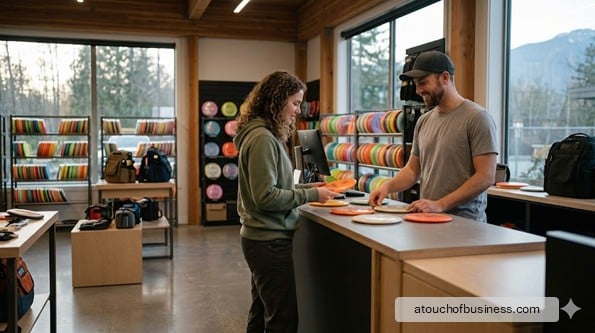
What to Expect From This Guide to Starting a Disc Golf Shop
The article provides an ordered route for planning a disc golf shop, beginning with owner research and business-model choices before moving into local demand, dealer approval, storefront setup, inventory control, finances, and opening checks. These highlights show some of the guide’s practical range.
Inside the guide, you will find:
- Startup roadmap: Work through seventeen connected steps covering the retail model, registration, suppliers, location, systems, staffing, and store testing.
- Owner interviews: Learn from retailers and founders discussing online sales, pro shops, events, community support, inventory, and long-term commitment.
- Startup FAQs: Clarify dealer accounts, storefront expectations, used discs, approved-product claims, online competition, and common cash-flow trouble.
- Fit and demand: Weigh thin margins, uneven income, retail hours, product knowledge, local courses, league activity, and existing competition.
- Inventory planning: Prepare for brands, molds, plastics, weights, colors, accessories, trade-ins, supplier minimums, and detailed stock tracking.
- Storefront setup: Check zoning, occupancy, signage, parking, layout, storage, checkout flow, returns, and customer access before opening.
- Financial planning: Price local setup costs, calculate sales volume, allow for seasonal slowdowns, and reserve operating capital beyond the first order.
Begin with the local player base, since it shapes the shop size, product mix, and sales volume your plan must support.
What It Takes to Open a Golf Disc Shop
As the owner of a golf disc shop, you sell putters, midrange discs, fairway drivers, and distance drivers to local players.
You also stock bags, baskets, apparel, and accessories, and you help customers find the right gear.
Most golf disc shops start small, often with a modest storefront or an online-first setup before expanding into a larger retail footprint.
Your customers usually fall into a few groups: new players, regular course players, league and tournament players, and gift shoppers.
Each group expects something different from your store, and that shapes how you stock shelves and train staff.
Is Owning a Golf Disc Shop Right for You?
Before you commit, think honestly about your motivation for opening this specific type of store.
Disc golf retail runs on thin margins per item, so volume and repeat local traffic matter more than any single sale.
Ask yourself whether you can handle slow weeks without panicking about cash flow.
This business may not fit you if:
- You expect quick profit from disc sales alone
- You’re not comfortable learning detailed flight characteristics for dozens of molds
- You can’t tolerate uneven income while the shop builds a local following
Consider your access to startup capital, your ability to cover personal living expenses during the early months, and whether household members support the time commitment.
Talk with your family about the hours a storefront demands, including evenings and weekends when players shop most.
You’ll also want a realistic view of demand: are there active courses, leagues, or clubs near your planned location?
If competing online retailers already dominate local players’ buying habits, you need a clear reason for customers to choose your store instead.
Think through whether you want to start from scratch or buy an existing shop, since an existing location may already have player relationships and supplier accounts in place.
Review the general startup process if this is your first time opening a retail business.
Red Flags Before You Start
A few structural realities of this niche deserve attention before you sign a lease or place a large order.
Watch for these warning signs before committing:
- Thin margins on individual discs that require strong volume to support the store
- Heavy competition from large online retailers with massive selection and aggressive pricing
- Manufacturer wholesale accounts that require an approved business type and a valid state sales license before you can buy stock
- Used-disc or trade-in programs that add sorting, grading, and tracking work, and may trigger added local rules
- Weak local course, league, or club activity that limits the player base in your area
None of these should automatically stop you, but each one changes how you plan your model.
If your area already has a well-established shop serving the same players, reconsider your differentiation plan before opening nearby.
Disc golf inventory also runs more complex than typical sporting goods retail. You’re managing many brands, molds, weights, and plastic types at once.
That complexity ties up more capital in inventory than a simpler retail category would, so plan your opening order carefully.
Step 1: Talk to Disc Golf Shop Owners
Reach out early to owners running shops in other cities or regions, never someone you’d compete against.
Prepare specific questions before the conversation so you get useful, practical answers.
- What surprised you most about opening your shop?
- What products moved fastest in your first months, and what sat on the shelf?
- What would you change before signing a lease or placing your first large order?
Firsthand insight from real owners is valuable because every shop’s path looks different.
You can also browse advice from real business owners as a starting point for finding people to talk to.
Step 2: Choose Your Business Model and Scale
Decide whether you’ll open a full storefront right away or start smaller and grow into it.
This Operating Model focuses on a physical storefront, so think through how much space, staffing, and inventory depth you can realistically support at launch.
What Customers Will Notice First:
- Whether the store is easy to find and easy to park near
- How organized and well-stocked the shelves look on day one
- Whether staff can answer questions about disc flight confidently
Your scale decision affects every step that follows, so revisit it after you validate local demand.
Step 3: Decide Between Starting From Scratch, Buying, or a Franchise Path
Some disc golf retail growth has happened through branch or franchise-style arrangements, so this path isn’t purely theoretical.
The right choice depends on your budget, timeline, desired control, and the availability of an existing shop for sale in your area.
Buying an existing shop can hand you supplier relationships and local customer trust immediately.
Starting from scratch gives you full control over location, branding, and product mix from day one.
Compare your options at starting from scratch versus buying a business before deciding.
Step 4: Validate Local Demand and Competition
Check how many active disc golf courses, leagues, and clubs exist within a reasonable driving distance of your planned location.
Look at whether local players already buy from a nearby shop or default to large online retailers.
Talk to league organizers and club members to gauge interest in a local physical store.
If demand looks weak or another shop already serves the area well, reconsider your location or your differentiation plan.
Step 5: Decide How You’ll Handle Used Discs and Trade-Ins
Offering used gear or trade-ins can attract local players looking for deals.
It also adds sorting, grading, and tracking work to your daily operations.
Used-merchandise handling may also change which local rules apply to your store, so treat it as a compliance question too.
Decide now whether this fits your opening model or whether you’ll add it once the store is established.
Step 6: Confirm Wholesale Dealer Eligibility With Disc Brands
You can only buy wholesale stock from major disc manufacturers by becoming an approved dealer partner.
To qualify, you typically need a valid state sales license and a business type that fits an approved retail category.
Some brands also require a qualifying physical business setup, such as a storefront, before approving an account.
Contact each brand you want to carry and confirm their specific dealer requirements before finalizing your lease or first order.
Pricing and wholesale terms usually aren’t shared until your dealer application is approved, so build in time for this step.
Step 7: Choose a Business Structure and Register Your Business
Decide between a sole proprietorship, an LLC, or another structure based on your liability comfort and tax preferences.
Register your business name and obtain a federal tax ID once you’ve chosen a structure.
Review how to register a business for the standard registration steps.
Step 8: Get Your State Sales Tax License
You’ll need a state sales tax license, or seller’s permit, to collect tax on sales.
This license is also typically required before a manufacturer will approve your wholesale dealer account.
Check your state’s department of revenue or taxation website for the application process and requirements.
Step 9: Check Zoning and Confirm Your Location
Before you sign a lease, confirm the space can legally operate as a retail store.
Contact your city or county zoning office and ask whether retail is allowed at that address.
Ask specifically whether disc golf retail is treated the same as general sporting goods retail under local zoning rules.
What Customers Will Notice First:
- How visible your storefront is from the street or parking area
- How easy parking and access are near your location
- Whether nearby traffic patterns make a quick stop convenient
Some cities require zoning approval to be confirmed in writing before you finalize a lease, so get this in hand early.
Step 10: Verify Certificate of Occupancy and Signage Rules
Check whether the space already has a certificate of occupancy that covers retail use.
If not, you may need a new certificate before opening, so confirm this with the city building department.
Ask whether exterior signs require a separate permit before installation.
Signage matters for visibility and foot traffic, so plan this step early rather than as an afterthought.
Step 11: Plan Your Product Mix and Store Layout
Decide how much shelf space goes to putters, midrange discs, fairway drivers, and distance drivers based on local player skill levels.
Plan space for bags, baskets, apparel, and accessories alongside your disc inventory.
Design your layout so customers can browse easily and staff can restock without disrupting the shopping flow.
What Customers Will Notice First:
- Whether discs are organized in a way that makes sense to browse
- How easy it is to compare similar discs side by side
- Whether the checkout area feels fast and uncluttered
Decide whether custom or exclusive stamped discs will be part of your mix, since this can set your store apart from online competitors.
Plan your storage and receiving area separately from the sales floor so new shipments don’t crowd the customer experience.
Step 12: Set Up Supplier and Dealer Accounts
Apply for wholesale dealer accounts with your chosen brands once your sales tax license and business registration are in place.
Clarify each brand’s minimum order requirements, return policies, and any physical storefront expectations.
Build relationships with more than one supplier so a single brand’s restrictions don’t limit your opening inventory.
Step 13: Choose Point-of-Sale and Inventory Systems
Disc golf inventory is far more detailed than typical retail stock, with each disc varying by mold, plastic type, weight, and color.
Choose point-of-sale and inventory software built to track that level of detail.
Test your checkout flow before opening so transactions move quickly during busy periods.
What Customers Will Notice First:
- How quickly checkout moves, especially during busy weekend hours
- Whether staff can quickly look up stock on a specific mold or weight
- Whether the store accepts the payment methods they expect
Step 14: Plan Startup Costs and Operating Capital
List every cost category you’ll need to price out locally: lease and build-out, fixtures, initial inventory, signage, licensing, and insurance.
Get quotes based on your specific location, store size, and product mix rather than relying on a generic figure.
Set aside enough operating capital to cover several slow months, not just your opening order.
Running out of operating money during a slow stretch is one of the most common reasons small retail stores close early.
Step 15: Set Up Business Banking and Funding
Open a dedicated business bank account before any sales occur.
If you need funding for build-out, inventory, or working capital, explore your options before committing to a lease.
Keep your personal and business transactions separate from the start.
Step 16: Build Your Brand and Signage
Your brand is more than a logo. It’s your name, your look, and how customers recognize you across your sign, website, and packaging.
Disc golf is a passion-driven community, so a brand that reflects that spirit can build loyalty faster than price alone.
Plan your exterior and interior signage early, since you’ve already confirmed whether a permit is required.
Consider business insurance needs alongside your branding and build-out planning, since both affect your opening timeline.
Step 17: Get Insurance, Hire Staff, and Prepare to Open
Arrange general liability and property coverage sized for a retail storefront carrying inventory.
If you’re hiring, look for staff who can speak credibly about disc flight characteristics and fitting advice.
Customers trust staff who can explain why one disc fits their throwing style better than another.
Run a soft test of your checkout, restocking, and returns process before your official opening day.
Business Plan
Your business plan should tie every earlier decision into one practical document.
Start with your chosen model: storefront scale, product mix, and whether you’ll handle used discs or trade-ins.
List your startup cost categories and the operating capital you’ll need to cover slow periods.
Work through your break-even logic: how many discs and accessories you need to sell to cover fixed costs like lease, payroll, and supplier minimums.
Because disc margins run thin, your plan should account for volume from repeat local players, not just one-time visitors.
Factor in seasonal demand. Disc golf activity often shifts with weather and daylight, which affects foot traffic and inventory planning.
Include your supplier strategy: which brands you’ll carry, their dealer requirements, and how you’ll diversify so one brand’s restrictions don’t limit you.
Use your plan to confirm the numbers work before you sign a lease or place your first large order.
Opening-Day Red Flags
Before you open, watch for these signs that the store isn’t quite ready.
- Wholesale dealer accounts not yet approved, leaving gaps in your opening inventory
- Zoning, certificate of occupancy, or sign permits still unresolved
- Point-of-sale or inventory software untested with your actual product mix
- Staff unable to confidently answer basic flight and fitting questions
- Storage and receiving space not separated from the sales floor, creating clutter customers will notice
- No tested process for returns, exchanges, or restocking
If any of these apply, delay your opening date rather than launching with gaps customers will notice immediately.
Frequently Asked Questions
Do I need a special license just to sell golf discs?
No disc-specific retail license typically exists.
A general business license, sales tax permit, and standard retail compliance apply, the same as other sporting goods retail.
Can I buy discs wholesale on my own without applying to each brand?
No. Wholesale stock is only available through an approved dealer account with each manufacturer.
You need a valid state sales license and dealer approval before you can buy at wholesale pricing.
Do I need a physical storefront to become an authorized dealer?
Requirements vary by manufacturer.
Some brands require a qualifying physical business setup more strictly than others, so confirm directly with each brand you want to carry.
What’s the difference between putters, midrange discs, fairway drivers, and distance drivers?
Speed indicates how fast a disc needs to travel to fly as designed.
Putters and midrange discs use lower speed ratings, while distance drivers use higher ones. This affects how you organize shelf space and train staff.
Should I carry used or trade-in discs?
It can attract local players, but it adds sorting, grading, and tracking work.
It may also change which local rules apply to your store, so weigh it as a compliance decision, not just a merchandising one.
How do I decide what to advertise as “PDGA approved”?
Only use that label for items that appear on the official approved discs and targets lists.
Check those lists directly before using the term in marketing or signage.
Is competition from online disc golf retailers something I should worry about?
Yes. Large online retailers carry extensive inventory and competitive pricing.
Your storefront needs a clear reason for customers to choose you, such as in-person fitting advice or local community ties.
What’s the biggest reason small disc golf shops run into trouble after opening?
Running short on operating capital during slow sales periods is a common cause of early closure.
Thin per-item margins make this risk especially relevant, so plan your operating capital to cover slower stretches, not just your opening order.
Advice From Disc Golf Shop Owners
These interviews share real experiences from disc golf shop owners, retailers, and founders who built businesses around discs, pro shops, online retail, events, and local player communities.
Readers can use these examples to think through inventory, location, customer service, online sales, seasonal demand, community support, and the amount of time needed before starting a golf disc shop.
I Turned My Hobby Into A $12M/Year Disc Golf Business
This written interview with Infinite Discs founder Alan Barker covers how a disc golf hobby became an online retail business with inventory, customer tools, content, and product development.
It is useful for someone starting a golf disc shop because it shows how online retail, search traffic, product selection, and customer-focused features can shape a disc business.
Meet Christopher Collette of Hawk’s Nest Disc Golf in Ayer
This interview covers buying an existing disc golf pro shop, restocking inventory, serving local players, adding an online store, and using expertise to help customers choose discs.
It is useful for someone starting a golf disc shop because it shows the value of location, community support, owner knowledge, and policies that help customers trust the store.
Pandemic Portraits: Disc Golf Shops In US & Europe
This article contains input from multiple disc golf shop owners about how local conditions, player demand, and changing course access affected their businesses.
It is useful for someone starting a golf disc shop because it highlights how outside factors can affect sales, inventory, communication, and the way a shop serves its local market.
Meet Andi and Don Young of Spring Valley Golf & Disc Golf
This interview covers how disc golf course development, events, pro shop merchandise, and local demand became part of a larger golf and disc golf business.
It is useful for someone starting a golf disc shop because it shows how merchandise sales can connect with courses, events, player traffic, and a strong local disc golf scene.
I Am Jeremy Rusco Owner of Dynamic Discs Ask Me Anything
This written Q&A with Dynamic Discs founder Jeremy Rusco discusses building a disc business from selling discs personally into retail stores, distribution, and manufacturing.
It is useful for someone starting a golf disc shop because it shows the time, sacrifice, brand building, team support, and customer focus involved in growing beyond a small start.
Was Disc ‘n Dat the First Disc Golf Only Store In The Retail World?
This video interview features Disc ‘n Dat owner Dan Bayless discussing his journey in disc golf retail and the history of running a disc-focused store.
It is useful for someone starting a golf disc shop because it gives perspective from a long-running shop owner on staying connected to the sport, the customer base, and the local scene.
Related Articles
- How To Start a Golf Shop
- How To Start a Sporting Goods Store
- How To Start a Golf Coaching Business
- How To Start a Golf Simulator Business
- How To Start a Mini Golf Business
- How To Start a Retail Game Store
Sources:
- Innova Disc Golf: Become a Retail Dealer, Flight Ratings System
- UDisc Blog: Disc Golf Disc Numbers Explained, Disc Golf Terms: Stability
- Marshall Street Disc Golf: Disc Golf Terms Glossary
- Discount Disc Golf: How to Read Disc Golf Numbers
- Infinite Discs Blog: Disc Golf Terminology Dictionary
- DGM: Disc Golf Terminology