
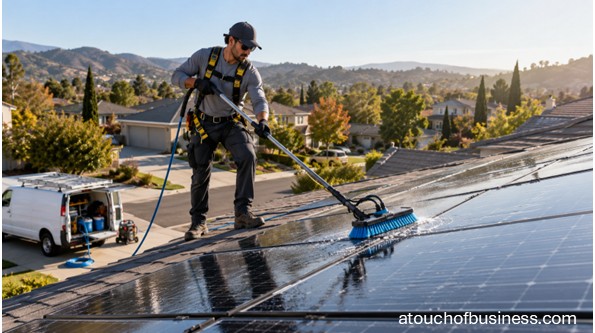
What to Expect From This Guide to Starting a Solar Panel Cleaning Business
This guide walks you through the practical decisions involved in starting a solar panel cleaning business, from evaluating the work to setting up equipment, pricing, and compliance before you open. The sections below highlight some of what it covers.
Inside the guide, you will find:
- Startup steps: Follow a numbered progression from choosing a service model through licensing, insurance, equipment, pricing, and a pre-opening test cleaning.
- Common questions: Find answers about part-time operation, equipment choices, and when to expand beyond solo work.
- Business fit: Weigh the narrow work windows, weather-dependent scheduling, and electrical safety training this business actually requires.
- Financial planning: See how pricing methods, insurance costs, and equipment choices affect your break-even point and operating capital needs.
- Equipment needs: Review the water-fed pole system, filtration setup, and safety gear this service depends on.
- Local requirements: Understand how licensing, zoning, and water-use rules vary by state and how to verify them.
- Risks and warnings: Learn the red flags that affect licensing, liability, scheduling, and long-term profit potential.
From there, the guide moves into the fit and safety considerations behind cleaning solar panels before walking through each startup step in order.
As a solar panel cleaning business owner, you keep rooftop and ground-mount solar arrays clean.
That means clearing away dust, pollen, tree sap, and bird droppings that block sunlight from reaching the cells.
You work with a water-fed pole system and deionized water instead of a pressure washer.
The wrong method can crack panels or void the manufacturer’s warranty.
Most customers come to you because their system’s output has dropped and they want it restored.
Starting this business involves the usual startup steps, plus a few that are specific to working near live electrical equipment.
Does This Solar Panel Cleaning Business Fit You?
Before you buy equipment, think honestly about whether this business fits your life.
The best cleaning hours are cool mornings, late afternoons, or overcast days.
Hot panels can crack when hit with cool water, so timing matters more here than in most cleaning trades.
That often means starting your mornings before the heat builds, plus a possible second window in the evening.
Rain, high wind, and extreme heat all cancel a day’s schedule, so your income can swing week to week.
Ask yourself whether your household can handle that unevenness while you build a steady client base.
You’ll also work near live electrical equipment, since solar arrays stay energized anytime they’re exposed to daylight.
That risk is manageable with training, but it isn’t something to shrug off.
Before you commit, talk with people already doing this work:
- Solar panel cleaners operating outside your planned service area
- Window cleaning business owners who added solar cleaning as a service
- Pressure washing contractors who understand route scheduling and weather delays
Prepare a few specific questions in advance, since each owner’s path looks a little different.
Ask about realistic daily job counts, water logistics, and the mistakes that cost them the most in year one.
Customers usually find you after noticing their solar monitoring app shows lower output than expected.
Your job is convincing them that a cleaning, not a system problem, is often the cause.
Before you commit to a service area, check how many solar installations exist nearby.
Also weigh how dusty, dry, or pollen-heavy the local climate is.
Dense solar neighborhoods in a dry climate generally support more recurring business than a rainy region with scattered installations.
You have a few realistic ways to enter this business:
- Start from scratch and build your own client list
- Buy an existing route or customer base from a retiring owner
- Explore a franchise, since at least one national solar-cleaning franchise brand operates in this space
Your budget, timeline, and appetite for franchise fees and reporting requirements should guide that choice.
Red Flags Before You Start
A few realities about solar panel cleaning are worth understanding before you commit money or time.
Consider these before moving forward:
- Your safe cleaning windows are short, which caps how many jobs you can complete in a day
- Weather cancellations are common and can create unpredictable income
- Live electrical exposure means real safety training is required, not optional
- Whether this work legally requires a contractor license varies by state, and sometimes by job size
- Some water utilities restrict commercial water use during drought, and mobile cleaning businesses aren’t always exempt
- Many prospective customers assume rain keeps panels clean enough, which can slow your sales cycle
These aren’t reasons to walk away. They’re structural facts that shape realistic planning.
Formal safety and quality standards for this trade are still relatively new industry-wide.
That means you may need to seek out training proactively rather than assume it’s standardized everywhere.
Step 1: Choose Your Service Model
Decide whether you’ll clean panels from the ground only, or also offer rooftop access.
Ground-based cleaning with a water-fed pole keeps your equipment and insurance costs lower.
Rooftop access adds fall-protection gear, extra training, and higher insurance costs.
It also opens up jobs that ground-based poles can’t reach.
Also decide whether you’ll serve residential customers only, or add commercial rooftops and solar farms.
Commercial and solar-farm accounts need higher-capacity water systems, so factor that into your equipment plan before you buy anything.
Step 2: Validate Local Demand for Your Service Area
Before committing to a service area, count how many solar installations already exist nearby.
Public solar-installer directories and a visual survey of rooftops both work for this.
Check what local competitors charge and which services they already offer.
A dense cluster of installations in a dry or dusty climate generally supports more recurring work than scattered installations in a rainy region.
Step 3: Choose a Business Structure and Register Your Business
Most owners in the solar cleaning field register as an LLC to separate personal assets from business liability.
A sole proprietorship is simpler to set up but won’t protect your personal assets if a customer disputes a damaged panel.
Once you choose a structure, register your business name.
File a DBA if you’re operating under anything other than your own legal name.
If you form an entity or plan to hire, apply for a federal tax ID too.
Financial tip: registration and structure choice affect your long-term liability exposure more than your upfront cost, so don’t pick based on price alone.
Step 4: Confirm Licensing, Zoning, and Water-Use Rules
This check shapes what you’re legally allowed to charge for, so confirm it before quoting a single job.
Some states treat routine panel cleaning as maintenance work that doesn’t require a contractor license.
Other states require a general or specialty license, and some only require it once a job’s cost passes a certain threshold.
Call your state’s contractor licensing board directly and ask how they classify this work.
Check your city or county for a general business license.
Also ask about any home-occupation rules covering a work vehicle parked at your house.
Ask your local water utility whether commercial cleaning businesses are exempt from drought water-use restrictions.
Some jurisdictions exempt cleaning businesses when water use is central to the service. Others don’t.
Step 5: Get Insured Before You Take Paid Work
General liability insurance is the minimum coverage you need.
It protects you if you damage a customer’s panel or property.
Add commercial auto insurance for your work vehicle.
A personal auto policy typically won’t cover accidents that happen during business use.
If you plan to hire anyone, secure workers’ compensation insurance first.
Most states require it by law once you have employees.
Financial tip: a single cracked panel or warranty dispute can outweigh a whole month of revenue, so treat insurance as a startup essential, not an optional extra.
Step 6: Complete Solar Safety Training
Solar arrays stay energized anytime they’re exposed to daylight, unlike most electrical systems you can simply power down.
Water and some pole materials conduct electricity, which adds real shock risk if you skip training.
Look for training that covers electrical-shock awareness and safe approach distances.
Add fall-protection training if your service model includes roof access.
This training is a genuine startup cost, not a corner to cut to save money.
Step 7: Buy Your Cleaning Equipment and Supplies
Your core cleaning setup should include:
- A water-fed pole system, often carbon fiber for its light weight
- A deionized or reverse-osmosis water filtration system with a purity meter
- Soft, non-abrasive brush heads made specifically for solar glass
- A portable water tank, pump, hoses, and fittings
If your service model includes roof access, add a personal fall-arrest harness and compatible anchor points.
Insulated gloves are worth adding to that list too.
You’ll also need a reliable vehicle to carry your tank, pole, and supplies between job sites.
Line up a supplier for filter resin and brush-head replacements before your first job.
These are ongoing costs, not one-time purchases.
Local water hardness affects how quickly you use up filter resin, so price that as a recurring cost, not a rounding error.
Step 8: Set Your Pricing Model
Common approaches include per-panel pricing, a flat rate per system, hourly pricing, and recurring maintenance plans.
Pricing your services clearly upfront builds the trust that keeps customers coming back.
Panel count, roof pitch, and soiling severity all shape a fair price.
Travel distance to the job matters too.
A recurring maintenance plan smooths out your income better than one-time jobs alone, since your safe work windows are already limited.
Financial tip: price in your travel time between sites, not just time spent cleaning, or your narrow daily window will cost you more than it earns.
Step 9: Prepare Documentation and Run a Test Cleaning
Write a simple service agreement that spells out scope of work.
Include how pre-existing panel damage will be handled.
A before-and-after inspection checklist protects you if a customer later disputes damage that existed before you arrived.
Set up your scheduling and payment system so customers can book and pay without friction.
Before taking your first paid job, run a test cleaning on a property you already know.
Time the job, check your water usage, and confirm your equipment performs the way you expect.
Business Plan
Turn your startup decisions into one working plan before you spend on equipment.
Your plan should cover your service model, target service area, pricing method, and whether you’ll start solo or bring on help from the start.
Profit potential in this business depends heavily on a few factors:
- How many jobs you can realistically complete inside your safe cleaning windows each day
- How tightly clustered your customers are, since drive time between jobs eats into those windows
- How many one-time customers you convert into recurring maintenance plans
- How often weather cancels a scheduled day
Because your safe panel-cleaning windows are short, your break-even point depends on route density more than on raw customer count.
A handful of customers spread across a wide area may earn you less than a tighter cluster with fewer total accounts.
Calculate your own break-even using your local pricing, your travel costs, and how many jobs you can realistically fit into a week.
Plan enough operating capital to cover slow weeks caused by weather.
You’ll also need it for the ramp-up period before recurring accounts build a steady base.
Running out of operating money before your client base matures closes more startups in this space than almost anything else.
Opening-Day Red Flags
Before your first paid job, confirm a few things that are easy to overlook.
- Test your water filtration system and confirm fresh resin and an accurate purity reading
- Leak-test your water tank and vehicle setup
- Inspect fall-protection gear if your service model includes roof access
- Confirm your licensing status is settled, not still pending
- Confirm your service area’s water-use restrictions, especially in dry regions
- Make sure your payment processing and scheduling system both work end to end
Skipping any of these on day one usually costs you more time than it saves.
Financial Decisions That Bite Later
A few money mistakes show up months into this business rather than on day one.
- Underpricing your first jobs, which trains those initial customers to expect a rate you can’t sustain
- Skipping workers’ compensation before hiring your first employee, since most states require it by law
- Buying commercial-grade equipment before you’ve validated demand for commercial accounts
- Ignoring how quickly filter resin gets used up in hard-water areas
- Mixing personal and business banking, which makes it harder to see whether you’re actually profitable
Catching these issues sooner is far cheaper than fixing them after they’ve shaped how customers see your pricing.
Frequently Asked Questions
Can I run this part-time while keeping my current job?
Yes, and it fits this business better than most, since your safe cleaning windows already fall in the morning and evening hours.
Just know that part-time work caps how many jobs you can realistically take on each week.
How do I decide between new and used equipment?
New equipment costs more upfront but comes with full manufacturer support and a longer expected lifespan.
Used equipment lowers your entry cost but may need repairs or replacement sooner.
Base the decision on your available budget and how much route capacity you actually need when you start.
When should I upgrade to a higher-capacity system for commercial accounts?
Wait until you have real demand from commercial or solar-farm customers, not just interest.
A residential-scale system is usually the better starting point, since commercial-grade equipment costs more to buy and maintain.
At what point does demand outgrow what I can handle alone?
Watch for a pattern of turning down bookings because they don’t fit inside your safe cleaning windows.
That’s a clearer signal than a fixed number of customers, since your daily capacity is limited by timing, not effort.
If rain keeps panels somewhat clean, how do I know a property actually needs my service?
Rain removes loose dust, but it doesn’t reliably clear bird droppings, tree sap, or pollen film.
Panels installed at a low tilt get little benefit from rain at all.
A drop in a customer’s solar monitoring app output, with no shading or equipment explanation, is usually a stronger signal than visible dirt.
Interviews with Solar Panel Cleaning Business Professionals
These interviews share practical perspectives on operating a solar panel cleaning business, including equipment, pricing, recurring service, customer expectations, partnerships, field operations, and larger commercial projects.
Readers can use the advice to better understand how experienced professionals approach the work, structure their services, manage operational challenges, and build relationships with customers and commercial decision-makers.
Inspiring Conversations with Tony Hernandez of Solis Clean
Tony Hernandez discusses how he and Milton Chavez formed Solis Clean by combining business experience with solar-industry knowledge. He also explains their cleaning equipment, service approach, system inspections, technical support, and residential pricing.
This interview is useful for considering how complementary skills between business partners, technical knowledge, specialized equipment, and additional solar services can shape a solar panel cleaning company.
What To Look For When Hiring Cleaners For Solar Panels with Trevor Steiner
Trevor Steiner discusses professional cleaning equipment, insurance, pricing, recurring cleaning packages, cleaning procedures, and questions customers should ask when choosing a solar panel cleaning company.
This interview is useful because it shows the business from the customer’s perspective. Someone preparing to offer solar panel cleaning can see what customers may expect regarding equipment, insurance, pricing, service frequency, and professional procedures.
Keep Your Solar Panels Efficient: Cleaning Tips from Don Kessler
Don Kessler, owner of Kessler’s Solar Panel Cleaning, discusses cleaning frequency, cleaning methods and tools, panel performance, and the differences between professional cleaning and homeowner cleaning.
This interview helps someone considering the business understand the practical service questions customers may have and the knowledge a professional cleaner needs when explaining cleaning methods, frequency, and the value of professional service.
Let’s Talk Solar Panel Cleaning with Rick Elmer
Rick Elmer of Sun Bros discusses how he and his brother started their solar panel cleaning business, initially operating part-time before growing it into full-time work. He also covers equipment, water filtration, insurance, cleaning methods, and customer service.
This interview is especially useful for someone considering the business because Rick explains how the company got started, acquired its first equipment and customers, and handled practical issues such as specialized insurance and service procedures.
Related Articles
- How To Start a Window Cleaning Business
- How To Start a Gutter Cleaning Business
- How To Start a Pressure Washing Business
- How To Start a Green Cleaning Business
- How To Start a Home Energy Audit Business
Sources:
- Aurora Solar: Step-by-step guide cleaning solar panels
- BizBuySell: Solar Businesses For Sale Listings
- Denver Water: Commercial Water Use Drought Rules
- EnergyRanked: Cleaning Timing and Thermal Shock
- Enphase: Solar Warranty Coverage Guide
- Entrepreneur: Solar Cleaning Franchise Profile
- Expert Safety Services: Solar Cleaner Electrical Safety
- GreenLancer: Solar Contractor Licensing by State
- OSHA: Ladder Safety and Fall Protection, Fall Protection Ladder Interpretation
- Palmetto: Homeowner Cleaning Frequency Guide
- PWNA: Solar Safety Training Course
- REC Group: Manufacturer Cleaning Guide
- Soilar.tech: Solar Cleaning Safety Risks
- Solar Energy International: State Solar Licensing Overview
- Solar Panels Network USA: Walking on Panels Warranty Risk
- Wolters Kluwer: Solar Business License Requirements