
What to Expect From This Guide to Starting a Trailer Rental Business
This guide walks you through the key decisions and practical steps for starting a trailer rental business, from checking your fit to a test rental. The bullets below highlight selected areas, and the article goes further.
Inside the guide, you will find:
- Startup steps: Follow 20 ordered steps, from checking your fit and local demand to insurance, rental terms, and a test rental.
- Business fit: Weigh your motivation, risk tolerance, household support, and the customer groups you would serve before you buy any trailers.
- Common questions: Find short answers on rental agreement protection, working alongside a job, booking options, and new versus used trailers.
- Daily reality: See what a typical day involves, including the parts owners often enjoy and the parts they find hard.
- Financial planning: Price costs locally, then test break-even, operating capital, and funding options before you add more trailers.
- Local requirements: Find the title, tax, zoning, and insurance questions to ask locally, since rules vary by location.
- Risks and warnings: Spot warning signs to weigh before you buy trailers and again before opening day, from storage limits to coverage gaps.
The first section looks at whether owning equipment that earns only when it is rented out fits your life and finances.
As a trailer rental owner, you buy trailers and rent them to customers for a day, a weekend, or a week.
Customers usually tow the trailers with their own vehicles, though you can offer delivery.
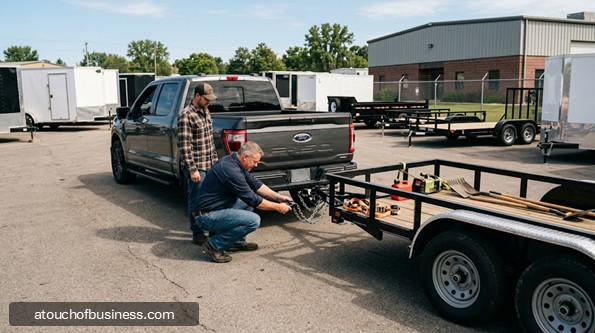
Either way, each handoff includes a hitch check, payment, and a return inspection.
Most of your startup capital goes into trailers and insurance. A trailer earns nothing while it sits idle.
Starting this business means working through a set of startup steps, from checking your fit to a test rental before your first paying customer.
Is a Trailer Rental Business a Good Fit for You?
A trailer rental business fits you if you can handle equipment upkeep, rental paperwork, and idle stretches without losing momentum.
Start with your motivation. Why do you want to own equipment that earns only when someone tows it away?
Think about risk tolerance. Trailers can be damaged or stolen, and any new business can fail.
Think about income uncertainty. Trailers cost money before they earn it, and bookings take time to build.
Talk with family or household members about the time, money, and risk involved. Their support affects how long you can stay with the business.
Before you go further, check these practical points:
- Startup costs and operating costs you can cover
- Access to capital for trailers, insurance, and storage
- Time for inspections, handoffs, and returns
- Basic skills in trailer upkeep, hitching, paperwork, and customer communication
- Local demand for the trailer types you plan to offer
- Willingness to serve the people who rent trailers
Learn from experienced owners who won’t compete with you. Prepare your questions before you talk to them.
Compare three entry paths: starting from scratch, buying an existing rental operation, or exploring a franchise.
Who Your Customers Will Be
Your customers are mostly movers, homeowners, landscapers, contractors, and people who occasionally need to haul a vehicle or equipment.
Many of them need a trailer for a short time. They’d rather rent one than buy it and pay to store it.
Your first customers may include:
- Movers and homeowners: a trailer for a short job, without buying one or finding a place to store it.
- Landscapers and contractors: a trailer for a job, with clear daily, weekend, or weekly rental terms.
- People hauling vehicles or equipment: a car hauler, equipment trailer, or large flatbed they do not want to own.
Every renter, whatever their job, needs clear hitch ball size, plug type, and towing requirements so the trailer matches their vehicle.
Do you want to serve these customers? Their needs shape your trailer mix, your paperwork, and every handoff.
Red Flags Before You Start
Several red flags should make you pause, change your model, or reconsider before you buy a single trailer.
Demand and financial red flags:
- Weak local demand. Pause. Check competitors and ask non-competing owners before buying any trailer.
- Chain and marketplace competition. Consider specialty trailers instead of matching chains on utility trailers.
- Seasonal swings. Sources describe demand peaking from spring into fall, with a softer winter. Verify your local pattern.
- Thin margins at low utilization. Reconsider if your break-even rental days look unrealistic.
- Financing several trailers before demand is proven. Reduce risk and start small.
- Thin operating cash. Pause until you can cover repairs, tires, and slow months.
- Hard-to-collect fees. One repair or damage claim can erase several months of earnings.
Legal and insurance red flags:
- Personal policy gaps. Sources say personal auto and homeowner’s policies often exclude rental activity.
- Assumed liability protection. A federal law called the Graves Amendment limits owner liability for rented vehicles when the owner was not negligent.
- Mixed court results. Courts have treated rented trailers differently under that law, so get legal advice.
- Storage limits. Zoning, deed, or association rules may block your storage site. Verify before buying trailers.
- Unclear tax treatment. Verify with your state tax agency before you set prices.
- Possible USDOT obligations. Verify if you plan to deliver with heavy combinations.
Operations and safety red flags:
- Theft, vandalism, and damage. A federal audit of a large leased trailer fleet flagged weak security and losses.
- Trailer failure during a rental. Industry sources say a breakdown creates liability and costs you the customer.
- Tow setup mismatch. Wrong hitch, capacity, or wiring creates a hazard.
- Towing hazards. Sources point to trailer detachment, chain failure, sway, and loading errors in severe crashes.
Structural conditions to understand before you commit:
- Trailers are capital-heavy for a small operator.
- Owner liability follows the asset onto public roads.
- Maintenance and downtime are built into the model.
- Brake, registration, and tax rules vary widely by location.
- Small operators compete with chains, dealers, and peer-to-peer listings.
A Day in the Life of Running a Trailer Rental Business
Many days center on check-outs, returns, and inspections, though routines differ from one owner to the next.
Your daily rhythm often includes:
- Inspecting each trailer before it goes out and after it comes back
- Checking tires, hitch, lights, and electrical connections
- Confirming the renter’s hitch, tow capacity, and wiring match the trailer
- Collecting renter ID, a signed rental agreement, and payment or a deposit
- Comparing return condition with pickup photos and noting damage
Recurring tasks beyond the core service:
- Scheduling and blocking dates in a booking system
- Answering renter questions and confirming pickup and return times
- Tracking trailer location and late returns
- Planning maintenance, tires, and repairs
- Following up on damage or fee disputes
Rental demand is described as busier from spring through fall in most markets, with a softer winter. Residential demand is the most seasonal.
Commercial and indoor-project renters are described as steadier. Verify the seasonal pattern in your own area.
What owners often enjoy:
- Running the business alongside another job
What owners often find hard:
- Damage, theft, and disputes after returns
- Keeping trailers maintained and available
- Finding the daily routine more hands-on than expected
Does this daily rhythm fit the life you want?
Step 1: Check Your Fit for an Asset-Based Rental Business
Step 1 is a practical self-check. Can you manage trailers that earn revenue only while they are out on rent?
Ask yourself these questions:
- Can you keep trailers maintained between rentals?
- Can you handle paperwork and disputes over damage or late returns?
If either answer is no, pause. Close the gap or choose a different model before you spend on trailers.
Step 2: Talk to Non-Competing Owners Before You Spend
Talk to owners who won’t compete with you, and bring prepared questions. Firsthand insight helps even though each owner’s path is different.
Good people to ask include those who run equipment rental, truck rental, or trailer sales operations in other markets.
Advice from real business owners can also sharpen your questions.
Ask these questions:
- How often do damage, theft, and late returns happen?
- How much trailer downtime do you plan around?
- Which trailer types stay rented, and which sit?
Step 3: Choose Between Starting New, Buying, or Franchising
You can start from scratch, buy an existing rental operation, or explore a franchise. The best path depends on your budget, timeline, and risk tolerance.
- Buying an existing operation may include trailers, customers, and records.
- A trailer rental franchise option appears in industry sources. Verify any franchise through its disclosure document.
- Weigh the control you want against the businesses actually for sale near you.
For a deeper comparison, read about whether to start from scratch or buy a business.
Step 4: Validate Local Demand and Competition
Check who already rents trailers near you and which trailer types are scarce before you buy any trailer.
Count your local competition:
- Truck and trailer rental chains
- Equipment rental stores
- Trailer dealers
- Online peer-to-peer marketplaces
Industry sources say specialty trailers, such as dump, car hauler, and large flatbed, can be less common at national chains. Verify this in your market.
Review how local supply and demand work, and check which customer groups in your area rent trailers most.
Then decide why a customer would choose you over a chain or a marketplace listing.
Keep customer reach to opening-stage basics: who you serve, what problem you solve, and how they first find you.
Step 5: Define Your Business Model and Trailer Mix
Decide your model before you price anything: which trailers you offer, how customers receive them, and where bookings come from.
Common trailer types and sizes:
- Utility trailers, commonly 6×10, 6×12, and 7×14
- Enclosed cargo trailers, commonly 12 to 20 feet
- Dump trailers, commonly 6×10, 6×12, and 14 feet
- Equipment trailers, commonly 16 to 24 feet
- Car hauler trailers
- Specialty or large flatbed trailers, as your market supports
Decide these model questions:
- Customer pickup or delivery
- Your own booking site, a marketplace listing, or both
- Working alone or with help
- One trailer or a small fleet
Delivery adds a tow vehicle, driver time, and business auto coverage.
Step 6: Plan Your Storage and Tow Vehicle Needs
Plan a secured storage location before you buy trailers, plus a tow vehicle if you deliver.
Your storage options include home, a rented yard, or a commercial site.
Zoning, home-occupation rules, deed restrictions, and association rules can limit trailer storage and customer pickups. Verify them locally before committing to a site.
If you deliver, your tow vehicle needs:
- Rated towing capacity for the trailers you offer
- The correct hitch
- Matching wiring
- Business auto insurance
Step 7: Decide on a Legal Structure
Plan your legal structure before you sign purchase agreements or take a booking.
Rental trailers travel public roads with customers you don’t know, so liability exposure is real.
These factors affect your business structure choice:
- Customers tow your trailers on public roads.
- Physical assets can be damaged or stolen.
- You may finance trailers.
- You sign rental contracts with the public.
- You may hire staff or delivery help.
A one-trailer start has less exposure, but the trailer still travels public roads. Ask an attorney whether a sole proprietorship fits.
A fleet with delivery or large trailers makes a stronger case for forming an entity.
Take the final choice to an attorney and a tax professional.
Step 8: Register the Business and Set Up Tax Accounts
Register your business, then set up the tax accounts your structure and location require.
- Register your business and any business name or DBA you plan to use.
- Get an EIN from the IRS when your structure or plans call for one. A business tax ID also helps with banking.
Sales tax on rentals varies by jurisdiction. Sources show short-term rental receipts of tangible property can be taxable.
Ask your state tax agency these questions:
- Can I buy rental-only trailers without paying sales tax upfront?
- Does a special rental-vehicle tax apply, and does it exclude trailers?
- Are delivery charges part of the taxable rental?
Some states allow tax-free purchases of rental-only trailers if you then collect tax on rentals.
Check your state department of revenue for “taxability of equipment rental” and “sales tax permit.”
Step 9: Check Zoning, Licensing, and Other Approvals
Confirm local approvals and any federal motor carrier obligations before you commit to a site or open for rentals.
Check these local items:
- A general business license from your city or county clerk
- Zoning for equipment rental and trailer storage
- Home-occupation rules and association rules, if you store trailers at home
- A certificate of occupancy if you lease or build out a commercial location
- Local signage or equipment rental rules
Federal rules may also apply. FMCSA requires a USDOT number for commercial vehicles in interstate commerce rated at 10,001 pounds or more.
A USDOT number can apply if you or staff haul property for business, such as delivering trailers with a heavy tow setup across state lines.
Sources state that a “not for hire” label does not remove the USDOT requirement.
If customers tow the trailer themselves, responsibility depends on who operates the combination and for what purpose.
Intrastate USDOT rules differ. Verify with FMCSA and your state motor carrier office.
Step 10: Estimate Startup Costs by Pricing Everything Locally
Your most accurate startup estimate comes from listing everything you need and pricing it locally.
Costs differ widely by whether trailers are new, used, or already owned. A figure from another business will mislead you.
Price these items:
- Trailers
- Titling and registration
- Insurance
- Storage or yard
- Tow vehicle needs, if you deliver
- Locks and trackers
- Software and payment tools
- Signage
- A repair reserve
Step 11: Run Your Profit and Break-Even Check
Run your break-even check for one trailer before you commit to more. Use your own local numbers.
Start with annual fixed costs per trailer: loan payment, insurance, registration, storage, and depreciation.
Add expected maintenance and damage costs. Then divide the total by realistic rental days to find the daily rate you need to break even.
Compare your break-even rate to what local competitors charge. A profit and revenue estimate can help you test your assumptions.
Test slow months and idle periods too. Don’t add trailers until the single-trailer numbers work.
Step 12: Plan Your Operating Capital
Hold enough cash to keep your trailers rentable through repairs, premiums, and slow months.
Running out of operating capital is a common cause of startup closures.
Plan cash for these costs:
- Insurance premiums
- Repairs and tires
- Deductibles
- Slow months
- Delays in collecting late fees or damage charges
Step 13: Explore Funding and Ask What Lenders Require
Explore your funding options, then ask each lender or investor which documents they require before you apply.
Funding options to explore:
- Personal savings
- Equipment financing
- SBA-backed loans
- Business credit
Read about how to get a business loan before you apply.
Start drafting your plan while you complete earlier steps. The Business Plan section below pulls these pieces together.
Step 14: Set Up Banking and Payment Collection
Open a business bank account after you register, and set up a way to collect payments and security deposits.
A business bank account keeps business and personal funds separate.
Define how you will hold and refund deposits before your first rental.
Step 15: Buy or Inspect Trailers and Verify Titles and Recalls
Verify each trailer’s VIN, weight rating label, and ownership documents before it joins your rental list.
Title and register each trailer under your business. New trailers typically come with a Manufacturer’s Certificate of Origin.
Trailers need a VIN to be titled or registered. Homemade trailers may need state-issued VIN verification.
Rental trailers may fall under commercial registration categories in some states. Check your state DMV for “rental trailer registration.”
Brake, breakaway, safety chain, lighting, and fender requirements often depend on trailer weight and vary by state.
Check your state highway patrol or DMV for trailer equipment requirements.
Look up open safety recalls with NHTSA using each VIN. Industry sources report trailer recalls involving safety chains and breakaway switches.
Inspect each trailer before it goes on the rental list:
- Tires
- Brakes
- Lights
- Coupler
- Jack
- Safety chains
- Breakaway system
Step 16: Set Up Insurance With a Rental-Savvy Broker
Set up insurance by the day you take ownership of any trailer, and before your first booking.
Work with a broker who understands rental operations.
Don’t assume your personal auto or homeowner’s policy applies. Sources say these policies often exclude rental activity.
Read more about business insurance, then ask your broker about these coverages:
- Commercial trailer or inland marine coverage for the trailer itself
- Commercial general liability
- Business auto, if you deliver
- Umbrella liability above underlying policies
- Property coverage for your storage site
Confirm these points in writing:
- Coverage applies while a trailer is in a customer’s possession.
- Whether the policy pays stated value or replacement cost instead of actual cash value.
- Deductibles and exclusions.
Rules on legally required insurance for rental trailers vary by jurisdiction. Check your state insurance department and DMV.
Step 17: Write Your Rental Agreement, Policies, and Pricing
Write your rental agreement and set your pricing before you accept a booking.
Your rental agreement should cover:
- Trailer identity and VIN
- Rental period
- Fees and deposit
- Late fees
- Tow vehicle requirements
- Pickup and return inspection
- Damage and theft responsibility
- Return terms
Have an attorney review the agreement before you use it.
When you price your services, set tiers for daily, weekend, and weekly rentals.
Charge more for larger or specialty trailers. Add an optional delivery fee if you deliver.
Compare competitor rates in your area, including marketplace listings.
If you plan to charge a damage waiver or protection fee, ask your state insurance department whether insurance rules apply.
Step 18: Set Up Security, Tracking, and Inspection Routines
Set up security and inspection routines before your first rental, because theft and damage are the risks you can partly control.
Security and tracking items:
- Hitch lock or coupler lock
- Wheel lock
- GPS tracker
- Secured storage with lighting or fencing
Inspection tools and routines:
- Tire pressure gauge
- Torque wrench for lug nuts
- Jack and lug wrench
- Trailer light tester or test connector
- Grease, basic hand tools, and brake and bearing service supplies
- A before-and-after checklist with photos
- A renter ID verification step
Step 19: Set Up Booking and Business Identity Basics
Set up your business identity and booking so customers can find and reserve trailers.
Your basics include:
- Business name and phone number
- Business email
- A booking page or marketplace listing
- Rental software for availability, billing, and trailer records
- Yard signage, if you use a commercial site
List these details on every trailer’s page:
- Hitch ball size, commonly 1-7/8 inch, 2 inch, or 2-5/16 inch
- Plug type
- Towing requirements
Renters can then confirm compatibility before they drive to pickup.
Step 20: Complete Your Pre-Opening Checklist and Run a Test Rental
Finish the checklist below and run a test rental before your first paying customer.
Legal and tax:
- Business registered, with an EIN if needed
- Business license and zoning approvals confirmed
- Sales tax permit set up where required
- Entity decision reviewed with an attorney and tax professional
Trailers:
- Each trailer titled and registered, with plates on and registration paperwork in hand
- VIN, weight rating, and recall status checked
- Tires, brakes, lights, coupler, jack, chains, and breakaway system inspected
- Spare tire and lock in place
Insurance and paperwork:
- Coverage in force and confirmed for rental periods
- Rental agreement reviewed by an attorney
- Inspection form and photo routine ready
- Renter ID verification step set
Payments, systems, and site:
- Business bank account open
- Payment collection tested
- Deposit and refund steps defined
- Booking page or listing live, with hitch ball size and plug type shown
- Secure storage and a pickup and return area in place
Final confirmations:
- Operating cash set aside
- Maintenance schedule written
- Your first customers identified
Do a dry run of check-out, hitching, inspection, and return. Fix any gaps before the first paid rental.
Business Plan
Draft your business plan as you complete the earlier steps. Finish it once your costs, funding, pricing, and break-even inputs are in place.
A business plan turns your startup steps into one practical document you can hand to a lender.
Pull these pieces into your plan:
- Your trailer mix, rental model, and customer groups
- Your itemized startup cost list
- Your funding sources and the documents each lender requires
- Your tiered pricing, deposit, and late-fee terms
- Your insurance coverage and legal checks
- Your pre-opening checklist
Include your profit logic in plain terms. Utilization drives results, and idle trailers hurt cash flow.
Show the rental days each trailer needs to cover its fixed costs, using your own numbers from Step 11.
Add what happens in slow months, and how you will cover costs while trailers sit.
Opening-Day Red Flags
Hold your opening if any warning sign below is still unresolved. Each one can turn a first rental into a loss.
- Coverage unconfirmed for rental periods. Get written confirmation before any trailer leaves your lot.
- A trailer missing title, registration, or a recall check. Finish the paperwork first.
- Uninspected tires, brakes, lights, or breakaway systems. Pull that trailer from the list.
- No photo record of trailer condition. Without it, damage disputes are hard to settle.
- A rental agreement no attorney has reviewed. Pause until the review is done.
- Payment collection or deposit handling untested. Run a test transaction.
- No sales tax permit where one is required. Verify with your state tax agency.
- Hitch, tow capacity, or wiring unverified for a renter. Don’t release the trailer until all three match.
- Storage that is not secured. Add locks, lighting, or fencing before trailers sit there overnight.
Review common startup mistakes once more before opening day.
Frequently Asked Questions
Does a signed rental agreement protect me from damage and injury claims?
No, not by itself. A rental agreement sets terms for damage, late returns, and responsibility.
Insurance remains a separate layer of protection.
Have an attorney review the agreement before you use it.
Can I run a trailer rental business alongside a full-time job?
Yes. Owner accounts describe running a trailer rental business alongside a full-time job.
Inspections, handoffs, and returns still need your time.
Industry interviews stress treating a side business as a serious business.
Should I use my own booking site or a rental marketplace?
Neither is automatically better. The choice depends on your priorities.
Compare control, fees, renter protections, and visibility across both options.
Marketplace protections supplement your own insurance. They don’t replace it.
Should I buy new or used trailers?
The choice depends on your numbers and your inspection results. No single option fits every owner.
Weigh condition, warranty, inspection history, financing, and how your insurer values the trailer.
Interviews with Trailer Rental Business Professionals
These interviews share practical experiences from people who have built, operated, and expanded trailer rental businesses. They discuss starting small, choosing trailers, finding customers, testing demand, managing rentals, and improving operations.
Readers can use these experiences to compare different approaches before starting a trailer rental business. Pay particular attention to how each operator tested the market, selected equipment, handled customers, and developed systems as the business grew.
The Most Hands-Off $6K/Month Side Hustle to Start
Chris Koerner interviews Nathan of Lanco Trailer Rentals about building and operating his trailer rental business alongside a full-time job. They discuss how he acquired his first trailers, automated much of the rental process, attracts customers through Google and Facebook Marketplace, and approaches trailer selection.
This interview is useful for examining how a trailer rental operation can be structured around limited owner time. Nathan also explains how someone can test local demand and which types of trailers he would consider first if starting again.
Navigating the Trailer Rental Market — Anthony and Mike
Justin Martin interviews Anthony and Mike from TRC Trailer Rentals about their path into the trailer rental business. They discuss their original idea, market analysis, financing, customer experience, operational challenges, software, and plans for expanding the business.
This interview provides useful perspectives on treating trailer rentals as a serious business rather than simply acquiring equipment and waiting for customers. Their discussion also shows how financing, systems, and customer service can affect growth.
Trailer Talk with Big Rentals — Ryan Keen
Justin Martin talks with Ryan Keen about his experience in trailer rentals and the systems used to manage rental operations. Their conversation covers automation, customer communication, breakdowns, data collection, rental management, customer support, and maintaining a personal connection with renters.
Ryan brings years of trailer rental experience and experience managing a sizable fleet. The conversation is useful for understanding the operational side of a growing rental business and where automation can help without completely replacing direct customer interaction.
Justin Martin’s Trailer Rental Side Hustle
Justin Martin explains how he began renting a trailer he already owned, found demand through Facebook Marketplace, and gradually expanded his fleet. He also discusses market research, trailer selection, customer communication, maintenance, and the basic rental process from booking through return.
This interview is useful for someone considering a small-scale start because Martin explains how he tested demand before expanding. He also discusses researching the local market and evaluating different trailer types before committing more money to additional equipment.
Related Articles
- How To Start a Heavy Equipment Rental Business
- How To Start a Car Rental Business
- How To Start a Motorcycle Rental Business
- How To Start an ATV Rental Business
- How To Start an RV Rental Service
Sources:
- Big Rentals: Trailer Rental Startup Guide, Trailer Rental Insurance Types, Rental Agreement and Hitch Checks, Year-Round Trailer Demand, Renting Versus Owning Trailers, Pre-Tow Trailer Inspection
- Twice Commerce: Trailer Rental Agreement Guide, Starting a Trailer Rental Business
- Reservety: Trailer Rental Business Plan
- Federal Motor Carrier Safety Administration: Ask FMCSA Registration
- U.S. Government Publishing Office: Federal Rental Vehicle Marking
- Electronic Code of Federal Regulations: Brakes to Be Operative
- Cornell Legal Information Institute: Brakes on All Wheels, Rental Tax Regulation Example
- J. J. Keller Compliance Network: DOT Numbers for Rentals, Vehicle Marking Requirements
- New Mexico State University: USDOT Number Guidance
- Recreation Vehicle Industry Association: Trailer Brake Requirements
- Snohomish County: Trailer Safety Tips
- UCOR: Trailer Towing Safety Factors
- RV News: Trailer Safety Recalls
- Texas Department of Motor Vehicles: Trailer Titling and Registration
- Virginia Department of Motor Vehicles: Trailer Title Documents
- Utah State Tax Commission: Trailer Rental Sales Tax
- Ezel Tax Rulings: Trailer Rental Tax Ruling, Waste Trailer Tax Ruling
- New York Courts: Trailer Lessor Liability Case, Graves Amendment Trailer Case
- Leadsurance: Trailer Insurance Coverage
- University of Arkansas: Trailer Rental Checklist
- U.S. Postal Service Office of Inspector General: Leased Trailer Fleet Audit
- Transport Topics: Trailer Rental Owner Interview, Trailer Rental Safety Protocols
- Houma Times: Trailer Rental Owner Profile
- Booqable: Bridgman Rentals Owner Story
- Trailer Hustle Podcast: Rental Company Interview
- Bureau of Labor Statistics via EBSCO: Counter and Rental Clerk Work
- Bureau of Labor Statistics via Edinformatics: Rental Clerk Duties and Schedules