
What to Expect From This Guide to Starting a Battery Reconditioning Business
This guide walks readers through the key decisions and practical steps involved in starting a battery reconditioning business, from assessing technical fit and local demand to compliance, shop setup, pricing, and pre-opening checks. The highlights below show only part of its practical depth.
Inside the guide, you will find:
- Startup roadmap: Follow an ordered path from skill and niche evaluation through demand testing, planning, setup, pricing, and opening checks.
- Industry interviews: Compare observations from professionals involved in battery refurbishment, repair, fleet support, and related service models.
- Startup FAQs: Review answers about permits, serviceable battery types, safety, training, sourcing, disposal, niche choice, and warranties.
- Financial planning: Work through startup costs, break-even volume, seasonal slow periods, funding options, and pricing differences across battery niches.
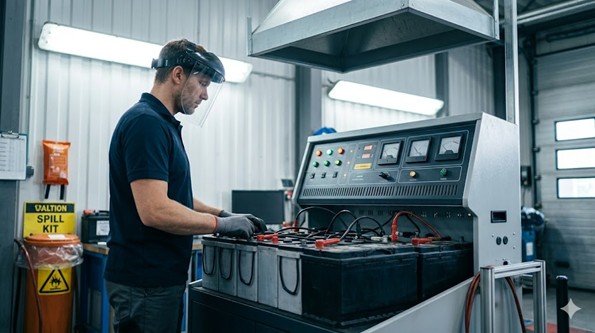
- Shop and equipment: Examine facility needs, workflow zones, diagnostic tools, chargers, handling equipment, ventilation, and protective gear.
- Local requirements: Understand federal, state, and local considerations involving waste handling, zoning, permits, fire codes, insurance, and worker training.
- Risks and preparation: Identify technical, market, safety, disposal, insurance, and workflow red flags before committing or opening.
Begin by deciding whether the technical demands, hazards, and income uncertainty fit your skills and circumstances.
Is This Business a Good Fit for You?
Running a battery reconditioning shop is hands-on, technical, and physically demanding. You need comfort working with sulfuric acid, hydrogen gas, and electrical test equipment every day.
This isn’t a business where you learn the chemistry on the fly with paying customers waiting. If you lack the technical foundation, getting formal training before investing in a shop costs far less than fixing avoidable mistakes after you open.
Beyond the technical side, ask yourself the ownership questions every first-time entrepreneur needs to answer honestly. Can you cover personal living expenses while the business ramps up? Does your household support the commitment? Can you absorb months of lower-than-expected revenue?
Battery reconditioning has real failure points. Not every battery can be reconditioned. Some jobs generate no revenue at all. Seasonal demand can stretch slow months into slow quarters in cold climates. A realistic tolerance for income uncertainty matters here.
Before you spend anything significant, talk to owners of battery service shops in markets you won’t compete in directly. Ask about compliance costs, slow periods, equipment problems, and what they wish they had known before opening. Every owner’s experience differs, but firsthand input beats assumptions.
More on learning from real business owners is worth your time before you commit.
Also think through your entry path. Starting a new shop from scratch gives you full control over niche and setup. Buying an existing battery service business can mean an established customer base and equipment already in place — though you’ll need to verify compliance status and equipment condition carefully before closing.
Thinking through starting from scratch versus buying an existing business is a decision worth making before the steps below.
Red Flags Before You Start
Some warning signs belong at the front of the decision, before you put money into this.
Slow down or reconsider if any of these apply:
- No technical background in battery chemistry or electrical systems. You can learn — but get formal training before taking paying customers, not during. The safety stakes are too high to skip this.
- Your local market lacks enough of the right customers. A fixed-overhead shop needs consistent volume. If your area has few hybrid vehicles, no golf courses or cart dealers, and no warehouses running electric forklifts, demand may not support a shop with rent and utilities.
- New battery prices in your niche are falling. The customer value of reconditioning depends on the price gap versus buying new. Research current new battery prices in your target segment before assuming that gap is stable.
- You plan to recondition high-voltage EV traction packs as a core service. This isn’t a shop-level service. Cell-level restoration of lithium-ion EV packs is almost exclusively done at OEM facilities. Build your model around lead-acid, hybrid NiMH, or 12V auxiliary batteries instead.
- Your facility will require expensive build-out to meet safety requirements. Ventilation, acid-resistant flooring, containment systems, and electrical upgrades add up fast. Get contractor estimates before signing a lease.
- You haven’t checked your state’s environmental compliance rules. Some states require permits or registrations for battery handlers beyond the federal baseline. Find out before you commit to a location.
- You underestimate the physical demands of industrial battery work. Forklift batteries can weigh hundreds of pounds. If that’s your target niche, budget for the lifting equipment to handle them safely — or choose a different niche.
- You can’t get insurance quotes at workable premiums. Environmental pollution liability coverage can be difficult to place for hazardous materials operations. Get quotes before finalizing your business plan.
Step 1: Assess Your Technical Skills and Safety Readiness
The first step is an honest self-assessment — not of your ambition, but of your technical baseline.
Battery reconditioning requires competency in battery chemistry, electrical diagnostics, charging protocols, and hazardous material handling. You need to understand how sulfuric acid behaves, why hydrogen gas is dangerous, and how to read a hydrometer and a load tester before you accept your first paying job.
If you have that foundation, you’re in a good position to build on it. If you don’t, equipment manufacturer training programs — including those offered by NuVant Systems for hybrid reconditioning and Midtronics for battery diagnostics — are a practical place to start.
Getting trained first is the patient path. Trying to learn on customer batteries is the fast path that often ends in a damaged reputation, a warranty dispute, or a safety incident.
Step 2: Choose Your Niche and Business Model
Battery reconditioning isn’t a single service. The niche you choose determines your equipment, facility requirements, compliance exposure, and customer base. Choose before you buy tools or sign a lease.
The main battery types you can service at the shop level include:
- Automotive and marine lead-acid batteries — the most accessible entry point. Wide customer base, readily available tools and chemicals. Reconditioning centers on desulfation, electrolyte adjustment, and controlled charge cycling. Competition from cheap new batteries is ongoing.
- Deep-cycle lead-acid batteries — golf carts, solar storage, wheelchairs, scooters, and marine applications. Golf courses, retirement communities, and cart dealers can provide reliable volume if they exist in your area.
- Industrial and forklift lead-acid batteries — high-ticket work. Warehouses, distribution centers, and manufacturing plants are the customer base. Batteries are heavy and large; your shop needs lifting equipment. The savings versus replacement make this niche compelling for customers.
- Hybrid NiMH battery packs — Toyota Prius, Honda Insight, Ford Escape Hybrid, and related models. This is a verified shop-level service using a charge/discharge cycler (such as the NuVant EVc) and module tracking software. A core exchange model is common: you install a reconditioned pack and keep the customer’s old pack for module harvesting.
- 12V auxiliary lead-acid batteries in EVs — a practical add-on service for shops that see electric vehicles. Standard diagnostic chargers with reconditioning modes handle this work.
One point worth stating clearly: high-voltage lithium-ion EV traction pack reconditioning is not a shop-level service. Cell-level restoration of those packs is almost never performed outside OEM facilities. If a customer asks about reconditioning their EV’s main battery pack, be direct about what your shop can and can’t do.
On the business model side, you have three main options:
- Service reconditioning only — customers bring their own batteries; you recondition and return them. Lower inventory risk. A good starting point.
- Buy-recondition-resell — you source used batteries, recondition them, and resell them with a limited warranty. Requires capital for inventory and creates warranty liability.
- Hybrid model — service reconditioning plus a reconditioned battery inventory, particularly useful in a hybrid vehicle shop running a core exchange program.
Starting with a clearly defined niche lowers your early risk. Expanding into additional battery types as your skills and cash flow grow is a reasonable path — but spreading across too many battery chemistries too early stretches your training, tooling, and compliance setup.
Step 3: Validate Local Demand and Competition
A shop with fixed overhead needs consistent, reliable volume. Before you sign a lease or order equipment, confirm that demand exists where you plan to operate.
Research your local market by niche:
- For automotive and marine batteries: how many auto repair shops, fleet operators, dealerships, and independent garages are in your area? Are any actively looking for a reconditioning partner?
- For golf cart batteries: how many golf courses, cart dealers, retirement communities, and cart rental operations are nearby?
- For hybrid batteries: what is the density of older hybrid vehicles in your market? Prius, Insight, Escape Hybrid, and similar vehicles from the early hybrid era are reaching the age where battery reconditioning becomes attractive to owners.
- For industrial batteries: are there distribution centers, warehouses, manufacturing plants, or cold storage facilities in your area running electric forklifts?
Also check whether established battery service shops, auto parts stores selling remanufactured batteries, or hybrid battery specialists already have a strong hold in your local market.
Understanding local supply and demand before committing to a location is how you avoid opening a shop in a market that can’t support it.
Step 4: Build a Business Plan and Assess Profit Potential
The business plan tells you whether this specific niche, in this specific location, with these specific startup costs, can actually work financially — before you commit to anything.
Use a business plan to organize your startup cost estimates, pricing assumptions, volume projections, and compliance budget in one place. This is where the math either holds up or it doesn’t.
The break-even logic to work through before opening:
- What are your fixed monthly costs — rent, utilities, insurance, loan payments, and any wages?
- How many reconditioning jobs per week do you need to cover those costs at your planned service prices?
- What is the realistic job volume in your market, based on your demand research?
- Do those two numbers align?
Per-job revenue varies significantly by niche. Automotive lead-acid reconditioning commands a relatively modest service fee. Hybrid battery pack reconditioning commands far more per job because the alternative for the customer — a new or OEM replacement pack — is much more expensive.
A shop focused on low-ticket automotive batteries needs high daily throughput. A shop focused on hybrid packs or industrial forklift batteries needs fewer jobs to reach the same revenue.
Neither model is automatically better. But the math is different, and you need to run it for your specific niche before signing a lease or ordering a full equipment package.
Plan for slow periods before you open. In cold climates, demand for automotive battery services often spikes in fall and winter — then cools off. Golf cart battery demand may drop through winter months. Your fixed costs don’t drop with the seasons.
Budget enough operating capital to cover fixed costs for at least three to six months before cash flow stabilizes.
Falling new battery prices are also a structural risk worth tracking. If prices for new batteries in your niche drop, the gap that makes reconditioning attractive to customers narrows. Confirm that gap is real and stable in your specific niche before you build a business around it.
Step 5: Choose a Location and Verify Zoning
A battery reconditioning shop requires a commercially or industrially zoned facility. Not every commercial zone permits a battery service and chemical storage operation without additional approvals.
Before signing a lease, verify directly with the local planning or zoning department that the specific address permits a battery reconditioning workshop, including chemical storage and battery charging operations. Some zones that allow general auto repair don’t allow hazardous material handling without a conditional use permit. Find this out before you sign, not after.
The facility itself has requirements that determine which spaces are actually usable — and which will need expensive build-out before you can open.
Your shop will need:
- Adequate mechanical ventilation. Charging lead-acid batteries generates hydrogen gas, which is colorless, odorless, and explosive at concentrations of 4% or higher in air. OSHA requires ventilation that prevents accumulation of explosive gas mixtures. Your local fire code may set the threshold even lower.
- Acid-resistant flooring or secondary containment trays under all charging stations and storage areas.
- An eyewash station and body-flush emergency facility within 25 feet of the battery work area.
- Electrical capacity for multiple simultaneous charge/discharge cycles. Some reconditioning chargers require 220V service.
- Loading access adequate for the battery types you plan to service. Industrial forklift batteries may require a pallet jack or forklift.
Get contractor estimates for all required facility improvements before committing to the space. Build-out costs for ventilation, flooring, containment, and electrical upgrades can be substantial.
If those costs would exhaust your startup budget before you open, find a different space — or a different niche that requires less infrastructure.
Step 6: Set Up Your Legal Structure and Register the Business
The environmental and safety risk profile of a battery reconditioning shop makes entity structure more than a formality.
Most owners form an LLC to separate personal liability from business liability. Consult a business attorney or CPA before forming — the chemical, environmental, and product liability exposure in this business makes professional advice worthwhile.
Once the entity is formed, apply for an EIN from the IRS. You’ll need it for banking, tax accounts, and hiring.
If operating under a trade name, register a DBA with the appropriate state agency. If you plan to sell reconditioned batteries as products, verify with your state revenue agency whether battery sales are subject to sales tax. If you hire employees, register for state employer accounts — unemployment insurance and state income tax withholding — with your state labor or revenue department.
Step 7: Understand and Comply with Environmental Regulations
This is the step that surprises most first-time owners of a battery reconditioning shop. The compliance layer is real, federal, and non-negotiable.
At the federal level, the EPA’s Universal Waste regulations (40 CFR Part 273) govern how batteries must be stored, labeled, and disposed of at your facility.
Batteries — including lead-acid, nickel-cadmium, and lithium-ion — can be managed as universal waste, which is a streamlined category under the Resource Conservation and Recovery Act (RCRA). Universal waste still has requirements, though they’re less stringent than full hazardous waste management.
Whether you qualify as a small quantity handler or large quantity handler determines your obligations. Small quantity handlers accumulate less than 5,000 kilograms of universal waste at any one time and don’t need to notify the EPA. Large quantity handlers must notify the Regional EPA Administrator, obtain an EPA Identification Number, and maintain shipment records.
When you remove electrolyte from batteries — or generate other solid waste during reconditioning — you must determine whether that waste qualifies as hazardous under 40 CFR Part 261. Spent sulfuric acid from lead-acid batteries can qualify.
If it does, disposal must go through a licensed hazardous waste hauler with proper manifesting under 40 CFR Part 262.
Lithium-ion batteries, when disposed of, are likely classified as hazardous waste due to ignitability and reactivity. The EPA recommends all lithium batteries be managed under the universal waste regulations.
Federal requirements are the floor, not the ceiling. Some states have adopted the federal universal waste rules; others have added requirements — including separate registration or permits for battery handlers. Contact your state’s environmental agency hazardous waste division before opening to confirm what applies to your operation.
Local fire codes add another layer. Your local fire marshal or authority having jurisdiction (AHJ) may apply the International Fire Code, NFPA 1, or NFPA 855 requirements to your facility. The quantity and type of batteries stored on-site can trigger additional fire safety requirements.
Contact the fire marshal before your build-out, not after.
Also verify floor drain requirements with your local water utility before assuming your drains are compliant. If acidic liquids can enter your floor drains, pretreatment may be required.
Three questions to answer before you open:
- What battery chemistries will you handle, and does your state have requirements beyond the federal universal waste rules for those specific chemistries?
- Will you generate spent electrolyte, and have you confirmed how your state classifies it for disposal purposes?
- If you hire employees, have you determined whether the OSHA Lead Standard (29 CFR 1910.1025) applies based on likely air lead levels in your shop?
Step 8: Apply for Business Licenses and Local Permits
Obtain a general business license from your city or county. Check whether your state also requires a separate license for battery handlers, hazardous material operations, or automotive battery service providers — some states regulate these separately from a general business license.
Apply for a certificate of occupancy once your build-out, ventilation, containment, and safety systems are in place. The building department will inspect the facility before issuing it.
Check whether your exterior signage requires a local sign permit. Most jurisdictions require one before installation. See business licenses and permits for a broader overview of what the licensing process typically involves.
Step 9: Get the Technical Training You Need
You — and any technicians you hire — need verified competency in reconditioning protocols before accepting paying customers. Training isn’t optional in this business; the safety and liability stakes make it necessary.
For lead-acid reconditioning: training on desulfation, equalization charging, specific gravity testing with a hydrometer, electrolyte adjustment, and load testing.
For hybrid NiMH battery packs: equipment manufacturer training is available. NuVant Systems offers training alongside their EVc charge/discharge cycler, covering module testing, capacity measurement, balancing protocols, and module inventory management.
For EV auxiliary (12V) battery service: standard diagnostic charger training from manufacturers like Midtronics covers the reconditioning modes and proper testing procedures.
OSHA also requires training on lead exposure, PPE use, and emergency response for workers handling lead-acid batteries when air lead concentrations may reach or exceed the Action Level. Document all training completed. Insurers and commercial customers will ask about it.
Skipping formal training and learning through trial and error on customer batteries looks fast in the short term. A safety incident, a failed battery that damages a customer’s equipment, or an OSHA citation for inadequate training costs far more than a few days of manufacturer instruction.
Step 10: Set Up Your Shop Equipment and Workspace
The shop layout affects how efficiently you move batteries through the reconditioning process — and how safely you do the work. Think through the flow before you place a single piece of equipment.
A functional shop has distinct zones: incoming battery intake and inspection, reconditioning and charging stations, testing, outgoing storage, and chemical supply. Batteries should move through the shop in a logical sequence without crossing paths or creating bottlenecks.
Core equipment for a lead-acid reconditioning shop includes:
- Digital multimeters and battery load testers
- Hydrometers for specific gravity testing
- Battery analyzers or conductance testers
- Multi-stage smart desulfating chargers (6V, 12V, 24V, 48V as needed for your niche)
- Multi-station desulfating/maintainer chargers for processing multiple batteries simultaneously
- Battery post cleaners, terminal pullers, battery pliers, and wrenches
- Funnel, battery filler, and distilled water supply
- Battery additive chemicals and electrolyte stored per SDS requirements
- Acid-resistant secondary containment trays under all charging and storage areas
- Heavy-duty battery handling cart for moving automotive batteries
For hybrid NiMH reconditioning, add a charge/discharge cycler (such as the NuVant EVc-30, which requires a 220V NEMA L6-30 outlet), battery management software, and a QR code reader for module tracking.
For industrial forklift battery work, add a pallet jack or forklift access and heavy-duty battery storage racks rated for the weight.
Safety equipment is part of your shop setup, not an afterthought:
- Face shields with acid-rated lenses
- Rubber aprons and acid-resistant gloves
- Plumbed eyewash station within 25 feet of the work area
- Emergency body-flush station or drench hose
- Acid spill kit with neutralizer (baking soda), absorbent material, and disposal bags
- Fire extinguishers appropriate for battery and electrical hazards
- Hydrogen gas detector — strongly recommended as an ongoing early warning system
Ventilation must be operational before your first reconditioning job. Hydrogen gas rises and accumulates near ceilings in poorly ventilated spaces.
Your mechanical exhaust system should be positioned and rated to keep hydrogen concentrations well below the explosive threshold.
Have a licensed electrician verify that your panel capacity and outlet configuration support all chargers and cyclers you plan to run simultaneously. Running heavy chargers on inadequate circuits creates both a safety risk and a source of equipment damage.
Step 11: Establish Supplier and Waste Disposal Relationships
Set up your supply chain and disposal arrangements before you take your first job. Scrambling to find a waste hauler after accumulating batteries that can’t be reconditioned is a compliance problem you don’t need.
On the supply side, establish sources for:
- Battery additive and desulfation chemicals
- Distilled water in bulk supply
- Battery electrolyte (sulfuric acid), stored per SDS requirements
- Replacement caps and seals
- Replacement modules for hybrid reconditioning shops
On the disposal side, confirm before opening:
- A licensed hazardous waste hauler for batteries that can’t be reconditioned and for any spent electrolyte classified as hazardous in your state
- A licensed lead-acid battery recycler for end-of-life batteries — the lead content has scrap value, and many recyclers will pay for spent lead-acid batteries
If you plan to source used batteries for a buy-recondition-resell model or a hybrid core exchange program, also identify acquisition sources: auto salvage yards, fleet operators, golf courses, car dealers, and forklift dealers all regularly retire batteries that may be candidates for reconditioning.
Step 12: Plan Your Financing and Open a Business Bank Account
Before spending significantly on equipment or signing a lease, price out your full startup cost list and confirm you have the capital — or a credible path to it — to cover everything through the ramp-up period.
Major startup cost categories to price out:
- Lease deposits and first month’s rent
- Facility build-out: ventilation installation, acid-resistant flooring or containment systems, electrical upgrades, eyewash station
- Reconditioning chargers, cyclers, and diagnostic equipment
- Hand tools, safety equipment, and initial chemical supplies
- Battery storage racks and containment trays
- Business registration, legal, and professional fees
- Insurance premiums
- Operating capital to cover fixed costs for at least three to six months
Funding options include personal savings, SBA loans, equipment financing, and a business line of credit. Equipment financing is commonly available for commercial diagnostic and reconditioning equipment.
Small Business Development Centers (SBDCs) offer free counseling and can help you evaluate financing options before you commit to a lender. If outside capital is required, explore getting a business loan and understand what lenders will need from you before you apply.
Open a dedicated business bank account before accepting the first payment. Keep business and personal transactions completely separate from the start.
Set up a merchant account or payment processing solution so you can accept credit and debit card payments at launch.
Step 13: Set Your Pricing and Service Terms
Pricing in this business isn’t one-size-fits-all. What you charge depends on battery type, service complexity, the warranty you offer, and what your local market will support.
For automotive lead-acid reconditioning, the customer’s motivation is saving money versus buying a new battery. Your price needs to be compelling relative to a new replacement — while still covering your time, chemicals, overhead, and the occasional job that generates no revenue because the battery can’t be reconditioned.
For hybrid battery packs, the alternative for the customer is far more expensive. That gap gives you more room to price the service appropriately — and you’ll need it, because hybrid reconditioning jobs take more time and require more specialized equipment.
For industrial forklift batteries, pricing reflects the significant savings versus buying new. Establish a clear per-battery or per-cell pricing model for that work.
Price your services to account for jobs that fail. Not every battery responds to reconditioning. A battery with severely degraded plates or a shorted cell isn’t recoverable. Those no-revenue outcomes are part of the model and must be built into your pricing across the jobs that do succeed.
Get a business attorney to draft your service agreement before you start. The agreement should define what reconditioning covers, what warranty you offer, what happens when a battery can’t be reconditioned, and what liability you accept for batteries that fail during or after the process.
See pricing your products and services for a broader framework on building a pricing structure that covers your costs.
Business Plan
A battery reconditioning business requires more upfront planning than most service businesses because the compliance costs, build-out requirements, and equipment investment all need to be understood before you sign anything.
Your business plan should connect the niche choice to the specific customer demand you’ve verified locally, then tie that demand to a realistic volume and pricing model. The break-even calculation — how many jobs per week at what price to cover your fixed monthly costs — belongs on paper before the first lease negotiation.
On the revenue side, the core question is whether your niche creates enough margin per job to be viable at the volume your market will support. Low-ticket automotive batteries require high throughput. High-ticket hybrid and industrial battery work requires fewer jobs but a larger equipment and training investment upfront.
Neither path is wrong, but each has different capital requirements, different volume targets, and different competitive dynamics. The plan needs to make that logic explicit.
Slow periods are a real factor. Budget operating capital to cover fixed costs — rent, utilities, insurance, and loan payments — through at least three to six months of slower-than-expected revenue. Shops that fail in the first year often do so because they ran out of operating cash before volume built up, not because the concept was flawed.
The plan should also address the resell model decision directly. Service-only reconditioning has lower capital requirements and avoids warranty inventory risk. A buy-recondition-resell model can generate additional margin but ties up capital in inventory and creates product liability exposure that must be insured and documented.
Document your insurance requirements, compliance budget, and facility build-out costs as separate line items. These depend on your niche, your facility’s starting condition, and your state’s environmental requirements. Getting real quotes for each before finalizing the plan is the difference between a plan that reflects reality and one that leads you into a cash shortfall.
Step 14: Complete Pre-Opening Checks
Don’t open before the shop is fully functional, compliant, and tested. Opening before key systems are in place is the fastest way to create a safety incident, a compliance violation, or a customer dispute in your first weeks.
Confirm all of these before opening:
- Zoning approval confirmed in writing from the local planning or zoning department
- Certificate of occupancy obtained
- Ventilation system installed and operationally tested
- Acid-resistant flooring or containment trays in place under all charging and storage areas
- Eyewash station installed and confirmed within 25 feet of the battery work area
- Emergency spill kit stocked with acid neutralizer, absorbent, PPE, and disposal materials
- Fire extinguishers in place and verified as appropriate for the hazard type
- Electrical capacity confirmed — 220V outlets operational for any chargers requiring it
- All reconditioning equipment received, tested, and calibrated
- SDS binder compiled for all chemicals on site, accessible to all employees — required by OSHA’s Hazard Communication Standard
- EPA and state universal waste requirements confirmed; disposal process established
- Licensed hazardous waste hauler identified and arrangement in place
- Lead-acid battery recycler identified and arrangement confirmed
- All insurance policies bound: general liability, commercial property, environmental pollution liability, and workers’ compensation if applicable
- Business license and local permits obtained
- Service agreement reviewed by attorney and ready for use
- Pricing documented for each service type
- Any employees trained on OSHA lead safety protocols, PPE use, spill response, and reconditioning procedures
- Hydrogen gas detector in place and operational
- Test reconditioning run completed on sample batteries before accepting paying customers
- Battery tracking and invoicing system confirmed operational
- Business signage installed, with permit if required
Run the full process — intake, testing, reconditioning, retesting, documentation — on sample batteries before you take a paying customer. Find the gaps in your workflow when the stakes are low.
Opening-Day Red Flags
Even with solid planning, certain gaps just before or during your first days signal that opening should wait.
- Your ventilation system hasn’t been tested under load. Don’t charge a single battery in the shop until ventilation is confirmed operational. Hydrogen gas accumulation is a fire and explosion risk that can materialize quickly.
- You don’t have a licensed waste disposal arrangement in place. The first battery you accept that can’t be reconditioned needs somewhere compliant to go. If you haven’t arranged it, you have no compliant disposal path.
- Your insurance hasn’t been bound. Operating without general liability, property, and environmental pollution liability coverage is a serious financial exposure. Confirm in writing that all policies are active before your first customer.
- Your service agreement isn’t ready. Taking customer batteries without written service terms — covering warranty, liability for non-reconditionable batteries, and damage limitations — leaves you exposed to disputes you can’t win.
- Your tracking system isn’t set up. You need to know exactly which battery belongs to which customer, where it is in the reconditioning process, and what the test results showed at intake and at completion. Opening without that tracking creates mix-up risk from day one.
- Your SDS binder is incomplete. OSHA’s Hazard Communication Standard requires Safety Data Sheets for every chemical in the workplace, accessible to all employees. Missing SDS documentation is a citation waiting to happen.
- You haven’t done a test run. Running the full reconditioning process on at least a few sample batteries before accepting paying customers is the minimum quality check. Discovering a workflow gap or equipment problem on a customer’s battery is avoidable.
Frequently Asked Questions
Do I need an environmental permit to open a battery reconditioning shop?
It depends on your state. At the federal level, batteries can be managed as universal waste under EPA’s 40 CFR Part 273, which has less stringent requirements than full hazardous waste management.
Small quantity handlers — those accumulating less than 5,000 kilograms of universal waste at one time — don’t need to notify the EPA. Some states have added requirements beyond the federal baseline, including registration or permitting for battery handlers. Contact your state’s environmental agency hazardous waste division before opening.
What battery types can I realistically recondition at the shop level?
Lead-acid batteries of all types — automotive, marine, golf cart, deep-cycle, and industrial — are the core of shop-level reconditioning. Hybrid vehicle NiMH battery packs are a well-established shop-level service with dedicated equipment available. The 12V auxiliary lead-acid batteries in EVs can be serviced with standard diagnostic chargers.
High-voltage lithium-ion EV traction packs are generally not reconditioned at the cell level by independent shops — that work is almost exclusively handled at OEM facilities. Be direct with customers who ask about EV battery reconditioning and clarify what your shop can and can’t do.
What is the biggest safety concern in a battery reconditioning shop?
There are two primary hazards. Charging lead-acid batteries generates hydrogen gas, which is colorless, odorless, and explosive at concentrations of 4% or above in air. Adequate ventilation is non-negotiable.
Lead-acid batteries also contain sulfuric acid, which causes severe burns on contact with skin or eyes. OSHA requires face shields, rubber aprons, rubber gloves, and an eyewash station within 25 feet of the work area. A hydrogen gas detector is strongly advisable as an ongoing early warning system.
Is there a required certification to offer battery reconditioning services?
There’s no single federally required certification for a battery reconditioning technician at the shop level. However, OSHA requires documented training on lead exposure, PPE, and emergency procedures for workers handling lead-acid batteries when air lead concentrations may reach or exceed the Action Level.
Equipment manufacturers such as NuVant Systems and Midtronics offer training programs tied to their specific equipment. Completing these is important for competency and is often expected by insurers and commercial customers. Maintain records of all training completed.
How do I source batteries to recondition and resell?
Common sources include auto salvage yards, car dealerships, fleet operators retiring old batteries, golf courses replacing cart battery banks, and forklift dealers or warehouse operators discarding industrial batteries. Some owners establish formal buy-back or drop-off arrangements with auto repair shops or auto parts stores.
Verify the condition of any battery before purchasing it. A battery that has been sitting discharged for an extended period or has physical damage may not respond to reconditioning — and a batch of unreconditionable batteries is a cost with no return.
What happens to batteries I cannot recondition?
A battery with severely degraded plates, physical damage, or a shorted cell won’t respond to the reconditioning process. These must go through a licensed battery recycler or hazardous waste hauler — not into regular trash.
Lead-acid batteries have active recycling infrastructure in the U.S. Many recyclers will pay for spent lead-acid batteries because of the scrap value of the lead content. Establishing a recycler relationship before you open is part of your compliance setup, not an afterthought.
Should I start with one battery niche or offer multiple services?
Starting with a clearly defined niche lowers early risk. Each battery type requires different tools, different protocols, different safety considerations, and targets different customer segments.
Automotive lead-acid is the broadest entry point but also the most price-competitive. Hybrid vehicle and industrial forklift reconditioning serve different customers and command higher per-job fees but require more specialized — and more expensive — equipment and training. Pick the niche that matches your skills, your local demand, and your available startup capital.
What warranty should I offer on reconditioned batteries?
Warranty terms vary by battery type, condition, and what your local competitors offer. For automotive lead-acid batteries, 30–90 days is common at the budget-positioned level. Established hybrid battery reconditioning shops commonly offer six to 12 months or longer, with extended warranty options available.
The longer your warranty, the more financial risk you carry. Set terms that reflect the realistic remaining service life of the battery after reconditioning. Have a business attorney review your service agreement to limit liability for consequential damages before you offer any warranty to customers.
Battery Reconditioning Business Advice From Industry Professionals
These interviews share practical lessons from battery refurbishment, repair, reconditioning, remanufacturing, and battery life-cycle businesses. They cover service positioning, technical process design, safety, customer value, fleet support, regulation, equipment, and the business case for extending battery life.
Readers can use these interviews before starting a battery reconditioning business to compare possible niches, such as lead-acid batteries, lithium batteries, hybrid vehicle batteries, e-bike batteries, fleet batteries, and industrial batteries. The advice can also help them think through training, testing equipment, compliance, customer trust, and whether to serve consumers, repair shops, fleets, or commercial operators.
Energy & Fire Tech’s BaaS Model Redefining Battery Financing and Management
This written interview with Kavinder Khurana discusses lead-acid battery life extension, refurbished batteries, Battery as a Service, franchise networks, and support for e-rickshaw operators. It is useful for someone studying how battery restoration can be packaged as a service with repeat customers and ongoing maintenance.
Spiers New Technologies Brings International Perspective to Oklahoma
This interview with Dirk Spiers explains the growth of a battery refurbishment and remanufacturing company serving advanced battery packs. It gives startup readers useful insight into location choice, logistics, technician hiring, growth pressure, and the operational side of serving electric vehicle battery customers.
EU Battery Repair Laws Are Coming. This Dutch Facility Is Getting Ahead
This article contains on-site interviews with leaders connected to Nowos and Dott about lithium-ion battery repair for micromobility fleets. It is useful for readers because it shows how professional battery repair businesses handle compliance, testing, repair flow, battery passports, customer partnerships, and scale.
Electric Bike Outfitters Tour, Hi-C Battery Repair Interview
This video interview features a battery repair operator discussing e-bike battery repair and repacking. It is useful for someone considering a niche battery reconditioning service because it shows how expertise, shop relationships, repair range, and customer trust matter in the e-bike battery market.
Be Energy at CES Las Vegas | Exclusive Interview
This video interview features Bertrand Coste of Be Energy presenting technology for safer lithium battery refurbishment in electromobility. It is useful for startup readers because it highlights the need for proper workstations, technician safety, process control, and credible equipment when handling lithium batteries.
Related Articles
- How To Start a Battery Recycling Business
- How To Start an E-Waste Recycling Business
- How To Start a Recycling Business
- How To Start an Electronics Repair Business
- How To Start an Auto Repair Shop
- How To Start an Auto Salvage Business Before Opening Day
Sources:
- US EPA: Universal Waste regulations overview, Lithium-ion battery recycling FAQs, Lead-acid battery regulatory exclusions
- eCFR: 40 CFR Part 273 Universal Waste, 29 CFR 1910.1025 Lead Standard
- OSHA: Lead Standard full text, Battery manufacturing hazards
- Midtronics: EV battery reconditioning limits, 12V reconditioning risks and benefits
- NuVant Systems: Hybrid battery reconditioning guide, Hybrid reconditioning equipment
- Concentric USA Blog: OSHA lead-acid battery safety and spill containment
- Eagle Eye Power Solutions: Battery room ventilation requirements
- Envigilance: OSHA lead exposure compliance guide 2026
- Growth Market Reports: Automotive battery pack reconditioning market 2033
- Coherent Market Insights: Battery rebuild service market 2025–2032
- AutoLeap: Zoning requirements for auto repair shops
- RD Batteries Blog: OSHA battery storage requirements
- Insureon: Environmental liability insurance for small businesses