
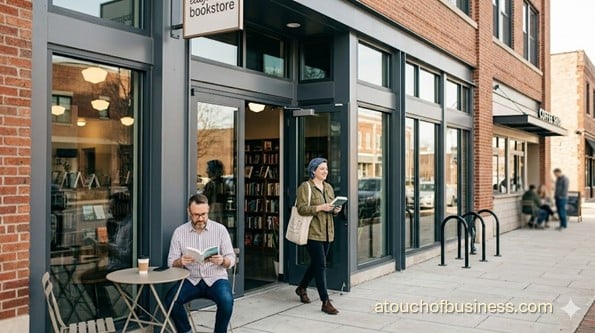
What to Expect From This Guide to Starting a Bookstore
This guide walks readers through the key decisions and practical steps involved in starting a bookstore, from testing personal and market fit to defining the concept, funding inventory, setting up retail systems, and preparing to open. The bullets highlight selected strengths within a detailed startup path.
Inside the guide, you will find:
- Startup roadmap: Follow the progression from fit and concept planning through market research, financing, inventory, store systems, staffing, and opening.
- Industry interviews: Hear bookstore operators discuss funding, locations, inventory, events, customer knowledge, online competition, and daily ownership pressures.
- Startup FAQs: Review answers about bookseller membership, distributors, trade discounts, returns, sales tax, niches, cost controls, and online sales.
- Concept and demand: Compare new, used, hybrid, niche, event, sideline, and café models while evaluating local customers and competitors.
- Financial planning: Examine thin book margins, higher-margin revenue options, startup funding, lease risk, inventory cash needs, and operating reserves.
- Inventory and systems: Plan distributor accounts, opening stock, returns, consignment agreements, ISBN-based point-of-sale software, and receiving procedures.
- Opening preparation: Check occupancy approval, payments, inventory data, staffing, supplier readiness, displays, safety items, and soft-opening plans.
Continue into the article to see how concept, inventory discipline, community appeal, and financial controls combine in a workable bookstore plan.
Independent bookstores are having a genuine resurgence. In 2025 alone, 422 new indie bookstores opened across the U.S.—a 24 percent jump from the year before, according to the American Booksellers Association.
That doesn’t mean opening one is easy. It means the market is receptive to the right concept, run by the right person, in the right location.
A bookstore is a retail business with thin margins on its core product. New books bought through wholesale distributors typically yield a gross margin of around 40 to 45 percent. After rent, payroll, utilities, and insurance, most independent bookstores operate on net margins of 2 to 10 percent. Understand that number before you sign a lease.
What makes the model work—and what drives the current revival—is that a well-run indie bookstore sells more than books. It sells an experience. Curated selections, staff recommendations, author events, community programming, and a welcoming physical space are things Amazon can’t offer. That’s where your competitive edge lives.
There are clear startup steps to follow when opening a retail business like this. But before you get into the sequence, take an honest look at whether this business fits your life and your financial situation right now.
Running a bookstore means long days on your feet, public-facing customer service, and physical inventory work—receiving shipments, shelving books, and processing returns. It also means managing cash carefully in a business where the product itself doesn’t generate much margin on its own.
Ask yourself a few direct questions. Can you cover your personal living expenses for at least 12 to 24 months while the store builds? Does your household support the risk? Are you prepared for the possibility that the store doesn’t turn a profit in its first year?
Talk to people who already own independent bookstores—in markets where you won’t compete with them. Ask how long it took to reach profitability, what they would do differently on the inventory side, and what their biggest surprise was in year one. Firsthand owner insight is worth more than any market report.
Also think about how you’ll attract customers from day one. Your customers will find you through foot traffic, local awareness, word of mouth, your Bookshop.org storefront, and the reputation you build in your community. That takes time, which is why cash reserves matter so much early on.
Most new owners weigh one of these three paths:
- Starting from scratch with a new concept and location
- Buying an existing bookstore with an established customer base and inventory system
- Exploring a franchise—though bookstore franchise options in the U.S. are very limited, and the indie revival is built on independent identity, not franchise branding
The right path depends on your budget, your timeline, your risk tolerance, and what stores are available. Buying an existing store reduces some early-stage risk, but requires careful due diligence on lease terms, inventory condition, supplier relationships, and the real reason the seller is leaving.
Red Flags Before You Start
A bookstore can be a meaningful and financially viable business. It can also drain your savings if you enter with the wrong model, the wrong location, or not enough cash. Know these warning signs before you commit.
Your store concept relies entirely on book sales:
New book sales alone, at 40 to 45 percent gross margin, aren’t enough to carry most storefront operating costs. Without sideline products, events, or a café component to lift your overall margin, breaking even is very difficult. Plan a diversified revenue model from the start.
Your projected rent will exceed 20 percent of realistic monthly revenue:
Rent is your largest fixed cost. If the space you’re targeting would consume more than 20 percent of what you can realistically sell each month, that location will work against you every month. Run the numbers before you fall in love with a space.
You don’t have enough operating capital in reserve:
Many bookstores close not because of poor sales, but because the owner ran out of cash while sales were building. You need six to 12 months of fixed operating costs in reserve on top of your startup expenses. If you don’t have that, delay your opening until you do.
Your target market is already well served:
The indie revival has created more competition in many markets. A second general-interest bookstore in a town that already has a strong local store is a harder proposition.
A clearly differentiated concept—a children’s bookstore, a genre-specific shop, a used-and-rare specialist—can succeed where another general store would struggle.
You have no retail or bookselling experience:
Passion for books isn’t enough to run a retail business. Owners without prior retail or bookselling experience make more expensive mistakes in inventory management, supplier negotiations, and cash flow planning.
Consider working in a bookstore before opening your own, or partner with someone who has that background.
Your chosen location has weak foot traffic and no complementary neighbors:
Bookstores depend on customers who walk by or choose to drive specifically to the store. A location without restaurants, coffee shops, or other specialty retail nearby works against you. Verify foot traffic patterns at different times of day and week before signing.
Step 1: Assess Fit and Talk to Owners
Before any spending, get honest about whether this business fits you—your skills, your temperament, and your financial position right now.
A typical day includes opening the store, reviewing overnight sales data, and processing incoming inventory shipments from Ingram or other distributors. You’ll also shelve and tag new stock, help customers find titles, handle special orders, process returns on slow sellers, and close out the register. On event days, add setup, hosting, and cleanup.
That’s a full physical and operational day in a low-margin business that demands financial discipline. You need to be as interested in the business side as the book side.
Seek out bookstore owners in non-competing markets and ask specific questions: How long did it take to reach break-even? What do you wish you’d known about inventory management? How do you handle publisher returns? What surprised you about your first year?
Prepare your questions before those conversations. Each owner’s path is different, but their experience is the most useful research you can do before committing.
Step 2: Define Your Concept and Business Model
Your concept drives every other decision—location, lease size, inventory budget, supplier setup, and staffing. Define it clearly before you price anything out.
Start by deciding on your inventory model:
- New books only (purchased through distributors at trade discount)
- Used books only (sourced from estate sales, library sales, and customer trade-ins)
- A hybrid of new and used
Then decide on your revenue mix:
- Books only
- Books plus sideline products: stationery, gifts, tote bags, bookmarks, merchandise
- Books plus ticketed events: author readings, writing workshops, book clubs
- Books plus a café or coffee service
These aren’t just concept decisions—they’re margin decisions. New books carry about 40 to 45 percent gross margin. Sideline gifts and stationery typically carry 50 to 60 percent. A café, if well-run, can generate 60 to 70 percent gross margins on beverages and reach 30 to 50 percent of total store revenue.
A store that sells only new books at standard margins will struggle to cover a typical retail lease and payroll. A store that pairs books with high-margin sidelines and events has a much more defensible financial model.
Finally, decide on your niche or identity:
- General independent bookstore
- Genre-focused (mystery, romance, science fiction, children’s, literary fiction)
- Used and rare books
- Community-focused or identity-driven store
A defined niche builds loyal audiences faster and creates a clearer reason for customers to choose you over Amazon. In a competitive market, a general store needs a strong location. A niche store can pull customers from a wider area.
Step 3: Validate Local Demand and Scout Your Market
Before committing to a location or spending on inventory, validate that your concept has a real customer base in the area you’re targeting.
Research local population density, median household income, proximity to schools and universities, and existing bookstores—both independent and chain. A community with no current bookstore and a strong reading culture is an opportunity. A community with three established indie stores is a tougher entry point for a general concept.
Visit your target neighborhoods at different times—weekday mornings, weekend afternoons, evenings. Count foot traffic and note the neighboring businesses. A block anchored by coffee shops, restaurants, and specialty retail draws a compatible customer.
Also verify demand for your specific concept. A children’s bookstore works best near family neighborhoods and elementary schools. A literary fiction store tends to thrive near universities and dense, walkable urban neighborhoods. Understanding local supply and demand before you commit is one of the most valuable steps you can take.
Business Plan
Write a business plan before you commit to a lease, place an opening inventory order, or take out a loan. The plan is how you catch problems on paper before they become problems in cash.
Your plan needs to cover your concept and niche, your target customer, your location strategy, your startup cost categories, your opening inventory estimate, your revenue model, and your projected monthly expenses. It also needs a break-even calculation.
The margin math is specific to bookstores. New books typically produce 40 to 50 percent gross margins. After rent, payroll, utilities, insurance, and inventory replenishment, net margins for most independent bookstores land between 2 and 10 percent.
Some well-run stores that include sideline products, events, and café service reach 8 to 15 percent net. Estimating your break-even realistically before opening is one of the most important steps you can take.
Use your plan to test these specific benchmarks:
- Rent should be no more than 8 to 12 percent of projected monthly revenue in lower-cost markets, and no more than about 20 percent in urban locations
- Combined rent and payroll should stay at or below 45 to 50 percent of revenue
- Your operating capital reserve should cover six to 12 months of fixed costs beyond startup expenses
If your numbers don’t work at these benchmarks, adjust before opening—smaller footprint, lower-cost location, or a stronger sideline revenue component.
Your plan also needs a funding section. Most new independent bookstores are funded through personal savings, small business loans, or community investment campaigns.
SBA loans, CDFI loans, and crowdfunding through platforms like Indiegogo or Kickstarter have all been used successfully by recent indie bookstore openings. Some stores have raised meaningful pre-opening capital through founding membership programs sold to community supporters.
Document your full business plan with enough detail that a lender or investor can evaluate it—and so you can use it as a benchmark once you open.
Step 4: Choose a Legal Structure and Register the Business
Most new independent bookstores form as limited liability companies (LLCs). An LLC provides personal liability protection and tax flexibility without the complexity of a corporation.
Register your LLC with your state’s Secretary of State office and pay the required filing fee. If you’re operating under a store name that differs from your legal business name, you’ll also need to file a DBA—Doing Business As—registration with your state or county.
Apply for an EIN—Employer Identification Number—through IRS.gov at no cost. You need it for taxes, business banking, and most permit applications, even if you’re starting without employees.
Set up these financial accounts before placing any business orders:
- A dedicated business checking account
- A business credit card for vendor payments and inventory reorders
- A merchant account or POS-integrated payment processor
Keep business and personal finances completely separate from day one. Mixing the two creates accounting problems and undermines your liability protection.
Step 5: Complete Legal and Compliance Requirements
Bookstores are standard retail businesses. The compliance requirements are well-defined, but they vary by state and locality. Work through each category before opening.
At the federal level:
- EIN from the IRS (free; apply at IRS.gov)
- I-9 employment eligibility verification if hiring employees
- Federal Wage and Hour Law (FLSA) compliance if you have staff
No federal product license is required to sell books.
At the state level:
- Seller’s permit or sales tax permit—required in most states before your first sale; apply through your state Department of Revenue
- Resale certificate—allows you to purchase book inventory through distributors without paying sales tax at the time of purchase
- State income or franchise tax registration—varies by state
- State employer tax accounts and unemployment insurance registration if you hire staff
- Workers’ compensation insurance if required—verify your state’s threshold
The sales tax question deserves a direct call to your state:
Some states tax print books at the standard sales tax rate. Others exempt them or apply reduced rates. Confirm your state’s book-specific rules before you configure your POS and pricing.
At the city and county level:
- General business license from your city or county clerk’s office
- Zoning confirmation that the retail space is approved for general retail use
- Certificate of occupancy confirming the space is safe and approved for your use
- Exterior sign permit if your signage requires one (varies by jurisdiction)
- Food service license and health department permit if you’re adding café or beverage service
- Fire safety inspection if required for a new retail tenant (varies by jurisdiction)
Contact your city’s Planning and Zoning Department to verify zoning before signing a lease. Confirm the certificate of occupancy situation with the Building Department—if you’re doing a build-out, you’ll likely need a new inspection.
For a full overview of what business licenses and permits typically apply to a new retail business, review the requirements specific to your state and county.
Step 6: Secure Financing
Confirm your total startup funding before signing a lease or placing an opening inventory order. The two biggest financial mistakes new bookstore owners make are underestimating operating costs and not reserving enough cash to survive the slow early months.
Startup funding typically needs to cover:
- Lease deposit (often first month, last month, and a security deposit)
- Leasehold improvements (shelving, lighting, flooring, checkout counter, accessibility upgrades)
- Fixtures and furniture (shelving units, display tables, seating, counter)
- POS system hardware and software
- Opening inventory (books and sideline items)
- Signage (interior section labels and exterior store sign)
- Legal, registration, and permit fees
- Insurance premiums
- Pre-opening staff training costs
- Professional fees (attorney for lease review, accountant for initial setup)
- Operating capital reserve: six to 12 months of fixed costs
Funding options used by recent indie bookstore owners include personal savings, SBA and conventional small business loans, CDFI community loans, crowdfunding campaigns, and pre-opening founding membership programs. Some stores have combined several of these sources.
Do not sign a lease until your funding is confirmed. A lease is a multi-year obligation. Signing one without secured capital puts the store at risk before it opens.
Step 7: Find, Evaluate, and Lease Your Space
Your location is one of the most consequential decisions you’ll make. It affects foot traffic, rent burden, store atmosphere, and how easily customers can find you. Make this decision after your business plan is complete and your financing is in place.
A small independent bookstore typically operates in 1,000 to 3,000 square feet. A well-organized 1,500-square-foot space can hold roughly 10,000 books, a checkout counter, a browsing area, and some seating. Every additional foot needs to earn its cost—more square footage means more shelving, more inventory, more staff, and more rent.
Look for these location characteristics:
- Steady foot traffic from pedestrians or regular destination shoppers
- Complementary neighboring businesses: coffee shops, restaurants, gift stores, specialty retail
- Good storefront visibility from the street with natural light if possible
- Adequate parking for customers who drive
- ADA-accessible entry and layout
- A space that suits the atmosphere you want to create—cozy, well-lit, browsable
Review every lease term before signing. Pay close attention to base rent and escalation clauses, whether the lease is gross or triple-net, the tenant improvement allowance, the permitted uses clause, and the exit conditions.
Have an attorney review the lease before you sign it. The legal review cost is small compared to what a bad lease clause can cost you over a multi-year term.
Confirm zoning and the certificate of occupancy before signing. Don’t assume the space is approved for retail—verify it with the Building Department.
Step 8: Build Out the Store
Once your lease is signed, plan and complete the build-out. Your goal is a space that functions well operationally and feels like a place customers want to spend time in—because dwell time and browsing lead directly to sales.
Standard build-out tasks for a bookstore storefront include:
- Shelving installation (adjustable shelving preferred; standard depth 8 to 10 inches for paperbacks, 10 to 12 inches for hardcovers)
- Display tables for face-out featured titles
- Checkout counter with barcode scanner, receipt printer, and cash drawer
- Lighting (warm track or pendant lighting over display areas)
- Interior section signage and wayfinding
- Storage and back-office space for receiving and returns
- ADA-compliant entry, aisles, and restroom access
- Window display area for street visibility
Plan your store layout—called a planogram in the trade—before the shelving goes in. Decide where each section lives, how customers will move through the space, and where the checkout counter will sit. A well-planned floor keeps sightlines open and draws customers toward your featured displays.
If you’re adding a café, budget for plumbing, ventilation, café counter construction, and health department inspection separately. A café build-out requires licensed contractors for the mechanical work and adds meaningful complexity to your timeline.
Good lighting, organized sections, browsable seating, and thoughtful visual merchandising aren’t decoration—they’re part of why customers choose you over ordering online.
Step 9: Set Up Supplier and Distributor Accounts
Your book supply chain starts with your wholesale distributor account. Get this set up early—you’ll need it before you can place your opening inventory order.
For new books, Ingram Content Group is now the primary U.S. wholesale distributor for independent bookstores. Baker & Taylor, previously the second-largest distributor, ceased operations in late 2025 and filed for Chapter 11 bankruptcy in early 2026. Ingram has absorbed most of that business. Set up your Ingram account before anything else.
Additional supplier accounts to establish before opening:
- Independent Publishers Group (IPG)—the second-largest independent distributor in the U.S.
- Publishers Group West (PGW)—an Ingram-owned distributor with a strong independent press catalog
- Individual publishers for direct ordering where possible, especially for niche or specialty titles
Understand how trade terms work before you place orders. Most new books purchased through Ingram and major publishers are returnable under standard trade terms. Books that don’t sell within 90 to 180 days can typically be returned for credit.
You pay return shipping, so build that into your cost planning. Set up a regular return schedule from the start and stick to it. Dead stock on your shelves is frozen cash.
For used books, your sourcing system works differently. Estate sales, library book sales, community book drives, and customer trade-in programs are the primary channels. You buy used inventory at low cost and price it at 20 to 50 percent of original cover price depending on condition and demand.
For local and independent authors, consignment arrangements are standard. The author or small press supplies the books, you sell them, and you pay the supplier after each sale—typically on a 60/40 split. Unsold copies go back to the supplier at no cost to you. Put consignment terms in writing before placing any inventory on the floor.
Consider joining the American Booksellers Association (ABA) early in this process. ABA membership gives you access to the ABACUS financial benchmarking program, educational resources, a new-owner series, negotiated business services, the Booksellers Insurance Program, and qualification for the Bookshop.org storefront affiliate account.
Step 10: Select and Set Up Your POS System
Your point-of-sale (POS) system is the operational center of your bookstore. Don’t use a generic retail POS. You need a system built for ISBN-based inventory management.
Books are identified by their ISBN—a unique 13-digit code on every book’s barcode. A bookstore-specific POS auto-populates the title, author, publisher, format, and price the moment you scan the barcode. This saves hours of manual data entry when receiving shipments and processing sales.
Bookstore-specific POS systems used by independent booksellers include:
- Booklog—40-plus years serving independent booksellers, used by more than 2,100 stores
- IBID—browser-based POS and inventory control for single or multi-location stores
- Basil—bookstore-first POS with built-in purchase ordering and fast barcode receiving
- Bookmanager—inventory management, purchase ordering, returns, gift cards, and loyalty programs
Your POS system needs to handle all of these functions:
- ISBN barcode scanning at checkout and during receiving
- Real-time inventory tracking by section, genre, author, and publisher
- Purchase order creation directly to Ingram and other distributors
- Return processing and return-to-distributor tracking
- Customer wish lists and special order management
- Gift card processing
- Sales reporting by category, time period, and title
- Event ticket sales if you’re hosting ticketed events
Install and configure your POS system before your opening inventory arrives. Load your opening inventory into the system as you receive and shelve it so you can track stock and process sales from your first transaction.
Step 11: Order and Receive Your Opening Inventory
Your opening inventory is a large upfront cash commitment. Order too much and you tie up cash in slow-moving titles. Order too little and your store looks sparse. Get this right before opening day.
A typical small independent bookstore opens with 5,000 to 10,000 books covering backlist staples, current bestsellers, new releases, and niche-specific titles. Your planogram should drive your order. Order to fill the shelves you have, not the shelves you might want someday.
A practical opening inventory framework:
- About 60 percent niche or mission-focused titles—the books your store is known for
- About 20 percent proven bestsellers and backlist staples that every general reader expects to find
- About 20 percent current new releases and locally relevant titles
If this is your first time placing a large opening order, consider working with a professional book buyer or bookstore consultant. The Bookstore Training Group and ABA education resources include guidance on opening inventory planning.
An experienced buyer can help you avoid over-ordering in slow categories while under-ordering in your core sections—a costly mistake that’s hard to fix once the store opens.
Also order your opening sideline inventory at this stage if your model includes gifts, stationery, tote bags, or bookmarks. These items come from different suppliers and may need additional lead time.
As you receive shipments, check in every title against the purchase order, scan each ISBN into your POS, apply price labels, and shelve according to your planogram. Build this receiving process into your pre-opening timeline—it takes more time than most new owners expect.
Step 12: Get Business Insurance in Place
Your store needs insurance before it opens. Don’t open to the public without it.
The American Booksellers Association runs the Booksellers Insurance Program (BIP), formerly known as LIBRIS. It’s a purpose-built program covering independent bookstores in all 50 states—a practical starting point because it’s designed specifically for this type of business.
Core coverage a bookstore storefront needs:
- General liability—covers customer injuries, property damage, and advertising-related claims
- Commercial property—covers your book inventory, shelving, fixtures, and POS equipment against fire, theft, vandalism, and covered events
- Business interruption—covers lost income if a covered event forces a temporary closure
- Workers’ compensation—required by most states if you have employees; verify your state’s threshold
Additional coverage to evaluate based on your store:
- Cyber liability—important if you’re processing payment data or maintaining customer records
- Inland marine—for rare or collectible books with high individual value
- Flood insurance—standard commercial property policies don’t cover flood damage; buy this separately if you’re in a flood-risk area
Check your lease before finalizing your policy. Most commercial landlords require a minimum level of general liability coverage as a lease condition and may need to be listed as an additional insured.
For more on what business insurance typically covers and how policies are structured, review your options before your first quote conversation.
Step 13: Hire and Train Your Staff
Determine your staffing needs based on your store’s square footage, operating hours, and concept before you open. A typical 1,500-square-foot bookstore needs two to three full-time equivalents, including yourself, to keep the sales floor covered and run daily operations.
Hire enough staff so you’re not the only person on the floor at all times. On opening week, you’ll need coverage to manage receiving, vendor calls, and the inevitable problems that come with a new operation.
Bookstore staff need to know your inventory well enough to make recommendations. Hand-selling—personally recommending a book based on what a customer is looking for—is one of the most powerful tools an independent bookseller has. Budget time before opening for staff to read and familiarize themselves with your sections.
Complete all employment paperwork before your first employee’s first day:
- Federal employer tax accounts (FICA, federal unemployment)
- State employer tax withholding and unemployment insurance accounts
- I-9 employment eligibility verification for each employee
- Required labor law posters displayed in the employee work area—varies by state
For guidance on when and how to hire your first employees, review both federal and state requirements before making any hiring decisions.
Step 14: Set Up Your Bookshop.org Storefront and Web Presence
Before opening day, establish two things: your Bookshop.org affiliate storefront and a basic web presence with your store’s address, hours, phone number, and a short description of your concept.
Bookshop.org is an online bookstore with a mission to support independent booksellers. ABA-member bookstores with a physical storefront can set up a Bookshop.org affiliate page and earn approximately 30 percent of the cover price on every sale made through their page—without managing inventory, shipping, or returns. This is a meaningful supplemental sales channel available from day one at no inventory cost to you.
Your Bookshop.org affiliation also lists your store on their Find a Bookstore map, which helps local customers discover you. You’ll need your ABA membership active to qualify for the bookstore affiliate tier.
Also decide before opening whether you’ll accept special orders—ordering a specific title for a customer who requests it. Most indie bookstores offer this. It builds loyalty and differentiates you from the “in stock now or wait a week for shipping” experience of online retail.
Step 15: Run Pre-Opening Checks and Prepare for Opening Day
Before you open to the public, work through every item on your pre-opening checklist. Opening with something missing—a permit, a supplier account, a POS configuration—creates problems you’ll have to solve while also serving customers.
Confirm all of the following before opening day:
- All permits and licenses in place (seller’s permit, business license, certificate of occupancy, sign permit)
- Business insurance active and landlord requirements met
- All supplier accounts open (Ingram, IPG, and others as needed)
- Opening inventory received, checked in, and shelved
- POS system fully configured, loaded with inventory, and tested for payment processing
- Payment processing active—test credit, debit, contactless, and gift card transactions
- Staff scheduled and trained for opening week
- Required labor law posters in place if you have employees
- Exterior signage installed and visible from the street
- Interior section signage, staff picks display, and new arrivals display ready
- Consignment agreements signed for any local author or small press titles on the floor
- Return policy posted or available at the checkout counter
- Cash register starting float counted and confirmed
- Fire extinguisher in place and inspected; first aid kit stocked
- Bookshop.org affiliate page live
- Store website live with address, hours, and store description
Consider a soft opening—an invite-only preview event for community members, friends, and local press—a few days before your public opening. Soft openings let you work out operational issues while serving a forgiving crowd and generate early word of mouth.
Opening-Day Red Flags
A few problems are common enough in bookstore openings that they’re worth checking specifically before you unlock the front door.
Your POS isn’t loaded with opening inventory:
If you open before your inventory is entered into your POS system, you can’t track what you’re selling, can’t process returns accurately, and lose the real-time data that drives your reorder decisions. Don’t open to the public with manual transaction tracking as a workaround.
Your staff picks display is empty:
The staff picks display—handwritten recommendations from you and your team—is one of the most important visual differentiators between a true independent bookstore and a generic book retailer. Have it ready before the doors open.
Your Ingram account isn’t active or your first order hasn’t arrived:
Opening with insufficient stock looks worse than delaying your opening by a week. Sparse shelves signal a store that isn’t ready. Confirm your opening inventory has been fully received and shelved before you invite the public in.
You don’t have a payment backup plan:
POS and internet outages happen. Know what you’ll do if your payment processing goes down on opening day. A manual backup process—or an offline payment mode in your POS system—prevents you from turning away customers during your highest-profile week.
You haven’t confirmed your certificate of occupancy:
Opening a retail space to the public without a valid certificate of occupancy is a compliance violation in most jurisdictions. Confirm it is in place—not pending, not assumed—before you open. Check with your local Building Department.
Your consignment titles aren’t covered by a signed agreement:
Any local author or small press titles on consignment need a signed agreement specifying the split, the payment schedule, and the return process before they go on the floor. Selling consignment inventory without a written agreement creates disputes that damage your local relationships.
Frequently Asked Questions
Do I need to be an ABA member to open an independent bookstore?
ABA membership isn’t legally required to open. But it provides practical startup benefits most new owners find valuable.
These include access to ABACUS financial benchmarking data, educational programs, negotiated business services, the Booksellers Insurance Program, and qualification for the Bookshop.org storefront affiliate program.
Can I order books directly from publishers, or must I use a distributor?
You can contact publishers directly, but most major publishers will refer new accounts to a wholesale distributor rather than setting up direct relationships.
Ingram Content Group is now the primary wholesale distributor for independent bookstores, following the closure of Baker & Taylor in 2025–2026. Independent Publishers Group and Publishers Group West are also important sources for independent and specialty titles.
What is the standard trade discount for new books through a distributor?
Independent bookstores typically receive a trade discount of approximately 40 to 46 percent off the cover price when purchasing through major wholesale distributors.
On a book with a $20 cover price, you pay roughly $11 to $12. That’s your gross margin per copy before any operating costs.
Can I return unsold new books to the publisher or distributor?
Yes. Most new books purchased through publishers and major distributors under standard trade terms are returnable.
The typical return window ranges from 90 to 180 days or longer for some titles. You generally pay return shipping. A disciplined return schedule for slow-moving titles protects your cash flow and keeps shelf space productive.
Do I need to collect sales tax on book sales?
Most states require retail businesses to collect sales tax. However, the tax treatment of books specifically varies by state—some tax print books at the standard rate, while others exempt them.
Register for a seller’s permit with your state Department of Revenue before your first sale, and confirm how your state classifies and taxes books.
How important is a niche or specialty focus for a new independent bookstore?
A defined niche builds loyal audiences faster and gives customers a clear reason to seek you out specifically.
Genre-specific stores, children’s bookstores, and identity-driven stores attract repeat customers who feel the store was built for them. A general store can work in underserved markets, but in competitive markets, a defined identity is a meaningful advantage.
What are the most important costs to control after opening?
Rent as a percentage of monthly revenue is the most critical number to watch. Target no more than 8 to 20 percent of projected revenue, depending on your market.
Combined rent and payroll should stay at or below 45 to 50 percent of revenue. Inventory discipline—disciplined ordering, active return of slow-moving titles, and tracking turnover—is the third key control.
Is Bookshop.org something I should set up before opening?
Yes. ABA-member bookstores with a physical storefront can establish a Bookshop.org affiliate page before opening day.
You earn approximately 30 percent of the cover price on each sale through your page. Bookshop.org handles fulfillment and returns. You get an online sales channel and a listing on their Find a Bookstore map from day one.
Insights From People Running Bookstores
These interviews share real-world lessons from people already running bookstores. Readers can learn about choosing a location, building inventory, understanding customers, managing events, competing with online sellers, and dealing with the daily pressure behind a bookshop that looks simple from the outside.
Interview with Naomi MacKinnon, an Independent Bookstore Owner
This written interview with Naomi MacKinnon of The Happy Duck Bookshop & Readery covers opening a brick-and-mortar shop, funding choices, used-book inventory, fear, family help, and the fast push from lease signing to opening.
Behind the Scenes of Opening a New Indie Bookstore
This podcast interview with the founders of The Book & Cover explains financing, choosing a location, learning local reading tastes, building inventory, using social media, and balancing the shop with other responsibilities.
Behind the Books: A Conversation with Independent Bookstore Owner Annie B. Jones
This written interview with Annie B. Jones of The Bookshelf in Thomasville discusses buying into an existing bookstore, daily operations, staffing, accounting, marketing, event planning, and the misconceptions people have about owning a bookshop.
Q&A with Brain Lair Books Founder Kathy Burnette
This Q&A with Kathy Burnette explains how she moved from librarian to bookstore founder, used a business support program, built a mission around inclusive books, and learned the importance of community support.
An Interview with Emily Arsenault, Owner of Dog Eared Books
This written interview with Emily Arsenault covers new and used inventory, trade-ins, local author support, community events, competing with online retailers, and turning a bookstore into a gathering place.
Bart’s Books: An Interview with Matt Henriksen
This Q&A with Bart’s Books general manager Matt Henriksen discusses the bookselling business, useful traits for bookstore operators, retail knowledge, online marketplaces, tourism, off-site sales, and community involvement.
How I Started My Bookshop With Public Knowledge Books
This interview with Bryony Lloyd of Public Knowledge Books covers opening a specialist bookshop, using customer conversations as field research, choosing a niche, selecting stock, and connecting the retail side with distribution.
How A Family Bookstore Became A City Landmark
This podcast interview with Andrea and Jordan Minter of Russell Books discusses managing a high-volume bookstore, handling new and used books together, estate buying, trade-ins, inventory systems, regular customers, and the browsing experience.
This written Q&A with Nic Bottomley and bookseller Danielle from Mr B’s Emporium of Reading Delights covers starting without retail experience, creating a distinct shop experience, customer service, book recommendations, and challenges from online competition.
Interview with YA Bookstore Owner Annabelle Chang
This interview with Annabelle Chang of Annabelle’s Book Club LA covers moving from online recommendations to pop-up events and then a physical YA-focused bookstore, with useful insight into niche positioning and store design.
Related Articles
- How To Start a Book Subscription Service
- How To Start a Comic Book Store Business
- How To Start an Educational Toy Store
- How To Start a Local Toy Store Business
- How To Start a Hobby Store
Sources:
- American Booksellers Association: ABA Education for Booksellers, ABA Membership Benefits, Booksellers Insurance Program
- Fast Company: Indie Bookstore Revival 2025
- Bisnow: Bookstore Comeback Story
- U.S. Chamber of Commerce: Modern Bookstore Revival
- BusinessDojo: Bookstore Market Trends 2025, Bookstore Profit Margin, Bookstore Profitability, Bookstore Insurance Cost, Bookstore Square Footage
- PlanBuildr: Bookstore Profitability Guide, Bookstore Inventory Strategy
- Distribution Strategy Group: Baker & Taylor Chapter 11 Filing
- Authors Guild: Baker & Taylor Closure Impact
- Nonfiction Authors Association: Book Distributors and Wholesalers List
- Bookshop.org Support: Bookshop.org Indie Bookstore Program
- Insureon: Bookstore Insurance Overview
- UpCounsel: Retail Business Legal Requirements
- LegalClarity: Retail License Steps and Requirements
- Merchant Maverick: Best Bookstore POS Systems
- Booklog: Booklog POS for Independent Booksellers
- Homebase: How to Open a Bookstore Café
- Bizfluent: Buying Books for a New Bookstore
- Bookstore Training Group: Bookstore Opening Inventory Guide
- Empower: Bookstores: Industry Outlook 2025