
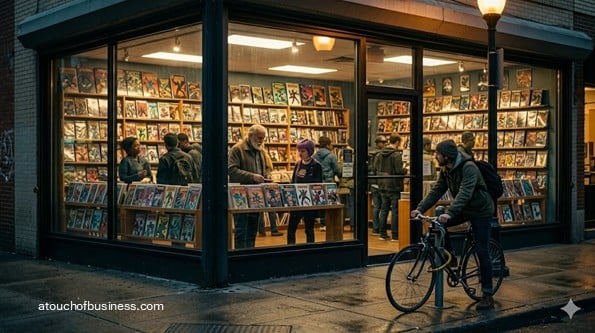
What to Expect From This Guide to Starting a Comic Book Store
This guide walks readers through the major decisions and ordered steps involved in starting a comic book store, from assessing personal finances and local demand to choosing inventory, establishing distributor accounts, setting up retail systems, securing a location, and preparing the shop to open.
Inside the guide, you will find:
- Startup roadmap: Progress from owner fit and concept planning through registration, location, distributors, systems, insurance, build-out, and opening checks.
- Retailer interviews: Hear comic shop owners discuss inventory, locations, staffing, ordering, margins, customer service, events, and business discipline.
- Startup FAQs: Review answers about distributors, non-returnable inventory, pull lists, margins, secondhand sales, software, and startup funding.
- Inventory planning: Compare product mixes while considering weekly releases, graphic novels, manga, back issues, collectibles, gaming products, and ordering risk.
- Market and location: Evaluate local fan activity, competition, visibility, parking, transit, zoning, event capacity, and suitable store space.
- Financial planning: Examine fixed costs, operating capital, subscriber growth, unsold stock, distributor terms, freight, payment systems, and funding options.
- Opening preparation: Confirm active supplier accounts, tested comic-store software, pull-list procedures, permits, insurance, stocked displays, hours, and staff training.
Continue with the guide to see how comic retail enthusiasm must connect with disciplined ordering, reliable systems, and realistic finances.
Comic Book Store Overview
As a comic book store owner, you run a specialty retail shop where customers find new weekly releases, graphic novels, manga, back issues, collectibles, and related merchandise.
Your customers aren’t just shoppers. They’re collectors, subscribers, and fans who come back every week—sometimes every Wednesday, the day new comics hit shelves.
That loyalty is one of the business’s real advantages. But it takes time to build, and the path from opening day to a healthy subscriber base requires careful planning and solid financial footing.
If you love comics and you’re drawn to running a community gathering place for fans, this could be the right business for you. Going in with clear eyes matters more than enthusiasm alone.
Before you commit to a lease, take time to understand the full picture—the steps to start a business, the margins, and the operational demands of specialty retail.
Is This Business a Good Fit for You?
Running a comic book store means managing inventory weekly, making ordering decisions under tight deadlines, and keeping fixed hours whether foot traffic is good or not.
Ask yourself whether you want to run a retail business—or whether you mainly want to be around comics all day. This business rewards discipline as much as passion.
You’ll need to cover rent, payroll (if you hire), insurance, distributor invoices, and your own personal expenses—often for months before the store pays you regularly.
Before going further, think through these fit questions:
- Can you cover your household expenses during a long startup period without drawing a salary from the store?
- Do the people in your household understand and support the financial and time commitment involved?
- Are you comfortable making high-stakes inventory decisions every week, knowing unsold stock can’t be returned?
- Do you have enough knowledge of publishers, titles, and characters to advise collectors and earn their trust?
- Can you handle the pressure of a niche retail business in a landscape that includes online competitors and digital subscription services?
There’s real upside here. A well-run store with a loyal subscriber base and a strong collectibles section can be profitable and deeply rewarding.
Owning a business is harder than it looks from the outside, and a comic store carries specific risks tied to its unique ordering model.
Talk to comic store owners in other cities—people who won’t compete with you—and ask them directly what they wish they had known.
Real owner conversations will sharpen your expectations in ways no article can. Prepare a list of questions before those calls. Ask about margins, pull list growth, the first year’s cash pressure, and how they handled distributor disruptions.
Each owner’s journey is different, but their experience is genuinely useful. Don’t skip this step.
Red Flags Before You Start
Some warning signs are personal. Others are structural—meaning they reflect the nature of the industry itself, not just your situation.
Pause or reconsider if any of these apply:
- There’s already a well-run comic store in your trade area with an active subscriber base and community programming—entering the same market gives customers little reason to switch.
- Your local area has low foot traffic, no visible fan community activity (conventions, game nights, collector groups), and no complementary businesses nearby.
- You can’t fund several months of fixed costs—rent, insurance, utilities, and staffing—before the store reaches sustainable sales volume. Undercapitalization is one of the main reasons new stores close.
- You’re planning to survive on new comics margins alone. After distributor discounts, freight, bags, boards, and overhead, those margins are thin. Higher-margin back issues, collectibles, and merchandise are structurally important to profitability.
- You don’t have a realistic plan for differentiation—a reason customers would choose your store over an existing competitor or an online retailer.
There are also industry-level realities to understand before committing:
- As of this article’s last update, comic distribution is no longer something a new store owner should assume will run through one dominant source. Diamond Comic Distributors, long the industry’s primary distributor, filed for bankruptcy in early 2025, and the market has become more fragmented. Before opening, verify which distributors currently serve the publishers and product lines you want to carry, since you may need to manage multiple accounts, ordering systems, terms, and supplier relationships.
- Digital subscription services such as Marvel Unlimited and DC Universe Infinite, along with online retailers such as Amazon, eBay, TFAW, and Midtown Comics, compete directly for print readers and graphic novel buyers. A physical store’s strongest advantages are community, expertise, and access to back issues and collectibles those channels can’t replicate.
- The direct market’s non-returnability rule means you absorb the full cost of unsold inventory. Accurate ordering is a skill that takes time to develop, and early mistakes are expensive.
These aren’t reasons to walk away automatically. They are facts to plan around before you sign a lease.
Step 1: Assess Your Fit and Personal Finances
Before you research locations or think about inventory, get clear on your personal financial reality.
List your fixed household expenses and any existing debt. Understand exactly how much the store needs to pay you—and by when—to keep your personal situation stable.
Customers notice whether a store feels well-resourced or stretched thin. A shop that opens underfunded often shows it in sparse shelves, inconsistent hours, and stressed service.
If your savings can carry you through a realistic startup period, that’s a strong foundation. If not, factor in the time needed to build capital or explore funding before committing.
This is also the moment to reflect on why you want to own this business—not just love comics, but own and operate a store. Passion helps when the early months are hard. It works best when paired with financial preparation and realistic expectations.
Step 2: Talk to Non-Competing Store Owners
Find comic store owners in markets you won’t compete with and reach out directly. Ask for a short conversation.
Most experienced owners are willing to share if you approach them genuinely and respectfully. Prepare your questions before the call.
Good questions to ask include:
- How long did it take to build a pull list base large enough to order confidently?
- What did you wish you had understood about distributor terms and freight charges before you opened?
- What was your biggest early inventory mistake?
- How long before the store covered its own fixed costs?
- What would you do differently if you were starting today?
Every owner’s story is different, but patterns emerge across conversations. Those patterns are some of the most valuable research you can do.
Step 3: Define Your Store Concept and Product Mix
The product mix decision is one of the most consequential choices you’ll make. It shapes your space requirements, startup capital needs, distributor relationships, and the type of customer you’ll attract.
Common product mix directions include:
- New weekly releases plus a strong graphic novel and manga section—the most common model for a full-service local comic shop
- Back issues and collectibles focus—higher margins but requires strong sourcing relationships and collector knowledge
- Mixed model combining new releases, back issues, collectibles, and tabletop gaming products—broadest customer base and margin mix, but higher startup investment
Collectors will judge your back-issue selection quickly. Casual readers will notice whether your graphic novel section is organized and browsable. Weekly subscribers will care about whether you carry their titles reliably.
Decide early whether you’ll buy used comics and collections from walk-in sellers. Purchasing from the public adds a valuable higher-margin inventory stream—but it also triggers secondhand dealer licensing requirements in many cities and states. That’s a compliance step to verify before you begin.
Also decide whether to include tabletop gaming and trading card products. These typically carry higher margins than new comics and attract a broader customer base.
Step 4: Research Local Demand and Competition
Walk or drive the area where you’re considering opening. Count nearby comic stores, game shops, bookstores, and coffee shops. Pay attention to evening foot traffic, parking, and transit access.
Look for signs of local fan community activity: conventions, tabletop game nights, collector groups, and pop culture events. These signal the kind of customer base a comic store depends on.
Check whether any existing local stores have recently closed, which could indicate a gap in the market—or whether well-run existing stores have loyal followings that would make subscriber competition difficult.
Use what you learn to validate (or question) your store concept before spending money on a lease or inventory. Understanding local supply and demand is a go/no-go decision, not just background research.
Step 5: Weigh Starting vs. Buying an Existing Store
An existing comic store may come with real advantages: an established subscriber base, active distributor accounts, a proven location, and existing fixtures and display cases.
If you buy an existing store, verify the quality of the inventory, the health of the pull list base, the state of supplier relationships, and why the current owner is selling.
Starting from scratch gives you full control over concept, product mix, layout, and customer experience—but you build the subscriber base from zero, which creates ordering uncertainty in the early months.
The right path depends on your budget, timeline, risk tolerance, and what’s available in your market. Read about the decision between starting and buying a business before committing either way.
Business Plan
A business plan turns your concept into a structured decision-making tool—and it’s a requirement if you plan to seek a loan.
Use it to document your store concept, product mix, distributor setup plan, cost planning items, staffing decisions, and the operating capital needed to stay open through the early months.
The most important financial exercise to complete before signing a lease is your break-even analysis. Estimate your average transaction value, the number of daily transactions needed to cover fixed costs, and what margin each major product category generates.
New comics generate thin margins after freight, bags and boards, and overhead. Back issues, collectibles, and gaming merchandise carry significantly higher margins.
If the math only works at high customer volume from month one, that’s a warning sign. Plan for a slower ramp-up and make sure your operating capital can cover the gap.
Weekly subscribers are your most reliable revenue. Build your plan around a realistic subscriber growth projection, not a best-case assumption.
Slow periods are real in this business—and the direct market’s non-returnability rule means unsold inventory from a slow month doesn’t come back as a credit. Build that reality into your cash flow planning.
Use this guide alongside the business plan resource and the profitability and revenue estimation guide to build projections from your own local costs and realistic assumptions.
Step 6: Choose a Legal Structure and Register the Business
Most single-owner comic stores start as a limited liability company (LLC), which separates your personal assets from business debts and liabilities.
Sole proprietorships are simpler to form but offer no personal asset protection. Partnerships and corporations apply when multiple owners or outside investors are involved.
The right structure depends on your risk tolerance, tax situation, and long-term plans. An accountant or business attorney can help you choose before you file. Read about business structure options to understand the tradeoffs.
Register the entity with your state’s Secretary of State. If you plan to operate under a store name that differs from your legal entity name, register a DBA (doing business as). Learn more about how to register a business and how to register a DBA.
Apply for an Employer Identification Number (EIN) through the IRS. The EIN is free, applied for online, and required for business banking, tax filing, distributor account setup, and payroll. Get your business tax ID here.
Step 7: Register for Taxes and Obtain Required Permits
A state sales tax permit—also called a seller’s permit or resale certificate—is required before your first sale in virtually every state.
This permit lets you collect sales tax from customers and purchase inventory from distributors tax-free using a resale certificate. Apply through your state’s Department of Revenue or Department of Taxation before you open accounts with any distributor.
Most cities and counties also require a general business operating license for retail businesses. Check with your city or county clerk’s office or business licensing office for what’s required in your jurisdiction.
If you plan to buy used comics from the public, check this first: Many states and cities require a secondhand dealer license or used goods permit for businesses that purchase items from individuals.
Requirements often include record-keeping, holding periods, and in some jurisdictions, reporting transactions to local law enforcement. Check with your state’s consumer affairs or business licensing agency and your city or county office before you begin purchasing from walk-in sellers.
If the store will play background music, you’ll need a blanket music license from a performance rights organization—ASCAP, BMI, or SESAC. Contact them directly. This isn’t a government permit, but it is a copyright compliance requirement.
Learn more about business licenses and permits to understand what to look for at each level of government.
Step 8: Find and Secure Your Location
Location is one of the highest-stakes decisions in this startup. Customers won’t find you if you’re hidden, hard to park near, or in the wrong part of town for your target buyers.
What customers notice first when considering a new comic store:
- Whether they can see the store from the street or parking lot
- Whether there’s easy parking or convenient transit access
- Whether the storefront looks like a place they’d feel welcome
- Whether the neighborhood feels like somewhere they’d come back to regularly
Before signing any lease, confirm with the local planning or zoning department that the space is zoned for general retail use. Get that confirmation in writing.
Some mixed-use zones that appear to allow retail have conditions on hours, use types, or event hosting that could restrict what you want to do.
If you plan to host in-store events—game nights, signing events, release parties—verify that the space’s occupancy classification covers assembly use. High-attendance events may trigger stricter building code requirements in some jurisdictions.
Check whether the space has a current certificate of occupancy (CO) for retail use. A CO is issued after fire, building, and sanitation inspections. Don’t open before one is issued if your jurisdiction requires it.
When you negotiate the lease, pay attention to tenant improvement allowance (TI), rent abatement during build-out, base rent, lease length, and renewal options.
Think through the physical space requirements of the product mix you’ve chosen. A store emphasizing new releases and graphic novels needs different shelving density than one with deep back-issue bins and display cases for collectibles. Plan the layout before committing to a square footage.
Step 9: Set Up Distributor Accounts
Comic retail should not be planned around the assumption that one distributor will handle everything. As of this article’s last update, Diamond Comic Distributors, long the industry’s primary distributor, had filed for bankruptcy, and the direct market had become more fragmented.
Before opening, verify which distributors currently serve the publishers and product lines you want to carry. Depending on your inventory mix, you may need separate accounts with distributors such as Lunar Distribution, Penguin Random House Publisher Services, Universal Distribution, or other suppliers.
Do not rely on old distributor lists when planning your store. Publisher rosters, ordering systems, discount terms, shipping rules, and account requirements can change, so confirm the current details directly with each distributor before you build your buying process.
Expect distributors to ask for proof that you operate a legitimate retail business. This may include a business address, business registration, tax ID, resale certificate, seller’s permit, or a signed retailer agreement, depending on the distributor and your location.
Review freight charges, fuel surcharges, order minimums, and payment terms before making financial projections. These costs can affect your margin, especially on lower-priced items such as individual comic issues.
For collectible merchandise, action figures, tabletop gaming products, and related inventory, you may need wholesale accounts outside your comic distributors. Verify what each supplier requires before you apply.
Weekly subscribers notice quickly when a store can’t reliably carry their titles. Getting the right distributor relationships in place before opening is one of the most important pre-launch steps you’ll take.
Step 10: Understand the Direct Market Ordering Model
The direct market has a defining rule every new owner must understand before placing a single order: comics ordered through distributor accounts cannot be returned if they go unsold.
You pay for what you order. If it sits on the shelf, you absorb the cost.
Orders for upcoming releases are placed weeks in advance. The Final Order Cutoff (FOC) is the weekly deadline by which you must submit final quantities—after that point, quantities can no longer be adjusted.
Collectors and subscribers will notice immediately if a key issue sells out because you under-ordered. They’ll also notice if your shelves look overloaded with titles nobody’s buying. Both are costly mistakes that start with the ordering decision.
A pull list—also called a pull-and-hold service—is the core tool for managing this risk. Customers subscribe to specific titles, and you reserve their copies each week.
Their subscriptions tell you the minimum number of copies you need before you order any additional shelf copies. Building a pull list base before opening reduces the guesswork in those first weeks when you have no sales history to guide your orders.
Step 11: Choose and Set Up Your Point-of-Sale System
A general-purpose retail POS system won’t work well for a comic store. The workflows are too specific: pull list management, multi-distributor ordering, FOC deadline tracking, variant cover inventory, and back-issue database management all require tools built for this industry.
Specialized options designed for comic retailers include Comic Shop Assistant, ComicHub, ComicKnowledge, and Manage Comics—the last of which integrates with general retail POS platforms like Lightspeed and Shopify. Verify current pricing, features, and distributor integrations directly with each provider before choosing one.
Your POS system should be installed, configured, and tested before you open. Entering inventory accurately from day one makes ordering, subscriber management, and sales reporting far more reliable going forward.
Pull list customers expect their titles to be tracked and ready on time. A system that handles subscriber data, pick lists, and new arrival notifications is visible to your most loyal customers every single week.
Step 12: Open a Business Bank Account and Set Up Payments
Open a dedicated business checking account using your EIN and registration documents before you make any purchases or place any orders.
Keeping business and personal finances separate from the start makes bookkeeping, tax filing, and financial tracking significantly cleaner. It also matters when you apply for a loan or line of credit. Read about opening a business bank account to understand what to bring and what to compare.
Set up a merchant account or payment processor to accept credit and debit cards. Compare transaction fees, funding timelines, and hardware requirements. Most customers pay by card—don’t open without this in place.
If you need outside funding to cover startup costs or operating capital, explore small business loan options alongside personal savings, partner contributions, and community crowdfunding—which some comic store owners have used to involve their local fan base in the launch.
Step 13: Get the Right Insurance
A comic book store carries specific insurance risks that make coverage decisions more consequential than they are for typical retail.
High-value collectibles, graded key issues, and back-issue inventory can represent significant assets. A single theft, fire, or water event could wipe out inventory worth far more than a standard retail store’s stock.
Key coverage to review and price:
- General liability insurance: Covers customer injury and property damage claims on the premises. Not legally required in most states, but practically essential for any store open to the public.
- Commercial property insurance: Covers the store’s inventory, fixtures, and equipment. Verify whether a separate scheduled property endorsement or collectibles rider is needed for rare and high-value items.
- Workers’ compensation insurance: Required by law in most states once you hire one or more employees. Check your state’s specific requirement before hiring anyone.
- Business interruption insurance: Covers income loss if a covered event forces a temporary closure.
- Business owner’s policy (BOP): Bundles general liability and commercial property coverage, often at a lower combined cost than purchasing each separately—a practical starting point for a small retail store.
Get quotes from multiple providers. Read about business insurance to understand what each type covers and how policies interact.
Step 14: Build Out the Store and Stock It
The physical store is what customers judge first—before they evaluate selection, pricing, or service. A poorly organized or sparse-looking store signals inexperience even if the inventory is solid.
Complete the build-out before inventory arrives. Install shelving, display racks, display cases, the checkout counter, lighting, and the security system.
Confirm that ADA accessibility requirements are met—aisle width, counter height, and entry clearance all need to comply with applicable building code requirements. Verify specifics with your local building department.
Fixtures and display equipment to plan for:
- New-release comic display racks with full-height pockets—standard retail shelving is not suited for single-issue periodicals; spines and covers need to be fully visible
- Wall-mounted or free-standing spinner racks near the entrance for new releases and featured titles
- Wall shelving for graphic novels and manga, organized by series or genre
- Long boxes and short boxes for back-issue browsing, organized so customers can navigate easily
- Glass display cases for high-value collectibles, graded comics, and key issues
- Merchandise display: pegboard, hooks, or shelving for figures, posters, apparel, and gaming products
Place opening inventory orders with each distributor account and confirm delivery timing. Order lead times vary by distributor and product type—plan for this in your pre-opening timeline.
Layout drives sales. Position new releases near high-traffic entry zones. Place browsable back-issue bins where customers have room to dig. Put high-value collectibles behind glass where they’re visible but protected.
A good layout moves customers through the store naturally and puts the right product in front of the right buyer.
Opening-Day Red Flags
A store that opens before it’s truly ready loses customers it may never win back. Confirm every item on this list before you unlock the door.
- All permits—business license, seller’s permit, and certificate of occupancy—are in hand and posted as required
- All distributor accounts are active and confirmed, and the first shipment has been ordered with delivery confirmed
- The POS and pull list management system is installed, fully configured, and tested with at least one real transaction
- The business bank account and payment processing are active, funded, and tested
- All insurance policies—including property coverage on opening inventory—are in effect before the first customer walks in
- The secondhand dealer license is in hand if you plan to buy used comics from walk-in sellers on or after opening day
- Shelves are stocked, organized, and clearly labeled—not partially set up with empty racks waiting for inventory
- The pull list signup process is ready for your first customers to use
- Store hours are posted on the door and reflected accurately on any active business listings or maps
- Staff (if any) know the pull list workflow, the POS system, and how to handle distributor-day receiving
Frequently Asked Questions
Do I need accounts with multiple distributors, or is there still one main source?
As of this article’s last update, new comic shop owners should not assume there is one main source for all comic inventory. Diamond Comic Distributors, long the industry’s primary distributor, filed for bankruptcy in early 2025, and the direct market became more fragmented.
You may need separate accounts with more than one distributor, depending on the publishers and product categories you want to carry. These may include distributors such as Lunar Distribution, Penguin Random House Publisher Services, Universal Distribution, or others based on current publisher relationships.
Each distributor may have its own ordering system, account setup process, payment terms, minimums, shipping rules, and product availability. Before opening, verify current publisher rosters and terms directly with each distributor so you do not build your inventory plan around outdated information.
What does it mean that the direct market is non-returnable?
Comics ordered through the direct market can’t be returned to the distributor for credit if they go unsold. You pay for what you order, whether it sells or not.
Accurate ordering—guided by your pull list subscriber count and early sales history—is one of the most important skills to develop. Overstocking new releases is one of the most common early cash flow problems.
What is a pull list, and why does it matter so much?
A pull list is a subscription service where customers tell you which titles to reserve for them each week. Subscribers are your most reliable revenue—they visit regularly and give you a minimum order floor that reduces ordering risk. Building and retaining a strong pull list base is a central goal, especially in the first year.
What is the FOC deadline?
The Final Order Cutoff (FOC) is the weekly deadline to submit final order quantities to the distributor before a new release ships. After the FOC, quantities can’t be adjusted.
Missing or misjudging the FOC can mean selling out of a hot title or getting stuck with too many copies of a slow seller. Your POS system should flag upcoming FOC dates automatically.
Do I need a secondhand dealer license if I buy used comics from customers?
Many states and cities require a secondhand dealer license or used goods permit for businesses that purchase items from individuals. Requirements often include record-keeping, holding periods, and transaction reporting.
Check with your state’s consumer affairs or business licensing agency and your local city or county office before you begin purchasing from walk-in sellers.
Do I need a specialized POS system?
Yes. General-purpose retail POS systems aren’t designed for comic store workflows: pull list management, FOC ordering across multiple distributors, variant cover inventory, and back-issue databases all require tools built for this industry.
Options include Comic Shop Assistant, ComicHub, ComicKnowledge, and Manage Comics. Verify current features, pricing, and distributor integrations directly with each provider.
Are back issues and collectibles important to profitability?
Very. The margin on new comics—after distributor discounts, freight, bags and boards, and overhead—is thin. Back issues, key issues, and collectibles can carry significantly higher margins, especially when sourced well.
Most financially stable comic stores generate a meaningful share of their profit from back issues, collectibles, and merchandise rather than new releases alone. Plan your product mix with this in mind from the start.
Can I start small and grow, or does a comic store require a large opening inventory?
You can start smaller, but there are practical minimums. You need enough new-release inventory to cover what your early subscribers want, a graphic novel and manga section broad enough to give browsers a reason to stay, and enough back-issue depth to signal credibility to collectors.
A common approach is to open in a smaller space with a focused concept, then expand the back-issue and collectibles selection as sourcing relationships and capital allow.
Real-World Comic Shop Startup Advice
These interviews share practical insight from comic shop owners and retailers who discuss inventory, location, customer service, community events, staffing, ordering, margins, and the reality of turning a love of comics into a retail business.
Readers can use these interviews to compare different shop models, spot common risks, and think through whether they are prepared for the daily business side before starting a comic book shop.
How to Open a Comic Book Store
This article includes advice from comic shop owners about startup money, community support, store setup, staffing, and the many small tasks involved in running a shop.
It is useful because it gives beginners a clear look at what comic shop ownership involves beyond simply loving comics.
Exit Strategy: An Interview with Andrew Neal of Chapel Hill Comics
This interview covers buying an existing shop, moving to a stronger location, store layout, inventory choices, customer demographics, events, and selling a shop after years in business.
It is useful because it shows how a comic shop owner treated the store as a serious retail business, not just an extension of a hobby.
Interview Series with Former Comic Book Store Owner and Online Seller – John Jelley
This interview shares how a former comic shop owner started, grew from a small space, made ordering mistakes, and learned the demands of selling comics.
It is useful because it gives direct advice about ordering, customer treatment, long hours, and shifting from collector mindset to business owner mindset.
Professor & Comic Book Store Owner Finds Ways To Effectively Reach Clientele & Community
This interview with HUB Comics owner Tim Finn covers staffing, ordering, inventory cleanup, customer recommendations, local competition, and community reach.
It is useful because it explains why a comic shop needs a distinct position, tight inventory control, and realistic expectations about margins.
Interview: Retailer Brian Hibbs on the Minimum Wage and Surviving in San Francisco
This interview focuses on small business costs, payroll pressure, rent, staffing, operating hours, and revenue ideas from a long-running comic retailer.
It is useful because it helps future shop owners understand how thin margins and fixed costs can shape daily decisions.
Profile: First Age Comics – An Interview with Lucy Braithwaite
This interview covers starting from a market stall, moving into a shop, handling imports, managing subscriptions, changing the customer base, and using livestream selling.
It is useful because it gives a candid view of stress, hard choices, peer support, and adapting when the comic retail market changes.
Related Articles
- How To Start an Anime Store
- How To Start a Bookstore
- How To Start a Retail Game Store
- How To Start a Hobby Store
- How To Start a Board Game Café
- How To Start a Local Toy Store Business
Sources:
- WIKIPEDIA: Direct Market explained
- THE COMICS JOURNAL: Diamond bankruptcy, distributor landscape
- BOOK RIOT: Comic store startup overview
- A TOUCH OF BUSINESS: Comic book store startup guide
- STARTPERMIT: Retail licensing and secondhand dealer rules
- UPCOUNSEL: Retail business license requirements
- TRUIC: Comic store compliance and insurance overview
- TRUIC INSURANCE: Comic store insurance overview
- INSUREON: Retail workers’ compensation requirements
- MANAGE COMICS: Pull list and POS software for comic stores
- ICv2: Comic store POS systems comparison
- STARTUP FINANCIAL PROJECTION: Licensing, distributor, and profitability inputs
- STARTUP FINANCIAL PROJECTION (PROFITABILITY): Margin structure and back-issue profitability
- SKYNOVA: Comic store legal and business setup steps
- LEGALZOOM: License and permit checklist for startups