
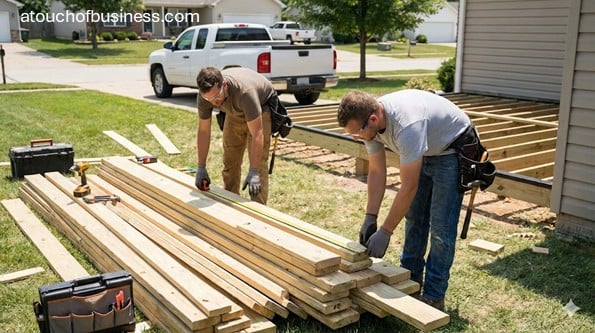
Deck Building Service Startup Overview: Steps and Permits
A deck building service designs, builds, repairs, and replaces exterior decks and related outdoor structures for residential and commercial properties. Most work happens at the customer’s site, and the business operates as a mobile contractor with tools, materials, and safety gear transported to each project.
This is usually a small-scale business you can start as an owner-operator. You can add helpers or subcontractors as your schedule fills up, but you do not need investors or a large staff to start in most cases.
Products And Services You Can Offer
Your “product” is a finished, code-compliant outdoor structure. Your service mix affects licensing, insurance, equipment, and pricing, so decide what you will offer before you register and buy gear.
- New deck builds: Ground-level and elevated decks, multi-level decks, attached or freestanding designs.
- Deck replacement: Tear-out and rebuild, including reframing or footings when needed.
- Deck repairs: Joist/beam replacement, ledger repairs, stair repairs, guard and handrail repairs, board replacement.
- Resurfacing: New decking boards and fasteners on existing framing (when structurally sound).
- Stairs and landings: New stairs, stringers, treads, landings, handrails.
- Guards and handrails: Guardrails, balusters, cable rail systems, handrails for stairs (as allowed by local code).
- Deck additions: Pergolas, privacy screens, built-in benches and planters (where permitted).
- Permitting support: Helping the customer assemble permit application materials (varies by jurisdiction and licensing rules).
- Site prep tied to the deck: Light grading or footing excavation required for the deck (may trigger stormwater rules depending on scale).
Who Your Customers Are
Most early customers are homeowners. Your first 10–20 jobs often come from a tight local radius and referrals, so choose a service area you can drive quickly and support with reliable suppliers.
- Homeowners: New decks, replacements, repairs, stairs, and safety upgrades.
- Property managers and landlords: Repairs, replacements, and safety-driven work with tighter timelines.
- Home flippers and remodelers: Deck replacements tied to broader renovation schedules.
- Small commercial properties: Entry decks, stairs, and railings (may involve stricter compliance and higher insurance requirements).
- Builders: Subcontract deck framing or finishing on new builds (requires strong scheduling discipline and documentation).
Pros And Cons
This business rewards craftsmanship and planning. It also punishes sloppy estimating and weak compliance. Look at both sides before you spend money.
- Pros: You can start as a solo operator; demand often tracks home improvement cycles; repeatable processes (estimating, material lists, permit packets) reduce errors; visible results help marketing.
- Cons: Safety exposure (falls, saws, lifting); permit and inspection timing can delay starts; cash flow can tighten if deposits and milestones are not structured; weather can disrupt schedules; liability is real if a structure fails or violates code.
Is This The Right Fit For You?
Before you do anything else, decide if business ownership is right for you, and then decide if a deck building service is right for you. Start with Points to Consider Before Starting Your Business and be honest about what you read.
Passion matters because it is what keeps you working the problem when things get hard. If you do not care about the work, you will look for an exit instead of solutions. Read How Passion Affects Your Business and ask yourself if you actually want this life.
Motivation check: “Are you moving toward something or running away from something?” If you are only trying to escape a job or fix a short-term money problem, that may not carry you through long days, setbacks, and slow weeks.
Risk and responsibility check: Income can be uncertain. Hours can be long. Some tasks are difficult and physical. Vacations can get pushed. You are responsible for everything, including safety and compliance. Talk with your household and make sure they understand what “all-in” really means.
Also ask: Do you have (or can you learn) the hands-on skills, estimating ability, and paperwork discipline to do this correctly? Can you secure enough funds to start and operate until payments come in?
Finally, talk to experienced owners, but only if they are not direct competitors. Only talk to owners you will not be competing against. Use the Business Inside Look approach and ask questions that reveal real startup issues, not highlight reels.
Smart questions to ask: What did you underestimate before your first jobs? What paperwork slowed your first projects (permits, inspections, contracts)? What tools did you buy too early, and what tools were urgent on day one?
Step 1: Decide What You Will Build And Where You Will Work
Define your service area first. Driving an extra hour for “one more job” can destroy your schedule and profit.
Decide what you will build in your first phase: repairs only, full builds, replacements, or a mix. A narrower starting scope makes estimating, compliance, and equipment purchases easier.
Step 2: Confirm Demand And Confirm Profit Potential
Do not assume demand. Verify it. Look at local search trends, local listings, and how many deck builders serve your area. Use the idea behind supply and demand and confirm customers are actively paying for the type of deck work you plan to sell.
Then confirm profit potential. Your pricing must cover materials, labor time, waste, fasteners, tool wear, insurance, fuel, permit time, and overhead. If the numbers do not support paying yourself, change the scope or the market before you form the business.
Step 3: Build A Startup Item List Before You Price Anything
Create a detailed list of everything you must have to legally and practically start: tools, safety gear, transport, storage, admin setup, and basic branding. This is the foundation for your budget.
After the list exists, research pricing per item and estimate what scale you can afford. Use estimating startup costs as a structured way to avoid “surprise” purchases.
Step 4: Choose A Business Model You Can Actually Run
Start lean unless you already have steady contracts. Most first-time owners begin as an owner-operator and bring in help later.
Your choices usually look like this: solo owner-builder; owner plus a part-time helper; owner using subcontractors for specific tasks (for example, excavation or certain rail systems). If you plan to scale fast, you may need employees sooner and more administrative setup.
Step 5: Close Skill Gaps Before You Sell Jobs
Deck work combines layout, structural basics, fastening systems, stairs, guards, and water management details. If you cannot build to code and document your work, fix that before you take the job.
If you do not have every skill, you can learn it or bring in qualified help. What matters is that the final work is correct, safe, and permitted when required.
Step 6: Define Your Standard Materials And Suppliers
Decide what you will offer as “standard” materials: pressure-treated lumber, composite decking, rail systems, and hardware. Material choices change your installation method and your estimating process.
Set up supplier accounts and confirm lead times. If you cannot get materials consistently, you cannot schedule jobs confidently.
Step 7: Write A Business Plan That Keeps You On Track
Write a plan even if you are not seeking funding. A business plan forces you to clarify what you sell, who you serve, and how you get paid.
Use how to write a business plan as a guide, then keep your plan practical: services, pricing method, startup items, legal steps, and a simple customer acquisition plan.
Step 8: Choose Your Name And Lock Down Matching Handles
Pick a name you can use consistently on paperwork, invoices, and signage. Then secure a matching domain and social handles if available.
If you need help picking a name the right way, use selecting your business name as a process so you do not create legal conflicts or branding confusion.
Step 9: Choose A Legal Structure That Matches Your Risk
Deck building has real liability risk. Many small U.S. businesses start as sole proprietorships by default, and no state formation is required for that structure. Many later form a limited liability company for liability separation and clearer structure, which can also help when dealing with banks and partners.
Do not guess. Compare structures and choose the one that fits your risk tolerance, tax filing approach, and growth plans. The U.S. Small Business Administration explains how structure affects liability and taxes on its Choose a business structure page, and the Internal Revenue Service summarizes common structures on its Business structures page.
Step 10: Register The Business And Any Assumed Name If Needed
Registration depends on your structure and your location. Some owners do not need state formation if operating as an individual under their legal name. Others must register an entity or an assumed name (often called a “doing business as” name) depending on how they present the business.
Use how to register a business for the flow, and cross-check with the U.S. Small Business Administration’s guidance on Register your business.
Step 11: Get Your Tax IDs And Set Up Employer Accounts If Needed
If you form an entity or plan to hire employees, you will likely need an Employer Identification Number. The Internal Revenue Service provides the official process on Get an employer identification number.
If you will hire within the first 90 days, also plan for state employer accounts such as unemployment insurance tax registration. The U.S. Department of Labor lists official state unemployment tax contacts on its state UI tax contacts page.
Step 12: Confirm Licenses, Permits, And Building Department Requirements
Decks often involve permits and inspections, but requirements vary by city, county, and state. You must verify what is required where the deck is built, not where your business is based.
Start with the U.S. Small Business Administration’s overview on Apply for licenses and permits, then confirm your state’s contractor licensing rules and your local building department’s permit process.
Step 13: Build Safety And Compliance Into Your Startup Plan
Falls are a core risk in deck work. If you will have employees, OSHA construction standards and training expectations matter, and customers may also expect professional safety practices even if you are solo.
Use OSHA’s 1926 Subpart M – Fall Protection as a starting point, and keep OSHA’s Fall Protection in Construction publication in your safety planning documents.
Step 14: Check Environmental Rules That Can Apply To Deck Work
If you disturb painted surfaces on older homes, lead rules can apply. The U.S. Environmental Protection Agency explains requirements for contractors under its Renovation, Repair and Painting Program: Contractors page, including the built-before-1978 trigger for many projects.
If your project disturbs a significant amount of land, stormwater permitting can apply under Clean Water Act rules. The U.S. Environmental Protection Agency summarizes when construction stormwater permits are required on Stormwater Discharges from Construction Activities.
Step 15: Set Up Insurance Before You Take Deposits
Deck work creates property damage and injury risk. At minimum, plan for general liability coverage. You may also need commercial auto coverage if you use a vehicle for business, and tool/equipment coverage if you transport expensive gear.
Use business insurance to understand the core coverage types, then confirm requirements tied to your licensing, contracts, and local rules.
Step 16: Set Up Banking, Bookkeeping, And Payments
Separate business and personal finances from day one. Choose a financial institution, open the accounts you need, and decide how you will accept deposits and milestone payments.
If you plan to borrow, learn the requirements early with how to get a business loan. Even if you self-fund, you still need clean records for taxes and insurance.
Step 17: Decide How You Will Price Jobs
Pricing is not guessing. You need a repeatable method that covers materials, labor time, waste, disposal, permit time, and overhead. Decide whether you price by square foot, by line-item estimate, or by standard packages.
Use pricing your products and services to build a method you can defend when customers compare bids.
Step 18: Prepare Your Paperwork For Quotes, Contracts, And Proof
Before you market hard, prepare your core documents: estimate template, written scope of work, change order form, and a simple contract. Your paperwork should clarify payment schedule, materials, start conditions, and what happens when inspections or weather delay work.
Build proof assets early: photos of past work (if you have it), references, and a simple process explanation. If you are new, start with smaller paid jobs that let you build a clean portfolio.
Step 19: Set Up Your Brand Basics And Online Presence
Keep branding simple, consistent, and professional. Start with a logo, a basic website, and contact points customers can trust.
Use corporate identity basics, create business cards you can hand to suppliers and customers, and plan your business sign needs if local rules allow it. For the website, start with building a business website and keep it focused on services, photos, and a clear request-a-quote path.
Step 20: Plan How You Will Get Your First Customers
Decide how you will get leads before you buy more tools. A simple plan might include local listings, supplier referrals, yard signs (if allowed), and a small paid ad test.
Do not overcomplicate it. You need a steady flow of quote requests you can answer quickly and professionally.
Step 21: Run A Pre-Opening Check And Book Your First Jobs
Do a final compliance check, confirm your insurance is active, confirm your quote and contract workflow, and confirm you can source materials on schedule. Then book the first jobs you can complete safely and correctly.
If you plan to scale and hire, read how and when to hire and start building your advisor bench with a team of professional advisors.
Essential Startup Items And Equipment
Use this list to build your startup inventory. Create your version as a checklist, then research pricing per item based on the scope you chose. This list excludes costs on purpose.
- Measuring, Layout, And Marking:
- Tape measures (multiple lengths)
- Speed square and framing square
- Chalk line
- Levels (2 ft, 4 ft) and/or laser level
- Plumb bob
- String line and line blocks
- Marking pencils, lumber crayons, markers
- Hand Tools:
- Hammers and mallets
- Pry bars
- Utility knives and extra blades
- Wood chisels
- Hand saw
- Socket set and wrenches
- Screwdrivers and nut drivers
- Clamps (various sizes)
- Caulk guns
- Power Tools:
- Cordless drill/driver and impact driver
- Cordless circular saw
- Miter saw (for clean cuts and repeatability)
- Reciprocating saw (demo and repairs)
- Jigsaw (notching and detail cuts)
- Angle grinder (as needed for metal hardware tasks)
- Router (as needed for detail work)
- Oscillating multi-tool (repairs and tight cuts)
- Fastening And Hardware Tools:
- Nail gun (if used for framing tasks where appropriate)
- Screw gun (especially for decking boards)
- Bit sets (drill bits, driver bits, specialty bits)
- Wrenches for structural connectors and bolts
- Post hole digger and digging bar (if doing footings)
- Wheelbarrow (site material movement)
- Site Prep And Protection:
- Tarps and plastic sheeting (dust and debris control when needed)
- Drop cloths
- Brooms, rakes, and magnetic nail sweeper
- Trash cans and contractor bags
- Temporary fencing or cones (when needed for safety)
- Work lights and extension cords (if corded tools used)
- Ladders, Access, And Fall Safety:
- Extension ladder and step ladders (rated appropriately)
- Scaffolding components (as needed for elevated work)
- Personal fall arrest system components as applicable (harness, lanyards, anchors)
- Guardrail or temporary edge protection materials as needed
- Personal Protective Equipment:
- Safety glasses and face shields
- Hearing protection
- Work gloves
- Respiratory protection as needed for dust and certain materials
- Hard hats (site-dependent)
- High-visibility clothing (site-dependent)
- First aid kit
- Transport And Storage:
- Work vehicle capable of hauling tools and materials
- Trailer (if needed for lumber and debris)
- Tool boxes and lockable storage
- Straps, tie-downs, and load securement gear
- Portable jobsite storage bins
- Admin And Customer Setup:
- Phone line or dedicated business number
- Email address on your domain
- Computer or tablet for estimates, permits, and invoices
- Estimate template, contract template, change order template
- Basic accounting/bookkeeping setup (software or professional support)
- Photo documentation process (camera or phone plus organized storage)
Skills You Need Before Launch
You do not need to be perfect at everything. You do need enough skill to build safely, price accurately, and document the job. Anything you cannot do well, you must learn or bring in qualified help.
- Job estimating and writing clear scopes of work
- Layout and measurements, including stair and guard planning
- Framing basics and fastening systems
- Stair building basics and rail installation methods
- Tool safety, ladder safety, and fall hazard awareness
- Basic permitting awareness and inspection readiness
- Customer communication and expectation setting
- Photo documentation and simple recordkeeping
Day-To-Day Work Looks Like
This is what the work usually includes once you start taking jobs. Knowing this upfront helps you decide if the business fits you.
- Responding to quote requests and scheduling site visits
- Measuring, planning, and writing a scope of work
- Ordering materials and coordinating delivery or pickup
- Demo and disposal (when replacing a deck)
- Footings, framing, and decking installation
- Stairs, guards, and final detailing
- Preparing for inspections when required
- Collecting progress payments and documenting completion
A Day In The Life Of A New Owner
Early on, your day is split between building and paperwork. You might start with a site visit and measurements, then spend an hour writing a clear estimate and material list. If you do not control your documentation, you will spend your nights fixing avoidable problems.
On build days, you will move between safety checks, layout, cuts, installation, and constant quality checks. Then you will finish with photos, a short customer update, and next-step planning so the job stays predictable.
Red Flags To Watch For
These are warning signs during the startup phase. If you ignore them, you may start busy and still lose money or create legal exposure.
- Pricing jobs without a written scope of work and change order process
- Taking deposits before insurance and licensing requirements are confirmed
- Agreeing to start dates without material lead time confirmation
- Skipping permit and inspection checks because “the customer said it’s fine”
- Using a vehicle or trailer setup that cannot safely transport lumber and tools
- Starting elevated work without a fall safety plan that fits the job
- Failing to document existing conditions before demo or repairs
- Not having a basic process for collecting milestone payments
Varies By Jurisdiction
Deck building touches building codes, permits, inspections, contractor licensing, and sometimes environmental rules. You must verify requirements where the deck is built. Use this checklist to confirm locally and avoid guessing.
- Building permits and inspections: Ask your city or county building department what triggers a permit for deck repair vs replacement vs new construction, and what inspections are required.
- Contractor licensing: Ask your state contractor licensing agency whether deck building requires a license for your project types and price ranges, and whether specialty categories apply.
- Zoning and home-based rules: If you run the business from home or store materials, ask your city or county zoning office about home occupation limits and storage rules. If you lease space, ask about Certificate of Occupancy (CO) requirements for that space.
- Sales and use tax: Ask your state department of revenue whether you must collect sales tax on materials, labor, or both, and how contractor transactions are treated.
- Right-of-way rules: If you place dumpsters, materials, or equipment on public streets or sidewalks, ask your city about right-of-way permits.
- Commercial vehicle requirements: If you operate a commercial motor vehicle in interstate commerce, confirm whether you need a USDOT number (often triggered at 10,001 lbs GVWR/GCWR or more, certain passenger thresholds, or hauling hazardous materials). Some states also require USDOT numbers for certain intrastate operations; confirm your state’s rules using the Federal Motor Carrier Safety Administration’s USDOT number guidance.
Pre-Opening Checklist
Use this to confirm you are ready to start booking work without creating avoidable legal or financial problems. If you are missing items, fix them before you “go live.”
- Service list and service area defined
- Pricing method tested against real material lists and time estimates
- Business structure selected and business name secured
- Registration and assumed name filings completed as needed
- Employer Identification Number obtained if needed
- Licenses and permits verified for your project types and locations
- Insurance active (general liability at minimum)
- Bank accounts and payment methods set up
- Estimate, contract, and change order documents ready
- Tool, vehicle, and safety gear checklist complete
- Basic website live and contact methods tested
- First customer acquisition plan active (listings, referrals, outreach)
- Final review of common startup pitfalls using avoid these mistakes when starting a small business
101 Everyday Tips for Running Your Deck Building Service
The tips below touch different parts of a deck building business.
Use them like a menu, not a checklist.
Bookmark this page so you can come back when a problem shows up.
To keep it simple, pick one tip, apply it, then move to the next when you’re ready.
What to Do Before Starting
1. Pick your starting scope in writing (new builds, replacements, repairs, or resurfacing) so your tools, insurance, and permitting plan match what you actually sell.
2. Choose a tight service radius and stick to it, because long drives quietly erase profit and make scheduling harder.
3. Verify your state’s contractor licensing or registration rules before you advertise or quote work, since requirements can change by state and sometimes by project value.
4. Build a permit checklist for the top cities and counties you plan to serve so you know what plans, inspections, and documents are usually required before you price a job.
5. Decide when you will require engineered drawings and who you will use, because some decks, supports, or unusual site conditions will not fit prescriptive details.
6. Set up supplier relationships early and confirm lead times for decking, rail systems, fasteners, and connectors so you do not promise dates you cannot meet.
7. Create your “day-one” equipment list and separate it from “nice-to-have” gear so you do not drain cash before your first paid project.
8. Build a pricing method that includes permit time, disposal, hardware, tool wear, and overhead, not just boards and labor hours.
9. Put a written estimate, contract, and change-order process in place before you accept deposits so scope changes do not turn into arguments.
10. Choose a business structure that fits your risk and growth plan, then open a separate business bank account so your records stay clean from day one.
11. Get an Employer Identification Number when needed and set up required tax registrations early, because late registrations can create delays when you are ready to invoice.
12. Line up insurance before taking money, including general liability and any vehicle or tool coverage you need for how you operate.
What Successful Deck Building Service Owners Do
13. Use a site-visit checklist and take plenty of photos, because missing details at the quote stage usually becomes expensive later.
14. Call 811 before any digging and document the locate results, because hitting a buried line can end a job fast.
15. Keep a few standard deck plan templates you can adapt, because repeatable drawings speed permitting and reduce errors.
16. Identify long-lead items (rail systems, specialty fasteners, custom posts) and do not lock in start dates until availability is confirmed.
17. Do a pre-job walk-through with the customer and confirm access, staging, and finish selections so there are no surprises on day one.
18. Keep short daily job notes (deliveries, weather, changes, key conversations) so you can defend decisions if questions come up later.
19. Stage materials to reduce trip hazards and re-handling, because fewer touches means fewer injuries and less wasted time.
20. Confirm critical structural details early (especially attachment and water management at the building connection) before you cover anything up.
21. Match connectors and fasteners to the lumber and environment, because some metals can corrode faster with treated wood or coastal exposure.
22. Treat stairs and guards as safety systems, not decoration, and verify local requirements before you build.
23. Photograph footings, framing, and any hidden connections before you install decking, because those images help with inspections and future service calls.
24. Close each job with a simple handoff packet (final photos, warranty terms, and care notes) so the customer knows what to expect after you leave.
Running the Business (Operations, Staffing, SOPs)
25. Use a written estimating workflow so every quote includes the same steps: site notes, takeoff, labor assumptions, hardware, disposal, and permit time.
26. Break labor into phases (demolition, footings, framing, decking, rails, stairs) so you can spot where your estimates are drifting.
27. Track job costs by project and compare estimate versus actual, because “busy” is not the same as “profitable.”
28. Tie payments to clear milestones (materials ordered, framing complete, decking complete, final walk-through) so cash flow matches the work.
29. Require a written change order for any scope change, and price it before you do the work so you do not donate labor.
30. Build schedule buffers for inspections and weather, because both can pause progress even when your crew is ready.
31. Confirm delivery windows and inspect materials on arrival, because missing boards or damaged rail parts can stop an entire phase.
32. Use a footing layout checklist so posts, beams, and stairs land where the plan expects them to land.
33. Keep a tool inventory and a simple sign-out method, because lost tools create downtime and hidden replacement costs.
34. Maintain sharp blades and bits, because dull cutting tools increase tear-out, rework, and injury risk.
35. End each day with a cleanup routine that includes a fastener sweep, because a single missed screw can become a serious injury.
36. Use a punch-list walk-through before final payment, because catching small issues early protects your reputation.
37. If you use subcontractors, put scope, schedule expectations, and insurance requirements in writing so you are not exposed by someone else’s work.
38. If you hire, document roles and standards from the start so “how we do it” does not change with every new person.
39. Train on ladder setup and fall hazards and keep proof of training, because your liability increases the moment you have employees.
40. Hold short safety talks regularly and focus on one hazard at a time so the crew actually remembers the message.
41. Set a communication cadence for customers (for example, a quick update at the end of each workday) so they do not fill the silence with worry.
42. Protect build time by setting specific hours for calls, estimates, and paperwork, otherwise the phone will run your schedule.
43. Back up photos, contracts, and permit documents in a secure system so a lost phone or laptop does not erase your proof.
44. Review permit comments and inspection feedback monthly so your next plan set is stronger than your last.
What to Know About the Industry (Rules, Seasons, Supply, Risks)
45. Assume codes and permit rules vary, and verify the local version before quoting, because what passes in one town may fail in the next.
46. Never assume a “repair” is permit-free; confirm with the building department when structural elements, stairs, or guards are involved.
47. Plan around weather, because rain can affect site access and cold can affect concrete curing and digging conditions.
48. If your area has frost conditions, learn local footing depth expectations before you bid, because redoing footings is expensive and visible.
49. Follow manufacturer spacing and fastening instructions for composite decking, because thermal movement problems usually show up after you have been paid.
50. Treat hardware selection as structural, not optional, because the wrong fasteners or connectors can fail early in outdoor exposure.
51. Treat guard and stair details as high-risk items and confirm local requirements, because they are common inspection and safety failure points.
52. Plan for heat, cold, and hydration needs, because outdoor crews lose productivity fast when conditions are ignored.
53. Identify fall hazards before the deck surface exists, and plan temporary edge protection so the job is safe during framing.
54. Manage cutting dust with collection, ventilation, and proper respiratory protection when needed, because dust exposure is a long-term health risk.
55. Learn when lead-safe rules may apply on older homes, because disturbing painted surfaces can trigger required practices and certifications.
56. Know that stormwater rules can apply to larger site disturbance, so ask early when a project includes major grading or excavation.
57. Expect supply swings in decking and rail systems, and keep approved alternates ready so you can solve shortages without redesigning from scratch.
58. Ask customers early about homeowner association approval, because missing that step can delay start dates even when permits are ready.
Marketing (Local, Digital, Offers, Community)
59. Choose a clear niche for your first year (for example, replacements, composite upgrades, or safety repairs) so your message is easy to understand.
60. Photograph every project in the same format (wide shots, detail shots, stairs, rails, connection areas) so your portfolio looks consistent and credible.
61. Ask for reviews right after a successful walk-through, because satisfied customers are most willing to write when the experience is fresh.
62. Use jobsite signage only where it is allowed and only with customer permission, because unwanted signs can create complaints and local issues.
63. Build referral relationships with lumberyards and suppliers, because they hear “Who builds decks?” all day long.
64. Connect with home inspectors and real estate professionals for repair leads, because safety issues on decks often show up during transactions.
65. Treat punctuality like a marketing tool, because homeowners remember who showed up when they said they would.
66. Create a simple customer handout that explains permit steps and typical inspection timing, because education reduces cancellations and delays.
67. Publish your service area and any travel fees clearly, because vague service boundaries attract leads you do not want.
68. Plan your promotion calendar around seasons, because most homeowners want decks ready for warm weather and start searching early.
69. Track where each lead came from and keep notes, because you need data to decide what to repeat and what to stop.
70. Keep a small set of standard design options you can price quickly, because too many choices can slow decisions and stall sales.
71. For commercial work, keep a ready packet that includes insurance proof and safety documentation, because many sites require it before you start.
72. Get permission to use project photos in marketing, and keep that permission in writing so you can share work without disputes.
Dealing with Customers (Trust, Education, Retention)
73. Start every project conversation with a written scope and exclusions, because most conflicts come from assumptions, not malice.
74. Teach customers the real trade-offs between wood and composite (appearance, heat, traction, and long-term care) so they choose with eyes open.
75. Explain why permits protect both sides and clearly state who is responsible for pulling them, because vague responsibility leads to delays.
76. Set expectations on noise, debris, and work hours so neighbors do not become a problem for your customer.
77. Confirm access needs before day one (gates, pets, parking, material staging) so the crew is not blocked when the clock starts.
78. Choose one point of contact for customer updates, because conflicting messages create distrust fast.
79. When a customer challenges price, walk back through scope, materials, and safety requirements instead of arguing, because clarity is more convincing than emotion.
80. Document every selection before ordering (colors, rail style, board direction) because the wrong order can erase the profit on a job.
81. If you uncover structural issues mid-project, stop, document, and present options, because continuing without agreement is how disputes start.
82. Schedule a short follow-up after completion to answer questions and catch small issues early, because service calls are cheaper than reputational damage.
Customer Service (Policies, Guarantees, Feedback)
83. Put payment terms in writing and repeat them on the estimate and contract so there is no confusion when a milestone arrives.
84. Use a reschedule policy that accounts for weather and inspections, because outdoor work rarely follows a perfect calendar.
85. Provide a written workmanship warranty and clearly separate it from manufacturer warranties, because the customer needs to know who covers what.
86. Create a simple warranty request process (who to contact, what photos to send, and expected response time) so issues get handled consistently.
87. Log every complaint with the cause and the fix, because patterns in complaints usually point to a process problem you can correct.
88. If something gets damaged, communicate immediately and propose a fix plan, because delays make small problems feel dishonest.
89. Ask customers for feedback in a structured way after the job, then change one process at a time so improvements stick.
90. Close every job with a final checklist that covers cleanup, fastener sweep, photos, and a documented walk-through, because consistency is customer service.
Sustainability (Waste, Sourcing, Long-Term)
91. Reduce waste by doing a detailed material takeoff and ordering in phases, because over-ordering ties up cash and creates disposal work.
92. Sort waste on site when practical (wood, metal, cardboard) so recycling is possible where local facilities accept it.
93. If local rules allow it, donate reusable boards or hardware that are still safe, because it reduces disposal and helps the community.
94. Ask suppliers about packaging take-back options, because wrap, cardboard, and pallets can add up on larger decks.
95. Maintain tools and batteries so they last longer, because replacement churn quietly raises your operating cost.
96. Favor materials you can source reliably and locally, because availability and consistent quality matter more than exotic options.
Staying Informed (Trends, Sources, Cadence)
97. Check your local building department’s updates at least once a year, because permit forms and adopted codes can change.
98. Review OSHA guidance and safety training whenever you add a new person or introduce new equipment, because new risks show up during change.
99. Keep current installation manuals for every decking and railing system you use, because manufacturer requirements can affect warranty and performance.
100. Attend training from reputable trade groups and wood councils, because small detail updates can prevent big callbacks.
101. Schedule a quarterly review of your contracts, safety checklists, and permit templates so your systems improve even when you are busy.
FAQ For a Deck Building Service
Question: Do I need a permit to build or rebuild a deck?
Answer: Many decks need a permit, but the rules depend on the city or county. Call the local building department and ask what triggers a permit for your exact project.
Question: What is the difference between a repair, a resurfacing, and a full replacement?
Answer: A repair fixes specific parts like boards, stairs, or rails. A resurfacing swaps surface boards but keeps the frame, while a replacement rebuilds major structural parts.
Question: Will the deck builder pull the permit, or do I have to?
Answer: It depends on the contractor and local rules. Ask who will apply, whose name will be on the permit, and who will schedule inspections.
Question: How do I check if a deck builder is properly licensed or registered?
Answer: Many states have an online license lookup for contractors. Ask for the license or registration number and confirm it with the state agency.
Question: What insurance should a deck building service carry?
Answer: General liability is a common baseline. Ask if they also have coverage for vehicles and tools used on the job.
Question: What affects the price of a new deck the most?
Answer: Size, height, stairs, rail style, and material choice usually drive the price. Site conditions like slope, access, and removal work can also change the total.
Question: How long does a typical deck project take?
Answer: Simple builds can take days, while larger or elevated decks can take longer. Permits, inspections, and material lead times can extend the schedule.
Question: Which is better: pressure-treated wood or composite decking?
Answer: Pressure-treated wood is often lower upfront cost and can be easier to modify later. Composite can reduce some routine upkeep, but it has strict install rules and can cost more.
Question: Why do stairs and rails matter so much in deck builds?
Answer: They are key safety parts and are often tied to local code rules. Small errors here can cause inspection issues and increase fall risk.
Question: What is a “ledger,” and why is it important?
Answer: A ledger is a board that connects an attached deck to the house. If it is installed wrong or water gets behind it, serious damage can follow.
Question: When do footings matter, and why can they raise costs?
Answer: Footings support the deck’s load and must match local requirements. Digging depth, soil issues, and limited access can make this work slower and more expensive.
Question: Can a deck be built in winter or rainy seasons?
Answer: Sometimes, yes, but weather can slow digging, concrete work, and safe access. Ask how the contractor handles delays and rescheduling.
Question: What should be in a deck estimate and contract?
Answer: It should list the scope, materials, payment steps, and how changes are handled. It should also state who handles permits and what the expected timeline depends on.
Question: What should I ask before I pay a deposit?
Answer: Ask what the deposit covers, when the next payment is due, and what happens if materials are delayed. Also ask when the project can start and what could change that date.
Question: Do homeowner associations have a say in deck projects?
Answer: Many homeowner associations require approval for exterior changes. Get that approval in writing before you order materials or schedule work.
Sources:
- Internal Revenue Service: Get employer identification number, Business structures, Instructions Form 940
- U.S. Small Business Administration: Choose business structure, Register your business, Apply licenses permits
- Occupational Safety and Health Administration: 1926 Subpart M fall protection, Fall protection construction
- U.S. Environmental Protection Agency: RRP contractors requirements, Stormwater construction activities
- Federal Motor Carrier Safety Administration: Need USDOT number
- U.S. Department of Labor: State UI tax contacts
- International Code Council: IRC guard height