
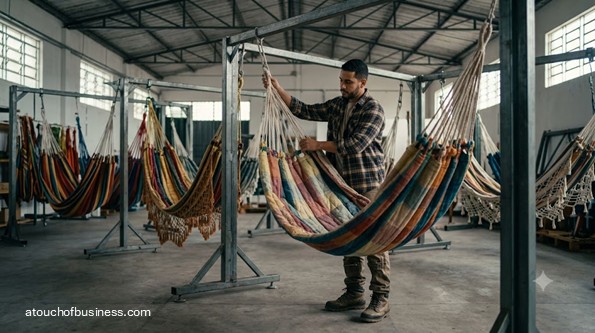
What to Expect From This Guide to Starting a Hammock Production Business
This guide walks through the key decisions and practical steps involved in starting a hammock production business, from evaluating your fit and market to setting up production and preparing for initial orders.
Inside the guide, you will find:
- Startup steps: Follow an ordered progression through product planning, demand research, compliance, production setup, testing, pricing, and opening preparation.
- Industry interviews: Learn from hammock professionals discussing design development, materials, production challenges, target markets, branding, and business growth.
- Startup FAQs: Review practical answers about licenses, fabrics, weight ratings, sales channels, home production, common mistakes, and seasonal demand.
- Business fit: Consider the physical work, sewing skills, repetition, seasonal income, and household financial demands involved.
- Market and finances: Examine differentiation, competition, wholesale margins, production costs, pricing, operating capital, and seasonal cash flow.
- Compliance and protection: Understand textile labeling, consumer-product rules, local requirements, zoning, business registration, and insurance considerations.
- Production planning: Explore prototypes, load testing, suppliers, equipment, workspace flow, quality checks, and the first complete production run.
Begin by considering whether the work, income pattern, and competitive demands of hammock production suit your skills and circumstances.
As a hammock production business owner, you cut fabric, run seams, attach hardware, and ship finished hammocks to consumers, outdoor retailers, boutique shops, or resort buyers.
The work is physical, repetitive, and detail-driven. Most of your day happens at a cutting table or industrial sewing machine — measuring panels, running reinforced seams, checking tension, and assembling suspension hardware.
Between production runs, you’re managing raw material inventory, placing supplier orders, communicating with buyers, packing orders, and tracking costs.
This is not a passive income business. It rewards owners who enjoy hands-on craft work, can maintain consistent quality across dozens or hundreds of units, and have the patience to build a buyer base methodically.
Before you invest in equipment or raw materials, take time to understand what starting a production business actually involves — from legal setup through your first production run.
The hammock market has real demand. But it also has serious competition from overseas manufacturers who produce at costs a small U.S. producer can’t match on price alone.
Your path forward is differentiation — not competing on price, but on quality, specialty materials, custom options, American-made positioning, or a niche the big brands don’t serve.
Think honestly about your household finances. Hammock demand peaks in spring and summer. Fall and winter can be very slow.
Can your household manage several months of reduced income while you build your customer base?
Talk to people who run small sewn-goods operations — camping gear producers, artisan outdoor brands, cottage manufacturers. Ask them what they didn’t know before they started. Talk only to people you won’t compete with directly, and prepare your questions before those conversations.
Some new owners start from scratch. Others buy an existing small production operation. If a hammock brand or small manufacturer is for sale in your area or niche, it’s worth evaluating — you get existing equipment, supplier relationships, and possibly an established buyer base.
The right entry path depends on your budget, your timeline, and how much startup risk you can absorb.
Red Flags Before You Start
Some conditions make this business harder to survive. Know them before you commit.
You plan to compete on price against imported hammocks. Overseas producers make hammocks at labor and material costs a small U.S. operation can’t match. If your only edge is a lower price, you don’t have an edge. If you can’t name a clear reason a buyer would choose your hammock over a cheaper import, pause and rethink the model.
Your unit economics don’t work at wholesale prices. If selling through retailers is part of your plan, those retailers typically pay about half the eventual retail price. Your fully-loaded production cost per unit — materials, labor time at a real hourly rate, packaging, overhead — must leave a viable margin at that wholesale level. Run the numbers before approaching any buyers.
You haven’t accounted for the slow season. Most hammock sales happen in spring and summer. If you can’t fund operations through fall and winter, the business will struggle every year. Build an off-season cash plan before you launch.
Your skills aren’t ready. Industrial sewing for load-bearing products is more demanding than home sewing. If you can’t confidently produce consistent, structurally sound hammocks right now, invest in skill development before launching commercially.
A defective product returned by a buyer costs money, reputation, and potential liability.
You haven’t verified your zoning. Many residential zones prohibit manufacturing. If you skip the zoning check and set up a home workshop in a prohibited zone, you risk fines and forced closure. Verify zoning before spending anything on equipment or facility improvements.
You’re launching without product liability coverage. A hammock that fails under load can cause serious injury. Without product liability insurance, a single claim could end the business. This is not optional coverage for a hammock manufacturer.
You’re starting without enough operating capital. Running out of cash before you establish a reliable buyer base is the most common reason small manufacturing businesses close. Build a realistic estimate of how many months it will take to reach consistent sales, and make sure you have the reserves to get there.
Step 1: Assess Your Fit and Skills Honestly
Start here — not with equipment, not with suppliers.
Running a hammock production operation requires real sewing competency — not home-project level, but industrial-production level. You need to run consistent seams on synthetic fabrics, build load-bearing end channels, attach hardware correctly, and inspect finished units against a quality standard.
If you have gaps, close them before launch. A skills gap that produces inconsistent or defective products is a business risk, not just a quality issue.
Also assess your tolerance for repetition. Most days involve the same sequence of tasks — cut, sew, assemble, inspect, pack — repeated across many units.
That suits some people well and burns others out quickly.
Ask yourself whether your household is prepared for income uncertainty. The slow season is real. Your family needs to understand that before you invest in this business.
Step 2: Define Your Product and Business Model
The hammock category is broader than most people realize. Before you cut a single piece of fabric, decide what you’re making and who you’re making it for.
Hammock types you might produce include:
- Camping and backpacking hammocks — lightweight ripstop nylon, gathered-end design, packed into a stuff sack
- Rope hammocks — cotton or polyester rope with spreader bars, for backyard lounging
- Fabric hammocks — Brazilian tightly woven cotton, Mayan open-weave style, quilted fabric designs
- Hammock chairs — hanging seated designs for porches, patios, or indoor use
- Hospitality and resort-grade hammocks — durable, weather-resistant, made for commercial installation
Each type uses different materials, different equipment setups, and serves a different buyer. Start with one type and learn it completely before expanding.
Your production model also shapes your whole business:
- Small-batch or cottage production — lower startup costs, manageable scale, suits a home workshop or small studio
- Volume manufacturing — higher output, requires more equipment, more space, more capital
- Made-to-order — produces only when a buyer pays; limits inventory risk but slows turnaround
- Standardized inventory — pre-builds stock for faster shipping; requires working capital to carry inventory
Your sales channel decision matters just as much. Direct-to-consumer gives you higher per-unit margin but requires you to handle fulfillment, customer service, and returns yourself.
Wholesale to retailers gives you volume potential at a lower per-unit margin — typically about half of retail. Many small producers start direct-to-consumer and add wholesale accounts later, once production reliability is proven.
Think carefully about whether buying an existing small hammock production operation might be a smarter path than starting from scratch. Existing equipment, supplier accounts, and buyer relationships have real value.
The right choice depends on your budget, your risk tolerance, and what’s available.
Step 3: Validate Demand and Research Your Competition
Don’t build a production setup around a niche or channel that can’t support your cost structure.
Your likely first customers depend on your model. Identify them before you invest in production capacity.
Potential first buyers include:
- Individual consumers buying direct through craft shows, online stores, or outdoor gear communities
- Small independent outdoor retailers looking for American-made or specialty products
- Boutique gift shops seeking artisan or distinctive hammocks
- Resort, glamping site, and hospitality property buyers needing durable outdoor furniture
- Custom-order buyers wanting specific colors, sizing, or branding
Research your competition at your target price point. The hammock market includes large overseas producers, private-label retail brands, and established U.S. outdoor gear companies.
Small domestic producers typically can’t compete on price. They compete on quality, customization, American-made positioning, specialty materials, or a niche the large brands don’t serve.
If you can’t clearly answer why a buyer would choose your hammock over a cheaper or better-known alternative, your differentiation strategy isn’t ready yet.
Check local and channel-level supply and demand before committing to a model. A niche that works well in one region or sales channel may be saturated in another.
Business Plan
Write your business plan before you buy a single piece of equipment or sign any supplier agreements.
Your plan should work through:
- Your product line and the specific hammock types you’ll produce at launch
- Your production model — batch size, made-to-order vs. inventory, home workshop vs. commercial facility
- Your target customers and sales channels
- Your startup cost categories — equipment, materials, facility, labeling, insurance, and registration
- Your operating capital needs — enough to fund several months of operations before reliable sales arrive
- Your pricing structure and whether your margins work at your chosen channel
The profit question is critical. Calculate your fully-loaded cost per unit — raw materials, labor time at a realistic hourly rate, packaging, and a share of overhead.
Then ask: does your selling price leave a viable margin after covering those costs and your fixed monthly expenses?
If you’re selling wholesale, retailers pay about half of what they charge consumers. Your production cost must stay well below that wholesale price for the model to work.
Address seasonal cash flow directly. Hammock demand concentrates in spring and summer. You need a clear plan for funding fall and winter operations without running out of working capital.
Read more about estimating profitability and revenue for a new business before setting your pricing.
If your startup costs exceed your savings, explore SBA loan options, equipment financing for industrial sewing machines, and Small Business Development Center (SBDC) resources for guidance.
Review common startup mistakes so you can plan around them rather than learn the hard way.
Step 4: Choose a Legal Structure and Register Your Business
Hammock manufacturing carries real product liability exposure. A hammock that fails under load can injure someone — and the manufacturer is the first target of any resulting claim.
For that reason, most hammock producers benefit from forming an LLC rather than operating as a sole proprietor. An LLC creates a legal separation between your personal assets and the business.
Learn more about how to choose the right business structure for your situation, including the key differences between an LLC and a sole proprietorship.
Once you’ve chosen a structure, register your business with your state. If you operate under a trade name that differs from your legal entity name, you’ll need a DBA filing. See how to register a DBA if that applies to you.
Apply for an Employer Identification Number (EIN) from the IRS. You’ll need it for your business bank account and tax filings — and potentially for your product labeling. The application is free at irs.gov.
Open a dedicated business bank account before any transactions occur. Keeping business and personal finances separate from day one protects you legally and makes bookkeeping far simpler.
Step 5: Satisfy Federal Compliance Requirements
Hammock manufacturing has meaningful federal compliance requirements. None of them are complicated, but skipping them creates real legal exposure.
FTC Textile Fiber Products Identification Act — this one applies directly to you. Hammocks are explicitly covered textile products under federal law. Every hammock you sell must carry a label disclosing:
- The generic name and percentage by weight of every fiber making up 5% or more of the product (for example, “100% Nylon” or “60% Cotton, 40% Polyester”)
- Your business name or your FTC Registered Identification Number (RN)
- The country where the product was processed or manufactured
Misbranding — incorrect or missing fiber content labeling — is unlawful under the FTC Act. Apply for your free RN at rn.ftc.gov before your first sale.
The FTC’s guidance document, Threading Your Way Through the Labeling Requirements Under the Textile and Wool Acts, is the authoritative reference. Read it before you design your labels.
CPSC General Certificate of Conformity. Hammocks sold to consumers fall under CPSC oversight. Manufacturers of consumer products subject to CPSC rules must maintain a written General Certificate of Conformity. Verify current GCC requirements at cpsc.gov before you begin selling.
If any product could be used by children under 12, get CPSC guidance before proceeding. Children’s products and infant sleep products face significantly stricter requirements, including a Children’s Product Certificate and tracking labels.
The CPSC has specifically reviewed infant hammocks as safety concerns. Don’t market any product as suitable for infants or young children without full CPSC compliance review.
OSHA applies once you hire employees. If you bring on workers, OSHA’s general industry standards apply — including standards specific to textile machinery (29 CFR 1910.262). Machine guards on industrial sewing equipment, proper lighting, hazard communication, and safety training are all required.
OSHA offers a free on-site consultation program for smaller manufacturers.
For more on business licenses and permits, including how to navigate the federal, state, and local layers, review that resource before finalizing your compliance checklist.
Step 6: Satisfy State and Local Requirements
State and local requirements vary. Don’t assume. Verify each one for your specific address and business structure.
At the state level, plan to check:
- Sales tax permit or seller’s permit — required in most states when selling taxable goods; check your state’s department of revenue
- State employer registration and payroll tax accounts — required if you hire employees; check your state’s department of revenue and department of labor
- Workers’ compensation insurance — most states legally require it once you have employees; check your state’s workers’ compensation board
At the city and county level, plan to check:
- General business license — most cities and counties require one; contact your city or county clerk’s office
- Zoning — if you’re operating from home, verify that light manufacturing is permitted at your address before investing in workshop setup; contact your local planning or zoning department
- Home occupation permit — some jurisdictions allow home manufacturing with conditions; others prohibit it entirely
- Certificate of occupancy — if you lease a commercial facility, verify it’s approved for light manufacturing before you move in; contact your city’s building department
If you’re in a homeowners association, read the covenants before setting up production. HOA restrictions can prohibit manufacturing activities even in jurisdictions that otherwise permit it.
Step 7: Design Your Products and Build Prototypes
Before sourcing materials at scale, you need finalized construction specifications for every hammock style you plan to produce.
Your specs should define:
- Fabric type and weight — denier, weave, coating, fiber content
- Finished dimensions and tolerances
- Seam type — double or triple-needle stitching for load-bearing seams
- End channel construction method
- Suspension hardware specs — carabiner, D-ring, or attachment loop ratings
- Stated weight capacity and the safety factor behind it
Build prototypes from those specs, then test them.
Load-bearing testing is not optional. Every component in your hammock — fabric, seams, webbing, hardware — must be rated to meet or exceed your stated weight capacity. Document your testing method and results. Those records matter if a product liability question ever arises.
Set your weight capacity based on the lowest-rated component in your system, then apply a meaningful safety factor. Your stated capacity should be well below what the product can hold under controlled conditions.
Don’t commit to raw material purchasing at scale until your prototype passes testing and your specs are locked. Changes after you’ve bought a large fabric order are expensive.
Step 8: Build Your Supplier Network
Consistent products require consistent materials. Your supplier network is part of your quality control system.
Raw materials you’ll need to source:
- Primary fabric — ripstop nylon or polyester for camping hammocks; woven cotton or cotton blends for lounging styles; specialty fabrics for premium or eco-focused lines
- Webbing — nylon, polyester, or cotton webbing for end channels, tree straps, and reinforcement; source from industrial narrow-fabric suppliers
- Hardware — carabiners, D-rings, tri-glide buckles, and connectors; confirm load ratings before purchasing
- Thread — heavy-duty thread matched to your fabric type and seam method
- Spreader bars and end hardware — if producing spreader bar styles
- Packaging — stuff sacks, mailers, boxes, and packing materials
Ripstop by the Roll is a well-known U.S. supplier that serves small-batch outdoor gear producers directly and carries hammock-specific technical fabrics. ThomasNet is a useful directory for finding U.S. webbing and narrow-fabric manufacturers.
Establish backup suppliers for every critical material before you open. A single-supplier dependency means one stockout or delay can halt your entire production line.
Confirm country-of-origin documentation for all materials. You’ll need it to satisfy FTC labeling requirements.
Understand each supplier’s minimum order quantity (MOQ) and lead time before building your production schedule. A supplier with a long lead time changes your inventory planning significantly.
Step 9: Set Up Your Production Facility and Equipment
Your production space and equipment determine your output capacity, your quality ceiling, and your safety baseline.
Core equipment your production setup requires:
- Industrial lockstitch sewing machine(s) rated for heavy synthetic and woven fabrics — a home sewing machine is not adequate for production-scale hammock work
- Walking-foot industrial sewing machine for thick webbing, reinforced seams, and multiple layers
- Large cutting table — minimum 4 × 8 feet; longer for full-length hammock panels
- Rotary cutter, straight-edge guides, and self-healing cutting mat
- Heat pen or heat-sealing cutter for finishing synthetic fabric edges without fraying
- Measuring tape, steel rulers, set squares, and fabric chalk for accurate, repeatable cuts
- Hardware assembly tools — grommet press if applicable, webbing heat cutter, and buckle and connector tools
- Load-testing rig for finished unit inspection
- Packaging station with shipping scale and label printer
For safety and workspace quality:
- Proper lighting at all work surfaces
- Machine guards on industrial sewing equipment
- First aid kit and appropriate fire extinguisher
- Ergonomic seating at sewing stations to reduce repetitive stress risk
Set up organized storage for raw materials — fabric rolls, webbing spools, hardware bins — separate from your finished goods area. A disorganized storage system leads to wasted material, lost inventory, and production delays.
Think about your production flow before you arrange the space. Fabric should move logically from receiving through cutting, sewing, assembly, quality inspection, packaging, and into storage.
A layout that forces you to carry materials back and forth creates bottlenecks and slows output.
Step 10: Set Your Prices and Establish Your Sales Channel
Price before you sell — not after.
Start by calculating your fully-loaded cost per unit: raw materials, direct labor at a realistic hourly rate, packaging, and a proportional share of your overhead — facility, equipment, insurance, and utilities.
That cost is your floor. Your price must be meaningfully above it.
The channel you choose changes your pricing math significantly:
- Direct-to-consumer: you capture full retail margin, but you handle fulfillment, customer service, and returns
- Wholesale to retailers: buyers typically pay about half of what they’ll charge consumers; your production cost must be low enough to leave a real margin at that level
- Custom or made-to-order: commands a premium, but limits production speed and batch efficiency
Verify that your prices are competitive with comparable products in your target channel. If your pricing is higher than the market will accept, the model needs to change — not just the price.
Read more about pricing your products and services before you set your first price list.
Set up payment processing before you take your first order. You need a business bank account, a merchant account or payment platform, and the ability to issue invoices before opening your sales channel to buyers.
Learn how to open a business bank account and how to set up a merchant account so you’re ready to accept payment from day one.
Step 11: Get Your Insurance in Place
Secure insurance before your first sale.
Product liability coverage is the most important policy for a hammock manufacturer. It covers bodily injury and property damage caused by a product you make.
Product liability coverage is not legally required at the federal level, but it’s essential for any business producing load-bearing consumer products. Many wholesale buyers and retailers will also require proof of coverage before placing an order.
Insurance coverage to plan for:
- General liability insurance with product liability coverage — often bundled for manufacturers
- Workers’ compensation insurance — legally required in most states once you have employees
- Commercial property insurance — covers your equipment and raw material inventory
If you’re leasing commercial space, your landlord will likely require a minimum general liability policy before you can occupy the space. Confirm their requirements before signing a lease.
Learn more about business insurance options and what manufacturers typically need to carry.
Step 12: Complete Your First Production Run and Quality Checks
Before you open for business, run a complete test production batch of every product type in your launch line.
This isn’t a prototype pass. It’s a full production sequence — cut, sew, assemble, inspect, label, and pack — exactly as you’ll do it for paying orders.
Inspect each unit from the test run for:
- Seam integrity — no skipped stitches, no unraveling at stress points
- Consistent finished dimensions — every unit matches your spec
- Correct hardware attachment — all carabiners, D-rings, and connectors properly installed and load-rated
- Complete labeling — fiber content label, weight capacity label, country of origin, manufacturer name or RN number
- Packaging completeness — stuff sack, care card, and any included accessories are present
Run a hang test on finished units. Confirm your load-test rig can verify structural integrity before any unit ships.
Measure your actual production rate — how many units can you realistically complete per day or per week? That number drives your delivery commitments to buyers.
Overpromising delivery timelines is one of the fastest ways to lose a wholesale account.
Fix any defects, labeling errors, or process gaps identified in the test run before accepting your first order.
Step 13: Confirm Launch Readiness
Before you take your first order, confirm every item on this list is in place.
Legal and compliance:
- Business entity registered; EIN obtained from IRS
- State sales tax permit obtained
- General business license obtained from city or county
- Zoning confirmed for your production address
- Certificate of occupancy confirmed if operating from a leased commercial space
- FTC Registered Identification Number (RN) received and included on product labels
- CPSC applicability reviewed; GCC process understood
Product and production:
- All required labels designed, printed, and attached to finished units
- Load testing completed and documented
- Test production run completed and inspected
- Defects and labeling issues from the test run corrected
Suppliers and inventory:
- Supplier accounts active; initial material orders received
- Backup suppliers identified for critical materials
- Enough raw material on hand to fulfill first orders and restock promptly
Operations and payments:
- Sales channel live and capable of accepting orders
- Payment processing tested and functioning
- General liability and product liability insurance in force
- Workers’ compensation in force if any employees are hired
- Accounting system configured
Opening-Day Red Flags
Even with a solid setup, watch for these warning signs before and after your first orders go out.
Your labels aren’t complete. If a finished unit leaves your facility without a fiber content label, country-of-origin disclosure, and your business name or RN number, you’re in violation of the FTC Textile Fiber Rule. Check every unit before it ships.
Your production rate doesn’t match your delivery commitments. Set delivery timelines based on your actual tested output, not your best-case projection. Missing a first delivery to a retail buyer often means losing that account permanently.
You have only one supplier for a critical material. If your primary fabric supplier has a stockout or a long lead time, your production stops. If you haven’t qualified a backup supplier before orders start arriving, you’re one delay away from a serious problem.
Your hardware specs and hammock weight rating don’t match. Every component in your suspension system — carabiner, D-ring, webbing, attachment loop — must be rated equal to or higher than your stated weight capacity. If you’ve mixed in hardware with lower ratings, correct it before another unit ships.
Your cost tracking isn’t working. If you don’t know your actual cost per unit after your first production run, you’re pricing blind. Track every material input and every hour of labor on your first batch. Adjust your pricing if the real numbers don’t match your plan.
You have no written quality inspection standard. Without a written checklist, quality control depends on memory — and memory varies. A written inspection standard covering seam quality, dimensions, hardware, labeling, and packaging keeps every unit consistent.
Frequently Asked Questions
Do I need a special license to manufacture and sell hammocks in the U.S.?
There’s no hammock-specific manufacturing license. You need standard business setup: entity registration, EIN, state sales tax permit, and a local business license.
Your most important federal requirement is the FTC Textile Fiber Products Identification Act, which mandates fiber content labeling, country of origin, and your business name or FTC Registered Identification Number on every hammock you sell.
If any product could be used by children under 12, CPSC requirements add significantly more complexity. Verify zoning with your local planning department before operating a home production workshop.
What fabric is best to start with for a first production line?
It depends on your target customer. Ripstop nylon — typically 30 to 40 denier — is standard for camping hammocks: lightweight, strong, quick-drying, and well-suited to industrial sewing.
Woven cotton or cotton-blend fabric is standard for Brazilian, Mayan, and quilted lounging styles. That segment serves a different buyer with different expectations.
Start with one fabric type and one hammock style. Learn that material system well before adding more complexity.
What is a Registered Identification Number (RN) and do I need one?
An RN is a number assigned by the FTC to U.S. businesses that manufacture or sell textile products. You can use it on your required fiber content labels instead of your full business name.
Applying is free at rn.ftc.gov. You’re not legally required to have one — your business name on the label satisfies the requirement — but having an RN is standard practice for manufacturers.
How do I determine a safe weight capacity for my hammocks?
Your weight capacity is based on the breaking strength of your lowest-rated component — fabric, seams, webbing, or hardware — with a meaningful safety factor applied.
The product should be capable of holding significantly more than the labeled capacity under controlled testing conditions. Every component in your suspension system must be rated at or above your stated capacity. Document your testing method and results and keep those records accessible.
Should I start with wholesale or direct-to-consumer sales?
Both are viable, but the economics are different. Direct-to-consumer gives you higher per-unit margin but requires you to manage fulfillment, customer service, and returns yourself.
Wholesale gives you volume potential but at a lower per-unit margin — typically about half of what the retailer charges consumers. Your production cost must leave a real margin at that level or the model doesn’t work.
Many small producers start direct-to-consumer and add wholesale accounts once they’ve proven consistent production reliability.
What are the biggest mistakes small hammock producers make at startup?
Underpricing is the most common. Many producers calculate material cost accurately but underestimate actual labor time per unit and overhead. The result is a price that can’t support the business.
The second most common mistake is overproducing inventory before establishing buyers. The third is competing on price against overseas-manufactured hammocks rather than differentiating on quality, materials, or a specialty niche. The fourth is failing to plan for seasonal cash flow.
Can I run a hammock production business from my home?
Possibly — but verify zoning first. Some residential zones prohibit manufacturing outright. Others allow it with a home occupation permit, sometimes with restrictions on noise, deliveries, or employees.
If your zone prohibits manufacturing, you’ll need commercial space. Factor that cost into your plan before making any home improvement investments for production.
How should I handle the seasonal slowdown in hammock sales?
Plan for it before you launch. Build a production and financial plan that accounts for peak spring and summer sales and slower fall and winter periods.
Use slow months to prototype new designs, pre-build spring inventory, place material orders, and handle administrative tasks. Maintain operating capital reserves sufficient to cover slow-season expenses without stress.
Some producers reduce seasonal concentration by adding complementary products — hammock accessories, tarps, bug nets — that extend their selling calendar, or by pursuing hospitality and resort buyers whose purchasing cycles differ from consumer retail.
Interviews with Professionals In the Hammock Business
These interviews share firsthand lessons about developing hammock designs, choosing materials, managing production, defining a target market, and building a recognizable brand.
Readers can use the advice to evaluate product ideas, anticipate manufacturing problems, improve quality standards, and understand the business decisions behind successful hammock companies.
Amazon Hammocks: Interview with Matthias Saul
AMAZONAS founder Matthias Saul discusses entering a small market, manufacturing hammocks in Brazil, improving dyeing methods, strengthening materials, and developing separate product lines.
This interview is useful for understanding how customer expectations can affect materials, production methods, quality standards, product positioning, and ongoing development.
Yellow Leaf Hammocks co-founders Joe Demin and Rachel Connors explain how the company began, developed its artisan production model, handled trade shows, solved product compliance challenges, and prepared for Shark Tank.
Their experiences show why founders should understand weaknesses in their business, listen carefully to feedback, solve unexpected production problems, and communicate the value behind their products.
Interview: Tom Hennessy From Hennessy Hammocks
Tom Hennessy explains how he turned an old military hammock concept into a specialized camping product through prototyping, testing, design changes, and manufacturing adjustments.
This interview helps prospective producers see how personal experience, repeated product improvements, customer needs, and production capacity can shape a hammock business.
Interview: Brandon Waddy From Warbonnet Outdoors
Warbonnet Outdoors founder Brandon Waddy discusses developing his sewing skills, introducing his first products, responding to patent problems, expanding the product range, and reaching international customers.
His story demonstrates the value of improving technical skills before selling, protecting product designs, recovering from setbacks, and building a focused line for a specific customer group.
Austin From Scratch, Episode #17: Greg McEvilly, Founder of Kammok
Kammok founder Greg McEvilly talks about creating a purpose-driven outdoor brand, developing physical products, managing entrepreneurial risk, and connecting the original hammock idea to a broader mission.
The interview encourages aspiring owners to define why the business should exist, divide difficult problems into manageable tasks, and build products around a clear purpose.
National Hammock Day — The Art of Slowing Down with ENO’s Anna Rawlins
ENO Chief Marketing Officer Anna Rawlins discusses the company’s beginnings, portable product design, knotless suspension systems, customer use cases, hammock safety, product inspection, and maintenance.
This interview is useful for planning customer education, identifying practical product benefits, communicating different uses, and making safety guidance part of the brand experience.
Related Articles
- How To Start a Hammock Retail Shop
- How To Start a Rope Manufacturing Business
- How To Start an Outdoor Furniture Store
- How To Start a Camping Supply Store
- How To Start an Outdoor Gear Retail Business
Sources:
- FTC: Textile/Wool Labeling Requirements Guide, Textile Fiber Rule, Textile Fiber Products Identification Act
- FEDERAL REGISTER: Textile Fiber Rules Amendment 2020
- eCFR: 16 CFR Part 303 Textile Rules
- CPSC: CPSC Labeling Requirements Overview, Tracking Label Guidance
- OSHA: Textile Safety Standards, 1910.262 Textile Standard
- REED SMITH: Hammocks Under Textile Labeling Law
- SEQUOIA LEGAL: Manufacturing Business Legal Requirements
- WEXFORD INSURANCE: Manufacturing License & Certification Guide
- SELF EMPLOYED: Home-Based Manufacturing Guide
- INSUREON: Product Liability Insurance for Manufacturers
- MONEYGEEK: Product Liability Insurance Guide
- RIPSTOP BY THE ROLL: Hammock Fabric for Small Producers
- GARAGE GROWN GEAR: Cottage Brand Fabric Sourcing
- YELLOW LEAF HAMMOCKS: Hammock Material Selection Guide
- JINGSOURCING: Hammock Fabric Types Guide
- ALLAMERICAN.ORG: US-Made Hammock Materials Overview
- WARBONNET OUTDOORS: Small-Batch US Hammock Production
- CRAFTYBASE: Small-Batch Manufacturing Process
- SHOPIFY: Wholesale vs. Retail Pricing
- MAKERS ROW: Wholesale vs. DTC Pricing for Producers
- ZION MARKET RESEARCH: Hammock Market Seasonality Analysis
- MANUFACTURING DIVE: OSHA Compliance for Small Manufacturers
- MEDIUM / JASE: Small-Batch Production for Startups