
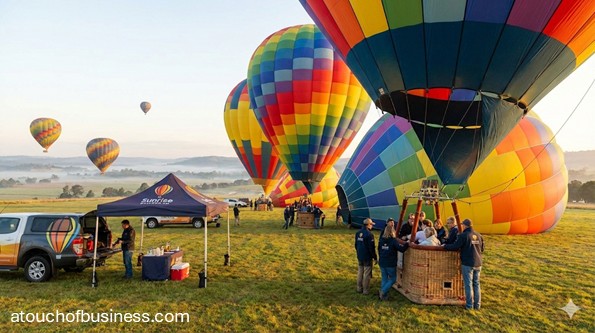
Licensing, Insurance, Gear, and Pre-Launch Checklist
Is a Hot Air Balloon Ride Business Right for You?
On paper, this sounds simple. You take people up, you bring them down, and everyone smiles.
In real life, you’re running an aviation activity with fuel handling, weather decisions, landowner coordination, and strict safety habits. If you love structure and responsibility, that can feel energizing. If you’re hoping for something “easy,” it can feel overwhelming fast.
Before you do anything else, read Points to Consider Before Starting Your Business. Then do a gut-check: is owning a business right for you, and is this specific business right for you?
Passion matters here. When weather cancels a flight, a supplier is delayed, or paperwork drags on, passion is what keeps you working the problem instead of looking for an exit. If you haven’t read it yet, spend a few minutes on how passion affects your business.
And ask yourself this question honestly: “Are you moving toward something or running away from something?” If you’re starting mainly to escape a job or solve a short-term cash squeeze, that motivation can fade when the hard parts show up.
Also think through the risk and responsibility side. Income can be uncertain. Days can be long. Some tasks will be uncomfortable. Vacations can be fewer at first. And the responsibility sits with you, even when things go wrong. Are the people in your life on board with that?
Finally, decide if you have (or can learn) the skills and can secure funds to start and operate. If you’re missing a skill, you can learn it or bring in help. You don’t have to be good at everything—but you do need a plan.
Step 1: Define Your Offer and Who It’s For
Get specific about what you plan to provide before you price anything or buy equipment. Are you offering shared rides, private rides, special-occasion rides, or tethered rides at events?
Then define your customers. You might serve tourists, locals celebrating milestones, corporate groups, or event organizers. Each group expects something different, and that changes your setup and your pricing.
Step 2: Understand the Aviation Side Early
This business is location-dependent, but it’s also rules-dependent. You’ll be operating an aircraft, coordinating a ground crew, and handling propane systems.
Start by reviewing the Federal Aviation Administration’s balloon guidance so you understand the reality of launch planning, crew coordination, and safety procedures before you commit your budget. The Balloon Flying Handbook chapter on layout to launch is a practical starting point.
Step 3: Decide Who Will Fly and What Credentials Are Needed
If you plan to fly paying passengers yourself, you’ll need the right pilot certificate and ratings for that role. If you plan to hire pilots, you’ll need a hiring and verification process that makes sense for aviation.
Medical certification can also apply in commercial balloon passenger work. The Federal Aviation Administration published a final rule that addresses medical certification standards for commercial balloon operations, including when a medical certificate is required and what class applies. Review the medical certification final rule summary and confirm how it applies to your plan.
To verify medical requirements in the regulation text, you can also review 14 CFR 61.23 (medical certificate requirements). If you need an Aviation Medical Examiner, the Federal Aviation Administration provides a locator at Find an Aviation Medical Examiner.
Step 4: Validate Demand Where You Plan to Launch
A balloon ride company doesn’t win just because the idea is exciting. It wins because people in your area actually book and pay.
Start with demand and competition checks. How many operators already serve your area? What do they offer? How far do customers travel to get a ride? If you need a framework for thinking about demand, review supply and demand basics and apply it to your local market.
Then confirm profitability. Don’t stop at “people will book.” Ask: will there be enough margin to pay yourself and still cover fuel, maintenance, insurance, staff, storage, and marketing?
Step 5: Choose a Business Model and Your Starting Scale
This can be a small operation with one balloon, a small ground crew, and an owner who is heavily involved. It can also be a larger operation with multiple balloons, more staff, and outside funding.
Be realistic. If you want to start part-time, you’ll need to think hard about scheduling and availability. If you want to run it full-time, you’ll likely build stronger booking momentum, but you’ll carry more responsibility day to day.
Also decide whether you’ll operate solo, bring on a partner, or involve investors. More balloons and more launch locations usually means more capital, more staffing, and more complex compliance planning.
Step 6: Build Your Startup Items List and Research Pricing
You can’t budget what you haven’t listed. Start by building a detailed bullet list of every startup item you will need—aircraft, ground equipment, safety gear, storage needs, office tools, software, and brand assets.
Once the list exists, research estimated pricing for each item and build a range. Your starting size drives startup costs. A one-balloon setup looks very different than a multi-balloon setup with several crews and vehicles.
If you want a structured way to work through this, use estimating startup costs as your guide for building a usable budget.
Step 7: Write a Business Plan Even If You’re Not Seeking Funding
A business plan isn’t just for lenders. It’s for you.
It forces you to connect demand, pricing, costs, staffing, risk, and launch steps into one plan you can follow. If you want a straightforward approach, review how to write a business plan and keep it practical.
Step 8: Pick a Name and Lock Down Your Online Identity
Your business name affects trust, branding, and discoverability. It also affects paperwork and online visibility.
Choose a name you can stand behind long term, then secure a matching domain and social handles if they’re available. If you want a process for this, use selecting a business name as a checklist.
Step 9: Line Up Funding and Set Up Banking
Before you spend, decide how you’ll fund the startup. Will you use savings, a partner contribution, a loan, or outside funding?
Then set up business accounts at a financial institution so you can keep business and personal transactions separate from day one. This makes taxes, reporting, and decision-making cleaner later.
Step 10: Form the Business and Register for Tax Basics
Many small businesses begin as sole proprietorships because it’s the default setup and does not require state formation, though licensing or a business name filing may still apply. Many owners later form a limited liability company for liability separation and clearer structure, which can also be helpful with banks and partners.
To understand the overall registration flow, review how to register a business and compare it to your state’s official guidance.
You’ll likely need an Employer Identification Number for banking, hiring, and tax reporting. The Internal Revenue Service provides the official process at Get an employer identification number and warns about third-party sites at Valid Employer Identification Numbers.
Step 11: Plan for Local Licensing, Permits, and Site Permissions
A balloon ride company is sensitive to where you store equipment, where you launch, and where you land. That pulls in local rules, property permissions, and sometimes special access agreements.
Use the Small Business Administration’s guides to understand the categories of requirements, then verify locally. Start with Register your business and Apply for licenses and permits. For tax identification basics, review Get federal and state tax ID numbers.
Step 12: Confirm Aircraft Ownership, Registration, and Airworthiness Steps
If you own the balloon, you’ll need to understand aircraft registration and airworthiness documentation before you carry passengers. If you lease, you still need clarity on who holds responsibility for required documents and maintenance records.
The Federal Aviation Administration provides overview information on aircraft registration and airworthiness certification. Use these as starting points, then confirm details with the appropriate Federal Aviation Administration office for your area.
Step 13: Build Your Ground Crew Plan and Safety Procedures
You’re not just providing rides. You’re coordinating a launch, flight, landing, and recovery process that depends on crew communication and shared routines.
The Federal Aviation Administration’s balloon materials emphasize organized setup and launch practices, including crew roles and launch preparation. Review the layout to launch guidance again, then convert what you learn into your own written procedures and training plan.
If your balloon uses an airborne heater system, the Federal Aviation Administration provides specific guidance in Advisory Circular 91-71.
Step 14: Set Your Pricing and Booking Rules
Pricing is not just a number. It’s your operating reality.
Set pricing that covers all predictable costs and leaves room for weather cancellations and seasonal swings. If you want help thinking through pricing logic, use pricing your products and services as a guide.
Also define your booking rules early: cancellation policy, rescheduling rules, refund approach, and how far in advance customers can book. Put it in writing so you’re not making decisions on the fly.
Step 15: Get Insurance in Place Before You Accept Bookings
Insurance is not optional in practice for most aviation-adjacent businesses, even when a specific policy type is not explicitly required by law. Many venues, landowners, and event organizers require proof of coverage before they’ll allow access.
At a minimum, think about general liability and coverage for business property and equipment. If you want a plain-language overview, start with business insurance basics, then talk to an insurance professional who understands aviation-related risk.
Step 16: Build Your Brand Assets and Customer-Facing Setup
People will judge you before they ever meet you. That’s normal. Your job is to look organized and trustworthy.
Set up the basics: a simple website, a logo, clean visuals, clear booking information, and professional communication templates. If you need a starting point, review an overview of developing a business website and corporate identity considerations.
Even if your business is not a storefront, you may still want tangible items like business cards for partners and venues, plus a basic sign plan for your storage site or event presence, depending on what local rules allow.
Step 17: Run Pre-Launch Checks and Get Ready to Open
Before you launch publicly, make sure your documents, procedures, and customer experience are consistent.
Finalize your customer paperwork, including any contracts, waivers, and booking confirmations. Set up invoicing and a way to accept payment that matches your policies. Then do controlled practice runs that simulate a real booking day—without rushing.
Overview: What This Business Looks Like
A balloon ride company provides scheduled flights for passengers, usually in scenic areas where weather and launch access allow safe operations. The customer experience typically includes check-in, passenger briefing, inflation and launch, flight time, landing, and recovery.
Because launch conditions and wind vary, the business is built around planning, safety, and flexibility. Cancellations are part of the model, so your pricing, policies, and customer communication must account for that upfront.
How Does a Hot Air Balloon Ride Business Generate Revenue?
This type of business earns revenue by providing passenger flight experiences and related services. The core product is usually a scheduled flight, sold as either a shared group ride or a private ride.
Depending on your setup and local rules, revenue may also include event-based tethered experiences, special-occasion packages, and educational services like flight training if you’re qualified and structured for it.
Products and Services You Can Offer
Keep your starting offer simple. You can expand later once you know what actually sells in your area.
- Shared passenger rides (group bookings)
- Private passenger rides (exclusive bookings)
- Special-occasion flights (proposals, anniversaries, milestone events)
- Tethered balloon experiences for events, when feasible and permitted
- Photography-focused flights, if you can support them safely
- Flight training services, only if your pilot credentials and structure support it
Typical Customers for This Type of Business
You’re usually selling to people who want an experience, not transportation. That changes how you market, how you schedule, and what “good service” means.
- Tourists looking for a memorable local activity
- Local residents celebrating special occasions
- Corporate groups planning team events
- Event organizers looking for a tethered attraction
- Hotels, resorts, and tourism partners referring guests
Pros and Cons of Owning and Operating This Business
This business can be meaningful and exciting. It can also be demanding in ways first-time owners don’t expect. Seeing both sides early helps you make a smarter call.
- Pros: High-perceived-value experience; strong word-of-mouth potential; clear differentiation if you’re in a scenic area; repeat referrals from tourism partners
- Pros: You can start smaller with one balloon and expand if demand supports it
- Cons: Weather-driven cancellations are normal and can disrupt cash flow
- Cons: Specialized staffing and safety procedures add complexity compared to many local service businesses
- Cons: Capital needs can be significant, especially if you aim for multiple balloons or multiple crews
Essential Equipment Checklist (No Costs)
Your exact equipment list depends on your balloon type, passenger capacity, and launch setup. Start with a complete list, then confirm specifics with manufacturers and your experienced aviation contacts.
The Federal Aviation Administration’s balloon resources describe common balloon components and launch setup items, which can help you build a realistic checklist.
Aircraft and Flight System
These are core items for flight operations. Confirm the exact configuration for your balloon model and the experience you plan to offer.
- Balloon envelope
- Basket (gondola)
- Burner system (airborne heater)
- Fuel system components (including fuel cylinders as applicable to your configuration)
- Suspension and load components used in your model’s setup
- Inflation and launch-related lines (for example, a crown line used during inflation and control)
Ground Support and Recovery
Passenger flights require ground support for setup, chase, landing recovery, and transport. Confirm what you need based on your launch and landing environment.
- Inflation fan (as used in the pre-launch process)
- Transport vehicle for chase and recovery
- Trailer or transport method appropriate for balloon and basket
- Communication devices used for pilot and crew coordination
- Basic ground handling tools and supplies used during setup and pack-down
Fuel Handling and Storage
Fuel handling needs safe, consistent procedures. Plan your storage approach and refueling approach before you open, not after.
- Propane supply plan (supplier relationship and delivery approach)
- Fuel cylinder storage setup consistent with local rules and safety practices
- Refueling tools and connectors required for your system
Passenger and Experience Setup
Customers remember how safe and organized you look. Build the experience around clear briefings and consistent routines.
- Passenger briefing materials (written and repeatable)
- Scheduling and booking system (software or platform)
- Customer communication templates (confirmation, cancellation, reschedule notices)
Office and Business Setup
Keep this simple at first. You want the basics working before launch day.
- Computer and secure file storage for business records
- Phone line or business phone setup
- Accounting and invoicing tools
- Website and email domain setup
Skills You’ll Need (Or Need Access To)
You don’t have to be born with these skills, but you do need them covered. Some you can learn. Some you may hire for. What matters is not pretending they don’t exist.
- Aviation knowledge and safe decision-making under changing conditions
- Clear communication with passengers and crew
- Planning and logistics for launch and recovery
- Basic business finance and recordkeeping
- Customer service and expectation setting
- Risk awareness and consistent safety routines
Day-To-Day Activities You’ll Handle
Even before launch, the workload is real. Your “day” often includes planning, compliance, and customer communication, not just flight time.
- Checking weather and determining go or no-go decisions
- Coordinating launch timing, crew readiness, and site access
- Briefing passengers and managing expectations when conditions change
- Coordinating recovery and transport after landing
- Maintaining required records and keeping documentation organized
- Managing scheduling, cancellations, reschedules, and customer questions
Business Models That Fit This Industry
Your model affects everything: staffing, costs, risk, and how quickly you can grow. Pick one starting model and build around it.
- Owner-operator model: The owner is deeply involved and may also be the pilot, supported by a small crew.
- Operator with hired pilots: The owner runs the business and hires pilots and crew to execute flights.
- Partnership model: Two or more owners share capital, responsibility, and roles.
- Multi-balloon growth model: More equipment and staff, often requiring larger funding and tighter management structure.
A Day in the Life of the Owner
You wake up and the first “task” is the same every time: conditions. If the weather isn’t right, you may need to cancel early so customers aren’t left guessing.
If it’s a go day, you’re coordinating people and timing. Crew shows up, equipment gets staged, passengers arrive, and you’re balancing calm communication with strict attention to procedure.
After the flight, the work continues. Recovery, transport, customer follow-ups, recordkeeping, and rescheduling for the next day can easily take as much time as the flight itself.
Red Flags to Watch for Before You Commit
Some warning signs show up early, even before you spend a dollar. Pay attention to them. They usually don’t fix themselves.
- You can’t identify consistent demand in your target area, even after research
- Competitors are already saturated and pricing leaves little room for margin
- You don’t have a workable plan for launch access, landing permissions, and recovery logistics
- You’re relying on “we’ll figure it out later” for staffing or safety procedures
- Your budget depends on best-case booking rates without room for cancellations
- You can’t get clear answers on aircraft documentation, registration, or airworthiness status
Varies by Jurisdiction
Local rules can change what “ready to launch” means. Don’t guess. Verify.
Use this checklist to confirm requirements where you live and where you plan to operate:
- Business formation and name filings: Check your state Secretary of State site. Search: “Secretary of State business registration” + your state name. Confirm entity filing, assumed name filings, and name availability rules.
- State taxes: Check your state Department of Revenue (or tax agency). Search: “Department of Revenue register business” + your state name. Confirm sales and use tax registration if it applies to your sales model.
- City and county licensing: Check your city or county business licensing portal. Search: “business license” + your city or county name. Confirm whether a general business license is required and what business activity category applies.
- Zoning and storage location: Check the local planning or zoning department. Search: “zoning office” + your city or county name. Ask about storing aircraft equipment, vehicles, and fuel at your chosen site and whether a Certificate of Occupancy applies to that building use.
- Site permissions: If you plan to use public land, parks, or managed spaces, check the managing agency’s permit process. Search: “special use permit” + the park or agency name.
- Aviation questions: Use the Federal Aviation Administration’s office directory to find the right contact point. Start with Flight Standards District Offices (FSDO) and ask where to route balloon-commercial questions for your region.
If you want a faster conversation with agencies, bring smart questions. Here are a few:
- “Does my storage site require zoning approval or a Certificate of Occupancy for this use?”
- “Do you require a general business license for this activity, and what category should I apply under?”
- “If I operate from a park or public land, what permit process applies and how far in advance should I apply?”
Talk to Experienced Owners (Non-Competing Only)
This step can save you months. But do it the right way.
Only talk to owners you will not be competing against. Think different city, different region, or a different target market.
If you want a structure for these conversations, use Business Inside Look to guide your questions. Here are a few that tend to get real answers:
- “What part of the startup phase took longer than you expected, and why?”
- “What did you underestimate about staffing and ground crew coordination?”
- “If you were starting again, what would you verify earlier with local agencies or landowners?”
Staffing: What You Can Do Yourself vs. What You Should Plan to Hire
Many first-time owners try to do everything. It’s normal. It’s also risky when the work involves safety and logistics.
Decide what you will personally handle and what you will delegate. If you need help thinking through timing, use how and when to hire and consider building a small bench of trained help before your first public bookings.
When you’re unsure, build a support circle. The right professionals can keep you from learning everything the hard way. A simple starting point is building a team of professional advisors.
Location Considerations for Launch and Storage
This business is not a typical storefront, but location still matters. You need places to stage equipment, launch safely, and recover after landing.
Start by evaluating accessibility for customers and practicality for crew operations. If you want a way to think through location tradeoffs, review business location considerations and adapt it to launch-site reality.
Pre-Opening Checklist
Before you announce your first public availability, do one last sweep. You’re looking for gaps that could create chaos on day one.
- Business formation and tax basics complete (entity, required registrations, Employer Identification Number if needed)
- Local licensing, zoning, and site permissions verified and documented
- Aircraft documentation, registration, and airworthiness steps confirmed for your setup
- Insurance coverage bound and proof documents available for partners and venues
- Written procedures complete (crew roles, passenger briefing, cancellation rules)
- Booking and payment system tested end-to-end
- Website live with clear offer, policies, and contact information
- Ground crew plan in place, including training and day-of communication routines
101 Real-World Tips for Your Hot Air Balloon Ride Business
These tips come from different parts of running a small business, so you can pick what fits your situation.
Some will match your next step perfectly, and others can wait until later.
Save this page and come back when your needs change.
Try one tip, put it into practice, and return when you’re ready for the next one.
What to Do Before Starting
1. Write down your exact starting offer (shared rides, private rides, tethered rides at events) so every later decision has a clear target.
2. Read the Federal Aviation Administration (FAA) commercial balloon guidance early so you know what “ready” means before you spend money on equipment.
3. Decide who will be pilot in command and confirm they can legally fly paying passengers (certificate level, balloon rating, and privileges).
4. If you will fly passengers for compensation or hire, confirm the current medical requirements for commercial balloon pilots and build the timeline into your launch plan.
5. Call your local Flight Standards District Office (FSDO) and ask what they recommend you review before you accept your first booking.
6. Choose a starting scale (one balloon vs. multiple balloons) based on capital, staffing, and how many bookings you can reliably support.
7. Validate demand with real signals, not guesses: check local tourism activity, search patterns, and existing operator calendars in your region.
8. Build a launch-and-recovery plan on paper: where you meet customers, where you stage equipment, and how you return people after landing.
9. Identify your likely launch areas and start contacting landowners early, because permissions can take longer than you think.
10. Decide how you will handle weather cancellations before you take any deposits, so you are not making emotional decisions under pressure.
11. Make a complete startup items list (aircraft, ground equipment, vehicle, storage, office tools, software, brand assets) before you price anything.
12. Get written quotes or documented price ranges for your biggest items, and keep them in a single budget file you can update.
13. Pick a business structure that matches your risk level; many owners start as sole proprietors and later form a limited liability company (LLC) for liability and structure.
14. Get an Employer Identification Number (EIN) early if you will hire, open business accounts, or want a cleaner separation for tax records.
15. Open business accounts at a financial institution before you start spending, so your business records are clean from day one.
16. Write a business plan even if you do not need a loan, because it forces your numbers, policies, and launch steps to line up.
What Successful Hot Air Balloon Ride Business Owners Do
17. They use written checklists for setup, passenger briefings, inflation, and recovery, and they treat the checklist as the standard.
18. They practice saying “no-go” early and clearly, because safety decisions get harder when customers are already waiting.
19. They train ground crew roles the same way every time, so a new helper can step in without confusion.
20. They keep required documents organized and ready to show (aircraft records, pilot documents, insurance, and site permissions).
21. They build relationships with a small set of reliable suppliers and service providers instead of scrambling each week.
22. They standardize communication templates for confirmation, cancellations, and reschedules so messages stay consistent.
23. They collect customer feedback after every flight and turn repeated comments into a specific improvement.
24. They protect their reputation by being honest about what they can control (weather and landing location are not controllable in a precise way).
What to Know About the Industry (Rules, Seasons, Supply, Risks)
25. Plan around the reality that balloon flights often work best in calmer wind periods, which can shape your scheduling and staffing.
26. Use aviation-grade weather sources (not generic phone apps) and learn how to read aviation weather observations and forecasts.
27. Treat power lines as a major hazard category and build your planning to reduce exposure during descent and landing.
28. Train your team on propane handling as a safety discipline, not a casual task, and follow published propane cylinder safety guidance.
29. If you store fuel at a facility, verify fire and building code requirements with local authorities because rules vary by jurisdiction.
30. Know that commercial balloon oversight has evolved over time; review FAA rule updates so you are not operating on outdated assumptions.
31. Do not assume federal drug and alcohol testing is mandated for commercial balloon rides; confirm the current FAA requirements and document what applies to your operation.
32. Understand that landing on private property can create conflict even when no damage occurs, so plan a respectful approach to landowner contact and recovery.
33. Expect seasonality: tourism cycles, local events, and weather patterns can create strong peaks and slow months.
34. Build your pricing and policies with cancellations in mind, because a “perfect weather month” is not a reliable baseline.
35. Be careful with passenger capacity assumptions; balloon performance limits depend on conditions and the specific aircraft configuration.
36. Plan your chase and recovery logistics to match your region’s road access and typical landing areas, not the ideal scenario.
37. If you buy a used balloon, verify aircraft records carefully before purchase because missing documentation can delay launch.
38. If you operate near complex airspace, learn the practical airspace rules that apply to balloons and confirm any equipment needs that could apply.
Running the Business (Operations, Staffing, SOPs)
39. Write a standard operating procedure (SOP) for your entire customer experience, from check-in to drop-off, so your team can repeat it.
40. Use a single daily “flight sheet” that includes passenger names, contact numbers, arrival time, and crew assignments.
41. Set a clear decision time for go or no-go, and build your customer notifications around that time to reduce confusion.
42. Choose one primary communication method for crew coordination and define a backup method if devices fail.
43. Train ground crew on safe positioning around burners, fuel, and lines so everyone knows where not to stand during inflation and launch.
44. Keep a dedicated gear kit for the crew (work gloves, basic tools, flashlights, and first-aid supplies) so small issues don’t derail the day.
45. Set up a secure, dry storage plan for the envelope and basket so you reduce damage risk between flights.
46. Build a maintenance log system that stays with the aircraft records, not scattered across phones and notebooks.
47. Store your critical documents in two places: a physical binder and a secure digital backup.
48. Use a booking system that can handle reschedules cleanly, because rescheduling is a core part of this business.
49. Create a simple payment and refund workflow that your team can follow without improvising.
50. Prepare a standard safety briefing that is short, clear, and repeated the same way each flight.
51. Establish a policy for late arrivals that protects safety and the schedule, and make it visible before customers book.
52. If you hire, set up payroll and employer accounts before the first day of work so you are not rushing compliance.
53. Train staff on how to answer the most common questions (weather, timing, safety, cancellations) using consistent language.
54. Create an incident and near-incident reporting form, and review each report as a learning tool, not a blame tool.
55. Build a plan for customer transport after landing that is reliable even when landing locations vary.
56. Run a full rehearsal day before your first public booking, including check-in, briefing, inflation, recovery, and paperwork.
Marketing (Local, Digital, Offers, Community)
57. Pick one clear message for your offer (for example, sunrise rides or private celebrations) so people know what you do in seconds.
58. Use a simple website that answers the basics fast: what’s included, how long it takes, where you meet, and how cancellations work.
59. Set up your Google Business Profile with accurate service area information, and update photos regularly to build trust.
60. Use real photos from your own operation instead of stock images, because customers notice authenticity quickly.
61. Build partnerships with hotels, bed-and-breakfast operators, and tourism staff who can refer guests in your peak season.
62. Contact wedding planners and event coordinators if you offer private rides or tethered experiences, and give them clear requirements.
63. Offer gift certificates only if your policies are written clearly, including expiration rules and rescheduling terms.
64. Collect customer emails and phone numbers with permission so you can notify people quickly when weather changes.
65. Create a short “how it works” video that sets expectations about timing, weather, and the full experience.
66. Track every booking source by asking one question at checkout: “How did you hear about us?” and use the answers to guide spending.
67. Use local media carefully: invite coverage for a controlled event, not your first public flight day.
68. Avoid deep discounts that attract risky behavior; instead, offer value with clearer packages or better scheduling options.
Dealing with Customers (Trust, Education, Retention)
69. Tell customers the total experience time, not just the flight time, so they plan their day correctly.
70. Explain weather cancellations as a normal safety outcome and set the expectation that rescheduling is common.
71. Provide clear clothing guidance in plain language (closed-toe shoes, layered clothing, and sun protection) to reduce day-of problems.
72. Ask customers to disclose any mobility limitations early, because getting in and out of a basket requires physical capability.
73. Handle weight and capacity limits respectfully by requesting accurate weights privately and explaining that safety margins matter.
74. Give nervous customers a simple, calm overview of what to expect during inflation, lift-off, and landing so anxiety does not take over.
75. Never promise an exact route or landing location; instead, explain what influences it (wind direction and safe landing options).
76. If a customer is unhappy, restate the facts, point to the written policy, and offer the options that policy allows.
Customer Service (Policies, Guarantees, Feedback)
77. Write your cancellation and reschedule policy in plain English and show it before payment, not after.
78. Send a confirmation message that includes the meeting time, what to bring, and how go or no-go decisions are communicated.
79. Send a short reminder the day before with arrival expectations and a clear note about weather checks.
80. After the flight, send a follow-up message with a thank-you, a review request, and a reminder of how to share photos appropriately.
81. Keep a consistent process for handling refunds so customers do not get different answers from different team members.
82. Track complaints and compliments in a simple log, then review it monthly to spot repeat issues.
83. If you offer any “satisfaction” commitment, define it tightly in writing so it does not create unsafe pressure to fly.
Staying Informed (Trends, Sources, Cadence)
84. Check FAA updates that relate to balloons and commercial operations on a regular schedule, such as monthly, so you catch rule changes early.
85. Re-read key sections of the FAA balloon handbook each season and update your training notes to match current guidance.
86. Attend safety seminars offered by recognized balloon and aviation groups, and bring one improvement back to your procedures each time.
87. Review National Transportation Safety Board reports related to balloon accidents occasionally to understand common risk patterns.
Adapting to Change (Seasonality, Shocks, Competition, Tech)
88. Build a waitlist so you can fill open slots when cancellations happen, instead of losing the whole day’s revenue.
89. Offer more than one package type (shared and private) so you can serve different customer needs without changing your core setup.
90. Revisit pricing quarterly and adjust if fuel, staffing, or insurance costs move materially.
91. Add new launch areas only after you confirm landowner access, vehicle access, and an achievable recovery plan.
92. When competition increases, compete on professionalism, clarity, and consistency, not on risky flight decisions.
93. Use booking automation to reduce admin work, but keep safety decisions and final go or no-go calls fully human-led.
Sustainability (Waste, Sourcing, Long-Term)
94. Use reusable briefing materials and durable gear so you reduce waste and avoid constant reprinting.
95. Leave every launch and landing area cleaner than you found it so landowners are more willing to work with you again.
96. Choose suppliers who can provide consistent safety documentation and support for propane cylinders and related equipment.
What Not to Do
97. Do not accept bookings until you confirm that your pilot qualifications, medical requirements, and aircraft documents are fully in order.
98. Do not rely on verbal landowner permission when you can document it, because misunderstandings are common.
99. Do not let refund anxiety push you into questionable weather decisions; safety calls must be protected from financial pressure.
100. Do not ignore local storage rules for fuel and equipment; verify requirements with local fire and building authorities because rules vary by jurisdiction.
101. Do not treat ground crew staffing as optional; an understaffed day increases safety risk and creates customer confusion.
FAQs
Question: Do I need a commercial pilot certificate to take paying passengers in a hot air balloon?
Answer: If you are flying passengers for compensation or hire, you generally need pilot privileges that allow commercial balloon operations.
Confirm the exact certificate and privilege requirements for your setup with the Federal Aviation Administration and your local Flight Standards District Office (FSDO).
Question: Do commercial balloon pilots need a medical certificate?
Answer: The Federal Aviation Administration has a final rule that requires a second-class medical certificate for commercial hot air balloon pilots flying paying passengers, with limited exceptions.
Verify current requirements in the rule summary and the related regulation text before you schedule your first paid flights.
Question: What federal rules apply if I sell sightseeing balloon rides?
Answer: Commercial sightseeing balloon rides are generally conducted under 14 CFR Part 91, and 14 CFR 91.147 is limited to nonstop passenger-carrying flights in an airplane, powered-lift, or rotorcraft. Ask your local Flight Standards District Office (FSDO) what specific federal requirements apply to your balloon operation.
Ask your local Flight Standards District Office (FSDO) how the rule applies to balloon operations in your area.
Question: Do I need a drug and alcohol testing program for this business?
Answer: Drug and alcohol testing requirements depend on how your operation is classified under federal rules.
Use Federal Aviation Administration guidance and confirm with your local Flight Standards District Office (FSDO) before you begin paid passenger flights.
Question: How do I register a hot air balloon as an aircraft?
Answer: Aircraft registration is handled through the Federal Aviation Administration Aircraft Registry, which explains the registration process and documents you must submit.
Start early, because incomplete paperwork can delay your launch timeline.
Question: What is an airworthiness certificate, and do balloons need one?
Answer: An airworthiness certificate is the Federal Aviation Administration’s authorization to operate an aircraft in flight.
The Federal Aviation Administration includes manned free balloons among the aircraft categories associated with standard airworthiness certificates.
Question: What licenses and permits do I need at the state and local level?
Answer: Many businesses need a mix of federal, state, and local licenses or permits, and the exact set varies by location and activity.
Use your city or county licensing portal and your state business agencies to verify what applies to a balloon ride operation and any storage site you use.
Question: Do I need zoning approval for my storage site and meeting location?
Answer: You may need zoning approval depending on where you store the balloon, vehicles, and fuel, and whether customers meet at that location.
Confirm requirements with your city or county planning and building departments because rules vary by jurisdiction.
Question: How do I get an Employer Identification Number (EIN) for the business?
Answer: The Internal Revenue Service provides an official online process to get an Employer Identification Number directly from the agency.
Use the Internal Revenue Service site to avoid third parties that charge fees.
Question: What insurance should I plan for before I launch?
Answer: Most owners budget for general liability and coverage for business property and equipment, and some venues or landowners may require proof of coverage.
Work with an insurance professional who understands aviation-related risk and document any coverage requirements from partners in writing.
Question: What essential equipment do I need to start with one balloon?
Answer: At a minimum, you need the balloon system (envelope, basket, burner, and fuel setup), plus inflation and ground recovery equipment.
The Federal Aviation Administration Balloon Flying Handbook is a practical reference for common components and launch-to-recovery workflow items.
Question: How should I handle propane cylinder storage and safety rules?
Answer: Propane cylinder placement and handling is safety-critical and can be affected by codes and local fire rules.
Use recognized safety guidance and confirm local requirements with your fire marshal or local authority having jurisdiction.
Question: What suppliers should I line up before opening?
Answer: Plan for suppliers and service providers tied to fuel, aircraft support, and any required maintenance or inspections for your equipment.
Get supplier terms in writing and build backup options for peak season demand.
Question: How do I estimate startup costs without guessing?
Answer: Start with an itemized list of aircraft, ground gear, vehicles, storage needs, insurance, licensing, and basic office systems.
Then collect documented price ranges for major items and build a buffer for approvals, training, and delays.
Question: What does a typical flight-day workflow look like for an owner-operator?
Answer: A flight day usually starts with aviation weather review, then crew coordination, setup and inflation, passenger briefing, launch, and recovery planning.
Use a written checklist so critical steps do not depend on memory or mood.
Question: How many ground crew people do I need, and how do I standardize the work?
Answer: Crew needs depend on balloon size, launch conditions, and the complexity of your recovery plan.
Define roles in advance and train with repeatable procedures drawn from Federal Aviation Administration balloon guidance.
Question: What marketing approach works without overpromising safety or weather outcomes?
Answer: Market the experience and your professionalism, not guarantees about exact routes, landing locations, or perfect conditions.
Set expectations clearly in your website copy and in your pre-flight communications to reduce disputes and cancellations.
Question: What numbers should I track weekly to keep the business healthy?
Answer: Track lead sources, conversion rate, cancellation rate, completed flights, average revenue per flight, and crew cost per flight-day.
Also track reschedule backlog so you do not build a future capacity problem you cannot fulfill.
Question: What are common mistakes new balloon ride operators make?
Answer: Common problems include unclear compliance assumptions, weak documentation systems, and inconsistent cancellation workflows.
Build checklists, document policies in plain language, and confirm requirements with the right authorities before you sell flights.
Question: Where should I get aviation weather information for go or no-go decisions?
Answer: Use aviation-focused sources designed for flight planning, such as the National Weather Service Aviation Weather Center.
Make weather review a repeatable process and keep records of key decision inputs for accountability.
Related Articles
- Starting a Tour Guide Business
- Start an Aerial Photography Business
- Start an Airport Shuttle Service from the Ground Up
- Start a Travel Agency
- Start a Charter Bus Company
- How to Start a Party Bus Business
- Drone Repair Business
Sources:
- Aviation Weather Center: Aviation Weather
- Federal Aviation Administration: Balloon Flying Handbook Chapter, Balloon Flying Handbook Chapter (bfh), Advisory Circular 91 71, Advisory Circular 91 71 (22439), Final Rule Medical Certification, Commercial Balloons Final Rule, Balloon Flying Handbook, Power Lines Thunderstorms, Find Aviation Medical Examiner, Flight Standards District, Aircraft Registration, Airworthiness Certification
- Internal Revenue Service: Get employer identification, Valid Employer Identification
- National Fire Protection Association: LP Gas Containers
- Propane Education & Research Council: Portable Cylinder Safety
- U.S. Census Bureau: North American Industry
- U.S. Small Business Administration: Register business, Apply licenses permits, Get federal state tax ID
- eCFR: 14 CFR 61 23 Medical