
What to Expect From This Guide to Starting a Radon Testing Business
This guide walks you through the key decisions and practical steps involved in starting a radon testing business, from evaluating whether the work fits you to getting certified, licensed, equipped, and ready to open. The highlights below point to some of what’s covered.
Inside the guide, you will find:
- Startup steps: Move step by step from certification and licensing through equipment, pricing, and final opening preparation.
- Business fit: Consider the physical demands, scheduling pressures, and income uncertainty involved before committing to this work.
- Market demand: Weigh local demand, competition, and how real estate activity shapes the flow of testing work.
- Legal requirements: Understand certification, state licensing, insurance, and zoning considerations that vary by location.
- Financial planning: See what to plan for, including startup costs, pricing methods, and break-even considerations.
- Risks and warnings: Review red flags worth weighing before starting and before accepting a first paid job.
- Common questions: Find answers about part-time work, equipment choices, certification timing, and gauging local demand.
From here, the guide begins by explaining what a radon testing business actually involves before moving into the startup steps themselves.
Testing Radon for a Living
Running a radon testing business means going into homes, and sometimes offices or schools.
You’re there to measure an invisible gas that can build up indoors.
Radon comes from uranium breaking down in soil and rock, and it can seep into a building through foundation cracks and gaps.
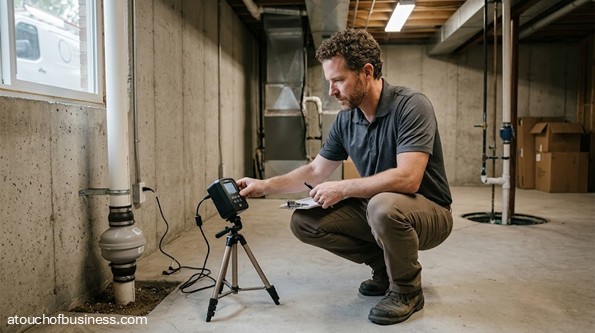
As the owner, you place a measurement device and let it run for the required period.
Depending on the device, you read the results yourself or send the device to a lab for analysis.
Most jobs come from real estate transactions, where a buyer or seller wants a reading before closing.
You also work with homeowners checking levels years after moving in, or after a radon mitigation system was installed.
You’ll build this business around travel between properties, scheduling, and paperwork instead of a storefront or shop.
Getting there involves the same broad startup steps every new business follows, shaped around this specific trade.
Is This Work for You
Radon testing work means crawling into basements and crawl spaces, often in homes you’ve never seen before.
You’ll need to feel comfortable in tight spaces, and comfortable working alone in someone else’s property.
Real estate deadlines drive much of this work.
Your schedule needs to flex around closing dates rather than a fixed routine.
Ask yourself honestly whether you have the patience for careful documentation, since certification depends on keeping accurate calibration and placement records.
Starting any business carries financial risk, and this one is no exception.
Before you commit, think through whether your household can handle a slower income stretch while you build a name for yourself.
Ask whether you have support at home if the first months bring long field days and unpredictable scheduling.
There’s a real chance this business takes longer to become profitable than you expect, and that possibility is worth sitting with honestly.
Genuine motivation for running a radon testing business will carry you through slower first months better than any spreadsheet will.
Talk to Owners First
Before you spend on certification or equipment, talk to radon measurement professionals working in other regions.
Ask about their certification path, the devices they chose, and how many tests they complete in a typical week.
Ask what surprised them most once they were doing this work full time, since every owner’s path looks different.
Firsthand advice from working owners is worth more than anything you’ll read online.
They’ve already worked through the mistakes you’d otherwise make on your own.
Once you’ve talked with a few testers, weigh whether you’re starting a radon testing business from scratch or buying an existing one.
A franchise is also worth a look if brand support, training, and territory rights matter to you.
Buying an established local testing route is worth considering if one happens to be available near you.
Who Will Hire You
Most of your first work will come from real estate agents whose clients need a radon reading before closing.
Buyers and sellers hire a radon testing business to get proof of safe indoor air.
That request might come from a lender, an agent, or simply their own caution.
Homeowners are a second steady source, especially those retesting years after moving in or after a mitigation system was installed.
Depending on your area, schools, childcare facilities, and commercial building owners may also need testing on a regular schedule.
Reaching these customers as you’re getting started usually means introducing yourself directly to local real estate offices and home inspectors rather than running ads.
Before you commit further, research whether radon testing is already a normal part of home sales in your area.
Look into how many established testers, inspectors, or environmental firms already serve local buyers and sellers.
Red Flags Before You Start
A radon testing business depends heavily on local demand.
Weak interest in your area is the clearest reason to pause.
If radon testing isn’t customary in local real estate deals, sales volume may be too thin to support a full business.
Regional soil and rock conditions affect how often elevated readings turn up, so this is worth researching before you invest.
Established competition is another signal worth weighing, since many home inspectors already bundle radon testing into their inspections.
If several experienced testers or environmental firms already serve your area, you may be entering a market that’s already covered.
Licensing and insurance requirements vary by state.
Some states add real time and cost before you can legally accept paid work.
If your state requires a separate business-entity license on top of your personal certification, build that timeline into your startup plan.
Radon measurement and radon mitigation are treated as separate lines of work.
Combining them on one property raises a real conflict of interest.
Some states restrict one license holder from testing and then fixing the same property, which limits how far a single job can grow.
Your equipment choice carries a tradeoff of its own.
Owning a continuous radon monitor costs more upfront, while mailed test kits tie you to a lab’s turnaround time.
Because individual tests are a low-ticket service, you may need more completed jobs per week than you expect just to cover fixed costs.
Calculate that number honestly before counting on this business to replace other income right away.
Steady work usually depends on referral relationships with agents and inspectors, and those relationships take time to build.
Expect a slower ramp-up period before referrals become a reliable source of jobs.
Certification renewal, device calibration, and layered state licensing are ongoing compliance costs built into this trade, not one-time startup hurdles.
Step 1: Get Certified
You start a radon testing business by earning national certification through the National Radon Proficiency Program or the National Radon Safety Board.
Both programs require an approved training course and a passing score on a proctored exam covering measurement protocols.
If you plan to use an analytical device such as a continuous radon monitor, you’ll also register that specific device under your certification.
Registering an analytical device means submitting proof of a device performance test and a current calibration record.
Standard devices, like charcoal test kits, still need to be registered, though the paperwork is lighter.
Keep your training certificate and exam results on file, since renewal requires proof of your original credential.
Step 2: Handle State Rules
National certification alone isn’t enough in every state, so check whether your state layers on its own licensing requirements for radon work.
Some states require an individual radon license or registration in addition to your national certification.
Some go further and require a separate license or registration for the business entity itself, apart from your personal credential.
Contact your state’s health or environmental agency radon program office to confirm which of these apply where you’ll be working.
If you ever plan to offer mitigation as well as testing, be aware of a real conflict-of-interest issue.
Testing and then fixing the same property is discouraged industry-wide, and some states restrict or prohibit it outright.
Review general business license and permit requirements for your state and city alongside your radon-specific credentials.
Step 3: Register Your Business
With your certification path settled, choose a legal structure for your radon testing business, such as an LLC or sole proprietorship.
File for an employer identification number, even if you don’t plan to hire yet, since most banks require one.
Register a DBA if you plan to operate under a name different from your own or your legal entity’s name.
If you’ll run the administrative side from home, check local home-occupation or zoning rules before storing devices or a company vehicle there.
Some cities and counties also require a general business license or tax registration separate from anything radon-specific.
Step 4: Secure Insurance
General liability coverage protects your radon testing business against claims tied to property damage or an inaccurate reading.
Some states set a minimum coverage amount and require the policy to name the state program as a certificate holder.
Confirm the exact requirement with your state’s licensing office rather than assuming a standard policy will satisfy it.
Even where insurance isn’t legally required, clients and real estate agents commonly expect to see proof of coverage before hiring you.
Review general business insurance options beyond liability coverage, including commercial auto if you’ll use a dedicated vehicle.
Step 5: Choose Your Devices
Your core equipment decision is between continuous radon monitors and passive devices like charcoal canisters or electret ion chambers.
A continuous radon monitor logs hourly readings and lets you read results on site or shortly after.
It costs more to buy.
Passive devices cost less upfront, but they need to be mailed to an accredited lab for analysis, which adds turnaround time.
If you choose passive devices, build a working relationship with an accredited lab before you accept your first paying job.
Whichever device you choose, budget for ongoing performance testing and calibration, since certification depends on keeping those records current.
Beyond the measurement device itself, plan for placement tools.
Tamper-evident seals, a tape measure, and a camera help you document each setup.
Basic protective gear, such as gloves, knee pads, and a headlamp, makes crawl space and basement work safer and faster.
Step 6: Set Up Banking
Open a dedicated business bank account before your first job, so personal and business transactions never mix together.
Set up a way to collect payment in the field, whether that’s a mobile card reader or an invoicing system tied to each report.
A separate business account also makes it easier to track income against your operating costs as the business grows.
Step 7: Plan Your Costs
List every category your radon testing business will need to fund, then price each one out locally rather than guessing a total.
Certification training, exam fees, and any state license application are your first costs, followed by your measurement devices.
Ongoing costs include device calibration and performance testing, insurance premiums, and lab fees if you’re using passive devices.
Vehicle expenses, basic office equipment, scheduling software, and a simple website round out your starter setup list.
Owning a continuous radon monitor raises your upfront cost but avoids a per-test lab fee that passive devices carry instead.
Whichever path you choose, set aside enough operating capital to keep the business running through a slow stretch.
Running out of operating money before referrals build up is one of the more common reasons new businesses shut down.
If you need funding beyond your own savings, compare your options.
Loans, leasing programs, and lines of credit are all worth pricing out before you commit to a purchase.
Step 8: Set Your Pricing
Look at what other radon testers in your area charge before setting your own rates.
Many testers charge a flat fee per test.
An added fee often applies for each extra area on a property that needs its own device.
Some testers also charge a rush fee when a real estate closing leaves little turnaround time.
Price out your certification, device, lab, insurance, and travel costs before settling on a number.
Your rate should cover what the job actually costs you, not just what sounds competitive.
Review general guidance on pricing your services as you work out a rate that covers your real costs.
Step 9: Build Your Paperwork
A written quality assurance plan is a standard requirement for keeping your radon certification active, not an optional extra.
Your plan should describe how you place devices, verify closed-house conditions, and handle calibration and record-keeping.
Create a placement and retrieval form for every job that records dates, times, foundation type, and confirmation of closed-house conditions.
This same paperwork is often called a chain-of-custody form, and it protects both you and your client if results are ever questioned.
Build a simple report template so every client receives a consistent, professional summary of their results.
Set up a record-retention system for calibration logs, device registrations, and client reports.
Some states require these records to be kept for a set number of years, so verify the rule for your state.
Step 10: Establish Your Identity
Pick a business name that’s easy to say over the phone and easy to find online.
Set up a dedicated business phone line and email address, separate from your personal accounts.
A simple website describing your certification and the areas you serve helps real estate agents find and trust you quickly.
Put a scheduling system in place so agents and homeowners can book a test without waiting on a callback.
Step 11: Run a Trial Test
Before you accept a paying job, place a radon measurement device in a controlled setting, such as your own home or a colleague’s property.
Confirm the device operates correctly, logs data as expected, and produces a report you’re comfortable handing to a client.
Work through your full process end to end, from placement through report delivery, so nothing is untested on your first real job.
Business Plan
Turning these radon testing steps into a working plan means organizing several decisions on one timeline.
That includes your certification, licensing, equipment, and pricing choices.
Start with your realistic revenue model: most income comes from many individual tests rather than a small number of large projects.
Work out roughly how many tests per week cover your fixed costs, including insurance, vehicle expenses, calibration, and certification renewal.
That sales volume tells you whether the business can realistically support you, or whether it needs to stay part time at first.
Margin pressure shows up mainly through your equipment and lab choices.
A per-test lab fee eats into passive-device jobs in a way owned equipment doesn’t.
Real estate activity in your area will drive slow stretches and busy stretches.
Plan your operating capital around that uneven pace.
If you’ll need funding for equipment or startup costs, compare your options.
Loans, leasing programs, and lines of credit are all worth pricing out before you commit to a lender.
Confirm your pre-opening items are complete before you accept your first paid job.
Make sure your pricing is set and your paperwork system is finished as well.
Opening-Day Red Flags
Before you take your first paid radon test, confirm your national certification and any required state license are both active, not still pending.
A pending application isn’t the same as an approved one, and testing before approval can create real legal exposure.
Confirm your liability insurance is in place and meets any state-set minimum before you schedule a real estate transaction test.
Check that your measurement devices have current calibration and performance-test documentation on file, not just a purchase receipt.
If you’re relying on passive devices, confirm your lab relationship is active and you understand their turnaround time.
Make sure your written quality assurance plan, placement forms, and report template are finished, not still in draft.
Run your trial test before your first paid one, since a real job is the wrong place to discover a problem.
Confirm your scheduling system, business phone, and website are live so agents and clients can actually reach and book you.
Check that your vehicle and field gear are set, including placement tools and basic protective equipment for crawl spaces and basements.
If you operate from a home office, confirm your local zoning or home-occupation questions are settled before storing equipment there.
Double-check your pricing against your actual costs one more time, since a rate set too soon often needs correcting later.
Frequently Asked Questions
Does the EPA certify individual radon testers directly?
No, national certification comes through the National Radon Proficiency Program or the National Radon Safety Board, not the EPA itself.
Both are private, industry-recognized programs, so your credential comes from one of them rather than a federal agency.
Can I run this business part time alongside another job?
Real estate transaction tests often need placement and retrieval within a tight, deadline-driven window, which can be hard to fit around a fixed schedule.
Non-transaction testing, like a homeowner’s periodic retest, usually carries more flexible timing and fits a part-time schedule more easily.
What happens if I buy a device before finishing certification?
Certification for an analytical device requires registering that specific model and submitting its performance-test results as part of your application.
Buying equipment before confirming it can be registered risks ending up with a device that doesn’t qualify.
How do I know I’ve validated enough local demand to commit?
There’s no fixed number here, since it depends on your area’s real estate activity and how established your competition already is.
A reasonable signal is confirming that radon testing is already routine in local home sales.
Another is confirming that existing testers aren’t already covering all the local demand.
Interviews with Radon Testing Business Professionals
These interviews share perspectives from professionals involved in radon measurement, testing, environmental services, and related field work. They discuss testing practices, equipment, customer communication, market demand, business operations, and professional standards.
Someone considering a radon testing business can use these discussions to better understand how professionals approach the work, develop services, work with customers and industry partners, and respond to real-world testing situations.
Alan J. Whitehead and Radon Environmental Management Corporation
Alan J. Whitehead discusses his role in developing Radon Environmental Management Corporation and its strategy around radon mapping, testing, measurement, and mitigation. He also addresses business planning, strategic relationships, expansion, capital requirements, and building a capable team.
This interview is useful for understanding the business side of radon services. It shows how testing can fit within a broader service model and highlights the importance of strategy, partnerships, specialized skills, and financing when building and growing a company.
Expert Interview with David Lenden of RPmatters
David Lenden discusses his company’s radon measurement work, the state of the measurement market, workplace demand, professional affiliations, laboratory relationships, testing devices, and day-to-day customer support.
This interview is useful for seeing how a small professional firm can combine technical expertise, testing services, laboratory support, and customer assistance. It also provides perspective on how regulations and public awareness can affect demand for radon measurement.
Real Talk About Radon with Bill Branch
Bill Branch discusses professional radon testing, testing equipment, short-term real estate measurements, proper device placement, interpreting results, customer education, and the differences between professional and consumer testing devices.
This interview is useful for understanding the importance of equipment selection, accurate placement, training, and clear communication with customers. Branch also discusses qualities he looks for when hiring, including attention to detail, customer service, and willingness to learn.
Radon in Northeastern Pennsylvania with Matt Abell
Matt Abell, co-owner of Northeast Radon Solutions, discusses field conditions, radon measurements, continuous digital monitors, post-mitigation testing, equipment choices, real estate work, customer communication, referrals, and scheduling around property transactions.
This interview is useful for understanding how field work and business operations connect. Abell’s experience shows the importance of dependable testing procedures, carrying appropriate equipment, communicating with real estate professionals, and managing jobs around strict transaction timelines.
Radon in Western Pennsylvania with Alex Micco
Alex Micco discusses professional radon testing, testing certification, common measurement mistakes, consumer monitors, real estate testing requirements, client education, post-mitigation testing, job intake, seasonal demand, and field conditions.
This interview is useful for understanding the practical standards behind professional testing and how testing connects with customer service and real estate demand. It also shows why proper placement, certification, clear explanations, and consistent procedures matter when providing paid radon services.
Related Articles
- How To Start an Environmental Testing Laboratory
- How To Start a Home Inspection Business
- How To Start an Environmental Consulting Firm
- How To Start an Asbestos Removal Business
Sources:
- NRSB: Become NRSB Certified Professional, NRSB Home
- NRPP: NRPP Home, Become NRPP Certified, Types NRPP Certification, Radon Measurement Methods
- National Radon Program Services: Radon Testing Real Estate, Radon Testing Protocols, Radon Testing Devices, Installing Radon Mitigation, State Multi-Family Requirements
- U.S. EPA: Home Buyer Seller Radon Guide, Radon Measurement Protocols
- CERTI Radon Training: Radon Testing Overview
- LegalClarity: Radon Testing Standards Regulations
- AARST: Regulation Through Certification Toolkit, AARST Radon Standards
- American Lung Association: State Radon Credentialing Programs
- Environmental Law Institute: State Indoor Air Quality Laws
- LicenseMap: Radon Professional License Requirements
- Wexford Insurance: Radon Business License Certification, Home Inspection Business Profitable
- InterNACHI: InterNACHI Radon Guidance
- Disaster Blaster: Common Radon Mitigation Scams
- Ecosense: Radon Testing Summer Homebuyers, Homebuyers Demand Continuous Testing
- HomeGauge: Home Inspectors Offer Radon Testing
- Inspector Pro Insurance: Radon Testing Home Inspectors
- Fullterra: Radon Commercial Buildings
- SWAT Environmental: Commercial Radon Testing Mitigation