
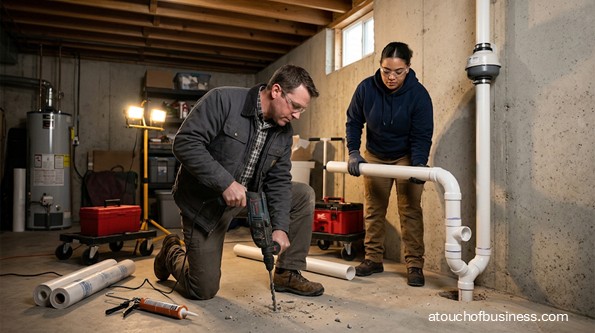
What to Expect From This Guide to Starting a Radon Mitigation Business
This guide walks you through the key decisions and practical steps involved in starting a radon mitigation business, from evaluating whether the work fits you through licensing, insurance, and getting your first jobs scheduled. The highlights below point to some of what’s covered.
Inside the guide, you will find:
- Startup steps: Follow a 14-step sequence from certification and licensing through equipment, pricing, and your first scheduled job.
- Business fit: Weigh the physical demands, income uncertainty, and lifestyle trade-offs before committing to this trade.
- Financial planning: See what pre-opening and ongoing costs to price out, plus how to think through break-even planning.
- Local requirements: Understand how certification, state licensing, and local permitting vary depending on where you operate.
- Risks and warnings: Review red flags tied to local demand, licensing delays, insurance gaps, and competitive pressure before you start.
- Opening preparation: Check the pre-launch items to confirm, from active insurance to staged materials for your first job.
- Common questions: Get answers on seasonal work, storage without a shop, and sequencing licensing before buying equipment.
From here, the guide moves into what running a radon mitigation business actually involves, starting with whether it’s a fit for you.
As a radon mitigation contractor, you inspect foundations and design soil-suction systems.
You install the fans and pipe that pull radon gas out of a home.
Radon problems turn up in every state, in old houses and new construction alike.
The gas rises from soil and rock, not from anything inside the building.
Most jobs start with a foundation walk-through and end the same day with a working system and a manometer reading.
You’ll spend real time in basements, crawl spaces, and attics.
You’ll climb ladders and roofs to run and terminate vent pipe.
It helps to review the general startup process before you dive in.
Radon mitigation adds its own licensing and certification layer on top of those basics.
Is a Radon Mitigation Business Right for You?
You’ll enjoy this business if you like solving a physical puzzle: sizing a suction system to a specific foundation.
You need patience for detail work — sealing, wiring, and pressure-testing — and comfort spending hours in tight spaces.
Before you commit, be honest about your risk tolerance.
Radon mitigation has fewer weekly jobs than many home-service trades.
Your income will likely be uneven in the early months while you build a referral network and a reputation.
Startup costs here include certification, a vehicle, tools, and initial inventory.
You’ll price each of these out in detail later in this guide.
Confirm you can cover your own living expenses during the ramp-up period.
Talk with your household about the income uncertainty this business involves.
Ask yourself these questions before you commit:
- Do you have the physical stamina to climb ladders, access roofs, and enter crawl spaces?
- Can your household absorb a slow first few months while referral relationships build?
- Do you have, or can you quickly learn, basic electrical and construction skills?
- Can you validate real local demand before you commit to a vehicle and full inventory?
Talk with radon mitigation contractors in other markets before you launch — people who won’t compete with you locally.
Prepare specific questions about weekly job volume, referral sources that actually produce work, and common early mistakes.
Firsthand insight from working contractors is valuable, even though every owner’s path looks different.
Most demand for a new radon business comes from real estate transactions.
Home inspectors and homeowners who tested on their own add to that demand.
Building relationships with inspectors and agents before you need the work gives you a lead source that doesn’t depend on advertising alone.
Decide how you want to enter this business:
You can start this business from scratch or buy an existing radon mitigation business.
A franchise network built around this trade is a third option.
A franchise can shorten your learning curve with training and brand recognition.
Expect ongoing fees and territory terms in exchange.
Buying an established business gives you existing customers and referral relationships.
You’ll pay for that history upfront.
Compare these paths using your available capital, timeline, and how much support you want. See starting from scratch versus buying a business.
Red Flags Before You Start
Radon mitigation is a smaller-volume trade than most home-service businesses, so weak local demand can stall you early.
Your local job volume depends heavily on the area’s soil and geology.
Verify local radon potential and typical local test results before you commit to a service area or a full inventory.
Licensing barriers vary widely by state. Some states require nothing beyond national certification, and others require a state license plus a contractor’s license.
A slow or costly state licensing process can delay your launch by months, so verify requirements and timelines early.
A large share of your demand will come from real estate transactions, a factor entirely outside your control.
Build referral relationships across several sources — inspectors, agents, and other tradespeople — rather than depending on one channel.
Standard general liability insurance commonly excludes pollution-related claims, leaving a real coverage gap for radon work.
Confirm your coverage details with an insurer familiar with environmental and radon contracting before your first job.
Weather and site access affect scheduling in colder climates, where roof access and vent-pipe condensation need extra precautions.
This industry includes small owner-operators, regional companies, and larger multi-market or franchise operations, all competing for the same jobs.
Competing on price alone against established players is difficult. Plan to build credibility through certification, reviews, and referrals instead.
Step 1: Learn the Business Model Options
Before you invest in tools or certification, decide what kind of radon business you’re building.
You can offer mitigation only, installing systems after another party tests the home, or combine measurement and mitigation.
Combining both services can generate leads into your mitigation work.
But offering testing and mitigation to the same customer can raise disclosure questions in some markets.
You can also focus on residential retrofit work, or add new-construction rough-in and fan activation for local builders.
Light-commercial and multifamily mitigation follow a different set of measurement and mitigation standards than single-family homes.
Choose your starting focus based on the training and certifications each path requires.
Step 2: Get Certified as a Radon Mitigation Specialist
Certification through NRPP or NRSB is the credential that lets you design and install mitigation systems in most markets.
Each program requires completing approved training courses and passing a proctored, knowledge-based exam covering mitigation protocols.
Many owners also complete measurement certification, since it supports a combined testing-and-mitigation offering.
Certification must be renewed on a set cycle, and both programs require continuing education credits.
Plan for these certification requirements:
- An approved initial mitigation training course, including hands-on instruction
- A proctored, knowledge-based exam through NRPP or NRSB
- Ongoing continuing education credits each renewal period
- Adherence to the certifying body’s code of ethics
Step 3: Confirm State and Local Licensing Requirements
National radon certification alone doesn’t guarantee you can operate legally everywhere.
Some states require a state-issued radon license or registration in addition to NRPP or NRSB certification.
Some states require radon work to be performed by, or under, a licensed general or specialty contractor.
Others rely only on national certification, and some have no radon-specific licensing requirement at all.
Check your state’s radon program, usually housed in the state health or environmental agency, before you advertise.
Also verify local rules on zoning or home-occupation limits and general business licensing.
Check whether a permit is needed for wall or roof penetrations too.
Review business licenses and permits as you work through this step.
Step 4: Choose a Business Structure and Register Your Business
Pick a legal structure for your business — a sole proprietorship, an LLC, or another entity — based on liability and taxes.
Register the entity with your state, obtain an EIN, and set up the state tax accounts your business needs.
This step also sets the legal name you’ll use to register with NRPP or NRSB and your state radon program.
Step 5: Register Your Business With Your Certifying Body
Individual certification and business registration are separate steps.
Register your company, not just yourself, with NRPP or NRSB.
If your state runs its own radon program, register there as well, since some states track certified businesses separately.
Being listed in these programs’ public contractor directories is one of the main ways customers verify a contractor before hiring.
Step 6: Set up Banking, Bookkeeping, and Payment Processing
Open a business bank account separate from your personal accounts before you take your first payment.
Set up a merchant account or payment processor able to handle deposits and final payment on-site.
Build a simple bookkeeping system, since compliance records and job costs pile up fast once you start scheduling radon jobs.
Step 7: Secure Insurance Coverage
Standard general liability policies commonly exclude pollution-related claims, which matters directly for a business built around soil gas.
Carry contractors pollution or environmental liability coverage specifically, in addition to general liability.
Add commercial auto coverage for your service vehicle and tools coverage for your fans, pipe, and diagnostic gear.
Workers’ compensation is generally required once you have employees, though exact rules depend on your state.
Review business insurance basics and confirm specifics with an insurer familiar with environmental contracting.
Step 8: Set up Suppliers, Your Vehicle and Workspace
Open a trade account with a radon equipment distributor for fans, Schedule 40 PVC pipe, fittings, sealants, and manometers.
Outfit a service vehicle with ladder racks, secure material storage, and room for your core drill and diagnostic tools.
Decide whether you’ll run this business from home or from a small commercial space.
Check home-occupation zoning limits before you park a marked work vehicle at a residential address.
Confirm certificate-of-occupancy and business-license requirements for whichever workspace you choose.
Step 9: Plan Your Startup Capital and Funding
Price out these pre-opening costs locally before you commit funds:
- Certification, exam, and business registration fees
- State licensing fees, if your state requires them
- Vehicle purchase or lease and trade outfitting
- Initial tools and diagnostic equipment
- Insurance premiums
- Initial materials inventory for your first several jobs
Plan for these ongoing costs too:
- Fuel and vehicle maintenance
- Materials for each job
- Insurance premiums
- Continuing education to keep your certification current
Running out of operating capital before demand builds is a common reason new trade businesses close in their first year.
If your own capital isn’t enough, compare funding sources based on your situation.
Options include SBA-backed loans, equipment financing, or a small-business line of credit.
Talk through your funding options before you commit to a specific vehicle or tool purchase.
Step 10: Set Your Pricing and Estimate Process
Most contractors price per system after an on-site inspection rather than quoting a flat rate over the phone.
Your estimate depends on foundation type, the number of suction points needed, and pipe-routing access.
It also depends on whether the job requires a dedicated electrical circuit for the fan.
Write your estimate into a clear proposal that spells out the fan, pipe path, and termination point.
Get the homeowner’s sign-off on that proposal before you schedule the job.
Build a change-order process for jobs where the site reveals extra suction points are needed once you open the slab.
Get the homeowner’s written approval before you expand the scope or the price.
Review pricing your services as you set your estimating process.
Step 11: Identify Your First Customers and Build Referral Relationships
Your earliest customers are likely home sellers and buyers responding to a radon test during a real estate transaction.
Existing homeowners who tested on their own, and builders needing a passive system activated, round out your early customer base.
Build relationships with home inspectors and real estate agents before you need the referrals.
Other trade contractors, such as basement waterproofers, are good referral partners too.
These relationships take time to build, so start them well before your official launch date.
Step 12: Stock Your Equipment and Prepare Your Paperwork
Stock enough core materials for your first several scheduled jobs before you start booking work.
Your core installation materials include:
- Radon fans sized for different soil and suction conditions
- Schedule 40 PVC pipe and fittings in the sizes your market needs
- U-tube or digital manometers, one per installed system
- Polyurethane caulk, backer rod, and PVC cement
- Roof and wall penetration boots, fan brackets, and fire collars
- Vapor barrier material for crawl-space, sub-membrane systems
Prepare your paperwork before your first job too: a mitigation proposal template, system description labels, and warranty documentation.
Check whether your state requires you to report completed mitigations, and build that step into your process now.
Step 13: Set up Scheduling and Field Systems
Set up a scheduling system that accounts for travel time between job sites across your service area.
Stage materials for each job the day before, matching fan size and pipe quantity to what the site review told you.
Build a simple estimating and invoicing system so quotes, approvals, and final payments don’t slip through the cracks.
Plan your closeout routine for every job: a manometer demonstration, a walkthrough, and a scheduled confirmation test.
Step 14: Hire and Train Help When You’re Ready
You can operate solo at first, since a single technician can typically complete a residential install in about a day.
When job requests outpace what you can handle alone, bring on an installer-level technician.
That technician must work under your direct supervision as the certified specialist.
Train new hires on ladder and roof safety, electrical safety around fan wiring, and confined-space awareness for crawl spaces.
Business Plan
Turn everything from your startup steps into one practical plan before you commit real capital.
Your plan should tie together your certification and licensing status, your costs, your pricing method, and your funding sources.
Include your profit-potential thinking here too, since it’s a go or no-go issue before you commit to a vehicle or inventory.
Radon mitigation is a lower-volume, higher-ticket trade compared with many home services.
A handful of completed installations a week can carry your fixed costs if you’ve priced your jobs correctly.
Work out how many installations per week or month you need to cover your vehicle, insurance, licensing, and overhead.
Factor in that your job volume will likely be uneven, tied to local real estate activity rather than a steady weekly flow.
Build in a cushion of operating capital so a slow month doesn’t force you to close before referral relationships mature.
Calculate your own break-even numbers using local pricing and expected job volume, rather than relying on someone else’s figures.
Avoid making financial promises to yourself based on a single competitor’s rate.
Opening-Day Red Flags
Confirm your certification and any state license are active before you advertise or schedule your first paid job.
Confirm your insurance is actually bound, not just quoted, including your pollution and environmental liability coverage.
Check that your supplier accounts are open and lead times for fans and pipe won’t stall a scheduled install.
Verify your vehicle is fully outfitted and your first job’s materials are staged before you’re scheduled to start.
Confirm your paperwork is ready: your proposal template, system description labels, and warranty documents.
Check your local vent-pipe termination clearance requirements before your first roof or wall penetration, so you don’t have to redo it later.
Complete a practice or discounted first installation before you take a full job schedule, to confirm your timing and workflow.
Confirm your post-installation confirmation-testing process is defined, so every customer knows how their system will be verified.
If you’re hiring help before launch, confirm your installer-level technician’s certification and supervision arrangement are documented.
Frequently Asked Questions
Is this work seasonal, or can you install systems year-round?
You can install active systems in cold weather with added precautions around roof access and vent-pipe condensation.
Winter’s closed-house conditions often produce the highest, most accurate radon readings, so demand doesn’t disappear in colder months.
What if you don’t have a warehouse or shop to store inventory?
Many contractors run this business from home, using a service vehicle as the main storage for pipe, fans, and tools.
Check your local home-occupation rules for parking a marked work vehicle and storing trade materials at a residential address.
Should you buy your vehicle and tools before confirming state licensing?
No. Confirm your state’s licensing requirements and timeline first, since some states require an active license before you can legally advertise.
Committing to a vehicle or a full tool purchase before that confirmation risks an expensive delay if licensing takes longer than expected.
Starting a Radon Mitigation Business: Advice From the Field
What Radon Mitigation Professionals Say About the Work
These interviews bring together radon mitigation business owners and working professionals who discuss how they entered the field, built their businesses, developed their skills, and handled the practical demands of mitigation work.
Their experiences can help you understand the training, fieldwork, customer communication, business systems, positioning, and financial decisions involved before starting a radon mitigation business.
Passion is Everything: Dave & Vickie Masa of Radon Reduction Systems
Dave and Vickie Masa discuss how they started Radon Reduction Systems as a home-based business after Dave lost his plumbing job. They explain how Vickie’s real estate experience helped them recognize demand for radon mitigation and how the company developed over more than three decades.
The interview is useful for seeing how existing trade skills and industry contacts can lead to a specialized service business. Their experience also provides perspective on growing a radon mitigation company over the long term.
A Day in the Life of a Radon Mitigator
Justin Myatt of Tennessee Radon Services discusses how he entered the industry, obtained training, prepares for jobs, manages tools and inventory, communicates with homeowners, performs diagnostic testing, installs systems, and deals with difficult mitigation situations.
The interview gives someone considering this business a practical look at the daily work. It also highlights the importance of construction knowledge, technical education, problem-solving, continuing education, patience, and communication skills.
Radon, Responsibility, and Building a Business on Truth
Bozeman Radon founder Jeff Squire discusses lessons from previous business failures and how those experiences influenced the way he built his radon company. He emphasizes clear procedures, written standards, repeatable systems, accountability, leadership, and a service-focused mission.
The interview is useful for understanding why operational discipline matters in a technical service business. It also shows how consistent processes and clear standards can support employees, customers, and long-term business stability.
Advanced Radon Mitigation Systems with Jessie Green
American Radon Mitigation owner Jesse Green discusses starting the company with his father in 2014, struggling financially during the first year, using business coaching, and changing the company’s market position. The conversation also covers system installation, testing, foundation types, and mitigation approaches.
The interview is useful because it connects technical work with business positioning. Jesse’s experience shows how identifying a more suitable customer niche and differentiating the service helped change the direction of the company.
The Dangers of Ignorance In Business
Nathan Lauzon, founder and CEO of Royal Radon, discusses operating a radon mitigation business alongside another construction business. The conversation covers starting another venture, understanding business numbers, profitability, cash flow, hiring, pricing, expenses, and financial planning.
The interview is useful for someone considering a radon mitigation business because it focuses on the financial and management decisions behind a service company. It reinforces the importance of understanding costs, cash flow, pricing, and hiring before trying to grow.
Related Articles
- How To Start an Environmental Cleanup Business
- How To Start an Asbestos Removal Business
- How To Start a Home Inspection Business
- How To Start an Environmental Testing Laboratory
- How To Start an HVAC Business
Sources:
- NRSB: Types Radon Certifications, Become NRSB Certified
- NRPP: Types NRPP Certification
- National Radon Program Services: Radon Certification Programs, Radon Real Estate Transactions, National Radon Fix-It Program
- U.S. EPA: Radon Standards Practice, Building Codes RRNC Standards
- AARST: AARST Radon Standards, Regulation Certification Toolkit, AARST Radon Insurance
- American Lung Association: State Radon Credentialing Programs
- Utah DEQ: State Radon Mitigation Qualifications
- Wexford Insurance: Radon License Certification, Radon Business Insurance Coverage
- FranNet: National Radon Defense Franchise
- AdvantaClean: Start Radon Mitigation Business
- DSM Radon: Radon Mitigation Pipe Fittings
- Festa Radon Tech: Necessary Radon Mitigation Equipment
- National Radon Defense: Radon Systems Ice Jams
- Building America Solution Center: Vertical Radon Ventilation Pipe
- CDPH: California Radon Testing
- SWAT Environmental: Commercial Radon Testing Mitigation