
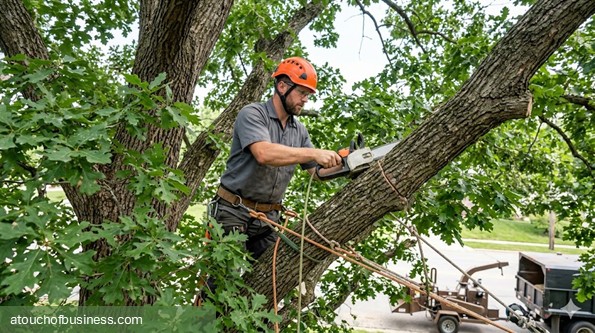
What to Expect From This Guide to Starting a Tree Service Business
This guide walks readers through the key decisions and practical steps involved in starting a tree service business, from assessing field skills and local demand to arranging equipment, insurance, crew systems, and opening checks. The highlights below show only part of the guidance provided.
Inside the guide, you will find:
- Startup roadmap: Follow an ordered path from personal fit and service choices through registration, funding, equipment, staffing, and pre-opening testing.
- Industry interviews: Hear tree service owners and arborists discuss practical experiences with equipment, pricing, seasons, crews, and business decisions.
- Startup FAQs: Review direct answers about training, equipment, insurance, home operation, pricing, seasonality, and licensing differences.
- Business fit: Consider physical demands, field experience, household finances, safety discipline, and whether ownership suits your circumstances.
- Market and model: Compare service mixes, entry paths, local competition, customer groups, and demand factors before committing resources.
- Financial planning: Examine fixed and variable costs, break-even job volume, cash reserves, funding choices, and seasonal pressure.
- Opening preparation: Check licensing, insurance, contracts, crew training, disposal arrangements, equipment performance, and job-site procedures before accepting paid work.
The article begins by defining the service and helping you judge whether its demands match your skills, resources, and goals.
What Is a Tree Service Business?
A tree service business provides professional tree care, trimming, pruning, and removal directly at the customer’s property.
The owner or crew drives to each job site, completes the work, and hauls away the debris. There is no retail space, no storefront, and no fixed facility required to operate.
Common services include tree removal, crown pruning, stump grinding, cabling and bracing, emergency storm cleanup, and plant health care. Some operators also offer fertilization, hazard tree assessments, and line-clearance work near utility lines.
Customers range from residential homeowners to commercial property managers, HOAs, municipalities, and general contractors who subcontract tree work.
The tree care industry is well established and in consistent demand. Trees grow, age, and fall regardless of economic cycles, and homeowners rarely have the equipment or skills to handle the work themselves.
That said, this is not a low-barrier business to enter. It requires real physical skill, serious safety discipline, significant upfront equipment investment, and a clear understanding of what it costs to run a crew before you price a single job.
If you are thinking about starting a tree service, the first question to ask yourself is not “how do I get customers.” It is “am I actually ready to run this kind of business safely and profitably?”
Is This Business the Right Fit for You?
Tree work is physically demanding, often performed at height, and carried out in whatever weather shows up. Before you read further, be honest about whether this matches your strengths and your life right now.
Do you have hands-on experience with a chainsaw, climbing gear, or rigging? Have you worked in tree care or a closely related trade? If not, that gap is not a dealbreaker, but it does mean you need substantial training or field experience before you can safely run a crew or estimate jobs with any accuracy.
Think about what “a typical day” really looks like. You or your crew will drive to job sites, assess hazards, climb trees, make precision cuts, rig heavy branches down safely, operate a chipper, clean up the site, and load equipment. Then do it again. Back, shoulder, and knee strain are common long-term realities in this trade.
Beyond the physical side, running this business means managing estimates, insurance, scheduling, crew communication, and cash flow. Are you comfortable handling the business side along with the field work, at least in the beginning?
Consider the financial pressure honestly. Startup costs are significant before your first job ever pays. Insurance premiums for tree care are among the highest of any service trade. Early months may bring slow revenue while you build a customer base.
Can your household absorb a period of lower income? Does your family understand the demands of running a trade business? These questions matter as much as the tools you plan to buy.
One of the best things you can do before committing is talk to people who have already done it. Find tree service owners in other markets — people you will never compete against — and ask them direct questions. What surprised them in the first year? What did they underestimate? What would they do differently?
You can read about this business for hours, but a single honest conversation with an experienced owner will teach you things no article can. For more on how to approach those conversations, see getting an inside look at a business before you commit.
Also take time to think through your entry path. Starting a tree service from scratch is the most common route, but buying an established operation or exploring a franchise are both realistic options worth evaluating. Each path has different cost structures, timelines, and tradeoffs. More on that in the steps ahead.
Red Flags Before You Start
Some problems are better caught before you spend a dollar. These are the warning signs that should make you pause, reconsider the model, or step back entirely.
You have no hands-on field experience. Tree removal is a high-consequence task. Climbing the wrong way, rigging a branch incorrectly, or misjudging a fall path can destroy property or seriously injure someone. Training and experience are not optional extras — they are prerequisites for operating safely.
You have not gotten actual insurance quotes. General liability, workers’ compensation, and commercial auto for a tree service cost significantly more than in most other trades due to the hazard classification. If you set your prices before you know your insurance costs, your margins may be negative from day one.
Your state requires a license that takes years to qualify for. Some states mandate a specific arborist or tree contractor license that requires documented field experience before you can even apply. Check this before assuming you can open next month.
You have not confirmed how residential zoning affects your home base. Storing commercial trucks, trailers, and chippers at a residential property violates zoning rules in many areas. An unexpected commercial yard rental was not in your original budget.
You have no cash reserve for slow months. Fixed costs — insurance, vehicle payments, software subscriptions — run whether or not you have jobs booked. Winter slowdowns are real in most northern markets. If you have no plan for covering those months, the business can fail even when demand is otherwise strong.
You are planning to price jobs before you understand your actual costs. Underpricing is one of the most common failure points in this trade. Fuel, dump fees, crew labor, equipment wear, and insurance must all be factored in before you quote a single job.
The local market may already be saturated. A dense market with many established, insured, ISA-certified operators will force a new entrant to compete on price — which is dangerous when margins are already tight. Research your specific area before committing.
Step 1: Assess Your Skills and Physical Readiness
Before any business decision, take an honest inventory of what you can actually do safely today.
Can you operate a chainsaw at the professional level needed for a felling job? Have you climbed trees using arborist gear, set up rigging systems, or lowered large sections safely? These are not skills you can develop on a customer’s property for the first time.
If you have real field experience, your next task is deciding how you will apply it — as a working owner on the tools, as an operator who manages a crew, or as a combination of both.
If you have limited experience, consider working for an established tree service company first, taking formal climbing and rigging training, or hiring an experienced crew lead before you accept your first paying job.
Also decide early what your physical limits will be as the business grows. A solo operator who does all the climbing is one injury away from no income. Build this reality into your plan from the start.
Step 2: Talk to Tree Service Owners Before You Commit
Find tree service operators who are outside your planned service area — people you will never compete against — and ask for a candid conversation.
Prepare your questions before reaching out. Ask about first-year surprises, actual insurance costs, equipment failures, seasonal income gaps, licensing complexity, and the hardest parts of crew management.
These conversations are valuable precisely because those owners have already learned things the hard way. Their experience will not match yours exactly, but they can confirm or challenge the assumptions you are making right now.
For guidance on how to approach these conversations, see talking to experienced business owners before starting.
Step 3: Decide on Your Business Model Before Spending Anything
Your service mix is one of the most important decisions you will make at startup, and it should be locked in before you buy a single piece of equipment.
Common startup service models include:
- Full-service removal — highest revenue per job, but requires the most equipment and carries the heaviest insurance requirements
- Trimming and pruning only — lower equipment costs at entry, with more potential for repeat residential clients
- Specialty focus — stump grinding, plant health care, or emergency storm response
- Mixed residential and commercial service from day one
A practical approach for many startups is to begin with climbing and removal, then subcontract stump grinding to another operator until your own volume justifies buying a grinder. This keeps startup costs meaningfully lower while you prove the model.
Also decide whether you will self-perform all jobs with your own crew, subcontract to other licensed operators, or use a blended approach. Each choice affects your insurance requirements, labor costs, and how fast you can scale.
Your service mix shapes everything that follows — equipment purchases, insurance needs, licensing requirements, and your pricing floor. Do not treat this as a decision you can make later.
Step 4: Consider Whether to Start Fresh, Buy, or Franchise
There are three realistic entry paths for a tree service. The right one depends on your budget, experience level, support needs, and tolerance for risk.
Starting from scratch gives you full control over your service area, service mix, and brand. There is no acquisition premium and no franchise fee. The tradeoff is that you build everything — equipment fleet, customer base, and reputation — from zero.
Buying an existing tree service can transfer equipment, a customer base, and an established reputation. Before committing, verify the equipment condition, current licensing status, any outstanding liability, insurance history, and the seller’s real reason for selling. Existing businesses are listed on business-for-sale marketplaces if you want to explore what is available locally.
Franchise options exist in the tree service industry and offer field-tested operating systems, safety training frameworks, vendor relationships, and brand support. This can be a strong path for first-time business owners entering a technically demanding, regulated trade. Franchise fees and ongoing royalties are part of the cost — review the Franchise Disclosure Document carefully before signing anything.
For a broader comparison of these entry paths, see starting from scratch versus buying a business.
Step 5: Validate Local Demand and Competition
Before finalizing your model or spending on equipment, confirm that your specific market can support the business.
Residential density, tree canopy coverage, and storm frequency all affect demand in your area. Look at how many established tree services operate locally, what services they offer, and whether there are visible gaps — no ISA-certified arborists in the area, poor emergency response coverage, or consistently weak reviews for existing operators.
Check whether local municipalities, property managers, or HOAs regularly hire tree service contractors. These clients often represent recurring, contract-based revenue that is more stable than one-off residential calls.
Local demand research is a go or no-go decision, not just background reading. If your area is already saturated with well-established, insured operators, you will need a clear reason why customers should call you instead. For more on evaluating local demand, see local supply and demand analysis.
Step 6: Research Your State and Local Licensing Requirements
This is one of the first compliance checks you need to complete — and it cannot wait until after you have already committed to equipment or a business name.
Tree service licensing in the United States varies significantly. There is no single federal standard. Some states require a specific arborist license or tree contractor license before you can legally advertise or perform commercial tree work. Others require only a general business license.
States known to require a specific tree service or arborist license include Alabama, California, Connecticut, Colorado, Florida, Hawaii, Iowa, Kansas, Louisiana, Maine, New Jersey, North Dakota, Oregon, Utah, and Washington, among others. Requirements differ substantially — California’s C-49 contractor license, for example, requires a minimum of four years of journeyman-level experience and a two-part state exam.
In states without a statewide license requirement, local city or county licensing may still apply. A tree contractor license issued by an individual city is common in many markets, particularly for work on publicly owned trees.
Check both your state contractor licensing board and your city or county licensing office. Do not assume that no state license means no licensing requirement.
If you plan to offer fertilization, soil treatments, or any pesticide application as part of your services, most states require a separate commercial pesticide applicator license before you can apply any products to someone else’s property for compensation. Verify this with your state’s department of agriculture.
For a general overview of business licenses and permits, see business licenses and permits.
Step 7: Obtain Required Credentials and Training
Licensing and professional credentials are separate things in this industry, and understanding the difference matters before you open.
The ISA Certified Arborist designation is issued by the International Society of Arboriculture. It is a voluntary professional credential, not a state license in most jurisdictions. To qualify, you need a minimum of three years of full-time experience in arboriculture and must pass a comprehensive written exam covering tree biology, pruning, rigging, risk assessment, and safe work practices.
Many commercial clients and municipalities expect to see at least one ISA Certified Arborist on staff before awarding contracts. It is not legally mandatory in most states, but in practice it functions as an industry standard of credibility.
The ISA also offers a Certified Tree Worker credential with separate Climber Specialist and Aerial Lift Specialist tracks. These involve both a written exam and a practical field skills test.
The Tree Care Industry Association offers the Certified Treecare Safety Professional (CTSP) designation, which focuses specifically on safety practices and knowledge. This credential matters both for crew safety and for insurance eligibility.
Regardless of which credentials you pursue, review and implement ANSI Z133 safety standards — the consensus safety standard for tree care operations — before you take on any paying jobs. Insurance carriers and commercial clients may ask about your safety program directly.
Step 8: Choose a Legal Structure and Register the Business
Most tree service startups register as a limited liability company (LLC). This structure separates your personal assets from business liabilities, which matters in a high-risk trade where property damage and injury claims are real possibilities.
Other options include a sole proprietorship or a corporation. The right choice depends on your tax situation, growth plans, and risk tolerance. For a comparison of the most common options, see LLC vs. sole proprietorship.
After forming your entity, apply for an Employer Identification Number (EIN) through the IRS at irs.gov. This is free and required before you can open a business bank account or hire employees.
If you plan to operate under a trade name different from your legal entity name, register a DBA (Doing Business As) with your state or county. For the full registration process, see how to register a business.
Step 9: Secure Insurance Before You Touch a Single Tree
This step cannot be delayed. You need active insurance coverage before your first job — not after you have already quoted it.
The three core policies for a tree service are:
- General liability insurance — covers third-party bodily injury and property damage. Most clients and commercial contracts require a minimum of $1 million per occurrence.
- Workers’ compensation insurance — required by law in most states once you have employees. Tree service operations carry elevated premium rates due to the hazard classification. Some states may require coverage even for sole proprietors performing high-risk work — verify your state’s rules.
- Commercial auto insurance — legally required for all business vehicles. Your personal auto policy will not cover accidents while hauling equipment or driving to job sites. This applies from the first day you use the vehicle for business purposes.
Additional coverages worth discussing with a broker who specializes in contractors: inland marine insurance for tools and equipment in transit, hired and non-owned auto coverage if employees use their personal vehicles for any business task, and an umbrella policy for higher-risk removals near structures or power lines.
Work with an insurance broker who knows the tree care industry. Rates, coverage terms, and eligibility can vary significantly depending on the services you offer, the equipment you use, and your safety program documentation.
For a general overview of business insurance options, see business insurance.
Step 10: Obtain Local Business Licenses and Permits
After your entity is formed and your state-level licensing is confirmed, apply for a general business license through your city or county.
Many municipalities also require a permit before a tree can be removed, particularly for heritage trees, protected species, or trees within certain setback distances from property lines or utility easements. Check with your city or county planning and forestry department before accepting any removal job — failure to obtain a required tree removal permit can expose you and your client to fines.
If you plan to operate from a home address, verify with your local zoning office whether storing commercial vehicles, trailers, and equipment overnight is permitted in your residential zone. This is a common restriction that many new owners overlook.
Business Plan
A written startup plan is not paperwork for its own sake. It is the document that forces you to answer the questions that matter most before you commit real money.
Your plan should define your target service area, the specific services you will offer at launch, your target customers, and your pricing approach. It should also map out what you need to spend before your first job, where that money will come from, and how long you can operate before revenue covers your fixed costs.
The break-even question is central. Calculate your total fixed monthly costs — insurance premiums, vehicle or equipment payments, software subscriptions, and any storage facility rent — and divide that by the average gross profit you expect per job after labor, fuel, and disposal costs. That number tells you the minimum jobs per month you need to survive, before you pay yourself anything.
Labor typically consumes about 30 percent of total revenue in direct field costs. Equipment maintenance, fuel, dump fees, insurance, and other overhead reduce what remains. Most owners in this industry net approximately 10 percent of total revenue after all costs are accounted for. That context should shape how you price, what jobs you accept, and how you manage cash in the early months.
Seasonality is a structural challenge in most markets, especially in colder climates where routine trimming and removal work slows through winter. Your plan should identify how many months you may face reduced income and what cash reserve you need to cover fixed costs through those periods. A reserve covering three to six months of fixed expenses is a reasonable target before launch.
For more on building a practical startup plan, see how to write a business plan. For guidance on thinking through early-stage revenue and profitability, see estimating profitability for a new business.
Step 11: Secure Funding if Needed
If your startup costs exceed what you have saved, you will need a funding plan before making major commitments.
Common funding options for a tree service startup include:
- Personal savings
- SBA 7(a) small business loans for equipment and working capital
- Equipment financing or leases for trucks, chippers, and stump grinders
- A business line of credit to smooth cash flow during seasonal slowdowns
- Seller financing when buying an existing operation
Equipment financing is worth considering separately from general business loans. Financing a specific piece of equipment preserves working capital for fuel, insurance, and the first slow months. Keep monthly payments manageable — you need the business to cover debt service even when job volume is light.
For guidance on financing options, see how to get a business loan.
Step 12: Open a Business Bank Account and Set Up Payments
Open a dedicated business checking account as soon as your entity is formed and your EIN is in hand. Never mix personal and business transactions — doing so creates accounting confusion, complicates taxes, and can undermine your liability protection as an LLC.
Set up payment processing before your first job so you can accept credit cards, ACH payments, and checks on-site or through digital invoices. Customers expect payment options; showing up to collect only cash creates unnecessary friction.
Also consider field service software designed for tree care businesses — tools like Jobber, Arborgold, or ArboStar allow you to generate estimates, schedule jobs, invoice clients, and track cash flow from your phone. Setting this up before your first job saves significant time and reduces billing errors from the start.
For guidance on opening a business bank account, see how to open a business bank account.
Step 13: Source and Acquire Equipment
Your equipment list should follow directly from your service model decision in Step 3. Do not buy equipment for services you are not yet offering.
The minimum kit for a climbing and removal operation includes:
- One or more professional-grade gas-powered chainsaws
- A top-handle saw for climbing work
- A complete climbing kit: saddle, climbing ropes, throw lines, carabiners, friction devices, and mechanical ascenders
- Rigging gear: rigging plates, rings, arborist blocks (pulleys), and a lowering device
- Full PPE: ANSI-compliant arborist helmet with face shield, cut-resistant chainsaw chaps, steel-toed boots, gloves, and eye protection
- A truck with sufficient towing capacity (minimum 3/4-ton rated)
- A trailer for hauling equipment and debris
A wood chipper is effectively required for any job involving significant debris. A commercial-grade model with at least a 6-inch feed capacity is the practical minimum for residential work.
A stump grinder can reasonably be deferred at startup. Renting one per job or subcontracting that portion of the work to another operator is a common approach that reduces your initial investment while you build volume.
Traffic cones, caution tape, job site first aid kits, and fire extinguishers in your truck are not optional extras — they are part of operating safely and professionally on any job site.
Confirm that all vehicles are covered under commercial auto insurance before loading them with equipment for the first time.
Step 14: Hire and Train Your Crew Before the First Job
If you plan to operate with any crew — even one helper — complete safety onboarding before they set foot on a job site.
The tree care industry falls under OSHA’s general industry standards (29 CFR 1910). The most frequently cited violations involve PPE requirements, vehicle-mounted platforms, and hand and portable powered tools. Work near energized electrical conductors adds additional electrical safety standard obligations.
Train all crew members on ANSI Z133 safety standards, PPE requirements, chainsaw handling, rigging procedures, and emergency rescue before any job begins. This is not just a compliance matter — it is the difference between a safe crew and a liability you cannot insure your way out of.
If you are hiring employees, set up state employer tax withholding accounts and state unemployment insurance accounts in addition to workers’ compensation coverage. For guidance on when and how to add staff, see hiring for a small business.
Step 15: Prepare Your Job Documents and Contracts
Operating without written agreements is a common mistake in the trades — and one that creates real exposure when scope disputes, property damage claims, or non-payment situations arise.
Prepare these documents before your first job:
- A written estimate and job contract template that clearly defines the scope of work, debris removal terms, property protection expectations, payment terms, and liability acknowledgment
- Certificates of insurance ready to share with clients, HOAs, commercial properties, and municipalities on request
- A job site safety checklist based on ANSI Z133 standards
- A subcontractor agreement if you plan to use any subcontracted services
Commercial clients and municipalities will often ask for a certificate of insurance before approving any work to begin. Have these ready before you submit a quote — not after you have already won the job.
Step 16: Complete Pre-Opening Readiness and Run a Test Job
Before accepting a paying customer, run a test operation on your own property or with a known contact who understands you are practicing your workflow.
Use the test job to confirm that equipment performs as expected, the crew understands their roles, safety procedures are followed correctly, and the job site is left clean and professional.
Your basic business identity should also be ready before your first real job: a business name, a dedicated phone number, and a simple contact page or website showing your services, service area, and confirmation that you are insured. Customers increasingly verify this before they call.
If your municipality requires vehicle lettering or magnetic signs with your business name, have those installed before operating commercially.
Confirm your debris disposal plan: identify the local transfer station or landfill, understand their fee structure, and know where you can deliver chip material if applicable.
Opening-Day Red Flags
Even if you have followed every step, certain problems should delay your opening until they are resolved.
Insurance is not yet active. General liability and commercial auto coverage must be confirmed in writing before any work begins. A verbal commitment from a broker is not coverage.
Your state or local license is still pending. Performing tree work for compensation without a required license is a legal violation in many states and can result in fines, criminal charges, or inability to collect payment. Do not accept paid work until licensing is confirmed.
Crew safety onboarding is incomplete. No team member should be on a job site until they have been trained on ANSI Z133 standards, PPE use, chainsaw handling, and emergency procedures. One injury without documentation of safety training creates significant legal and financial exposure.
You have not confirmed tree removal permit requirements locally. Some municipalities require a permit before removing any tree above a certain size on private property. Taking a job without confirming this in advance can expose you and your client to fines.
You do not have a signed contract for the first job. A verbal agreement is not enough. The scope, payment terms, and debris removal expectations must be in writing before work starts.
Your pricing was set before your full cost picture was confirmed. If insurance quotes, dump fees, or equipment costs came in higher than you originally estimated, reprice before accepting jobs — not after.
Frequently Asked Questions
Do I need to be a certified arborist to start a tree service?
It depends on your state. Some states require a specific arborist or tree contractor license to perform commercial tree work. The ISA Certified Arborist credential is a respected voluntary professional designation, but it is separate from state licensing. Research your state’s specific requirements before starting.
Is this realistic for someone with no prior tree work experience?
Not without significant preparation. Tree work carries serious risks of property damage and serious injury. Working in the industry as an employee or completing formal climbing and rigging training before starting is strongly advisable.
What is the minimum equipment needed to start?
At a basic level: at least one professional-grade chainsaw, a complete climbing and rigging kit, full PPE, and a truck capable of towing a trailer and chipper. A wood chipper is effectively required for any job with meaningful debris volume. A stump grinder can often be rented or subcontracted at startup.
Should I start from scratch, buy an existing business, or consider a franchise?
All three paths are realistic. Starting from scratch offers full control with no acquisition premium. Buying an existing business transfers equipment and possibly a customer base, but requires careful due diligence. Franchises offer operating systems and safety training support, which can be especially valuable for first-time owners in a technically demanding, regulated field. The best choice depends on your budget, experience, and how much support you need.
How does seasonality affect the business financially?
In most U.S. markets, demand slows during winter, especially for routine trimming and removal. Emergency storm work can help offset this, but it is unpredictable. Entering the slow season without a cash reserve to cover fixed monthly costs is one of the most common failure points in this trade.
What insurance do I need before my first job?
General liability, commercial auto, and workers’ compensation if you have employees. Most clients and commercial contracts require at least $1 million in general liability per occurrence. Have certificates of insurance ready to distribute before quoting any job.
Can I operate from my home address?
Many tree service owners start from home to avoid facility costs. However, residential zoning rules in many areas restrict commercial vehicle and equipment storage overnight. Check with your local zoning office before assuming home-based operation is permitted.
How do I figure out what to charge for jobs?
Always conduct an in-person site assessment before quoting. Pricing inputs include tree height and diameter, proximity to structures and power lines, equipment access, debris removal requirements, crew size needed, and risk level. Research what other operators in your area charge before setting your pricing floor. Never quote a job without factoring in your insurance, fuel, disposal, labor, and equipment costs first.
Do I need to offer stump grinding to be competitive?
Not necessarily at launch. Many startups subcontract stump grinding to another operator, which keeps startup costs significantly lower while the business proves itself. You can always bring stump grinding in-house once consistent volume justifies the equipment investment.
What OSHA rules apply to a tree service?
Tree care businesses must comply with OSHA’s general industry standards under 29 CFR 1910. The most frequently cited standards involve PPE requirements, vehicle-mounted platforms, and hand and portable powered tools. Work near energized power lines triggers additional electrical safety standards. OSHA also has a Tree Care Operations standard currently in rulemaking — check osha.gov for updates.
Should I join the Tree Care Industry Association or pursue ISA membership?
Both are voluntary but worth considering once your core startup setup is complete. TCIA membership requires carrying general liability and workers’ compensation insurance and provides access to safety programs, training discounts, and regulatory updates. ISA membership supports certification maintenance and continuing education. Both provide credibility signals that commercial and municipal clients notice.
How do I think about break-even before committing to equipment?
Add up your total fixed monthly costs — insurance, vehicle payments, software, storage — then estimate your average gross profit per job after labor, fuel, and disposal. Divide fixed costs by average gross profit. That result is your minimum number of jobs per month before you can pay yourself anything. Then ask whether your local market realistically generates that volume at your planned price point.
What Tree Service Owners Say About Starting Out
No article can fully prepare you for what it actually feels like to run a tree service.
The best way to bridge that gap is to hear directly from owners who have already built one — people who made real decisions about equipment, pricing, insurance, crew, and cash flow, and who can tell you what surprised them.
The resources below include interviews and podcast episodes featuring tree service owners and arborists sharing honest, practical advice. Listen to a few before you commit to anything significant.
From Failure to Fabulous: The Don’s Tree Service Story with Doni Jones
Doni Jones, president of Don’s Tree Service in metro Atlanta, shares how she started her business with almost nothing and built it into a successful local operation. She covers early challenges, how she grew her customer base, and what she would do differently.
Interview: Basil Camu, Leaf & Limb Tree Service
A written interview with Basil Camu, who took over a struggling family tree service during the 2008 recession and rebuilt it from the ground up. He talks candidly about entering the industry without a background in trees, differentiating a business in a crowded market, and what it took to build a loyal client base.
9 Lessons in Growing a Tree Service Business — Interview with Dave Sheridan
Based on an interview with Dave Sheridan of Ascension Tree Care, this article-style piece covers nine practical lessons from his experience building a tree care company. Topics include avoiding unprofitable jobs, how to estimate accurately, and what actually drives growth in this industry.
Branching Out Podcast — Interview with Chris Phelps, Paramount Tree Service
Host Justin Rademacher interviews Chris Phelps about his path from lawn care into tree service ownership. Chris discusses the calculated risks of starting a business, the role of continuous training, employee management realities, and how word-of-mouth shapes early growth.
Arborist Growth Partners Podcast — Interview with John Wight, Wight Tree Service
Graeme Knight interviews John Wight, a second-generation arborist who runs a year-round tree service. John shares how he plans 90 days ahead to manage seasonal slowdowns, what services still sell in winter, and the hiring lessons most owners learn the hard way.
Tree Business Podcast — Hosted by Chris Francis, BCMA
Hosted by Chris Francis, a Board Certified Master Arborist, this ongoing podcast covers practical topics for tree service owners including pricing, safety standards, hiring employees versus subcontractors, and what it takes to build a business that runs without the owner present. Multiple episodes are directly relevant to someone thinking about starting out.
Related Articles
- How To Start a Lawn Care Business
- How To Start a Snow Removal Business
- How To Start a Gutter Cleaning Business
- How To Start a Gardening Class Business
- How To Start a Bonsai Tree Business
Sources:
- Insurance Canopy: Starting a Tree Service Business, Tree Service Insurance Checklist
- ArboStar: Start a Tree Removal Service
- HouseCall Pro: How to Start a Tree Service
- WorkWave: Tree Service Business Steps
- Tree Service Authority: U.S. Licensing Requirements
- National Tree Service Authority: ISA Certified Arborist Explained, Tree Service Equipment Overview
- ISA Rocky Mountain Chapter: Six ISA Certifications
- OSHA: Tree Care Industry Standards, Tree Care Safety Programs, Tree Care Rulemaking, Inspection Guidance 2021
- TCI Magazine: Tree Care Safety Standards
- TCIA: TCIA Membership Benefits, TCIA Accreditation
- 1-800-Insurance: Workers Comp for Tree Service, Commercial Auto for Tree Service
- Wexford Insurance: Tree Service Insurance Requirements, Equipment to Buy First
- Jobber: Tree Service Equipment List, How to Price Tree Removal
- ArboNote: Pricing and Profit Margins, Tree Worker Pay Guide
- Arborgold: Structuring Tree Service Estimates
- Arbjobs: U.S. Tree Cutting Licensing by State
- HomeServiceDirect: Tree Service Startup Guide 2026
- HomeGuide: Starting a Tree Service
- Relay: Seasonal Cash Flow for Service Businesses
- FranChoice: Tree Service Franchise Guide
- Harbor Compliance: Tree Contractor Licensing Overview
- Zentive: Tree Service Tools and Equipment
- Rutgers Extension (NJ): Pesticide Applicator Licensing