
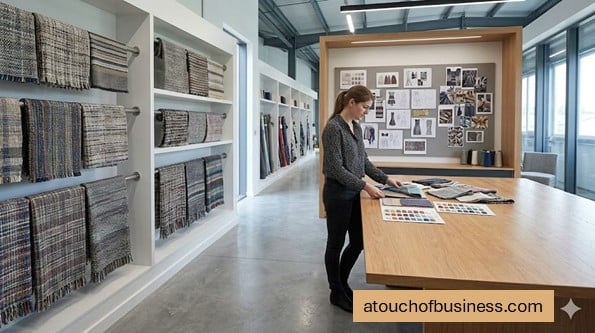
Overview of Starting a Weaving Business
A weaving business makes woven goods by interlacing warp and weft on a loom, then finishing the fabric into products people can use or wear. In a workshop or shop-based setup, most of the work happens behind the scenes: planning the warp, setting up the loom, weaving, wet finishing, labeling, packing, and getting orders ready on time.
Many new weaving businesses start with a narrow line such as towels, scarves, table runners, placemats, rugs, or cloth by the yard. That is a smart place to begin because your first product decisions affect almost everything else, including loom width, yarn choice, storage, finishing space, pricing, and how much time each item takes to make.
This is a production business, even when the work feels creative. Your customers care about quality, consistency, lead time, and whether the item looks and feels the way they expected. A weaving business can be rewarding, but it also asks for patience, physical setup work, careful recordkeeping, and steady attention to detail.
The common early risks are easy to miss. You can buy too much equipment too soon. You can spread yourself across too many fibers and colors. You can lose time in sampling, loom setup, and finishing if your process is loose. You can also open before the workshop is truly ready. For this kind of business, a small, clean launch usually beats an ambitious one.
Decide If This Business Fits You
The choice here is simple: do you actually want the daily work, or do you only like the idea of owning a weaving business? The tradeoff is creative satisfaction versus a lot of repetitive setup, finishing, cleanup, and production discipline.
If you enjoy winding warps, threading heddles, checking samples, tracking shrinkage, fixing small errors, and finishing pieces well, this business may suit you. If you mainly want the fun part and dislike careful setup work, the reality may wear you down fast. A weaving business is not just designing beautiful cloth. It is also planning, measuring, labeling, packing, and solving problems when materials or timing do not go your way.
You also need to be honest about pressure. Can you handle slow sales at the start? Can you stay patient while you sample and redo work? Can you carry the business through days that feel more like setup than progress? Your passion for the work matters because that is what helps you keep going when the work is repetitive or sales are still building.
Ask yourself this once and answer it honestly: are you moving toward something or trying to run away from something? Do not start a weaving business only to escape a job you hate, fix immediate financial pressure, or chase the status of being a business owner. Those reasons are too weak when the workshop is quiet, the loom is half dressed, and you still have bills to cover.
Before you go further, talk to weaving business owners who will not become competitors. Find people in another city, region, or market area. Use those conversations to ask real questions about equipment, space, lead times, customer problems, pricing, waste, and the hardest parts of the first year. That kind of firsthand owner insight is valuable because it comes from people who have lived the work, even if their exact path will not match yours.
A short reality check helps here. In the early stage, your day may include receiving yarn, winding a warp, threading, weaving samples, wet finishing, measuring shrinkage, updating records, packing an order, and answering customer questions. Does that sound good to you? If yes, keep going.
Decide What You Will Weave First
The first choice is whether to launch wide or narrow. The tradeoff is variety versus control. For a new weaving business, starting with a small product line usually gives you better quality, more reliable lead times, and less waste.
Pick one or two product families first. Towels and table linens need different yarns, widths, and finishing choices than scarves or rugs. Rugs can push you toward heavier fibers, sturdier looms, and more demanding finishing. Cloth by the yard brings its own measurement and consistency issues. Custom work adds communication and approval steps before the loom even gets dressed.
Your first product line should answer a few practical questions right away. What width do you need? What fibers make sense? How much time will each piece take from warp planning through finishing? How easy is it to repeat the result? If you cannot answer those questions yet, your line is still too broad.
Keep this in mind: every extra product type adds more than design variety. It adds more yarn decisions, more sampling, more storage, more labeling choices, and more chances for inconsistent results.
Decide Who You Want To Serve
The choice is whether your weaving business will mainly serve gift buyers, home-textile customers, apparel buyers, interior-focused clients, or custom-order customers. The tradeoff is stable production versus special requests. The more custom your work becomes, the more time goes into communication, approvals, and one-off setup.
Think about who will buy from you first, not who might buy someday. A workshop-based weaving business often starts best with direct retail customers who want functional handmade goods, such as towels, scarves, or table pieces. Those products are easier to explain, easier to photograph, and easier to price than a studio full of unrelated ideas.
You also need to look at local supply and demand. Are people already buying handmade woven goods in your area? Are similar sellers focused on fine art, home decor, seasonal gifts, or custom orders? A weaving business does better when you understand how buyers in your market already think, shop, and compare.
Do not skip the competition check. Look at what others sell, how polished their product line is, what materials they use, how long delivery takes, and whether their work feels like everyday use, luxury, or art. That tells you what gap might still be open for you.
Decide What Your Plan Needs To Prove
The choice here is whether you will build a simple working plan now or keep everything in your head. The tradeoff is a little planning time versus a lot of confusion later. For a weaving business, your first plan should prove that your products, prices, production pace, and startup costs can work together.
Your plan does not need to be fancy. It does need to show what you will sell, who will buy it, how much each item should sell for, how many pieces you need to move, what equipment you must have before opening, and how much working capital you need for yarn, packaging, and overhead. That is the practical core of putting your business plan together.
Set first-stage success targets that fit a small weaving operation. You might track your first finished collection, number of launch-ready products, number of repeatable designs, order turnaround time, gross margin by product, and how much yarn you need to keep on hand. For this kind of business, clarity beats optimism.
Decide How Your Weaving Business Will Operate
The choice is whether your workshop will be production-only or whether customers will enter the space. The tradeoff is convenience for customers versus more setup, more presentation demands, and possibly more local requirements.
A workshop or shop-based weaving business usually needs separate areas for loom work, yarn storage, warping, finishing, packaging, and general cleanup. If the public will visit, you also need to think about traffic flow, safety, signs, parking, and what customers will see when they walk in. If the operation stays mostly behind the scenes, you can design the space almost entirely around production.
Other models do exist. Some weaving businesses start at home. Some sell mainly online. Some use market booths. Some mix teaching with product sales. Those models can work, but they change the startup requirements. For this guide, the safer assumption is a physical workshop where the production process drives the layout.
Decide On Your Business Name And Structure
The choice is which name you will use and what legal structure will hold the business. The tradeoff is simplicity versus liability protection, paperwork, and cost. This step matters early because your legal structure affects taxes, ownership records, bank setup, and how you register the business.
If you are starting alone, you may compare a sole proprietorship with an LLC. If you are starting with someone else, a partnership or LLC may make more sense. If you want a separate legal entity, stronger separation between personal and business activity, or a cleaner path for agreements, that usually pushes the decision toward a formal structure. Spend time choosing your legal structure before you file anything.
Your name decision matters too. If your weaving business will use a trade name that is different from your own legal name or your exact entity name, you may need a DBA filing. Keep the name practical. Can it work on product tags, labels, packaging, a sign, and a domain name? Can customers say it, remember it, and spell it?
There is no prize for making this complicated. Pick a structure that fits the risk and size of the business you are actually starting, not the one you imagine years from now.
Decide Where The Workshop Will Be
The choice is whether your weaving business will run from a dedicated studio, a small shop, a mixed-use unit, or a temporary space that may not fit for long. The tradeoff is lower cost versus better function. A weaving workshop needs room not only for the loom, but also for yarn storage, warp handling, finishing, packaging, and safe movement around the equipment.
Think through the physical flow before you sign anything. Where will yarn come in? Where will you store cones and finished goods? Is there enough room to move long warps? Where will wet finishing happen? Do you have enough power, lighting, and ventilation for a comfortable work area? Can you keep the workshop clean without moving half the business every day?
If customers will enter, the space has to support both production and presentation. If not, you can focus on function first. Either way, a poor layout causes delays, clutter, and frustration very quickly in a weaving business.
What To Verify Before You Commit To A Space
- Whether local zoning allows your kind of workshop and any customer visits.
- Whether a local business license is required at that address.
- Whether a certificate of occupancy is needed before opening, especially after a build-out or change in use.
- Whether signs, tenant improvements, or fire review need separate approval.
Decide Which Legal And Tax Requirements Apply
The choice is whether you will sort out the legal details early or deal with them one by one after problems show up. The tradeoff is a little upfront work versus expensive delays. A weaving business is not usually treated as a heavily regulated activity, but that does not mean you can skip the basics.
You will likely need to handle entity registration if you form an LLC or corporation, get an Employer Identification Number if your setup requires one, register for sales tax where your state requires it, and set up employer accounts if you hire. If you use a trade name, you may also need a DBA filing. This is also the point where you review product rules. Some woven goods fall under federal textile labeling rules. Garments and certain fabrics may trigger care labeling. Rugs and some textile categories may raise flammability questions.
What To Verify By Level
- Federal: whether your products need textile labels, care labels, or flammability review.
- State: whether you need sales-tax registration, employer accounts, and any state business filings.
- City Or County: whether you need a local business license, zoning approval, occupancy approval, or sign permits.
Keep the local questions simple when you call or visit the agency. Tell them you are opening a weaving workshop that will produce and sell woven goods, then ask if that use is allowed at your address and what you need before opening.
Decide What Insurance You Need Before Opening
The choice is whether you will insure the business based on real risk or assume nothing serious will happen. The tradeoff is recurring cost versus protection when equipment, inventory, property, or people are involved.
A weaving business usually has several obvious risk points: expensive looms, yarn inventory, customer pickups, possible property damage, and product claims if something goes wrong with a sold item. If you hire, workers’ compensation may be required under state rules. Even when it is not required, do not treat insurance as an afterthought. A workshop concentrates a lot of value into one room.
Look at the business through a plain lens. What would it cost you if the loom were damaged, the space had a problem, or someone was hurt in the workshop? That is why business insurance belongs in your launch planning, not months later.
Decide What Equipment To Buy Now
The choice is whether to buy for your first collection or buy for every future idea. The tradeoff is control of startup costs versus flexibility. A new weaving business usually does better when it buys equipment that fits the first product line, then expands only after the process is working.
Your core list usually starts with the loom, the right reeds or heddles, heddles for the loom if needed, shuttles, bobbins or pirns, a bobbin winder, and a bench or seating setup that matches the loom. You also need warping tools such as a warping board, frame, or mill, plus threading and sley hooks, measuring tools, and strong task lighting.
Do not forget finishing. Many weaving businesses underestimate how much space and equipment finishing takes. You may need sink access, drying space, an iron or press, fringe-finishing tools, and a sewing machine if you will hem items. Storage matters too. Yarn, samples, work in progress, finished goods, tags, and packaging all need a home.
Current vendor listings make the scale clear. Small rigid-heddle setups can begin in the hundreds of dollars, while floor looms often run into the low thousands before accessories. The wrong buying order can strain your cash before the first real batch is ready.
Decide How The Workshop Will Flow
The choice is whether your workspace will follow the real production sequence or whether tools and materials will end up wherever they fit. The tradeoff is smooth output versus constant friction. In a weaving business, poor flow wastes time long before it ruins quality.
A practical workshop flow often looks like this: receive yarn, store it by type and color, plan the warp, wind the warp, dress the loom, weave samples, weave the batch, wet finish, inspect, label, pack, store, then hand off or ship. That may sound obvious, but the layout needs to support that order.
Think about distance and movement. Can you get yarn to the loom without dragging cones across the room? Can you finish pieces without blocking production? Can you store finished goods away from dust and traffic? Can you pack orders without using your loom bench as a shipping table? A weaving business feels much smaller when the layout works.
A Simple Production Flow To Set Up
- Receiving and yarn storage
- Warp planning and calculation
- Warp winding and loom dressing
- Sample weaving and approval
- Production weaving
- Wet finishing and pressing
- Inspection, labeling, and packing
- Storage, pickup, or shipping
Decide How You Will Control Quality
The choice is whether quality will depend on memory or on records. The tradeoff is a little documentation versus repeated mistakes. A weaving business needs standards early because small changes in sett, yarn, tension, finishing, or shrinkage can change the finished result more than you expect.
Start with sampling. Weave test pieces before you commit to inventory. Wash them the way the final product will be finished. Measure the result. Check the hand, drape, width, shrinkage, and overall look. Then write it down.
Keep project records for draft used, yarn type, colors, sett, picks per inch, measured width before and after finishing, shrinkage, and any finishing notes. Those records are what help you repeat a product, price it correctly, and solve problems when one batch turns out differently from the last.
This is one of the clearest lines between a hobby process and a real weaving business. If you want consistency, your notes cannot stay in your head.
Decide Your Startup Costs And Working Capital
The choice is whether you will plan for the full launch cost or only for the fun purchases. The tradeoff is realism versus surprise. In a weaving business, working capital matters because yarn, labels, packaging, rent, and accessory purchases can continue long before sales become steady.
Your startup cost list should include legal setup, workshop deposit or rent, basic improvements, looms and accessories, warping tools, lighting, shelves, yarn inventory, finishing tools, labels, packaging, bookkeeping tools, payment processing, and basic brand materials. If customers will visit, signs and presentation details join the list. If you hire, labor setup adds another layer.
The big cost drivers are easy to spot. Loom size and quality matter. Product type matters. A rug line can look very different from a towel line. Custom work can slow output and raise labor time. A larger workshop adds rent and storage. Too many yarn lines tie up cash on the shelf. That is why a small first collection is often the safer move.
Do not forget waste and sampling. In weaving, not every inch of warp becomes a finished product, and your early batches may teach you more than they sell.
Decide How You Will Price Your Woven Goods
The choice is whether you will price from guesswork or from the real work involved. The tradeoff is a lower sticker shock now versus a more sustainable business later. In a weaving business, pricing needs to cover more than yarn.
Build your numbers from materials, warp setup time, weaving time, finishing time, packaging, payment fees, and expected waste. Add overhead from the workshop. Then decide whether you are pricing by the finished piece, by the yard, or by the custom order. That is the practical side of setting your prices.
A woven towel does not just cost what the cotton costs. A scarf does not just cost what fits into the visible part of the warp. Time spent dressing the loom, testing the sample, wet finishing, pressing, and tagging the piece belongs in the price. If you leave those steps out, your numbers will look good on paper and fail in real life.
Price for repeatability. If a product cannot be made consistently at the price you need, it is not a strong launch product yet.
Decide How You Will Fund The Launch
The choice is whether to bootstrap the launch, borrow, or use a mix of both. The tradeoff is lower debt versus slower setup. A weaving business can sometimes start modestly, but equipment, rent, and inventory still create real startup pressure.
Your funding options may include personal savings, owner capital, or a small loan. For some startups, an SBA microloan can help with equipment, supplies, inventory, and working capital. Just be careful not to borrow for a workshop that is bigger than your first-stage output can support.
You also need the financial side organized before opening. That means getting your business banking in place, choosing how you will take card payments, deciding how you will track expenses and deposits, and separating business activity from personal activity. A weaving business can feel small, but your recordkeeping still needs to be clean from day one.
Set up a simple bookkeeping routine and a place to store receipts, supplier invoices, tax records, and sales records. That habit matters more than fancy software in the beginning.
Decide Which Suppliers You Need Before Opening
The choice is whether to buy from whoever has something available each week or to build a supplier base you can rely on. The tradeoff is convenience versus repeatability. A weaving business depends on steady access to the right fibers, colors, tools, and replacement parts.
You will likely need a core yarn supplier, a loom and accessory supplier, and vendors for labels and packaging. If you plan to repeat designs, backup sources matter too. Running out of a key yarn can delay orders or force a redesign that throws off your pricing and quality standards.
Think beyond the first cone of yarn. How will you reorder? How long are lead times? Do you need to keep safety stock for best sellers? Do you have spare bobbins, repair parts, or an extra reed for the setts you use most? Supplier problems can slow a weaving business long before the loom itself fails.
Decide On Your Name, Domain, And Brand Basics
The choice is whether to build a simple, clear identity or spend too much time polishing brand details before the workshop is ready. The tradeoff is professionalism versus delay. Your name and visual basics matter, but they should support the launch, not replace it.
Start with what the customer actually sees. That may include your business name, a clean domain, simple labels, care instructions where needed, packaging, and a short explanation of what the item is made from. If customers visit the workshop, signs and presentation become more important. If the space is private, your product tags and online presence carry more of that load.
Keep the look consistent and practical. A weaving business often benefits from simple branding that lets the textile work stand out. The point is to look dependable, not overdesigned.
Decide Which Systems And Documents You Need
The choice is whether you will build a few simple systems early or let every order become a new puzzle. The tradeoff is a little setup time now versus repeated confusion later. A weaving business runs better when the process is written down in small, usable pieces.
Your starter documents may include a project record sheet, pricing sheet, supplier list, reorder list, custom order form, order confirmation template, care instruction insert, label template, packing checklist, and a simple inventory sheet for finished goods and yarn on hand. If you sell custom work, write down what the customer approved and what lead time you promised.
These are not corporate documents. They are practical tools that help you protect time, quality, and customer expectations. In a weaving business, simple paperwork can save hours of rework.
Decide Whether You Will Hire At Launch
The choice is whether to stay solo at first or bring in help early. The tradeoff is lower payroll complexity versus less capacity. Many weaving businesses begin as one-person operations because the owner is still refining products, process, and pricing.
That said, some tasks can be delegated sooner than others. Packing, labeling, simple finishing, workshop cleanup, and order handling may be easier to train than design and loom setup. If you hire, you need to add payroll setup, employer accounts, workers’ compensation rules where required, and basic workplace safety responsibilities.
If your launch depends on extra hands right away, pause and ask why. Are you building too large a collection? Is the workshop too big? Is the custom work too complex? A small weaving business often becomes more stable when it proves the process before it adds staff.
Decide How Customers Will Buy From You First
The choice is whether your early sales will be simple or scattered. The tradeoff is reach versus control. A weaving business needs a clear first sales path so customers know what you sell, how long it takes, and how to place an order.
Choose the easiest buying path you can manage well. That might be a small website, direct messages handled with care, workshop pickup by appointment, or a limited opening collection with clear prices and delivery timing. If you offer custom work, set boundaries early. What can the customer choose? What is fixed? How many revisions are allowed before production starts?
Your first marketing should match your capacity. Do not promote a dozen product lines if your workshop can only deliver one or two well. The best launch message is often the simplest one: here is what we make, here is what it is made from, here is how long it takes, and here is how to buy.
Decide What A Good First Week Looks Like
The choice is whether you will open with a vague hope for sales or with a clear picture of what success looks like in the first few days. The tradeoff is emotional noise versus practical learning. A weaving business rarely needs a dramatic opening. It needs a controlled start that shows you where the real problems are.
A good first week may mean your workshop stays organized, the payment process works, labels are accurate, orders leave on time, and your first products match the sample standard. That is a stronger start than chasing attention while the back end is shaky.
If customers visit the workshop, test that experience before you announce anything widely. Walk the space as if you were the customer. Is it safe? Is it clear where to go? Does the business look ready, or does it still feel like a personal craft area that is only half set up?
Decide Which Red Flags Mean Stop And Fix It
The choice is whether you will recognize problems before opening or wait for customers to find them for you. The tradeoff is a delayed opening versus a messy one. Some issues are worth stopping for.
Red flags in a weaving business are usually practical, not dramatic. Your samples still vary too much. You do not know your real production time. Your pricing leaves out finishing. Your yarn supply is shaky. The workshop is cramped or unsafe. Your records are thin. You are still guessing about local approvals. Your first collection is too broad. Those are not small details. They are launch problems.
Another warning sign is emotional. If you feel pulled in ten directions and keep changing the product line, that often means you have not made the core decisions yet. Narrow the plan. Finish the setup. Then open.
Decide If You Are Ready To Open
The choice is whether to launch on hope or on proof. The tradeoff is speed versus stability. A weaving business is ready to open when the workshop, paperwork, products, prices, and customer path all work together.
Use a final checklist and be strict with it. The goal is not perfection. The goal is readiness.
- Your first product line is narrow and fully sampled.
- Your loom, reeds, heddles, shuttles, bobbins, and warping tools are set up and tested.
- Your workshop layout supports receiving, weaving, finishing, packing, and storage.
- Your business structure, tax ID needs, registrations, and local approvals are handled.
- Your labels and care information are ready where the product type requires them.
- Your bank account, payment processing, and bookkeeping routine are in place.
- Your prices reflect materials, labor, waste, finishing, packaging, and overhead.
- Your supplier list and reorder plan are ready.
- Your order process, custom order boundaries, and customer communication are clear.
- Your first finished batch is packed, labeled, and ready to sell.
If you can say yes to those points, your weaving business is much closer to a solid opening. If not, fix the gaps now. A short delay is easier than opening before the workshop can do what you promised.
FAQs
Question: Do I need a separate business entity to start a weaving business?
Answer: Not always. You can begin as a sole proprietor, but many owners choose an LLC for liability separation and cleaner paperwork.
Question: Do I need a permit to open a weaving workshop?
Answer: It depends on your city and county. The first calls should usually go to local zoning, business licensing, and the building department for the address you plan to use.
Question: Will I need a sales tax permit for woven goods?
Answer: Many states require registration before you collect sales tax, but the rule is state-specific. Check your state revenue department before you sell anything.
Question: Does a weaving business need special product labels?
Answer: Some textile items need fiber, origin, and business identity labeling under federal rules. Clothing and certain fabric products may also need care information, and rugs can raise separate product-rule questions.
Question: What insurance should I look at before I open?
Answer: General liability and property coverage are common starting points. If you hire staff, workers’ compensation may also be required under state law.
Question: Is it better to start with one loom or several?
Answer: Most new owners do better with one well-matched setup and a tight product line. More equipment adds cost, storage needs, and repair risk before sales are proven.
Question: Which business model is easiest for a new weaving business?
Answer: A small production workshop with a few repeatable items is often the simplest start. It is easier to control quality when you are not juggling classes, markets, custom jobs, and too many product types at once.
Question: How do I know which products to launch first?
Answer: Start with items you can make well, repeat with confidence, and finish without extra complexity. Towels, scarves, and table pieces are often easier starting points than a broad line of unrelated goods.
Question: What should I include in my pricing worksheet?
Answer: Add yarn, loom setup time, weaving time, finishing time, packaging, fees, and overhead. If you leave out prep time and waste, your price will look better than your profit.
Question: How much money should I hold back for the first opening phase?
Answer: Keep room for rent, utilities, yarn reorders, labels, packing supplies, and slow early sales. The opening month often costs more cash than people expect because stock, tools, and setup bills hit before income settles in.
Question: What are the most common early mistakes in this business?
Answer: New owners often buy too much gear, launch too many products, and skip detailed records. Another common problem is opening before the workspace, labels, and approvals are ready.
Question: What does a normal workday look like right after opening?
Answer: You may spend the day receiving yarn, setting up looms, making cloth, finishing pieces, packing orders, and answering messages. In the early phase, production and admin usually share the same day.
Question: Should I hire help during the first month?
Answer: Usually only if the work is already too much for one person and the process is stable. It is hard to train someone when your own methods are still changing week to week.
Question: What basic systems should I have before the doors open?
Answer: You need a way to track projects, inventory, expenses, payments, and customer orders. Even a simple setup works if it is used every day and kept up to date.
Question: How should I handle custom orders at the start?
Answer: Keep the choices narrow and put the details in writing before you begin. Custom work can eat time fast if size, fiber, colors, and delivery dates stay loose.
Question: What should my first-month marketing look like?
Answer: Keep it small and clear. Show a limited collection, explain what you make, and make ordering easy instead of promoting more than you can deliver.
Question: Do I need written shop policies before I open?
Answer: Yes, even simple ones help. Put down your turnaround times, custom-order terms, pickup rules, damage handling, and payment expectations before the first order gets messy.
Question: How much finished stock should I have ready for opening day?
Answer: Enough to show consistency, not so much that cash gets trapped on the shelf. A small line with matching quality usually gives a better opening than a large batch with uneven results.
Learn From Working Weavers
Talking to people who already earn, teach, design, or produce in this field can save you time and help you avoid expensive beginner errors.
The resources below give you real-world perspectives on studio setup, product choices, workflow, teaching, and what professional weaving looks like in practice.
- Long Thread Podcast: Lilly Marsh, Custom Weaver — A useful look at full-time custom weaving and working closely with local fiber sources.
- Long Thread Podcast: Justin Squizzero — Good for seeing how a professional handweaver thinks about cloth, tools, and studio practice.
- Life of a Professional Weaver: Laura Fry — Strong insight into professional weaving, time value, and what it takes to produce saleable work.
- Episode 073: Weaving What Makes You Happy with Jane Stafford — Helpful for new owners who want to learn from a production weaver, teacher, and weaving business owner.
- An Interview with Syne Mitchell — Especially useful for beginners thinking about loom choice, learning habits, and keeping records.
- Developing the Arras Tapestry Loom: An Interview with Rebecca Mezoff — A good resource for understanding how an experienced weaver evaluates tools and workflow.
Related Articles
- How To Start a Crochet Business
- Start a Successful Macrame Business
- Start a Persian Rug Store
- How To Start a Quilt Business
- How To Start Your Upholstery Business
- How To Start a Yarn Store
- How To Start Your Fabric Shop
- Starting a Fabric Dyeing Business
- Starting a Drapery Business
- Start an Embroidery Business
- How To Start Your Linen Store
Sources:
- SBA: Pick Business Location, Choose Business Structure, Register Your Business, Federal State Tax ID Numbers, Open Business Bank Account, Get Business Insurance, Microloans
- IRS: Employer Identification Number, Starting Ending Business
- FTC: Textile Fiber Rule, Clothes Captioning Care Labeling
- CPSC: Flammable Fabrics Act
- OSHA: Employer Responsibilities
- Gist Yarn: Looms Weaving Equipment, Weaving Glossary, Weaving Calculator Calculate Yarn, Keeping Weaving Project Records
- Handwoven: Finishing Handwovens Part Weaving
- Schacht: All Wolf Looms