
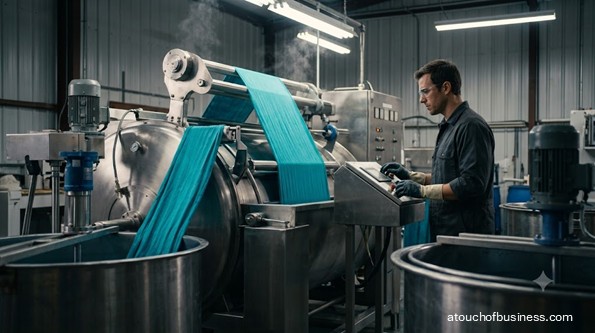
What to Expect From This Guide to Starting a Fabric Dyeing Business
This guide walks you through the key decisions and practical steps involved in starting a fabric dyeing business, from defining services and validating demand to preparing a compliant workshop, pricing production, testing processes, and opening for client orders. These highlights sample the guide’s broader practical coverage.
Inside the guide, you will find:
- Startup roadmap: Move through ordered decisions covering skills, services, demand, entry options, registration, compliance, workshop setup, pricing, safety, and testing.
- Industry interviews: Learn from dye studio founders and textile professionals discussing gradual starts, production limits, quality control, suppliers, and varied revenue sources.
- Startup FAQs: Find practical answers about permits, wastewater, textile labeling, suitable fibers, workshop needs, and other operating questions.
- Service planning: Compare service dyeing, dyed yardage, combination models, and technique specializations that shape clients, equipment, and facility requirements.
- Market and finances: Evaluate local buyers, fixed workshop costs, per-lot pricing, break-even volume, seasonal demand, and operating reserves.
- Workshop compliance: Understand location-dependent wastewater, zoning, ventilation, chemical storage, safety documentation, insurance, and textile labeling considerations.
- Process validation: Prepare equipment and written procedures, then test dye lots, record formulas, verify colorfastness, and complete opening checks.
Start by deciding whether the technical demands, service model, and workshop responsibilities match the operation you intend to build.
Running a fabric dyeing business means you take raw, undyed textiles—yardage, garments, fiber—and transform them with color through a controlled chemical process in a dedicated workshop. You manage dye baths, control temperatures, test pH levels, fix color into fiber, and return finished work that meets a client’s color brief.
This is not a general craft project. It is a technical production service built on chemistry, process discipline, and repeatable results.
The clients who hire you—fashion designers, theater wardrobe departments, interior designers, fiber artists—are paying for color accuracy and consistency, not just enthusiasm.
Before you go further, understand the full scope of what starting a business involves. A fabric dyeing service combines creative work with environmental compliance, chemical safety, and precise production management.
That combination either energizes you or it doesn’t. Be honest about which one it is.
You’ll be on your feet all day in a wet, chemically active workspace. You’ll lift heavy, waterlogged fabric. You’ll manage heat and steam.
You’ll document every dye formula carefully so you can replicate a color weeks later for a repeat client. The work is deeply satisfying for people who love color and process—and exhausting for those who expected it to be more freeform.
Think carefully about the financial side before you commit. Workshop rent, utilities, dye chemicals, equipment, and insurance all create fixed monthly costs before you receive a single order.
Can your household manage a gap in income while you build a client base? Does your family understand and support the commitment?
Talk to people who already run dye studios or textile workshops—ones you won’t be competing against directly. Ask them what surprised them most about environmental compliance.
Ask how long it took to reach consistent order volume. Ask which clients were most reliable and which were most difficult.
Those conversations will sharpen your plan faster than anything else.
Red Flags Before You Start
A fabric dyeing business has real barriers that are easy to underestimate from the outside.
The biggest early warning: wastewater compliance. Dye bath wastewater is not simply rinsed down the drain. It contains dye chemicals, mordants, fixatives, and salts that municipal sewer systems regulate.
If the local treatment authority requires a discharge permit or pretreatment system before you can drain a dye bath, that requirement can delay or block your opening entirely.
Do not sign a lease without contacting your local publicly owned treatment works (POTW) first. Ask specifically whether your type of operation requires a wastewater discharge permit and whether any pretreatment is required. The answer determines whether a location is viable—not just affordable.
Weak local demand is another early warning. A B2B dye service depends on local fashion designers, theater companies, interior design studios, and similar clients who need custom color work on an ongoing basis.
If your market doesn’t have that creative community, building consistent order volume will be difficult.
Thin order volume is especially dangerous because this business carries high fixed costs—rent, utilities, insurance, chemical supplies—that run regardless of how many dye lots you process in a week.
Watch for a pricing mismatch, too. A dye lot takes hours from pre-treatment through drying and quality check. Owners who price per garment without accounting for full labor time and overhead frequently find they’re not covering their costs.
The domestic dye house sector has contracted significantly compared to offshore production. A small artisan workshop serving local designers and creative clients fills a specialized niche—but the addressable market for volume commercial work is limited. Position your business accordingly from day one.
If you’re not prepared to handle chemical safety daily—proper gloves, respirators when mixing dye powders, ventilation, documented procedures—this business carries real occupational health risk. That’s not a reason to walk away, but it requires genuine preparation before you open.
Step 1: Assess Your Fit and Skills
Fabric dyeing requires technical knowledge before you can take paid client work. You need a working understanding of dye chemistry: which dye classes work on which fibers, how pH affects color uptake, how mordants interact with natural dyes, and how to set color reliably.
You also need color judgment—the ability to assess whether a completed lot matches a client’s brief and to diagnose why a dye bath produced an uneven or unexpected result.
The fiber-dye pairing is not optional knowledge. Fiber-reactive dyes bond to cellulose fibers like cotton, linen, and rayon. Acid dyes work on protein fibers like wool and silk.
Disperse dyes are required for polyester and most synthetics, but they involve high-temperature processes and more complex wastewater. Many small workshops limit service to natural fibers specifically to reduce chemical and compliance complexity—and that’s a legitimate strategic choice.
Resist dyeing techniques—shibori, tie-dye, batik, ice dyeing—require additional hands-on skill. If your service offering includes patterned work, make sure you have genuine proficiency before you market it to clients.
Talk to dye studio owners and textile artists who won’t compete with you. Ask what skills they wish they’d developed before opening. Ask what their hardest early compliance challenge was.
Step 2: Define Your Service Model
The model you choose shapes every other decision—facility requirements, equipment, pricing, and client type. Settle this before you spend anything significant.
The three main approaches for a workshop-based fabric dyeing service are:
- Service dyeing only: Clients supply or ship fabric and garments; you dye them and return the finished work. This model requires less upfront inventory investment.
- Dyed yardage production: You buy undyed (greige or PFD—prepared for dyeing) fabric, dye it in your chosen colorways, and sell finished yardage to designers and crafters.
- Combination model: Service dyeing plus yardage sales, and potentially workshops or classes as an additional revenue stream.
Within service dyeing, you’ll also decide on technique specialization. Straight immersion dyeing for solid color? Garment dyeing for finished sewn pieces? Hand-painted or resist patterning? Natural botanical dyeing? Lab dip and color matching for B2B clients who need Pantone-referenced color?
Each specialization attracts a different client and requires different equipment and process knowledge. A studio with a clear identity—”we do small-batch natural dyeing for independent designers”—is easier to position and easier for clients to recommend.
Step 3: Validate Local Demand
Before committing to a location, find out whether enough paying clients are actually nearby.
The clients most likely to hire you at launch include local fashion designers and small clothing brands who need custom color on small runs, theater and film wardrobe departments, interior designers needing custom-colored yardage, and fiber artists or quilters seeking specific hand-dyed effects.
You reach them through direct outreach—not advertising campaigns. Contact design programs at local art schools. Reach out to theater companies. Visit fabric shops and ask who their most color-focused customers are. Attend fiber arts guild meetings.
Large industrial dye houses require high minimum orders and don’t offer small-batch flexibility. DIY dyeing produces inconsistent results. Digital fabric printing doesn’t replicate immersion dyeing effects.
A skilled dye studio fills the gap between those alternatives, and that’s what you’re selling.
If your research turns up a local creative community that’s actively sending color work elsewhere—or doing it inadequately in-house—that’s a strong signal of unmet demand. If you find almost no one who needs this kind of service, adjust your model or your location before you commit.
Step 4: Choose Your Entry Path
There is no established franchise model in fabric dyeing. Your realistic options are starting from scratch or acquiring an existing operation.
Acquiring an existing dye studio or textile workshop can give you equipment, an established client base, and existing compliance documentation. But it also means inheriting any unresolved environmental issues or unpermitted conditions.
Before acquiring any existing dyeing operation, conduct thorough environmental due diligence—specifically around prior wastewater discharge, chemical storage, and site contamination.
Starting fresh gives you full control over equipment selection, process design, and compliance setup. It also means building a client base from zero, which takes time to translate into consistent revenue.
Factor that ramp-up period into your operating capital planning from the start.
Business Plan
A business plan for a fabric dyeing service has to reckon honestly with a cost structure that is heavier than most creative service businesses.
Your monthly fixed costs include workshop rent, utilities (heating large dye baths uses significant energy), water costs, chemical supplies, insurance, and equipment maintenance. Those costs run whether you process two dye lots in a week or 20.
Revenue in a service dyeing model is earned per lot—per pound of fabric dyed, per yard, or per garment. Your break-even calculation comes down to a specific question: how many dye lots do you need to process per week to cover fixed costs, and is that volume realistic given local demand?
A full dye lot—pre-treatment, dyeing, rinsing, fixing, drying, quality check, packaging—can take most of a production day. Pricing that doesn’t account for full cycle time will leave you working long hours without covering overhead.
Slow periods are real. Fashion-adjacent businesses can see seasonal variation in order volume. A diversified client base—designers, theater companies, interior projects, individual crafters—reduces dependence on any single sector’s calendar.
Your plan should include an operating capital reserve that covers rent, utilities, chemical purchases, and personal living expenses through the ramp-up period. Most workshops don’t reach consistent order volume immediately.
Think through your profitability and revenue estimates carefully before committing to a lease.
Map your startup cost categories before you finalize any financial plan: workshop space and build-out, dyeing equipment, safety infrastructure, initial chemical inventory, insurance, licensing, and compliance-related costs. Price each one out locally and specifically.
Look at how to write a business plan that captures these inputs in a form you can revisit as actual costs and order volumes become clear.
Step 5: Choose a Legal Structure and Register
A fabric dyeing service handles customer-owned property and uses chemicals that create environmental and liability exposure. That combination makes legal structure a real decision, not a formality.
An LLC creates separation between your personal assets and the business—important if a client’s garment is damaged during dyeing or if an environmental compliance issue arises. Compare an LLC and a sole proprietorship before you decide.
Register your business name with the appropriate state agency. If you’re operating under a trade name different from your legal entity name, file a DBA (doing business as). Review the full business registration process for your state.
Obtain an Employer Identification Number (EIN) from the IRS—required if you hire employees and useful for business banking regardless. Learn how to get your business tax ID.
Open a dedicated business bank account before any transactions occur. Keep business finances completely separate from personal ones from the start.
Step 6: Research Permits and Environmental Compliance
This step comes before signing a lease—not after. Where and how you operate depends on what your local regulatory environment permits and requires.
Wastewater discharge is the most critical compliance issue for a fabric dyeing workshop. Contact your local publicly owned treatment works (POTW) before you commit to any space.
Ask whether your dyeing operations require an industrial wastewater discharge permit and whether pretreatment of dye wastewater is required before discharge to the municipal sewer.
Some jurisdictions require pH adjustment, settling, or other pretreatment before dye-bath water can enter the sewer. Others may not require formal permits for small-scale operations with low-impact chemistry. The answer is location-specific—you must ask, not assume.
The EPA’s National Emission Standards for Hazardous Air Pollutants (NESHAP) cover certain fabric dyeing operations. Small artisan workshops may not meet the applicability threshold, but verify this with your state air quality agency rather than assuming exemption.
If your dyeing process generates hazardous waste—spent chemicals, contaminated sludge, or certain chemical packaging—the Resource Conservation and Recovery Act (RCRA) may require registration as a hazardous waste generator. Verify the classification of the specific chemicals you plan to use.
OSHA’s Hazard Communication Standard (HazCom) applies as soon as you have employees working with dye chemicals. It requires a chemical inventory, Safety Data Sheets accessible for every chemical on-site, proper container labeling, and training on chemical hazards.
On the local side, confirm zoning approval for your specific address. Many jurisdictions classify a dye workshop as light manufacturing or light industrial use. Standard commercial and residential zones typically don’t allow chemical processing operations.
Check with the local planning or zoning department before you commit to a space.
If you build out or modify a space, a certificate of occupancy may be required before you can operate. The local building department handles this.
If you sell your own dyed textile products—not just service dyeing on client-owned goods—the FTC’s Textile Fiber Products Identification Act requires proper labeling: fiber content, country of origin, and your business name or a Registered Identification Number (RN) obtained free from the FTC at rn.ftc.gov.
If you provide only a service and return goods to clients, this labeling requirement generally doesn’t apply—but confirm with an attorney if your model is mixed.
Register with your state revenue department for sales and use tax. Whether dyeing services, dyed fabric sales, or both are taxable varies by state—check with your state’s department of revenue. Review the broader landscape of business licenses and permits.
Step 7: Secure and Prepare Your Workshop
A fabric dyeing service needs a dedicated commercial or light industrial space. A home kitchen, a garage, or a shared studio without chemical infrastructure won’t work.
The physical requirements of the space are non-negotiable. High-capacity hot and cold water supply must support large-volume dye baths and rinsing. Floor drains must connect to the municipal sewer in compliance with local pretreatment rules—confirm this before you sign anything.
Mechanical ventilation is required. Heated dye baths produce steam. Powdered dyes create inhalation risk when mixing. Chemical auxiliaries can release fumes.
Local building and mechanical codes specify minimum air changes per hour for commercial workshop spaces. The building department will tell you what’s required for your address.
Electrical service must support heating equipment, exhaust fans, drying equipment, and any dyeing machines you plan to use. Have an electrician assess the existing service before you commit.
The floor should be water-resistant and non-slip—sealed concrete or an epoxy coating. Chemical spills happen, and dye stains are permanent.
Chemical storage areas need secondary containment—drip trays or bermed sections—to prevent spills from reaching floor drains.
Think about layout before you sign. Your production flow moves from fabric intake through pre-treatment, to the dye station, through rinsing tanks, to drying, and on to quality inspection and packaging. Each stage needs space, and bottlenecks between them slow your output.
Loading access matters. Wet fabric is heavy. You’ll receive fabric deliveries and return finished work. A space with poor access adds unnecessary labor to every order.
Step 8: Select and Acquire Equipment
Equipment selection depends on what you’re dyeing, in what quantities, and at what level of color precision your clients expect.
At the studio scale, stainless steel dyeing vats in multiple sizes are the workhorse of the operation. Stainless steel doesn’t react with dyes and tolerates heat. Heating elements—commercial electric or gas burners, induction hotplates—must be sized to heat your largest vats efficiently.
Precision measurement tools are not optional for a commercial service. An accurate digital scale is essential for weighing fabric and dye chemicals. A calibrated pH meter is required for managing reactive and acid dye baths. A digital thermometer keeps dye bath temperatures in the range where specific dyes activate correctly.
For resist techniques, you’ll need dedicated binding and clamping tools, wax-resist equipment for batik, or other technique-specific tools depending on your offering. Keep dedicated stirring paddles and tongs for each dye color to prevent cross-contamination.
If you plan to offer color matching to B2B clients, a color-corrected light booth for evaluating finished lots is worth investing in early. Inconsistent lighting leads to color approval disputes.
Industrial or semi-industrial dyeing machines—jigger machines, winch machines, soft-flow machines—process larger volumes with better consistency than hand-vat operations. They represent meaningful capital investment. Match equipment scale to realistic projected order volume, and consider leasing or buying used equipment while demand is still being proven.
Your drying setup—stainless drying racks, clotheslines, or a commercial dryer—needs to handle wet fabric volume without creating bottlenecks between dyeing and delivery.
Safety equipment is part of your production infrastructure. Chemical-resistant gloves, goggles, dust masks rated for fine particulates, waterproof aprons, an eyewash station, a first aid kit, a chemical spill kit, and an appropriate fire extinguisher must all be in place before you handle any dye chemicals.
Step 9: Set Up Your Supply Chain
Establish supplier relationships before you open, not after your first client order arrives.
You’ll need dye suppliers across the classes you plan to offer—fiber-reactive dyes for cellulose work, acid dyes for wool and silk, natural dye extracts if you’re doing botanical dyeing, and the chemical auxiliaries that go with each: soda ash, sodium carbonate, citric acid, alum, urea, mordants, and fixatives.
If you’re selling your own dyed yardage rather than just service dyeing, add undyed fabric suppliers to your list: PFD (prepared for dyeing) fabric wholesalers or greige goods suppliers.
Every supplier must provide Safety Data Sheets for all chemicals they send you. This is an OSHA requirement. Confirm that each supplier can fulfill this before placing your first order.
Place small test orders before committing to bulk purchases. Not all undyed fabrics accept dye evenly. A fabric that looks identical to another on paper may perform completely differently in a dye bath. Test before you stock.
Step 10: Set Pricing and Client Terms
Build pricing from actual cost inputs. Guessing from competitor rates or intuition usually leads to underpricing—and underpricing in this business means working long hours without covering fixed costs.
For each dye lot, calculate the full cost: dye and chemical cost for that specific lot, water and utility cost, your labor time from pre-treatment through packaging, and your share of fixed overhead allocated to that time period. Add your desired margin, then divide by the unit count in the lot to arrive at a per-pound, per-yard, or per-garment rate.
Complex techniques take longer. Shibori, batik, hand-painted resist work, and detailed pattern work require more skilled labor time than straight immersion dyeing. Price that difference explicitly.
Before accepting a single paid project, create a written service agreement. It should cover liability for client-supplied goods, colorfastness expectations and limits, fiber content disclosure requirements, turnaround times, deposit terms, and payment on delivery. Review how to think about pricing your services.
Require clients to disclose accurate fiber content before you accept their goods. If you’re unsure of the fiber, run a burn test before dyeing. A mismatch between expected and actual fiber type creates disputes—and a written agreement establishes where responsibility lies.
Step 11: Banking, Payments, and Funding
Open a dedicated business checking account before any transactions occur. Use your EIN and business registration documents. See how to open a business bank account.
Set up a payment processing system that allows you to accept card payments and send invoices. A deposit on custom or larger orders is standard practice—it protects you from clients who disappear after you’ve already dyed their fabric.
Workshop build-out and equipment purchases can be significant. Explore your funding options before you start committing: personal savings, small business loans, SBA-backed financing, or equipment leasing.
Have a clear picture of your total startup cost list—all items priced out locally and specifically—before approaching any lender. Review how to approach a business loan if needed.
Step 12: Get the Right Insurance
A fabric dyeing service operates with chemical exposure, client-owned property, and environmental risk. Standard home or renters insurance doesn’t cover any of this. Understand what business insurance covers before you rely on it.
General liability insurance—including product liability—is the foundation. It covers third-party injury on your premises and property damage claims. In a dyeing service, product liability is particularly relevant: if a client’s garment is damaged or dye bleeds after delivery, you may face a claim.
Commercial property insurance covers your equipment, chemical inventory, and business contents against fire, theft, or damage.
Environmental liability—also called pollution liability—covers cleanup costs and regulatory penalties from accidental chemical spills or wastewater discharge events. Given the chemical nature of dye operations, get a quote for this before deciding it’s unnecessary.
If you hire employees, workers’ compensation insurance is legally required in most states. Chemical exposure risk in a dye workshop makes this coverage especially important. Check your state’s labor or workforce agency to confirm the requirements where you operate.
Step 13: Safety Systems and Chemical Protocols
Before any dye chemicals enter your workshop, your safety infrastructure must be in place and functional.
Every chemical on-site needs a Safety Data Sheet (SDS) accessible to anyone in the space. Maintain a physical binder or a digital system reachable immediately in an emergency. All chemical containers must be properly labeled per OSHA’s Hazard Communication Standard.
Post emergency procedures visibly—what to do if a chemical splashes in someone’s eyes, what to do in case of a spill, where the eyewash station is, where the fire extinguisher is.
Notify your local fire department of the types and quantities of chemicals stored on-site. Some jurisdictions require this, and doing it proactively is wise regardless.
If you hire employees before opening, OSHA chemical safety training is required before they handle dye chemicals.
Write standard operating procedures (SOPs) for each step of your dye process: chemical mixing, bath preparation, temperature management, rinsing, disposal, and cleanup. Written procedures create consistency and make training a future assistant much easier.
Step 14: Test Your Process Before Opening
Run test dye lots for every technique and fiber type you plan to offer before you accept paid work. This is not optional for a service that clients are trusting with their fabric and garments.
Document every test: dye type and quantity, fiber type and weight, liquor ratio (water to fabric), pH, temperature, timing, mordant or fixative used, and the resulting color. That documentation becomes your dye formula library—the basis for repeating a color accurately when a client returns for a second lot.
Wash your test samples several times and check for color bleeding or fading. Colorfastness problems caught in testing don’t become client disputes.
Confirm that your wastewater disposal is fully compliant before your first production run. Complete the full pre-opening checklist. Then begin direct outreach to your identified first clients.
Opening-Day Red Flags
Your pre-opening checklist should confirm every item below before you accept a paid client order.
If any of these aren’t in place, stop and resolve them first:
- Written confirmation from the local POTW that your wastewater discharge complies with local requirements, or a permit in hand if one was required
- Zoning confirmed in writing for your specific address
- Certificate of occupancy obtained if required
- All required environmental permits or registrations obtained
- General business license in hand
- All chemicals on-site have accessible SDS documentation
- Chemical containers properly labeled
- PPE station stocked and functional
- Eyewash station installed
- Fire extinguisher appropriate for a chemical workshop, posted and in date
- Mechanical ventilation operational
- Water supply tested under production conditions
- All dye equipment tested through a full production cycle
- Precision scale and pH meter calibrated
- Test dye lots completed and colorfastness verified
- Service contract template ready before client intake begins
- Payment processing functional
- Business insurance bound
Opening a dye workshop before the facility is fully functional and compliant doesn’t save time. It creates liability and potential regulatory consequences that are far more disruptive than a delayed opening.
If a client arrives for intake and your chemical safety documentation isn’t posted, your ventilation isn’t working, or you haven’t confirmed your discharge compliance—those are operational failures that should delay accepting work.
Frequently Asked Questions
Do I need a special permit to open a fabric dyeing workshop?
Almost certainly yes, for at least some part of the operation. A general business license is a baseline. Zoning confirmation is required before committing to a location. In most cases, you’ll need to contact the local publicly owned treatment works (POTW) about wastewater discharge compliance before you can legally drain a dye bath.
Some states also require environmental permits or registrations for chemical processing operations. Research all of this before signing a lease.
Can I discharge dye bath wastewater down a standard floor drain?
Not without verifying local pretreatment requirements first. Dye wastewater contains chemicals regulated under local sewer use ordinances and the Clean Water Act’s pretreatment program.
Contact the local POTW and ask what discharge limits or permits apply to your specific operation. Discharging untreated dye wastewater without compliance can result in fines and forced closure.
Do I need to register with the FTC for an RN number?
An RN (Registered Identification Number) from the FTC is required on labels if you market or sell your own dyed textile products. If you only provide a service on customer-supplied goods and return those goods to the client, FTC textile labeling generally doesn’t apply to those transactions.
Confirm with an attorney if your model involves both service dyeing and selling your own products.
What fiber types can a small dye workshop realistically handle at launch?
Most small workshops launch with natural cellulose fibers—cotton, linen, rayon, hemp—using fiber-reactive dyes, and protein fibers—wool, silk—using acid dyes.
Polyester and synthetic fiber dyeing requires disperse dyes at high temperature and pressure, which involves more complex equipment and different wastewater chemistry. Many artisan dye houses restrict service to natural fibers at launch to keep chemistry, safety, and compliance manageable.
How do I determine what to charge for dyeing services?
Build pricing from actual cost inputs: dye and chemical cost per lot, water and utility cost, full labor time from pre-treatment through packaging, and your allocated fixed overhead for that production period. Add your desired margin, then divide by the unit count in the lot.
Complex resist techniques like shibori or batik require more skilled labor time than straight immersion dyeing—price that difference explicitly.
What is the most common cause of color inconsistency across dye lots?
Variation in process parameters: temperature drift during dyeing, inaccurate dye measurement, pH variation, or inconsistent liquor ratios. Consistent results require precise measurement, calibrated equipment, and documented process records for every lot.
The more precisely you document and replicate your parameters, the more reliable your color matching becomes—which is what B2B clients require.
Do I need employees to start a fabric dyeing workshop?
Not necessarily. You can run a small-batch studio solo in the early months while order volume builds. The physical demands—heavy wet fabric, dye bath management, rinsing, drying—are manageable alone at moderate volume.
As orders grow, a part-time assistant handling pre-treatment, rinsing, and packing can free you to focus on dye preparation and quality. If you hire anyone, workers’ compensation insurance becomes legally required in most states, and OSHA chemical safety training must happen before they handle dye chemicals.
How long does it take to process a dye lot?
A standard immersion dye lot—pre-wet fabric, prepare dye bath, dye with controlled heat and agitation, rinse, fix, dry—typically takes several hours from start to finish. Natural dye processes may take longer due to mordanting and extended simmering.
Resist techniques like shibori require additional time for binding or pleating before the dyeing begins. Your production schedule must account for full cycle time per lot, not just the dyeing portion, to set realistic turnaround commitments with clients.
Expert Advice From People in the Fabric Dyeing Business
These interviews share practical lessons from fabric dyers, textile artists, dyehouse founders, and creative entrepreneurs. They discuss testing demand, developing dyeing skills, sourcing materials, controlling quality, organizing production, and building a recognizable brand.
Use their experiences to compare business models, understand production challenges, and identify skills that require more practice. Their advice can also help you test products and customer interest before making a larger investment.
Creative Entrepreneur Andrea Carneiro on Turning a Tie-Dye Passion Into a Vibrant Business
Andrea Carneiro explains how customer requests, boutique sales, and a successful trunk show helped turn her tie-dye hobby into a full-time business.
This interview is useful for learning how to test demand, begin selling gradually, and keep another source of income while proving the business concept.
The Botanical Designer: Interview With the Founder of Natural Dye Brand Botanical Threads
Alicia Hall discusses discovering plant dyes, creating distinctive products, operating from a small space, teaching customers, and exploring wholesale opportunities.
Her experience shows how a fabric dyeing business can evolve as the owner discovers stronger products, services, and sources of revenue.
Building a Beautiful Language: Maiwa’s 30 Year Journey
Charllotte and Sophena Kwon explain how Maiwa grew from a home-based operation into a textile company with a shop, classes, dye supplies, and artisan partnerships.
The interview offers valuable guidance about understanding the market, maintaining quality standards, managing inventory, and building relationships with textile producers.
Reimagining What Scale Means for Natural Dyeing
Winona Quigley of Green Matters Natural Dye Company discusses professional fabric dyeing services, production limits, responsible growth, large projects, and natural variations between dye lots.
This conversation helps prospective owners think realistically about capacity, repeatable results, employee costs, profitability, and the challenges of expanding production.
Saigon Indigo Fosters Love for Traditional Natural Dyeing
Founder Đỗ Bích Phương describes learning indigo dyeing, postponing her original plans, turning the craft into a business, selecting fabrics, and managing the fermentation process.
The interview provides a realistic look at the knowledge, patience, material choices, and production controls required for a handmade dyeing operation.
Interview With Ceilidh Chaplin of BillyNou
Ceilidh Chaplin explains how she runs a natural dye clothing brand from home, sources dye materials, completes each production step, and receives help with marketing and website management.
Her experience helps readers assess home-based production, supplier relationships, workload, division of responsibilities, and additional income from workshops and tutorials.
Natural dye expert Jenny Dean discusses experimentation, dependable dye plants, recordkeeping, color consistency, and the importance of lightfastness and wash-fastness testing.
This interview is useful because product testing and reliable results are essential when customers expect dyed fabrics to retain their appearance after washing and use.
Related Articles
- How To Start a Tie Dye Business
- How To Start a Fabric Shop
- How To Start an Embroidery Business
- How To Start a Screen Printing Business
- How To Start a Weaving Business
- How To Start a Yarn Store
Sources:
- U.S. EPA: Textile Mills Effluent Guidelines, Textile Manufacturing Sector NAICS 313, NESHAP Fabric Printing Coating Dyeing
- Federal Trade Commission: FTC Textile Labeling Requirements, Textile Fiber Rule
- OSHA: Chemical Hazards Standards
- CDC/NIOSH: Controlling Dust in Dyeing Operations
- Southeast Fiber Arts Alliance: Dyeing Techniques and Equipment
- Wayne Mills: Types of Textile Dyeing
- WAXON Batik & Dye Studio: Dye Studio Services and Model
- Green Matters Natural Dye Company: Natural Dye Studio Services
- Metro Dyeing: Fabric Dyeing Service Overview, Dye Types and Applications
- Makers Row: Garment Dyeing Guide
- The Southern Agency: Textile Dyeing Facilities Insurance
- EK Insurance: Dye Manufacturers Insurance Coverage
- Textile Learner: Dyeing Lab Equipment List
- Timber Creek Farm: Natural Dye Tools and Materials
- Forests and Meadows Studio: Safety and Equipment for Natural Dyeing
- CSULB: Dyeing Safety Guidelines
- Golden Dye House: Custom Dye House Operations
- ALG Corp: Wastewater Discharge Permit Guide
- jim.com: Starting a Yarn Dyeing Business
- Textile Blog: Dyeing Cost Calculation
- Textile Mentor: Textile Dyeing Methods and Types