
What to Expect From This Guide to Starting an Eyelash Extension Business
This guide walks you through the key decisions and practical steps involved in starting an eyelash extension business, from confirming training and licensing to validating demand, selecting a studio model, setting prices, preparing systems, and completing opening checks. The bullets identify several of its most useful planning areas.
Inside the guide, you will find:
- Startup roadmap: Follow an ordered progression through licensing, training, market research, entry choices, location, registration, supplies, insurance, pricing, and opening preparation.
- Industry interviews: Gain perspective from lash artists, salon owners, educators, and founders discussing training, clientele, costs, specialization, systems, and business pressures.
- Startup FAQs: Review answers about practitioner and salon licenses, home studios, training, supplies, pricing, and other common setup decisions.
- Business fit: Examine patience, fine-motor demands, physical strain, income uncertainty, household support, and realistic appointment capacity.
- Training and compliance: Distinguish state licensing from private certification while reviewing sanitation, facility permits, insurance, consent, and local requirements.
- Studio and supplies: Plan the location, treatment environment, humidity control, sanitation station, tools, adhesives, inventory, booking, and payment systems.
- Financial preparation: Calculate service costs, fill-based recurring revenue, break-even appointments, operating reserves, pricing, and a complete pre-opening checklist.
The guide begins with the personal, training, and licensing questions that shape every later studio decision.
As a lash technician, you apply semi-permanent synthetic, silk, or faux-mink fiber extensions one at a time to a client’s natural lashes using a cyanoacrylate-based adhesive — building a customized set that lasts until the natural lash sheds.
The core service menu runs from classic extensions (one extension per natural lash) to hybrid, volume, and mega-volume sets (fans of two to 16 ultra-fine extensions per lash). Fill appointments every two to three weeks keep the look intact as natural lashes cycle out.
What makes this business model distinctive is its recurring revenue structure. Every full set creates a fill client. A booked studio lives on two-week and three-week fills — not just on new clients.
That said, starting any business requires honest self-assessment before the first lease is signed or license is pursued.
Is This Business Right for You?
Lash extension work is physically demanding in ways most people don’t anticipate.
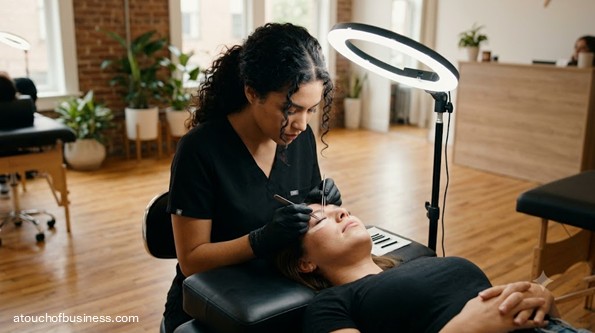
Each full-set appointment runs 90 to 180 minutes. You’re bent over a client, tweezers in both hands, isolating and placing extensions one lash at a time under a ring light.
Neck strain, wrist fatigue, and eye strain are common complaints among lash technicians who overbook early.
Ask yourself these questions honestly:
- Do you have steady hands and patience for sustained fine-motor precision work?
- Can you stay calm and focused for long appointments, back to back?
- Does close physical proximity to clients’ faces feel natural to you?
- Are you genuinely interested in the personal care and beauty field?
Beyond the physical demands, think about your financial runway. Client volume builds slowly.
Fill clients can only exist after full-set clients rebook — and that takes months to accumulate. Your household needs to cover living expenses during that ramp-up period without depending on business income.
Talk to your family or housemates before committing. Income uncertainty in the first six to 12 months is real, and their support matters.
Before signing anything or enrolling in training, talk to lash studio owners in markets where you won’t compete.
Ask them how long it took to reach consistent booking volume. Ask what surprised them. Ask whether they’d do it the same way again.
Your first clients will likely be friends, family, and people in your personal network. From there, referrals and a strong client experience drive growth.
Clients who choose a dedicated lash studio over a general salon are usually looking for a cleaner environment, a more skilled technician, and more consistent results. You need to deliver all three from day one.
Red Flags Before You Start
Some of these warning signs mean pause and verify. Others mean reconsider the model entirely.
Local market saturation is the most common trap.
The eyelash extension service market is competitive and well-established in many U.S. cities and suburbs. Before committing to a lease, count the active lash studios, lash bars, full-service salons offering extensions, and booth renters in your target trade area.
If the area is already dense with well-rated competitors, plan for a longer ramp-up — or identify a clear differentiation angle before you open.
Not yet licensed? Factor in the timeline.
If you don’t hold a cosmetology or esthetics license, completing the required program takes months. Some state programs require hundreds of hours before you can sit for the exam. That timeline must factor into any lease start date you’re planning.
Signing a standalone studio lease before building a client book is the most common financial mistake.
Fixed costs — rent, insurance, utilities, software — accrue every month whether your chairs are full or empty. Starting in a lower-overhead setup (salon suite, chair rental) to build volume first is a smarter risk structure for most new operators.
Adhesive allergy risk is real and unavoidable.
You’re working with cyanoacrylate-based adhesive inches from a client’s eyes. Clients can have unknown sensitivities. Without professional liability insurance and a consent process in place, one bad reaction can result in a claim you’re not covered for.
Pricing too low at launch is hard to fix.
Lash extension markets in many areas see constant discounting from competitors. If you open with low introductory prices to attract clients, you risk building a price-sensitive client base that won’t follow you when rates rise. Calculate your cost floor before setting any price.
Physical burnout is a structural industry challenge.
Lash technicians who overbook to compensate for income pressure burn out quickly. Plan your daily appointment capacity with physical limits in mind — not just financial ones.
Step 1: Assess Your Fit and Verify Your Licensing Path
Before enrolling in any training or signing any agreements, contact your state Board of Cosmetology — or the equivalent licensing authority in your state — and confirm exactly what credential is required to legally apply eyelash extensions.
Licensing in this field varies significantly by state. Most require a cosmetology or esthetician license. Some states offer a standalone eyelash technician license or a specialty permit.
A small number of states have no licensure requirement at all. Requirements are also actively changing in some jurisdictions — what applied a year ago may not be current.
Do not assume your existing license covers lash extensions.
If you already hold a cosmetology or esthetics license, confirm with your state board that it includes eyelash extension services within its scope of practice. Some licenses do; some require additional registration.
Also understand the difference between a license and a certification. A license is a legal authorization issued by the state board. A certification is a credential from a private training program. Both are often expected — but they are not the same thing.
Step 2: Complete Your Lash Training and Practice Sets
Once you know your state’s licensing requirement, complete the required training program and pass the necessary written and practical exams to obtain your license.
After that — or concurrently, depending on your state’s rules — complete a lash-specific extension certification course. A good program covers:
- Classic extension application (1:1 technique)
- Volume fan construction (handmade and pre-made fans)
- Lash mapping for different eye shapes
- Adhesive chemistry and humidity effects on cure time
- Isolation technique to protect natural lashes
- Sanitation and infection control
- Complication management — allergic reactions, overly heavy sets, natural lash damage
Many professional liability insurance carriers require certification documentation before issuing coverage. Some reputable lash suppliers require license verification before allowing technicians to enroll in advanced training.
Before opening to clients, complete 50 to 100 practice sets on models.
Speed, consistency, and lash retention quality take repetition to develop. Clients who get inconsistent results don’t rebook. Build your technique before your reputation depends on it.
Step 3: Validate Local Demand and Assess the Competition
This step happens before you choose a location, sign a lease, or make any major financial commitment.
Search for lash studios, lash bars, beauty salons offering extension services, and individual technicians renting chairs in your target area.
Look at the following:
- How many active competitors are operating within a realistic travel distance for clients?
- What service types do they offer — classic only, or full volume and mega-volume menus?
- What are their published prices for full sets and fills?
- What do their reviews say about consistency, cleanliness, and wait times for appointments?
If the market already has well-rated, price-competitive studios with full booking calendars, a new entrant faces a long ramp-up.
Ask yourself: what would make a client choose your studio over an established one? A specific style specialty? A cleaner, more clinical environment? Faster fill turnaround? Better availability?
You need an honest answer to that question before you spend money on a location.
Your most likely first clients are:
- Women who use strip lashes or mascara daily and want a lower-maintenance alternative
- Clients preparing for weddings, events, or vacations
- Existing beauty service clients looking for a more specialized lash experience
- Clients who’ve had poor experiences with inconsistent technicians elsewhere
Step 4: Choose Your Entry Path — Start, Buy, or Franchise
There are three realistic ways into an eyelash extension business. Each has a different cost structure, risk profile, and level of support.
Starting from scratch (independent studio):
- Full creative and pricing control
- Lower startup cost than a franchise
- Requires building brand recognition and a client base from zero
- Most common path for solo lash technicians
Buying an existing lash salon:
- May include an established client book, equipment, staff, and permits
- Verify actual client retention rate, reason for the sale, lease transferability, and permit status before agreeing to any terms
- Check existing equipment condition and adhesive inventory expiration dates
Franchise:
- Established lash franchise brands operate across the U.S. with proven systems, national branding, and technician training programs
- Franchise fees, ongoing royalties, minimum investment requirements, and required build-out standards are significantly higher than independent startup costs
- Creative and operational control is more limited
- Better suited to owners who want structured systems and brand support over full independence
The right choice depends on your budget, your risk tolerance, your desired level of control, and whether a suitable existing business or open franchise territory is available locally. For guidance on thinking through this decision, see buying vs. building a business.
Step 5: Find and Evaluate Your Physical Location
The physical setup of a lash studio matters more than most service businesses. Clients care deeply about cleanliness, atmosphere, and comfort when someone is applying adhesive inches from their eyes.
Your main space options are:
- Standalone dedicated studio — complete control over branding, layout, and environment; higher rent and build-out costs; best suited when you already have consistent volume
- Salon suite within a shared facility — private treatment room, shared overhead, lower startup cost; limited exterior branding; a strong starting point for new operators
- Chair or room rental within an existing salon — lowest overhead; least control over environment and client experience; useful for building volume before committing to your own space
Before you commit to a space, verify these things:
- Is the address zoned for personal services or cosmetology businesses? Get written confirmation from the city or county planning department.
- Does the space already hold a cosmetology establishment permit — or can it obtain one? Check with your state board before signing.
- Does the space have hard-surface flooring in work areas (no carpet), adequate ventilation, and a client-accessible restroom with hot and cold running water? Most state boards require all three.
- If the space was not previously used as a salon, does it require a certificate of occupancy or change-of-use permit from the local building department?
A previously operated cosmetology facility can be significantly faster to open than a space that requires build-out to meet code requirements.
Review the lease carefully before signing. Commercial lease terms are very different from residential leases. Consider engaging a commercial real estate attorney or advisor for the review and negotiation.
For more on signage rules at your location, check local requirements for business signs before purchasing anything.
Step 6: Choose a Legal Structure and Register the Business
Choose a legal entity before opening a bank account, signing contracts, or applying for permits.
Your main options:
- Sole proprietorship — simplest to set up; no separation between personal and business liability
- Limited liability company (LLC) — most common choice for personal care businesses; provides liability separation; requires state filing
- Corporation — more complex; better suited to multi-owner or investor-backed setups
For a side-by-side comparison, see LLC vs. sole proprietorship. If you’re leaning toward an LLC, the LLC overview covers the formation process.
After forming your entity, complete these registrations:
- Register a DBA (doing business as) if operating under a trade name — see how to register a DBA
- Obtain an EIN (Employer Identification Number) from the IRS — free, online at IRS.gov; needed for banking, taxes, and hiring
- Register for state sales tax if your state taxes salon services or retail product sales — verify with your state revenue agency
- Register for a state employer withholding account if you plan to hire employees
Step 7: Apply for Your Establishment Permit and Local Licenses
Your personal cosmetology or esthetics license is not enough to legally operate a salon location. The physical studio must hold its own permit.
Most states require a separate cosmetology establishment permit — sometimes called a salon license or salon permit — issued by the state board. This permit covers the physical facility, not the individual technician.
The application typically requires:
- Business owner identification
- Facility address
- Proof of zoning compliance for the location
- A pre-opening facility inspection by the state board or a delegated health authority
Apply early. Processing times and inspection scheduling can add weeks to your pre-opening timeline.
At the city or county level, also obtain:
- A general business license from your city or county government
- A signage permit if you’re installing an exterior sign
- A seller’s permit if you’ll retail products (aftercare kits, lash serums, cleansers) from the studio
For a full overview of the licensing and permit landscape, see business licenses and permits.
Step 8: Set Up the Treatment Room to Meet Board Standards
The state board and local health department will inspect your facility before issuing an establishment permit. The room must meet specific sanitation and facility standards.
Required facility elements in most jurisdictions:
- Hard-surface, washable flooring in work areas (no carpet)
- Adequate ventilation to exhaust adhesive fumes and allow airflow
- Client-accessible restroom with working toilet, hot and cold running water, soap, and single-use towels
- Hand-washing sink with hot and cold water at or near the treatment station
- Covered, labeled storage containers for clean tools and disinfected implements
- A disinfectant jar sized to fully submerge tweezers and other reusable tools
- Blood-spill cleanup kit
- Safety Data Sheets (SDS) binder for all chemical products used on-site
Licenses and permits must be posted in conspicuous locations. Most state boards specify exactly where individual practitioner licenses must be displayed — often at or near the client chair, or available at the reception desk.
Install a hygrometer before your first appointment.
Lash adhesive cures via moisture in the air. Too much humidity causes it to cure too fast; too little slows it down. Most adhesives perform best between 45% and 65% relative humidity, depending on the formula.
Monitor humidity daily. Use a humidifier or dehumidifier to maintain the right range in your studio.
A nano mister at the end of each appointment accelerates cure and reduces residual adhesive vapor for your client.
Step 9: Stock Your Supplies and Set Up Vendor Accounts
Lash extension work requires a specific toolkit. Missing or low-quality items show up directly in your results and your clients’ retention.
Application tools you need before opening:
- Isolation tweezers (straight fine tip — one hand isolates, one hand applies)
- Pickup / application tweezers (straight for classic; curved or L-shaped for volume fans)
- Multiple sets of each — tweezers wear out and tips get damaged
- Precision scissors
- Micro brushes / microtip applicators (for primer, bonder, and cleanser application)
- Spoolie brushes and lash wands (for grooming during and after application)
- Fan brush (for post-application adhesive drying and debris removal)
- Nano mister
- Eye wash bottle
Adhesive and application products:
- Professional-grade lash adhesive (select a formula matched to your studio’s typical humidity range)
- Adhesive holding surface: jade stone, crystal tile, glue ring, or silicone palette ring
- Lash primer (pre-treatment to remove oils and prep natural lashes)
- Bonder or sealer
- Adhesive remover (cream or gel type for removal services)
- Under-eye gel pads (single-use, hydrogel)
- Medical-grade lash tape
- Lint-free wipes
- Disposable glue rings
Extension inventory:
- Classic extension trays in multiple curls (B, C, CC, D), lengths (8–14mm), and thicknesses (0.12mm–0.20mm)
- Volume extension trays in thinner diameters (0.05mm–0.10mm) for fan work
- Pre-made fan trays (optional, to speed volume sets)
- Lash palette or tray holder
Sanitation supplies:
- EPA-registered disinfectant solution (bactericidal, virucidal, fungicidal)
- Disinfectant jars deep enough to fully submerge tweezers
- Barbicide or equivalent wet disinfectant
- Disinfectant spray and wipes for surfaces
- UV storage unit (used for dry storage only, not as a disinfection step)
- Sterile tool storage bags
- Labeled containers for clean vs. used implements
Adhesive has a short shelf life — typically up to five weeks once opened, up to three months unopened. Order quantities that minimize waste, not quantities that maximize your discount.
Source from professional-grade suppliers. Cheap adhesive and low-quality extensions produce poor retention, and poor retention means clients don’t come back.
Step 10: Plan Startup Costs, Secure Funding, and Open Your Business Bank Account
List every startup cost item before committing to a location or a lease. The categories below give you a complete framework to price out locally.
Startup cost categories to price locally:
- Training program tuition and licensing exam fees (if not yet licensed)
- State practitioner license application fee
- State cosmetology establishment permit fee
- City/county business license fee
- Legal entity formation (LLC filing fees, registered agent if required)
- Commercial lease deposit (first month, last month, security deposit)
- Build-out or renovation costs if the space requires changes to meet code
- Certificate of occupancy or change-of-use permit fees if applicable
- Treatment room furniture: lash bed or reclining treatment chair, tech stool, lighting, storage
- Application tools (tweezers, scissors, brushes, nano mister)
- Opening inventory: extension trays across curls, lengths, thicknesses; adhesives; disposables
- Sanitation equipment and supplies
- Environmental control: hygrometer, humidifier or dehumidifier
- Business software: booking platform, POS system, card reader
- Client intake forms and consent waivers
- Required signage and permit display materials
- Insurance premiums
- Working capital reserve — enough to cover rent, supplies, and living expenses during the ramp-up period
For funding, consider personal savings, SBA loan programs, CDFI (Community Development Financial Institution) small business lending, personal credit lines, or commercial bank loans.
Open a dedicated business bank account before spending anything on the business. Keep business and personal finances completely separate from the start.
Step 11: Get Insurance Before Your First Client
Lash extension services carry genuine liability risk. You’re working with chemical adhesive directly adjacent to a client’s eyes.
Clients can have unknown adhesive sensitivities. Natural lashes can be damaged by overly heavy or improperly applied extensions. Eye area injuries from tools do happen.
Insurance coverage you need before opening:
- Professional liability insurance (also called malpractice or errors and omissions insurance) — covers claims arising from services you perform, including adhesive reactions, lash damage claims, and eye irritation injuries
- General liability insurance — covers third-party bodily injury (a client who slips and falls in your studio) and property damage
- Product liability coverage — covers claims tied to products you use or sell; often bundled with professional liability policies marketed to beauty professionals
- Commercial property insurance — covers your equipment, furnishings, and supplies against fire, theft, and vandalism
- Workers’ compensation insurance — legally required in most states as soon as you have employees; verify the threshold and rules with your state labor agency
Some state boards require proof of professional liability insurance as a condition of licensing or permit renewal. Verify this with your state board.
Commercial landlords and salon suite operators also typically require a certificate of insurance before you move in.
Several professional associations offer policies specifically designed for lash technicians and esthetics professionals — compare coverage amounts and policy terms carefully. For a general overview, see business insurance.
Step 12: Build Your Service Menu and Pricing Structure
Your service menu communicates your skill level, your positioning, and your price point all at once. Build it deliberately.
Core service types to offer:
- Classic full set — one extension per natural lash; 90–120 minutes; entry-level classic look
- Hybrid full set — mix of classic and volume techniques; two to 2.5 hours; textured, natural-full appearance
- Volume full set — fans of two to six ultra-fine extensions per lash; two to three hours; fluffy, dense look
- Mega-volume full set — fans of six to 16 extensions per lash; three or more hours; advanced-only service
- Fill appointments (two-week and three-week intervals) — 45 to 75 minutes; priced at roughly half the full-set rate
- Removal service — full dissolution of existing extensions using cream or gel remover
Price each service based on your actual cost floor — not by copying a competitor’s menu.
To calculate your cost floor:
- Total your monthly fixed costs (rent, insurance, software, utilities, licensing)
- Add your product cost per appointment (adhesive used, extension trays, disposables)
- Add the hourly value of your time
- Divide by realistic working hours per month
That math gives you the minimum price needed to break even — before profit.
Structure fill pricing to reward timely rebooking. Price two-week fills lower than three-week fills. This encourages consistent fill cadence, which protects lash health and keeps your calendar predictable.
For pricing strategy principles, see pricing your products and services.
Step 13: Set Up Client Intake, Consent, and Booking Systems
Before your first client sits in the chair, you need documentation and booking infrastructure in place.
Client intake and consent documents:
- Health history and intake form — eye conditions, contact lens use, known adhesive or latex allergies, previous extension experience, prior reactions
- Natural lash assessment notes — condition, thickness, length, spacing
- Lash mapping record — custom design plan for the client’s eye shape and desired style
- Client consent and liability waiver — outlines service risks, patch test recommendation, and aftercare responsibilities; requires client signature
- Written aftercare instruction card — given to every client at every appointment
Establish a patch test protocol.
For new clients, apply a small amount of adhesive to a single test lash 24 to 48 hours before the full-set appointment. This screens for cyanoacrylate sensitivity before you commit two hours of work — and before the client commits to a full set.
Booking system requirements:
- Online booking platform with client-facing scheduling
- Automated appointment reminders via email or text
- Deposit collection for new clients and long appointments
- Clear cancellation and no-show policies enforced at booking
- Client record storage for appointment history and lash notes
No-show appointments on a two-hour full-set booking are expensive. Require a deposit from new clients from day one.
Step 14: Hire Staff or Confirm Your Solo Schedule
Many lash studio owners open as solo operators. Before you do, confirm that the appointment volume you can realistically complete per day covers your fixed monthly costs.
A solo technician doing classic sets can complete roughly four to five full appointments per day. Volume sets take longer — often three hours or more. Calculate whether solo capacity meets break-even before deciding against hiring from the start.
If you plan to hire additional lash technicians, each must hold valid state licensure. Verify credentials before the first appointment.
The employment classification decision matters.
Technicians hired as employees require payroll tax withholding, workers’ compensation, and state employer account registration.
Technicians who rent a chair or suite from you as booth renters are independent contractors — they run their own businesses within your space, set their own prices, and supply their own products. Misclassifying employees as contractors creates tax and labor law risk.
For guidance on the hiring decision, see how and when to hire.
If renting chairs or suites to other technicians, require proof of their individual state license and their own professional liability insurance. Execute a written booth rental agreement before they begin working in your space.
Business Plan
A lash extension business plan is a working document — not a formality. It should answer the specific financial and operational questions that determine whether you open, and when.
Use the startup steps above to build your plan around these core questions:
What is your break-even appointment volume?
Total your monthly fixed costs. Divide by your average service price per appointment. That quotient is the minimum number of appointments per month needed to cover costs — before you earn anything as the owner.
A studio running on high-rent commercial space needs significantly more monthly volume than one operating from a salon suite. Know this number before you sign a lease.
How does your fill structure drive recurring revenue?
Full-set appointments generate the largest individual tickets. But fills — recurring every two to three weeks — are the financial engine.
A studio with strong client retention runs primarily on fill income, with new full-set bookings supplementing that base. A studio that constantly needs new full-set clients to survive has a retention problem and a cash flow problem.
What is your operating capital plan?
The period between opening and reaching consistent fill volume can take six months or longer. Your plan must account for rent, supply costs, insurance, and your personal living expenses during that period — without relying on revenue that doesn’t exist yet.
Undercapitalization — running out of operating money before client volume stabilizes — is one of the most common reasons lash studios close. Plan your reserve before you commit to fixed overhead.
What does your service menu contribute per hour?
Classic sets at a lower price take two hours. Volume sets at a higher price take three. Fills take 45 to 75 minutes with minimal product cost. Calculate your contribution per hour across service types so you know which appointments do the most financial work.
For a framework to estimate your early revenue potential, see estimating profitability and revenue for a new business.
Your business plan should also include: legal structure, licensing path and timeline, location type and lease terms, equipment list with sourced pricing, insurance coverage, funding sources, and your first 90-day appointment volume target.
Opening-Day Red Flags
Don’t unlock the door until every item on this list is confirmed.
Licensing and permits:
- Your personal cosmetology, esthetics, or lash technician license is active and displayed as required by your state board
- The cosmetology establishment permit for the physical studio is issued and posted
- City/county general business license is obtained
- Zoning compliance is confirmed in writing for personal services at the address
- Certificate of occupancy or change-of-use permit is in hand if required
- Any required health department inspection is complete
Space and sanitation:
- Flooring in the work area is hard-surface and washable (not carpet)
- Ventilation is adequate to exhaust adhesive fumes
- Client restroom is clean, stocked, and accessible
- Hand-washing sink is operational at or near the treatment station
- Sanitation station is stocked: EPA-registered disinfectant in a jar deep enough to submerge tweezers, disinfectant spray, labeled storage containers, SDS binder, blood-spill kit
- Hygrometer is installed and studio humidity is in range for your adhesive formula
Supplies and tools:
- Adhesive is unexpired and stored correctly per manufacturer instructions
- Extension inventory covers your full opening menu (multiple curls, lengths, thicknesses)
- All single-use disposables are stocked: eye pads, micro brushes, glue rings, lint-free wipes, spoolies
- Tweezers are calibrated and tips are undamaged
Business operations:
- Professional liability and general liability insurance are in force; certificate of insurance is available
- Business bank account is open and operational
- POS and payment processing are tested and functional
- Online booking is live with deposits enabled and confirmation emails functioning
- Client intake forms, consent waivers, and aftercare cards are printed or digitally ready
- Patch test protocol is documented and ready to apply with new clients
Soft opening completed:
- At least one full mock appointment has been run in the space to identify setup gaps
- Workflow from client check-in through payment and handoff has been rehearsed
- First week of bookings is confirmed with deposit holds in place
Frequently Asked Questions
Do I need a cosmetology license to open an eyelash extension salon?
Most states require a cosmetology or esthetician license to legally apply eyelash extensions. Some offer a dedicated eyelash technician license or specialty permit. A small number of states have no licensure requirement, and requirements are actively changing in some jurisdictions.
Contact your state’s Board of Cosmetology — or equivalent licensing authority — before enrolling in any training program or making business commitments.
Do I need a separate license for the salon location itself?
Yes, in most states. Your personal practitioner license covers you as an individual. The physical studio must hold a separate cosmetology establishment permit or salon license, issued by the state board. This typically requires a pre-opening facility inspection. Apply early — processing and inspection scheduling can add weeks to your timeline.
Can I operate an eyelash extension studio from my home?
This is restricted or prohibited in many states. Most boards require lash services to be performed in a licensed cosmetology establishment with specific facility requirements — including a client-accessible restroom, hard-surface flooring, a sanitation station, and an entrance that doesn’t pass through a private living area.
Verify with your state board and local zoning authority before investing in a home setup.
What are the main liability risks for a lash studio?
The primary risks involve adhesive reactions (cyanoacrylate sensitivity causing eye irritation, swelling, or allergic response), mechanical damage to natural lashes from overly heavy or improperly applied sets, eye infections from inadequate sanitation, and tool injuries near the eye area.
Professional liability insurance, general liability insurance, client consent and waiver documentation, patch testing protocols, and strict sanitation practices are all essential before your first appointment.
What is the difference between a classic set, a volume set, and a fill?
A classic full set applies one extension per natural lash and takes 90 to 120 minutes. A volume set applies fans of two to six ultra-fine extensions per natural lash and takes two to three hours or more. A fill appointment replaces shed extensions from an existing set and typically takes 45 to 75 minutes.
Volume sets require more advanced technique, take longer, and are priced higher than classic sets. Fill pricing is typically structured around appointment duration or a two-week versus three-week interval.
Should I start as an independent studio, buy an existing salon, or franchise?
Starting independently gives you full control at a lower upfront cost, but requires building your brand and client base from zero. Buying an existing salon may include an established client book, equipment, and permits — verify all three before agreeing to terms.
Franchise brands offer proven systems, national branding, and training support but require significantly higher initial investment and limit your operational independence. The right path depends on your budget, risk tolerance, and how much structured support you want.
How does room humidity affect my lash studio?
Lash extension adhesive cures via moisture in the air. Too much humidity causes it to cure too fast, creating brittle bonds. Too little humidity slows the cure excessively.
Most professional adhesives are formulated for a specific humidity range — often 45% to 65% relative humidity. Install a hygrometer in your treatment room, monitor humidity daily, and use a humidifier or dehumidifier to maintain the correct range for your adhesive formula. Use a nano mister at the end of each appointment to finalize curing.
How many appointments per day do I need to cover my costs as a solo operator?
The answer depends on your specific fixed costs and average service price — there is no universal number.
Add up all monthly fixed costs. Divide by your average revenue per appointment. Divide that by your working days per month. That calculation gives you the minimum daily appointment count needed to break even before you earn anything as the owner.
Classic full sets take two hours each. Volume sets take three or more. Fills take under an hour with lower product cost. The mix of service types you book each day significantly affects how many appointments you need to hit break-even.
Business Tips From Experienced Eyelash Extension Professionals
These interviews share practical lessons from lash artists, salon owners, educators, and beauty entrepreneurs who have built businesses around eyelash extensions.
Readers can use their experiences to evaluate training, service quality, client development, business costs, specialization, and the demands of operating an eyelash extension business.
Starting Your Own Lash Business vs. Working in a Salon
Lash artist Zoe Kinnear McIntyre discusses working in a salon before opening her own eyelash extension business.
The interview helps readers compare employment with self-employment while considering training, scheduling, customer service, and business responsibilities.
The Magic of Perseverance: An Interview With Lash Chance Artistry
Carol Jaame shares how she rebuilt her clientele, handled overwhelm, and developed a profitable lash business.
The discussion is useful for learning about client acquisition, action planning, business support, and choosing suitable mentors.
Interview: Sugarlash Founder Courtney Buhler Shares Her Business Tips, Top Trends and More!
Courtney Buhler explains how she progressed from a part-time home-based lash artist to operating a lash lounge and training employees.
Her answers highlight education, service quality, client safety, industry challenges, and the importance of building strong technical skills.
Interview With the Lash Artist: Time to Talk
Maritza Westbrooks discusses finding her first clients, selecting adhesives, understanding humidity, managing startup costs, and encouraging repeat visits.
The interview gives beginners a practical look at technical decisions and business challenges they may face when starting.
Ashley Andrews describes her transition from salon employee to eyelash extension business owner and the challenges of building a clientele.
Her advice helps readers understand specialization, continued education, consistent scheduling, reliability, and the demands of a service-based business.
Yegi Saryan of Yegi Beauty: Five Things You Need to Know to Succeed in the Modern Beauty Industry
Yegi Saryan discusses opening an eyelash extension salon, working with limited funds, asking for help, building systems, and promoting the business online.
The interview helps aspiring owners consider financial pressure, training standards, support systems, problem-solving, and business visibility.
- How To Start an Eyebrow Threading Business
- How To Start a Facial Spa Business
- How To Start a Beauty Salon
- How To Start a Bridal Makeup Business
- How To Start a Makeup Artist Business
- How To Start a Laser Hair Removal Business
Sources:
- American Lash Association: State Licensing Regulations
- The Lash Professional: State Licensing Requirements by State; License Requirements Overview; Essential Tools List
- Boulevard (joinblvd.com): State Compliance and Sanitation Requirements
- Lash Affair: Lash Business Start-Up Guide; Home Studio Location Requirements
- Pearl Lash: State Regulations Guide
- Lash Studio and Academy: License vs. Certification Explained
- Indiana Department of Health: Eyelash Extension Sanitation Rule
- Connecticut DPH: Salon Inspection Form Guidelines
- Texas TDLR: Barbering and Cosmetology Inspections Guide; Establishment License Application
- Virginia Administrative Code: Salon Sanitation and Safety Standards
- LA Business Navigator: Beauty Salon Permits and Zoning Checklist
- Maryland Board of Cosmetologists: Salon Permit Application Requirements
- Profitable Venture: Business License Overview
- ASCP (Associated Skin Care Professionals): Professional Liability Insurance for Lash Techs
- Elite Beauty Society: Eyelash Extension Insurance Coverage
- Beauty & Bodywork Insurance (BBI): Lash Tech Insurance Overview; Insurance Ultimate Guide
- NACAMS: Esthetician Insurance Guide
- Prolong Lash: Salon Insurance Importance
- Lash Stuff: Complete Supply List
- Aki Lashes: Supply List for Beginners
- Sense Lashes: Essential Tools Guide; 2026 Pricing Guide
- Lash Affair (pricing): Lash Extension Cost Guide
- Lutily: Lash Service Pricing and Profit
- Lash Jungle: Pricing Guide for Beginners
- BL Lashes: Salon Sanitation Checklist
- Stacy Lash: Common Startup Pitfalls
- Prolong Lash (industry): Industry Evolution and Challenges
- Essence: Current State of Lash Tech Businesses
- Sugarlash PRO: Economic Challenges and Competition
- Zolmi: Lash Franchise Opportunities Overview
- Salon Studios: Salon Suite License Requirements