
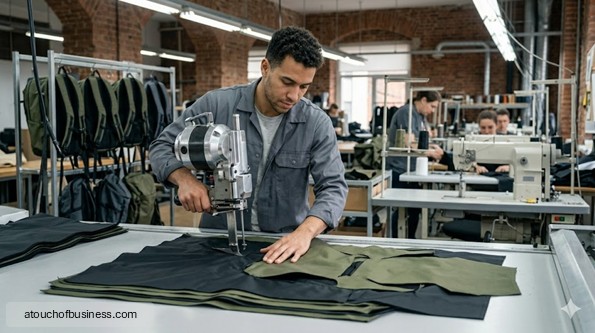
What to Expect From This Guide to Starting a Backpack Manufacturing Business
This guide walks readers through the key decisions and practical steps involved in starting a backpack manufacturing business, moving from production-model and niche choices to product design, sourcing, compliance, quality control, sales setup, and shipment preparation. The bullets highlight selected areas within a much deeper review.
Inside the guide, you will find:
- Startup roadmap: Move through an ordered process covering production strategy, product development, suppliers, legal setup, financing, sales channels, and pilot manufacturing.
- Expert interviews: Learn from founders and designers discussing materials, prototypes, factory relationships, specialized products, brand positioning, and buyer needs.
- Common questions: Find answers about tech packs, manufacturing models, minimum orders, children’s products, labeling, home production, and government contracts.
- Production choices: Compare in-house, domestic contract, and overseas manufacturing based on control, capital, labor, lead times, and supply-chain risk.
- Product development: See how niche selection, technical specifications, prototypes, component sourcing, manufacturing agreements, and inspections shape a reliable first product.
- Compliance planning: Review textile labels, origin claims, children’s-product rules, facility zoning, worker protections, insurance, and requirements tied to specific markets.
- Financial realities: Work through per-unit costs, wholesale margins, break-even volume, cash-flow gaps, funding needs, and warnings before major spending.
Begin by deciding which production model matches your skills, capital, desired control, and tolerance for manufacturing risk.
What Does a Backpack Manufacturing Business Actually Do?
A backpack manufacturing business designs, produces, and sells backpacks under an original brand or as a contract producer for other brands.
You might run your own cut-and-sew shop in a light industrial space, hire a U.S.-based sewing contractor to produce your designs, or work with an overseas factory to manufacture your products at volume.
The product is a sewn, soft-goods item — shaped by fabric, hardware, foam padding, webbing, and zippers — and the path from concept to finished product involves far more decisions, time, and capital than most first-time owners anticipate.
Product categories range from outdoor and hiking packs to tactical gear, school bags, laptop commuter packs, corporate promotional bags, children’s bags, camera cases, and medical or EMS packs.
Before you follow any of the startup steps below, read this section and the red flags that follow. This business carries real financial and operational risk at every stage. Going in clear-eyed is the only way to start well.
Is This Business the Right Fit for You?
Backpack manufacturing is capital-intensive, operationally complex, and slow to generate revenue. It isn’t a business you can test cheaply over a weekend.
Before you commit to anything, ask yourself honest questions about your skills, your finances, and your tolerance for risk.
This business may not fit you if:
- You don’t have product design skills or access to a qualified soft-goods designer
- You can’t fund startup costs and personal living expenses simultaneously for six or more months
- You expect fast revenue and can’t absorb a slow ramp-up period
- You have no experience with manufacturing, quality control, or supply chain coordination
- Your household depends on your income starting immediately
If some of those gaps are manageable, keep reading. Take them seriously now, not after you’ve signed a lease or placed a production order.
Talk to people who have launched small U.S.-based soft-goods brands or run cut-and-sew operations. Speak only with people you won’t compete against. Ask what their startup period actually cost, how long it took to reach profitability, what they wish they had known, and what they would do differently.
Prepare specific questions before each conversation. No two journeys are identical, but firsthand experience from people running this kind of operation is worth more than any business book.
If you’re drawn to a physical product but uncertain about full manufacturing, review your options between starting from scratch and acquiring an existing operation. Buying an established cut-and-sew shop or an existing backpack brand can shorten the timeline considerably — at the right price and with the right due diligence.
Red Flags Before You Start
The backpack market has real entry barriers. These aren’t hypothetical risks — they stop underprepared startups before they reach their first sale.
Stop and reconsider if any of these apply to you:
- Your product concept is generic. Mass-market backpack categories are saturated and priced by high-volume Asian factories that small U.S. manufacturers can’t match. Without a clear niche — tactical, ultralight, corporate custom, specialty technical — you’re competing on price in a race you can’t win.
- You’re planning in-house production but can’t identify sewing labor. Skilled industrial sewing operators, pattern makers, and sample sewers are scarce in most U.S. markets. If you can’t locate them before committing to a facility, your production model may not be viable where you’re located.
- Your operating capital doesn’t cover the production gap. Overseas factories typically require a deposit before production begins and the balance before shipment. Lead times run 60–120 days. You must fund that gap before revenue arrives. If your capital can’t sustain three to six months of expenses, your financial plan isn’t ready.
- You haven’t identified a specific buyer at launch. Know who your first customer is and why they’ll choose your product. A wholesale account, a corporate buyer, or a confirmed e-commerce audience is a real answer. “Selling online” isn’t.
- You want to claim “Made in USA” without verifying what that requires. The FTC’s standard is “all or virtually all” made domestically. Most synthetic fabrics, zippers, and hardware used in U.S.-assembled packs are sourced overseas. That may disqualify an unqualified origin claim entirely — verify before building your brand around it.
- You’re planning to start with a children’s backpack line. Products designed for children aged 12 and younger trigger CPSIA compliance requirements, including third-party lab testing and a formal Children’s Product Certificate for each style. That adds cost and complexity. Consider starting with adult products and adding children’s SKUs once cash flow is established.
Step 1: Choose Your Production Model
This is the most consequential decision you’ll make. Your production model shapes every other choice — equipment, facility, staff, cost structure, margin, and how long it takes to get your first product to market.
The three realistic options for a startup are:
- Full in-house manufacturing (cut-and-sew): You lease a light industrial space, equip it with industrial sewing machines, hire skilled operators, and produce backpacks under your own roof. This is the highest-cost, highest-control path. It may open doors to government and military contracts, “Made in USA” positioning, and specialty retail — but the capital requirement and labor challenge are significant.
- Domestic contract manufacturing: You design the product and hire a U.S.-based cut-and-sew contractor to produce it. You don’t own the factory. You supply or approve materials, review samples, and oversee quality. Lower capital outlay than in-house, but you depend on contractor capacity and minimums.
- Overseas contract manufacturing: You design the product, develop a tech pack, and work with a factory — commonly in China, Vietnam, or Bangladesh — to produce it at volume. This is the most common model for new backpack brands. Lower per-unit cost, but it requires managing MOQs, long lead times, import duties, and quality control at a distance.
Many successful mid-size backpack brands use a hybrid: design and quality control in the U.S., production overseas.
Each model carries a different risk profile. In-house manufacturing risks labor shortages and high fixed costs. Overseas manufacturing risks quality gaps, long lead times, and capital tied up months before goods arrive. Domestic contracting risks limited availability and capacity constraints from the contractors themselves.
Choose your model before pricing anything, committing to a facility, or ordering materials.
Step 2: Define Your Niche, Customer Type, and Product Line
The global backpack market is dominated by well-capitalized brands. New manufacturers who succeed do so by targeting a specific, underserved niche — not by competing broadly.
Niche categories to seriously evaluate:
- Outdoor and hiking packs
- Tactical and military packs
- Laptop and urban commuter packs
- Corporate and promotional custom bags
- Travel and carry-on packs
- Ultralight backpacking packs
- Specialized functional bags (camera, hydration, medical/EMS, diaper)
Your niche determines your customer type: direct-to-consumer buyers, specialty outdoor or gear retailers, corporate and promotional products buyers, government and military procurement offices, or institutional buyers such as school districts.
Launch with one or two products, not a full line. Validate your design concept before committing to a production run.
A narrowly defined niche also makes it easier to identify your first buyer and explain why your product is different from what’s already available — which is the clearest signal of whether the business is worth launching.
Step 3: Validate Market Demand and Competitive Reality
Before you design anything or spend on samples, confirm that real demand exists for your specific product in your target segment.
Research existing competitors at your price point. Read buyer reviews on outdoor gear sites, Amazon, and tactical forums. Identify what complaints keep surfacing — those gaps are where new products earn traction.
Ask a concrete question: who is your most likely buyer at launch, and why would they choose your product over what’s already available? “Better quality” isn’t an answer. A specific functional advantage, a material difference, a price-point gap, or a niche the big brands have ignored — those are answers.
If you’re targeting corporate or promotional buyers, research whether local or regional promotional product distributors or incentive firms purchase custom branded bags. That channel doesn’t require consumer retail infrastructure and can generate early B2B revenue at meaningful order quantities.
If you’re targeting government or military buyers, research Berry Amendment compliance early. This requirement — which mandates U.S.-sourced materials and domestic assembly for Department of Defense purchases — significantly affects your production model. Confirm it before designing your supply chain.
Step 4: Design Your Product and Build Your Tech Pack
A tech pack — short for technical package — is the master blueprint your factory uses to produce your backpack. Without a complete tech pack, you can’t get an accurate quote, a useful sample, or reliable production.
A complete backpack tech pack includes flat technical drawings from all angles, panel dimensions, outer shell fabric specifications (type, denier, finish, DWR coating if applicable), lining specifications, padding type and thickness, zipper brand and model, buckle and hardware callouts, webbing width and material, stitch type and count, seam allowances, bartack placement at stress points, colorways, label placement, and care instruction requirements.
YKK is the industry-standard zipper brand. Specify the model and size for each zipper in the pack.
If you don’t have this skill, hire a soft-goods product designer or technical designer experienced in bags. Platforms like Maker’s Row and trade events such as Outdoor Retailer connect you with U.S.-based designers.
Budget for multiple rounds of prototyping. The first sample almost never matches the final spec. Expect two to four revision rounds before approving production. Each revision adds time and cost — far less than discovering problems during a full production run.
If your design includes a genuinely novel construction feature or functional innovation, consult an intellectual property attorney before sharing your tech pack widely. A design patent covers the ornamental appearance of a product; a utility patent covers a functional innovation.
Trademark your brand name and logo separately through the U.S. Patent and Trademark Office before approaching retailers or distributors.
Step 5: Source Materials and Identify Suppliers
A single backpack requires fabric, lining, foam padding, webbing, zippers, buckles, D-rings, mesh, thread, woven care labels, hang tags, and packaging. Each component has its own supplier, lead time, and minimum order quantity.
Key material categories to source:
- Outer shell fabric — nylon (Cordura, ballistic, ripstop), polyester, canvas, recycled PET
- Lining fabric — typically polyester
- EVA or PE foam padding — for shoulder straps, back panels, laptop sleeves
- YKK zippers — specify type and size per component
- Duraflex or equivalent hardware — buckles, D-rings, snap hooks
- Nylon webbing — for shoulder straps, sternum straps, waist belts, load lifters
- Heavy-duty bonded polyester thread rated for the fabric weight
- Woven labels and care labels — must comply with FTC labeling requirements before production begins
If you’re manufacturing in the U.S., most synthetic fabrics, zippers, and hardware are still sourced from overseas even for American-assembled products.
That adds import lead times and costs — and may complicate any “Made in USA” claim. Verify what domestic sourcing actually requires under FTC standards before building your brand positioning around it.
Build relationships with at least two potential suppliers for every critical component. Single-source dependency is one of the clearest supply chain risks you can eliminate before launch. If your sole zipper supplier has a delay, your entire production run waits.
Request material samples, test reports, and certifications before committing to any supplier. Approve samples against your tech pack specifications before placing material orders for production.
Step 6: Select and Vet Your Manufacturing Partner
If you’re using a contractor rather than producing in-house, choosing the right manufacturing partner is one of the highest-risk decisions in your startup.
For domestic cut-and-sew contractors, search Maker’s Row, ThomasNet, and industry trade events. Outdoor Retailer in Salt Lake City, Texworld USA, and The Travel Goods Show all attract U.S. soft-goods producers and contractors. When searching, use terms like “cut-and-sew contractor” and “soft goods manufacturer” rather than “backpack factory” — those are the terms domestic shops use to describe themselves.
For overseas factories, request factory audits, production capability assessments, and references from other brands they’ve produced for. Review social compliance audit certifications such as BSCI or SMETA, and quality management certifications such as ISO 9001 where applicable.
Before signing any manufacturing agreement, confirm in writing:
- Minimum order quantity per style and per order
- Lead times from order confirmation to shipment
- Sample fees and revision policy
- Payment terms — typically a deposit at order and balance before shipment
- Defect rate thresholds and remedy process
- Intellectual property ownership — your designs must remain yours
- Confidentiality obligations
Don’t rely on verbal agreements. A manufacturing agreement that specifies all of these terms is the only real protection you have if production goes wrong.
Step 7: Understand Your Product Compliance Obligations
Several federal labeling and safety requirements must be in place before you sell a single unit. Missing any of them can result in product recalls, regulatory action, or lost retailer accounts.
FTC Textile Fiber Products Identification Act (TFIA):
Every backpack with textile components sold in the U.S. must carry a permanent label disclosing fiber content by percentage using FTC-approved generic names, country of origin, and either your full registered business name or your FTC Registered Identification Number (RN). Register for your RN at rn.ftc.gov — it’s free.
The label must also include care instructions under the FTC’s Care Labeling Rule.
FTC “Made in USA” standard:
If you make a domestic-origin claim anywhere — on the product, packaging, or in advertising — the FTC requires the product be “all or virtually all” made in the U.S. Assembly in the U.S. using foreign materials generally doesn’t qualify for an unqualified claim. Verify at ftc.gov before using this language.
CPSIA — for children’s products only:
If you manufacture backpacks designed or marketed for children aged 12 and younger, the Consumer Product Safety Improvement Act applies. You must test with a CPSC-accepted third-party laboratory, maintain a written Children’s Product Certificate per style, and include a tracking label on every unit with manufacturer identity, production location, date, and batch number.
Adult outdoor, travel, tactical, and corporate packs are not subject to CPSIA. Review cpsc.gov for current guidance and a list of accepted labs.
OSHA — if you operate a production facility with employees:
Federal OSHA general industry standards apply. Key areas for a cut-and-sew operation include machine guarding on all industrial sewing machines (29 CFR §1910.212), personal protective equipment, and musculoskeletal disorder prevention.
OSHA’s Sewing and Related Procedures eTool provides sewing-specific ergonomics guidance. OSHA also offers a free, confidential on-site consultation for small manufacturers through its consultation program at osha.gov/consultation.
FLSA and state wage laws:
All production employees must receive at least federal minimum wage and overtime pay after 40 hours per week. Some states have enacted specific hourly wage requirements for garment and soft-goods workers that also prohibit piece-rate pay. Verify current requirements through your state’s labor department before setting any compensation structure for sewing workers.
Step 8: Secure Your Facility
Backpack production is light industrial manufacturing. You need a space zoned for light industrial or manufacturing use — not residential, not standard commercial retail.
Confirm zoning before you sign any lease. Contact your local planning or zoning department, or search your city or county’s online zoning map. A lease on a space that isn’t properly zoned can force you to relocate before you open.
For a cut-and-sew production space, evaluate:
- Electrical capacity for multiple industrial sewing machines (confirm voltage and amperage requirements for your equipment)
- Sufficient lighting at every sewing station
- Ventilation — fabric dust and thread particles accumulate in sewing environments
- Space for cutting tables, sewing stations, material storage, finished goods storage, and a packing and shipping area
- Fire code compliance — sewing environments carry meaningful fire load from fabric and thread waste
- ADA accessibility requirements
Confirm whether your city or county requires a certificate of occupancy or a change-of-use permit before you begin production. Contact your local building department early — this process can take weeks.
Running industrial sewing equipment from a home is typically prohibited by residential zoning and noise ordinances. If you’re considering a home-based launch, verify your local home-occupation rules before setting up any equipment.
If traditional industrial space is unavailable or too expensive, some cities support shared light manufacturing spaces — sometimes called co-manufacturing hubs or maker campuses. These operate in pre-approved zones and can reduce your capital outlay while giving you access to production infrastructure.
Step 9: Register the Business and Complete Legal Setup
Get your legal foundation in place before producing goods or taking any money.
Choose a business structure that fits your situation. An LLC is common for small manufacturers because it separates personal and business liability — important when you’re making a physical product that could injure someone or trigger a product recall. Consult an attorney or accountant before deciding.
Register your business name through your state’s Secretary of State office. If you operate under a name different from your registered legal entity, you’ll need a DBA registration as well.
Obtain an EIN — Employer Identification Number — from the IRS. You need one if you have employees, operate as an LLC or corporation, or open a business bank account. Apply free at IRS.gov.
Register for state and local sales tax if you sell finished goods directly to consumers in your state. If selling wholesale to retailers, research resale certificate requirements in your state. Verify obligations through your state’s department of revenue or taxation.
Register as an employer with your state’s labor department when you hire workers. This sets up withholding, unemployment insurance, and workers’ compensation accounts. Obtain a general business license from your city or county.
File your brand name and logo as a federal trademark through the USPTO before you launch. Once you’re in the market, competitors can copy an unprotected brand. A pending trademark application provides legal notice of your claim from the filing date.
Step 10: Assess Profit Potential and Plan Your Finances
Manufacturing has a demanding financial structure. Don’t commit to a facility lease, equipment purchase, or production run until you understand your break-even requirements.
Your revenue depends entirely on your sales channel. Selling direct-to-consumer at retail prices generates the most revenue per unit. Selling wholesale to retailers means your revenue per unit drops to roughly half the suggested retail price. Selling to corporate buyers at negotiated contract prices falls somewhere in between.
Each channel requires a different cost structure to be profitable.
Economy-tier backpacks — basic school bags, undifferentiated daypacks — operate on very thin wholesale margins that high-volume factories have built their operations around. You can’t compete there as a small manufacturer. Mid-range and premium segments offer better margin potential, but only if your product is meaningfully differentiated and your brand can support the price point.
Work through these questions with your real numbers before spending:
- What is your cost of goods per unit — materials, labor or contractor fee, freight, duties, packaging?
- What are your fixed monthly costs — lease, utilities, payroll, insurance, software, loan payments?
- How many units do you need to sell per month at your expected selling price to cover those fixed costs?
- Is that sales volume realistic given your production capacity and the buyer relationships you have at launch?
- How many months can you operate before revenue covers costs — and do you have that capital reserved?
Plan for the cash-flow gap. Your production costs come before your revenue. Wholesale buyers pay net-30 to net-60. Overseas factories want payment before shipment. Budget explicitly for the period between when you spend and when you collect.
For a deeper look at how to estimate profitability for a new business, work through the math before your commitments get large.
Step 11: Obtain Funding and Open Business Banking
Identify your funding needs across two categories: startup capital for one-time setup costs, and operating capital to cover expenses until revenue covers costs. Both must be funded before you open.
Funding options to research:
- Personal savings
- SBA 7(a) loans for general small business needs
- SBA 504 loans for equipment and real property
- Equipment financing or leasing for industrial sewing machinery
- CDFI loans — Community Development Financial Institution financing, often accessible to small manufacturers
- State and local manufacturing development grants or economic development programs
- Angel investment if your brand has a compelling, scalable concept
If you’ll need outside capital, read up on how to get a business loan before approaching any lender. Lenders will want to see your production model, your cost structure, your buyer pipeline, and your break-even analysis.
Open a dedicated business bank account and keep all business transactions completely separate from personal finances from the first day. Set up a merchant account before you take any orders or deposits.
Step 12: Set Up Insurance
Before production begins and before you ship any product to buyers, you need the right coverage in place. A product defect, a workplace injury, or a fire in your facility can end the business if you’re uninsured.
Coverage to secure before your first unit ships:
- Product liability insurance: Covers claims that your backpack caused injury or property damage. Retailers and distributors will often require proof of coverage before placing any order — this coverage is non-negotiable for manufacturers.
- Commercial general liability insurance: Covers bodily injury and property damage on your premises.
- Commercial property insurance: Covers your facility, equipment, inventory, and materials.
- Workers’ compensation insurance: Legally required in most states once you have employees. Verify your state’s threshold and requirements through your state’s workers’ compensation agency.
- Inland marine or cargo insurance: Covers materials and finished goods in transit.
For more on coverage types and what to ask an insurer, see business insurance options for small operations.
Step 13: Set Up Production, Pricing, and Sales Channels
With your manufacturing partner confirmed and your compliance documentation in place, finalize your production workflow and sales infrastructure before you take a single order.
Your pricing needs to hold up across your entire cost structure. Set your wholesale price at a realistic multiplier of your per-unit cost of goods — materials, labor or contractor fee, duty, freight, and overhead. Then confirm that doubling your wholesale price for suggested retail produces an MSRP your target buyer will actually pay.
If that math doesn’t work, your cost structure or your target segment needs to change before you produce anything.
Read through the fundamentals of pricing products before finalizing your numbers.
Sales channel options to confirm before you launch:
- Direct-to-consumer through your own e-commerce storefront
- Wholesale to independent outdoor, specialty, or lifestyle retailers
- Corporate and promotional products distributors (B2B)
- Trade shows — Outdoor Retailer, The Travel Goods Show
- Amazon Seller Central (note: Amazon has its own listing and compliance requirements)
Prepare your business identity materials before approaching any buyer: product spec sheets, sample bags, compliant labels and packaging, your FTC Registered Identification Number, and proof of product liability insurance.
Step 14: Run a Pilot Production Run Before Full Volume
Produce a small pilot run before committing to a full volume order. Inspect every unit from the pilot against your approved sample and tech pack specifications.
Inspect for:
- Stitching integrity and stitch count at seams and stress points
- Bartack reinforcement at strap junctions, handle attachments, and zipper anchors
- Zipper function — smooth operation, no skipping, pulls seated correctly
- Hardware attachment — buckles, D-rings, and snap hooks secured without play
- Panel dimensions against your tech pack specs
- Label placement — fiber content label, care instructions, country of origin, RN, and CPSIA tracking label if applicable
- Overall appearance and finish against the approved sample
A quality defect caught in a pilot run costs a fraction of what it costs in a full production run — and a fraction of what a product recall or a lost retail account costs.
Build a quality control process that applies to every batch, not just the first one. Inconsistent quality across production runs is one of the clearest reasons small product brands lose wholesale accounts.
Business Plan
A business plan for a backpack manufacturing startup needs to be honest about risk, grounded in real cost and pricing data, and specific enough to guide actual decisions.
Start with your production model. Document which model you’ve chosen, why it fits your capital and skills, and what the key risks of that model are. A plan that acknowledges risk is more useful than one that doesn’t.
Document your niche and customer type. Name your first target buyer and describe specifically why your product addresses a need that existing products don’t. This is the section that will be tested first — by buyers, by lenders, and by the market.
Build your cost structure around real numbers. List every startup cost category: entity formation, trademark filing, product design and tech pack development, prototyping, materials, manufacturing, equipment if applicable, facility costs, compliance testing, insurance, packaging, and labels.
Estimate your per-unit cost of goods for your first production run. Then calculate your operating capital requirement — how many months until revenue covers monthly costs, and how much capital you need to bridge that gap.
Work through your break-even calculation. How many units do you need to sell per month, at your expected per-unit selling price, to cover fixed costs? Is that volume achievable in your first year given your production capacity and current buyer pipeline? If not, your plan needs to change before your spending does.
Address margin pressure directly. Economy-tier backpacks carry margins that small manufacturers can’t sustain. Document why your niche and price point support the margin your cost structure requires. If they don’t, resolve that in the plan — not after launch.
Plan for the cash-flow gap. Your production costs come before your revenue. Wholesale buyers pay net-30 to net-60. Overseas factories want payment before shipment. Budget explicitly for that gap.
For a detailed guide to organizing all of this into a usable document, see how to write a business plan.
Opening-Day Red Flags
These are the warnings that matter the day before you ship your first order. If any of these are unresolved, stop and fix them first.
- Product liability insurance is not yet active. Don’t ship a single unit before this coverage is confirmed in writing. One injury claim without coverage can end the business before it starts.
- Labels are incomplete or non-compliant. Every backpack must carry a fiber content label (percentage by FTC generic fiber name), care instructions, country of origin, and your company name or FTC RN. Missing or incorrect labels violate federal law and can get your product pulled from retail shelves.
- CPSIA tracking labels are missing on children’s products. If your pack is classified as a children’s product, the tracking label and Children’s Product Certificate must exist before shipment. Third-party lab testing must be on file.
- The pilot production run hasn’t been fully inspected. Approving a full production run without a completed quality inspection is one of the most common and costly early mistakes. Inspect every unit in the pilot. Document what you find. Fix problems before they multiply.
- Your manufacturing agreement is unsigned or incomplete. Without a written agreement specifying specs, defect remedies, IP ownership, and confidentiality, you have no legal recourse if something goes wrong.
- Operating capital is insufficient to cover the first three months. Know your cash position on opening day. If you’ve spent down your reserves during startup and don’t have enough left to cover fixed costs while waiting for revenue, you’re already in a fragile position.
- Zoning hasn’t been confirmed for your facility. If you haven’t verified that your space is legally approved for light manufacturing, you could face a stop-work order or forced relocation after production has already begun.
Red Flags Before You Spend
These are the moments when real money goes out the door. Each one carries a distinct warning worth naming before you commit.
Before you sign a facility lease: Confirm zoning, confirm electrical capacity for your equipment, and confirm you can get a certificate of occupancy for manufacturing use. A signed lease on the wrong space is money you can’t recover.
Before you place a material order: Your approved production sample must match the tech pack spec. Material orders placed before sample approval can result in fabric and hardware you can’t use.
Before you pay a factory deposit: Your manufacturing agreement should be signed, your tech pack finalized, your sample approved, and your import duties and freight costs calculated into your per-unit cost. Deposits paid before any of these are resolved give the factory leverage and leave you with limited recourse.
Before you hire sewing operators: Verify your state’s wage and hour requirements for garment and soft-goods workers, including whether piece-rate pay is permitted. Some states require hourly wages and prohibit piece-rate compensation entirely. A compensation structure built on assumptions can expose you to back-wage liability.
Before you claim “Made in USA”: Confirm through FTC guidance that your actual sourcing and assembly meet the “all or virtually all” domestic standard. A premature origin claim in advertising or on packaging can result in enforcement action and required corrective notices.
Frequently Asked Questions
Do I need a federal manufacturing license to produce and sell backpacks in the U.S.?
No license is specific to backpack manufacturing at the federal level. You must comply with FTC labeling requirements — fiber content, country of origin, and manufacturer identity or RN — on every product. If your backpacks are designed for children aged 12 and younger, CPSIA testing and certification requirements apply. Standard business registration, an EIN, and applicable state and local licenses are also required.
What is a tech pack and why do I need one before approaching any factory?
A tech pack is the master specification document that tells a factory exactly how to produce your backpack. Without one, factories can’t quote accurately, samples won’t match your design, and you have no basis for disputing quality problems. Most factories won’t begin sampling or quoting without a complete tech pack. Missing specs lead to costly revision rounds and delayed production timelines.
What is the difference between OEM and ODM manufacturing?
OEM means you supply your own original design in a tech pack and the factory produces it to your specification — your IP ownership of the design is clear. ODM means the factory already has existing designs you can select, sometimes customize, and sell under your brand. ODM is faster and cheaper to launch, but you’re selling a design that other brands can also purchase from the same factory.
What is an MOQ and how does it affect a startup?
MOQ stands for minimum order quantity — the fewest units a factory will produce per style per order. Overseas factories typically set MOQs at 200–1,000 or more units per style. Some low-MOQ suppliers serve startups at 30–200 units. U.S. cut-and-sew contractors often accept lower MOQs but charge more per unit. Starting with fewer styles and a factory with startup-friendly MOQs reduces the capital you must commit before knowing whether a design sells.
Does my backpack need to comply with CPSIA even if I don’t specifically market it to children?
CPSIA applicability depends on whether the product is designed or intended primarily for children aged 12 and younger. Four factors are considered together: any manufacturer statement about intended use, how the product is represented in packaging and advertising, whether the product is commonly recognized as designed for children, and the CPSC’s Age Determination Guidelines.
A school bag with children’s themes, cartoon graphics, or child-specific sizing is likely a children’s product regardless of what you call it. When in doubt, consult CPSC guidance at cpsc.gov or a product safety attorney before launch.
What does Berry Amendment compliance mean and when does it apply?
The Berry Amendment requires certain items purchased by the U.S. Department of Defense to be made in the U.S. using U.S.-sourced materials. For backpacks and tactical gear sold under government military contracts, this means both the materials — fabric, webbing, zippers, hardware — and the assembly must be domestic. If you want to pursue military or defense contracts, Berry Amendment compliance is typically mandatory and significantly limits your sourcing options. Verify specific contract requirements through the relevant procurement office.
Can I manufacture backpacks from my home to reduce startup costs?
Possibly, but with real constraints. Industrial sewing machines generate noise that typically violates residential noise ordinances. Most jurisdictions prohibit production equipment or employees in a home-based setting. You may be able to handle design and administrative tasks from home while contracting all production to a factory or sewing contractor. If you intend to sew personally on a small scale, verify your local home-occupation zoning rules before setting up any equipment.
What label information is required on every backpack I sell?
Federal law requires a permanent label disclosing fiber content by percentage using FTC-approved generic names, listed in order of predominance. The label must also include country of origin and either your full registered business name or your FTC Registered Identification Number (RN). Care instructions are required under the FTC Care Labeling Rule.
If the backpack is a children’s product subject to CPSIA, a tracking label with manufacturer identity, production location, date, and batch number is also required. Review the FTC’s labeling guidance at ftc.gov or consult an attorney before finalizing your label copy.
Expert Advice From People in the Backpack Business
These interviews share practical lessons from people who have designed, produced, marketed, and sold backpacks or related bag products.
You can use their advice to better understand product design, manufacturing choices, materials, sourcing, customer fit, and the business pressure behind building a backpack brand.
Gear Tech Interview with Hyperlite Mountain Gear Co-founder, Mike St. Pierre
This written interview covers backpack materials, Dyneema fabrics, durability, product engineering, and how material choices affect backpack performance.
An Interview With Attitude Supply
This interview with founder Michele Fasano discusses starting without design or manufacturing connections, learning the carry industry, building the ATD1 backpack, and developing a durable travel product.
The “Perfect” Moto Backpack: An Interview with Colfax Design Works Founder
This interview with Adam Shock explains backpack product development, prototyping, sourcing materials, working with manufacturers, small-batch production, and building a specialized pack for motorcycle commuters.
The CORDURA® + The Brown Buffalo Collab: Interview with Douglas Davidson
This interview with The Brown Buffalo founder Douglas Davidson covers bag design experience, fabric selection, collaboration, quality choices, and building a focused product line.
Minimalist and Socially Responsible Adventurist Backpack and Accessories Company
This founder interview with Matilda and Kelly Belknap discusses backpack brand positioning, retail channels, manufacturer relationships, shipping, customs, small-team operations, and adapting to business challenges.
How to Build a Successful E-Commerce Business Using Only Social Media Marketing
This interview with Brevite co-founder Dylan Kim covers launching a camera backpack on Kickstarter, identifying a product gap, using social media, and building an e-commerce backpack brand.
Supply and Demand: Herschel’s Founder on Building a Backpack Empire
This interview with Herschel co-founder Lyndon Cormack offers insight into brand focus, product inspiration, collaborations, price positioning, and manufacturing-related product decisions.
How We Started A $300K/Month Business Selling Carry On Travel Backpacks
This founder story with Tortuga co-founder Fred Perrotta covers identifying a travel backpack problem, building a focused product, reaching customers, and growing a backpack business.
Related Articles
- How To Start a Handbag Manufacturing Business
- How To Start a Jute Bag Manufacturing Business
- How To Start an Athletic Clothing Line
- How To Start a Jeans Manufacturing Business
- How To Start a Life Jacket Manufacturing Business
- How To Start a Rope Manufacturing Business
Sources:
- Federal Trade Commission: Textile Labeling Requirements, Apparel and Labeling Overview, Made in USA Standard
- U.S. Consumer Product Safety Commission: CPSIA Overview, Tracking Labels for Children’s Products
- OSHA: Apparel and Footwear Industry, Sewing Procedures eTool, Textile Standards
- U.S. Department of Labor: FLSA Reference Guide
- ComplianceGate: U.S. Bag Regulations Overview, CPSIA Manufacturers Guide
- DH Bags: U.S. Backpack Manufacturer Sourcing
- Fieldtex Cases: U.S. Tactical Backpack Manufacturing
- Omaska: Custom Backpack Manufacturer Guide
- Idealab GZ: Backpack Manufacturing Guide
- SZoneier: How a Backpack Is Made
- Insurance Canopy: Manufacturing Insurance Guide
- Business Research Insights: Backpack Market Report
- Mordor Intelligence: Backpack Market Share and Trends
- Deego Bag: Backpack Tech Pack Guide
- California DIR: Garment Worker Protection Act FAQ
- Sequoia Legal: Manufacturing Compliance Overview
- Industrial Property Loan: Industrial Zoning Guide
- Matthew Antonis CRE: Light Manufacturing Zoning
- Gerben IP: Design Patent and Trade Dress