
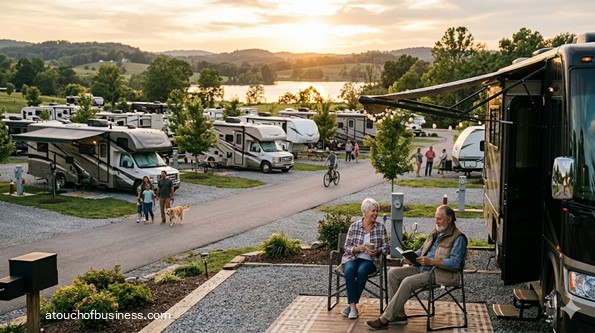
What to Expect From This Guide to Starting an RV Park Business
This guide walks readers through the key decisions and practical steps involved in starting an RV park business, from assessing fit and choosing an entry path to developing the property and preparing for guests. The bullets point to selected areas within the article’s detailed planning sequence.
Inside the guide, you will find:
- Startup roadmap: Progress from fit, build-buy-franchise choices, market research, concept design, land checks, permits, financing, construction, staffing, and opening preparation.
- Industry interviews: Compare first-hand perspectives from RV park owners, investors, operators, and hospitality professionals discussing acquisitions, financing, staffing, amenities, and guest experience.
- Startup FAQs: Find answers about viable site counts, timelines, campground licenses, build-versus-buy tradeoffs, hookups, seasonality, insurance, and franchise options.
- Land and approvals: Examine zoning, parcel capacity, flood exposure, road access, wells, wastewater, development permits, accessibility, fire standards, and local requirements.
- Financial planning: Build revenue, occupancy, site-rate, cost, funding, break-even, and reserve assumptions around the park’s concept, location, and operating season.
- Facility planning: Understand roads, electrical pedestals, water and sewer service, bathhouses, Wi-Fi, booking software, payments, staffing, and guest policies.
- Opening preparation: Confirm permits, inspections, utility testing, water quality, accessibility, roads, signage, booking accuracy, staff training, insurance, and a limited soft opening.
Begin with the fit and entry-path decisions, then use the guide to judge whether the market, property, financing, and development plan align.
Running an RV park means managing land, utilities, facilities, and the guest experience — all at once, all the time. You’re in the hospitality business, but you’re also in the infrastructure business. Before your first guest parks a rig and plugs in, you’ll need to navigate zoning, utility installation, state permits, financial planning, and a facility that has to be ready for real use on day one.
This guide walks you through the steps to start an RV park from the earliest fit and feasibility questions through the pre-opening checklist.
Is This Business Actually a Good Fit for You?
Running an RV park is hands-on work that doesn’t stop at five o’clock. You’re managing a property, troubleshooting utilities, handling guest check-ins, keeping facilities clean, and staying available when something breaks — which it will.
Ask yourself honestly: Do you enjoy working with the public? Are you comfortable managing maintenance tasks, seasonal employees, and a facility that operates on weekends and holidays? Can your household absorb income uncertainty during what could be a multi-year startup process before you turn a profit?
This business also requires significant upfront capital. Land, utility infrastructure, bathhouse construction, and equipment add up to a major financial commitment before a single guest arrives.
Talk only to RV park owners who won’t compete with you directly. Prepare specific questions: What took longer than expected? What did you underestimate? What would you do differently? Each owner’s path will be different, but firsthand experience is worth more than any guide.
Think carefully about how you’ll attract guests — especially in the first season. Location matters enormously. Proximity to a national park, a popular highway corridor, or a regional tourist destination can mean the difference between strong early occupancy and a slow, painful ramp-up.
If your household depends on a steady income, make sure you have enough personal savings or a working partner to cover living expenses while the park builds its reputation. The realities of business ownership can be harder than the idea.
Red Flags Before You Start
Some of these warning signs mean pause and verify. Others mean reconsider entirely.
The land can’t be zoned for an RV park. If the property you’re eyeing can’t receive a zoning approval or conditional use permit for campground use, the project is over before it starts. Verify this before you spend anything.
The site can’t support enough sites to be viable. Industry practitioners commonly cite 75 to 90 sites as the threshold for a commercially viable private RV park. If the available acreage — after roads, setbacks, utility easements, and facility buildings — won’t support that count, the financial model may not work.
Financing isn’t available on acceptable terms. Ground-up RV park construction is notoriously difficult to finance through conventional lenders, who prefer revenue-producing properties. If you can’t access SBA or comparable financing, building from scratch may not be realistic.
You’re underestimating the permitting timeline. New campground builds can take one to several years to receive all required approvals. Capital is deployed during that period with zero revenue coming in. Without sufficient reserves to bridge that gap, you face serious financial pressure before ever opening.
The operating season is too short to cover year-round costs. In cold-weather climates, an RV park may sit nearly empty for months. Fixed costs — debt service, insurance, property taxes, minimum staffing — continue regardless. If the peak season isn’t long enough to carry the full year, the model may not work at your location.
The land is in a FEMA-mapped floodplain. Developing in a flood zone creates major permitting complications, higher construction costs, and very expensive or unavailable flood insurance. Check FEMA flood maps before purchasing any site.
Water and wastewater systems aren’t feasible on the property. In rural areas without municipal water and sewer, on-site well and septic systems must be permitted and installed. If soil conditions, lot size, or regulatory requirements make that impossible or prohibitively expensive, the land may not be buildable as an RV park.
Two structural realities apply to this industry regardless of how well you execute. RV parks are capital-intensive — land, utility hookups, roads, bathhouses, and facilities require a large financial commitment before any revenue arrives. That creates a structural disadvantage for new independent operators compared to well-capitalized investors and multi-park consolidators.
Industry profit margins have also been squeezed in recent years by rising labor and utility costs. Plan your financial model around these realities, not around best-case scenarios.
Step 1: Check Whether This Business Fits Your Life
Before researching land or running the numbers, take an honest look at what running an RV park actually requires day to day.
You’ll manage the full guest experience from the moment someone books a site to the moment they unhook and leave. That means keeping facilities clean, responding to utility issues, managing reservations, handling guest complaints, and making sure every site is ready for the next arrival.
In peak season, that pace is relentless. In the off-season, revenue drops sharply while many fixed costs stay constant.
Many successful RV park owners describe the job as rewarding precisely because of the variety — but that variety also means no two days are the same, and the property rarely lets you fully step away.
Connect with experienced RV park operators through the Outdoor Hospitality Institute (OHI), the national organization for private RV parks and campgrounds. Their resources and membership community can provide education and real-world perspective before you commit.
Step 2: Should You Build, Buy, or Franchise?
This decision shapes everything that follows — your timeline, your financing options, your startup costs, and how quickly you can start earning revenue.
Three paths are worth comparing:
- Build from scratch: Full control over design, layout, and modern infrastructure. But permitting is slow, financing is harder to obtain, and you earn nothing during the build period.
- Acquire an existing park: Faster revenue, existing guests, and significantly better access to SBA and conventional financing. The purchase price is typically higher, and you may need to invest capital to address deferred maintenance or outdated site layouts.
- Join a franchise (such as KOA): Brand recognition, reservation volume, and systems from day one. Franchise fees apply, the franchisor must approve your location, and brand standards must be maintained. A franchisor won’t approve a location that competes with one it already has in the area.
Most first-time RV park owners find that acquiring an existing park is the more accessible path. Lenders understand revenue-producing properties far better than ground-up construction projects. The build vs. buy decision often comes down to financing availability as much as preference.
Talk to SBA-approved lenders early. Knowing what financing is actually available to you — and on what terms — may make the decision for you.
Step 3: Research the Market Before Committing to a Location
Does the area you’re considering actually support a new RV park? That’s the question to answer before you spend anything on land or planning.
Search booking platforms like Hipcamp, RoverPass, and Good Sam to see what parks already exist nearby. Look for signs of high occupancy — sites that book up weeks or months in advance suggest strong demand. A market full of underbooked parks tells a different story.
Think about what drives RV travel in the region. Is it proximity to a national park or scenic highway? A warm winter climate that attracts snowbirds? A popular tourist destination? Local events? The strongest RV parks are positioned near something that draws travelers consistently.
Pay attention to climate and seasonality as well. Do freezing temperatures close the park for months? Does summer heat deter camping? Your operating window is fundamental to understanding your revenue potential. Learn how to assess local supply and demand before choosing a location.
For industry-level data, consult reports from the RV Industry Association (RVIA), the KOA Annual North American Camping and Outdoor Hospitality Report, and OHI. These resources can help you understand whether the broader camping market supports your concept and whether your target region is growing or softening.
Step 4: Define Your Park Concept and Model
What kind of RV park are you building? The answer shapes your land requirements, utility infrastructure, permit needs, staffing model, pricing structure, and capital requirements.
The main models to consider:
- Transient or destination park: Short nightly and weekly stays near attractions or travel corridors. High turnover and peak-season revenue concentration. Guest experience expectations are higher because travelers are choosing you over other nearby options.
- Seasonal or long-term park: Monthly or full-season site rentals. More predictable cash flow, but revenue depends on fewer, longer-staying guests.
- Mixed model: A combination of nightly and monthly tenants that balances peak-season income with off-season stability.
- Resort-style or amenity-focused park: Premium sites with pools, laundry, playgrounds, Wi-Fi, a camp store, and organized activities. Higher infrastructure investment, but supports premium pricing and attracts guests who prioritize comfort.
- Glamping hybrid: Cabin rentals, yurts, or safari tents alongside traditional RV sites. Opens a parallel revenue stream but adds construction and compliance complexity.
Also identify your target guest. Retirees and full-timers who live in their RVs behave differently from weekend families towing a travel trailer. Snowbirds need monthly rates and warm-climate amenities. Digital nomads want fast Wi-Fi and longer stays. Your concept should match your location and your target guest’s expectations.
A general rule of thumb: one usable acre supports roughly 10 RV sites. Commercially viable independent parks commonly require 75 to 90 sites or more to cover fixed costs. Know your target site count before you evaluate any parcel of land.
Step 5: Find Land and Verify Zoning Before You Buy
Zoning approval is the single most critical check in the entire startup process. Never purchase land for an RV park before confirming it can legally be used for one.
Contact the local county or municipal planning and zoning department with the parcel in mind. Ask whether the land is zoned for campground or recreational vehicle park use, or whether a conditional use permit or rezoning is required. Some jurisdictions require a formal public hearing and approval process even when campground use is technically permitted in the zone.
Beyond zoning, evaluate the land carefully. You need sufficient flat or gradable acreage for your target site count, soil that can support a septic system if municipal sewer isn’t available, and road access that works for large modern motorhomes and fifth wheels.
Check the FEMA flood map before purchasing. Any portion of the site in a mapped 100-year floodplain creates major development restrictions, higher construction costs, and potential insurance problems.
Engage a licensed civil engineer, land surveyor, or campground design consultant early. These professionals can identify land-use barriers before you commit capital. Many jurisdictions require a formal site plan — showing roads, utility routing, setbacks, service buildings, and stormwater management — before any construction permits are issued. Starting that process with professional help saves time and prevents costly redesigns later.
Step 6: Set Up Your Legal Entity and Tax Accounts
Get your legal and tax structure in place before you sign any land contracts, apply for permits, or open any accounts.
Choose a business structure. Many RV park owners operate as a limited liability company (LLC) because it separates personal assets from the liabilities of a property that welcomes the public. Consult a business attorney or CPA familiar with real estate and hospitality businesses before deciding.
Once your entity is formed, register it with your state’s Secretary of State or Department of State. If you’re operating under a trade name different from your legal entity name, register a DBA and verify the name is available.
Obtain an Employer Identification Number (EIN) from the IRS at irs.gov. You’ll need it for banking, tax filings, and most permit applications.
Set up state sales and lodging tax accounts with your state’s revenue or taxation agency. Many states treat nightly and weekly RV site rentals as taxable transient occupancy, similar to hotel stays. Monthly rentals may be treated differently. A local CPA familiar with hospitality businesses can clarify your specific obligations.
If you’ll be hiring employees, open employer tax accounts with your state’s labor or workforce agency before your first hire.
Step 7: Secure Your Permits and Regulatory Approvals
Permitting is where RV park startups — especially new builds — lose the most time. Build this step into your timeline as the longest and least predictable phase of the process.
The specific permits required vary significantly by state and locality. For most new builds, the process includes a land use or site development permit, building permits for bathhouses and structures, electrical and plumbing permits, road and access permits, and water supply and wastewater permits.
Many states also require a specific campground license or RV park operating license issued by the state health department or environmental agency. This license often depends on the park meeting minimum design standards for site spacing, sanitary facilities, potable water supply, and waste disposal systems. Check with your state’s health or environmental department before designing your layout — their standards must be built in from the start.
If your project disturbs one acre or more of land, you’ll typically need NPDES (National Pollutant Discharge Elimination System) stormwater permit coverage under the Clean Water Act, along with a stormwater pollution prevention plan. Your civil engineer should handle this, but the responsibility is yours. Contact the EPA or your state environmental agency to confirm which requirements apply.
Fire safety is governed by NFPA 1194, the national standard for recreational vehicle parks and campgrounds. This standard has been the industry benchmark since the 1940s and covers electrical requirements, fire safety design, road and fire lane dimensions, and environmental sanitation. Some jurisdictions adopt it as a mandatory standard; others use it as a reference. Confirm with your local fire marshal or building department.
The ADA also applies. As a facility open to the public, your park must include accessible parking, at least one accessible RV site with a level surface and an accessible route to amenities, accessible restrooms, and accessible pathways. Build these into your site plan from the beginning — retrofitting for accessibility after construction is far more expensive.
For general business licensing, check with your city or county clerk’s office. Most municipalities require a general business license regardless of what other specialized permits apply.
Business Plan
Before you spend significant money on land or engage contractors, you need a written plan that forces you to think through the numbers honestly.
Your business plan should cover your park concept, target guests, location strategy, site count and layout, amenity plan, revenue model, startup cost categories, operating cost projections, and funding plan. SBA-approved lenders require it. A solid plan also protects you from committing capital to a model that doesn’t actually pencil out.
Build your revenue model with realistic assumptions:
- How many sites of each type — nightly, weekly, monthly?
- What rates will you charge for each site type and season?
- What occupancy rate can you realistically expect in year one, year two, and at maturity? Industry data suggests average annual occupancy for private RV parks runs roughly 60 to 70%, with peaks approaching full capacity in prime season.
- What secondary revenue will you generate — camp store sales, laundry, LP gas, dump station fees, cabin or glamping rentals?
Then build your cost model. Fixed costs include your land mortgage or payment, utility infrastructure debt service, property taxes, insurance premiums, base staffing, and software subscriptions. Variable costs include electricity and water usage, seasonal labor, supplies, and maintenance.
Running out of operating capital is one of the leading reasons new businesses close — your plan must account for this.
The break-even question is straightforward in concept: how many site nights must you sell, at what average rate, to cover your fixed monthly costs? Then ask whether your location and site count can realistically reach that threshold — and how long it will take. For more on this exercise, see estimating profitability for a new business.
In the first season or two, occupancy is typically below where it needs to be. Plan an operating capital reserve to bridge that gap explicitly — don’t assume the park will fill quickly because camping is popular.
For help structuring the plan itself, see how to write a business plan.
Step 8: Line Up Your Funding
RV parks require more capital than most small businesses to launch. Land, utility hookups, road construction, bathhouse buildings, and equipment add up to a substantial investment before you collect your first reservation. Secure committed funding before making major expenditures.
The most common financing options for RV park startups and acquisitions:
- SBA 7(a) loan: The most flexible option. Can fund land acquisition, construction, equipment, and working capital. RV parks qualify under NAICS code 721211. Typically requires as little as 10% down for a true startup.
- SBA 504 loan: Designed for fixed assets — real estate and major equipment. Structured through a bank and a Certified Development Company (CDC). Lower equity injection than conventional loans; well-suited for large property acquisitions and infrastructure projects.
- USDA Business and Industry (B&I) loan: Available for eligible rural area parks. Can cover significantly larger project amounts than SBA programs alone.
- Conventional commercial real estate loan: Larger down payment required. Harder to obtain for ground-up construction without existing revenue history.
- Seller financing: In acquisition transactions, some sellers will finance part of the purchase price, which can simplify the overall loan structure.
Talk to an SBA-preferred lender experienced with campground financing early. They’ll tell you what they need to see — business plan, financial projections, personal financial statement, site plan, market analysis — and whether the deal you’re pursuing is financeable before you spend time and money chasing it.
Step 9: Open Your Business Bank Account and Set Up Payments
Separate your business finances from your personal ones from the very beginning. Open a dedicated business checking account and run all business transactions through it — land purchase deposits, permit fees, contractor payments, and eventually guest revenue.
Set up a merchant account and payment processing terminal to accept credit and debit cards for reservations, camp store sales, laundry, and other on-site services.
Also select and set up your campground management software — often called a property management system or PMS — before you open. These platforms handle online reservations, interactive site maps, check-in and check-out workflows, dynamic pricing, and guest communication. They also integrate with online travel agencies (OTAs) like Hipcamp, RoverPass, and Good Sam, where many RV travelers discover and book new parks.
Choose your PMS early so you understand how it manages availability, rates, and booking confirmations. Getting this right before your first guest arrives is far easier than correcting it after.
Step 10: Design and Build the Facility
This is the most capital-intensive phase of the startup. Work with a licensed civil engineer, landscape architect, or campground design consultant to develop your site plan, road layout, utility routing, grading plan, and stormwater management plan before any ground is broken.
Internal roads must accommodate large modern RVs and motorhomes. Fire lanes are required in most jurisdictions — typically a minimum of 20 feet of clear width — per NFPA 1194. Use gravel or asphalt rated for heavy vehicle traffic.
Utility infrastructure at each RV site should include:
- Electric: A utility pedestal offering both 30-amp and 50-amp service, properly grounded and surge-protected, meeting National Electrical Code requirements.
- Water: A fresh water hookup connected to the park’s potable water supply, meeting EPA drinking water standards whether it comes from a municipal connection or a permitted well.
- Sewer: A direct sewer connection at each site, or a central dump station for parks where individual connections aren’t practical.
Pull-through sites — where an RV can drive in and out without unhooking — are strongly preferred by most travelers. Back-in sites cost less to develop but are less desirable for larger rigs. Build as many pull-through sites as your layout allows.
Your bathhouse is not optional. Nearly all state health departments require shared restroom and shower facilities at RV parks. Your park’s cleanliness and facility condition will directly drive your reviews. Design the bathhouse with sufficient capacity for your site count, include ADA-compliant accessible stalls and showers, and establish your cleaning routine before you open.
Wi-Fi infrastructure matters just as much. RV guests — especially full-timers and digital nomads — expect reliable connectivity throughout the park. Plan your router distribution early and test coverage before opening.
Use only licensed contractors for all utility installation. All work must be inspected and approved by the relevant authorities before the park can open.
Step 11: Get the Right Insurance in Place
An RV park is a public-use facility where guests sleep, cook, and move around on your property. That creates real liability exposure. Get insurance in place before your first guest arrives.
Work with a broker who specializes in campgrounds and RV parks. Specialized programs exist for this industry and provide significantly broader coverage than generic commercial policies.
Coverage types to evaluate:
- Commercial general liability: Covers third-party bodily injury and property damage claims on your property. Essential for any park open to the public.
- Commercial property insurance: Protects buildings, bathhouses, equipment, and site improvements against fire, storms, theft, and vandalism.
- Business interruption insurance: Replaces lost revenue if a covered property loss forces you to close temporarily.
- Commercial auto insurance: Required if you or your staff operate any business-owned vehicles for maintenance, supply runs, or guest transport.
- Workers’ compensation insurance: Required in most states for any employer. Verify the threshold and exemptions with your state’s labor or workers’ compensation agency.
- Umbrella or excess liability policy: Provides coverage above your primary general liability limits — particularly important given the public-use nature of the property and amenity risks like pools and playgrounds.
- Flood insurance: Not included in standard commercial property policies. Evaluate based on your FEMA flood zone designation.
If your park will include a pool, LP gas sales, or watercraft access, those activities require additional endorsements. Discuss your full amenity plan with your broker so the policy matches what you actually offer. For more on coverage basics, see business insurance.
Step 12: Build Your Team Before You Open
Who runs the park when you’re not there? That question needs a clear answer before you welcome the first guest.
At minimum, most parks need a manager available on-site or on-call at all times. Some states require a designated on-site manager with contact information accessible to guests and state officials. You’ll also need maintenance staff for utility issues, grounds upkeep, and facility cleaning, plus front desk coverage for reservations and arrivals.
Many RV parks rely on work-campers — RV travelers who live on-site and work part-time in exchange for a free or reduced-cost site. This can be a cost-effective staffing option for seasonal parks, but you’ll need to manage work-campers like employees and understand your state’s rules for the arrangement.
Seasonal staffing is a structural challenge in this industry. Rural locations make it harder to find and retain reliable workers, and rising wages have put pressure on park margins in recent years. Hire and train before you open — not after your first busy weekend reveals the gaps. For more on when and how to hire, build that plan into your startup timeline.
Before opening, also write your guest policies: reservation and cancellation terms, deposit requirements, quiet hours, pet rules, check-in and check-out times, fire safety rules, and speed limits on internal roads. These need to be communicated clearly at booking and posted throughout the park.
Opening-Day Red Flags
A guest who checks in to a broken hookup, an unclean bathhouse, or a site that doesn’t match what they booked will leave a review that follows your park for years. Don’t open until the experience is genuinely ready.
Before your first guest arrives, confirm all of the following:
- All required permits, licenses, and inspection approvals are in hand — including the state campground license or operating permit if your state requires one.
- Every RV site utility hookup has been tested: electric (30-amp and 50-amp), water pressure and flow, and sewer connection.
- Potable water supply meets applicable standards and has passed required testing.
- The wastewater system has been inspected and approved by the applicable agency.
- Bathhouses are operational, clean, ADA-accessible, and stocked.
- Wi-Fi coverage has been tested throughout the park.
- Internal roads are clear and passable for large RVs.
- Fire lanes meet minimum width requirements.
- All required signage is in place: entrance sign, site markers, speed limit signs, quiet hours, fire safety rules, emergency contact posting, and ADA accessible site markers.
- Online booking is live, payment processing is tested, and the PMS site map accurately reflects available sites and rates.
- Guest registration agreements and site rules packets are ready for check-in.
- Staff have been trained on check-in procedures and emergency protocols.
- All insurance policies are active.
Run a soft opening before promoting the park at full capacity. Take reservations for a limited number of sites, work through the check-in and check-out process, test your utility hookups under real load, and find the problems before you’re fully booked. Fix what’s broken before you invite more guests.
Frequently Asked Questions
How many sites does an RV park need to be financially viable?
Industry practitioners commonly cite 75 to 90 sites or more as a threshold for commercial viability. A general rule of thumb is roughly 10 RV sites per usable acre.
Parks with fewer sites may generate revenue, but fixed costs — debt service, insurance, property taxes, staffing, and utilities — can be difficult to cover at smaller site counts. Verify your break-even site count using your actual projected costs and local rate comparables before committing to land.
How long does it take to open a new RV park from scratch?
It varies widely. Obtaining zoning approval, a campground development permit, utility permits, building permits, and all required inspections can take one to several years for a ground-up build. Acquiring an existing park with licenses already in place dramatically shortens the timeline.
Don’t assume construction can begin immediately after a land purchase. Permitting timelines should be investigated and built into your financial plan from the start.
Do I need a specific campground license to operate an RV park?
Many states require one, typically issued by the state health department or environmental agency. The park must meet minimum design standards — for site spacing, sanitary facilities, potable water, and waste disposal — before the license is issued.
Contact your state’s health or environmental department before designing your layout. Their requirements need to be incorporated from the beginning.
Is it better to build a new RV park or buy an existing one?
Both paths have real tradeoffs. Building from scratch gives you design control but faces difficult financing, long permitting timelines, and no early revenue. Acquiring an existing park delivers faster revenue and better financing access, but typically costs more upfront and may require capital investment to address deferred maintenance or outdated layouts.
Most first-time owners find acquisition to be the more accessible path.
What utility connections does each RV site need?
Modern RV guests expect full hookups: electric service at both 30-amp and 50-amp, fresh water meeting EPA drinking water standards, and either a direct sewer connection at the site or access to a central dump station.
Electrical pedestals must meet National Electrical Code standards, including proper grounding and surge protection.
How does seasonality affect RV park planning?
In most markets, revenue concentrates heavily in the warm-weather months. Fixed costs — debt service, insurance, property taxes, minimum staffing — continue during the off-season when revenue drops.
Plan cash flow to carry those fixed costs through slow months. An adequate operating capital reserve is essential, especially in the first few years before the park builds consistent occupancy.
What insurance does an RV park need?
At minimum, you need commercial general liability insurance, commercial property insurance, and workers’ compensation if you have employees. Additional coverage to evaluate includes business interruption, commercial auto, umbrella or excess liability, and flood insurance based on your location.
Work with a broker who specializes in campgrounds and RV parks, not a generalist commercial insurance agent.
Can I join a franchise like KOA instead of starting an independent park?
Yes. KOA and other campground franchise systems offer brand recognition, reservation volume, training, and lender familiarity. Franchise fees apply, the franchisor must approve your location, and brand standards must be met.
Whether a franchise or independent operation is right for you depends on your budget, your tolerance for brand compliance, and the specific opportunity available in your target market.
Expert Advice From People in the RV Park Business
These interviews share practical lessons from RV park owners, campground operators, investors, and outdoor hospitality professionals. They cover buying an existing park, improving guest experience, managing operations, using creative financing, and understanding what makes an RV park attractive to guests.
Readers can use these interviews to compare different paths before starting an RV park business. The advice can help them think through property selection, daily management, staffing, amenities, financing, and the realities of operating a park before committing money or time.
How Prioritizing Guest Experience Powers Quilly’s Campgrounds’ Success
This written interview features Katie McLeod of Quilly’s Campgrounds and explains how she became a multi-park campground owner. It covers guest experience, branding, property differences, team building, and the role of reservation software.
This is useful for someone starting an RV park because it shows how owner decisions affect guest satisfaction and repeat stays. It also gives a practical look at how different park locations and guest types can shape operations.
How RV Park Investing Created Massive Cash Flow and Legacy Wealth
This interview with RV park owner and investor Mychele Bisson discusses moving from single-family real estate into RV parks. It covers preserving family-friendly campgrounds, creative financing, business growth, and community building.
This is useful for someone starting an RV park because it explains the owner mindset behind acquiring and improving existing campgrounds. It also highlights why the customer community matters as much as the property itself.
EP 114 | Interview With MHP And RV Owner Heather Blankenship
This audio interview features Heather Blankenship discussing RV park ownership compared with mobile home park ownership. It covers RV industry trends, staffing, park operations, and practical advice for people looking at the sector.
This is useful for someone starting an RV park because it compares RV parks with another land-based housing model. It can help readers think about staffing needs, operating differences, and whether the RV park model fits their goals.
Craig Alsup & Askews Landing RV Campground
This podcast interview features Craig Alsup, owner of Askew’s Landing RV Park in Mississippi. He explains how he took over a rundown park through an off-market, seller-financed deal and worked to transform the property.
This is useful for someone starting an RV park because it shows the realities of buying a distressed property. It can help readers think through cleanup, repositioning, amenities, and the effort required to turn a weak park into a stronger business.
Erika Bates & Inez Spring Riverfront RV Resort
This interview features Erika Bates, a newer RV park owner, discussing her entry into the RV park industry. It covers finding and negotiating the deal, revenue streams, creative financing, expansion plans, market analysis, and management strategy.
This is useful for someone starting an RV park because it follows an owner close to the beginning of the journey. It gives readers a grounded look at deal structure, revenue planning, risk, and growth decisions before opening or expanding.
Related Articles
- How To Start a Campground Business
- How To Start a Glamping Business
- How To Start an RV Rental Service
- How To Start a Hostel
- How To Start a Bed and Breakfast
Sources:
- Hipcamp: Start Campground RV Park, Install RV Hookups
- Pitchup.com: US Zoning Permit Guide
- Environmental Design Group: Campground Zoning Permits
- CRR Hospitality: RV Park Permit Requirements, RV Park Utility Setup, ADA Compliance Campgrounds
- NFPA: NFPA 1194 RV Standard
- Woodall’s Campground Magazine: NFPA 1194 Park Standards, SBA 504 RV Park Loans
- OHI: RV Park Financing Options, RV Park Owner Resources
- Crestmont Capital: Campground Business Loans
- SBA 504 Blog: SBA RV Park Loans
- Newbook: Start RV Park, RV Park Management Software
- RoverPass: Build Buy RV Park
- MMCG Invest: RV Park Planning Development, RV Park Feasibility Study
- Loan Analytics: RV Park Industry Outlook
- Florida RV Park & Campground Association: RV Park Development
- KOA: KOA Franchise Opportunities
- Aligned Insurance: RV Park Insurance Guide
- EPA: NPDES Permit Basics
- Spot2Nite: ADA Camping Accessibility
- Campground Mavericks: RV Park Zoning Requirements
- Staves Consulting: Buying Campground RV Park