
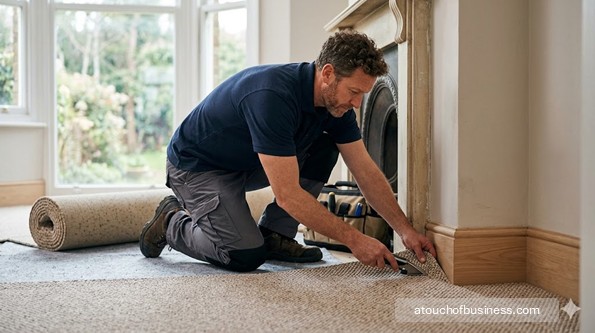
What to Expect From This Guide to Starting a Carpet Installation Business
This guide follows the key decisions and practical steps involved in building a carpet installation business, beginning with physical and technical fit and continuing through the systems needed before accepting paid jobs. The selected points below reflect only part of the article’s practical depth.
Inside the guide, you will find:
- Startup roadmap: Progress from skills, business model, and demand research to registration, tools, pricing, job documents, and pre-opening verification.
- First-hand insights: Learn from flooring founders and installers discussing estimates, margins, customer trust, crews, job flow, and business management.
- Common questions: Find practical answers about licenses, tax treatment, insurance, power stretchers, vehicles, pricing, and home-based administration.
- Business fit: Evaluate installation ability, sustained physical demands, travel, income uncertainty, market access, and household financial support.
- Tools and transport: Review professional installation tools, safety gear, consumable supplies, software, supplier accounts, and suitable commercial vehicles.
- Pricing and finances: Account for labor, materials, travel, vehicle costs, insurance, overhead, profit, startup purchases, and operating reserves.
- Job safeguards: Prepare insurance certificates, written scopes, measurements, subfloor records, change orders, compliant invoices, and a tested field workflow.
The article begins by testing whether the trade, physical workload, and financial uncertainty fit your situation.
As a carpet installer, you travel to clients’ homes and commercial properties, remove old flooring when needed, prepare the subfloor, and lay new carpet using professional tools and methods.
It’s a project-based trade. You take a job, complete it, and move on to the next one. Revenue comes from completing enough square footage at profitable rates to cover your costs and pay yourself.
The startup process involves real decisions about skills, licensing, tools, insurance, and how you’ll find your first clients. This guide walks you through each one in the order they matter.
Before you commit, be honest about whether this business fits your life. You’ll be on your knees for hours every day, hauling heavy material, and driving a work vehicle across your service area. Income won’t be steady right away, and your household needs to be able to weather a slow start.
Talk to people who already run carpet installation operations in other markets — not competitors in your area, but owners who’ve done this work. Prepare questions about how they priced their first jobs, where their work came from, and what they wish they’d known. That firsthand insight is worth more than any checklist.
Most carpet installation owners start from scratch. Buying an established operation is possible but uncommon. Franchise options exist but aren’t the norm in this trade. Think through which path fits your budget, timeline, and need for support before committing. You can read more about whether to build or buy a business if you’re weighing both options.
Red Flags Before You Start
Some warning signs are worth addressing before you spend a dollar on tools or registration.
Physical limitations are a real barrier. According to the National Institute for Occupational Safety and Health (NIOSH), carpet layers account for 6% of all reported knee injuries — a rate 100 times the national worker average. Installers spend roughly 75% of their time kneeling on hard subfloors. If you already have significant knee, back, or shoulder problems, this trade will compound them.
No installation skill means no business yet. Seam quality, stretch technique, and pattern-matching errors show immediately on the finished floor. They cost real money to fix and damage your reputation early. If you don’t have hands-on professional experience, build that first — then open the business.
Markets dominated by flooring chain retailers can be hard to crack. Large national flooring stores often have their own installation crews or locked-in subcontractor relationships. In those markets, getting client-direct residential work takes longer. Know what you’re entering before you invest in a vehicle and tools.
Undercapitalization is a consistent failure point. You’ll need a work vehicle, a full tool set, insurance, and enough reserve to cover living expenses while revenue builds. If you can’t fund that before opening, the business may stall before it gains momentum.
Underpricing labor is one of the most common early mistakes. New carpet installers often underprice to win jobs without accounting for drive time, non-billable hours, material waste, insurance, and vehicle costs. Price to cover every real cost — not just the hours you spend on the floor.
The sales and use tax rules for carpet installation contractors are also more legally complex than most service trades. Whether you pay use tax on materials or collect sales tax from clients depends on your state and how you invoice. Get that sorted before your first job.
Step 1: Assess Your Fit and Readiness
Before anything else, be honest about two things: your physical condition and your installation skill level.
This is demanding physical work. Heavy carpet rolls, sustained kneeling, repetitive tool use, and constant movement are part of every job. If you plan to be the primary installer, your body is your most important business asset.
Your skill level matters just as much. Can you produce clean seams, proper stretches, and tight stair work on your own? If not, start with training — not with client jobs.
Also think through the daily reality. You’ll drive to job sites, move furniture, tear out old carpet, prep subfloors, complete the installation, clean up, and communicate with clients — often in the same day.
Talk to owners of carpet installation businesses in other markets. Ask how they found early work, what their margins actually looked like, and what broke down in their first year. Real insight from business owners can save you from expensive assumptions.
Step 2: Get Trained and Certified if Needed
If you already have professional installation experience, evaluate whether you can deliver consistent, client-ready results from day one.
If you need formal training, the International Certified Flooring Installers Association (CFI) offers programs ranging from single-day workshops to multi-week courses. They cover carpet, hardwood, resilient, and ceramic installation at both entry and advanced levels.
CFI certification isn’t legally required in most areas, but it signals verified competency to clients, property managers, and general contractors who need to trust who they’re letting onto a job site.
You should also know the Carpet and Rug Institute’s installation standards — CRI 105 for residential work and CRI 104 for commercial. These are the industry’s baseline reference documents for professional installation.
Know both primary installation methods before opening:
- Stretch-in installation — uses tack strips and a power stretcher; standard for most residential work
- Glue-down installation — uses full-spread adhesive; standard for commercial high-traffic applications
Which method a job requires depends on the carpet type, the subfloor, and the application. You’ll need both in your skill set to handle the range of jobs that clients bring.
Step 3: Decide How Your Business Will Work
Most people think starting a carpet installation business means buying carpet and selling it with installation. But many successful operators start as labor-only subcontractors — installing carpet that flooring retailers and dealers supply — and that’s worth understanding before you commit to a model.
You have two primary operating approaches:
- Labor-only (subcontractor model) — You install carpet purchased by flooring dealers, retailers, or general contractors. Lower startup capital, no material purchasing risk, and a faster path to a job stream through dealer relationships.
- Supply and install — You provide both carpet and labor. Higher revenue per job, more client control, and better margin potential — but requires supplier accounts, capital to purchase material, transport capacity, and more complex tax management.
Many owners begin as subcontract installers under an established flooring dealer while building reputation and capital. That’s a real and respected entry path in this trade.
You also need to decide which market you’ll focus on first.
Residential vs. commercial work involves different demands:
- Residential clients want clean seams, pattern matching, careful furniture handling, and a tidy finish in their home
- Commercial clients often need larger square footage, tighter timelines, glue-down expertise, after-hours scheduling, and proof of insurance before you start
Starting with a clear focus helps you set up the right tools, pricing, and client approach before you try to do everything at once.
Step 4: Check Local Demand and Competition
Before committing to a vehicle, tools, or licensing fees, check whether enough work exists in your market — and whether you can access it.
Research what’s already operating in your area. Are there established independent carpet installers? Do local flooring retailers use in-house crews or outside labor? How much of the residential market do big-box chains control?
Talk to local property managers and real estate agents. Both are consistent sources of carpet work — rental unit turnover, home staging, and pre-sale renovations generate steady demand. Their feedback tells you whether that demand is active in your market or already locked up by established relationships.
New construction activity, rental housing stock, commercial build-outs, and home renovation cycles all affect how much work is available. Understanding local supply and demand before you invest protects you from building a business in a market that won’t support it.
Step 5: Research Your Local Licensing Requirements
Licensing for carpet installation contractors varies widely across the country. Check your specific requirements before taking any jobs.
Some states require a specialty flooring contractor license. Others require a home improvement contractor (HIC) registration with a consumer protection or attorney general’s office. Some states handle licensing at the city or county level only, and some have no state-level requirement at all.
Some jurisdictions also require a contractor surety bond as a condition of licensure. Operating without a required license can result in fines — and in some states, it prevents you from legally collecting payment on a completed job.
To find your requirements, check with:
- Your state’s contractor licensing board — search “[your state] flooring contractor license”
- Your state’s consumer protection agency or attorney general’s office — search “[your state] home improvement contractor registration”
- Your local city or county building department for any local registration requirements
Do this before you spend money on tools, insurance, or entity registration. The license requirement affects your timeline and may affect which jobs you can legally take.
Step 6: Set Up Your Business Structure and Registration
Once you know what you need to operate legally, set up your business entity.
Most carpet installation owners choose between a sole proprietorship and an LLC. Property damage claims are a real risk in this trade — a client’s furniture, adjacent flooring, or baseboards can be damaged during a job. An LLC separates your personal assets from those business liabilities, which matters more here than in many other service businesses.
Register your business name with the state. If you’ll operate under a trade name, file a DBA (doing business as) registration. Apply for your federal Employer Identification Number (EIN) from the IRS — you’ll need it to open a business bank account, hire helpers, and file taxes correctly.
Register for state and local taxes at the same time. This includes any required sales or use tax account — but the rules for carpet installation contractors are more complex than most service businesses, so read Step 7’s compliance notes carefully and consult a CPA before you set up that account.
Step 7: Get Insurance in Place Before Any Jobs
Don’t take a single paying job without insurance. Most clients, property managers, and general contractors will ask for a certificate of insurance (COI) before they let you on a job site.
The core coverages to have in place before opening:
- General liability insurance — covers property damage and bodily injury to third parties; the standard in this trade is a $1 million per occurrence policy
- Commercial auto insurance — your personal auto policy does not cover your vehicle when used for business; this coverage is legally required in most states for business vehicles
- Workers’ compensation insurance — legally required in most states if you have employees; also strongly recommended for sole proprietors, since most personal health insurance plans exclude work-related injury claims
Ask your insurance agent about an installation floater, which covers carpet materials and tools during transport and while stored at job sites.
Contractors errors and omissions (E&O) coverage is worth discussing too — it protects you if a client claims your installation method or specifications caused damage or required rework.
Get your COI generated as soon as your policies are active. You’ll need it ready to send before your first commercial job.
Learn more about business insurance for contractors to understand what each policy covers and how to compare quotes.
Step 8: Build Your Tool Set
Here’s something most people assume: carpet installation is low-cost to start because the tools seem simple. In reality, professional-grade tools are required — and the most important one, a power stretcher, is a significant investment on its own.
Knee kicking alone — without a power stretcher — is considered substandard installation practice. It produces carpet that ripples and loosens over time, which leads to callbacks and reputation damage. A quality power stretcher is non-negotiable.
Your core tool set before the first job:
- Power stretcher kit with extension tubes, tail block, and carrying case
- Knee kicker (for edge work and stair installation)
- Seaming iron and seam roller
- Carpet knife, row cutter, and wall trimmer
- Hammer tacker and stair/tucking tools
- Chalk line, tape measure, and laser measure for larger spaces
- Heavy-duty knee pads, gloves, safety glasses, and respirator for adhesive work
- First aid kit
Consumable supplies — tack strips, carpet padding, seaming tape, transition strips, adhesives, and metal door bars — need to be stocked or readily available before each job.
You’ll also need field service management or estimating software that produces itemized invoices separating labor from materials. This matters both for client clarity and for sales and use tax compliance in most states.
Step 9: Get a Suitable Work Vehicle
Your vehicle is core infrastructure, not an afterthought. Standard broadloom carpet comes in 12-foot-wide rolls that can weigh several hundred pounds. A regular pickup truck is generally not adequate for transporting full rolls safely.
You’ll need a full-size cargo van or box truck. It has to carry your complete tool set, padding rolls, tack strips, transition strips, and consumables — along with the carpet itself on jobs where you’re supplying material.
Whatever vehicle you use must be covered by a commercial auto insurance policy before you drive it for any business purpose.
Step 10: Set Up Supplier Accounts
If you’ll be supplying carpet and materials to clients, you need wholesale supplier accounts before you can price jobs accurately.
Flooring distributors and wholesalers in your region supply broadloom carpet, carpet tiles, padding, seaming tape, adhesives, and installation sundries. Most require a business license, EIN, and sometimes a minimum order commitment before opening an account.
Even in the labor-only model, you’ll typically stock common consumables — tack strips, padding, seaming tape, and transition strips — and need reliable sources for those materials.
If you plan to subcontract under a flooring retailer or dealer, contact those businesses directly to understand their installer requirements. Many have specific insurance, licensing, and workmanship standards you’ll need to meet before being added to their referral list.
Step 11: Work Out Your Pricing Before the First Job
Carpet installation is typically priced per square foot for labor, with materials quoted separately when you’re supplying them. Commercial jobs are often priced as a total project bid with a detailed written scope.
Before quoting anything, understand your real cost to complete a job — not just the labor hours on the floor. Your actual costs include vehicle fuel and wear, equipment overhead, insurance, non-billable drive time, quoting time, and cleanup.
Build your quote to include:
- Labor (all hours, not just installation time)
- Materials markup if you’re supplying carpet and supplies
- Old carpet removal and disposal when included in scope
- Subfloor preparation if required
- Tack strips, padding, transition strips, and metal door bars
- Travel and overhead allocation
- Profit margin above all costs
Get accurate measurements before quoting every job. A measurement error on a large room can eliminate the entire profit on that job.
Always separate labor and materials on your written estimate and invoice — regardless of how you charge the total. This protects you under your state’s sales and use tax rules, which vary significantly for flooring contractors.
Read about how to price your services before you finalize your rate structure.
Step 12: Set Up Banking and Payment Processing
Open a dedicated business checking account before taking any jobs. Keep business revenue and expenses completely separate from your personal finances from the first transaction.
Set up payment processing before your first client contact. Residential clients expect to pay by credit card. Commercial clients may pay by ACH or check on net payment terms.
Your invoicing system needs to produce separate line items for labor and materials. In many states, that separation determines how sales and use tax applies to your jobs.
A CPA familiar with flooring contractor tax rules in your state can help you set this up correctly.
See the guide on opening a business bank account for practical steps on getting started.
Step 13: Prepare Your Job Documents and Contracts
Every job needs a written scope of work before you start.
Some states require written contracts for residential improvement work above a certain project value. Even where it’s not required, a clear written agreement protects you when clients dispute scope, price, or responsibility after the job is done.
Your written estimate or contract should clearly define:
- The rooms or areas included
- Whether old carpet removal and disposal is included
- Whether subfloor preparation is included or priced separately
- The carpet type and padding being installed
- Labor and material charges as separate line items
- Payment terms and deposit requirements
- A change order process for scope changes mid-job
Also photograph subfloor conditions before installation begins. If moisture damage, structural issues, or unevenness exist before you touch the floor, you want a record of what you found — not what the client thinks you caused.
Business Plan
Before you open, write down the financial reality of running this business — a clear, honest picture of what it will cost to operate and what it will take to cover those costs.
Start with your startup costs: the work vehicle, tool set, insurance, licensing and registration fees, supplier account setup, and operating reserve. Price out each item specifically — used versus new tools, van purchase versus lease, insurance quotes from multiple carriers.
The gap between what you estimated and what things actually cost is where new businesses run into trouble.
Then work out your break-even math. How many square feet do you need to install per week at your target labor rate to cover fixed costs? Include vehicle expenses, insurance, phone, software, and the portion of your time that isn’t billable.
If that number seems unreachable in your market, the model needs to change before you commit.
Carpet installation demand follows housing market cycles. Slow months happen. New construction slows. Renovation budgets tighten. Your plan needs a cash reserve that covers operating costs and personal living expenses during those periods.
Your model choice also affects your financial picture. The labor-only model requires less upfront capital but limits revenue per job. Supply and install increases revenue potential but raises the capital requirement and complexity. Your plan should reflect whichever model you’re actually starting with.
Think through your funding path before committing to major purchases. Personal savings, equipment financing, and small business loans are all options. Whatever you use, make sure you have enough to operate for at least two to three months before income becomes consistent.
Read more about how to write a business plan for guidance on organizing your numbers and decisions into a working document.
Pre-Opening Checklist
Confirm each item before you take your first paying job.
- Required state and local licenses or registrations active
- EIN received from IRS
- Business entity registered; DBA filed if applicable
- Business bank account open
- Sales or use tax account established (verify requirement with your state’s department of revenue)
- General liability insurance active; COI ready to deliver
- Commercial auto insurance active on work vehicle
- Workers’ compensation insurance in place if required or if you have employees
- Surety bond in place if required by your jurisdiction
- Full tool set assembled and tested, including power stretcher, knee kicker, seaming iron, and safety gear
- Work vehicle confirmed as commercially insured and capable of transporting full carpet rolls
- Supplier accounts open if doing supply-and-install work
- Per-square-foot labor rate and materials markup finalized
- Written estimate and contract templates ready, with labor and materials as separate line items
- Payment processing active and tested
- Job scheduling or field service software in place and producing compliant invoices
- Safety data sheets (SDS) available for all adhesives and chemical products you’ll use
- PPE stocked: knee pads, gloves, eye protection, respirator
- First aid kit in vehicle
- Business contact information in place: phone, email, basic web presence
- At least one complete test job done to verify tools, workflow, documentation, and client communication
Opening-Day Red Flags
Even if you’ve done everything right, these problems can derail a job — or your reputation — before you’ve built either.
You don’t have a signed scope document before starting work. Verbal agreements disappear when a client disputes what was included. Get it in writing — the rooms covered, what’s included in the price, and what happens if the subfloor requires unexpected preparation.
You haven’t photographed the subfloor before installation. Moisture damage, unevenness, and previous adhesive residue are pre-existing conditions. Without photos, you can’t prove you didn’t cause what the client finds after the job.
Your COI isn’t ready to produce immediately. A property manager or general contractor may ask for it before you set a single tool down. If your certificate isn’t accessible, you lose the job.
Your measurement was estimated, not confirmed. A room that’s larger than your quote covers becomes a job where you absorb the extra material and labor cost. Measure every space before every quote.
You haven’t confirmed your vehicle is covered for commercial use. Personal auto policies exclude business use. Verify your commercial coverage is active before you load a single roll of carpet.
You don’t have a change order process. Scope changes mid-job without written approval create disputes over what was owed. Have a simple written change order process in place before the first job, not after the first disagreement.
Frequently Asked Questions
Do I need a license to start a carpet installation business?
It depends on where you operate. Some states require a specialty flooring contractor license or a home improvement contractor registration. Others handle licensing at the city or county level, and some have no state-level requirement at all.
Check with your state’s contractor licensing board, consumer protection office, and local building department before taking any jobs. Operating without a required license can result in fines — and in some states, it may prevent you from legally collecting payment.
Should I start as a labor-only subcontractor or offer supply and install?
Both are legitimate paths. Starting as a labor-only installer under existing flooring retailers is often faster and requires less capital — you build skills, cash flow, and reputation before taking on material purchasing risk.
Supply and install increases revenue per job and gives you more client control, but it requires supplier accounts, purchasing capital, material transport, and more complex tax management. Many successful owners start in the subcontractor model and expand over time.
Do I need to collect sales tax from my carpet installation clients?
This varies significantly by state. Some states treat carpet installation as a retail transaction and require you to collect sales tax from the client on materials, and sometimes labor. Other states classify you as the end consumer of materials, meaning you pay use tax on purchases and don’t separately charge the client.
The correct treatment may also depend on whether labor and materials are separately itemized on your invoice. Consult a CPA familiar with your state’s rules before your first job — not after.
What insurance does a carpet installation business need?
At minimum: general liability insurance (the standard is a $1 million per occurrence policy), commercial auto insurance on your work vehicle, and workers’ compensation if you have employees.
Sole proprietors should also consider workers’ compensation — personal health insurance typically excludes work-related injuries. An installation floater protects materials and tools in transit and at job sites. Contractors errors and omissions (E&O) coverage protects against professional mistakes that result in rework or damage claims.
Is a power stretcher really necessary, or can I use a knee kicker instead?
A power stretcher is necessary for professional installation. Knee kicking alone produces carpet that ripples and loosens over time, leading to callbacks and reputation damage.
Use the knee kicker for edge work and stair detail. Complete all primary stretching with a power stretcher. This also protects your knees — NIOSH reports carpet layers account for 6% of all U.S. worker knee injury claims at 100 times the national average.
What type of vehicle do I need?
You need a full-size cargo van or box truck. Standard broadloom carpet comes in 12-foot-wide rolls that can weigh several hundred pounds. A regular pickup truck is generally not adequate for transporting full rolls safely.
The vehicle must also carry your complete tool set, padding, tack strips, transition strips, and other supplies. Any vehicle used for the business must be covered by a commercial auto insurance policy before you drive it for work.
How do carpet installation businesses typically price jobs?
Residential work is typically priced per square foot for labor, with materials quoted separately or as part of a total project price. Commercial jobs are usually priced as a complete project bid.
Factors that affect price include room configuration, number of seams, stair installation, pattern matching, old carpet removal, subfloor preparation, carpet type, and installation method. Always measure before quoting, and separate labor and materials on your invoice regardless of how you charge the total.
Can I start a carpet installation business from home?
You can handle quoting, scheduling, and invoicing from home. All installation work happens at client locations, so there’s no client-facing storefront required.
Before doing so, check your local zoning rules. Some residential zones restrict commercial vehicle storage or business activity at a home address. You’ll also need adequate storage space for tools and supplies, and a vehicle large enough to transport carpet rolls to job sites.
Expert Advice From People in the Carpet Installation Business
These interviews share practical advice from flooring founders, installers, contractors, and flooring business operators. They cover pricing, customer service, estimates, installer management, job flow, marketing, and the shift from doing installs yourself to running the business.
Readers can use these conversations to understand what daily carpet and flooring installation business ownership can involve before they commit money, tools, vehicles, crews, or supplier relationships.
Episode 487: Bryan Park – Starting a Flooring Business
This interview covers Bryan Park’s path to founding Footprints Floors, including customer service, mobile operations, pricing structure, and growth in the flooring market.
It is useful for someone starting a carpet installation business because it shows how a flooring company can operate without a large showroom while still managing customers, crews, and job quality.
How to Properly Run A Flooring Company with Kyle Hedin
This interview covers Kyle Hedin’s move from flooring installer to flooring business coach, with discussion about operations, profit margins, numbers, and business foundations.
It is useful for someone starting a carpet installation business because it highlights the difference between being skilled at installation and learning how to run a profitable company.
The Carpet Lady Dianne Explains How She Gets Paid to Go on Estimates
This interview covers how Dianne charges for estimates, improves closing rates, and prepares for stronger customer conversations in the carpet and flooring sales process.
It is useful for someone starting a carpet installation business because estimates can consume time and fuel, so charging, qualifying leads, and selling value can affect profit.
This interview covers Chris Rogers’ path from installer to owner of Wally’s Carpet & Tile, including branding, sales, marketing, and business growth lessons.
It is useful for someone starting a carpet installation business because it shows how installer experience can become a business asset when paired with sales systems and customer trust.
Ep 02: Floor Exchange, How Jason Kimmel Built a Wholesale Model That Helps Installers Get Customers
This interview covers Jason Kimmel’s wholesale-style flooring model, including material sales, lead support, Google profiles, reviews, shop-at-home service, and quote strategy.
It is useful for someone starting a carpet installation business because it explains how installers can improve margins by thinking beyond labor-only pricing.
30 in 30 – Episode 14 – Getting Off the Tools Saved My Business
This interview covers Dean Smith’s experience growing a commercial flooring business, managing fitters, stepping away from daily installation work, and improving systems.
It is useful for someone starting a carpet installation business because it shows the pressure that can come from quoting, fitting, managing people, and trying to build a company at the same time.
Related Articles
- How To Start a Carpet Shop
- How To Start a Carpet Cleaning Business
- How To Start an Epoxy Flooring Business
- How To Start a Home Renovation Business
- How To Start a Construction Business
- How To Start a Handyman Business
Sources:
- OSHA: Floor Laying SIC Code
- OSHA Safety Manuals: Carpet Layer Safety
- CPWR Construction Solutions: Floor Coverings Kneeling Hazard
- CFI: Carpet Installer Certification
- Carpet and Rug Institute: Carpet Installation Standards
- O*NET OnLine: Carpet Installers Profile
- Insureon: Flooring Installer Insurance, Flooring Insurance Cost
- 1800Insurance: General Liability Flooring Installers
- Procore: Contractor License Requirements
- Next Insurance: General Contractor License Requirements
- Housecall Pro: Flooring Prices Guide 2026
- Flex.one: Flooring Business Margins
- QFloors: Sales Tax vs Use Tax
- RYC Flooring: Installation Labor Sales Tax
- Ohio Department of Taxation: Carpet Sales Tax Rules
- Crain Tools: Carpet Installation Tools
- United Rentals: Carpet Installation Equipment
- Floor Care Installation: Commercial Carpet Installation Methods
- Wilder Law Group: Flooring Installer Injuries