
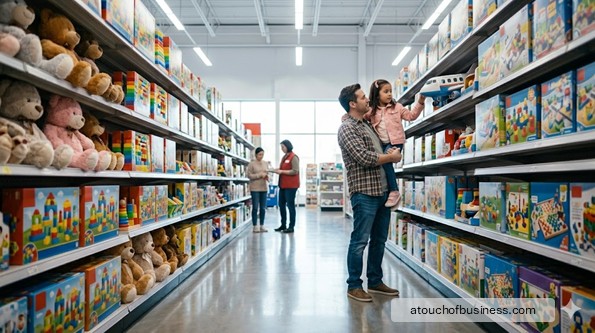
What to Expect From This Guide to Starting a Toy Store
This guide walks through the major decisions and practical steps involved in opening an independent toy store, from testing the concept and market to preparing inventory, staff, systems, and the retail space. These highlights introduce the coverage without replacing the fuller planning guidance.
Inside the guide, you will find:
- Startup roadmap: Follow the progression from owner fit, niche, and demand validation through funding, sourcing, store setup, pricing, and opening checks.
- Owner interviews: Compare experiences from toy retailers discussing store concepts, product selection, seasonal pressure, customer service, staffing, and community ties.
- Startup FAQs: Review answers about toy-selling requirements, product certificates, opening inventory, wholesalers, competition, seasonality, and retail experience.
- Market positioning: Assess family density, local competition, retail traffic, store niches, target customers, and differentiation from major retailers.
- Seasonal finances: Plan for startup costs, margins, holiday-dependent revenue, quiet months, funding, reserves, and the risk of excess inventory.
- Inventory compliance: Understand supplier selection, safety documentation, age warnings, landed costs, lead times, product mix, and stock replenishment.
- Store preparation: Address leases, zoning, fixtures, customer flow, security, insurance, staff training, point-of-sale testing, and final operating checks.
Begin with the retail realities and financial warning signs that should be examined before choosing products or signing a lease.
What It Means to Run an Independent Toy Store
Running an independent toy store means curating, buying, and selling toys, games, and related products through a physical retail storefront you own and operate.
You choose the product mix, manage suppliers, merchandise the floor, oversee daily operations, and serve as the primary face of the store — especially in the early months.
The startup path is real work. It involves lease negotiations, product sourcing, inventory management, federal safety compliance, and surviving several months of slow sales before your first holiday season.
Toy stores are deeply seasonal. The October through December holiday period can account for 40% to 60% of a store’s entire annual revenue. You must plan and capitalize accordingly.
Before you commit, ask yourself these questions:
- Do you have genuine interest in retail operations — not just a love of toys?
- Can you tolerate income uncertainty through the startup period and slow months?
- Can you cover personal living expenses while the business gets established?
- Do you have household support for the time demands, financial risk, and seasonal stress?
- Do you have retail experience, or are you willing to build it before you open?
If several of these give you pause, take time to address them before moving forward. The challenges of ownership are real, and this business has some specific ones.
Talk to people who run independent toy stores in other markets so you won’t be competing with them. Prepare questions in advance. Ask about cash flow, inventory buying, holiday pressure, staffing, and the realities of competing with Amazon and big-box retailers.
Red Flags Before You Start
Some warning signs deserve serious thought before you sign a lease or place an opening inventory order.
Watch for these start-or-stop signals:
- Not enough capital to survive the slow season. You’ll need to cover six to nine months of fixed costs — rent, payroll, insurance, utilities — largely without holiday-level revenue. If that reserve doesn’t exist on top of your startup investment, the business may fail before its first profitable December.
- Low family density in the trade area. Toy stores depend on a local population with households full of children. If the demographic doesn’t support it, no amount of great product selection will fix it.
- No clear differentiation from big-box retailers. A general toy store competing on price and selection against Walmart, Target, and Amazon is not a viable model for independent retail today. You need a niche.
- Insufficient retail experience. Buying decisions, inventory planning, and supplier negotiation are skills that take time to develop. Entering without them significantly raises the risk of costly early mistakes.
- Weak margins from the product mix. Licensed and electronic toys carry compressed gross margins. If your assortment skews heavily toward those categories, the numbers may not work for a storefront.
- Trend-chasing without discipline. Inventory tied to short-lived licensed properties or viral moments can lose value fast. Overstocking trend items is a common early failure in toy retail.
Two structural realities can affect a toy store regardless of how carefully the owner operates. First, independent and specialty toy retailers often compete against large chains, online marketplaces, discount stores, and major retailers with stronger buying power. That can put pressure on pricing, margins, and product selection.
Second, many toys are imported through global supply chains. Import costs can change because of tariffs, trade policy, shipping delays, fuel costs, currency changes, supplier price increases, or product shortages. Plan inventory costs using current landed prices, not historical pricing.
These aren’t reasons to walk away — they’re reasons to plan carefully, capitalize conservatively, and build your store around a clear niche from day one.
Step 1: Assess Your Fit, Motivation, and Financial Readiness
This step happens before you look at locations, product lines, or suppliers.
Be honest about why you want to run a toy store. Enthusiasm for toys is a fine starting point, but the daily reality involves inventory management, receiving shipments, tracking margins, managing staff, and surviving the slow months between January and September.
Assess your readiness across these areas:
- Tolerance for income uncertainty and the possibility of failure
- Ability to fund personal living expenses during the startup and early operating period
- Household or family support for the financial risk and time commitment
- Relevant skills: retail buying, inventory management, customer service, bookkeeping, and supplier relations
- Gaps you’ll need to address through experience, hiring, or outside help
If you don’t have prior retail experience, make a plan to get some. Work in a specialty retail environment before you open, or partner with someone who has hands-on retail management background.
Talk to independent toy store owners in non-competing markets. Firsthand owner insight is one of the most valuable inputs at this stage. Prepare specific questions about seasonal cash flow, inventory buying, competition, and what they wish they’d known before opening.
Step 2: Research the Business Model and Niche
The niche decision shapes everything: your location requirements, supplier access, customer base, price points, and competitive positioning.
Common toy store models to consider:
- General toy store — broad age range, mixed product categories
- Specialty or curated store — educational, STEM, eco-friendly, wooden, or artisan toys
- Collectibles and hobby store — action figures, trading cards, tabletop games, licensed products
- Vintage and nostalgic toy store — pre-owned, antique, or retro products
Specialty and curated models generally offer more pricing power and customer loyalty than general mass-market assortments. They’re also more defensible against big-box and online competition.
You also need to decide how to enter the market. Starting from scratch, buying an existing store, or exploring a franchise each involve different capital requirements, timelines, and risk profiles.
Buying an existing toy store with an established customer base and supplier relationships can shorten your ramp-up. Franchise options in this space are limited — verify availability before building plans around that path.
Step 3: Validate Local Market Demand
Before you commit to a niche or location, confirm there’s enough local demand to support your store.
Check these factors before moving forward:
- Family density: Are there enough households with young children in the trade area?
- Income levels and spending patterns of local families
- Number of existing independent toy stores in the market
- Location of big-box competitors and their toy departments
- Gaps in local product availability your store could fill
- Foot traffic patterns and retail activity in candidate neighborhoods
Talk informally to local parents, teachers, and preschool directors. Their input on what they can’t find locally is more reliable than any market report.
Proximity to schools, parks, pediatric offices, and family-oriented businesses is a strong positive signal. Understanding local supply and demand before you commit protects you from opening in the wrong market.
Validate the market before you look at lease options.
Business Plan
Your business plan connects your concept to your numbers — and your numbers to the reality of whether this store can survive.
Don’t treat it as a formality. Lenders and investors expect a written plan with financial projections, a market analysis, and a clear description of your competitive advantages. Building it also forces you to confront the questions that matter most before you spend a dollar.
Your business plan should address:
- Store concept, niche, target customer, and how you’ll differentiate from mass-market retailers
- All startup cost categories, researched and priced locally for your model and store size
- Gross margin reality for your intended product mix
- Funding sources and confirmation that funding is in place before lease signing
- Monthly fixed operating costs and how many months you can cover them on reserves
- Staffing plan for launch and the holiday season
- Pricing approach tied to your specific wholesale costs and niche
The margin picture deserves real attention. Specialty and educational toy categories typically support stronger gross margins than licensed or electronic toys.
If your assortment skews toward lower-margin products, covering fixed costs requires higher sales volume.
Toy stores are Q4-dependent businesses. The holiday period can drive 40% to 60% of annual revenue. Model the full year — not just the holiday peak — and confirm your reserves cover the long quiet stretch from January through September.
Running out of operating capital before your first December is one of the most common failure points in this business. Model your profit potential and break-even honestly before you sign anything.
Use the business plan to test whether the numbers work before you commit to a location.
Step 4: Choose a Location and Negotiate the Lease
Location is one of the most consequential decisions you’ll make. A toy storefront lives and dies on visibility, foot traffic, and the right surrounding customer base.
Evaluate every candidate location on these criteria:
- Zoning confirmed for commercial retail use before you sign anything
- Foot traffic from families: proximity to schools, parks, pediatric offices, and family restaurants
- Visibility from the street and ease of access for customers
- Adequate parking, including space for strollers and young children
- Square footage for a sales floor, stockroom, checkout area, and restrooms
- Condition of the space: can it open as-is, or does it need a build-out?
- Certificate of occupancy status and what inspections are required before you open
If the space has a different prior use, a change-of-use permit may be required before you can operate. Check with the local building department before signing.
Build-out time, permit approval timelines, and fixture installation all happen before opening day — and those weeks cost money in rent without generating revenue. Account for them in your lease start date negotiations.
Negotiate lease terms carefully:
- Rent amount and escalation schedule through the full lease term
- Lease length — long enough for stability, short enough to exit if needed
- Tenant improvement allowance for build-out costs
- Permitted use clause that explicitly covers specialty toy retail
- Termination provisions in case the business underperforms
Engage a commercial real estate attorney to review the lease before you sign. A bad lease can lock you into a location even if the business struggles.
Exterior signage also requires a city sign permit — factor in the approval timeline before your planned opening date.
Step 5: Choose a Legal Structure and Register the Business
Your legal structure affects your personal liability exposure, tax obligations, and how lenders and suppliers perceive your business.
Most independent toy store owners use a limited liability company (LLC) for the liability protection it provides. Given the product liability exposure from toy-related injuries, operating as a sole proprietor without a legal entity is a meaningful risk. Consult an attorney or CPA before deciding.
Complete these registration steps before opening:
- Choose your business structure and file with the appropriate state agency
- Register your business name — file a DBA if operating under a trade name
- Obtain your Employer Identification Number (EIN) from the IRS — required for banking, taxes, hiring, and wholesale supplier accounts
Step 6: Complete Legal and Compliance Setup
Toy retail involves a layer of federal compliance that most other retail businesses don’t face. The products you carry for children are regulated by the U.S. Consumer Product Safety Commission (CPSC).
Federal compliance requirements:
- All toys for children 12 and under must meet mandatory federal safety standards under the Consumer Product Safety Improvement Act of 2008 (CPSIA), including the ASTM F963 toy safety standard
- Each qualifying product must be accompanied by a Children’s Product Certificate (CPC) from the manufacturer or importer confirming third-party testing and compliance
- Required age-appropriate warning labels — including choking hazard warnings for toys intended for children under three — must appear on all applicable products as received from suppliers
- Request CPC documentation from every supplier and keep it on file for all toys for children 12 and under
The primary compliance obligation for testing and certification falls on the manufacturer or importer. Your responsibility as a retailer is to source from compliant suppliers and keep documentation available.
State and local compliance steps:
- Obtain a state sales tax permit (also called a seller’s permit or resale certificate) before making any taxable sales — this also allows you to purchase inventory from wholesalers without paying sales tax on those purchases
- Apply for a general business license from the city or county
- Confirm a certificate of occupancy for retail use and pass all required inspections (fire, building, safety) before opening
- Obtain a sign permit before installing exterior signage
- Register for state employer accounts if hiring staff, including state income tax withholding and unemployment insurance
- Post required federal and state labor law posters in employee areas before your first hire starts
Verify all local requirements with city, county, and state agencies. Requirements vary by jurisdiction. Visit your city or county business licensing office early — some permit timelines are longer than expected.
Step 7: Set Up Supplier Relationships and Plan Your Opening Inventory
Your product mix is the foundation of the store. How you source it, what you buy, and how much you order at launch will shape your cash flow and your customers’ first impression.
Wholesale accounts typically require your EIN, state sales tax permit (resale certificate), and proof of a retail location before a supplier will open an account.
Ways to find and connect with suppliers:
- Attend trade shows — the annual Toy Fair and the ASTRA Marketplace & Academy are the primary venues for independent retailers to meet manufacturers, see new products, and negotiate terms
- Apply directly to manufacturers and distributors whose products fit your niche
- Join a toy buying cooperative — U.S. buying groups for independent toy retailers allow smaller stores to pool purchasing volume and qualify for better pricing
- Join ASTRA (American Specialty Toy Retailing Association), the largest professional organization for specialty toy retailers, which connects members with supplier networks and industry resources
Plan your opening inventory carefully:
- Cover enough age ranges, price points, and product categories to create a credible shopping experience — bare shelves on opening day drive customers away
- Balance core steady sellers against trend-driven items; keep trend-dependent purchasing conservative at launch
- Account for supplier lead times: domestic suppliers typically deliver in 30 to 45 days; overseas suppliers require 60 to 90 days or more
- Verify that all inventory will carry required age-appropriate warning labels and CPC documentation before it ships
Understand the tariff environment before you commit to a sourcing plan:
- Approximately 80% of U.S. toy imports originate in China
- As of 2025, significant tariffs on Chinese toy imports have raised landed costs substantially — tariff rates have fluctuated dramatically across the year
- Price your opening inventory at current landed cost, including tariffs and shipping — not historical pricing
- Diversify suppliers across countries of origin where possible to reduce single-source risk
- Monitor tariff developments through the Toy Association and ASTRA before placing large orders
Don’t overorder at launch. Tying up too much cash in opening inventory leaves you without the operating capital to survive the slow months.
Order enough to open credibly, then replenish based on actual sales data.
Step 8: Set Up Funding and Banking
Funding setup happens before you sign a lease, place inventory orders, or commit to build-out expenses.
Funding sources to evaluate:
- Personal savings
- SBA 7(a) business loans or SBA microloan programs
- Commercial bank or credit union loans
- Friends and family financing
- Seller financing, if you’re buying an existing store
Lenders expect a written business plan, financial projections, and evidence of retail management experience. Have those ready before approaching any lender.
Open a dedicated business checking account as soon as your EIN and entity registration are in place. Keep business and personal finances completely separate from day one.
Set up your payment processing before opening. A toy store point-of-sale (POS) system should handle inventory tracking, barcode scanning, sales reporting, and purchase order management. Choose a system designed for retail, not just a basic card reader.
Establish a separate operating reserve — funds set aside to cover rent, payroll, utilities, and supplier costs through the slow months before your first holiday season generates meaningful revenue.
Step 9: Build Out the Store and Set Up Fixtures
Your store’s layout, presentation, and physical setup directly shape how customers feel the moment they walk in — and whether they stay, browse, and buy.
Design the floor plan for customer flow and safety:
- Wide aisle clearance throughout, including room for strollers and young children
- Clear sightlines from the checkout counter to the main floor
- Products grouped logically by age range, category, or price tier
- Interactive or demo areas positioned to draw customers deeper into the store
- Window displays visible from the street to attract foot traffic
Fixtures and equipment to have in place before opening:
- Gondola shelving units for the main floor display
- Wall-mounted shelving and pegboard systems
- Glass display cases for collectibles, premium items, or fragile products
- End-cap and rotating display fixtures for featured or seasonal items
- Floor dump bins for lower-price, high-volume items
- Checkout counter with POS terminal, barcode scanner, receipt printer, cash drawer, and card reader
- Stockroom shelving for back-of-house inventory storage
- Hand truck or dolly for receiving and moving merchandise
- Security camera system and alarm monitoring
- Fire extinguisher(s) compliant with local fire code
All build-out work must have the required building permits before construction starts.
Confirm that your certificate of occupancy is in place before you open to the public — no store can legally operate without it.
Set up and test your POS system, payment terminals, and barcode scanners before your first inventory receiving day.
Step 10: Get Insurance in Place Before Opening
Insurance for a toy store is not optional. You’re selling products designed for children, operating a public retail space, and carrying significant inventory.
Required or lender/landlord-required coverage:
- General liability insurance — typically required by commercial landlords as a lease condition; covers customer injuries on premises, property damage, and personal injury claims
- Workers’ compensation insurance — required in most states once you have employees; verify your state’s specific threshold
Risk-planning coverage to consider:
- Product liability coverage — typically included in general liability; critical for toy retailers, as you can be named in injury claims arising from products you sell, even when the defect originated with the manufacturer
- Commercial property insurance — covers inventory, fixtures, and equipment
- Business interruption insurance — especially important given Q4 revenue concentration; a forced closure during November or December can be financially devastating
- Business owner’s policy (BOP) — combines general liability and commercial property coverage, often at better rates than separate policies
- Commercial umbrella insurance — extends coverage limits above your primary policy thresholds
Work with a commercial insurance broker who has experience with specialty retail or children’s product businesses. Standard retail policies may not fully address toy-specific risks.
Get business insurance in place before your first employee starts and before any inventory arrives.
Step 11: Hire and Train Staff Before Opening
Staffing needs depend on your store size and planned hours. Most independent toy stores open with one to three staff members, then scale up significantly for the holiday season.
Before your first employee starts:
- Register for workers’ compensation coverage
- Set up state employer withholding accounts
- Post all required federal and state labor law posters in the employee area
Train all staff on these areas before opening day:
- Product knowledge across your inventory categories
- CPSC safety compliance basics: how to read age labels, what choking hazard warnings mean, and what to do if a recalled product is identified
- POS system operation, including returns and exchanges
- Receiving procedures: how to check in, inspect, tag, and enter inventory
- Customer service standards for a family-focused retail environment
Plan your holiday staffing well in advance. The demand spike from October through December requires significantly more floor coverage than the rest of the year.
Hiring and onboarding takes time — don’t wait until November to start recruiting seasonal help.
Step 12: Set Pricing and Finalize Launch Preparations
Pricing every product in your opening inventory is a required step before the store can open — not something to finalize on day one.
Set retail prices based on:
- Full landed cost of each product, including shipping, tariffs, and any import costs — not just the wholesale unit price
- Target gross margin for each category (specialty and educational toys typically support stronger margins than licensed or electronic products)
- Competitive positioning within your niche
- Price points that reflect the value of your curation and in-store experience
A keystone markup — doubling the wholesale cost to set the retail price — is a common starting baseline in toy retail. Your actual pricing will vary by product category and market.
Finalize these launch details before your opening date:
- Store hours posted at the entrance
- Return and refund policy finalized and posted at the checkout counter
- Gift card program ready if you plan to offer one at launch
- Gift wrap supplies, retail bags, and receipt paper stocked
- Supplier reorder schedule confirmed so you know when and how to replenish after opening
Price every item before it goes on the shelf.
Opening-Day Red Flags
These are the operational gaps that sink a store in the first weeks. Confirm every item before you unlock the doors.
Do not open until you can check every item on this list:
- Certificate of occupancy obtained and all required inspections passed
- Sign permit in hand and signage installed
- General business license and state sales tax permit confirmed
- All insurance certificates in place, including general liability and workers’ compensation if you have employees
- POS system fully operational, card processing tested, cash drawer stocked
- All opening inventory received, inspected, tagged, and entered into the inventory system
- CPC documentation on file from suppliers for all toys for children 12 and under
- All products on the floor verified to carry required age-appropriate warning labels
- Federal and state labor law posters displayed in the employee area
- All staff trained before the first customer walks in
- Operating capital reserve confirmed in the business account
- Stockroom organized and receiving area clear for the first reorder shipments
- Soft opening or preview day completed to catch any operational issues
A store that opens before it’s ready is harder to recover from than a store that opens a week late. Do a complete walkthrough the day before your public opening and fix anything that isn’t right.
Frequently Asked Questions
Do I need a special license to sell toys?
There’s no single federal toy-selling license, but there are firm compliance obligations. All toys for children 12 and under must meet CPSC standards under the CPSIA, including the ASTM F963 safety standard.
At the state and local level, you’ll need a sales tax permit, a general business license, and a certificate of occupancy for your retail space. Verify the full list of local requirements with your city and county offices.
What is the Children’s Product Certificate (CPC) and do I need to worry about it?
The CPC certifies that a toy has been tested by a CPSC-accepted laboratory and complies with applicable federal safety requirements. The obligation to obtain the CPC falls on the manufacturer or importer.
Your job as a retailer is to request that documentation from every supplier for toys intended for children 12 and under and keep it on file. Selling products without required documentation exposes you to liability and regulatory risk.
How much opening inventory should I have on day one?
Enough to create a credible shopping experience — bare shelves on opening day communicate that the store isn’t ready. Work backward from your store’s square footage, fixture capacity, and the number of product categories you intend to carry.
Be careful not to overorder. Tying up too much cash in opening inventory depletes the operating capital you need to survive the slow months before the holiday season.
How do I find wholesale suppliers as a new independent toy store?
Start with trade shows — the New York Toy Fair and the ASTRA Marketplace & Academy are the primary events for connecting independent retailers with manufacturers and distributors.
Apply directly to suppliers whose products fit your niche. Joining a toy buying cooperative allows smaller stores to qualify for wholesale accounts and better pricing. Wholesale accounts typically require your EIN, state sales tax permit, and proof of a retail location.
How can an independent toy store compete with Amazon and big-box retailers?
Not on price or selection breadth — you won’t win there. Specialty toy stores that focus on curated, hard-to-find, educational, or artisan products offer something mass-market channels can’t replicate.
In-store experience, knowledgeable staff, hands-on product discovery, gift wrapping, special orders, and genuine community relationships are all advantages an independent store can deliver that a big-box retailer cannot.
How significant is seasonality, and how should I plan for it?
It’s the defining financial reality of the business. The Q4 holiday period can account for 40% to 60% of annual revenue.
Holiday inventory must be ordered months in advance — typically by July or August — to account for supplier lead times. Your operating capital must cover the full slow period from January through September.
Model the entire year, not just the holiday peak, before committing to a location and overhead structure.
Can I open a toy store without prior retail experience?
It’s possible, but the risk is substantially higher. Toy retail success depends heavily on buying skills, inventory planning, and supplier negotiation — all of which take time to develop.
If you don’t have that background, speak with experienced toy store owners before opening, consider working in a specialty retail environment first, and engage a knowledgeable accountant and attorney for the financial and legal setup.
Joining ASTRA before you open is also a practical way to accelerate the learning curve.
What is the biggest financial risk in the first year?
Running out of operating capital before your first profitable holiday season. The business must cover months of fixed costs — rent, payroll, utilities, insurance, and loan payments — while sales are well below the Q4 peak.
New owners who underestimate operating costs, overestimate early sales, or fail to reserve adequate working capital face a cash crisis before the business has a chance to prove itself. A six-to-12-month operating reserve on top of your startup investment isn’t optional — it’s the margin between surviving and closing early.
Expert Advice From People in the Toy Store Business
These interviews share practical lessons from toy store owners and managers who have dealt with product selection, customer experience, staffing, seasonal demand, specialty positioning, and the realities of independent retail.
Readers can use these stories to compare different toy store models before starting, from local specialty shops to destination stores, collectible toy retailers, and stores with strong community ties.
Interview with a Toy Shop Owner: Dr Wendy Hamilton
This interview covers how Grasshopper Toys and Curious Minds grew from an online science toy business into a physical toy shop.
It is useful because it shows how customer demand, product focus, and local interest can shape the decision to open a storefront.
Episode #136: When Your Toy Dream Is To Open A Toy Store with Isaac Elliott-Fisher
This podcast interview covers the creation of The Village Toy Castle, including startup costs, store concept, location, product ideas, and customer experience.
It is useful because it gives a detailed look at what it takes to make a small toy store stand out as a destination.
Interview with XL-Shop, Toy Store Owner
This written interview covers how XL-Shop grew from a collector-driven idea into a toy business with multiple locations and an online presence.
It is useful because it shows how a clear niche, collector knowledge, and customer community can support a specialty toy store.
Toy Store Owner Deployed during Pandemic: Timeless Toy’s Scott Friedland
This interview covers how the owner of Timeless Toys and Timeless Tots adapted during a major disruption while managing stores and staff.
It is useful because it highlights flexibility, leadership, local retail pressure, and how toy stores can adjust during difficult conditions.
Episode 36: The Magic Behind the Holiday Season at Tiddlywinks Toy Store
This podcast interview covers holiday operations, product sourcing, customer suggestions, science toys, pretend play, and the owner’s path into the toy business.
It is useful because it shows how seasonal planning, customer relationships, and careful product curation affect a toy store’s success.
Q&A with Main Street Toy Shoppe Owner
This Q&A covers a specialty toy shop owner’s experience with store identity, bestsellers, customer service, and choosing toys based on each child.
It is useful because it shows the importance of personal service, niche inventory, and knowing what makes a small toy shop different from large retailers.
Exclusive: 80 years of Banba Toymaster
This interview covers Banba Toymaster’s history, store evolution, online sales, customer changes, and how the business adapted over decades.
It is useful because it gives a long-view example of how an independent toy retailer can adjust while keeping a strong store identity.
Related Articles
- How To Start an Educational Toy Store
- How To Start a Comic Book Store Business
- How To Start a Hobby Store
- How To Start a Retail Game Store
- How To Start a Bookstore
- How To Start an Anime Store
Sources:
- CPSC: Toy Safety Business Guidance, CPSIA Overview
- Toy Association: U.S. Safety Standards, Tariff Impact Survey 2025
- Federal Register: ASTM F963 Mandatory Standard
- ASTRA: American Specialty Toy Retailing Assoc.
- Toy Industry Journal: Retail Consolidation and Independents
- KLCC (NPR): Independent Stores vs. Big Box 2025
- Thomas Net: Toy Industry Tariff Impact
- Spreetail: Chinese Toy Tariffs Impact
- Hobby Coalition: Daily Tariff Tracker
- Fortune: Toy Shortages and Tariffs
- BusinessDojo: Toy Store Profit Margins, Toy Store Inventory Planning
- Insureon: Toy Store Insurance Coverage
- UPCounsel: Legal Requirements for Retail
- Toy Coach: Insider Tips: Open a Toy Store
- TRUiC: How to Open a Toy Store
- Shopify: Toy Retail Ecommerce Guide