
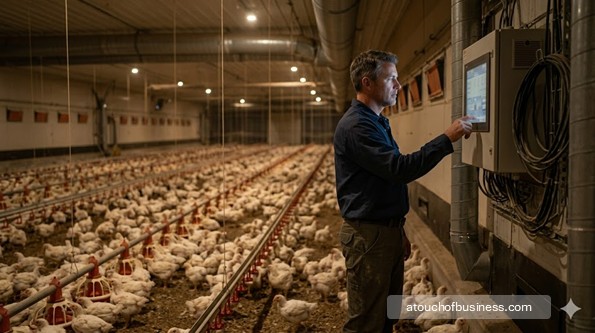
What to Expect From This Guide to Starting a Chicken Farm
This guide walks readers through the key decisions and practical steps involved in starting a chicken farm, from choosing a production model to preparing for flock placement. The preview highlights selected parts of a detailed resource on land, finance, regulation, facilities, disease control, and daily production.
Inside the guide, you will find:
- Startup roadmap: Progress from owner fit, production choice, market study, and site approval through housing, suppliers, biosecurity, sales, and flock-placement checks.
- Farmer interviews: Hear first-hand experiences covering startup pressure, poultry housing, flock routines, sanitation, disease risk, cash demands, and long-term responsibility.
- Startup FAQs: Find answers about integrators, processing exemptions, NPIP, CAFO rules, backup power, farm loans, and product labeling.
- Business models: Compare contract broilers, independent meat or egg production, and chick or pullet sales before designing the operation.
- Financial planning: Work through local construction, feed, utility, equipment, financing, operating-capital, and break-even assumptions for the chosen model.
- Compliance and land: Examine zoning, processing access, environmental permits, waste plans, inspections, testing, and location-dependent approvals.
- Opening preparation: Check generators, ventilation, water, temperature, insurance, mortality handling, biosecurity, records, and processing arrangements before birds arrive.
Start with the lifestyle and risk questions before choosing the production path that drives the farm’s remaining setup.
As a chicken farmer, you raise birds for commercial production — meat, eggs, chicks, or some combination of the three.
The setup varies widely. Some owners grow broilers under a contract with a large poultry company. Others raise hens and sell eggs directly. Each path requires different land, equipment, compliance steps, and buyer relationships.
What doesn’t vary is the commitment. A chicken farm runs every day of the year. There are no breaks during a flock cycle.
Before you go further, take an honest look at the steps involved in starting a business of this nature. The poultry industry is capital-intensive, highly regulated, and physically demanding.
Can your household manage several months without farm income while housing is built and birds are placed?
Can you handle a power failure at 2 a.m.—knowing a full flock could die within hours if you don’t act?
These aren’t hypotheticals. They’re part of the job.
Talk to chicken farm owners in regions you won’t compete with before you spend anything. Prepare questions in advance. Ask what the first year actually looked like financially. Ask what they’d change.
Their experience won’t match yours exactly, but their answers will be more useful than any article.
If you want a broader view of what real business ownership involves, those conversations will shape your thinking before a single dollar is committed.
Red Flags Before You Start
Poultry farming has genuine structural challenges. Review these before committing to any land, building, or loan.
No integrator contract, no construction:
If you’re pursuing contract broiler growing, don’t build without a written integrator commitment. Lenders typically require it. If no integrator serves your area, contract growing isn’t a viable option.
Not enough land for litter:
Your flock will produce significant manure and litter. You need land to apply it at agronomically safe rates — or a confirmed plan to haul it off-farm. Without that, you may face environmental violations before your first flock cycle ends.
No inspected processing access:
If you plan to sell processed meat birds independently, you need a USDA-inspected processing facility you can actually reach. In many rural areas, that access is limited. Understand your options before raising a single broiler for sale.
Undercapitalization:
From your first major investment to your first income payment, months can pass. Running out of operating capital during that gap is a common reason new farm operations fail.
Market consolidation is a structural fact:
A small number of large companies control most of the commercial broiler supply chain. Contract terms are written by integrators. The tournament pay system—where growers are paid based on performance compared to a pool of other growers—can reduce your actual income below the stated base rate.
Short-term contracts can also be canceled with limited notice. Some growers have been left with large debt and no buyer when a processing plant closed.
Single-buyer dependency:
If one integrator controls your area and that relationship ends, you may have no alternative buyer for a facility built for one purpose.
Highly Pathogenic Avian Influenza (HPAI) is a persistent risk:
HPAI is not a one-time threat. It’s a recurring structural risk across the entire poultry industry. An outbreak can trigger mandatory depopulation of your entire flock. Government indemnity programs exist but may not cover full losses.
Environmental and zoning opposition:
Some counties actively restrict new poultry operations. Zoning denial after land purchase is a serious financial exposure. Verify zoning approval before committing to any site.
Step 1: Assess Your Fit and Motivation
Running a chicken farm is a 365-day production commitment. There are no off days during a flock cycle.
A typical day includes checking house temperatures, inspecting ventilation and water systems, and removing dead birds. You’ll do this multiple times a day — every day the flock is in the house.
Mechanical breakdowns and disease events don’t wait for business hours. You need to be ready to respond at any hour.
Ask yourself these questions before going further:
- Can you handle the physical demands of daily flock monitoring and equipment maintenance?
- Does your household support a large capital commitment with delayed income?
- Can you cover personal living expenses through the startup period?
- Are you prepared for the risk that a disease event or integrator decision could eliminate your income?
Understanding the real challenges of business ownership before you commit is one of the most valuable things you can do.
Step 2: Choose Your Production Model
This is the most consequential decision you’ll make. Your production model determines your facility design, compliance path, cash flow structure, and buyer relationships.
The four primary models are:
- Contract broiler growing: You provide land, housing, utilities, and labor. The integrator provides chicks, feed, and processing. You’re paid based on performance. The integrator owns the birds.
- Independent egg production: You own the hens, manage feed, and sell table eggs through farmers markets, restaurants, or direct sales.
- Independent meat production: You raise your own broilers and sell processed birds. You need either a USDA-inspected processor or a qualifying federal exemption.
- Pullet and chick sales: You raise and sell day-old chicks, started pullets, or hatching eggs. Buyers typically expect NPIP-enrolled birds.
Each path has a different startup cost structure, different regulatory requirements, and a different customer relationship. Pick one primary model before planning anything else.
Step 3: Talk to Farm Owners and Study Your Market
Talk to broiler growers and egg producers in regions you won’t compete with. Prepare questions before those calls.
Ask about integrator reliability, income predictability, contract terms, flock cycle timelines, and what they’d do differently.
Then study your specific market:
- Are integrators actively recruiting growers in your area?
- Is there real local demand for farm-fresh eggs or pasture-raised meat?
- Can you access a USDA-inspected processing facility within a practical distance?
Commercial broiler production is typically concentrated within about 35–50 miles of an integrator’s processing plant. If no integrator operates near you, contract growing isn’t viable.
For independent egg or meat operations, verify that buyers exist before you plan your production scale. Assumed demand isn’t confirmed demand.
Step 4: Assess Land, Location, and Zoning
Before you purchase or lease any land, confirm that poultry farming is allowed on that parcel.
Contact your county planning and zoning office. Ask about setback requirements — the required distances from property lines, roads, residences, and water bodies.
Land use affects more than legal compliance. You’ll also need:
- Enough land to apply poultry litter at agronomically safe rates
- A reliable water supply — many integrators require two independent sources
- Access to electricity and fuel (propane or natural gas) for heating and ventilation
If you’re drilling a well, test water quality before making commitments. Poor water quality can require treatment systems that add to startup costs.
For contract broiler growing, don’t commit to any site until you have written integrator confirmation. Integrators often specify facility dimensions and equipment standards that affect site selection.
Step 5: Verify Legal, Regulatory, and Environmental Requirements
The poultry industry involves multiple layers of regulation. Know what applies to your model before you build anything.
Federal requirements to verify:
- USDA FSIS inspection: Selling processed poultry for human food generally requires a USDA-inspected facility or a qualifying exemption. The 1,000-bird and 20,000-bird exemptions allow on-farm slaughter and intrastate sale under specific conditions — verify requirements with your USDA FSIS District Office.
- EPA CAFO rules: If your operation meets the Concentrated Animal Feeding Operation (CAFO) threshold under federal rules, you must obtain an NPDES permit (or state equivalent) before operating. Large CAFO thresholds for chickens are set in federal regulations; check with your state environmental agency early.
- NPIP enrollment: The National Poultry Improvement Plan is federally voluntary, but most buyers expect it. It’s commonly required for interstate bird shipments and chick sales. Contact your state’s Official State Agency for NPIP to enroll.
State and local requirements to verify:
- Business entity registration and state licenses
- State meat and poultry inspection program requirements
- State egg grading and handler licensing rules (if selling shell eggs)
- State-level CAFO or animal feeding operation permit requirements
- Building permits and any certificate of occupancy for new structures
Requirements vary significantly by location. Contact your state’s department of agriculture and environmental agency before breaking ground.
Step 6: Assess Profit Potential Before Major Spending
Work through the basic financial logic before you commit to land, housing, or loans.
The break-even question is different for each model.
For contract broiler growing, calculate how many flock cycles per year — at an average payment per pound of live weight — cover your fixed costs and loan payments. The tournament pay system means your actual income can fall below the stated base rate.
For independent egg production, calculate how many hens, at what lay rate and local egg price, cover your feed costs, utilities, and personal income needs.
For meat birds, add up the total cost per bird — chick, feed, utilities, processing, packaging — and compare it to what your market will actually pay.
Feed is typically the largest variable cost in any independent model. Equipment, utilities, loan payments, insurance, and labor are fixed costs that run every month — including slow periods and flock downtime between cycles.
Don’t commit to scale until the numbers work with your real local costs.
Business Plan
Your business plan keeps your startup decision honest.
Use it to lay out your production model, startup cost estimates, and projected income against fixed costs. Build it from your local numbers — land, construction quotes, equipment prices, feed supplier rates, and utility costs.
Your plan should address:
- Which production model you’ve chosen and why it fits your location
- Whether you’ve confirmed integrator interest, buyer demand, or processing access
- All startup costs, priced from real local quotes
- Your funding sources — FSA loans, commercial agriculture lenders, or personal capital
- Operating capital to cover costs through the pre-income period
- Break-even logic: how many birds, at what production efficiency, cover fixed costs
The USDA Farm Service Agency (FSA) offers Farm Ownership Loans and Farm Operating Loans designed for new agricultural producers. FSA also offers microloans and guaranteed loans through commercial lenders for those who don’t qualify for conventional credit alone.
For contract broiler growing, confirm the loan sequence: some lenders require an integrator contract before approving construction financing.
A plan that doesn’t show how you cover costs during slow periods or between flock cycles isn’t complete. That gap is where many new farm operations run into trouble.
For guidance on building a solid plan, see how to write a business plan.
Step 7: Register Your Business and Complete Legal Setup
Register your business entity with your state — LLC, sole proprietorship, or another structure — before opening accounts or signing contracts.
Get an EIN (Employer Identification Number) from the IRS. You’ll need it for banking, tax filing, and hiring.
Register for state tax accounts. If you’re hiring employees, register for unemployment insurance and withholding accounts with the appropriate state agencies.
If you’re operating under a trade name, file a DBA (Doing Business As) registration where required.
Open a dedicated business bank account. Keep farm income and expenses separate from personal finances from the start.
Step 8: Secure Land and Get Site Approval
If purchasing land, explore FSA Farm Ownership Loan programs or work with an agricultural lender.
If leasing, confirm that the lease explicitly permits poultry production and meets any integrator requirements.
Before any ground is broken:
- Complete zoning and use permit applications
- Apply for any required state or federal environmental permits (NPDES/CAFO where applicable)
- Receive written approval before spending on site preparation
Verify setback requirements with your county planning office and your state’s environmental agency. These requirements affect where on the property you can legally build.
Step 9: Plan, Permit, and Build Your Housing
Chicken houses require building permits in most jurisdictions. Contact the local building department before any construction begins.
The facility design depends on your production model:
- Broiler growout houses are large, environmentally controlled structures. They require tunnel ventilation fans, automated feed lines, nipple water systems, gas or propane heaters, and solid insulated walls.
- Layer houses use battery cage or cage-free systems with automated egg collection, manure management systems, and lighting controls.
- Small-scale or specialty operations may use modified structures with outdoor access for pasture or free-range systems.
For contract broiler growing, the integrator specifies house dimensions, equipment brands, and infrastructure standards. Get those specs before pricing construction.
Install a backup generator with an automatic transfer switch before any birds arrive.
Ventilation, heating, water, and lighting must stay on during a power outage. A prolonged failure can kill an entire flock. Most integrators and insurers require backup power as a condition of coverage.
If required locally, obtain a certificate of occupancy for completed structures before birds are placed.
Step 10: Plan Your Environmental and Waste Management System
Every chicken farm generates significant litter — the mixture of bedding and manure that accumulates on house floors.
You need a written Nutrient Management Plan (NMP) before operations begin. The NMP outlines how much litter can be applied to which fields, at what rates, without causing runoff or water quality violations.
If you don’t have enough land for application, arrange off-farm disposal before your first flock cycle — through litter sales to crop farmers, composting operations, or contracted haulers.
Build covered litter storage if litter can’t be applied immediately after cleanout.
Establish a mortality disposal plan before birds arrive. Composting bins, rendering contracts, and other methods are available. Verify which methods are approved in your state with the department of agriculture.
Step 11: Get Insurance Coverage in Place
Arrange all coverage before any birds are placed. Farm insurance for poultry operations covers multiple exposure types — and each one matters.
Coverage to arrange before opening:
- Farm property insurance — covers chicken houses, storage, and structures
- Equipment breakdown coverage — critical for fans, heaters, generators, and water systems
- Livestock mortality coverage — protects against bird loss from covered perils; review suffocation sub-limits carefully
- General farm liability — covers bodily injury and property damage claims
- Business interruption coverage — replaces income during covered shutdowns
- Workers’ compensation — legally required in most states when you hire employees
For contract growers, the integrator owns the birds. Your coverage focus is on structures, equipment, and liability. Your integrator contract may specify required coverage types and minimums.
Standard farm policies often set low sub-limits for suffocation losses. Confirm your policy limits match your actual flock value before finalizing coverage.
Step 12: Set Up Feed, Supplies, and Supplier Relationships
For contract broiler growing, the integrator provides chicks, feed, and medications. Your pre-opening supply focus is on litter material, biosecurity supplies, equipment repair parts, and mortality management materials.
For independent operations, establish a feed supplier relationship before birds arrive. Feed is your largest variable cost. Confirm delivery schedules, minimum order requirements, and pricing before committing to a flock size.
Source bedding material — wood shavings, rice hulls, or sawdust — and confirm delivery before placement day.
Source chicks or pullets from a reputable hatchery. If buyers expect NPIP-certified stock, verify the hatchery’s NPIP enrollment status before purchasing.
Step 13: Enroll in NPIP and Complete Disease Testing
The National Poultry Improvement Plan is a cooperative federal-state-industry disease-testing and certification program. Participation is voluntary at the federal level.
In practice, NPIP enrollment is expected by most buyers of chicks or hatching eggs. It’s also required for interstate bird shipments using the VS Form 9-3 movement document.
The only required test to enroll is annual Pullorum-Typhoid (PT) Clean testing. Additional disease classifications — including Avian Influenza surveillance — are available and required for some commercial operations.
Contact your state’s Official State Agency for NPIP to begin enrollment before you plan your first sale of live birds.
Step 14: Write and Implement a Biosecurity Plan
Your biosecurity plan should be written and operational before the first flock arrives — not after.
A basic biosecurity plan covers:
- Controlled entry points and visitor logs at house entrances
- Footbath stations and dedicated farm footwear
- Protocols for vehicles, clothing, and equipment entering the farm
- Procedures to prevent contact with wild birds and rodents
- Vaccination schedules and mortality management procedures
USDA’s free Defend the Flock program offers biosecurity assessment tools and on-farm assessments. Request an assessment before flock placement — it supports NPIP compliance and insurance eligibility.
Post biosecurity warning signs at all farm entrance points. This is expected by integrators and recommended by USDA APHIS.
Step 15: Set Up Sales Channels and Labeling
For contract growers, this step is handled by the integrator. Your production cycle ends when birds are picked up at the farm.
For independent producers, sales and labeling setup must happen before your first harvest.
For table egg producers:
Confirm your state’s egg grading, licensing, and labeling requirements with your state department of agriculture. Requirements vary. Set up your sales channel — farm stand, farmers market, restaurant accounts, or direct CSA — before hens reach peak lay.
For meat bird producers:
Confirm processing access and arrange your first appointment before birds are placed. Processed poultry sold under a federal exemption must carry specific required labeling — including the statement “Exempted – P.L. 90-492” and safe handling instructions.
Claims like “organic” or “pasture-raised” require separate verification. Confirm certification requirements before using any regulated claim on labels or in sales materials.
Step 16: Pre-Opening Checks and Flock Placement Readiness
Before the first birds arrive, confirm that every system is operational and every approval is in hand.
Run these checks before flock placement:
- All permits, licenses, and approvals received and posted
- Backup generator tested under load with alarm system active
- Ventilation, heating, and water systems run and confirmed stable
- House preheated and humidity stable for 24–48 hours before chick delivery
- Litter material placed and mortality disposal pathway operational
- All insurance coverage confirmed active
- Feed delivery scheduled and confirmed (independent producers)
- Biosecurity plan posted and entry controls in place
- Recordkeeping system set up — flock log, mortality log, feed log, and medication log
- Emergency contact list posted in each house
For egg producers, confirm that your egg collection equipment, washing and grading setup, and carton labeling materials are all ready before hens reach lay.
Opening-Day Red Flags
These are warning signs that something critical isn’t ready. Don’t place birds if any of these conditions exist.
- Generator hasn’t been load-tested. A backup system that hasn’t been verified under full farm load is no backup at all.
- Water pressure or quality is unconfirmed. Flush water lines and confirm delivery pressure before chick placement.
- Temperature hasn’t stabilized. House temperature and humidity should be stable for at least 24 hours before birds arrive.
- Mortality disposal plan isn’t operational. If your composter isn’t built or your rendering contract isn’t signed, you’re not ready.
- Litter storage plan is unconfirmed. Know where your first cleanout litter is going before the flock cycle ends.
- Insurance isn’t active. All coverage must be confirmed in force before birds are placed — not just applied for.
- Biosecurity entry controls aren’t in place. Footbaths, signs, and access logs should be operational on day one.
- Processing appointment isn’t booked (meat birds). For independent meat production, schedule your processing date before birds are placed.
Frequently Asked Questions
Do I need to work with an integrator, or can I raise and sell my own birds?
Both models exist. Most commercial broiler production runs through integrators, who provide chicks, feed, and processing in exchange for growing services.
Independent producers manage their own feed sourcing, processing access, and sales — but must navigate inspection rules and buyer relationships on their own.
The right model depends on your location, capital, and whether you’re comfortable with integrator contract terms.
What is the USDA’s 1,000-bird exemption?
It allows producers who raise and slaughter no more than 1,000 birds of their own raising per year to sell processed poultry intrastate without mandatory USDA inspection.
The birds must be healthy, processing must meet sanitation standards, and specific labeling is required. Interstate sales are not permitted.
Requirements vary by state. Verify with your USDA FSIS District Office and your state department of agriculture before relying on this exemption.
What is the NPIP, and do I need to join?
The National Poultry Improvement Plan certifies poultry flocks for freedom from specific diseases, primarily Pullorum-Typhoid.
Participation is federally voluntary, but most buyers of chicks or hatching eggs expect it. It’s also required for shipping birds across state lines. Contact your state’s Official State Agency for NPIP to start enrollment.
Is my farm likely to be classified as a CAFO?
Concentrated Animal Feeding Operation classification depends on flock size and your manure management system. Federal thresholds apply to large operations, but state programs often cover smaller ones.
A CAFO classification requires an NPDES permit or state equivalent, a Nutrient Management Plan, and ongoing recordkeeping. Check with your state’s environmental agency before you build.
What is the biggest financial risk in contract broiler growing?
The combination of high upfront housing costs, single-use facility design, short-term contracts, and tournament-based pay creates a structural financial exposure that’s built into the model.
Integrators can mandate costly upgrades, reduce flock allocations, or cancel contracts. Review every contract term with an agricultural attorney before committing to construction financing.
What backup power setup is required?
A standby generator with an automatic transfer switch is standard for commercial operations.
Ventilation, heating, lighting, and water systems must stay on during outages. An extended failure can kill an entire flock. Most integrators and insurers require backup power and a phone or alarm notification system.
Can I use USDA loans to start a chicken farm?
Yes. The USDA Farm Service Agency offers Farm Ownership Loans, Farm Operating Loans, and microloans for eligible beginning farmers. Guaranteed loans through commercial lenders are also available.
For contract broiler growing, some lenders require proof of an integrator contract before approving construction financing. Contact your local USDA Service Center to discuss eligibility before making any major commitments.
What labeling is required when selling eggs or exempt processed poultry?
For shell eggs, labeling requirements are set at the state level. They typically include the producer’s name and address, net weight, and a safe handling statement. Check with your state department of agriculture for any additional requirements.
For processed poultry sold under a federal exemption, labeling must include the product name, producer name and address, safe handling instructions, and the statement “Exempted – P.L. 90-492.” No USDA inspection legend may appear. Regulated claims like “organic” require separate certification.
What Chicken Farmers Say Beginners Should Know
These interviews share practical lessons from chicken farmers, poultry business owners, and experienced chicken keepers. They cover startup costs, housing, flock care, biosecurity, daily routines, business planning, and the realities of managing birds as a serious farm operation.
Readers can use these interviews to compare different chicken farm models before starting. The advice can help them think through land, equipment, disease prevention, cash flow, labor, and whether the day-to-day demands fit their goals.
This as-told-to interview follows Andrew Fletcher, who left banking and invested his savings into a chicken farm in the Philippines.
It is useful for someone starting out because it shows the pressure of learning fast, managing a controlled environment, tracking cash expenses, and handling the physical demands of poultry farming.
Raising Chickens: An Interview with Author Chris Lesley
This written interview features Chris Lesley, a long-time chicken keeper and poultry educator, discussing her experience raising chickens and helping others care for flocks.
It is useful for beginners because it highlights common mistakes, including underestimating the time, money, energy, and long-term commitment involved in keeping chickens.
Quality Chicken: An Interview with a Chicken Farmer
This interview with Diane Pastoor explains how her family became chicken farmers and gives a close look at broiler barns, flock care, biosecurity, and chicken handling.
It is useful for future chicken farm owners because it shows how much planning goes into barn setup, temperature control, sanitation, animal care, and moving birds to market.
Poultry Farmer to BAM Mentor: Interview with an Agriculture Veteran
This interview features Dan Wiebe, who started his poultry business in 1970 and shares lessons from decades in the agriculture and poultry sector.
It is useful for someone starting a chicken farm because it gives a long-term owner’s view of building a poultry business, working through growth, and understanding agriculture as both a business and a responsibility.
This interview-based article features Joshua Beebe of Tardif Poultry Farm and explains how disease risk, quarantine, flock loss, and biosecurity affect a working poultry farm.
It is useful for beginners because it shows why disease prevention, visitor control, new-bird quarantine, flock separation, and emergency planning need to be considered before starting.
Related Articles
- How To Start an Egg Farm
- How To Start a Fish Farming Business
- How To Start a Hay Farm
- How To Start a Farm Equipment Repair Service
- How To Start a Butcher Shop
- How To Start a Fertilizer Production Business
Sources:
- USDA FSIS: Poultry Inspection Exemption Guidance, Poultry Exemptions Guidance
- USDA APHIS: Biosecurity Assessments – Resources, NPIP Reference Guide, NPIP Regulatory Updates 2025
- USDA FSA: Farm Loan Programs, Beginning Farmer Loans, Farm Ownership Loans, Farm Operating Loans
- U.S. EPA: NPDES CAFO Permitting
- National Chicken Council: Vertical Integration Overview
- Cornell Small Farms: 1,000-Bird Exemption Guide
- Penn State Extension: Marketing Exempt-Processed Poultry
- Alabama Cooperative Extension: USDA Exemptions for Small-Scale Processors, New Farmer’s Guide to Broiler Industry
- The Poultry Site: Starting a Poultry Business Overview, Guide for Contract Broiler Producers
- Mississippi State Extension: Contract Grower Decision Guide
- UGA Poultry Environmental Quality Handbook: CAFO Requirements for Poultry, Poultry Litter Management Planning
- UGA Cooperative Extension: Poultry Manure Nutrient Management
- Farm-to-Consumer Legal Defense Fund: State Poultry Processing Regulations Map
- Niche Meat Processor Assistance Network: Understanding Poultry Exemptions
- UC ANR Agriculture Ombudsperson: On-Farm Poultry Processing with USDA Exemption
- NPIP: National Poultry Improvement Plan Official Site
- Farmkeep: NPIP Certification Complete Guide
- Choices Magazine (AAEA): Broiler Grower Industry Challenges
- Sentient Media: Contract Farming Financial Risks
- Socially Responsible Agriculture Project: Contract Grower First-Person Account
- Mitchell Joseph Farm Insurance: Poultry Farm Insurance Coverage Guide
- Ruhl Insurance: Confinement Poultry Insurance Coverage