
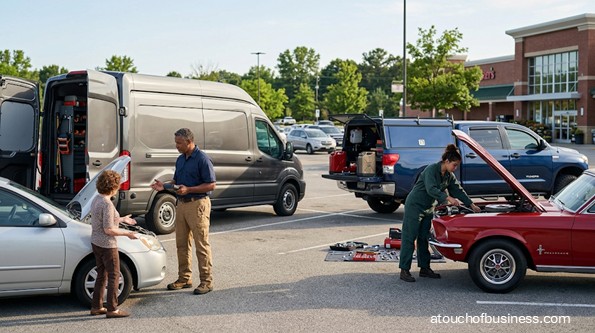
What to Expect From This Guide to Starting a Mobile Mechanic Business
This guide walks you through the key decisions and practical steps involved in starting a mobile mechanic business. The bullets below highlight selected areas, not everything included.
Inside the guide, you will find:
- Startup steps: Work through numbered steps from skills and demand checks to registration, insurance, vehicle setup, pricing, and a practice job.
- Industry interviews: Listen to, watch, or read five interviews with mobile mechanics and business owners about pricing, scheduling, equipment, training, and customer communication.
- Common questions: Find concise answers on certification, part-time operation, vehicle choice, diagnostic fees, calibration work, and when working solo stops working.
- Daily reality: See what a typical day involves, including the parts owners often enjoy and the parts they find hard.
- Business fit: Weigh your skills, stamina, household finances, and risk tolerance, plus warning signs to consider before you spend.
- Financial planning: Think through profit potential, break-even logic, operating capital, funding, and pricing using your own local numbers.
- Local requirements: Learn what to verify locally, such as A/C certification, used-oil handling, zoning, and repair-facility rules, since requirements vary.
Start by asking whether mobile repair suits your skills, schedule, and finances, because that answer shapes every decision after it.
Mobile mechanics work at customers’ homes, workplaces, and parking lots. Your service vehicle becomes the workshop.
You sell technician time plus convenience. Customers skip the tow truck, the waiting room, and the trip to a shop.
You follow the same broader startup process as any other owner. Mobile repair adds vehicle, compliance, and site decisions.
If you skip vehicle, compliance, and site planning, you may buy equipment that insurance, zoning, or customers will not support.
Is a Mobile Mechanic Business a Good Fit for You?
A mobile mechanic business fits best when you want to run your own schedule and can repair vehicles alone on-site.
You also need to be able to live with uneven income.
Start with your reasons. Why do you want to run a repair business instead of working for a shop?
Look at pressure and risk. Income can rise and fall, and slow periods will test your savings.
Consider your household. Can your family cover living expenses while your schedule fills?
Think about capital. Can you fund a vehicle, tools, insurance, and operating costs before your first job?
Time demands matter too. Evening and weekend appointments are common in repair.
Accept that some startups fail. Decide in advance how much you are willing to risk.
Read about the hardest parts of owning a business before you commit.
Name your first customers and your edge. Who will you serve, and why would they choose you over a shop?
Talk to experienced owners you will not compete against. Prepare questions first, since each owner’s path differs.
You also have entry options: start from scratch, buy an existing operation, or explore a franchise.
Budget, timeline, control, and risk tolerance decide which entry path suits you.
Red Flags Before You Start
Several conditions should make you pause, change your model, or stop before you spend on a vehicle.
If you ignore these conditions, you may own equipment that your jobs cannot pay for.
Warning signs to weigh before you spend:
- Scattered or weak demand: Spread-out customers turn drive time into lost income. Verify more or tighten your service area.
- Crowded competition: If many mobile mechanics and app-based services already fill your area, change your model or specialize.
- Startup costs beyond your budget: A vehicle, tools, diagnostics, and operating capital can outrun your funding. Pause or narrow your scope.
- Thin margins: If local rates cannot absorb unbillable travel time, reconsider the model.
- No compliant home base: If zoning, your lease, or association rules block your vehicle and parts, delay until you find a base.
- Site restrictions nearby: If most apartment complexes and workplaces ban repairs, demand may shrink.
- Frequent bad weather: If your climate adds many lost days, plan for slow periods.
- Compliance gaps: Offering A/C service without certification, or oil changes without a waste plan, can block your opening.
- Insurance trouble: If no insurer will cover your operation or vehicle, delay until you find coverage.
- Physical limits: If you cannot handle the physical load, reconsider.
- Skill gaps: If you cannot diagnose alone or explain and estimate repairs, build those skills or work for a mobile repair company first.
- Outdated diagnostics: If you cannot afford software that covers the model years you plan to service, narrow your scope.
Structural conditions to understand:
- Portable equipment limits scope: Some jobs need a lift or a shop, so you will refer them out.
- Specialized vehicle systems: Driver-assistance sensors and high-voltage batteries need specialized equipment and training.
- Larger competitors: Dealerships, independent shops, and app-based services all serve the same drivers.
- Logistics burden: You carry parts, fluids, and tools, and you manage waste disposal on the move.
- Local saturation: Oversaturation is a local question, so test your own market rather than assuming.
None of these conditions is a verdict. Each one is context for realistic planning.
A Day in the Life of Running a Mobile Mechanic Business
A typical day centers on scheduled appointments, travel between sites, and repairs in driveways and parking lots.
Customers get a fixed time window, so you plan your route around those slots.
Your day starts with the vehicle. You confirm that the tools and parts for each job are on board.
Many owners begin each job with a customer interview, sometimes by phone, to pinpoint the service.
At the site, you inspect, diagnose, and explain the repair. After approval, you complete it, invoice, and collect payment.
After each repair, you handle used fluids before driving to the next stop.
Recurring tasks beyond the repair itself:
- Parts runs and routing between job sites and suppliers
- Estimates, authorizations, invoices, and repair records
- Customer messages before and after visits
- Used-oil and waste handling
- Keeping diagnostic software current
Weather changes the day. Snow, heavy rain, and extreme heat can postpone or reschedule outdoor repairs.
Evening and weekend appointments are common in the repair trade.
What owners often enjoy:
- Independence and control over their own schedule
- Personal, trusted relationships with customers, since you serve one vehicle at a time
What owners often find hard:
- Physical strain from heavy parts and tools, kneeling, and long stretches under vehicles
- Last-minute schedule changes caused by weather
- Unsuitable or restricted sites, such as steep driveways or lots that ban repairs
- Limited portable equipment, which can force follow-up visits
- Wearing several roles at once: technician, estimator, and communicator
Does that daily rhythm sound like a life you want?
Step 1: Test Your Skills and Stamina for On-Site Repair
You need three things for on-site repair. You must diagnose alone, explain and estimate repairs, and have the stamina for outdoor jobs.
Mobile jobs often reveal their full scope only after you arrive. Experience is your best tool for handling that.
You also act as your own service advisor. You interview the customer, explain the repair, and estimate parts and labor.
If you skip building advisor and estimating skills, solid repairs can still lose customers. Brushing up on essential business skills helps close that gap.
The trade is physical. Technicians handle heavy parts and tools, and the occupation carries one of the highest injury rates.
Weather is part of the job too. It can change or cancel an appointment at the last minute.
Ask yourself these questions:
- Can I diagnose unfamiliar problems without a coworker to ask?
- Can I explain a repair and its cost in plain language?
- Can my body handle kneeling, lifting, and awkward positions for years?
- Am I comfortable working outdoors in changing weather?
Step 2: Learn From Owners You Won’t Compete With
Talk to mobile mechanics in other service areas, owners of other mobile trades, and independent shop owners outside your market.
Fleet managers and property managers are potential customers, not competitors. Their view of mobile service is useful too.
Prepare your questions first. Firsthand advice from real business owners shows what running this business demands before you spend anything.
Questions worth asking:
- Which jobs pay off on-site, and which do you refer to a shop?
- How do you handle parts runs?
- What do apartment, condo, and workplace parking rules do to your schedule?
- Which insurance and diagnostic software choices would you change?
- How long did it take to fill your schedule?
If you skip owner conversations, you learn the same lessons with your own capital.
Step 3: Choose How You Will Enter the Business
You can start from scratch, join a network of mobile technicians, explore a franchise, or buy an existing mobile operation.
Compare the tradeoffs before you choose, including whether to start from scratch or buy a business.
- Start from scratch: You choose the vehicle, tools, and service mix, and you build your own schedule.
- Join a network: Networks of mobile technicians exist. Read any agreement for pay, tools, insurance, and liability.
- Franchise: Franchises are reported to exist for mobile repair, though availability varies. Have an attorney review the franchise disclosure document.
- Buy an existing operation: Availability varies by market. Price the vehicle, equipment, diagnostic software, and customer base separately.
Joining a network changes your insurance, structure, and registration steps, so settle your entry path before you spend.
Step 4: Define Your Service Scope and Customers
Choose services that fit portable equipment, and decide which jobs you will refer to a shop.
Mobile repair suits oil and fluid changes, brake jobs, battery and starter replacement, belts, diagnostics, and light suspension jobs.
Limited portable equipment can force follow-up visits. If you accept jobs your vehicle cannot support, you lose a day and risk the customer’s trust.
Jobs usually better suited to a shop:
- Major engine or transmission repairs
- High-voltage battery replacement on electric vehicles
- Advanced alignment and driver-assistance calibration
Decide whether you will offer:
- A/C service, which requires federal certification and approved equipment
- Oil changes, which require a used-oil handling plan
- Hybrid or electric vehicle service, which needs specialized training and equipment
- Diesel and heavier trucks, which are a separate trade from cars and light trucks
Likely customers include:
- Apartment residents without a private garage or driveway
- Busy individuals at home or work
- Fleet operators who want less downtime and no towing
- Owners of a specific vehicle brand
Decide whether you will be a generalist or a specialist. That choice affects your tools, diagnostic software, and pricing.
Step 5: Check Local Demand and Competition
Confirm that enough customers live or work within a reasonable drive of you before you spend on a mobile service vehicle.
Define your service area by drive time, not map miles.
Unbillable travel must be recovered through pricing, so a wide area is costly.
Understanding local supply and demand helps you judge competitors and customer density.
List every competitor type nearby:
- Dealership service departments
- Independent shops
- Other mobile mechanics
- App-based mobile repair services
Note each competitor’s services, hours, and reviews.
Check these local conditions next:
- How many apartment complexes, condominiums, and workplaces sit within your service area
- Whether fleet yards operate nearby
- Whether property managers allow on-site repairs
Write down what evidence would make you proceed, change your model, or stop.
If you skip the competitor and customer checks, you may judge demand by hope instead of facts.
Step 6: Plan How Your First Customers Will Find You
Name your first customers and the problem you solve for them. Then decide how those customers will reach you at opening.
The problem you solve is usually time and hassle. Customers avoid towing, waiting rooms, and time away from work.
Fleet operators focus on downtime and towing costs. Busy individuals value convenience most.
Decide why customers would choose you. Reasons might include a specialty, availability, clear pricing, or trust.
Choose two or three simple ways to reach first customers at opening:
- Your personal network
- Direct introductions to fleet managers and property managers
- Accurate business details wherever local customers look
Planning for first customers is not a marketing campaign. If you skip it, you open with a vehicle and nobody expecting you.
Step 7: Test Profit Potential Before You Spend
Check whether your jobs can cover your fixed costs, including unbillable travel. Do this before you commit to a vehicle, tools, or financing.
Use a method for estimating profit and revenue with your own local numbers.
Your revenue sources:
- Labor
- Parts
- Diagnostic fees
- Travel or trip charges
Your fixed costs:
- Vehicle payment
- Insurance
- Diagnostic software and subscriptions
- Phone and business systems
- Tool replacement
Your variable costs:
- Parts
- Fuel
- Supplies
- Fluid and waste disposal
Time you cannot bill includes:
- Driving between job sites and parts suppliers
- Unpaid diagnosis
- Weather cancellations and rescheduling
- Redo or warranty jobs on your own time
Small-ticket jobs depend on route density. Larger jobs depend on strong diagnostics and parts control.
Redo jobs can consume the next week’s billable hours.
Answer these questions with your own numbers:
- How many jobs can one person finish in a day, including travel?
- What labor rate and parts margin cover your fixed costs?
- Does the model survive a slow or rainy month?
- Which job types are worth your time?
Local rates and costs differ, so this guide does not calculate break-even for you.
You will not have every number yet. Repeat your break-even check after you collect insurance quotes in Step 13.
If you skip the break-even check, a full schedule can still lose money.
Step 8: Plan Operating Capital and Funding
Plan enough operating capital to cover the slow start, because running out of operating funds is a main reason startups close.
List what you must fund before and after opening:
- Vehicle and upfit
- Tools and equipment
- Diagnostic tools and software updates
- Initial parts and fluid inventory
- Training, insurance, registrations, and certification exams
- Your personal living expenses until the schedule is steady
Diagnostic equipment may need updates every couple of years so it can read newer model years.
Explore savings, vehicle or equipment financing, bank or credit union loans, and Small Business Administration resources.
Learn how to get a business loan before you apply.
Confirm funding before you buy a vehicle or sign financing. If you skip this, you may own a vehicle you cannot afford to stock.
Step 9: Choose a Business Structure
Plan your structure before you sign a vehicle loan or insurance application, because mobile repair exposes your personal assets to risk.
A sole proprietorship does not separate business and personal assets.
An LLC generally protects your vehicle, home, and savings from business lawsuits.
Mobile repair involves driving, customer vehicles, safety-related repairs, and costly tools in a vehicle.
A financed vehicle adds more personal exposure.
A sole proprietorship can fit a solo start with few assets. Weigh that against your driving, customer-vehicle, and tool risks.
No entity type is legally required for this business. Rules differ by state.
Review the basics of choosing a business structure, then ask an attorney and a tax professional to confirm your choice.
Step 10: Register the Business and Set Up Taxes
Register your name and entity, get your tax IDs, and set up state tax accounts. Do this before you open a bank account.
Follow the process to register a business in your state. Requirements vary by U.S. jurisdiction.
- Check name availability, and register a DBA if you use a trade name. Check your county clerk or state filing office.
- File entity paperwork if you form an LLC or corporation.
- Get an Employer Identification Number from the IRS if you form an entity or plan to hire.
- Register for state tax accounts.
- Businesses that sell products usually need a sales tax permit, and some need a resale permit.
- Ask your state revenue department whether parts, labor, and trip charges are taxable.
- Apply for a local business license. Cities usually issue them, and some counties do too.
Review business licenses and permits so you know which offices to contact.
Step 11: Settle Your Home Base and Site Rules
Decide where you will park the vehicle and store parts, then confirm that local rules and your lease allow it.
Some local codes prohibit automotive repair as a home occupation. They may also limit commercial vehicles and outdoor storage.
Other local codes allow automotive repair only through a special permit. Check your city or county planning and zoning office.
Check your lease and homeowners association rules for vehicle and inventory storage.
If you skip the lease and association check, you may have to move your vehicle and inventory after you buy them.
Write a site policy for customer locations:
- Require a flat, stable surface. Steep driveways can make a site unsuitable.
- Expect apartment complexes, condominiums, workplaces, and paid lots to prohibit repairs in some cases.
- Use nearby public parking if your city allows repairs there, or schedule with the property’s permission.
- Get permission for commercial lots, since most are private property.
- Decide whether you decline or reschedule when a site fails your policy.
Step 12: Complete Compliance Checks Before Your First Job
Check federal certification, waste handling, repair-facility rules, and vehicle rules before your first paid job.
Compliance requirements vary by U.S. jurisdiction.
If you skip these compliance checks, a certification gap or waste problem can stop you after you have bought the vehicle.
Federal checks:
- Section 609 certification for A/C: Anyone who services vehicle A/C for payment or bartering must be trained and certified by an EPA-approved program. Servicing includes repair, leak testing, and topping off.
- Approved refrigerant equipment: Technicians must use certified recovery equipment. Service shops must keep records showing each equipment user is certified, so ask EPA how that applies to a mobile operation.
- Section 608 versus 609: Section 609 covers vehicle A/C. Section 608 covers other equipment.
- Used oil: If you change oil, EPA’s used-oil standards apply to you. State guidance for mobile oil change work treats you as a used-oil generator.
- Used-oil transport: Generators can often self-transport their own used oil to a collection center, subject to a quantity cap and vehicle-ownership conditions. Other transport generally requires a hauler with an EPA ID number.
- Other wastes: Solvents, antifreeze, brake fluid, and battery acid are vehicle-maintenance wastes. Confirm your hazardous-waste generator category with your state environmental agency.
- OSHA: Automotive service hazards include lifts, chemicals, and hazard communication. Confirm with OSHA how its rules apply if you work alone or hire.
- Commercial vehicle rules: Federal motor carrier rules apply above a vehicle weight rating threshold. Ask FMCSA or your state motor-vehicle agency whether your vehicle’s rating triggers them.
State and local checks:
- Repair-facility rules: Some states require registration, written estimates, invoices, and posted customer notices. Ask your state’s consumer-protection or motor-vehicle agency whether the rules cover mobile operators.
- Technician credentials: Ask your state licensing or consumer-protection agency whether any technician credential is required.
- Environmental rules: Your state environmental agency regulates used oil and other wastes. Some publish guidance for mobile oil change businesses.
- Employer rules: If you hire, check workers’ compensation, unemployment, and payroll rules. Each state runs its own workers’ compensation program.
- Vehicle registration: Ask your state motor-vehicle agency about commercial plates and classification.
Ask yourself:
- Will I work on A/C systems, change oil, or both?
- Will I work alone or hire a helper?
- Will I store the vehicle and inventory at a residence?
Ask the agencies:
- Does my state’s repair-facility law cover mobile operators, and must I register?
- Does my city allow a service vehicle and parts storage at my address?
- Which agency do I call about used oil and antifreeze handling for a mobile operation?
Step 13: Get Insurance Quotes Before You Buy the Vehicle
Ask an agent who insures mobile repair to quote coverage before you buy, so the vehicle and your service list match the policy.
Learn the basics of business insurance before you meet the agent.
Auto liability and, if you hire, workers’ compensation are generally state-driven. Verify the rules with your state agencies.
The other coverages below are risk planning, not confirmed legal requirements.
Coverages to ask about:
- General liability
- Commercial auto
- Inland marine, which covers tools and equipment you carry away from your base
- Garagekeepers, which covers loss to a customer’s vehicle in your care, custody, or control
- Workers’ compensation, if you hire
Do not assume general liability covers a customer’s vehicle while you repair it. Care, custody, or control exclusions remove that coverage.
Ask whether customer-vehicle coverage applies when you work at the customer’s location.
Give the agent your exact service list, including A/C and brake jobs.
If you skip the service list, the policy may not match what you do.
Have coverage in place before your first paid job.
Step 14: Choose and Equip Your Service Vehicle
Pick a reliable vehicle with enough secured storage for your service mix, then buy tools in order of the jobs you will accept.
Your services decide the space. A diagnostics service needs less room than a mobile tire setup.
Reliability matters because travel is how you earn. A flexible interior lets you fit your entire setup.
Core tools and support gear:
- Professional hand tool set, metric and standard, plus torque wrenches
- Cordless impact wrench with multiple battery packs
- Hydraulic floor jack, jack stands, and wheel chocks
- Creeper or mat
- Portable work lights and a compact air compressor
- Power inverter or portable generator to charge cordless tools
- Shelving, toolboxes, and secure tie-downs
Diagnostics:
- Professional scan tool
- Battery and charging-system tester, and a multimeter
- Repair information subscription for the vehicles you service
- Software that covers the model years you plan to service
If your software is too old for a newer model year, the scan tool cannot communicate with the vehicle.
Fluids and waste:
- Drain pans and funnels
- Labeled used-oil containers
- Separate labeled containers for antifreeze and other fluids
- Spill kit and absorbent
- A plan to drain used filters
Weather and safety:
- Tent or canopy to shelter equipment from rain
- Rain gear and knee protection
- Gloves, eye protection, fire extinguisher, and first aid kit
If you offer A/C service:
- EPA-certified refrigerant recovery and recycling equipment
- Proof of Section 609 certification
Build a loading routine too. Check tools and parts against the day’s jobs before you leave.
Step 15: Set Up Parts Suppliers and Accounts
Open accounts with local parts stores or distributors before opening, and decide which common parts you will carry versus order per job.
- Ask about trade accounts, delivery, and return and core policies.
- Keep fresh inventory of common parts in the vehicle so you do not run out.
- Arrange a drop-off destination for used oil and other waste.
- Confirm refrigerant purchase rules before you stock A/C supplies. EPA restricts refrigerant sales to certified technicians.
- Ask your supplier which certification applies to each refrigerant you buy.
If you skip supplier setup, a missing part turns one visit into two.
Step 16: Set Prices and Customer Paperwork
Set your labor rate, diagnostic charge, parts markup, travel charge, and minimum job charge so pricing covers unbillable drive time.
Start with the basics of pricing your products and services, then apply your local costs.
Understand parts cost, parts resale, and labor estimating. Weak estimating leads to underpriced jobs.
Customers value convenience, and a specialist can charge for it. Check competitors’ pricing before you set yours.
Choose your pricing method after owner conversations and local cost checks.
Prepare the paperwork for each job:
- Estimate form
- Written authorization record
- Invoice
- Parts-return and core-charge policy
- Warranty statement
Some states require written estimates, invoices, or posted customer notices. Verify your state’s rules.
Write a cancellation and weather policy. Consumer advice tells customers to ask about weather rescheduling and any related fee.
Many mobile mechanics collect payment right after the job. State your payment terms on the estimate.
Step 17: Set Up Banking, Payments, and Business Identity
Open a business bank account after registration and tax ID, then set up field payment acceptance and invoicing.
Learn how to open a business bank account once your registration is complete.
Keep estimates, repair orders, and invoices organized. Technicians keep records of diagnostic tests and repairs.
Finalize your business name, phone number, email, and a clear description of your service area and services.
Check local sign rules before you order vehicle lettering.
Step 18: Plan Staffing and Training
Many mobile mechanics start solo, so plan staffing only if you intend to hire when you open.
If you hire, look for two skills in one person. One owner hired a skilled technician who communicated clearly with customers.
That owner then trained the technician as a service advisor.
- Each person who services vehicle A/C needs Section 609 certification.
- Each state runs its own workers’ compensation program, so check your state rules.
- Check OSHA rules on lifts, chemicals, and hazard communication.
- Train staff in estimating and customer communication.
Step 19: Run a Test Job and Final Pre-Opening Checks
Test your full process on a friend’s or family member’s vehicle, then confirm every item on the pre-opening list below.
Your test job covers booking, travel, setup, estimate, authorization, repair, invoice, payment, and waste handling. If you skip it, your first customer finds the gaps.
Before the test, ask your insurance agent whether your policy covers an unpaid test job.
Approvals and compliance:
- Business registration, tax accounts, and local license in hand
- Section 609 certification, if you offer A/C service
- Labeled used-oil containers and a confirmed drop-off destination
- Repair-facility registration or posted notices handled where required
Insurance:
- Policies in place and matched to your service list
Vehicle and equipment:
- Vehicle inspected and legally registered
- Tools, jack stands, and power supply tested
- Scan tool and software tested on several vehicles
- Parts, fluids, and supplies stocked
Suppliers, payment, and paperwork:
- Parts accounts open, with return and core policies understood
- Business bank account open
- Card reader tested with a live charge
- Estimate, authorization, invoice, and warranty forms ready
Site policies and schedule:
- Site policy and weather and cancellation policy written
- Route and travel times tested
- First-day schedule set with buffer time between jobs
If a license or registration is still pending, ask the agency whether you can operate before your first paid job.
Business Plan
Your business plan ties your startup steps, costs, legal checks, pricing, and break-even logic into one document you can test.
Make your plan easy for a lender or partner to follow. Use a guide to write a business plan, then add the sections below.
Include these mobile-specific sections:
- Service scope, refer-out list, and customer types
- Service area defined by drive time
- Vehicle and equipment list, priced from local quotes
- Insurance quotes and your compliance checklist
- Pricing, estimate, and paperwork setup
- Funding sources and operating capital
Break-even is the point where your jobs cover your fixed costs.
Calculate your break-even with your own labor rate, parts margin, jobs per day, and travel time.
Check margin pressure from parts costs. Then state whether your plan depends on many small jobs or fewer large ones.
Test slow weeks and weather cancellations. If the plan only works in perfect weeks, it will not hold.
Opening-Day Red Flags
Pause your opening if any of these problems remains unresolved before your first paid job.
- A/C service without certification: If you lack a Section 609 card or approved recovery equipment, remove A/C from your service list.
- No waste plan: If you have no labeled used-oil container or drop-off destination, hold off on oil changes.
- Insurance mismatch: If policies are not in place or do not match your services, fix that first.
- Pending license: If a license or registration is unresolved, get the agency’s answer in writing before you take paid jobs.
- Failing diagnostics: If your scan tool or software fails on your target model years, update it or narrow your scope.
- Missing parts flow: If you have no supplier account or lack common parts, one visit will become two.
- Payment problems: If your card reader fails a live test, fix it before the first customer.
- Missing forms: If you have no estimate and authorization forms, you cannot document approval.
- Unwritten policies: If your site and weather policies are not written, you will decide them under pressure.
- Untested routes: If you skipped the route test or left no buffer, your first day can run late.
Frequently Asked Questions
Do I Need ASE Certification to Start a Mobile Mechanic Business?
Usually not, but confirm locally. Industry groups describe ASE certification as a voluntary credential, not a government license.
To earn ASE certification, you pass a test and document relevant hands-on experience. Formal training can substitute for part of that experience.
Can I Start a Mobile Mechanic Business Part-Time While Employed?
Yes. Mobile repair can run part-time.
One owner moonlighted small mobile jobs for years before going fully mobile.
Paid repairs still bring the same certification and insurance questions, even on a limited schedule.
Can I Start With My Own Car or Pickup Instead of a Service Van?
Sometimes, if your insurer agrees. Personal auto policies often exclude business use, and some exclude vehicles used in a vehicle-repair business.
One owner started in a station wagon with tools he already owned. Another works from a pickup with a bed topper.
A smaller vehicle limits what you can carry, so match your service list to its space.
Ask an insurance agent about commercial auto coverage before your first paid job.
Can I Charge a Diagnostic Fee if the Customer Skips the Repair?
Yes, if the customer agrees to the fee first and your state allows it.
Some states require consent before you charge for an estimate or diagnosis, and written consent above a set amount.
One owner collects a prepaid diagnostic fee through online booking and credits part of it toward the repair.
Ask your state’s consumer-protection or motor-vehicle agency what it requires before you set your policy.
Can a Routine Repair Create Driver-Assistance Calibration Work?
Yes. Alignments and windshield replacements can require recalibrating driver-assistance sensors.
Calibration equipment generally lives in a shop, so check vehicle service information before you accept the job.
When Does Working Solo Stop Working?
Usually when demand outgrows one person’s day or when jobs need a lift.
One owner added a technician as demand rose, then added a shop for bigger repairs.
Mobile Mechanic Interviews: Lessons From Working Professionals
These interviews share firsthand experiences from mobile mechanics and business owners working in different markets.
They discuss how they entered the field and structured their services.
They also describe handling customers, organizing mobile work, and the realities of running the business.
If you are considering this business, use these interviews to think through service limits, scheduling, and pricing.
They also help you weigh equipment, customer communication, and training.
They can show you the systems needed to operate efficiently away from a traditional repair shop.
Avern Collins: How to Make Money as a Mobile Mechanic
Avern Collins discusses operating a mobile mechanic business in Fayetteville, North Carolina, where he provides on-site services.
The conversation covers paid diagnostics, pricing, branding, and customer expectations.
The conversation also covers business systems, technician hiring, drive time, and deciding which repair jobs fit the mobile model.
This interview is useful for understanding why technical ability alone is not enough.
Collins explains the importance of standard procedures, professional presentation, and accurate quoting.
He also explains the importance of setting customer expectations and limiting services to work that makes sense for a mobile operation.
Building Rolling Wrench Mobile With Bruce Oliver
Bruce Oliver talks about his path from working in automotive shops to operating Rolling Wrench Mobile.
The conversation covers his experience building the business, technical training, and continuing education.
The conversation also touches on customer handling and some of the financial and operational realities of working independently.
This interview is useful for someone considering going mobile because it highlights the experience and training needed before working independently.
The conversation also covers starting as a legitimate business instead of a side job.
He also discusses jobs a mobile mechanic should avoid and how he sets up his van.
He also mentions using residential recovery equipment for A/C work on vehicles.
Step 12 explains what EPA requires for vehicle A/C service, so check any A/C setup against it.
Inspiring Conversations with Ashleigh Barchuh of Mobile Auto Clinic
Ashleigh Barchuh discusses building Mobile Auto Clinic from a small family operation into a business offering both mobile mechanic services and a full-service shop.
She talks about bootstrapping, slow periods, and hiring technicians.
She also talks about customer communication, transparency, growth, and maintaining a personal approach to automotive service.
This interview gives you a look at challenges that can appear as a mobile mechanic business grows.
Her experience shows the importance of managing cash constraints and finding qualified technicians.
Her experience also shows the importance of communicating clearly with customers and preserving service quality while expanding.
Maddi Downs
Maddi Downs, founder of Miss Mobile Mechanic, explains how she started her mobile automotive servicing and repair business and describes what a typical workday involves.
She discusses qualifications, diagnostics and repairs, and travel between customers.
She also covers preparing tools and parts, managing bookings, paperwork, customer inquiries, and scheduling.
This interview is useful for seeing how much organization happens behind the mechanical work.
Downs explains how travel time, parts preparation, and customer communication affect the daily operation of a mobile mechanic business.
She also explains how booking systems, administrative work, and time management affect that operation.
Barwick’s Mobile Auto Repair Brings Honest Quotes to Bradenton
Jacob Barwick discusses how he entered mobile auto repair and the types of jobs he commonly handles.
He also describes how he operates from his service vehicle.
The interview covers his truck and tools, brake jobs, and customer pricing expectations.
The interview also covers initial customer calls, diagnostics, quoting, and scheduling repairs.
This interview provides a practical look at the day-to-day setup of a small mobile mechanic operation.
You can see how one mechanic equips his vehicle and evaluates incoming jobs.
You also see how he moves from diagnosis to repair and communicates with customers before a job is scheduled.
Related Articles
- How To Start an Auto Repair Shop
- How To Start an Automotive Fleet Maintenance Business
- How To Start an Automotive Electrical Repair Shop
- How To Start an Automotive AC Repair Business
- How To Start an Automotive Radiator Repair Business
- How To Start a Motorcycle Repair Shop
Sources:
- U.S. Bureau of Labor Statistics: Automotive Technician Outlook
- U.S. Environmental Protection Agency: MVAC Servicing Requirements, Section 608 and 609 Overlap, Managing Used Oil FAQ, Vehicle Maintenance Best Practices
- Refrigeration Service Engineers Society: EPA Section 609 Certification
- GovInfo (Code of Federal Regulations): Used Oil Management Standards
- State Environmental Agency Guidance: Mobile Oil Change Used Oil, Auto Repair Waste Management
- Occupational Safety and Health Administration: Automotive Services Directive
- Federal Register (FMCSA): Commercial Motor Vehicle Definition
- ASE: ASE Work Experience Rules
- U.S. Department of Transportation: Auto Repair Consumer Fact Sheet
- Connecticut Attorney General: Auto Repair Estimate Consent
- Small Business Administration: Choose a Business Structure
- SCORE: Business Licenses and Permits
- Patriot Software: Licenses, Sales Tax, Resale
- Congressional Research Service: Workers’ Compensation Overview
- Ratchet+Wrench: Investing in Mobile Repair, Mobile Repair Company Q&A
- Jalopnik: Mobile Mechanic Site Limits
- TruckUp: Mobile Mechanic Drawbacks, Starting Mobile Mechanic Steps
- Entrepreneur: Mobile Mechanic Business Idea
- Capital One: Mobile Mechanics Overview
- ClickMechanic: Becoming a Mobile Mechanic
- House Call Auto Mechanics: All About Mobile Mechanics
- Crown Auto Repair: Mobile Mechanic Process
- Mobile Mechanics of Sacramento: Apartment Lot Repairs
- Jim.com: Starting a Mobile Mechanic
- AutoLeap: Mobile Mechanic Equipment, Mobile Mechanic Setup
- Fullbay: Mobile Mechanic Setup
- Mitchell 1: ADAS Repair Calibration
- Local Zoning Records: Home Occupation Standards, Special Home Occupation Permit
- IRMI: Care Custody Control Definition
- Insurance Journal: Garagekeepers Coverage Explained
- Progressive Commercial: Inland Marine Coverage
- Insureon: Commercial vs. Personal Auto
- American Insurance ID: Personal Auto Business Use
- Wexford Insurance: Mobile Mechanic Coverage Types
- Repair-CRM: Reducing Windshield Time
- Financial Models Lab: Mobile Mechanic Route Economics
- The Bradford Era: ASE Certification Voluntary