
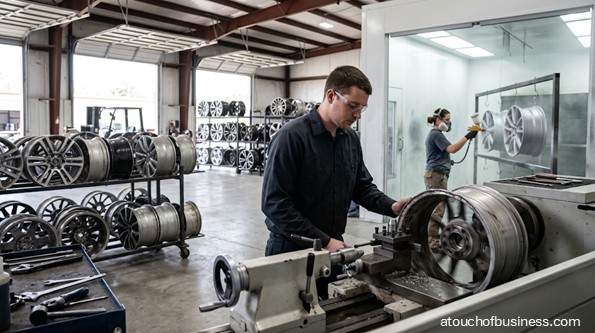
What to Expect From This Guide to Starting a Wheel Repair Business
This guide walks you through the key decisions and practical steps involved in starting a workshop-based wheel repair business. The highlights below show selected areas of value, and the full article goes deeper.
Inside the guide, you will find:
- Startup steps: Follow ordered steps from checking whether the workshop suits you through test jobs, paperwork, and opening preparation.
- Common questions: Find answers to situations outside the main path, such as home garages, limited experience, and equipment choices.
- Daily reality: See what a typical day involves, including the physical and chemical demands owners often find hard.
- Repair scope: Weigh cosmetic-only work against straightening and welding, including vehicle maker positions and the liability each choice adds.
- Local requirements: Check zoning, fire, air, waste, and sewer rules that vary by location before you choose a site.
- Equipment needs: Plan the machines, power, air, and ventilation a wheel repair workshop requires.
- Financial planning: Test local demand, profit potential, funding, and operating capital before committing to a lease or equipment.
Start with the first section to decide whether a wheel repair workshop fits your goals, budget, and tolerance for demanding shop work.
Wheel repair owners and technicians restore damaged wheels so vehicles can return to the road.
Jobs range from cosmetic refinishing to straightening and, in some workshops, crack repair.
This guide covers a workshop-based wheel repair business, where private vehicle owners and trade customers drop off wheels for repair.
Trade customers are tire shop owners, dealership service managers, and collision repair shop owners who send wheels out for repair.
General startup steps apply to this business too, adjusted for wheel-specific equipment, safety rules, and repair limits.
Should You Open a Wheel Repair Workshop?
Open one if you want hands-on technical repairs and can fund a slow ramp-up. You give up predictable income and low overhead.
Start with your reasons for wanting this business.
Motivation matters because a workshop brings slow weeks, equipment problems, and rework.
Liking the craft and liking the demands of ownership are two different things.
Ask yourself these questions before you go further:
- Can your household cover living expenses while customers and trade accounts build up?
- Will family or household members support the time and capital this takes?
- How do you handle pressure, income uncertainty, and the possibility that the business fails?
- Can you fund startup costs, ongoing operating costs, and a cash cushion?
- Can you commit the time a workshop demands, including bookkeeping and customer calls?
- Do you have the technical skills, or a plan to build them?
Owning a workshop also means handling estimates, invoices, supplier orders, permits, and customer questions.
You also need to know who your first customers will be and why they would choose you over other options.
Talk only with owners you will not compete against, and prepare your questions in advance.
Each owner’s path is different, yet firsthand experience reveals patterns you cannot find elsewhere.
Most people consider one of three entry paths:
- Starting from scratch
- Buying an existing shop
- Joining a franchise or licensed network
Each path trades control, cost, and support differently.
Red Flags Before You Start
Pause, change your service scope, or walk away if any red flag below describes your plan. Each one is easier to fix before you spend.
Demand and competition:
- Few tire shop owners and dealership managers are willing to send wheels out, or many repair wheels in-house. Verify more before you lease.
- Many local competitors offer what you plan to offer. Pause, or change your scope.
- Saturation is hard to judge from a distance. Count local competitors yourself.
Scope and liability:
- Your plan depends on welding or straightening, but you have not checked insurer and trade-account views. Verify first, or switch to cosmetic-only work.
- Insurance quotes are unavailable or unaffordable for your planned scope. Reduce the scope or reconsider.
Compliance and site:
- Zoning or fire rules block coating or heated equipment at your chosen site. Change the site before you sign.
- Air, waste, or sewer rules are unclear. Get written answers from the agencies.
- You are unwilling to run respiratory, hazard communication, and fire programs. Reconsider, because these programs are part of daily operation.
Capital and profit:
- Equipment, utility upgrades, and operating capital exceed what your funding can cover. Scale back or delay.
- Your break-even point requires more wheels per week than you can finish. Change the model or reconsider.
- Trade-account pricing leaves thin margins after consumables and rework. Verify more before committing.
Owner fit:
- Noise, dust, chemicals, and physical demands are a poor match for you. Reconsider.
- You have technical skill gaps and no training plan. Delay until training is secured.
Industry conditions to understand before you commit:
- Capital intensity: straightening, lathe, coating, and curing equipment need power, air, space, and ventilation.
- A safety-related product: the part supports a vehicle, so errors carry high consequences.
- Layered regulation: workplace safety, air, waste, sewer, fire, and zoning rules all touch coating and grinding.
- Dust hazard: aluminum dust can be combustible or explosive.
- Customer overlap: some trade customers may repair wheels in-house, and a vehicle maker’s program can name approved outside refinishers.
Industry-wide conditions are context for realistic planning, not automatic reasons to walk away.
A Day in the Life of Running a Wheel Repair Business
Your day centers on moving damaged wheels through a set sequence: inspection, repair, coating, cure, and final checks.
You or your technician inspect each wheel first, measuring runout and checking for cracks before any other step.
Runout is how far a spinning wheel wobbles from true.
Next come tire removal, straightening if the wheel is bent, and surface prep.
Coating and cure follow, then remounting the tire, balancing, a final check, and tagging the wheel for pickup.
Several recurring tasks fill the day beyond the repairs themselves:
- Cleaning grinding and coating areas so metal dust does not build up
- Checking and changing booth filters
- Labeling chemicals and keeping Safety Data Sheets (SDS) available
- Handling and storing waste
- Quoting, scheduling, customer pickups, and invoicing
Frequent cleaning is one common way to control metal dust. The Occupational Safety and Health Administration (OSHA) has cited missing or clogged powder booth filters.
What owners often find hard:
- Noise, since related body repair shops are often loud
- Physical demands, including awkward or cramped positions
- Dust, fumes, and coating chemicals that call for respirators and other protection
- Telling customers a wheel cannot be repaired, because cracked or structurally compromised wheels call for replacement
Could you picture yourself in that daily routine for years?
Step 1: Decide Whether the Workshop Conditions Suit You
Choose this business only if you can accept noise, dust, chemicals, and precision tasks. You give up comfort.
Body repair, the closest related trade, takes place indoors in shops that are often noisy.
OSHA’s autobody guidance lists chemical hazards, noise, welding, respiratory protection, and isocyanates among its topics.
Ask whether you can:
- Do precise, repetitive tasks for long stretches
- Turn away wheels that cannot be repaired securely
- Carry liability for a part that supports a vehicle
Keep these order rules in mind as you move through the steps:
- Decide your service scope before equipment, lease, insurance, or compliance planning.
- Check zoning, fire, air, waste, and sewer rules before signing a lease.
- Confirm power, air, and space needs with equipment suppliers before signing a lease or buying machines.
- Plan your business entity before signing leases, equipment financing, or vendor agreements.
- Open the bank account after registration and your Employer Identification Number (EIN) are in place.
Requirements from lenders, landlords, suppliers, and local regulators can change this step order, so verify before you commit.
Step 2: Decide Whom to Learn From Before You Spend
Spend time with non-competing owners before you spend capital. You gain candid lessons and give up some time.
Good people to approach include:
- Wheel repair owners in other markets
- Powder coaters
- Collision repair shop owners
- Tire shop owners outside your service area
Useful topics to cover:
- Workflow from intake to pickup
- Equipment lessons
- Supplier sources
- Rework and waste handling
- Insurance
- The mix of walk-in and trade jobs
Reading advice from real business owners adds more patterns to compare.
Step 3: Decide How You Will Build the Craft
Pick a training route before you buy equipment. You gain skill before spending and give up some time.
Training routes to explore:
- Equipment supplier training, which some supplier materials list as available
- Training included with a franchise or licensed network
- Hands-on time with an experienced wheel repair owner
Core skills include measuring runout, spotting cracks, controlled straightening, surface prep, coating, color matching, and finishing.
Welding and lathe skills matter only if you plan to offer those services.
You also need basic bookkeeping, estimating, and customer communication.
Step 4: Choose Between Starting Fresh, Buying a Shop, or Franchising
Starting fresh gives you full control. Buying a shop or joining a franchise can bring existing systems but adds cost and obligations.
Under the Federal Trade Commission (FTC) Franchise Rule, you must receive a Franchise Disclosure Document before you pay anything or sign a contract.
Read the Franchise Disclosure Document with an attorney, and talk to current and former franchisees.
Before buying an existing shop, evaluate:
- Equipment condition and calibration
- Customer accounts
- Lease terms
- Environmental and safety compliance history
The best path depends on budget, timeline, support needs, available shops for sale, desired control, and risk tolerance.
Compare the start-from-scratch and buy-a-business options in more detail.
Step 5: Decide How Far Your Repair Scope Goes
Choose cosmetic-only jobs for simpler equipment and lower risk, or add straightening and welding for more jobs and more liability.
Scope options include:
- Cosmetic refinishing only
- Adding straightening
- Adding crack repair by welding
- Machined-face work on a lathe
- Powder coating
- Chrome plating, which some shops send to a specialty plater
- Tire mounting and balancing
One major vehicle maker’s published collision position statement says welding, bending, straightening, and re-machining wheels are not endorsed.
The statement permits only cosmetic refinishing of wheel coatings, using the maker’s recommended procedures.
Trade sources say a bent wheel can be straightened if its structural integrity is not compromised.
Trade sources generally advise against repairing cracked wheels unless the repair keeps the wheel’s strength intact.
Heat control matters, because too much heat can soften an alloy wheel.
The main risk comes from repairing structurally compromised wheels that should be replaced. Runout measurement and written refusal criteria reduce that risk.
Inspect every wheel for cracks before any job, even cosmetic-only jobs. One vehicle maker’s statement says cracked wheels must not be refinished.
Write down which damage types you will accept and which you will refuse.
Ask an insurance agent whether coverage is available for the scope you are considering before you commit to it.
Decide whether you will serve walk-in retail customers, trade accounts, or both.
Step 6: Decide Whether Local Demand Supports a Workshop
Commit to a location only if local demand supports it. Testing demand first costs time but protects you from a lease you cannot use.
Count local competitors by type:
- Fixed-location wheel repair shops
- Mobile wheel repair providers
- Powder coaters
Some tire shop owners and dealership managers repair wheels in-house, so they may be competitors instead of customers.
Talk to tire shop owners, dealership service and body shop managers, and collision repair shop owners.
Ask shop owners and managers who repairs their wheels, how they handle turnaround, and which jobs they send out.
Some industry operators report that insurance collision estimators list wheel repair as a first option. Verify this with local shops and adjusters.
Your likely first customers include:
- Private vehicle owners with curb damage
- Shop owners who send wheels out for repair
- Fleets
Decide why each customer group would choose you, such as a capability they lack, like straightening or machined-face work, or reliable turnaround.
At opening, reach your first customers through direct conversations with shop owners and managers, and agree on drop-off and pickup terms.
Learn how local supply and demand shape your market.
Step 7: Decide Whether the Numbers Can Work
Test profit potential before you commit to a lease or equipment. You give up some optimism and gain a clear go or no-go.
List your fixed costs:
- Rent
- Loan or lease payments
- Utilities
- Insurance
- Equipment maintenance
- Staff
List your per-job costs:
- Coatings, abrasives, filler, media, and other consumables
- Waste disposal
- Rework
Jobs are priced per wheel, based on finish and damage level.
Trade accounts often bring higher volume at lower per-wheel prices than retail customers.
Each job passes through sequential stages: inspection, straightening when needed, repair, prep, coating, cure, remount, and balance.
Map how many wheels you can finish in a week.
Include slow weeks and rework in your model.
Calculate break-even with your own local costs, prices, and expected volume.
For more detail, see how to estimate profit and revenue for a business.
Step 8: Decide How to Fund the Start and Build Operating Capital
Choose your funding mix before you sign anything. Savings keep control, while loans and leases spread costs but add payments.
Running out of operating capital is one reason startups close.
Plan enough operating capital to keep the doors open while customers and referrals build.
List and price these startup cost items:
- Equipment
- Workshop lease, deposits, and build-out
- Electrical, compressed air, and ventilation work
- Initial coatings and consumables
- Safety equipment and signs
- Licenses, permits, and inspections
- Insurance
- Training
- Working capital for the first months
Cost drivers that move your total:
- Service scope, since welding or lathe work adds equipment, ventilation, and training
- New, used, or leased equipment
- Site condition, since a space with strong power and air needs fewer upgrades
- Working solo or hiring
- Booth and oven size
- Waste volume and hauling terms
Your most accurate estimate comes from listing every item you need and pricing it locally. No single budget fits every workshop.
Start with preliminary figures at this step. Finish your equipment quotes in Step 13 before you submit a loan application.
Funding options to explore:
- Personal savings
- Loans guaranteed by the Small Business Administration (SBA), which offers a Lender Match tool
- Equipment financing or leasing
- Landlord build-out contributions, where available
- Franchise financing programs, if you franchise
Loan applications usually call for a business plan and a calculated startup cost. The Business Plan section later in this guide shows what to include.
Learn how to get a business loan.
Step 9: Choose a Legal Structure Before Major Commitments
Plan to form a business entity before you sign a lease, equipment financing, or trade-account agreements.
You gain personal liability protection and give up some simplicity.
Safety-related parts, chemicals, heated equipment, and employees all raise liability exposure in a wheel repair workshop.
Entity planning applies to any scope, because even cosmetic-only work involves chemicals, fire risk, and customers’ property.
Registering a business can open the door to personal liability protection and tax benefits.
Ask an attorney and a tax professional which entity type fits your scope.
See how to choose a business structure.
Step 10: Decide Which Registrations and Accounts You Need
Register under a name you will keep, set up tax accounts, and then open your business bank account.
You gain a clean record and give up the freedom to rename cheaply.
Register your business name, and a DBA if needed, with state and local offices. Varies by U.S. jurisdiction.
Review the steps to register a business.
Get an EIN, since you need one to open a bank account and pay taxes. A business tax ID guide explains the process.
Set up state tax accounts, including sales and use tax.
Whether repair labor and parts are taxable varies. Ask your state revenue agency, and ask about resale certificates for parts you buy.
If you will hire, set up employer accounts.
Open a business bank account once registration and your EIN are in place.
Having the account ready lets you pay lease deposits, equipment orders, and supplier accounts from the business.
Learn how to open a business bank account.
Step 11: Decide Which Sites Pass Zoning, Fire, Air, Waste, and Sewer Checks
Check local rules before you pick a site. The checks cost time but prevent a lease you cannot use.
Federal, state, and local requirements all apply, and business licenses and permits differ by location.
Zoning: Confirm the location allows an auto-related workshop with coating, grinding, and heated equipment. Varies by U.S. jurisdiction.
- Ask the city or county planning office for written zoning verification.
- Zoning clearance can take a long time if hearings are needed, so build a permit timeline.
Building: A certificate of occupancy is often needed when a space changes use.
- Ask the building department about permits for new circuits and ventilation.
Fire: Ask the local fire official about booth, oven, and flammable storage requirements.
Air: The Environmental Protection Agency (EPA) has an air rule for coating operations.
The rule covers spray coatings that contain compounds of chromium, lead, manganese, nickel, or cadmium.
- It also covers paint stripping with methylene chloride.
- If it applies to autobody shops, it requires reporting, emissions reduction, and training in protective gear, spray coating selection, spray guns, and booth filters.
- Whether wheel refinishing falls under the EPA coating rule is not clear-cut.
- Get your state air agency’s answer in writing before you assume the rule applies or is exempt.
- Ask suppliers whether coatings contain the listed metals.
Hazardous waste: EPA sets three generator categories based on how much hazardous waste you produce each month.
- State categories can differ from the federal ones.
- Likely waste streams include spent solvents, coating waste, spent stripper, and blasting residue.
- Do a waste determination, and ask your state hazardous waste agency what applies.
Sewer: Process wastewater sent to a public treatment plant is subject to local pretreatment limits.
- Pretreatment matters if rinsing, washing, or stripping creates wastewater.
- Ask your local sewer utility for its industrial pretreatment contact.
Step 12: Choose and Secure the Workshop Space
Choose a space that already supports your equipment. You give up some site choice in exchange for fewer upgrades.
Ask equipment suppliers for each machine’s power, air, and space needs before you sign, so you know what the space must offer.
Confirm the space offers:
- Three-phase or high-capacity power
- Compressed air
- Ventilation paths
- Floor space and staging space for wheels waiting between stages
- A secure area for customers’ wheels
Ask the landlord in writing about coating, powder, welding, and exhaust modifications.
Add lease contingencies tied to permits and approvals.
Plan the layout so wheels move one direction: intake, straightening when needed, repair, prep, coating, cure, remount, and pickup.
Decide whether customers enter the workshop or stop at a drop-off counter.
Step 13: Decide What Equipment to Buy and When
Buy equipment for the scope you chose, not the scope you hope to reach. You lower startup costs and give up some capacity.
Get quotes and compare new, used, and leased options.
Before delivery, a machine maker’s installation checklist advises confirming electrical needs, air supply quality, and layout with the distributor.
Intake and inspection:
- Runout measurement tools, since a straightening machine with built-in measurement lets you confirm results
- A crack inspection method, such as dye penetrant testing
- A camera for condition photos and tags
Tire handling:
- Tire changer suited to alloy wheels
- Wheel balancer
- Coated or stick-on balance weights suited to alloy wheels
- New valve stems
Straightening, if offered:
- Hydraulic wheel straightening machine
- Controlled heat source with temperature control
Crack repair, if offered:
- TIG welding setup suited to aluminum, matched filler rod, and grinding tools
- Dedicated ventilation and welding protective gear
- Verification of vehicle maker and insurer positions before you add this service
Surface prep:
- Blasting cabinet or another prep method, abrasives, and sanding supplies
- Alloy-specific filler
- Wash and rinse area, with wastewater rules checked first
Machined-face work, if offered:
- CNC wheel lathe on a stable mount with dust collection
- Power and air planned with the supplier
Coating:
- Paint booth or powder booth with filtration
- Spray guns, powder gun, curing oven, and cure racks
- Compressed air with dryers
- Coatings, clear coat, and color-matching supplies
Safety setup:
- Respirators, fit-testing supplies, gloves, eye protection, and hearing protection
- Eyewash station, fire extinguishers, and flammable storage cabinets
- SDS system, chemical labels, and safety signs
- Waste containers, labeled storage, and a spill kit
- Dust collection and housekeeping tools suited to aluminum dust
Office and customer systems:
- Estimating, work order, and invoicing software
- Intake forms, tags, and secure racks for customers’ wheels
- Payment acceptance device
Facility:
- Dedicated electrical circuits, compressed air lines, ventilation, and lighting
- Drop-off counter
Skip a mobile unit for a shop-based start.
Add a pickup vehicle only if your trade accounts require pickup and delivery.
Step 14: Choose Your Suppliers
Choose suppliers for coatings, abrasives, and consumables before opening. You gain steady materials flow and give up some price shopping.
Line up sources for:
- Coatings and clear coat
- Abrasives and blasting media
- Filler and chemicals
- Balance weights suited to alloy wheels
- Valve stems
Request an SDS for every chemical product.
Check stripping chemicals against federal restrictions. Federal rules restrict most commercial uses of methylene chloride, including paint and coating removers.
Confirm the current status and any phase-in periods with EPA before you buy a stripper.
Arrange a licensed waste hauler if you generate regulated waste.
Step 15: Decide How You Will Run Safety and Compliance
Put written safety programs in place before the first paid job. You gain protection for staff and yourself and give up some setup time.
OSHA highlights these standards for autobody repair and refinishing:
- Flammable liquids and spray finishing
- Eye, face, and general protective equipment
- Respiratory protection
- Lockout/tagout
- Portable fire extinguishers
- Abrasive wheel machinery
- Electrical
- Hazard communication
Hearing conservation, welding, hexavalent chromium, and isocyanates also appear as OSHA topics.
These standards apply when you have employees. State-run OSHA plans can differ or be stricter.
OSHA consultation services and its frequently cited standards list for your industry code can help you prepare.
Programs to write before opening:
- Hazard communication, with labels and SDS access
- Respiratory protection, including training and fit testing where respirators are required
- Protective equipment hazard assessment, hearing protection if needed, and machine guarding
- Fire protection and extinguisher plans
- Dust housekeeping
- Waste handling and storage
OSHA has no specific standard for combustible dust. It cites those hazards under its General Duty Clause.
Aluminum dust can be combustible or explosive when suspended in air at certain concentrations.
One OSHA enforcement case involved missing booth filters, no dust housekeeping program, and no sprinklers in a powder coating area.
Step 16: Decide What Insurance and Risk Coverage to Carry
Match coverage to your exact repair scope. A broader scope gains more jobs but can make coverage harder to find or afford.
Tell your insurance agent whether you straighten or weld wheels.
Ask how policies treat customers’ wheels in your custody, workmanship claims, fire, and equipment.
Coverage to consider for risk planning:
- General liability
- Property coverage for equipment and contents
- Coverage for customers’ wheels and tires in your custody
- Workmanship or completed-operations coverage
- Commercial auto, if you pick up or deliver
Many states require workers’ compensation when you hire. Programs differ by state, and exemptions depend on employee counts.
Check your state workers’ compensation agency.
Do not assume the optional coverage listed here is legally required. Ask your agent and your state.
Learn more about business insurance.
Step 17: Decide Whether to Work Solo or Hire
Work solo to keep costs and control tight, or hire to add capacity at the price of payroll duties and training.
Write simple procedures for inspection, refusal criteria, straightening, coating, cure, and final checks.
Train every person on SDS, respirator use, and fire and dust safety before they handle jobs.
If you hire, set up employer accounts and workers’ compensation.
See guidance on how and when to hire.
Step 18: Decide How to Price Each Job
Price from your own costs and your market. Lower prices win jobs but squeeze margins, while higher prices protect margins but may cost you jobs.
Build your price list around:
- Service type
- Finish
- Wheel size
- Damage level
Decide add-ons for bends, machined faces, and multi-step jobs.
Set separate retail and trade pricing, with payment terms for each.
Include consumables, waste disposal, and a rework allowance in your cost base.
Write estimate rules: a written quote, approval before work, and limits for structural repairs.
Have an attorney review your warranty terms.
Read more about pricing products and services.
Step 19: Decide How You Will Get Paid
Set up payment acceptance and invoicing before the first job. Settling these early prevents confusion at the counter.
Set up payment acceptance for walk-in customers.
Set up invoicing and billing terms for trade accounts.
Deposit payments into the business bank account you opened in Step 10.
Step 20: Decide What Paperwork and Identity Customers Will See
Create written intake and disclosure forms before the first wheel arrives. They add a little friction at the counter but record condition and limits.
Your intake paperwork should include:
- Wheel condition notes, photos, and tags
- A record of the wheel’s identification markings
- A disclosure of repair limits
- An authorization signature
Have an attorney review these forms.
Set up a business sign, phone, and contact details customers need to find and pay you.
Check local sign rules before you order a sign.
Step 21: Run Test Jobs Before Taking Paid Jobs
Process practice wheels from intake to final check before taking paid jobs. You spend extra time up front and gain a tested workflow.
Check each practice wheel for:
- Runout
- Finish quality
- Cure results
- Balance
Review each wheel’s results, and fix workflow and safety problems before you open.
Look for bottlenecks between stages, since a slow stage holds up every wheel behind it.
Step 22: Confirm Pre-Opening Items and Open
Open only after each pre-opening item below is complete. Waiting costs time, but each item protects your customers, staff, and business.
Approvals:
- Zoning approval and certificate of occupancy confirmed
- Building, electrical, mechanical, and sign permits closed out
- Fire inspection passed
- Air agency filing or exemption confirmed
- Waste generator status confirmed, and hauler arrangements in place if you generate regulated waste
- Sewer discharge approval, or confirmation that you create no process wastewater
- Business license and tax accounts active, plus employer accounts if you hire
Equipment:
- Every machine installed, level, and calibrated
- Power, compressed air, ventilation, and dust collection tested
- Booth filters installed and oven tested
- Runout and crack inspection tools working
Safety and compliance:
- Hazard communication program, SDS access, and labels in place
- Respirator program with fit tests complete where required
- Protective gear, eyewash, extinguishers, and signs in place
- Dust housekeeping routine written
Suppliers, payment, and insurance:
- Coating, abrasive, and consumable accounts open
- Balance weights and valve stems stocked
- Waste hauler schedule set, if you generate regulated waste
- Bank account and payment acceptance tested
- Intake form, repair-limit disclosure, and invoices ready
- Wheel tagging and storage racks ready
- Policies bound, with your scope described accurately to the agent
Post your written refusal criteria at the counter, and confirm everyone is trained on safety and procedures.
Start with a soft opening using your first trade accounts or a limited number of retail jobs.
Business Plan
Your business plan pulls the startup steps, costs, funding, legal checks, and pricing into one practical document.
Test your plan against your own numbers, and show it to lenders when you apply.
Build your plan around these pieces:
- Your chosen scope and written refusal criteria
- Your likely customers and why they would choose you
- Your site, permit timeline, and compliance checks
- Your equipment list with quotes
- Your priced startup cost list and operating capital
- Your funding sources
- Your pricing structure
- Your pre-opening confirmations
Add your break-even logic. Compare fixed costs against the sales volume you need, using your own local numbers.
Factor in margin pressure from consumables and rework.
Show how many wheels you can finish in a week, and how you will cover slow or no-sale periods.
Treat the plan as a working tool, not paperwork. Learn how to write a business plan.
Opening-Day Red Flags
Stop and fix these issues before your first paid job. Each one points to a gap in your preparation.
- Permits or inspections are still pending, or zoning and certificate of occupancy questions remain unresolved.
- Booth filters are missing, the oven is untested, or dust collection is not running.
- SDS access, chemical labels, or respirator fit testing are incomplete.
- Insurance is not bound, or the policy describes different services than you offer.
- Written refusal criteria are missing or not posted at the counter.
- Practice wheels show runout, finish, cure, or balance problems.
- You generate regulated waste, but storage or hauler arrangements are missing.
- Anyone handling jobs is untrained on safety and procedures.
- Bank account or payment acceptance is untested.
Frequently Asked Questions
Can I run a wheel repair business from a home garage?
Sometimes, but local zoning decides first. Home-occupation rules vary by city and county.
Ask your planning office before you buy anything.
Aluminum dust, coatings, and heated equipment still raise fire and waste questions in a garage.
OSHA’s workplace standards apply when you have employees, so hiring changes your obligations.
Can I start without wheel repair or body shop experience?
Yes. A federal guide to body repair, a closely related occupation, says many repairers start in the trade without previous training.
Before you open, ask your state consumer-protection and motor vehicle agencies whether repair-shop registration applies. Requirements vary by location.
Can my hazardous waste category change from month to month?
Yes. A busy month can move you into a different category than a slow one.
Many small-business owners who shift between categories choose to meet the stricter requirements to keep compliance simple.
Do vehicle makers set their own rules for outside wheel refinishers?
Yes, for some brands. One major vehicle maker’s statement for outside refinishers requires tracking each wheel’s identification and returning the wheel to its vehicle.
The statement for outside refinishers also calls for uncoated mounting surfaces, permanent ID stamping, and a minimum warranty period.
Ask each trade customer for their written requirements before you accept their wheels. Rules depend on the customer and the vehicle brand.
Should I buy new or used equipment?
Either can work. The deciding factors are measurement accuracy, calibration, supplier training, and access to service and parts.
A machine that cannot confirm accurate runout creates quality and liability risk, so check measurement capability first.
Ask what training and service come with each option before you decide.
Wheel Repair Business Interviews and Industry Insights
These interviews share perspectives from professionals involved in alloy wheel and rim repair businesses. They discuss business models, industry experience, operations, training, growth, and the specialized skills involved in wheel repair.
Readers can use these perspectives to better understand the work, business structure, customer base, technical demands, and growth considerations involved before starting a wheel repair business.
Gerald Green, President of RGX Rim Repair
Gerald Green discusses how RGX Rim Repair developed from a mobile wheel repair service into an operation with physical locations and multiple mobile units. The interview also covers services, training, business challenges, daily franchisee responsibilities, sales, customer service, and team management.
This interview is useful for understanding how a wheel repair operation can combine mobile and shop-based services. It also provides insight into the responsibilities an owner may handle as the business grows.
Friso Roorda of Alloy Wheel Repair Specialists
Friso Roorda discusses Alloy Wheel Repair Specialists and his experience developing the company’s European network. He talks about the alloy wheel repair market, the specialized knowledge required for the work, vehicle safety, training, and the development of repair locations.
This interview is useful for readers evaluating the technical and business sides of alloy wheel repair. It highlights that the work involves specialized skills and considers how a wheel repair network can expand into new markets.
Minesh Patel on Building The Wheel Specialist
Minesh Patel, founder of The Wheel Specialist, discusses the development of an alloy wheel refurbishment business and its franchise model. The interview addresses the brand’s history, operating model, partner network, and business development.
This interview is useful for seeing the wheel repair business from a founder’s perspective. It can help prospective owners think about operating systems, business growth, network development, and the structure behind a specialized wheel refurbishment company.
Related Articles
- How To Start a Tire Shop
- How To Start an Auto Repair Shop
- How To Start an Auto Body Repair Shop
- How To Start a Custom Car Shop
Sources:
- Modern Tire Dealer: Straightening a Bent Wheel
- General Motors: Refinishing Aluminum Wheels
- WheelRestore: Is Wheel Straightening Safe, Can You Repair Alloy Wheels, Alloy Wheel Damage Repair
- Wheel Repair US: Wheel Repair Equipment Training
- Okuma: CNC Installation Checklist
- Occupational Safety and Health Administration: Autobody Repair Standards, Combustible Dust Interpretation, Aluminum Grinding Hazards, Aluminum Dust Enforcement
- North Carolina Department of Labor: Autobody Repair Topics
- U.S. Environmental Protection Agency: Surface Coating Air Rule, Methylene Chloride Rule, Hazardous Waste Generator Categories, Generator Regulatory Summary, Pretreatment Program Basics
- North Carolina Division of Air Quality: Autobody Rule 6H FAQ
- Bureau of Labor Statistics: Automotive Body Repairers
- Small Business Administration: SBA Business Guide, Starting a Business Steps, SBA Lender Match
- SCORE: Licenses and Permits Timeline
- Federal Trade Commission: Considering a Franchise
- Congressional Research Service: Workers’ Compensation Overview