
Setup, Permits, Insurance, Tools, Pricing, Workflows
Before you build anything, do a fit check. Owning a business can work for you—or it can drain you fast if you’re not ready.
Start with two questions: Is owning a business right for you, and is this business right for you? If you don’t like working with your hands, handling details, and dealing with last-minute changes, this may not be your lane.
Passion matters here. When challenges show up—tool problems, material delays, picky requests—passion helps you stay steady and solve problems instead of quitting. If you’re not sure where you stand, read why passion supports persistence.
Now ask yourself this exact question: “Are you moving toward something or running away from something?” If you’re starting only to escape a job or financial stress, slow down. That reason can push you into rushed choices.
Here’s the reality check. Income can be uncertain. Hours can be long. Some tasks will be hard, boring, or physical. Vacations may shrink at first. The responsibility is on you, and your family has to be on board. You also need the skills and the funds to start and to operate until your sales are steady.
One more smart move—talk to owners before you commit. Only talk to owners you will not be competing against. Look in a different city or region and ask questions like: What surprised you most about getting started? What did you underestimate in time or effort? What do you wish you had set up before your first real orders?
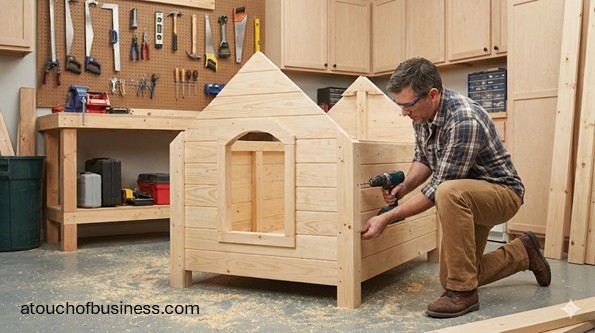
A dog house building business is a woodworking-based business that builds dog houses and outdoor dog shelters. You can sell standard models in a few sizes, offer custom builds, or sell flat-pack kits that customers assemble at home.
This is usually a small-scale business you can start on your own. Many owners begin in a home workshop or a small rented space, then add help later if demand grows.
How Does a Dog House Building Business Generate Revenue
You generate revenue by selling finished dog houses and related add-ons. Most startups keep it simple—standard models with limited options—then expand once the build process is stable.
Common revenue lines include standard dog houses, custom builds, insulated upgrades, flat-pack kits, delivery, and on-site placement or assembly where allowed.
Products, Services, And Customers
At launch, your best friend is a clear product list. You want customers to understand sizes, options, and what they get without a long back-and-forth.
Typical products and services include standard dog houses in preset sizes, custom-sized builds, optional insulation packages, flat-pack kits, replacement parts, and delivery or placement services when you can do it safely and legally.
Your customers are usually dog owners with a yard, patio, or porch. You may also sell to rescues, breeders, and kennels that want durable, repeatable units in batches.
If you want a quick snapshot of what business ownership feels like day to day, read this inside look at business ownership. It helps you picture the lifestyle before you commit.
Potential Advantages And Drawbacks
This business can be straightforward to start because you can launch with a small catalog and improve as you go. But it’s still a physical build business, so your body, your tools, and your workspace rules matter.
Potential advantages include repeatable builds once your designs are set, local demand tied to dog ownership, and the option to sell locally or ship kits.
Potential drawbacks include bulky products that are harder to move and ship, workshop limits in some neighborhoods, and real safety planning for cutting and sanding.
Step 1: Choose Your Build Focus And Business Model
Decide what you will build before you spend on tools or ads. Your build focus controls your materials, your workspace needs, and how fast you can deliver.
Pick a model that fits your life. Will this be a solo business, a partner build, or a business that may involve investors later? Most dog house builders start solo or with a partner, then add help after the process is proven.
Make one more call now: made-to-order, small ready-to-sell inventory, flat-pack kits, or a mix. Made-to-order reduces storage needs. Ready-to-sell helps faster delivery if you have space.
For broader planning points, review business start-up considerations and tie them back to your own situation.
Step 2: Validate Demand And Profit Potential
Demand is not the same as a business that pays you. You need both: customers who want the product and pricing that covers expenses and your pay.
Start with simple proof. Search your area for custom dog houses, outdoor dog shelters, and flat-pack dog house kits. Look at how many listings exist, how long they’ve been active, and what features show up again and again.
Use a basic supply-and-demand lens. If you need a refresher, read how supply and demand affects opportunity and apply it to your local market.
National context can help you sanity-check demand. The American Pet Products Association reports dog ownership at tens of millions of U.S. households. Use APPA’s pet industry statistics as background, then focus on local buying behavior.
Step 3: Decide Where You’ll Work And What “Location” Means Here
This business doesn’t depend on foot traffic unless you open a storefront. Location matters because of workshop space, zoning, noise, dust, storage, and how far you can deliver.
If you’re home-based, your first job is to confirm you’re allowed to run a workshop where you live. City and county rules can limit customer pickups, signage, and equipment use.
If you rent a shop, ask about permitted use, ventilation, dust control, and whether customers can pick up orders there. If you want more detail on choosing a location, use this location guide to think through the tradeoffs.
Step 4: Define Your Core Designs And Specs
If you offer “anything,” you’ll price wrong and build slow. Create three to five core designs with fixed specs so you can quote fast and build consistently.
Write down the specs for each model. Include dimensions, roof style, ventilation approach, floor elevation, materials, hardware, and finish type.
Prototype each model before you sell it. Your goal is to confirm build time, cut lists, assembly steps, and how the finished unit holds together.
Step 5: Know The Skills You Need (And What You Can Outsource)
You don’t need to be a master carpenter on day one, but you do need safe tool use, accurate measuring, and solid assembly habits. You also need basic quoting and clear customer communication.
Plan for the skill gaps now. If you don’t want to do design work, bookkeeping, or branding, you can learn the basics or work with a pro. A short consult can prevent expensive rework later.
If you want to build a support bench of experts, see how to build a team of professional advisors so you’re not guessing alone.
Step 6: Plan Your Equipment, Shop Setup, And Safety
Tool choices should match your product line. You don’t need every tool on day one, but you do need a setup that can cut accurately, assemble safely, and finish consistently.
Wood dust is a real health concern during cutting and sanding. Review OSHA’s wood dust overview and plan dust controls and personal protective gear from the start.
NIOSH has tested controls that can reduce dust from table saws. Use this NIOSH guidance on table saw dust control as a reference point when you choose your dust setup.
Here’s an essential equipment list to build and launch.
- Measuring And Layout: tape measures, combination square, speed square, straight edge, carpenter pencils/markers, calipers (optional for repeatable parts)
- Cutting And Shaping: table saw or circular saw with guide track, miter saw, jigsaw, router, drill/driver set, spare blades and bits
- Assembly And Fastening: impact driver, clamps (bar and corner), exterior-rated screws, nailer (optional) and compressor if pneumatic, exterior-rated adhesive/wood glue used according to product specs
- Sanding And Surface Prep: random orbit sander, sanding blocks, sandpaper assortment, hand files/rasps
- Finishing Tools: brushes/rollers, paint tray, drop cloths, masking tape, clean rags, stirring sticks, disposable gloves for finishing work
- Dust Control And Cleanup: shop vacuum with fine dust filter, dust collection hoses/adapters, dust collection system (as needed for your tool mix)
- Safety Gear: safety glasses, hearing protection, respiratory protection suitable for dust, work gloves, first aid kit, fire extinguisher appropriate for a workshop
- Work Surfaces And Storage: workbench/assembly table, sawhorses, shelving or lumber rack, bins for hardware, moisture-safe storage for finishes
- Delivery And Handling (If Offered): moving blankets, straps, hand truck or dolly, basic on-site tool kit, vehicle capacity plan for assembled units or kits
- Admin Setup: computer or tablet for quotes and invoices, phone line option, photo setup for product images (basic backdrop and lighting)
Step 7: Estimate Startup Essentials And Typical Cost Drivers
You need a clear list of what you must purchase and what you can delay. Scale matters here. A home workshop startup can cost far less than a rented shop with new tools and dust collection.
Build your startup cost estimate using quotes from real suppliers and tool sellers. If you want a structured method, use this guide to estimating startup costs and tailor it to your setup.
Here are common startup essentials and cost drivers to price out.
- Tools You Don’t Own Yet: saws, drill/driver, sander, clamps, blades/bits, dust collection
- Safety And Dust Controls: respirators, filters, hearing protection, shop vacuum upgrades, ventilation add-ons
- Materials And Hardware: exterior-rated lumber or sheet goods, fasteners, exterior adhesives, sealants, roofing materials, trim
- Finishes: exterior paint or stain, primer if used, brushes/rollers, cleanup supplies
- Workspace Costs: rent (if applicable), electrical upgrades, lighting, storage racks
- Packaging And Delivery: straps, blankets, protective corner guards, boxes if selling kits
- Business Setup: registration fees, permits as required, basic accounting and invoicing tools, website and branding items
Pricing guidance: get three quotes where you can. Price both new and used tools. Price materials from at least two suppliers so you understand your range before you promise a “standard price.”
Step 8: Set Your Pricing And Your Quote Process
Pricing has to cover more than wood and screws. It needs to cover your time, tool wear, shop costs, waste, and rework.
Start by timing your prototypes. Track minutes for cutting, assembly, sanding, and finishing. Then build a quote template that uses your real times, not guesses.
If you want a structured approach, use pricing guidance for products and services and adapt it to your build process.
Step 9: Choose Suppliers And Lock In Material Standards
Your finish quality depends on consistent materials. If you change lumber grades or hardware every week, your build quality will swing.
Pick a short supplier list. That usually includes a lumber yard or home improvement supplier, a hardware supplier, and a paint or finish supplier.
Set standards in writing: exterior-rated fasteners where needed, finish type, roof materials, and any insulation options you plan to offer. Keep it simple at launch so you can deliver on time.
Step 10: Write A Business Plan (Even If You Don’t Want A Loan)
A business plan is not only for funding. It’s for you. It forces you to define your model, pricing, target customers, and launch steps.
Keep it practical. Your plan should explain what you build, who you sell to, how you price, where you work, and how you will get your first customers.
If you want a guide, use how to write a business plan and keep it focused on startup decisions.
Step 11: Decide How You’ll Fund The Launch And Set Up Banking
Be honest about your funding plan. Are you using savings, a partner contribution, or a loan? If the business needs a rented shop, new tools, and a delivery vehicle, funding needs can rise fast.
Many owners start as a sole proprietorship when risk and volume are low, then form a limited liability company as the business grows. The right choice depends on your situation and state rules, so verify with your Secretary of State and a qualified professional if needed.
Set up a business bank account at a financial institution once your registration and tax setup supports it. Keep business income and expenses easy to track from day one.
If you’re exploring financing, start with how business loans work so you know what lenders typically request.
Step 12: Register The Business And Handle Tax Setup
This is where new owners freeze. Don’t. Just follow the steps and verify rules for your state and city.
At a high level, you will choose a structure, register if required, and set up tax IDs and accounts. The U.S. Small Business Administration explains the basics of registering your business and how it depends on your structure and location.
You can apply for an Employer Identification Number from the Internal Revenue Service using the IRS EIN application information. The SBA also explains federal and state tax ID setup at a starter level.
Licenses and permits vary. The SBA’s overview of licenses and permits is a good starting point, but you still have to confirm your city and county rules.
Varies by jurisdiction checklist: check your Secretary of State for entity registration and name rules, check your state tax agency for sales and employer accounts, and check your city or county for business licensing and zoning.
Ask your local office: Do I need a general business license for a home-based shop? Is customer pickup allowed at my address? Do I need a Certificate of Occupancy for this space?
If you plan to hire, learn the basics of worker classification using IRS guidance on employee vs. contractor status. Employers also need to understand federal employment taxes, and the IRS summarizes that in its employment tax overview.
Step 13: Plan Insurance And Risk Before You Deliver Anything
Insurance is part of risk control. General liability is commonly used in product and service businesses, and some landlords or clients may require proof before you can work with them.
If you hire employees, workers’ compensation rules are set at the state level. Start with your state workers’ compensation agency’s guidance, then confirm requirements with your state workers’ compensation authority.
For a broader overview, see business insurance basics and decide what coverage matches your setup.
Step 14: Lock In Your Name, Domain, And Basic Online Presence
Your name has to be usable in the real world. That means it should be available with your state, and it should be easy to spell and search.
Check your state database and secure your domain and social handles. If you want a structured process, follow this guide to selecting a business name.
Step 15: Build Your Brand Identity And Proof Assets
Brand identity is not about looking fancy. It’s about looking consistent so customers trust you enough to place an order.
At launch, focus on a simple logo, consistent colors, and clean product photos. If you need help, read corporate identity package considerations.
Basic items to prepare include business cards and signs if you allow pickups or have a shop. Use business card basics and business sign considerations if they apply to your setup.
Also prepare proof assets that reduce questions: a size chart, options list, lead time statement, and clear photos of each model from multiple angles.
Step 16: Decide How You Will Accept Payment And Document Orders
If you’re building custom products, your paperwork matters. You need clear specs, a clear price, and clear rules for changes.
Set up a simple order process that includes a written spec sheet, a quote, and a confirmation step before you cut materials. Decide what you will accept payment by and when, and keep it consistent.
Prepare basics you’ll use from day one: invoice template, receipt method, and a simple terms page that covers lead times, pickup or delivery rules, and what counts as a change to the original request.
Step 17: Plan Your Pre-Launch Marketing And First Customer Flow
You don’t need a huge marketing system at launch. You need a clear way for customers to find you and a clear way to request a quote.
Common early channels include a simple website, local listings, social profiles with clear photos, and local partnerships. If you need a starting point, use an overview of building a business website.
If you choose a storefront or showroom, you may also plan a launch event. If that fits your model, review grand opening ideas and keep it realistic for your budget and time.
Step 18: Run A Small Pre-Launch Test And Do A Final Checklist
Before you go wide, do a small test run. Take a few real orders, build them end to end, and track time and defects. Your goal is to confirm your process and your promised lead times.
Expect to adjust. You may tighten your options list, change a design detail, or simplify finishing steps so quality stays consistent.
Here’s a final pre-opening checklist to close gaps before you accept more orders.
- Compliance Check: business registration complete as required, tax setup complete as required, local licensing and zoning confirmed, workshop use allowed
- Tool And Safety Check: core tools ready, dust control in place, safety gear stocked, workspace organized for safe movement
- Product Readiness: core models finalized, specs written, size chart ready, photos complete, pricing template tested
- Order System: quote template, invoice method, payment method, written order confirmation process
- Marketing Kickoff: website or listings live, contact method tested, sample responses ready for common questions
- Delivery Plan: pickup rules defined, delivery area defined, packaging method tested for protection
A Day In The Life And Day-To-Day Work
Most days start with messages and quotes. Then you move into cutting, assembly, sanding, and finishing, with cleanup at the end so dust doesn’t pile up.
You’ll also spend time on photos, material runs, and delivery planning. If that mix sounds frustrating, be honest with yourself now.
Day to day tasks usually include reviewing requests, confirming sizes and options, creating cut lists, building and finishing, quality checks, and scheduling pickup or delivery.
Red Flags To Watch For Before You Commit
Red flags are not only about the market. They’re often about your setup and your rules.
Watch for these issues early so you don’t build yourself into a corner.
- Unclear Workspace Rules: you haven’t confirmed zoning, home occupation limits, or whether customer pickups are allowed
- No Dust Plan: you plan to cut and sand without dust control or respiratory protection
- Custom Orders With No Specs: you are willing to start builds without written dimensions, materials, options, and lead time
- Delivery Without A Method: you haven’t tested how you’ll protect and secure a bulky item during transport
- Pricing Based On Guessing: you have not timed a prototype build or priced real materials from suppliers
- Legal Steps Delayed: you plan to sell first and “fix it later” on registration, taxes, and local rules
Recap And Is This The Right Fit For You
A dog house building business is usually a small-scale startup you can begin on your own. The key is getting clear on your models, your build specs, your workspace rules, and your pricing before you go public.
If you like hands-on work, you can follow specs, and you can handle responsibility, this can fit. If you hate detail work, don’t like physical builds, or want quick and easy income, you’ll feel the pressure fast.
So ask yourself: Do you have a workable space, basic tool skills, and a way to fund the first builds? Are you willing to do careful setup—registration, local rules, proof assets—before you chase sales? If the answer is yes, your next step is simple: prototype one core model and price it using real numbers.
101 Tips to Improve and Grow Your Dog House Building Business
This section pulls together practical tips that touch everything from your product decisions to your daily workflow.
Use the ideas that match your goals and skip anything that doesn’t fit your setup.
Bookmark this page so you can return to it when you feel stuck or want to tighten up your process.
Pick one tip at a time, implement it, then move to the next when the timing is right.
What to Do Before Starting
1. Define your starting product line as three to five standard models with clear sizes and options so quotes don’t turn into long back-and-forth messages.
2. Build a simple size guide that ties interior floor space and doorway size to the dog’s measurements so customers can self-select faster.
3. Prototype every model you plan to sell and time each stage (cutting, assembly, sanding, finishing) so your lead times are based on reality.
4. Write a basic spec sheet for each model that lists materials, hardware, roof style, ventilation approach, and finish so you can build consistently.
5. Decide upfront whether you sell assembled units, flat-pack kits, or both, because that choice changes packaging, delivery, and customer expectations.
6. Set a materials standard for pet safety: smooth interior surfaces, no sharp edges, and finishes that cure fully before handoff.
7. Make a policy for pressure-treated and reclaimed wood before you buy materials in bulk, especially if a dog could chew the surface or touch it daily.
8. Confirm your workspace is allowed for your activity before you scale up—local zoning and home-occupation rules can limit noise, dust, and customer pickup.
9. Create a dust-control and housekeeping plan before you run production, because wood dust can be a health hazard during cutting and sanding.
10. Decide how you’ll handle waste wood and sawdust now (storage, separation, disposal) so it doesn’t pile up and create safety problems.
11. Set up your legal basics early: business registration where required, tax accounts where required, and a separate business bank account to keep records clean.
12. Put basic risk controls in place before selling: general liability coverage, safe delivery practices, and a written process for handling damage claims.
What Successful Dog House Building Business Owners Do
13. They standardize repeatable parts and build using templates or jigs so quality stays consistent when volume rises.
14. They keep a “bill of materials” for every model, including exact fasteners and finish, so reorders don’t rely on memory.
15. They photograph every completed build in the same lighting and angles, building a library that makes selling easier.
16. They track real build time per model and adjust pricing when the numbers show a problem, not when cash gets tight.
17. They maintain a short list of reliable suppliers and keep backup options for critical items like exterior hardware and weatherproof finishes.
18. They use a written quality check for every unit: stability, roof fit, ventilation openings, smooth edges, and hardware tightness.
19. They set clear boundaries on customization so “custom” doesn’t become a new design every time.
20. They keep one finished example of each core model on hand when possible to speed customer decisions and reduce returns.
21. They document lessons learned after each busy season and update specs and processes before the next wave hits.
Running the Business (Operations, Staffing, SOPs)
22. Use a single quoting template that asks for the dog’s measurements, the local climate, indoor or outdoor use, and whether the dog is a chewer.
23. Require written approval of the final specs before you cut material so “small changes” don’t turn into unpaid rebuilds.
24. Batch similar work (cutting day, assembly day, finishing day) to reduce tool changes and shorten total build time.
25. Keep a labeled hardware system (bins by size and type) so you don’t lose time hunting for screws and brackets.
26. Store finishes and adhesives correctly and track open dates so you don’t use degraded materials that cause early failures.
27. Treat sanding and edge finishing as a safety step, not a cosmetic step—customers notice splinters and sharp corners immediately.
28. Create a finishing checklist that includes cure time, temperature limits, and handling rules so products don’t get delivered “too soon.”
29. Build a dust-control routine into the day: capture dust at the tool, clean floors and surfaces, and avoid letting fine dust accumulate.
30. Separate dusty work from finishing work so dust doesn’t land in wet paint or stain.
31. Maintain blades and bits on a schedule; dull cutting tools raise risk and reduce cut quality.
32. Use a simple job tracking board (digital or physical) that shows each order’s stage so nothing gets lost mid-build.
33. If you add help, train on tool safety, dust control, and quality checks before you let anyone work alone.
34. Assign one person to final inspection for each job, even if it’s you, so accountability is clear.
35. Document your build steps as short written instructions so the work stays consistent when you’re busy or tired.
36. Make delivery and pickup a defined process: protect corners, secure loads, and confirm placement instructions with the customer before arrival.
What to Know About the Industry (Rules, Seasons, Supply, Risks)
37. Expect seasonal demand swings—interest often rises before cold weather and during storms—so plan inventory and marketing around your local climate.
38. Build for real-world weather: water-shedding roofs, raised floors, and ventilation that reduces heat buildup in warmer months.
39. Avoid product claims you can’t prove, especially about temperature performance; instead, describe materials and construction features clearly.
40. Treat sharp edges and exposed fasteners as a serious defect, because animal housing should be built to prevent injury.
41. If you sell to kennels, shelters, or commercial dog facilities, learn whether they follow specific housing standards and tailor specs accordingly.
42. Know that local rules can affect customers too—some places regulate outdoor dog conditions—so provide safe-use guidance without giving legal advice.
43. Watch your supply chain for exterior-rated materials; shortages of certain lumber, roofing materials, or fasteners can delay builds.
44. Plan for finish and adhesive limits; humidity and temperature can extend cure time and slow output even when orders are strong.
45. Take combustible dust seriously in any woodworking setup: dust buildup plus ignition sources can create fire risk.
46. Don’t assume reclaimed wood is safe; older treated wood can have preservatives that are hard to identify once tags are gone.
47. If you dispose of treated wood, follow safe handling practices and local disposal rules, which can vary by state and locality.
Marketing (Local, Digital, Offers, Community)
48. Build your marketing around proof: clear photos, a size guide, and a short list of options customers can understand quickly.
49. Show “scale” in photos (a dog, a person, or a tape measure) so customers don’t guess the size and order the wrong model.
50. Use short product names that match how customers search (size + roof style + key feature) so listings are easier to find.
51. Create a seasonal content plan tied to real needs: rain protection, summer shade, winter wind protection, and raised floors for damp yards.
52. Build partnerships with groomers, trainers, pet supply stores, and veterinarians by offering a simple referral process and a spec sheet they can share.
53. Donate or discount one unit for a rescue raffle or community event to get photos in the real world and build local recognition.
54. Make your website or listings answer common questions: lead time, delivery area, how sizing works, and what customers should measure.
55. Collect reviews consistently and ask customers to mention the model name and the dog’s size so future customers see relevant details.
56. Offer a “good-better-best” structure (basic, upgraded, premium) so customers can self-select without negotiating the entire build.
57. Use a simple quote request form that captures essentials so you can respond fast and consistently.
58. Photograph the build process occasionally to show craftsmanship, but keep it focused on what customers care about: durability, comfort features, and safe finishes.
59. Track which channels produce real orders, not just messages, so you spend time where it turns into revenue.
60. If you sell kits, create an assembly video and a clear printed instruction packet to reduce support requests.
61. Keep a small “ready-to-go” option available for urgent needs, but limit designs so it doesn’t disrupt custom orders.
Dealing with Customers (Trust, Education, Retention)
62. Start every inquiry by confirming the dog’s measurements, age, and behavior (especially chewing) so you recommend the right materials and features.
63. Ask where the dog house will sit (sun exposure, wind direction, drainage) so you can recommend placement and design options that fit the site.
64. Use plain-language explanations of ventilation, raised floors, and weatherproofing so customers understand value without feeling “sold.”
65. Provide a written quote that lists exactly what’s included and what costs extra so customers don’t assume features you didn’t price.
66. Use a change process: any change after approval gets a new price and timeline, in writing, before work continues.
67. Confirm finish color and texture with a sample or photo reference so “that’s not what I pictured” doesn’t happen at pickup.
68. If a customer wants features you don’t offer safely or reliably, say no and explain why in practical terms.
69. After delivery, send a short care and placement guide so customers use the product correctly and get better results.
70. Create a repeat-customer path: seasonal upgrades, replacement roofs, or matching units for multi-dog households.
71. Keep a record of each customer’s model specs so reorders don’t start from scratch.
Customer Service (Policies, Guarantees, Feedback)
72. Write a simple warranty that covers workmanship issues and clearly excludes damage from misuse, chewing beyond normal wear, and extreme events.
73. Set a damage-on-delivery process: photos, a short reporting window, and clear next steps so issues don’t drag on.
74. Use a pickup policy that prevents rushed handoffs; confirm the customer has the right vehicle size and tie-down points before they arrive.
75. For delivery, confirm placement responsibility in advance so you don’t end up moving heavy units across unsafe terrain.
76. Keep a short “common fixes” kit ready (touch-up finish, spare fasteners, sealant) so small issues don’t become big problems.
77. Create a feedback loop: ask one focused question after delivery, then update your specs if the same issue repeats.
78. Track returns and complaints by model so you can spot design weaknesses and fix them permanently.
79. If a customer is unhappy, start by restating the approved specs and photos, then offer solutions that match what was agreed.
80. Set response-time expectations for yourself and communicate them, so customers aren’t left guessing when they’ll hear back.
Sustainability (Waste, Sourcing, Long-Term)
81. Optimize cut plans to reduce scrap, then reuse offcuts for small add-ons like trim, raised feet, or entry windbreak parts.
82. Separate clean wood scrap from treated or painted wood so recycling and disposal are safer and easier.
83. Find a local outlet for sawdust and clean scrap where allowed, but confirm local rules and avoid sending treated wood to the wrong place.
84. Offer responsibly sourced wood options when feasible and be clear about what certification means, instead of making vague claims.
85. Choose finishes that are designed for exterior use and follow label directions so the product lasts longer and reduces early replacement.
86. Design for repair: replaceable roof panels and floors can extend product life and reduce waste for the customer.
87. Never burn treated wood or dispose of it casually; treat it as a special waste stream and follow safe handling guidance.
Staying Informed (Trends, Sources, Cadence)
88. Review safety guidance for woodworking dust control at least once a year and update your shop rules as your tool set changes.
89. Watch pet industry trend reports annually to understand how spending and preferences shift, then adjust your product options accordingly.
90. Check your state tax agency and local licensing portal periodically because requirements and forms can change over time.
91. Track competitor offerings quarterly to see which features are becoming standard, then decide whether to match or differentiate.
92. Keep a simple log of which models sell best by season so you base decisions on your data, not guesses.
Adapting to Change (Seasonality, Shocks, Competition, Tech)
93. Build a winter-ready plan and a summer-ready plan so you can shift messaging and features without redesigning everything.
94. Keep two suppliers for critical items like exterior fasteners and roofing materials so you can keep building during shortages.
95. If demand spikes, reduce customization temporarily and focus on your best-selling standard models to protect quality.
96. Use simple design software or templates to speed quoting and reduce errors, especially when customers request non-standard sizes.
What Not to Do
97. Don’t accept a custom build without written specs, because unclear expectations are the fastest route to disputes.
98. Don’t use reclaimed treated wood when you can’t identify the preservative, especially where a dog may chew or spend long periods.
99. Don’t ignore dust control and housekeeping; fine dust can harm health and increase fire risk when it accumulates.
100. Don’t promise exact delivery dates without buffer time for cure time, weather, and supplier delays.
101. Don’t expand into delivery, on-site assembly, or signage without confirming local rules, because permits and restrictions vary by jurisdiction.
Use these tips as a checklist for tightening up quality, reducing avoidable problems, and making it easier for customers to say yes.
If you want the fastest progress, focus on three areas first: clear specs, consistent build steps, and a quoting process that prevents surprises.
FAQs
Question: Can I start a dog house building business from a home workshop?
Answer: Often, yes, if local rules allow it and you can control noise and dust.
Check home-occupation and zoning rules before you invest in tools or marketing.
Question: What business structure should I start with?
Answer: Many owners start as a sole proprietor and later form a limited liability company as sales and risk grow.
Check your state’s Secretary of State guidance and talk with a qualified tax or legal professional before you choose.
Question: When do I need an Employer Identification Number (EIN)?
Answer: Get an Employer Identification Number (EIN) when you need a federal tax ID for banking, hiring, or certain filings.
Apply directly through the Internal Revenue Service and avoid sites that charge a fee.
Question: What state tax accounts should I expect to set up?
Answer: If your state taxes the products you sell, you may need a sales tax permit and a way to file returns.
If you hire, you may also need state employer accounts tied to payroll programs.
Question: Do I have to charge sales tax on dog houses I sell?
Answer: Product tax rules vary by state and sometimes by local area.
Verify taxability and registration steps with your state tax agency before your first sale.
Question: What licenses or permits should I check before I start selling?
Answer: Start with a general business license, zoning, and home-occupation rules if you work from home.
If you rent a shop, confirm the use is allowed for woodworking and any customer pickup.
Question: Will I need a Certificate of Occupancy for a rented workshop?
Answer: Some cities require a Certificate of Occupancy for certain uses or when a space changes hands.
Ask the local building department before you sign a lease or build out the space.
Question: What insurance should I have before I accept my first order?
Answer: General liability coverage is a common baseline for product businesses.
If you have employees, check your state rules for workers’ compensation coverage.
Question: What safety setup matters most in a small woodworking shop?
Answer: Wood dust control and basic personal protective gear should be non-negotiable.
Set up dust capture at the tool, clean regularly, and use respiratory protection when cutting or sanding.
Question: What tools do I need to launch without overbuying?
Answer: Start with accurate measuring tools, a reliable saw setup, a drill/driver, clamps, and a sander.
Add specialty tools after you prove which models sell and what slows your builds.
Question: Are there materials I should avoid for dog safety and liability reasons?
Answer: Avoid mystery wood and questionable finishes on surfaces a dog can touch or chew.
Be careful with older pressure-treated lumber, because some older treated wood used chemicals like chromated copper arsenate.
Question: What should I know about handling and disposing of treated wood?
Answer: Rules for treated wood disposal can vary by state.
Follow official guidance and never assume you can burn, chip, or grind treated wood safely.
Question: How do I choose suppliers and keep quality consistent?
Answer: Pick a short supplier list and lock in a written material standard for each model.
Consistency in lumber grade, fasteners, and exterior finishes reduces rework and complaints.
Question: How do I set up pricing so it covers my time and overhead?
Answer: Base pricing on a bill of materials plus your measured labor time, overhead, and a waste allowance.
Prototype and time every model so you are not pricing from guesswork.
Question: What should my startup budget include besides tools and lumber?
Answer: Budget for registration fees, permits where required, insurance, and safety and dust-control gear.
Add a cash buffer for material price swings and finish cure-time delays.
Question: Should I sell assembled dog houses, flat-pack kits, or both?
Answer: Assembled units can be simpler to deliver as a finished product, but they are harder to store and transport.
Kits can expand your reach, but they require clear instructions and a plan for assembly support.
Question: What workflow keeps builds consistent once orders start coming in?
Answer: Use a written spec sheet, a customer approval checkpoint, a cut list, and a final inspection checklist.
A simple stage board (quote, build, finish, ready) helps you avoid dropped jobs.
Question: What numbers should I track to know if the business is healthy?
Answer: Track quotes sent, orders won, average build hours per model, and material cost per build.
Also track defects and rework time, because those two can erase profit fast.
Question: When should I hire help, and what tasks should I delegate first?
Answer: Hire when backlog starts hurting quality or lead times.
Start with prep and sanding, finishing support, and delivery help, then add skilled build labor after your process is documented.
Question: If I sell to kennels or commercial facilities, do any standards affect my specs?
Answer: Some facilities follow Animal Welfare Act standards and may have specific expectations for shelter and temperature protection.
Ask buyers what standards they must meet and build from documented specs, not assumptions.
Related Articles
- How to Start a Profitable Dog Treat Business
- How to Start a Successful Dog Training Business
- How to Start a Profitable Dog Kennel Business
- How to Start a Successful Dog Grooming Business
- How to Start a Dog Walking Business Beginner’s Guide
- Start a Pet Sitting Business: Complete Step-by-Step Guide
Sources
- American Pet Products Association — Industry Trends and Stats
- Centers for Disease Control and Prevention / NIOSH — Table Saw Dust Control
- Internal Revenue Service — Get an Employer Identification Number
- Internal Revenue Service — Independent Contractor or Employee
- Internal Revenue Service — Understanding Employment Taxes
- Occupational Safety and Health Administration — Wood Dust Overview
- U.S. Department of Labor — Workers’ Compensation
- U.S. Small Business Administration — Register Your Business
- U.S. Small Business Administration — Federal and State Tax ID Numbers
- U.S. Small Business Administration — Apply for Licenses and Permits
- U.S. Environmental Protection Agency — CCA Overview
- U.S. Consumer Product Safety Commission — CCA-Treated Wood
- USDA APHIS — Dog Temperature Requirements
- American Veterinary Medical Association — Companion Animal Care Guidelines
- U.S. Environmental Protection Agency — Construction and Demolition Best Practices
- USA.gov — Workers’ Compensation
- National Pesticide Information Center — CCA Treated Wood