
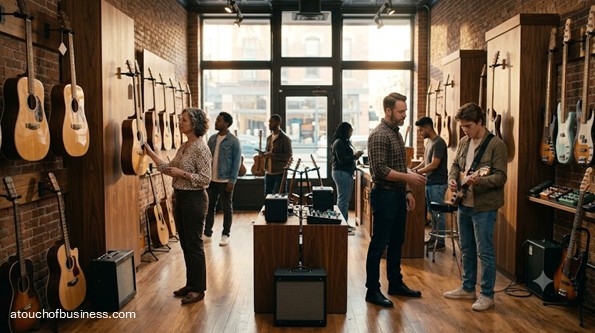
What to Expect From This Guide to Starting a Guitar Shop
This guide walks through the key points to starting a guitar shop, from evaluating personal fit and local demand to building inventory, setting up the store, and preparing to open. The highlights below represent only part of the detailed guidance included.
Inside the guide, you will find:
- Startup steps: Follow an ordered path from owner fit and niche selection through registration, store setup, staffing, and pre-opening checks.
- Industry interviews: Hear owners and retail professionals discuss specialized inventory, customer trust, repairs, online sales, growth, and operating challenges.
- Startup FAQs: Find practical answers about dealer authorization, pricing policies, used-guitar licensing, humidity control, lessons, membership, and inventory priorities.
- Business fit: Weigh product knowledge, household finances, risk tolerance, competition, local demand, and whether a focused niche can stand out.
- Financial planning: Examine revenue streams, startup costs, break-even calculations, operating capital, pricing, payment systems, and slower sales periods.
- Store preparation: Plan the lease, layout, displays, humidity control, security, repair or lesson areas, software, inventory, and opening checks.
- Requirements and warnings: Review location-dependent rules, dealer access, inventory risks, compliance concerns, and problems that should delay opening.
Begin by considering what guitar retail involves each day and whether the business fits your skills, finances, and circumstances.
How to Start a Guitar Shop
As a guitar shop owner, you stock, display, and sell guitars and guitar-related gear from a retail storefront.
Your inventory can range from entry-level acoustics for first-time players to high-end electrics for serious collectors. Many owners also run repair services, give lessons, and buy used and consignment instruments alongside new stock.
The storefront model puts the in-person experience at the center of the business. Customers come in to play before they buy, ask detailed questions, and get instruments set up the way they want them. That’s something online retailers can’t replicate — and it’s the clearest reason someone chooses your shop over a website.
But this is also a competitive, capital-intensive retail category. Independent guitar shops face pressure from national chains, major online retailers, and peer-to-peer used gear platforms. Getting honest about those realities before you invest is the most important thing you can do at this stage.
Is a Guitar Shop Right for You?
Do you have deep knowledge of guitars, amplifiers, effects, and accessories — the kind customers can sense within the first two minutes of a conversation?
Product expertise isn’t optional here. It’s the foundation of every sale, every trade-in evaluation, and every repair intake.
Think about what running this business actually involves day to day. You’re receiving shipments and entering inventory, assisting customers on the sales floor, buying used instruments from walk-in sellers, managing supplier accounts, keeping humidity levels stable in the store, processing repairs, and closing the register. On a slow Tuesday, you’re doing most of that alone.
Before you go further, talk to people who run guitar shops in other markets — owners you won’t compete against. Ask them what they’d do differently. Ask whether their model actually supports the operation financially. Ask what they know now that they wish they’d known before opening.
Each owner’s story is different, but firsthand experience is worth more than any industry overview.
Also think honestly about your household. Can your family manage reduced or unpredictable income while you ramp up?
Retail inventory businesses often take longer to reach break-even than first-time owners expect. Your household’s ability to carry that gap without serious strain belongs in the plan from the beginning.
The possibility of failure is real. Knowing that going in — and building a plan that accounts for it — is more useful than optimism alone.
You can also read more about the hardest parts of business ownership before you commit.
There’s also the question of how you’d enter. Starting from scratch versus buying an existing guitar shop are very different paths.
A shop for sale may come with inventory, a lease, supplier relationships, and an established customer base. What it also comes with is the previous owner’s reputation and any liabilities they leave behind.
Inspect the inventory condition, lease terms, supplier standing, and accounts carefully before any purchase.
Note that a standard franchise model doesn’t exist in independent guitar retail. Don’t build a plan around that option unless you’ve found a specific, verified opportunity.
Red Flags Before You Start
Some conditions should make you pause before committing to this business.
Weak local demand or no clear gap in the market:
If your area already has a Guitar Center, strong online purchase habits, and another independent shop, opening a general-line guitar store without a clear differentiation is a serious risk. Verify that a gap actually exists before signing a lease.
Authorized dealer access problems:
If the major brands you want to carry — Fender, Gibson, Taylor, Martin, PRS — deny or delay your dealer application, you may not be able to stock the instruments customers most want.
Some major brands require minimum opening orders and display commitments that a small startup can’t meet. Research brand authorization requirements before finalizing your business model.
Insufficient capital:
Guitar retail is inventory-intensive. You need enough capital not only to open, but to cover rent, utilities, staff, insurance, and restocking for a realistic period before sales reach a sustainable level.
Running short on operating capital before the store builds momentum is one of the most common reasons retail startups close.
No clear niche:
Trying to out-stock or out-price Guitar Center and major online retailers on general inventory isn’t a viable strategy for most independent startups.
Successful independent shops tend to focus: vintage instruments, boutique or hard-to-find brands, expert repair, high-end acoustics, a specific musical community. What’s yours?
Margin pressure on new instruments:
New guitar retail margins on commodity and mid-range instruments are structurally thin. Accessories — strings, picks, cables, straps — typically carry better margins.
Repair and lessons, if you offer them, tend to improve the overall picture. A business built entirely on new instrument sales at competitive price points faces real financial strain.
Structural industry pressure:
Independent music retail is an established but intensely competitive industry. Storied retailers with long histories have closed.
Online retailers have permanently shifted buying habits for new instruments. Peer-to-peer platforms have made it easier for buyers and sellers to transact without a middleman.
This doesn’t mean the opportunity doesn’t exist — it means the model and niche must be thought through carefully.
No humidity control plan:
If you’re not prepared to maintain proper humidity in the store, your acoustic guitar inventory is at risk from the day it goes up on the wall. Cracked tops, warped necks, and finish checking are real and expensive losses that also damage your reputation.
Step 1: Assess Owner Fit and Business Reality
The first thing to sort out is whether this business actually fits you — not just your interest in guitars, but your capacity to run a capital-intensive retail operation in a competitive market.
Start by being direct with yourself about your product knowledge. Do you understand the differences between guitar models, brands, and construction quality well enough to guide a beginner and impress a collector?
Can you evaluate a used instrument’s condition and fair market value on the spot? Those skills determine whether customers trust you — and whether they come back.
Your risk tolerance matters too. Retail income is variable. Slow periods happen. Your household needs to absorb that uncertainty for as long as it takes the business to stabilize.
Talk to guitar shop owners in other markets before you go further. Prepare specific questions: What does a typical week look like? Which revenue stream actually carries the business — instrument sales, repair, lessons, or accessories?
What do they know now that would have changed how they started? Their answers will shape your plan more than any article can.
Step 2: Define Your Business Model and Niche Focus
What kind of guitar shop are you actually opening? The answer changes your inventory requirements, supplier relationships, lease needs, staffing, margins, and customer base.
A general-line guitar shop that competes on broad selection is a difficult model for an independent startup. The shops that survive tend to be clear about what they specialize in. Some common directions:
- Used and vintage instruments
- High-end or collector-level guitars
- A specific instrument type — all acoustic, all classical, lap steel, or bass
- Boutique and hard-to-find brands not carried by the national chains
- Repair and setup as the anchor, with retail alongside it
- A hybrid new, used, and consignment model built around a specific musical community
Each niche changes what this startup looks like. A repair-focused shop needs bench tools, a technician, and work order systems. A vintage shop needs deep knowledge of older instruments, awareness of regulated wood species, and sourcing relationships. A lesson-plus-retail model needs studio space, instructors, and scheduling software.
Decide early whether you’ll buy used instruments from the public. This changes your compliance picture — many jurisdictions require a secondhand dealer license when you buy used musical instruments from walk-in sellers. Knowing your model now saves costly corrections later.
Also decide whether you’ll offer lessons on the premises. That choice affects your space needs, staffing, insurance, and scheduling systems — and it’s a meaningful source of recurring revenue that also drives accessory sales.
Step 3: Research Local Market Demand and Competition
Before committing to a location or an inventory order, find out whether the market can actually support your niche. Local supply and demand research is a go/no-go step, not a formality.
Map out what already exists: Guitar Center locations, other independent shops, pawn shops that handle instruments, big-box stores with instrument sections. Then ask what’s missing.
Is there no strong vintage dealer? No shop focused on acoustic instruments? No repair-first destination?
Think about where your first customers will come from and why they’d choose your shop over the alternatives. Music teachers who refer students. Churches and schools that need instruments in quantity. Gigging musicians who want reliable, fast repair service. Collectors looking for instruments the chains don’t carry.
The answer shapes your niche, your location, and how you introduce yourself to the community at launch.
Location matters a great deal for a storefront. Proximity to music schools, recording studios, colleges with music programs, and active live music venues generates consistent foot traffic from people already in the market.
Suburban locations often offer lower rent and easier parking while still drawing from a large population. Assess both options against your budget and your target customer.
Step 4: Research Entry Paths — Start or Buy
Starting from scratch gives you full control over your niche, inventory, and store identity — but you build a customer base from zero and absorb the startup period entirely on your own capital.
Buying an existing guitar shop can give you immediate revenue, an established customer base, supplier accounts, and an existing lease. That changes your financial picture significantly.
What it doesn’t give you automatically is the previous owner’s authorized dealer agreements. Most brand agreements don’t transfer; you’ll likely need to reapply.
Inspect everything — inventory condition, lease terms, outstanding liabilities, and supplier standing — before you make any offer.
The best entry route depends on your budget, your timeline, and how much startup support you need.
Business Plan
Your business plan is where you turn your niche decision and market research into a financial reality check before you spend any meaningful money.
Think of it as the document that answers whether this business can actually work — in your market, with your capital, at your chosen scale.
Start with your revenue model. How will you generate income — new instrument sales, used and consignment sales, repair and setup services, lessons, accessories, or some combination?
Each stream has a different margin profile and a different cost structure. Accessories typically carry better margins than new instruments. Services like repair and lessons can improve your overall margin picture, but they require additional capability and space.
Map your startup cost categories: lease deposit, build-out, fixtures, inventory, humidity control systems, POS hardware and software, insurance, licenses, and operating capital. Then be honest about how much capital you need to stay open — not just to open.
The break-even question is critical. What is your total monthly fixed cost — rent, utilities, staff, insurance, loan payments?
What is your average sale? How many transactions per month cover the fixed costs before you reach profitability?
Work through this with your own local numbers, not assumptions. New instrument retail margins are structurally thin, especially at popular price points. Accessories, repair, and lessons improve the picture, but the volume math still has to work.
Plan for slow periods. Guitar retail has seasonal patterns. If your fixed costs don’t flex and sales dip for two or three months, does your operating capital cover the gap?
Build that scenario into the plan before you’re in it.
Include a section on how you’ll reach customers at opening — a practical list: music teachers in the area, schools and churches, local bands, recording studios, musicians you already know. Those relationships generate your first sales.
If you need outside funding, a well-organized plan is what lenders and investors evaluate. You can find guidance on writing a business plan and getting a business loan.
Step 5: Choose a Legal Structure and Register the Business
Choose an entity type before you open any bank accounts, apply for licenses, or sign a lease.
Most independent guitar shop owners choose an LLC for the liability protection it provides. Consult an attorney or accountant to confirm the right structure for your situation — this decision affects how your income is taxed and how your personal assets are protected.
Once you’ve chosen a structure, register the entity with your state’s Secretary of State or equivalent agency.
If you’re operating under a trade name different from your legal entity name, you’ll also need to register a DBA.
Obtain your Employer Identification Number (EIN) from the IRS. You need it for business banking, tax filings, and supplier accounts — even if you’re not hiring anyone right away.
Register with your state’s revenue agency for sales tax and, if you’re hiring, for employer withholding.
Step 6: Check Zoning and Secure a Lease
Before you sign any lease, confirm the location is zoned for retail. This is usually straightforward for a guitar shop, but confirm with the local planning or zoning office before assuming.
If you plan to offer guitar repair using lacquers, solvents, or chemical finishes, ask specifically whether the zoning or building permits that use and whether you’ll need additional ventilation or permits. Get that answer before you commit to the space.
Evaluate the space carefully against your intended layout. You need room for wall-mounted instrument display, a customer try-out area where people can plug in and play, display cases for accessories and high-value items, storage for receiving and back stock, and a repair bench area if offering repair.
Lesson studios, if applicable, need acoustic separation from the sales floor.
Look closely at the HVAC system. Instruments are sensitive to temperature swings and humidity extremes. If the building’s existing system can’t maintain stable conditions, factor the cost of upgrades into your lease negotiation.
Negotiate carefully. Lease terms, rent escalation clauses, tenant improvement allowances, lease length, and renewal options all affect your financial picture for years. Don’t sign without understanding every provision.
Exterior visibility matters. A sign on a low-traffic side street doesn’t generate the walk-by awareness that a well-placed storefront does. Parking accessibility draws customers who might otherwise keep driving. Think about how your target customers move through the area, not just how many people pass by.
Step 7: Obtain Licenses, Permits, and Compliance Items
Guitar retail has a layered compliance picture. Work through it methodically rather than assuming a single business license covers everything.
Federal compliance items:
If you plan to play background music in the store, federal copyright law requires performance licenses. Three Performing Rights Organizations — ASCAP, BMI, and SESAC — each license different catalogs. Most stores need licenses from all three.
Playing commercially released music without a license is a copyright violation, regardless of how the music is accessed. Verify current requirements and annual fees directly at ASCAP.com, BMI.com, and SESAC.com.
If you plan to deal in vintage instruments, be aware of federal regulations on protected wood species. Brazilian rosewood (Dalbergia nigra) is subject to strict trade restrictions under CITES (Convention on International Trade in Endangered Species) and cannot be commercially traded.
Older guitars containing this wood require careful documentation. The U.S. Fish and Wildlife Service enforces these rules. If you’re buying and reselling vintage instruments, verify the wood species in any older guitar before you purchase it.
State compliance items:
Register for a seller’s permit and resale certificate through your state’s Department of Revenue or equivalent agency. The seller’s permit allows you to collect sales tax on retail sales. The resale certificate lets you buy inventory from suppliers tax-free. Both are required before you open.
If you’re buying used instruments from the public, many states require a secondhand dealer license — and many specifically list musical instruments as a covered category.
Check with your state’s consumer protection agency and your local city or county licensing office before you start buying used gear. This one is easy to overlook and important to get right.
If you’re hiring, set up employer tax withholding accounts with the state revenue agency. Workers’ compensation insurance is required by law in most states when you have employees; verify the requirement with your state labor agency.
City and county items:
Most cities require a general business license or local business tax registration before you open. Apply with the city clerk or business licensing office.
A certificate of occupancy is typically required before a retail store opens to the public. This follows an inspection by local building, fire, and zoning officials confirming the space meets code. If you’re doing a tenant build-out, this comes after construction is complete.
Exterior signs usually require a sign permit. Some cities have size, lighting, or placement restrictions. Get the permit before installing anything — this is a common oversight that creates fines and delays.
Some jurisdictions also require an alarm permit for commercial security systems. Check locally.
Step 8: Apply for Brand Authorizations and Open Supplier Accounts
Don’t wait until after you sign a lease to start this step. Authorized dealer applications take time, and some are denied. Begin the process as early as possible — ideally while you’re still evaluating your niche.
Major guitar brands — Gibson, Fender, Taylor, Martin, PRS, and others — require a formal authorized dealer agreement before they’ll supply new instruments. Without authorization, you can’t carry their new inventory with manufacturer warranties.
Each brand sets its own terms. Expect minimum opening order requirements, floor display commitments (some brands specify a minimum number of instruments on display), and Minimum Advertised Price (MAP) policies. MAP compliance is not optional — advertise below MAP and you lose the dealer relationship.
Not every major brand is accessible to a small new independent. Some require volume or footprint commitments that a startup can’t meet. Research which brands have dealer programs suited to your size before you build your model around them.
Open accounts with national and regional music product distributors. A distributor relationship gives you access to multiple brands through a single account and simplifies ordering.
Ask about payment terms — net 30 or net 60 terms from distributors reduce your immediate cash demand and help with inventory cash flow.
Ask about consignment programs for new dealers. Some manufacturers and distributors will stock instruments on consignment to help a new shop get up and running, reducing the upfront inventory capital requirement. Not every brand offers this, but it’s worth asking.
For used inventory, develop sourcing relationships with local musicians, estate sales, and pawn shops.
Write a clear consignment agreement covering commission rates, holding period, payment terms, condition standards, and liability before you take in any consignment instrument.
Step 9: Set Up Equipment, Fixtures, and the Store Environment
The physical setup of your store is both a compliance requirement and a sales tool. How instruments are displayed, how the space feels to a customer walking in, and whether the environment protects your inventory all matter before day one.
Display systems:
Install wall-mounted slatwall panels or pegboard with guitar hangers and hooks. This is the standard display system for guitars — it saves floor space, puts instruments at eye level, and makes the store look stocked and organized.
Plan the hook count carefully; some brand agreements specify how many instruments of their line must be on display.
Add floor display stands for additional instruments, glass counter cases for high-value accessories, and shelving for amplifiers and larger gear. The checkout counter needs space for the POS terminal, payment processing equipment, and receipt printer.
Humidity control:
Acoustic guitars require 45–55% relative humidity. Below that range, tops crack, fretboards dry out, and necks shift.
Install digital hygrometers throughout the store and a humidification or combined humidifier/dehumidifier system rated for your square footage. This protects your inventory from the day it arrives.
Repair bench (if offering repair):
Set up a dedicated workbench with proper lighting, tool storage, and adequate ventilation if you’ll use lacquers or solvents. The bench should be separated from the sales floor, both for workspace efficiency and for customer safety.
Lesson studio (if offering lessons):
The studio needs acoustic separation from the sales floor — sound bleed distracts customers and makes lessons hard to hear. A basic setup includes sound-absorbing wall treatment, seating, a music stand, and a guitar amplifier.
Security:
Install a monitored commercial alarm system and a camera system covering the sales floor, storage area, and entry points. High-value instruments on wall display overnight should be secured — some shops use cable locks or overnight storage in a back room for the most valuable pieces.
POS and inventory systems:
Choose a POS system designed for music stores rather than general retail. Music-store-specific platforms handle serialized inventory tracking (each instrument has a serial number), repair work orders, consignment tracking, rental management, and lesson scheduling in a single system.
General retail POS software can work but lacks these capabilities. This choice changes your daily workflow significantly — serialized inventory alone makes a guitar shop operationally more complex than most retail.
Step 10: Build Opening Inventory
Your inventory is your most important startup cost and your most important sales tool. Getting the mix right from the start matters more in guitar retail than in most product categories.
A focused, well-chosen inventory beats a broad, thin one. A store carrying 30 guitars that represent a clear niche looks more confident and authoritative than one carrying 80 guitars that don’t signal what the shop stands for.
Your assortment is your positioning.
Work with your authorized distributors and brand reps to place opening orders. Before any instrument goes on the wall, it should be set up: action adjusted, intonation checked, neck relief confirmed, and strings changed if needed.
Instruments that play well sell. Instruments that don’t play well come back — or sit on the wall.
Build the used inventory in the weeks before opening through buy-backs, trade-ins, and consignment sourcing. Enter every instrument into the POS system with its serial number, condition notes, and price before the store opens.
Receiving, photographing, tagging, and entering inventory takes longer than most new owners expect — don’t compress this into the final days before launch.
Stock accessories well from day one. Strings, picks, cables, straps, tuners, cases, and capos are high-margin, fast-turning products that nearly every customer buys.
An accessory wall that looks fully stocked signals that the store is professional and ready. A thin one does the opposite.
Step 11: Set Up Pricing, Payments, and Financial Systems
Price every piece of new inventory within MAP compliance for each brand. Advertising below MAP — even on an in-store price tag visible to customers — can put your dealer relationship at risk.
Understand each brand’s MAP policy before you set a single price.
For used and vintage instruments, research current resale values on peer-to-peer platforms to understand what the market will bear. Condition, brand, model, and current demand all affect where a used guitar should be priced.
Your goal is a price the customer finds fair and that leaves you adequate margin after your acquisition cost.
Set service pricing for repair and setup before opening — customers will ask on day one. Research what similar services cost at other shops in your market.
Open a dedicated business bank account and keep business finances completely separate from personal finances from the very beginning.
Set up accounting software connected to your POS — for a retail shop with inventory, repair services, and possibly lessons, accurate books are essential from the start.
Set up a merchant account and confirm your payment processing terminal integrates with your POS. Test it before opening day.
Finalize written policies for returns, exchanges, trade-ins, consignment terms, and repair warranties before any customer walks in. These policies protect you and set clear expectations.
Step 12: Hire and Train Staff
A small guitar shop can open owner-operated, but the moment you bring someone onto the sales floor, their product knowledge represents your business.
A customer who asks a detailed question about pickup configurations or fret material and gets a blank stare doesn’t come back.
Prioritize guitar-playing experience and genuine product knowledge when hiring. Retail experience is useful. Product knowledge is non-negotiable.
If you’re offering repair, you need a qualified repair technician — either yourself, if you have those skills, or someone you hire.
The National Association of Professional Band Instrument Repair Technicians (NAPBIRT) maintains a network of repair schools and a member directory that can help you find trained technicians.
If you’re offering lessons, hire instructors who are qualified to teach in the styles your customer base wants to learn. Consider background check requirements for instructors who will teach minors — verify what’s required in your jurisdiction.
Complete all payroll registration and employer tax accounts before the first paycheck goes out.
You can find guidance on our post, when and how to hire.
Step 13: Complete Pre-Opening Checks and Launch
Don’t open until the checklist is complete. A missing permit, a non-functioning POS system, or a humidity problem discovered on opening day creates a poor first impression — and sometimes a compliance issue that has to be resolved under pressure.
Before opening, confirm:
- All licenses and permits received and posted as required
- Certificate of occupancy in place
- All insurance policies active and certificates on file
- Authorized dealer agreements confirmed with all target brands
- PRO performance licenses obtained if playing background music
- All inventory entered in POS, tagged, priced, and displayed
- Humidity control system active and reading within 45–55% RH
- POS system and payment processing tested with successful transactions
- Security system installed and monitored
- Repair bench tools and work order system ready (if offering repair)
- Lesson studio set up and tested (if offering lessons)
- Return and exchange policy posted at point of sale
- Store hours posted on the door and window
In the days before opening, contact local music teachers, music schools, recording studios, churches with music programs, and any local bands or musician communities you’re connected to.
These relationships are your first customer pipeline — not an afterthought.
Consider a soft opening or by-appointment preview before the full public launch. A day or two of limited traffic reveals operational gaps — in the POS workflow, the checkout process, the instrument intake system — before they happen in front of a full floor of customers.
Opening-Day Red Flags
These are the specific conditions that should stop you from opening — or signal a real problem if you notice them on launch day.
Instruments not set up before display. An acoustic guitar with high action doesn’t sell. A customer who picks it up, struggles to play it, and puts it back isn’t coming back. Every instrument on the wall should play well before opening day.
Humidity control not working. If your humidifier system isn’t maintaining the right range before you open, don’t put expensive acoustics on the wall. One dry week in a low-humidity environment can crack a guitar top.
POS or payment processing not fully tested. A system that fails during the first transaction creates a bad first impression and a scramble. Test everything — including the receipt printer and card reader — before you open the door.
No secondhand dealer license for shops buying used instruments. If you’re planning to buy a guitar from a walk-in seller on day one without having checked your local license requirements, stop. This is a compliance issue in many jurisdictions, not a technicality.
Background music playing without PRO licenses. Playing commercially released music in a retail space without ASCAP, BMI, and SESAC licenses is a copyright violation. If you haven’t obtained them, turn the music off until you do.
Certificate of occupancy not in place. Opening a retail store to the public before the certificate of occupancy is issued is a code violation in most jurisdictions. Confirm this is resolved before you unlock the door.
Inventory too thin to make a convincing presentation. If the walls look sparse and the accessory rack is mostly empty, hold the opening until the store looks ready. A weak first impression in a local market is hard to overcome — word travels fast in musician communities.
Frequently Asked Questions
Do I need to become an authorized dealer to sell new guitars from major brands like Fender, Gibson, or Taylor?
Yes. Major guitar brands require a formal authorized dealer agreement before they’ll supply new inventory. Without authorization, you can’t legally stock and sell their instruments with manufacturer warranties. Contact each brand’s sales or dealer relations department — or work through a music products distributor — to begin the application process.
What is a MAP policy and how does it affect my pricing?
MAP stands for Minimum Advertised Price. Guitar manufacturers set MAP policies to prevent authorized dealers from advertising products below a set price threshold. Violating MAP can cost you your dealer authorization for that brand. Understand each brand’s MAP rules before you commit to carrying that line.
If I want to buy and sell used guitars from walk-in sellers, do I need a special license?
Possibly — and in many places, yes. Many states and cities regulate secondhand dealers and specifically list musical instruments as a covered category.
Requirements vary by jurisdiction but may include a license, purchase record-keeping, identity verification of sellers, and regular reporting of purchased items to local law enforcement.
Check with your city or county licensing office and your state’s consumer protection agency before buying used instruments from the public.
How important is humidity control in a guitar retail store?
Very important. Acoustic guitars are vulnerable to low-humidity damage — cracked tops, warped necks, fret sprouting, and finish problems.
Most guidance recommends maintaining 45–55% relative humidity. Failing to control humidity in your store can damage your own inventory, leading to costly losses and customer returns.
Is it realistic to compete against Guitar Center and Sweetwater as an independent shop?
Yes, but only with a clear differentiated niche — not on general price and selection. Successful independent shops focus on one or more specific areas: vintage and rare instruments, boutique or hard-to-find brands, expert repair and setup services, high-end acoustics, or deep community connection through lessons and local musician relationships.
Can I offer guitar lessons in my store, and how does that affect my setup?
Many guitar shops offer in-store lessons as a revenue stream that also drives instrument and accessory sales. Offering lessons requires a studio with acoustic separation, qualified instructors, a scheduling system, and possibly additional liability insurance.
If lessons are offered to minors, background checks for instructors are standard practice. Confirm with your insurer whether your existing coverage extends to lesson activities.
What is NAMM membership and is it worth joining?
NAMM — the National Association of Music Merchants — is the trade association for the music products industry. Retail membership gives you access to the annual NAMM trade show, industry data and resources, advocacy support, and a network of fellow music retailers.
For a new independent guitar shop, NAMM membership provides a path into the industry ecosystem and a channel to connect with brands, distributors, and peer retailers. Membership details are available at NAMM.org.
What inventory should I prioritize if I have limited startup capital?
Start with what your niche demands most directly and what will sell in your local market. Accessories — strings, picks, straps, cables, tuners, cases — typically turn faster than instruments, carry better margins, and require less capital per unit.
They’re a financially efficient category to stock well from day one. Instruments should reflect your niche clearly rather than trying to cover every price point. A focused, well-chosen inventory signals confidence in what your shop stands for.
Interviews with Guitar Shop Professionals
These interviews share firsthand experiences from guitar shop owners and retail professionals. They discuss business growth, specialized inventory, customer relationships, online sales, marketing, repairs, and the challenges of operating an independent store.
Readers can use this advice to evaluate possible store concepts, identify useful revenue channels, and understand the importance of product knowledge, trust, service, and a clearly defined market before starting a guitar shop.
Matthieu Lucas Lifts the Veil on the Artist Guitar Market
Matt’s Guitar Shop founder Matthieu Lucas explains how he progressed from privately buying and selling guitars to operating a specialized Paris showroom. He discusses credibility, marketing, social media, customer demand, and authenticating collectible instruments.
This interview is useful for understanding how a focused niche, trusted relationships, and careful product verification can help a guitar shop attract serious buyers.
Episode 621 – Saving Vintage Guitar Stores With Ben Montague
Ben Montague discusses building The North American Guitar, acquiring established guitar stores, and preserving respected retail brands. The conversation also covers authentication, online demonstrations, team culture, and customer trust.
This interview shows how reputation, knowledgeable staff, strong customer relationships, and effective online presentation support both in-store and online guitar sales.
The Celestion Interview: Lee Anderton, Andertons Music Company
Lee Anderton describes his entry into the family business and how Andertons developed from a local guitar shop into a major international retailer. He discusses sales experience, changing customer expectations, product knowledge, and digital content.
This interview helps prospective owners see how a traditional store can adapt to changing buying habits while retaining its expertise, personality, and connection with musicians.
Interview: Mark Stutman of Folkway Music
Mark Stutman explains how a small guitar-building and repair operation gradually became a respected guitar store. He discusses repairs, used instruments, consignment inventory, hiring skilled employees, online selling, and business assets.
This interview is useful for considering a gradual startup model in which repair services, specialized knowledge, and carefully selected inventory create demand before the business expands.
Dave Rogers Interview – Dave’s Guitar Shop – Everyone Loves Guitar #44
Dave Rogers shares how he grew Dave’s Guitar Shop from a small rented space in a former dental office into a large guitar retail operation. He also discusses the sacrifices behind that growth and lessons gained from selling guitars and amplifiers.
This interview gives prospective owners a realistic view of long-term growth, inventory experience, personal commitment, and the work involved in building a recognized guitar shop.
Nate Corning, Mark’s Guitar Shop – Thriving During a Pandemic
Nate Corning discusses operating a shop that sells and services new and used guitars. He explains the many responsibilities handled by a small-business owner and the value of using online channels to reach buyers outside the local market.
This interview helps readers think about service revenue, slow-moving inventory, online listings, administrative responsibilities, and creating a business model suited to the owner’s market and skills.
Related Articles
- How to Open a Musical Drum Shop
- Start a Concert Venue Business
- DJ Business Startup Guide
- Guitar Lesson Business
Sources:
- NAMM: Retail Membership Overview, Membership Categories Overview, Music Products Industry Introduction
- USITC: Rosewood Protection Guitar Industry
- Reverb: CITES Instrument Exemption Update
- Guitar World: Save Brick-Mortar Guitar Stores
- Music Shop 360: Open Guitar Store Guide, Music Store Startup Costs, Music Store POS System
- Insureon: Music Store Insurance Coverage
- Wolters Kluwer: Retail Business License Guide
- NAPBIRT: Band Instrument Repair Association
- 42Signals: Authorized Dealer Benefits
- Lightspeed: Music Store POS Features
- Guitar Storage: Guitar Humidity Storage Guide
- Sweetwater: CITES Rosewood Instrument Impact
- Toast: Retail Licenses Permits Overview
- Scout Services: Retail Licenses Permits 101
- BMI: Retail Music Licensing Guide
- CloudCover Music: In-Store Music Licensing Laws
- MicroBiz: Musical Instrument Store POS
- TRUiC: Start Musical Instrument Store
- InsuredBetter: Music Store Insurance Types